

|
시장보고서
상품코드
2118227
미디어 및 엔터테인먼트 기업 컨텐츠 관리(ECM) 시장 : 시장 점유율 분석, 업계 동향 및 통계, 성장 예측(2026-2031년)Media and Entertainment Enterprise Content Management (ECM) - Market Share Analysis, Industry Trends & Statistics, Growth Forecasts (2026 - 2031) |
||||||
 Mordor Intelligence
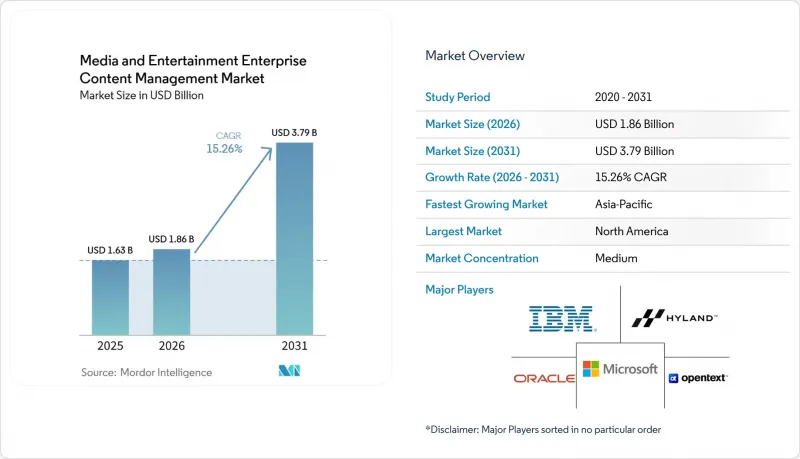
Mordor Intelligence에 의하면, 미디어 및 엔터테인먼트 기업 컨텐츠 관리(ECM) 시장 규모는 2025년 16억 3,000만 달러로 평가되었고, 2026년 18억 6,000만 달러에서 2031년까지 37억 9,000만 달러로 확대될 것으로 예측되며, 2026-2031년 연평균 복합 성장률(CAGR)은 15.26%를 나타낼 전망입니다.
본 보고서는 솔루션 유형별(문서 관리, 기록 관리, 워크플로우 및 비즈니스 프로세스 관리, 케이스 관리, 디지털 자산 관리 등), 배포 방식별(클라우드, 하이브리드 등), 기업 규모별(중소기업, 대기업) 및 지역별로 분류되어 있습니다. 시장 전망은 금액(달러) 기준으로 제시되어 있습니다.
세계의 미디어 및 엔터테인먼트 기업 컨텐츠 관리(ECM) 시장 동향 및 인사이트
AI를 활용한 메타데이터 태깅 및 검색성
메타데이터의 품질이 검색, 재사용, 규정 준수의 핵심 요소로 부상함에 따라 미디어 및 엔터테인먼트 기업 컨텐츠 관리(ECM) 시장은 성장세를 보이고 있습니다. AI를 활용한 태깅을 통해 새로운 자산을 검색 가능하게 만드는 데 필요한 시간이 단축되어 컨텐츠 팀의 업무 부담이 경감되고 있습니다. 컨텐츠 팀은 트랜스크립션, 번역, 클립 검색 분야에서 AI를 활용한 워크플로우를 통해 시간을 절약하고 있으며, AI를 템플릿 생성 도구와 결합할 경우 주당 시간 절감 효과는 11시간에서 18시간으로 증가했습니다. Cloudinary는 2026년 5월, 엔터프라이즈급 미디어 라이브러리에서 분류 체계,검색, 검토, 워크플로 작업을 위한 AI 에이전트를 출시하여 이러한 추세를 더욱 가속화했습니다. 그 결과, 미디어 및 엔터테인먼트 분야 엔터프라이즈 컨텐츠 관리(ECM) 시장은 수동적인 저장에서 능동적인 컨텐츠 인텔리전스로 전환되고 있습니다. 또한, 개인화, 추천, 검색 시스템이 효과적으로 작동하기 위해서는 정확한 메타데이터가 필수적이기 때문에 적절하게 구조화된 저장소의 가치도 다시금 부각되고 있습니다.
증가하는 OTT 및 스트리밍 컨텐츠의 양
미디어 및 엔터테인먼트 기업 컨텐츠 관리(ECM) 시장은 스트리밍 전송량의 확대와 컨텐츠 라이브러리와 관련된 비용에 의해서도 성장 동력을 얻고 있습니다. Backlight사의 2026년판 ‘iconik’ 보고서에 따르면, 해당 플랫폼에서 관리되는 데이터 양은 연평균 56%의 성장률을 기록하며 2025년에는 324페타바이트에 달했고, 신규 컨텐츠는 시간당 11.1테라바이트의 속도로 시스템에 투입되고 있었습니다. 넷플릭스는 2026년 3월 31일자 Form 10-Q에서 스트리밍 컨텐츠와 관련된 의무가 241억 3,900만 달러에 달했다고 밝혔으며, 이는 대규모 컨텐츠 파이프라인이 초래하는 재정적·운영상의 부담을 여실히 드러내고 있습니다. 이 정도 규모가 되면 권리 관리, 배포 형식, 아카이브 검색, 재사용과 같은 요소들이 방대한 라이브러리 전체에서 유기적으로 연계되어 작동해야 하므로, 비정형 데이터 관리는 더욱 어려워집니다. 따라서 플랫폼이 현재의 제작 흐름과 과거 아카이브를 모두 처리할 수 있는 체계적인 거버넌스 환경이 필요할 경우, 미디어 및 엔터테인먼트 기업 컨텐츠 관리(ECM) 시장이 그 혜택을 누리게 될 것입니다. 또한 아카이브의 재사용 속도도 점점 더 중요해지고 있습니다. 검색 및 재포장 과정을 신속하게 처리함으로써 초기 제작비를 늘리지 않고도 수익성을 높일 수 있기 때문입니다.
복잡한 레거시 미디어 시스템의 전환
미디어 및 엔터테인먼트 기업 컨텐츠 관리(ECM) 시장은 여전히 레거시 시스템 전환이라는 큰 과제에 직면해 있습니다. 많은 미디어 조직은 수년에 걸쳐 메타데이터, 접근 권한, 워크플로우, 권리 규칙이 구축되어 온 오래된 저장소를 운영하고 있으며, 이를 원활하게 전환하는 것은 어렵습니다. 따라서 다운타임, 접근 제어 오류, 혹은 권리 이력 손실이 방송 및 스트리밍 업무에 지장을 줄 가능성이 있어 시스템 현대화에는 더 큰 위험이 따릅니다. 규정 준수 규칙 또한 복잡성을 더욱 가중시키고 있습니다. 시스템 변경 중에도 AI 거버넌스,보존 기간, 데이터 관리 요건을 지속적으로 준수해야 하기 때문입니다. EU AI법에 따라 투명하고 감사 가능한 워크플로우에 대한 압박이 강화되면서, 마이그레이션 작업이 부적절하게 수행될 경우의 위험이 높아지고 있습니다. 이 때문에 장기간에 걸친 복잡한 마이그레이션을 한 번에 감당하기를 원치 않는 일부 중견 방송사나 지역 미디어 사업자의 경우, 시스템 업데이트 주기가 지연되고 있습니다.
부문 분석
2025년, 디지털 자산 관리(DAM)는 미디어 및 엔터테인먼트 분야 엔터프라이즈 컨텐츠 관리(ECM) 시장 점유율의 24.11%를 차지했으며, 이미지, 동영상, 오디오 라이브러리를 대규모로 관리하는 데 있어 핵심적인 역할을 확고히 다졌습니다. DAM은 스튜디오, 방송사, 스트리밍 사업자 전반에 걸친 메타데이터 거버넌스, 자산 검색, 멀티채널 배포의 기반으로서 여전히 중요한 위치를 차지하고 있습니다. 미디어 및 엔터테인먼트 기업 컨텐츠 관리(ECM) 분야에서는 문서 관리 및 기록 관리가 규정 준수 및 아카이빙 요구를 지속적으로 뒷받침하는 반면, 케이스 관리 및 웹 컨텐츠 관리는 보다 제한적인 업무상의 이용 사례를 다루고 있습니다. 이러한 분포 상황은 많은 구매 결정에서 고도의 자동화보다 리포지토리 관리가 여전히 우선시되고 있음을 보여줍니다.
워크플로우 및 비즈니스 프로세스 관리는 2031년까지 연평균 성장률(CAGR) 16.71%로 확대될 것으로 예측되며, 미디어 및 엔터테인먼트 기업 컨텐츠 관리(ECM) 시장에서 가장 빠르게 성장하는 솔루션 분야가 되고 있습니다. 이러한 성장은 단순히 컨텐츠를 저장하는 것에서 수집, 검토, 승인, 권리 확인, 최종 배포와 같은 각 단계의 자동화로 전환되고 있음을 반영합니다. EU의 AI 법은 이러한 움직임을 뒷받침하고 있습니다. 미디어 플레이어들은 제작 및 공개와 관련된 AI 지원 작업에 대해 보다 명확한 프로세스 기록을 필요로 하기 때문입니다. OpenText는 2026년 2월, Forrester로부터 디지털 자산 관리(DAM) 분야의 ‘리더’로 선정되었다고 발표했습니다. 이는 컨텐츠가 풍부한 환경에서 엔터프라이즈급 DAM이 여전히 중요함을 입증합니다. 그 결과, 솔루션 간의 경쟁은 단순히 저장소의 규모뿐만 아니라 워크플로우의 깊이, 추적 가능성, 거버넌스로 이동하고 있습니다.
지역별 분석
2025년, 북미는 미디어 및 엔터테인먼트 기업 컨텐츠 관리(ECM) 시장 점유율의 41.29%를 차지하며 최대 지역 클러스터가 되었습니다. 이 지역은 복잡한 권리 및 배포 모델 하에서 운영되는 주요 스트리밍 플랫폼, 방송 네트워크, 대형 미디어 그룹이 집중되어 있다는 이점을 가지고 있습니다. 넷플릭스, 아마존 프라임 비디오, 디즈니+ 및 이와 유사한 플랫폼들은 권리 추적, 아카이브 관리, 다양한 포맷에 걸친 조정이 필요한 방대한 컨텐츠 자산을 관리하고 있습니다. ATSC는 2026년 4월, 디지털 저작권 관리에 관한 권장 표준 ‘A362’를 발표했습니다. 이에 따라 미국 내 권리 중심의 방송 및 스트리밍 워크플로우에 대한 기대가 높아지고 있습니다. 따라서 북미 미디어 및 엔터테인먼트 기업 컨텐츠 관리(ECM) 시장은 계속해서 높은 컨텐츠 예산과 성숙한 벤더 생태계에 힘입어 성장하고 있습니다.
아시아태평양은 2031년까지 연평균 성장률(CAGR) 17.04%로 확대될 것으로 예측되며, 미디어 및 엔터테인먼트 기업 컨텐츠 관리(ECM) 시장에서 이 지역이 가장 빠른 성장 속도를 보일 것으로 전망됩니다. 이러한 성장은 OTT의 확대, 아카이브의 디지털화, 그리고 다국어 메타데이터 및 지역별 권리 변형을 대규모로 관리해야 할 필요성과 밀접하게 관련되어 있습니다. 도시바 디지털 솔루션즈는 2026년 6월, 통합형 영상 컨텐츠 관리 시스템 ‘meify’를 출시했습니다. 이 시스템은 프로그램의 메타데이터, 권리 데이터, 크리에이터 기록을 일원화하여 관리하며, 방송사를 대상으로 AI를 활용한 인식 도구를 제공합니다. 또한, 소니 마케팅도 2026년 7월, AI를 활용한 영상 분석, 폭넓은 파일 형식 지원, 감시 폴더 자동 동기화 기능을 갖춘 ‘A2 Production’ 및 ‘Ci Media Cloud’의 최신 버전을 출시했습니다.
유럽에서는 ‘클라우드 퍼스트’를 중심으로 한 공급망 현대화가 진행되고 있는 반면, 남미, 중동 및 아프리카에서는 미디어 및 엔터테인먼트 기업 컨텐츠 관리 분야가 아직 초기 단계에 있지만 성장을 거듭하고 있습니다. 또한 유럽에서는 GDPR(EU 개인정보보호규정) 및 EU AI법에 따라 컨텐츠 데이터, 워크플로우 로그, 자동화된 의사결정에 대한 입증 가능한 관리의 필요성이 높아짐에 따라 거버넌스에 관한 정책적 압력도 강해지고 있습니다. 2026년 4월, BCE는 ‘Perfect Memory’를 자사의 Media-as-a-Service 서비스에 통합하여, 매니지드 서비스 모델이 중규모 방송사에서 어떻게 더욱 강력한 자산 거버넌스와 메타데이터 관리를 실현하는지를 입증했습니다. 남미에서는 미디어 그룹들이 VOD 및 광고 워크플로우를 위한 시스템을 구축하는 가운데, 브라질이 여전히 주요 투자처로 자리 잡고 있습니다. 한편, 중동 및 아프리카에서는 아카이브의 디지털화, 제작 확대, 그리고 새로운 컨텐츠 생태계 전반에 걸친 클라우드 도입 증가를 통해 성장이 진행되고 있습니다.
기타 혜택 :
- 엑셀 형식 시장 예측(ME) 시트
- 3개월간의 애널리스트 지원
자주 묻는 질문
목차
제1장 서론
제2장 조사 방법
제3장 주요 요약
제4장 시장 구도
제5장 시장 규모 및 성장 예측
제6장 경쟁 구도
제7장 시장 기회 및 향후 전망
AJY 26.09.03According to Mordor Intelligence, the media and Entertainment Enterprise Content Management (ECM) market size is projected to expand from USD 1.63 billion in 2025 and USD 1.86 billion in 2026 to USD 3.79 billion by 2031, registering a CAGR of 15.26% between 2026 and 2031.
This report is Segmented by Solution Type (Document Management, Records Management, Workflow and Business Process Management, Case Management, Digital Asset Management, and More), Deployment Mode (Cloud, Hybrid, and More), Enterprise Size (Small and Medium Enterprises, and Large Enterprises), and Geography. The Market Forecasts are Provided in Terms of Value (USD).
Global Media and Entertainment Enterprise Content Management (ECM) Market Trends and Insights
AI-Assisted Metadata Tagging and Searchability
The Media and Entertainment Enterprise Content Management (ECM) market is gaining momentum as metadata quality becomes central to search, reuse, and compliance. AI-based tagging is reducing the time required to make new assets searchable and reducing the manual workload on content teams. Content teams saw time savings from AI-powered workflows for transcription, translation, and clip search, while weekly time savings rose from 11 hours to 18 hours when AI was combined with templating tools. Cloudinary strengthened this trend in May 2026 by launching AI agents for taxonomy, search, moderation, and workflow tasks in enterprise-scale media libraries. As a result, the Media and Entertainment Enterprise Content Management (ECM) market is shifting away from passive storage and toward active content intelligence. This also underscores the value of well-structured repositories, as personalization, recommendation, and discovery systems depend on clean metadata to perform effectively.
Rising OTT and Streaming Content Volume
The Media and Entertainment Enterprise Content Management (ECM) market is also being boosted by the scale of streaming output and the costs associated with content libraries. Backlight's 2026 iconik report showed that data managed on the platform reached 324 petabytes in 2025, after 56% annual growth, while new content entered the system at 11.1 terabytes per hour. Netflix stated in its March 31, 2026, Form 10-Q that its streaming content obligations stood at USD 24.139 billion, underscoring the financial and operational burden of large content pipelines. This scale makes unstructured storage harder to manage because rights, delivery formats, archive retrieval, and reuse need to work together across large libraries. The Media and Entertainment Enterprise Content Management (ECM) market, therefore, benefits when platforms need governed environments that can handle both current production flows and older archives. Archive reuse speed is also becoming increasingly important because faster retrieval and repackaging can improve margins without increasing the original production spend.
Complex Legacy Media System Migration
The Media and Entertainment Enterprise Content Management (ECM) market still faces a major hurdle in legacy migration. Many media organizations run older repositories where metadata, permissions, workflows, and rights rules were built over many years and are difficult to transfer cleanly. That makes modernization more risky because downtime, broken access controls, or lost rights history can disrupt broadcast and distribution operations. Compliance rules add another layer of complexity because AI governance, retention, and data control requirements must remain in place during system changes. The EU AI Act has added pressure for transparent, auditable workflows, raising the stakes for poorly executed migrations. This is slowing refresh cycles for some mid-tier broadcasters and regional media operators that do not want to absorb a long and complex transition at once.
Other drivers and restraints analyzed in the detailed report include:
- Cloud-First Production and Collaboration Workflows
- Need for Faster Multi-Channel Content Reuse
- High Metadata Cleanup and Content Normalization Burden
For complete list of drivers and restraints, kindly check the Table Of Contents.
Segment Analysis
Digital asset management held 24.11% of the Media and Entertainment Enterprise Content Management (ECM) market share in 2025, which confirmed its central role in managing image, video, and audio libraries at scale. DAM remains the base layer for metadata governance, asset retrieval, and multichannel distribution across studios, broadcasters, and streaming operators. In the media and entertainment enterprise content management industry, document management and records management continue to support compliance and archival needs, while case management and web content management serve narrower operational use cases. This distribution shows that repository control still comes before advanced automation in many buying decisions.
Workflow and business process management is projected to expand at a 16.71% CAGR through 2031, making it the fastest-growing solution area in the Media and Entertainment Enterprise Content Management (ECM) market. That growth reflects a shift from simply storing content to automating ingestion, review, approval, rights checks, and final delivery steps. The EU AI Act is reinforcing this move because media companies need clearer process records for AI-assisted actions tied to production and publishing. OpenText stated in February 2026 that it was named a Leader in digital asset management by Forrester, which supports the continued importance of enterprise-grade DAM in content-heavy environments. As a result, solution competition is moving toward workflow depth, traceability, and governance rather than solely on repository scale.
Complete Report Scope:
- By Solution Type
- Document Management
- Records Management
- Workflow and Business Process Management
- Case Management
- Digital Asset Management
- Web Content Management
- Other Solutions
- By Deployment Mode
- On-Premises
- Cloud
- Hybrid
- By Enterprise Size
- Small and Medium Enterprises
- Large Enterprises
- By Geography
- North America
- United States
- Canada
- Mexico
- South America
- Brazil
- Argentina
- Rest of South America
- Europe
- United Kingdom
- Germany
- France
- Rest of Europe
- Asia-Pacific
- China
- Japan
- India
- South Korea
- Australia
- Rest of Asia-Pacific
- Middle East
- United Arab Emirates
- Saudi Arabia
- Rest of Middle East
- Africa
- South Africa
- Kenya
- Rest of Africa
- North America
Geography Analysis
North America held 41.29% of the Media and Entertainment Enterprise Content Management (ECM) market share in 2025, which made it the largest regional cluster. The region benefits from the concentration of major streaming platforms, broadcast networks, and large media groups that operate under complex rights and distribution models. Netflix, Amazon Prime Video, Disney+, and similar platforms manage large content estates that require rights tracking, archive control, and coordination across multiple formats. The ATSC published its A362 recommended practice on digital rights management in April 2026, and this is shaping expectations for rights-aware broadcast and streaming workflows in the United States. The Media and Entertainment Enterprise Content Management (ECM) market in North America, therefore, remains anchored by high content budgets and a mature vendor ecosystem.
Asia-Pacific is projected to expand at a 17.04% CAGR through 2031, giving the region the fastest pace in the Media and Entertainment Enterprise Content Management (ECM) market. Growth is tied to OTT expansion, archive digitization, and the need to manage multilingual metadata and regional rights variants at scale. Toshiba Digital Solutions launched its meify integrated video content management system in June 2026, centralizing program metadata, rights data, and creator records, and providing AI-supported recognition tools for broadcasters. Sony Marketing also launched updated versions of A2 Production and Ci Media Cloud in July 2026, featuring AI video analysis, broader file support, and automated watch-folder synchronization.
Europe is moving through cloud-first supply chain modernization, while South America, the Middle East, and Africa remain earlier-stage but growing parts of the media and entertainment enterprise content management industry. Europe also faces stronger policy pressure on governance, as the GDPR and the EU AI Act increase the need for demonstrable control over content data, workflow logs, and automated decisions. In April 2026, BCE integrated Perfect Memory into its Media-as-a-Service offering, demonstrating how managed service models are helping mid-scale broadcasters achieve stronger asset governance and metadata control. In South America, Brazil remains the main investment point as media groups build systems for VOD and advertising workflows, while the Middle East and Africa are growing through archive digitization, production expansion, and rising cloud adoption across newer content ecosystems.
- Adobe Inc.
- Aprimo LLC
- Box, Inc.
- Bynder B.V.
- Cloudinary Ltd.
- DocuWare GmbH
- Fabasoft AG
- Hyland Software, Inc.
- IBM Corporation
- Laserfiche, Inc.
- MediaValet Inc.
- M-Files Oy
- Microsoft Corporation
- Newgen Software Technologies Limited
- Objective Corporation Limited
- OpenText Corporation
- Oracle Corporation
- Sitecore A/S
- Wedia SA
- WoodWing Software B.V.
Additional Benefits:
- The market estimate (ME) sheet in Excel format
- 3 months of analyst support
TABLE OF CONTENTS
1 INTRODUCTION
- 1.1 Study Assumptions and Market Definition
- 1.2 Scope of the Study
2 RESEARCH METHODOLOGY
3 EXECUTIVE SUMMARY
4 MARKET LANDSCAPE
- 4.1 Market Overview
- 4.2 Market Drivers
- 4.2.1 Rising OTT and Streaming Content Volume
- 4.2.2 AI Assisted Metadata Tagging and Searchability
- 4.2.3 Need for Faster Multi Channel Content Reuse
- 4.2.4 Cloud First Production and Collaboration Workflows
- 4.2.5 Greater Demand for Rights Aware Content Governance
- 4.2.6 Integration of Content Repositories With Revenue Workflows
- 4.3 Market Restraints
- 4.3.1 Complex Legacy Media System Migration
- 4.3.2 High Metadata Cleanup and Content Normalization Burden
- 4.3.3 Security and Rights Management Integration Complexity
- 4.3.4 Resistance from Decentralized Creative Teams
- 4.4 Industry Value Chain Analysis
- 4.5 Impact of Macroeconomic Factors on the Market
- 4.6 Regulatory Landscape
- 4.7 Technological Outlook
- 4.8 Porter's Five Forces Analysis
- 4.8.1 Bargaining Power of Suppliers
- 4.8.2 Bargaining Power of Buyers
- 4.8.3 Threat of New Entrants
- 4.8.4 Threat of Substitutes
- 4.8.5 Competitive Rivalry
5 MARKET SIZE AND GROWTH FORECASTS (VALUE)
- 5.1 By Solution Type
- 5.1.1 Document Management
- 5.1.2 Records Management
- 5.1.3 Workflow and Business Process Management
- 5.1.4 Case Management
- 5.1.5 Digital Asset Management
- 5.1.6 Web Content Management
- 5.1.7 Other Solutions
- 5.2 By Deployment Mode
- 5.2.1 On-Premises
- 5.2.2 Cloud
- 5.2.3 Hybrid
- 5.3 By Enterprise Size
- 5.3.1 Small and Medium Enterprises
- 5.3.2 Large Enterprises
- 5.4 By Geography
- 5.4.1 North America
- 5.4.1.1 United States
- 5.4.1.2 Canada
- 5.4.1.3 Mexico
- 5.4.2 South America
- 5.4.2.1 Brazil
- 5.4.2.2 Argentina
- 5.4.2.3 Rest of South America
- 5.4.3 Europe
- 5.4.3.1 United Kingdom
- 5.4.3.2 Germany
- 5.4.3.3 France
- 5.4.3.4 Rest of Europe
- 5.4.4 Asia-Pacific
- 5.4.4.1 China
- 5.4.4.2 Japan
- 5.4.4.3 India
- 5.4.4.4 South Korea
- 5.4.4.5 Australia
- 5.4.4.6 Rest of Asia-Pacific
- 5.4.5 Middle East
- 5.4.5.1 United Arab Emirates
- 5.4.5.2 Saudi Arabia
- 5.4.5.3 Rest of Middle East
- 5.4.6 Africa
- 5.4.6.1 South Africa
- 5.4.6.2 Kenya
- 5.4.6.3 Rest of Africa
- 5.4.1 North America
6 COMPETITIVE LANDSCAPE
- 6.1 Market Concentration
- 6.2 Strategic Moves
- 6.3 Market Share Analysis
- 6.4 Company Profiles (includes Global Level Overview, Market Level Overview, Core Segments, Financials as available, Strategic Information, Market Rank/Share, Products and Services, Recent Developments)
- 6.4.1 Adobe Inc.
- 6.4.2 Aprimo LLC
- 6.4.3 Box, Inc.
- 6.4.4 Bynder B.V.
- 6.4.5 Cloudinary Ltd.
- 6.4.6 DocuWare GmbH
- 6.4.7 Fabasoft AG
- 6.4.8 Hyland Software, Inc.
- 6.4.9 IBM Corporation
- 6.4.10 Laserfiche, Inc.
- 6.4.11 MediaValet Inc.
- 6.4.12 M-Files Oy
- 6.4.13 Microsoft Corporation
- 6.4.14 Newgen Software Technologies Limited
- 6.4.15 Objective Corporation Limited
- 6.4.16 OpenText Corporation
- 6.4.17 Oracle Corporation
- 6.4.18 Sitecore A/S
- 6.4.19 Wedia SA
- 6.4.20 WoodWing Software B.V.
7 MARKET OPPORTUNITIES AND FUTURE OUTLOOK
- 7.1 White Space and Unmet Need Assessment


