|
시장보고서
상품코드
2118230
규산칼슘 시장 : 시장 점유율 분석, 업계 동향 및 통계, 성장 예측(2026-2031년)Calcium Silicate - Market Share Analysis, Industry Trends & Statistics, Growth Forecasts (2026 - 2031) |
||||||
 Mordor Intelligence
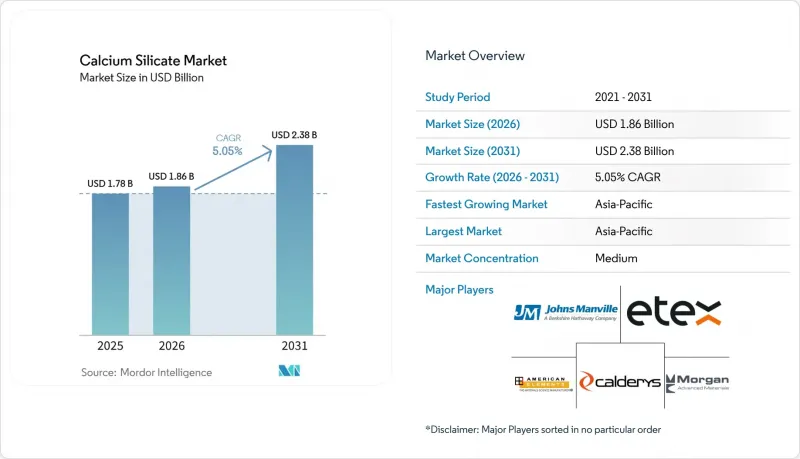
Mordor Intelligence에 의하면, 규산칼슘 시장 규모는 2025년에 17억 8,000만 달러로 평가되었고, 2026년 18억 6,000만 달러에서 2031년까지 23억 8,000만 달러에 이를 것으로 추정되며, 예측 기간(2026-2031년) CAGR은 5.05%를 나타낼 전망입니다.
본 보고서는 형태별(보드, 블록 등), 용도별(건축 및 건설, 산업용 단열재 등), 최종 이용 산업별(건설, 석유 및 가스,발전, 금속 및 광업, 식품 및 음료, 제약 등) 및 지역별(아시아태평양, 북미, 유럽, 남미, 중동 및 아프리카)로 분류되어 있습니다. 시장 예측은 금액(달러) 기준으로 제시되어 있습니다.
세계의 규산칼슘 시장 동향 및 인사이트
전체 산업 시설에서 고성능 단열재에 대한 수요 증가
산업의 탈탄소화로 인해 사업자들이 고온 설비용 단열재를 선정하는 방식이 변화하고 있습니다. 현재 많은 구매자들은 초기 제품 가격 외에도 내구 연한과 열 손실 성능도 고려하고 있습니다. 규산칼슘는 반복되는 열 사이클을 통해 치수 안정성을 유지할 수 있으므로 보일러, 가마, 공정 용기, 배관에 사용하기에 적합합니다. 그 수명은 20-25년으로 예상되며, 더 빈번한 유지보수가 필요한 저비용 소재와 비교하여 교체 필요성을 줄일 수 있습니다. 따라서 산업 시설에서 설비 현대화가 진행되고, 보다 안정적인 단열 성능이 요구되는 상황에서 규산칼슘 시장은 그 혜택을 누리고 있습니다. 미국의 산업용 설비 요건 및 고온 배관 단열재에 관한 기술 기준은 이러한 용도에서 확립된 규정 준수 기반이 되고 있습니다.
상업 및 주택 건설에서의 내화 건축자재 채택 확대
건축 사양서에서는 내화 성능이 입증된 자재의 사용이 점점 더 요구되고 있습니다. 규산칼슘는 불연성이기 때문에 외벽, 구조물 보호, 천장, 칸막이 및 방화 칸막이 부재에 적합합니다. 유럽연합 집행위원회는 2024년에 건축 제품의 내화 성능 분류를 개정했는데, 이는 이러한 용도에서의 사양 선정에 영향을 미칠 가능성이 있습니다. 2025년에 공표된 ‘승인 문서 B’의 개정에 따라 웨일스 내 건축자재의 방화 안전 요건도 강화되었습니다. 이러한 규정은 제품의 성능을 문서화하고 일관된 품질을 유지할 수 있는 제조업체를 우대하는 것입니다. 또한, 방화 대책이 단순한 선택 사항이 아니라 건축 인프라의 핵심으로 취급되는 건설 프로젝트 증가도 칼슘 실리케이트 시장에 호재가 되고 있습니다.
원자재 및 에너지 비용 변동이 제조 비용에 미치는 영향
규산칼슘 생산에는 실리카, 석회 및 에너지 집약적인 가공 공정이 필수적입니다. 따라서 천연가스나 전력은 특히 저비용 에너지 공급 체계가 갖춰져 있지 않은 시설에서 제조 비용에 직접적인 영향을 미칩니다. 석회 생산에서도 소성에는 다량의 열이 필요하기 때문에 에너지 비용이 반영됩니다. 고정 계약 하에서 투입 비용의 상승분을 고객에게 전가할 수 없는 경우, 규산칼슘 시장은 이익률 압박에 직면할 가능성이 있습니다. 안정적인 원자재 공급원을 확보하고 있거나 효율적인 생산 라인을 갖춘 제조업체는 이러한 위험에 대처하기 쉬운 입장에 있습니다. 또한, 규산칼슘와 더 저렴한 단열재를 비교 검토하는 프로젝트에서도 비용 관리는 중요한 요소가 됩니다.
부문 분석
2025년 기준, 형태별 시장 점유율에서 보드가 44.72%를 차지했습니다. 이러한 주도적인 위상은 산업용 단열재, 건축용 어셈블리, 방화 시스템 등 폭넓은 용도로 활용되고 있음을 반영합니다. 조립식 보드는 맞춤형 주조품에 비해 시공 시간을 단축할 수 있습니다. 또한 치수 관리가 요구되는 모듈식 건축이나 산업용 스키드 어셈블리에도 적합합니다. 인증을 받은 보드는 상업용 천장, 칸막이, 구조용 강재 보호에 사용되고 있습니다. 기술 기준 및 불연성 요건에 따라 성능이 문서화된 제품에 대한 수요가 뒷받침되고 있습니다. 이로 인해 건축 및 산업 분야의 최종 용도 모두에서 이 보드는 규산칼슘 산업의 핵심 제품으로 자리매김하고 있습니다. 이 형태는 시공업체에게 친숙하며, 다양한 프로젝트의 요구 사항에 맞추어 절단 및 조립이 가능합니다. 이러한 실용성 덕분에 신규 설치와 교체 공사 모두에서 사용이 촉진되고 있습니다. 또한, 보드가 단독 재료가 아닌 검증된 완전한 시스템의 일부로 지정될 경우 공급업체에게도 이점이 있습니다. 이러한 특성들 덕분에 보드에 대한 수요가 여러 최종 용도 범주로 확대되고 있는 이유를 설명할 수 있습니다.
분말은 2031년까지 연평균 성장률(CAGR)이 6.13%로 가장 빠르게 성장할 것으로 예측됩니다. 이는 도료, 코팅, 시멘트 배합, 특수 세라믹의 첨가제로 사용됩니다. 이러한 용도로 인해 분말은 단순한 단열 프로젝트에 그치지 않고 공정 화학 분야에서도 활용되고 있습니다. 수열 합성 및 미세 구조 제어 기술의 발전으로 내열성과 기계적 특성을 향상시킬 수 있습니다. 블록은 맞춤형 내화 백업 단열재가 필요한 용광로 및 철강 주조 분야에서 여전히 유용합니다. 설비의 형상이나 하중 허용치가 특정 요건을 충족해야 하는 분야에서는 그 역할이 작지만 중요합니다. 다양한 형태가 존재하기 때문에 공급업체는 확립된 건설 수요부터 소규모 기술 용도에 이르기까지 폭넓게 대응할 수 있습니다. 분말은 배합 설계자가 더 대규모의 컴파운드나 코팅 시스템에 통합할 수 있는 재료를 필요로 하는 경우에 특히 적합합니다. 블록은 맞춤형 단열 형상과 안정적인 열 성능이 필요한 프로젝트에 활용됩니다. 여러 형태를 사용할 수 있기 때문에 단일 용도 경로에 대한 의존도가 낮아집니다. 또한, 이로 인해 생산자는 건설 분야와 특수 용도 고객 각각에 대해 기술 부서와 영업 부서를 별도로 운영할 이유가 생깁니다.
지역별 분석
아시아태평양은 2025년에 칼슘 실리케이트 시장 점유율의 43.72%를 차지한 것으로 평가되었으며, 2031년까지 연평균 성장률(CAGR) 5.88%로 확대될 것으로 전망됩니다. 이 지역에서는 건설 활동, 산업 생산 능력 증강, 내화재 개보수 공사에 대한 수요가 복합적으로 작용하고 있으며, 중국에는 규산칼슘 보드 생산 기반이 확립된 반면, 인도와 동남아시아에서는 새로운 산업 및 인프라 기회가 창출되고 있습니다. 일본은 노후화된 발전소, 정유시설, 제조 시설의 교체 수요를 주도하고 있습니다. 한국은 첨단 제조업 및 발전 분야의 특수 수요를 뒷받침하고 있습니다. 이러한 지역적 구성으로 인해 아시아태평양은 칼슘 실리케이트 시장의 수익과 예상 성장의 주요 원천이 되고 있습니다. 건설 수요는 여러 국가에서 광범위하게 나타나는 반면, 산업 프로젝트는 특수 단열재에 대한 수요를 더욱 높이고 있습니다. 이로 인해 단일 국내 시장에 대한 의존도가 낮아집니다. 지역 생산자들은 짧은 공급 경로를 활용하여 납기 준수가 중요한 프로젝트 수주를 놓고 경쟁할 수 있습니다. 국제적인 생산자들은 자사의 기술적 우위와 현지 공급 체계 및 서비스 필요성 사이의 균형을 맞추어야 합니다.
북미는 절대 소비량 측면에서 성숙한 시장이며, 석유화학 플랜트, 발전, 상업 건축에 의해 지속적으로 뒷받침되고 있습니다. OSHA 요건 및 ASTM C533 규격은 고온 배관용 단열재의 기술적 기준을 유지하는 데 기여하고 있습니다. 캐나다의 LNG 수출 인프라와 멕시코의 제조 산업 회랑은 추가적인 프로젝트 기회를 제공합니다. 유럽은 규제 및 에너지 효율 요건에 의해 보다 직접적으로 형성되고 있습니다. 유럽연합 집행위원회의 2024년 규정에 따라 건축자재의 내화 성능 분류가 갱신될 예정입니다. 독일은 화학 처리 및 제철 시설에서 열을 많이 사용하는 설비용 단열재가 필요하기 때문에 여전히 중요한 시장입니다. 또한 유럽의 고객들은 안전성, 에너지 효율, 제품 성능 요건을 동시에 충족해야 하는 과제에 직면해 있습니다. 이러한 요인들로 인해 신뢰할 수 있는 문서화와 긴 수명을 갖춘 제품이 유리해질 수 있습니다.
남미에서는 석유 및 가스 채굴, 철강 생산, 제약 시설에서 수요가 있지만, 프로젝트 파이낸싱이 시장 변동 요인이 될 수 있습니다. 중동 및 아프리카는 시장 점유율은 작지만, 정제, 발전, 해수 담수화, 건설 분야에서 여전히 중요한 시장입니다. 높은 주변 온도와 가혹한 가동 조건으로 인해 내구성이 뛰어난 배관 및 설비 단열재의 사용이 요구되고 있습니다. 사우디아라비아와 아랍에미리트에서는 열 관리 시스템이 필요한 산업 다각화 프로그램이 추진되고 있습니다. 이 지역 수요는 대규모 산업 시설뿐만 아니라 상업시설 및 공공 건축물과도 관련이 있습니다. 프로젝트 조건에 따라 고온의 주변 환경이나 가혹한 실외 환경에서도 성능을 발휘하는 자재가 요구될 수 있습니다. 현지에서 생산하거나 지역별 유통망을 갖춘 공급업체는 납기를 단축하고 사양 수립을 지원할 수 있습니다. 이는 프로젝트 일정이 엄격하거나 자재 승인 요건이 까다로운 경우 특히 중요합니다. 또한, 이 지역에서는 건축자재 수요와 고온 환경 하의 산업용도가 혼재되어 있어, 각각 다른 제품 형태나 판매 채널이 필요할 수 있습니다. 따라서 공급업체는 건설 분야의 광범위한 유통 체계와 정유시설, 발전소, 해수 담수화 프로젝트를 위한 기술 지원 간의 균형을 맞추어야 합니다. Etex사의 오만 내 파트너십은 특히 석고를 기반으로 한 산업 활동에 초점을 맞추고 있으나, 이는 현지 사업을 통해 걸프 지역의 건축자재 수요에 부응하겠다는 보다 광범위한 관심을 반영한 것입니다.
기타 혜택 :
- 엑셀 형식 시장 예측(ME) 시트
- 3개월간의 애널리스트 지원
자주 묻는 질문
목차
제1장 서론
제2장 조사 방법
제3장 주요 요약
제4장 시장 구도
제5장 시장 규모 및 성장 예측
제6장 경쟁 구도
제7장 시장 기회 및 향후 전망
AJY 26.09.03According to Mordor Intelligence, the calcium silicate market size was valued at USD 1.78 billion in 2025 and is estimated to grow from USD 1.86 billion in 2026 to reach USD 2.38 billion by 2031, at a CAGR of 5.05% during the forecast period (2026-2031).
This report is Segmented by Form (Boards, Blocks, and More), Application (Building & Construction, Industrial Thermal Insulation, and More), End-Use Industry (Construction, Oil & Gas, Power Generation, Metals & Mining, Food & Beverage, Pharmaceutical, and More), and Geography (Asia-Pacific, North America, Europe, South America, and Middle-East and Africa). The Market Forecasts are Provided in Terms of Value (USD).
Global Calcium Silicate Market Trends and Insights
Growing Demand for High-Performance Thermal Insulation Materials Across Industrial Facilities
Industrial decarbonization is changing how operators select insulation for high-temperature equipment. Many buyers now consider service life and heat-loss performance alongside the initial product price. Calcium silicate can retain dimensional stability through repeated thermal cycles, which supports use in boilers, kilns, process vessels, and piping. Its expected 20-25-year service life can reduce replacement needs when compared with lower-cost materials that need more frequent attention. The calcium silicate market therefore benefits where industrial sites are upgrading equipment and seeking more consistent thermal performance. U.S. requirements for industrial equipment and technical standards for high-temperature pipe insulation provide an established compliance base for these uses.
Increasing Adoption of Fire-Resistant Building Materials in Commercial and Residential Construction
Construction specifications increasingly require materials with verified fire performance. Calcium silicate is non-combustible, which makes it relevant for facades, structural protection, ceilings, partitions, and fire-separating assemblies. The European Commission updated fire resistance performance classifications for construction products in 2024, which can affect specification choices across these applications. Amendments to Approved Document B published in 2025 also reinforced fire-safety requirements for building elements in Wales. These rules favor manufacturers that can document product performance and maintain consistent quality. The calcium silicate market also gains from construction projects where fire protection is treated as core building infrastructure rather than an optional addition.
Volatility in Raw Material and Energy Costs Impacting Manufacturing Expenses
Calcium silicate production depends on silica, lime, and energy-intensive processing. Natural gas and electricity, therefore, have a direct effect on manufacturing costs, particularly at facilities without lower-cost energy arrangements. Lime production also reflects energy costs because calcination requires substantial heat. The calcium silicate market can face margin pressure when input inflation cannot be passed through to customers under fixed contracts. Producers with secured raw material supply or efficient production lines are better placed to manage this exposure. Cost control also matters when projects compare calcium silicate with lower-priced insulation materials.
Other drivers and restraints analyzed in the detailed report include:
- Expansion of Oil & Gas, Power Generation, and Petrochemical Infrastructure
- Growing Utilization of Calcium Silicate in High-Temperature Refractory Applications
- Competition from Alternative Thermal Insulation Materials Such as Mineral Wool and Aerogels
For complete list of drivers and restraints, kindly check the Table Of Contents.
Segment Analysis
Boards held 44.72% of the calcium silicate market share by form in 2025. Their leading position reflects broad use across industrial insulation, construction assemblies, and fire-protection systems. Prefabricated boards can reduce installation time compared with custom-cast options. They are also suited to modular construction and industrial skid assemblies where dimensions must be controlled. Certified boards are used in commercial ceilings, partitions, and structural steel protection. Technical standards and non-combustibility requirements support demand for products with documented performance. This keeps boards central to the calcium silicate industry across both building and industrial end uses. The format is familiar to installers and can be cut or assembled for different project requirements. That practicality supports its use in both new installations and replacement work. Suppliers also benefit when boards are specified as part of a complete tested system rather than as a stand-alone material. These characteristics explain why board demand is spread across several end-use categories.
Powder is projected to be the fastest-growing form, at a 6.13% CAGR through 2031. It is used as an additive in paints, coatings, cement formulations, and specialty ceramics. These uses place powder in process-chemistry applications rather than only insulation projects. Improvements in hydrothermal synthesis and microstructure control can improve temperature tolerance and mechanical properties. Blocks remain useful in furnace and steel-casting applications that need custom refractory backup insulation. Their role is smaller but important, where equipment geometry and load tolerance are specific. The range of forms allows suppliers to address established construction volumes and smaller technical applications. Powder is especially relevant where formulators need a material that can be integrated into a larger compound or coating system. Blocks serve projects that need tailored insulation shapes and stable thermal performance. The availability of several forms reduces reliance on one application pathway. It also gives producers a reason to maintain separate technical and sales capabilities for construction and specialty customers.
Complete Report Scope:
- By Form
- Boards
- Blocks
- Powder
- Other Forms
- By Application
- Building and Construction
- Industrial Thermal Insulation
- Refractories and High Temperature Components
- Fire Protection
- Paints and Coatings
- Cement Additives
- Ceramics
- Other Applications
- By End-Use Industry
- Construction
- Oil & Gas
- Power Generation
- Metals & Mining
- Food & Beverage
- Pharmaceutical & Healthcare
- Automotive
- Chemical & Petrochemical
- Other End-Use Industries
- By Geography
- Asia-Pacific
- China
- India
- Japan
- South Korea
- Rest of Asia-Pacific
- North America
- United States
- Canada
- Mexico
- Europe
- Germany
- United Kingdom
- France
- Italy
- Russia
- Rest of Europe
- South America
- Brazil
- Argentina
- Rest of South America
- Middle-East and Africa
- Saudi Arabia
- South Africa
- Rest of Middle-East and Africa
- Asia-Pacific
Geography Analysis
Asia-Pacific held 43.72% of the calcium silicate market share in 2025 and is forecast to expand at a 5.88% CAGR through 2031. The region combines construction activity, industrial capacity additions, and demand for refractory retrofit work. China has a substantial base of calcium silicate board production, while India and Southeast Asia offer new industrial and infrastructure opportunities. Japan contributes replacement demand from aging power, refinery, and manufacturing assets. South Korea supports specialized demand from advanced manufacturing and power generation. The regional mix makes Asia-Pacific the main source of both revenue and forecast growth for the calcium silicate market. Construction demand is broad across several countries, while industrial projects add demand for specialized thermal insulation. This reduces dependence on a single national market. Regional producers can use short supply routes to compete for time-sensitive project orders. International producers must balance their technology position with the need for local availability and service.
North America is mature in absolute consumption and remains supported by petrochemical plants, power generation, and commercial construction. OSHA requirements and ASTM C533 standards help maintain a technical baseline for high-temperature pipe insulation. Canada's LNG export infrastructure and Mexico's manufacturing corridor offer additional project opportunities. Europe is shaped more directly by regulation and energy-efficiency requirements. The European Commission's 2024 regulation updates fire-resistance performance classifications for construction products. Germany remains important because chemical processing and steelmaking sites need insulation for heat-intensive equipment. European customers also face a combination of safety, energy-efficiency, and product-performance requirements. These factors can favor products with reliable documentation and long service lives.
South America has demand from oil and gas extraction, steel production, and pharmaceutical facilities, although project financing can cause volatility. The Middle-East and Africa represent a smaller share but remain important for refining, power generation, desalination, and construction. High ambient temperatures and severe operating conditions support the use of durable pipe and equipment insulation. Saudi Arabia and the United Arab Emirates are progressing industrial diversification programs that require thermal-management systems. Regional demand is linked to large industrial facilities as well as commercial and public construction. Project conditions can require materials that perform in high ambient temperatures and demanding outdoor environments. Suppliers with local manufacturing or regional distribution can shorten delivery times and support specification work. This can be particularly important where projects have strict schedules and material approval requirements. The region also brings together building-materials demand and high-temperature industrial applications, which may require different product forms and sales channels. Suppliers must therefore balance broad construction distribution with technical support for refinery, power, and desalination projects. Etex's Oman partnership is specifically focused on gypsum-based industrial activity, but it signals a wider interest in serving Gulf construction-materials demand through local operations.
- A&A Material Corporation
- American Elements
- Beijing Hocreboard Building Materials Co., Ltd.
- BNZ Materials, Inc.
- Calderys
- Etex Group
- HIL Limited
- Isolite Insulating Products Co., Ltd.
- Johns Manville
- Luyang Energy-saving Materials Co., Ltd.
- Morgan Advanced Materials plc
- NICHIAS Corporation
- Ramco Industries Limited
- Shandong Hongyang Insulation Materials Co., Ltd.
- Sibelco
- Skamol
- Soben International Ltd.
- Taisyou International Business Co., Ltd.
Additional Benefits:
- The market estimate (ME) sheet in Excel format
- 3 months of analyst support
TABLE OF CONTENTS
1 Introduction
- 1.1 Study Assumptions and Market Definition
- 1.2 Scope of the Study
2 Research Methodology
3 Executive Summary
4 Market Landscape
- 4.1 Market Overview
- 4.2 Market Drivers
- 4.2.1 Growing Demand for High-Performance Thermal Insulation Materials Across Industrial Facilities
- 4.2.2 Increasing Adoption of Fire-Resistant Building Materials in Commercial and Residential Construction
- 4.2.3 Expansion of Oil & Gas, Power Generation, and Petrochemical Infrastructure
- 4.2.4 Growing Utilization of Calcium Silicate in High-Temperature Refractory Applications
- 4.2.5 Stringent Building Safety and Fire Protection Regulations Supporting Product Adoption
- 4.3 Market Restraints
- 4.3.1 Volatility in Raw Material and Energy Costs Impacting Manufacturing Expenses
- 4.3.2 Competition from Alternative Thermal Insulation Materials Such as Mineral Wool and Aerogels
- 4.3.3 High Installation and Maintenance Costs for Industrial Insulation Systems
- 4.4 Value Chain Analysis
- 4.5 Porter's Five Forces Analysis
- 4.5.1 Threat of New Entrants
- 4.5.2 Bargaining Power of Suppliers
- 4.5.3 Bargaining Power of Buyers
- 4.5.4 Threat of Substitutes
- 4.5.5 Competitive Rivalry
- 4.6 Regulatory Landscape
5 Market Size and Growth Forecasts (Value)
- 5.1 By Form
- 5.1.1 Boards
- 5.1.2 Blocks
- 5.1.3 Powder
- 5.1.4 Other Forms
- 5.2 By Application
- 5.2.1 Building and Construction
- 5.2.2 Industrial Thermal Insulation
- 5.2.3 Refractories and High Temperature Components
- 5.2.4 Fire Protection
- 5.2.5 Paints and Coatings
- 5.2.6 Cement Additives
- 5.2.7 Ceramics
- 5.2.8 Other Applications
- 5.3 By End-Use Industry
- 5.3.1 Construction
- 5.3.2 Oil & Gas
- 5.3.3 Power Generation
- 5.3.4 Metals & Mining
- 5.3.5 Food & Beverage
- 5.3.6 Pharmaceutical & Healthcare
- 5.3.7 Automotive
- 5.3.8 Chemical & Petrochemical
- 5.3.9 Other End-Use Industries
- 5.4 By Geography
- 5.4.1 Asia-Pacific
- 5.4.1.1 China
- 5.4.1.2 India
- 5.4.1.3 Japan
- 5.4.1.4 South Korea
- 5.4.1.5 Rest of Asia-Pacific
- 5.4.2 North America
- 5.4.2.1 United States
- 5.4.2.2 Canada
- 5.4.2.3 Mexico
- 5.4.3 Europe
- 5.4.3.1 Germany
- 5.4.3.2 United Kingdom
- 5.4.3.3 France
- 5.4.3.4 Italy
- 5.4.3.5 Russia
- 5.4.3.6 Rest of Europe
- 5.4.4 South America
- 5.4.4.1 Brazil
- 5.4.4.2 Argentina
- 5.4.4.3 Rest of South America
- 5.4.5 Middle-East and Africa
- 5.4.5.1 Saudi Arabia
- 5.4.5.2 South Africa
- 5.4.5.3 Rest of Middle-East and Africa
- 5.4.1 Asia-Pacific
6 Competitive Landscape
- 6.1 Market Concentration
- 6.2 Strategic Moves
- 6.3 Market Share (%)/Ranking Analysis
- 6.4 Company Profiles (includes Global Overview, Market Overview, Core Segments, Financials as available, Strategic Information, Products and Services, and Recent Developments)
- 6.4.1 A&A Material Corporation
- 6.4.2 American Elements
- 6.4.3 Beijing Hocreboard Building Materials Co., Ltd.
- 6.4.4 BNZ Materials, Inc.
- 6.4.5 Calderys
- 6.4.6 Etex Group
- 6.4.7 HIL Limited
- 6.4.8 Isolite Insulating Products Co., Ltd.
- 6.4.9 Johns Manville
- 6.4.10 Luyang Energy-saving Materials Co., Ltd.
- 6.4.11 Morgan Advanced Materials plc
- 6.4.12 NICHIAS Corporation
- 6.4.13 Ramco Industries Limited
- 6.4.14 Shandong Hongyang Insulation Materials Co., Ltd.
- 6.4.15 Sibelco
- 6.4.16 Skamol
- 6.4.17 Soben International Ltd.
- 6.4.18 Taisyou International Business Co., Ltd.
7 Market Opportunities and Future Outlook
- 7.1 White-Space and Unmet-Need Assessment