

|
시장보고서
상품코드
2118231
코팅 연마재 시장 : 시장 점유율 분석, 업계 동향 및 통계, 성장 예측(2026-2031년)Coated Abrasive - Market Share Analysis, Industry Trends & Statistics, Growth Forecasts (2026 - 2031) |
||||||
 Mordor Intelligence
Mordor Intelligence에 의하면, 코팅 연마재 시장 규모는 2025년에 149억 2,000만 달러로 평가되었고, 2026년 156억 8,000만 달러에서 2031년까지 202억 6,000만 달러에 이를 것으로 추정되며, 예측 기간(2026-2031년) CAGR은 5.26%를 나타낼 전망입니다.
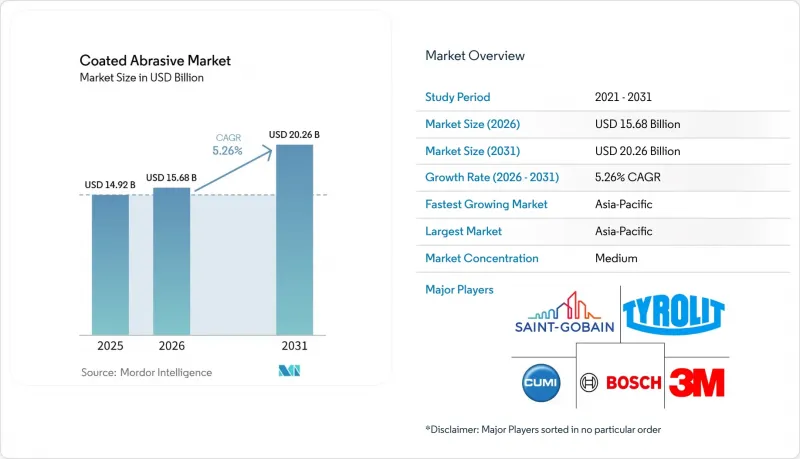
본 보고서는 제품 유형별(디스크, 벨트, 롤, 시트, 기타 제품 유형), 소재 유형별(알루미늄 산화물, 실리콘 카바이드 등), 최종 이용 산업별(금속 가공, 자동차, 목공·가구 등), 지역별(아시아태평양, 북미, 유럽, 남미, 중동 및 아프리카)로 분류되어 있습니다. 시장 전망은 금액(달러) 기준으로 제시되어 있습니다.
세계의 코팅 연마재 시장 동향 및 인사이트
금속 가공 및 제조 산업에서 정밀 표면 마감에 대한 수요 증가
제조업의 현대화에 따라 코팅 연마재 시장 전반에 걸쳐 표면 마감 작업에 대한 성능 요구 사항이 높아지고 있습니다. 항공우주, 조선, 정밀 기계 가공 분야의 자동화 라인에서는 일관된 마감과 치수 정밀도를 실현하는 연마재가 요구되고 있습니다. 용융 알루미나 및 실리콘 카바이드는 항공우주, 자동차, 가구, 철강 용도의 결합형 및 코팅형 연마재 제품의 다운스트림 공정에서 사용됩니다. 고합금강, 티타늄, 니켈 초합금의 경우, 절삭 성능을 저하시키지 않으면서 경질 재료를 가공할 수 있는 제품이 필요합니다. 따라서 정밀 가공 용도에서는 기본적인 종이 제품보다 구조화된 연마재가 더 적합합니다. 절삭 속도의 향상과 공구 수명의 연장으로 가동 중단 시간과 재작업이 줄어들기 때문에 구매자는 고가 제품을 채택할 정당한 근거를 얻을 수 있습니다.
자동차 생산 확대와 애프터마켓 수리 활동 증가가 연마재 소비를 견인
자동차 생산은 도장 전 표면 처리, 차체 재도장, 구동계 가공 및 부품 디버링에 사용되는 코팅 연마재 수요를 뒷받침하고 있습니다. 전기차 및 하이브리드차의 경우, 배터리 하우징, 파워 일렉트로닉스 기판, 그리고 알루미늄 구조 부품의 마감 가공 수요가 증가하고 있습니다. 이러한 용도에서는 기존의 파워트레인 마감 가공과는 다른 사양이 채택되고 있습니다. 또한 북미와 유럽에서는 노후 차량이 더 오랫동안 사용되고 있기 때문에 수리 활동도 수요를 뒷받침하고 있습니다. 차체 수리 공장에서는 도장면이나 차체 패널을 수리할 때 여러 단계의 연마 공정이 필요합니다. 이에 따라 코팅 연마재 시장은 자동차 생산과 교체 작업 양쪽 모두에서 수요를 얻고 있습니다.
원자재 가격 변동이 연마 입자 및 기판 비용에 영향을 미치고 있습니다.
원자재 비용 변동은 코팅 연마재의 전체 밸류체인 및 코팅 연마재 시장에서 여전히 이익률에 대한 위험 요인으로 작용하고 있습니다. 미국 내 연마 및 정제된 용융 알루미나(fused aluminum oxide)의 수입 가격은 2023년 톤당 1,380달러에서 2024년에는 톤당 1,500달러로 상승했습니다. 같은 기간 동안, 조제 실리콘 카바이드(silicon carbide)의 가격은 톤당 905달러에서 770달러로 하락했습니다. 이러한 가격 변동은 두 연마재를 모두 사용하는 제조업체가 동시에 서로 다른 비용 압박에 직면할 가능성이 있음을 보여줍니다. 중국공급은 미국의 조제 용융 알루미나 수입량의 94%, 조제 실리콘 카바이드 수입량의 98%를 차지하고 있어 조달 리스크가 집중되어 있습니다. 관세 조치 및 수출 허가와 관련된 압박으로 인해 이중 조달(dual sourcing) 및 조달 계획의 중요성이 더욱 커지고 있습니다.
부문 분석
2025년, 디스크는 코팅 연마재 시장 규모의 34.86%를 차지했습니다. 앵글 그라인더, 랜덤 오비탈 샌더, 로봇 샌딩 헤드와 함께 사용되어 금속 가공 및 자동차 차체 작업 분야 수요를 뒷받침하고 있습니다. 표준 장착 시스템과 폭넓은 입도 범위로 인해 디스크는 재료 제거, 샌딩, 연마에 유용합니다. 이들은 수탁 가공 공장이나 OEM(원청 브랜드 제조) 제조업체의 마감 라인에서 널리 사용되고 있습니다. 코팅 연마재 시장에서는 집진 장치와 함께 사용할 경우 프리미엄 디스크 시스템이 계속해서 선호되고 있습니다. 2026년 4월, 3M사는 세라믹과 알루미나를 혼합하고 최대 95%의 집진율을 실현하는 오픈 넷 구조를 갖춘 ‘Hookit Blue Net Abrasives’를 출시했습니다.
코팅 연마재 시장에서 벨트는 2026-2031년 연평균 성장률(CAGR) 5.94%를 나타낼 것으로 예측됩니다. 와이드 벨트 라인은 가구 제조, 엔지니어드 우드 바닥재 및 강대의 연속 연마를 지원합니다. 그 성능은 기계 속도, 공작물 처리 능력, 그리고 벨트의 내구성과 밀접한 관련이 있습니다. 밀카(Milka)사는 2026년 2월, 목재, 도료 및 솔리드 서피스용 유연하고 방진성이 뛰어난 수동 연마 시트를 출시하여 ‘이리듐(Iridium)’ 시리즈를 확충했습니다. 롤 제품은 유지보수 작업이나 규격 유연성이 요구되는 정척 절단 용도에서 여전히 중요한 역할을 하고 있습니다.
지역별 분석
아시아태평양은 2025년 연마 시트 시장 점유율의 45.41%를 차지했으며, 2031년까지 연평균 성장률(CAGR) 6.02%를 나타낼 것으로 예측됩니다. 중국 양쯔강 삼각주 지역에는 공작기계와 자동 연삭 셀이 집중되어 있습니다. 인도는 산업 기반과 자동차 공급망에 힘입어 두 번째 성장 거점으로 부상하고 있습니다. 일본과 한국은 정밀 기계, 반도체 제조 장비 및 자동차 부품의 마감 가공을 통해 수요를 창출하고 있습니다. 중국의 국가표준(GB) 및 일본의 일본공업규격(JIS) 인증 요건에 따라 제품 사양이 엄격해지고 있어, 인증을 획득한 공급업체가 유리한 입지를 점하고 있습니다.
북미는 자동차 생산, 항공우주 제조, 건설 활동으로 인해 여전히 중요한 코팅 연마재 시장으로 자리 잡고 있습니다. 미국의 반도체 제조에 대한 투자는 웨이퍼 및 기판 가공에 사용되는 고사양 제품에 대한 지역적 수요를 창출하고 있습니다. 중국은 미국의 조제 용융 알루미나 수입의 94%, 조제 실리콘 카바이드 수입의 98%를 공급하고 있어, 이로 인해 공급망은 무역 정세의 변화에 취약한 상태입니다. 멕시코의 자동차 공급망은 전기 구동계 부품의 정밀 마무리를 뒷받침하고 있습니다.
유럽의 코팅 연마재 시장에서 고급 제품에 대한 수요는 정밀 기계 가공, 자동차 생산, 항공우주 산업이 확립된 독일, 프랑스, 이탈리아에 집중되어 있습니다. 동유럽은 자동차 및 전자기기 제조에 대한 투자를 통해 지역 내 입지를 확대되고 있습니다. 남미는 브라질의 자동차 및 농업 기계 부문에 의존하고 있는 반면, 아르헨티나는 경공업 및 기계 산업을 통해 기여하고 있습니다. 사우디아라비아의 산업 다각화 및 인프라 프로젝트는 중동 및 아프리카의 철강 가공 및 건설 마감 작업을 뒷받침하고 있습니다. 유럽의 에코디자인 및 생산자 책임에 관한 규제로 인해 수명 주기에 대한 문서화에 대한 구매자의 관심이 높아지고 있지만, 밀카는 승인된 2026년판 LCA 도구를 통해 이에 대응했습니다.
기타 혜택 :
- 엑셀 형식 시장 예측(ME) 시트
- 3개월간의 애널리스트 지원
자주 묻는 질문
목차
제1장 서론
제2장 조사 방법
제3장 개요
제4장 시장 구도
제5장 시장 규모 및 성장 예측
제6장 경쟁 구도
제7장 시장 기회 및 향후 전망
AJY 26.09.01According to Mordor Intelligence, the coated abrasive market was valued at USD 14.92 billion in 2025 and is estimated to grow from USD 15.68 billion in 2026 to reach USD 20.26 billion by 2031, at a CAGR of 5.26% during the forecast period (2026-2031).
This report is Segmented by Product Type (Discs, Belts, Rolls, Sheets, and Other Product Types), Material Type (Aluminum Oxide, Silicon Carbide, and More), End-Use Industry (Metal Fabrication, Automotive, Woodworking & Furniture, and More), and Geography (Asia-Pacific, North America, Europe, South America, and Middle-East and Africa). The Market Forecasts are Provided in Value (USD).
Global Coated Abrasive Market Trends and Insights
Growing Demand for Precision Surface Finishing in Metalworking and Manufacturing Industries
Manufacturing modernization is raising performance requirements for surface finishing work across the coated abrasive market. Automated lines in aerospace, shipbuilding, and precision machining need abrasives that produce consistent finishes and dimensional accuracy. Fused aluminum oxide and silicon carbide are used downstream in bonded and coated abrasive products serving aerospace, automotive, furniture, and steel applications. Higher-alloy steels, titanium, and nickel superalloys need products that can work on hard materials without losing cutting performance. Structured abrasive formats are therefore more relevant in precision applications than basic paper products. Buyers can justify premium products when higher cut rates and longer tool life reduce downtime and rework.
Increasing Automotive Production and Aftermarket Repair Activities Driving Abrasive Consumption
Automotive production supports coated abrasive demand in paint preparation, body refinishing, drivetrain work, and component deburring. Electric and hybrid vehicles add finishing needs for battery housings, power electronics substrates, and aluminum structural parts. These applications use specifications that differ from conventional powertrain finishing work. Repair activity also supports demand because older vehicles remain in service longer in North America and Europe. Body shops require several sanding stages when repairing painted surfaces and body panels. This gives the coated abrasive market exposure to both vehicle production and replacement work.
Volatility in Raw Material Prices Affecting Abrasive Grain and Backing Material Costs
Raw material cost changes remain a margin risk across the coated abrasive value chain and the coated abrasive market. U.S. import prices for ground and refined fused aluminum oxide increased from USD 1,380 per metric ton in 2023 to USD 1,500 per metric ton in 2024. In the same period, crude silicon carbide prices declined from USD 905 per metric ton to USD 770 per metric ton. These movements show that manufacturers using both grains can face different cost pressures at the same time. China supplied 94% of U.S. crude fused aluminum oxide imports and 98% of U.S. crude silicon carbide imports, concentrating sourcing exposure. Tariff measures and export licensing pressures have made dual sourcing and procurement planning more important.
Other drivers and restraints analyzed in the detailed report include:
- Rising Adoption of High-Performance Ceramic and Zirconia Abrasives for Industrial Applications
- Increasing Use of Recyclable and Bio-Based Backing Materials
- Competition from Bonded Abrasives and Non-Woven Abrasive Products
For complete list of drivers and restraints, kindly check the Table Of Contents.
Segment Analysis
Discs held 34.86% of the coated abrasive market size in 2025. Their use with angle grinders, random orbital sanders, and robotic sanding heads supports demand in metal fabrication and automotive bodywork. Standard attachment systems and a broad grit range make discs useful for stock removal, sanding, and polishing. They are widely used in job shops and original equipment manufacturer finishing lines. The coated abrasive market continues to favor premium disc systems when they work with dust extraction equipment. In April 2026, 3M introduced Hookit Blue Net Abrasives with a ceramic and aluminum oxide blend and an open net structure that provides up to 95% dust extraction.
Belts are forecast to grow at a 5.94% CAGR from 2026 to 2031 in the coated abrasive market. Wide-belt lines support furniture production, engineered wood flooring, and continuous steel strip polishing. Their performance is closely linked to machine speed, workpiece throughput, and belt endurance. Mirka extended its Iridium range in February 2026 with flexible, dust-repellent handsanding sheets for wood, paint, and solid surfaces. Rolls retain a role in maintenance work and cut-to-length applications where format flexibility matters.
Complete Report Scope:
- By Product Type
- Discs
- Belts
- Rolls
- Sheets
- Other Product Types
- By Material Type
- Aluminum Oxide
- Silicon Carbide
- Zirconia Alumina
- Ceramic Alumina
- Garnet
- Emery
- Other Material Types
- By End-Use Industry
- Metal Fabrication
- Automotive
- Woodworking & Furniture
- Electronics & Semiconductor
- Aerospace & Defense
- Construction
- Machinery & Equipment
- Other End-Use Industries
- By Geography
- Asia-Pacific
- China
- India
- Japan
- South Korea
- Rest of Asia-Pacific
- North America
- United States
- Canada
- Mexico
- Europe
- Germany
- United Kingdom
- France
- Italy
- Russia
- Rest of Europe
- South America
- Brazil
- Argentina
- Rest of South America
- Middle-East and Africa
- Saudi Arabia
- South Africa
- Rest of Middle-East and Africa
- Asia-Pacific
Geography Analysis
Asia-Pacific held 45.41% of the coated abrasive market share in 2025 and is forecast to grow at a 6.02% CAGR through 2031. China's Yangtze River Delta concentrates machine tools and automated grinding cells. India is a secondary growth center, supported by its industrial base and automotive supply chain. Japan and South Korea generate demand through precision machinery, semiconductor equipment, and automotive parts finishing. China's Guobiao (GB) standards and Japan's Japanese Industrial Standards (JIS) certification requirements are tightening product specifications and favoring certified suppliers.
North America remains an important coated abrasive market because of automotive production, aerospace manufacturing, and construction activity. U.S. semiconductor fabrication investment is creating localized demand for high-specification products used in wafer and substrate work. China supplied 94% of U.S. crude fused aluminum oxide imports and 98% of U.S. crude silicon carbide imports, making supply chains vulnerable to changes in trade conditions. Mexico's automotive supply chain supports precision finishing for electric drivetrain components.
Europe's premium demand in the coated abrasive market is centered on Germany, France, and Italy, where precision machining, automotive production, and aerospace are well established. Eastern Europe broadens its regional footprint through automotive and electronics manufacturing investment. South America relies on Brazil's automotive and agricultural equipment sectors, while Argentina contributes through the light industry and machinery. Saudi industrial diversification and infrastructure projects support steel fabrication and construction finishing in the Middle-East and Africa. European ecodesign and producer responsibility rules are increasing buyer attention to lifecycle documentation, which Mirka addressed through its approved 2026 LCA tool.
- 3M
- Bibielle S.p.A.
- Carborundum Universal Limited
- Deerfos Co., Ltd.
- Hermes Schleifmittel GmbH
- Hubei Yuli Abrasive Belts Group Co., Ltd.
- Klingspor AG
- Kovax Corporation
- Mirka Ltd.
- Robert Bosch GmbH
- Saint-Gobain
- Sak Abrasives Limited
- Sia Abrasives Industries AG
- Smirdex S.A.
- Tyrolit AG
- VSM AG
Additional Benefits:
- The market estimate (ME) sheet in Excel format
- 3 months of analyst support
TABLE OF CONTENTS
1 Introduction
- 1.1 Study Assumptions and Market Definition
- 1.2 Scope of the Study
2 Research Methodology
3 Executive Summary
4 Market Landscape
- 4.1 Market Overview
- 4.2 Market Drivers
- 4.2.1 Growing Demand for Precision Surface Finishing in Metalworking and Manufacturing Industries
- 4.2.2 Increasing Automotive Production and Aftermarket Repair Activities Driving Abrasive Consumption
- 4.2.3 Expansion of Woodworking and Furniture Manufacturing Supporting Demand for Coated Abrasives
- 4.2.4 Rising Adoption of High-Performance Ceramic and Zirconia Abrasives for Industrial Applications
- 4.2.5 Increasing Use of Recyclable and Bio-Based Backing Materials
- 4.3 Market Restraints
- 4.3.1 Volatility in Raw Material Prices Affecting Abrasive Grain and Backing Material Costs
- 4.3.2 Competition from Bonded Abrasives and Non-Woven Abrasive Products
- 4.3.3 Frequent Replacement Requirements and Performance Variability Under Heavy-Duty Applications
- 4.4 Value Chain Analysis
- 4.5 Porter's Five Forces Analysis
- 4.5.1 Threat of New Entrants
- 4.5.2 Bargaining Power of Suppliers
- 4.5.3 Bargaining Power of Buyers
- 4.5.4 Threat of Substitutes
- 4.5.5 Competitive Rivalry
5 Market Size and Growth Forecasts (Value)
- 5.1 By Product Type
- 5.1.1 Discs
- 5.1.2 Belts
- 5.1.3 Rolls
- 5.1.4 Sheets
- 5.1.5 Other Product Types
- 5.2 By Material Type
- 5.2.1 Aluminum Oxide
- 5.2.2 Silicon Carbide
- 5.2.3 Zirconia Alumina
- 5.2.4 Ceramic Alumina
- 5.2.5 Garnet
- 5.2.6 Emery
- 5.2.7 Other Material Types
- 5.3 By End-Use Industry
- 5.3.1 Metal Fabrication
- 5.3.2 Automotive
- 5.3.3 Woodworking & Furniture
- 5.3.4 Electronics & Semiconductor
- 5.3.5 Aerospace & Defense
- 5.3.6 Construction
- 5.3.7 Machinery & Equipment
- 5.3.8 Other End-Use Industries
- 5.4 By Geography
- 5.4.1 Asia-Pacific
- 5.4.1.1 China
- 5.4.1.2 India
- 5.4.1.3 Japan
- 5.4.1.4 South Korea
- 5.4.1.5 Rest of Asia-Pacific
- 5.4.2 North America
- 5.4.2.1 United States
- 5.4.2.2 Canada
- 5.4.2.3 Mexico
- 5.4.3 Europe
- 5.4.3.1 Germany
- 5.4.3.2 United Kingdom
- 5.4.3.3 France
- 5.4.3.4 Italy
- 5.4.3.5 Russia
- 5.4.3.6 Rest of Europe
- 5.4.4 South America
- 5.4.4.1 Brazil
- 5.4.4.2 Argentina
- 5.4.4.3 Rest of South America
- 5.4.5 Middle-East and Africa
- 5.4.5.1 Saudi Arabia
- 5.4.5.2 South Africa
- 5.4.5.3 Rest of Middle-East and Africa
- 5.4.1 Asia-Pacific
6 Competitive Landscape
- 6.1 Market Concentration
- 6.2 Strategic Moves
- 6.3 Market Share (%)/Ranking Analysis
- 6.4 Company Profiles (includes Global Overview, Market Overview, Core Segments, Financials as available, Strategic Information, Products and Services, and Recent Developments)
- 6.4.1 3M
- 6.4.2 Bibielle S.p.A.
- 6.4.3 Carborundum Universal Limited
- 6.4.4 Deerfos Co., Ltd.
- 6.4.5 Hermes Schleifmittel GmbH
- 6.4.6 Hubei Yuli Abrasive Belts Group Co., Ltd.
- 6.4.7 Klingspor AG
- 6.4.8 Kovax Corporation
- 6.4.9 Mirka Ltd.
- 6.4.10 Robert Bosch GmbH
- 6.4.11 Saint-Gobain
- 6.4.12 Sak Abrasives Limited
- 6.4.13 Sia Abrasives Industries AG
- 6.4.14 Smirdex S.A.
- 6.4.15 Tyrolit AG
- 6.4.16 VSM AG
7 Market Opportunities and Future Outlook
- 7.1 White-Space and Unmet-Need Assessment


