

|
시장보고서
상품코드
2118248
기밀 컴퓨팅 소프트웨어 시장 : 시장 점유율 분석, 업계 동향 및 통계, 성장 예측(2026-2031년)Confidential Computing Software - Market Share Analysis, Industry Trends & Statistics, Growth Forecasts (2026 - 2031) |
||||||
 Mordor Intelligence
Mordor Intelligence에 의하면, 기밀 컴퓨팅 소프트웨어 시장 규모는 2025년에 32억 5,000만 달러로 평가되었고, 2026년 39억 1,000만 달러에서 2031년까지 114억 2,000만 달러에 이를 것으로 예측되며, 예측 기간(2026-2031년) CAGR은 23.91%를 나타낼 전망입니다.
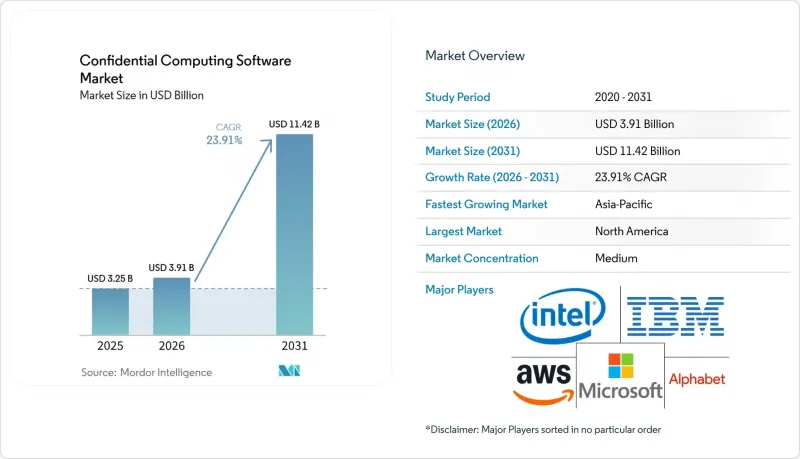
본 보고서는 구성 요소별(소프트웨어 및 서비스), 도입 모델별(클라우드, 하이브리드, 온프레미스), 기업 규모별(대기업, 중소기업), 최종 사용자별(자동차 및 운송, 의료 및 생명과학, 소매 및 전자상거래, 산업 제조 등) 및 지역별로 분류되어 있습니다. 시장 예측은 금액(달러) 기준으로 제시되어 있습니다.
세계의 기밀 컴퓨팅 소프트웨어 시장 동향 및 인사이트
사용 중인 데이터 보호에 관한 규제 요건
규제 요건은 기밀 컴퓨팅 소프트웨어 시장에 지속적인 수요 원천이 되고 있습니다. EU AI법(규정 2024/1689)은 2024년 8월부터 시행되고 있으며, 고위험 AI 시스템에 의해 처리되는 개인 데이터에 대한 보호 조치를 의무화하고 있습니다. DORA는 2025년 1월부터 적용되기 시작하며, 금융 서비스 분야의 ICT 리스크 관리에 대한 관심이 높아지고 있습니다. 스웨덴 데이터 보호 당국은 2026년 5월, 관리자가 인증 검증 및 암호화 키 관리 권한을 보유하는 경우, 신뢰할 수 있는 실행 환경(TEE)이 GDPR(EU 개인정보보호규정) 제32조에 따른 보호 조치로 기능할 수 있다고 결론지었습니다. 이 견해는 볼보 그룹, 에릭슨, 카나리비트가 참여한 실제 운영 도입 사례를 바탕으로 합니다. 이에 따라 인증 키 관리는 단순한 기술적 세부 사항에서 규제 대상 조직의 거버넌스 과제로 그 위상이 변화했습니다.
클라우드 및 하이브리드 클라우드 워크로드의 확대
기밀성이 높은 워크로드가 클라우드 및 하이브리드 환경으로 이전되는 추세에 따라, 기밀 컴퓨팅 소프트웨어 시장의 이용 사례가 확대되고 있습니다. 프로세서가 데이터를 사용하는 동안 데이터는 평문으로 처리되므로, 기존의 스토리지나 네트워크 암호화만으로는 메울 수 없는 보안상의 허점이 발생하고 있습니다. 클라우드 제공업체들은 표준 컴퓨팅 카탈로그에 기밀 가상 머신 및 기밀 컨테이너를 추가하고 있으며, 호환되는 인스턴스에서는 설정을 선택하기만 하면 바로 사용할 수 있게 되었습니다. 마이크로소프트는 2026년 2월, Azure Government를 대상으로 AMD SEV-SNP 기밀 가상 머신의 일반 제공을 시작하며, 하드웨어 기반 보호 기능을 모든 기밀 분류 수준의 미국 정부 워크로드로 확대했습니다. 또한 Google Cloud도 2026년, NVIDIA RTX PRO 6000 Blackwell Server Edition GPU를 탑재한 G4 머신 시리즈에서 기밀 GKE 노드 제공을 확정했습니다. 이러한 서비스를 통해 기존 클라우드 운영 모델을 통해 기밀 AI 및 데이터 처리를 더욱 쉽게 활용할 수 있게 되었습니다.
높은 도입 및 통합 비용
기밀 컴퓨팅 소프트웨어 시장에서 도입 비용이 채택의 장벽이 될 수 있습니다. 특히 기술 예산이 제한된 조직의 경우 이러한 경향이 더욱 두드러집니다. 프로덕션 환경으로의 배포에는 호환 가능한 AMD SEV-SNP, Intel TDX 또는 NVIDIA의 기밀 컴퓨팅 하드웨어가 필요합니다. 또한 용도 변경, 인증 파이프라인 구성, 그리고 기존 ID 관리 및 키 관리 시스템과의 통합도 필요합니다. 클라우드상의 기밀 가상 머신은 하드웨어 조달 부담을 줄여주지만, 사후 수정이나 인증 통합에 드는 비용을 완전히 제거하는 것은 아닙니다. 대기업의 경우, 규정 준수 요건이나 고가치 워크로드를 이유로 이러한 비용을 정당화할 수 있는 경우가 많습니다. 반면, 소규모 조직에서는 하이브리드 아키텍처로 인해 온프레미스와 클라우드 통합 비용이 추가되므로 도입을 미룰 가능성이 있습니다.
부문 분석
2025년에는 소프트웨어가 매출의 74.18%를 차지했습니다. 기업들은 엔클레이브 관리 플랫폼, 기밀 가상 머신 소프트웨어 및 원격 인증 도구를 사용하여 현재의 클라우드 환경과 온프레미스 환경 전반으로 보호 범위를 확대되고 있습니다. 이러한 제품들은 용도의 전면적인 재설계를 필요로 하지 않고도 도입을 지원합니다. 조직이 쿠버네티스 워크로드와 GPU 기반 추론을 보호함에 따라, 기밀 AI 소프트웨어 및 기밀 컨테이너 소프트웨어에 대한 투자가 증가하고 있습니다. 엔클레이브 관리 및 원격 인증 소프트웨어는 핵심 운영 요구 사항을 지원하기 때문에 계속해서 중요한 지속적인 수익 부문으로 자리 잡고 있습니다. 서비스 부문의 기밀 컴퓨팅 소프트웨어 시장 규모는 2026-2031년 연평균 성장률(CAGR) 25.82%로 확대될 것으로 예측됩니다.
서비스 부문의 성장이 빠른 이유는 기밀 컴퓨팅 소프트웨어 시장에서 멀티 벤더 TEE 환경의 경우, 구현, 통합, 모니터링 및 정책 관리를 위해 외부 지원이 필요한 경우가 많기 때문입니다. Red Hat은 2026년에 베어메탈 기반의 ‘Confidential Containers’를 일반에 공개하여, 하드웨어 기반 메모리 암호화 및 인증 기능을 온프레미스 Kubernetes 환경에 도입함으로써 하이브리드 배포에서 적용 가능한 이용 사례를 확대했습니다. 또한 Fortanix도 2026년 3월, NVIDIA 생태계와 함께 ‘Cisco Secure AI Factory’에 참여했습니다. 이를 통해 기밀 AI 기능이 더 광범위한 엔터프라이즈 인프라 제공 범위 내에 통합되었습니다.
2025년에는 클라우드가 매출의 68.41%를 차지했습니다. 마이크로소프트, Google Cloud, Amazon Web Services는 각각의 컴퓨팅 서비스에 기밀 기능을 통합하여, 고객이 호환 가능한 TEE 하드웨어를 운영해야 할 필요성을 줄였습니다. 에어 갭 환경, 기밀 처리 및 극도로 기밀성이 높은 제조 워크로드의 경우, 온프레미스 배포가 여전히 중요하게 여겨지고 있습니다. 2026년 2월 마이크로소프트가 발표한 ‘Azure Government’는 정부 요구 사항도 클라우드 인접형 인프라를 통해 충족할 수 있음을 보여주었습니다. 레드햇의 베어메탈 지원은 클라우드 제공업체와의 분리를 더욱 강화해야 하는 조직에 또 다른 선택지를 제공합니다.
하이브리드 배포는 2026-2031년 연평균 성장률(CAGR) 24.63%로 확대될 것으로 예측됩니다. 금융 서비스, 의료, 정부 기관에서는 일부 워크로드에 대해서는 로컬에서의 제어가 필요한 반면, 분석, AI 추론, 재해 복구에는 클라우드 규모의 처리 능력이 요구됩니다. 하이브리드 아키텍처에서는 가장 기밀성이 높은 처리를 온프레미스 TEE 노드에서 실행하는 동시에, 추가 용량으로 기밀성이 높은 클라우드 가상 머신을 활용합니다. 공유 인증 정책을 통해 이러한 환경을 공통된 관리 모델 하에서 연계할 수 있습니다. 또한, 기밀 컴퓨팅 소프트웨어 시장은 2026년 2월 Fortanix와 NTT 데이터가 인도 내 주권 AI 팩토리 도입을 위해 제휴한 것도 호재로 작용하고 있습니다.
지역별 분석
2025년, 북미는 기밀 컴퓨팅 소프트웨어 시장의 34.62% 점유율을 차지했습니다. 미국은 하이퍼스케일러의 연구 개발, 규제 대상 기업 고객의 방대한 기반, 그리고 사용 중인 데이터 보호에 관한 연방 정부의 요구 사항 등의 혜택을 받고 있습니다. 마이크로소프트는 2026년 2월, Azure Government의 기밀 가상 머신을 미국 정부의 모든 기밀 분류 수준으로 확대했습니다. 이를 통해 FedRAMP 인증 환경 내 정부 사용자를 위한 조달 절차가 더욱 명확해졌습니다. 캐나다에는 데이터 상주 의무를 지는 클라우드 관련 금융 서비스 및 의료 기관도 존재합니다.
유럽, 특히 독일, 영국, 프랑스에는 기술적으로 수준 높은 구매자층이 존재합니다. NIS2의 의무 사항에 따라 중요 서비스 사업자 간의 투자가 촉진되고 있습니다. 2026년 5월 스웨덴 당국이 제시한 GDPR(EU 개인정보보호규정)에 관한 견해는 기술적 보호 수단으로서 TEE를 평가하는 조직에게 실용적인 지침이 되고 있습니다. 2026년 1월 유럽위원회의 제안은 회원국 간 사이버 보안 요건을 보다 긴밀하게 조율하는 것을 목표로 하고 있습니다.
아시아태평양은 2026-2031년 연평균 성장률(CAGR) 25.73%로 확대될 것으로 예측됩니다. 중국은 2025년 1월에 GB/T 45230-2025를 공표하고, 2025년 8월부터 시행을 시작했습니다. 이를 통해 국내 TEE 조달에 대한 공식적인 근거가 마련되었습니다. 인도의 데이터 주권 관련 노력이 안전한 AI 인프라에 대한 수요를 견인하고 있습니다. 인도 내 AI 팩토리 구축을 위한 Fortanix와 NTT DATA의 제휴도 기밀 컴퓨팅 소프트웨어 시장에 기여하고 있습니다. 남미, 중동 및 아프리카는 여전히 초기 단계에 있는 지역이지만, 사우디아라비아, UAE, 브라질, 아르헨티나에서는 AI 주권, 은행, 핀테크 및 보안 결제 분야의 이용 사례에서 초기 수요가 나타나고 있습니다.
기타 혜택 :
- 엑셀 형식 시장 예측(ME) 시트
- 3개월간의 애널리스트 지원
자주 묻는 질문
목차
제1장 서론
제2장 조사 방법
제3장 개요
제4장 시장 구도
제5장 시장 규모 및 성장 예측
제6장 경쟁 구도
제7장 시장 기회 및 향후 전망
AJY 26.09.01According to Mordor Intelligence, the confidential computing software market size was valued at USD 3.25 billion in 2025 and estimated to grow from USD 3.91 billion in 2026 to reach USD 11.42 billion by 2031, at a CAGR of 23.91% during the forecast period (2026-2031).
This report is Segmented by Component (Software, and Services), Deployment Model (Cloud, Hybrid, and On-Premises), Enterprise Size (Large Enterprises, and Small and Mid-Sized Enterprises), End Users (Automotive and Transportation, Healthcare and Life Sciences, Retail and E-Commerce, Industrial Manufacturing, and More), and Geography. The Market Forecasts are Provided in Terms of Value (USD).
Global Confidential Computing Software Market Trends and Insights
Regulatory Requirements for Data-in-Use Protection
Regulatory requirements are creating a durable source of demand for the Confidential Computing Software Market. The EU AI Act (Regulation 2024/1689) has been in effect since August 2024 and requires safeguards for personal data processed by high-risk AI systems. DORA became applicable in January 2025 and has increased attention on ICT risk management within financial services. Sweden's data protection authority concluded in May 2026 that trusted execution environments can serve as a safeguard under GDPR Article 32 when controllers retain control of attestation verification and encryption keys. This position came from an operational deployment involving Volvo Group, Ericsson, and CanaryBit. It moves attestation key control from an engineering detail to a governance issue for regulated organizations.
Expansion of Cloud and Hybrid-Cloud Workloads
The movement of sensitive workloads into cloud and hybrid environments is widening the use case for the Confidential Computing Software Market. Data is available in plaintext while a processor uses it, leaving a gap that conventional storage and network encryption do not close. Cloud providers have added confidential virtual machines and confidential containers to their standard compute catalogs, reducing activation to a configuration choice for compatible instances. Microsoft made AMD SEV-SNP confidential VMs generally available for Azure Government in February 2026, extending hardware-enforced protection to U.S. government workloads across classification levels. Google Cloud also confirmed confidential GKE nodes on G4 machine series with NVIDIA RTX PRO 6000 Blackwell Server Edition GPUs in 2026. These offerings make confidential AI and data processing more accessible through existing cloud operating models.
High Implementation and Integration Costs
Implementation costs can limit adoption in the Confidential Computing Software Market, especially for organizations with limited technology budgets. Production deployments require compatible AMD SEV-SNP, Intel TDX, or NVIDIA Confidential Computing hardware. They also require application changes, attestation pipeline configuration, and integration with existing identity and key-management systems. Cloud confidential virtual machines reduce the burden of hardware procurement but do not remove retrofitting and attestation integration costs. Large enterprises can often justify these expenses based on compliance requirements and high-value workloads. Smaller organizations may delay deployment when hybrid architectures add on-premises and cloud integration costs.
Other drivers and restraints analyzed in the detailed report include:
- Rising Cybersecurity Threats Against Sensitive Workloads
- Confidential AI Adoption for Sensitive Models and Data
- Shortage of Confidential-Computing and Cryptography Skills
For complete list of drivers and restraints, kindly check the Table Of Contents.
Segment Analysis
Software held 74.18% of revenue in 2025. Enterprises use enclave management platforms, confidential virtual machine software, and remote attestation tools to extend protection across current cloud and on-premises environments. These products can support deployment without a complete application redesign. Confidential AI software and confidential container software are receiving greater investment as organizations protect Kubernetes workloads and GPU-based inference. Enclave management and remote attestation software remain important recurring revenue categories because they support core operating requirements. The Confidential Computing Software Market size for services is projected to grow at a 25.82% CAGR from 2026 to 2031.
Services grow faster because multi-vendor TEE environments often require external support for implementation, integration, monitoring, and policy management within the Confidential Computing Software Market. Red Hat made Confidential Containers on bare metal generally available in 2026, bringing hardware-backed memory encryption and attestation to on-premises Kubernetes environments and expanding the serviceable use case for hybrid deployments. Fortanix also joined the Cisco Secure AI Factory, alongside the NVIDIA ecosystem, in March 2026. This placed confidential AI capabilities within a broader enterprise infrastructure offer.
Cloud captured 68.41% of revenue in 2025. Microsoft, Google Cloud, and Amazon Web Services have built confidential capabilities into their compute services, reducing the need for customers to operate compatible TEE hardware. On-premises deployments continue to matter for air-gapped, classified, and highly sensitive manufacturing workloads. Microsoft's February 2026 Azure Government release showed that government requirements can also be served through cloud-adjacent infrastructure. Red Hat's bare-metal support provides organizations with another option when they need greater separation from a cloud operator.
Hybrid deployments are projected to expand at a 24.63% CAGR between 2026 and 2031. Financial services, healthcare, and government organizations need local control for some workloads but cloud-scale capacity for analytics, AI inference, and disaster recovery. Hybrid architectures place the most sensitive processing on local TEE nodes while using confidential cloud virtual machines for additional capacity. Shared attestation policies can connect those environments under a common control model. The Confidential Computing Software Market is also gaining from Fortanix and NTT DATA's February 2026 partnership for sovereign AI factory deployments in India.
Complete Report Scope:
- By Component
- Software
- Confidential Virtual Machine Software
- Confidential Container Software
- Enclave Management Software
- Remote Attestation Software
- Confidential AI Software
- Services
- Software
- By Deployment Model
- Cloud
- Hybrid
- On-Premises
- By Enterprise Size
- Large Enterprises
- Small and Mid-sized Enterprises
- By End Users
- IT and Telecommunication
- BFSI
- Automotive and Transportation
- Healthcare and Life Sciences
- Retail and E-Commerce
- Industrial Manufacturing
- Other End Users
- By Geography
- North America
- United States
- Canada
- Mexico
- South America
- Brazil
- Argentina
- Rest of South America
- Europe
- Germany
- United Kingdom
- France
- Russia
- Spain
- Rest of Europe
- Asia-Pacific
- China
- Japan
- India
- South Korea
- Southeast Asia
- Rest of Asia-Pacific
- Middle East and Africa
- Middle East
- Saudi Arabia
- United Arab Emirates
- Rest of Middle East
- Africa
- South Africa
- Nigeria
- Rest of Africa
- Middle East
- North America
Geography Analysis
North America held 34.62% of the Confidential Computing Software Market share in 2025. The United States benefits from hyperscaler research and development, a large base of regulated enterprise buyers, and federal requirements for data-in-use protection. Microsoft expanded Azure Government confidential virtual machines across U.S. government classification levels in February 2026. This created a clearer procurement path for government users in FedRAMP-authorized environments. Canada also has cloud-adjacent financial services and healthcare organizations with data residency responsibilities.
Europe has a technically advanced buyer base, especially in Germany, the United Kingdom, and France. NIS2 obligations are encouraging investment among operators of essential services. The Swedish authority's May 2026 GDPR position offers a practical basis for organizations evaluating TEEs as a technical safeguard. A January 2026 European Commission proposal seeks to align cybersecurity requirements more closely across member states.
Asia-Pacific is projected to expand at a 25.73% CAGR between 2026 and 2031. China issued GB/T 45230-2025 in January 2025, with implementation beginning in August 2025, providing a formal basis for domestic TEE procurement. India's data sovereignty agenda is driving demand for secure AI infrastructure. The Fortanix and NTT DATA partnership for Indian AI factory deployments also serves the Confidential Computing Software Market. South America, the Middle East, and Africa remain early-stage regions, though Saudi Arabia, the UAE, Brazil, and Argentina show early demand in AI sovereignty, banking, fintech, and secure payment use cases.
- Advanced Micro Devices, Inc.
- Arm Holdings plc
- NVIDIA Corporation
- Microsoft Corporation
- Alphabet Inc.
- Amazon Web Services, Inc.
- International Business Machines Corporation
- Alibaba Group Holding Limited
- Oracle Corporation
- Fortanix, Inc.
- Anjuna Security, Inc.
- Edgeless Systems GmbH
- Profian, Inc.
- Opaque Systems, Inc.
- Decentriq AG
- Cosmian SA
- Thales S.A.
- Nillion Network
- Enveil
- HUB Cyber Security (Israel) Ltd.
- Applied Blockchain Limited
- Evervault Limited
- Duality Technologies, Inc.
- Zama SAS
- Arcium AG
- RISC Zero, Inc.
- Enclaive GmbH
Additional Benefits:
- The market estimate (ME) sheet in Excel format
- 3 months of analyst support
TABLE OF CONTENTS
1 INTRODUCTION
- 1.1 Study Assumptions and Market Definition
- 1.2 Scope of the Study
2 RESEARCH METHODOLOGY
3 EXECUTIVE SUMMARY
4 MARKET LANDSCAPE
- 4.1 Market Overview
- 4.2 Market Drivers
- 4.2.1 Regulatory Requirements for Data-in-Use Protection
- 4.2.2 Expansion of Cloud and Hybrid-Cloud Workloads
- 4.2.3 Rising Cybersecurity Threats Against Sensitive Workloads
- 4.2.4 Confidential AI Adoption for Sensitive Models and Data
- 4.2.5 Cross-Domain Data Collaboration Without Data Disclosure
- 4.2.6 Remote Attestation as an Enterprise Procurement Requirement
- 4.3 Market Restraints
- 4.3.1 High Implementation and Integration Costs
- 4.3.2 Shortage of Confidential-Computing and Cryptography Skills
- 4.3.3 Fragmented Attestation and Trust-Policy Ecosystems
- 4.3.4 Performance Overhead and Exposure to TEE-Specific Attacks
- 4.4 Impact of Macroeconomic Factors on the Market
- 4.5 Industry Value-Chain Analysis
- 4.6 Technology Outlook
- 4.7 Regulatory Landscape
- 4.8 Porter's Five Forces Analysis
- 4.8.1 Threat of New Entrants
- 4.8.2 Bargaining Power of Suppliers
- 4.8.3 Bargaining Power of Buyers
- 4.8.4 Threat of Substitutes
- 4.8.5 Intensity of Competitive Rivalry
5 MARKET SIZE AND GROWTH FORECASTS (VALUE)
- 5.1 By Component
- 5.1.1 Software
- 5.1.1.1 Confidential Virtual Machine Software
- 5.1.1.2 Confidential Container Software
- 5.1.1.3 Enclave Management Software
- 5.1.1.4 Remote Attestation Software
- 5.1.1.5 Confidential AI Software
- 5.1.2 Services
- 5.1.1 Software
- 5.2 By Deployment Model
- 5.2.1 Cloud
- 5.2.2 Hybrid
- 5.2.3 On-Premises
- 5.3 By Enterprise Size
- 5.3.1 Large Enterprises
- 5.3.2 Small and Mid-sized Enterprises
- 5.4 By End Users
- 5.4.1 IT and Telecommunication
- 5.4.2 BFSI
- 5.4.3 Automotive and Transportation
- 5.4.4 Healthcare and Life Sciences
- 5.4.5 Retail and E-Commerce
- 5.4.6 Industrial Manufacturing
- 5.4.7 Other End Users
- 5.5 By Geography
- 5.5.1 North America
- 5.5.1.1 United States
- 5.5.1.2 Canada
- 5.5.1.3 Mexico
- 5.5.2 South America
- 5.5.2.1 Brazil
- 5.5.2.2 Argentina
- 5.5.2.3 Rest of South America
- 5.5.3 Europe
- 5.5.3.1 Germany
- 5.5.3.2 United Kingdom
- 5.5.3.3 France
- 5.5.3.4 Russia
- 5.5.3.5 Spain
- 5.5.3.6 Rest of Europe
- 5.5.4 Asia-Pacific
- 5.5.4.1 China
- 5.5.4.2 Japan
- 5.5.4.3 India
- 5.5.4.4 South Korea
- 5.5.4.5 Southeast Asia
- 5.5.4.6 Rest of Asia-Pacific
- 5.5.5 Middle East and Africa
- 5.5.5.1 Middle East
- 5.5.5.1.1 Saudi Arabia
- 5.5.5.1.2 United Arab Emirates
- 5.5.5.1.3 Rest of Middle East
- 5.5.5.2 Africa
- 5.5.5.2.1 South Africa
- 5.5.5.2.2 Nigeria
- 5.5.5.2.3 Rest of Africa
- 5.5.5.1 Middle East
- 5.5.1 North America
6 COMPETITIVE LANDSCAPE
- 6.1 Market Concentration
- 6.2 Strategic Moves
- 6.3 Market Share Analysis
- 6.4 Company Profiles (includes Global Level Overview, Market Level Overview, Core Segments, Financials as available, Strategic Information, Market Rank/Share, Products and Services, Recent Developments)
- 6.4.1 Advanced Micro Devices, Inc.
- 6.4.2 Arm Holdings plc
- 6.4.3 NVIDIA Corporation
- 6.4.4 Microsoft Corporation
- 6.4.5 Alphabet Inc.
- 6.4.6 Amazon Web Services, Inc.
- 6.4.7 International Business Machines Corporation
- 6.4.8 Alibaba Group Holding Limited
- 6.4.9 Oracle Corporation
- 6.4.10 Fortanix, Inc.
- 6.4.11 Anjuna Security, Inc.
- 6.4.12 Edgeless Systems GmbH
- 6.4.13 Profian, Inc.
- 6.4.14 Opaque Systems, Inc.
- 6.4.15 Decentriq AG
- 6.4.16 Cosmian SA
- 6.4.17 Thales S.A.
- 6.4.18 Nillion Network
- 6.4.19 Enveil
- 6.4.20 HUB Cyber Security (Israel) Ltd.
- 6.4.21 Applied Blockchain Limited
- 6.4.22 Evervault Limited
- 6.4.23 Duality Technologies, Inc.
- 6.4.24 Zama SAS
- 6.4.25 Arcium AG
- 6.4.26 RISC Zero, Inc.
- 6.4.27 Enclaive GmbH
7 MARKET OPPORTUNITIES AND FUTURE OUTLOOK
- 7.1 White-Space and Unmet-Need Assessment


