

|
시장보고서
상품코드
2118857
대화형 마케팅 소프트웨어 시장 : 시장 점유율 분석, 업계 동향 및 통계, 성장 예측(2026-2031년)Conversational Marketing Software - Market Share Analysis, Industry Trends & Statistics, Growth Forecasts (2026 - 2031) |
||||||
 Mordor Intelligence
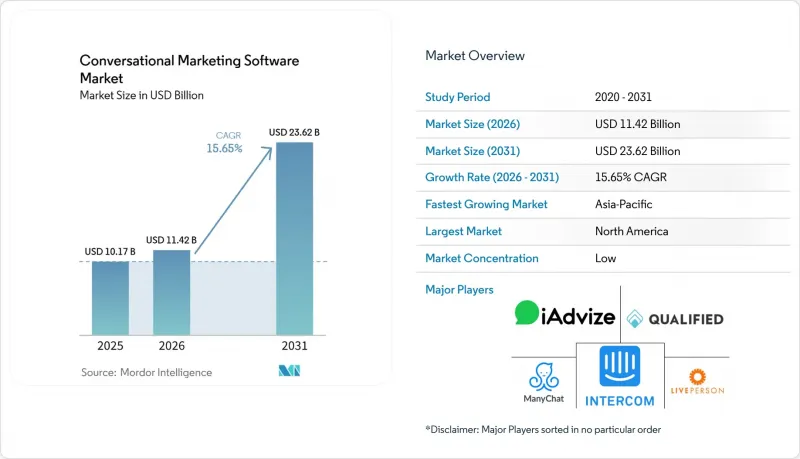
Mordor Intelligence에 의하면, 대화형 마케팅 소프트웨어 시장 규모는 2025년에 101억 7,000만 달러로 평가되었고, 2026년 117억 6,000만 달러에서 2031년까지 236억 2,000만 달러에 이를 것으로 예측되며, 예측 기간(2026-2031년) CAGR은 15.65%를 나타낼 전망입니다.
본 보고서는 제공 형태별(소프트웨어 및 서비스), 도입 모델별(클라우드, 하이브리드, 온프레미스), 기업 규모별(대기업, 중소기업), 최종 사용자별(IT 및 통신, 은행, 금융서비스 및 보험(BFSI), 자동차 및 운송, 헬스케어 및 생명과학 등) 및 지역별로 분류되어 있습니다. 시장 예측은 금액(달러) 기준으로 제시되어 있습니다.
세계의 대화형 마케팅 소프트웨어 시장 동향 및 인사이트
실시간 맞춤형 고객 참여
구매자가 몇 분 이내에 제품 페이지, 메시지, 영업 대화 사이를 자유롭게 오갈 수 있게 된 지금, 획일적인 접근 방식의 효과는 점차 떨어지고 있습니다. 플랫폼이 실시간으로 방문 목적을 파악하고 이에 따라 대화를 조정할 수 있다면, 대화형 마케팅 소프트웨어 시장은 그 혜택을 누릴 수 있습니다. 고객 지원 팀은 이러한 상호 작용을 활용하여 잠재 고객이 채널을 떠나기 전에 관련 제품 정보를 제공하거나, 문의를 적절한 담당자에게 전달하거나, 다음 단계를 제안할 수 있습니다. 이를 통해 대화형 도구의 가치는 예정된 캠페인에 대한 의존도가 줄어들고, 일상적인 고객 활동에 대한 의존도가 높아집니다. 라이브 세션 데이터를 활용하는 제공업체는 수익 및 서비스 프로세스에 더욱 긴밀하게 통합될 것입니다. 또한 고객이 고객 유치, 지원 및 고객 유지 업무에 동일한 플랫폼을 이용할 경우, 제공업체의 역할도 확대됩니다.
AI를 활용한 리드 선별 및 전환
자동화된 잠재 고객 선정을 통해 영업 팀은 영업 개발 인력을 같은 속도로 증원하지 않고도 인바운드 문의에 대응할 수 있게 됩니다. 대화형 소프트웨어는 기본적인 요구 사항을 수집하고, 구매 의도를 파악하며, 미팅을 예약하고, 잠재 고객을 적절한 팀으로 안내할 수 있습니다. 이를 통해 특히 표준 업무 시간 외에 잠재 고객의 문의가 들어오는 경우 등, 문의가 집중되는 기간의 지연을 줄일 수 있습니다. Fin사는 자사의 고객 상담원이 매주 200만 건 이상의 고객 문의를 해결했다고 보고하고 있으며, 이는 전문 상담원이 고객 대응 워크플로우에서 어느 정도의 규모로 활동할 수 있는지를 보여줍니다. 그 상업적 가치는 공급자가 대화를 유망한 파이프라인이나 완료된 영업 활동으로 연결할 수 있는지 여부에 달려 있습니다. 이러한 연관성을 입증할 수 있는 공급업체는 단순히 수작업을 줄이는 것뿐만 아니라 비즈니스 성과 측면에서도 경쟁력을 발휘할 수 있습니다.
데이터 개인정보 보호 및 동의 관리의 복잡성
개인화된 대화에는 고객 이력, 행동 신호, 세션 정보에 대한 접근이 필요하며, 이로 인해 명확한 동의와 데이터 관리가 직접적으로 요구됩니다. 조직은 정보의 이용 방법을 설명하고, 수집을 적절한 목적으로 제한하며, 고객의 데이터에 관한 권리를 존중해야 합니다. 플랫폼이 대화 이력을 보관하거나 자동 응답 개선에 활용하는 경우, 이러한 의무 이행은 더욱 어려워집니다. 유럽 데이터 보호 위원회는 조직이 AI 모델을 개발 및 활용할 때 데이터 보호상의 과제를 신중하게 평가해야 한다고 밝혔습니다. GDPR(EU 개인정보보호규정)에 따른 과징금은 2,000만 유로(2,260만 달러) 또는 전 세계 연간 매출액의 4% 중 더 높은 금액에 달할 가능성이 있습니다. 이러한 위험으로 인해 조달 심사가 장기화될 가능성이 있으며, 상세한 거버넌스 프로세스를 제시할 수 있는 공급업체가 우대받게 될 것입니다.
부문 분석
2025년, 대화형 마케팅 소프트웨어 시장에서 소프트웨어의 점유율은 72.41%를 차지했습니다. 구매자들은 인력 증원 없이 자동화를 확대할 수 있기 때문에 지속적인 소프트웨어 구독을 선호합니다. 소프트웨어 계층은 에이전트 생성, 대화 관리, 채널 연동 및 고객 상호작용 검토를 지원합니다. Fin사는 2026년 7월 API 플랫폼을 출시하여 개발자와 기업이 API를 통해 해당 회사의 대화형 AI 기능을 활용할 수 있도록 했습니다.
서비스 부문은 2031년까지 연평균 성장률(CAGR) 16.82%로 확대될 것으로 예상되며, 이는 대화형 마케팅 소프트웨어 시장 전체의 성장률을 상회합니다. 이 부문에는 도입, 설정, 모델 평가, 프롬프트 작성 및 인간으로의 인계 설계가 포함됩니다. 소프트웨어 구매만으로는 직원의 충분한 준비, 운영 책임의 명확화, 고객 프로세스의 재설계를 충분히 수행할 수 없기 때문에 이 부문은 여전히 중요한 역할을 하고 있습니다. ISO/IEC 42001:2023은 체계적인 거버넌스를 추구하는 조직을 위해 AI 관리 시스템의 프레임워크를 제공합니다.
2025년에는 클라우드 도입이 68.19%의 점유율을 차지했습니다. 클라우드는 확장 가능한 컴퓨팅, 신속한 업데이트, 그리고 변화하는 고객 요구에 대응하기 위한 공통 관리 환경을 지원합니다. 2025년 LivePerson이 Google Cloud Marketplace에서 서비스를 시작한 것은 마켓플레이스를 통한 제공이 기존 클라우드 사용자에게 조달 과정을 얼마나 간소화할 수 있는지를 보여주었습니다. 고객의 보안 및 데이터 소재지 관련 정책이 허용하는 한, 클라우드는 여전히 실용적인 기본 선택지로 남을 것입니다.
하이브리드 배포는 2031년까지 연평균 성장률(CAGR) 16.34%로 확대될 것으로 예측됩니다. 이를 통해 규제 대상 조직은 특정 데이터, 관리 기능 또는 시스템을 사내에 유지하면서, 기타 기능에는 클라우드 용량을 활용할 수 있게 됩니다. 이러한 접근 방식은 금융 서비스, 의료, 정부 기관 및 서로 다른 관할 구역에 걸쳐 사업을 운영하는 고객과 관련이 있습니다. 온프레미스 배포는 일부 국방, 중요 인프라 및 에어갭 환경에서는 여전히 필요하지만, 소유 비용이 높고 업데이트 주기도 느립니다.
지역별 분석
2025년, 북미는 대화형 마케팅 소프트웨어 시장 점유율의 37.63%를 차지했습니다. 이 지역은 B2B 소프트웨어 공급업체가 밀집해 있고, 고객 관계 관리(CRM) 인프라가 확립되어 있다는 등의 이점이 있습니다. 기존의 Salesforce, HubSpot, Marketo 환경을 활용함으로써 통합 작업을 줄일 수 있습니다. Salesforce는 2026년 6월, Fin 인수를 위한 최종 합의서에 서명했습니다. 이는 고객 관계 관리(CRM) 플랫폼 내에서 대화형 에이전트의 역할이 확대되고 있음을 보여줍니다. 미국은 여전히 이 지역의 주요 수요 원천이지만, 캐나다에서는 개인정보 보호 기준이 로컬 클라우드 기능 도입을 촉진하고 있어 시장이 발전하고 있습니다.
아시아태평양은 2031년까지 연평균 성장률(CAGR) 16.85%를 나타낼 것으로 예측됩니다. WhatsApp, LINE, WeChat, KakaoTalk, Zalo 등이 존재하는 메시징 환경은 세분화되어 있으며, 고객과의 원활한 소통의 중요성이 부각되고 있습니다. 모바일 우선의 행동 양식과 전자상거래의 확대가 해당 지역 전체의 대화형 상거래를 뒷받침하고 있습니다. 인도는 대규모 디지털 고객 기반과 진화하는 고객 데이터 관리 요건을 통해 수요를 주도하고 있습니다. 중국, 일본, 한국은 계속해서 중요한 투자 거점인 반면, 인도네시아, 베트남, 태국, 필리핀, 말레이시아에서는 메시징을 원동력으로 한 추가적인 성장 기회가 예상됩니다.
유럽은 독일, 영국, 프랑스를 필두로 중요한 수익 기반이 되고 있습니다. GDPR(EU 개인정보보호규정)(일반 데이터 보호 규정) 및 EU AI법에 따라 투명성, 데이터 최소화, 인간 감독에 대한 감시가 강화되고 있습니다. 대화형 마케팅 소프트웨어 시장은 규제가 엄격한 유럽의 고객을 확보하기 위해 이러한 기대에 부응해야 합니다. 유럽 데이터 보호 위원회는 적절한 보호 조치의 필요성을 포함하여 AI 모델과 관련된 데이터 보호 문제를 지적하고 있습니다. 남미에서는 브라질과 아르헨티나를 통해 새로운 가능성이 열리고 있으며, 중동 및 아프리카에서는 사우디아라비아, 아랍에미리트, 나이지리아, 남아프리카공화국이 초기 단계 수요를 뒷받침하고 있습니다.
기타 혜택 :
- 엑셀 형식 시장 예측(ME) 시트
- 3개월간의 애널리스트 지원
자주 묻는 질문
목차
제1장 서론
제2장 조사 방법
제3장 개요
제4장 시장 구도
제5장 시장 규모 및 성장 예측
제6장 경쟁 구도
제7장 시장 기회 및 향후 전망
AJY 26.09.01According to Mordor Intelligence, the conversational marketing software market size was valued at USD 10.17 billion in 2025 and estimated to grow from USD 11.76 billion in 2026 to reach USD 23.62 billion by 2031, at a CAGR of 15.65% during the forecast period (2026-2031).
This report is Segmented by Offering (Software, and Services), Deployment Model (Cloud, Hybrid, and On-Premises), Enterprise Size (Large Enterprises, and Small and Mid-Sized Enterprises), End Users (IT and Telecommunication, BFSI, Automotive and Transportation, Healthcare and Life Sciences, and More), and Geography. The Market Forecasts are Provided in Terms of Value (USD).
Global Conversational Marketing Software Market Trends and Insights
Real-Time Personalized Customer Engagement
Generic outreach is becoming less effective when buyers can move between product pages, messages, and sales conversations within minutes. The Conversational Marketing Software Market benefits when a platform identifies the purpose of a live visit and changes the conversation accordingly. Customer teams can use these interactions to offer relevant product information, route a request, or suggest a next step before a prospect leaves the channel. This makes the value of conversational tools less dependent on scheduled campaigns and more dependent on daily customer activity. Providers that work with live session data can become more closely embedded in revenue and service processes. Their role also expands when customers use the same platform for acquisition, support, and retention work.
AI-Powered Lead Qualification and Conversion
Automated qualification gives sales teams a way to respond to inbound interest without expanding their sales development staff at the same pace. Conversational software can collect basic requirements, identify buyer intent, schedule meetings, and direct a lead to the appropriate team. This can reduce delays during high-volume periods, especially when interest arrives outside standard business hours. Fin reported that its customer agent handled more than 2 million customer resolutions each week, showing the scale at which specialized agents can operate in customer-facing workflows. The commercial value depends on whether providers can connect conversations to a qualified pipeline and completed sales activity. Vendors that show this connection can compete on business outcomes rather than only on reduced manual work.
Data Privacy and Consent Management Complexity
Personalized conversations require access to customer histories, behavioral signals, and session information, which creates a direct need for clear consent and data controls. Organizations must explain how they use information, restrict collection to appropriate purposes, and support customers' rights over their data. These duties become harder when platforms retain conversation histories or use them to improve automated responses. The European Data Protection Board stated that organizations need a careful assessment of data protection issues when developing and using AI models. GDPR penalties can reach EUR 20 million (USD 22.6 million) or 4% of global annual revenue, whichever is higher. This risk can lengthen procurement reviews and favor providers that can show detailed governance processes.
Other drivers and restraints analyzed in the detailed report include:
- Omnichannel Messaging Adoption
- Generative AI and Multilingual Conversation Expansion
- Legacy-System Integration and Data-Silo Friction
For complete list of drivers and restraints, kindly check the Table Of Contents.
Segment Analysis
Software accounted for 72.41% of the conversational marketing software market share in 2025. Buyers favor recurring software subscriptions because they can extend automation without matching increases in staff. The software layer supports agent creation, conversation management, channel connections, and customer-interaction review. Fin launched its API Platform in July 2026, giving developers and enterprises access to its conversational AI capabilities through an API.
Services are projected to expand at a 16.82% CAGR through 2031, faster than the Conversational Marketing Software Market. The segment covers implementation, configuration, model evaluation, prompt work, and human-handoff design. It remains important because a software purchase alone does not adequately prepare employees, clarify ownership of operations, or redesign customer processes. ISO/IEC 42001:2023 provides an AI management system framework for organizations seeking structured governance.
Cloud deployment held 68.19% share in 2025. It supports scalable computing, faster updates, and a common administrative environment for changing customer demand. LivePerson's Google Cloud Marketplace availability in 2025 showed how marketplace distribution can simplify procurement for existing cloud users. Cloud remains the practical default where customer security and data residency policies permit it.
Hybrid deployment is projected to expand at a 16.34% CAGR through 2031. It allows regulated organizations to retain selected data, controls, or systems while using cloud capacity for other functions. This approach is relevant to financial services, health care, government, and customers with operations across different jurisdictions. On-premises deployment remains necessary for some defense, critical infrastructure, and air-gapped environments, but it has higher ownership costs and slower refresh cycles.
Complete Report Scope:
- By Offering
- Software
- Services
- By Deployment Model
- Cloud
- Hybrid
- On-Premises
- By Enterprise Size
- Large Enterprises
- Small and Mid-sized Enterprises
- By End Users
- IT and Telecommunication
- BFSI
- Automotive and Transportation
- Healthcare and Life Sciences
- Energy and Utilities
- Industrial Manufacturing
- Retail and E-commerce
- Travel and Hospitality
- Other End Users
- By Geography
- North America
- United States
- Canada
- Mexico
- South America
- Brazil
- Argentina
- Rest of South America
- Europe
- Germany
- United Kingdom
- France
- Russia
- Spain
- Rest of Europe
- Asia-Pacific
- China
- Japan
- India
- South Korea
- Southeast Asia
- Rest of Asia-Pacific
- Middle East and Africa
- Middle East
- Saudi Arabia
- United Arab Emirates
- Rest of Middle East
- Africa
- South Africa
- Nigeria
- Rest of Africa
- Middle East
- North America
Geography Analysis
North America held 37.63% of the conversational marketing software market share in 2025. The region benefits from a dense base of business-to-business software vendors and an established customer relationship management infrastructure. Existing Salesforce, HubSpot, and Marketo environments can reduce integration work. Salesforce signed a definitive agreement in June 2026 to acquire Fin, indicating the growing role of conversational agents within customer relationship management platforms. The United States remains the main source of regional demand, while Canada is developing as privacy standards encourage local cloud capabilities.
Asia-Pacific is projected to expand at a 16.85% CAGR through 2031. WhatsApp, Line, WeChat, KakaoTalk, and Zalo create a fragmented messaging environment, underscoring the value of coordinated customer interactions. Mobile-first behavior and e-commerce expansion support conversational commerce across the region. India adds demand through its large digital customer base and evolving customer data management requirements. China, Japan, and South Korea remain important investment centers, while Indonesia, Vietnam, Thailand, the Philippines, and Malaysia offer further messaging-led growth opportunities.
Europe is a significant revenue base, led by Germany, the United Kingdom, and France. GDPR and the EU AI Act increase scrutiny of transparency, data minimization, and human oversight. The Conversational Marketing Software Market must meet these expectations to compete for regulated European accounts. The European Data Protection Board has highlighted data protection issues related to AI models, including the need for appropriate safeguards. South America offers emerging potential through Brazil and Argentina, while Saudi Arabia, the United Arab Emirates, Nigeria, and South Africa support earlier-stage demand in Middle East and Africa.
- Intercom
- Manychat, Inc.
- LivePerson, Inc.
- iAdvize
- Qualified.com, Inc.
- Conversica, Inc.
- Saleswhale Pte. Ltd.
- Whisbi Technologies, S.L.
- Snaps Media, Inc.
- Verloop Technology Solutions Private Limited
- Automat Technologies, Inc.
- Spectrm GmbH
- Audiense Co.
- Zoovu Ltd.
- Crisp IM SAS
- Chatfuel
- Customers.ai, Inc.
- Tidio Ltd.
- Landbot.io, S.L.
- MobileMonkey, Inc.
- Dashly LLC
- Botpress Technologies Inc.
Additional Benefits:
- The market estimate (ME) sheet in Excel format
- 3 months of analyst support
TABLE OF CONTENTS
1 INTRODUCTION
- 1.1 Study Assumptions and Market Definition
- 1.2 Scope of the Study
2 RESEARCH METHODOLOGY
3 EXECUTIVE SUMMARY
4 MARKET LANDSCAPE
- 4.1 Market Overview
- 4.2 Market Drivers
- 4.2.1 Real-Time Personalized Customer Engagement
- 4.2.2 AI-Powered Lead Qualification and Conversion
- 4.2.3 Omnichannel Messaging Adoption
- 4.2.4 Generative AI and Multilingual Conversation Expansion
- 4.2.5 API-Based Revenue-Operations Integration
- 4.2.6 Lower Inference Costs Enabling Mid-Market Adoption
- 4.3 Market Restraints
- 4.3.1 Data Privacy and Consent Management Complexity
- 4.3.2 Legacy-System Integration and Data-Silo Friction
- 4.3.3 Hallucination, Brand-Safety, and Misrouting Risk
- 4.3.4 Escalating LLM Inference and Human-Handoff Costs
- 4.4 Impact of Macroeconomic Factors on the Market
- 4.5 Industry Value-Chain Analysis
- 4.6 Technology Outlook
- 4.7 Regulatory Landscape
- 4.8 Porter's Five Forces Analysis
- 4.8.1 Threat of New Entrants
- 4.8.2 Bargaining Power of Suppliers
- 4.8.3 Bargaining Power of Buyers
- 4.8.4 Threat of Substitutes
- 4.8.5 Intensity of Competitive Rivalry
5 MARKET SIZE AND GROWTH FORECASTS (VALUE)
- 5.1 By Offering
- 5.1.1 Software
- 5.1.2 Services
- 5.2 By Deployment Model
- 5.2.1 Cloud
- 5.2.2 Hybrid
- 5.2.3 On-Premises
- 5.3 By Enterprise Size
- 5.3.1 Large Enterprises
- 5.3.2 Small and Mid-sized Enterprises
- 5.4 By End Users
- 5.4.1 IT and Telecommunication
- 5.4.2 BFSI
- 5.4.3 Automotive and Transportation
- 5.4.4 Healthcare and Life Sciences
- 5.4.5 Energy and Utilities
- 5.4.6 Industrial Manufacturing
- 5.4.7 Retail and E-commerce
- 5.4.8 Travel and Hospitality
- 5.4.9 Other End Users
- 5.5 By Geography
- 5.5.1 North America
- 5.5.1.1 United States
- 5.5.1.2 Canada
- 5.5.1.3 Mexico
- 5.5.2 South America
- 5.5.2.1 Brazil
- 5.5.2.2 Argentina
- 5.5.2.3 Rest of South America
- 5.5.3 Europe
- 5.5.3.1 Germany
- 5.5.3.2 United Kingdom
- 5.5.3.3 France
- 5.5.3.4 Russia
- 5.5.3.5 Spain
- 5.5.3.6 Rest of Europe
- 5.5.4 Asia-Pacific
- 5.5.4.1 China
- 5.5.4.2 Japan
- 5.5.4.3 India
- 5.5.4.4 South Korea
- 5.5.4.5 Southeast Asia
- 5.5.4.6 Rest of Asia-Pacific
- 5.5.5 Middle East and Africa
- 5.5.5.1 Middle East
- 5.5.5.1.1 Saudi Arabia
- 5.5.5.1.2 United Arab Emirates
- 5.5.5.1.3 Rest of Middle East
- 5.5.5.2 Africa
- 5.5.5.2.1 South Africa
- 5.5.5.2.2 Nigeria
- 5.5.5.2.3 Rest of Africa
- 5.5.5.1 Middle East
- 5.5.1 North America
6 COMPETITIVE LANDSCAPE
- 6.1 Market Concentration
- 6.2 Strategic Moves
- 6.3 Market Share Analysis
- 6.4 Company Profiles (includes Global Level Overview, Market Level Overview, Core Segments, Financials as available, Strategic Information, Market Rank/Share, Products and Services, Recent Developments)
- 6.4.1 Intercom
- 6.4.2 Manychat, Inc.
- 6.4.3 LivePerson, Inc.
- 6.4.4 iAdvize
- 6.4.5 Qualified.com, Inc.
- 6.4.6 Conversica, Inc.
- 6.4.7 Saleswhale Pte. Ltd.
- 6.4.8 Whisbi Technologies, S.L.
- 6.4.9 Snaps Media, Inc.
- 6.4.10 Verloop Technology Solutions Private Limited
- 6.4.11 Automat Technologies, Inc.
- 6.4.12 Spectrm GmbH
- 6.4.13 Audiense Co.
- 6.4.14 Zoovu Ltd.
- 6.4.15 Crisp IM SAS
- 6.4.16 Chatfuel
- 6.4.17 Customers.ai, Inc.
- 6.4.18 Tidio Ltd.
- 6.4.19 Landbot.io, S.L.
- 6.4.20 MobileMonkey, Inc.
- 6.4.21 Dashly LLC
- 6.4.22 Botpress Technologies Inc.
7 MARKET OPPORTUNITIES AND FUTURE OUTLOOK
- 7.1 White-Space and Unmet-Need Assessment


