|
시장보고서
상품코드
2118871
3D 프린팅용 플라스틱 시장 : 시장 점유율 분석, 업계 동향 및 통계, 성장 예측(2026-2031년)3D Printing Plastics - Market Share Analysis, Industry Trends & Statistics, Growth Forecasts (2026 - 2031) |
||||||
 Mordor Intelligence
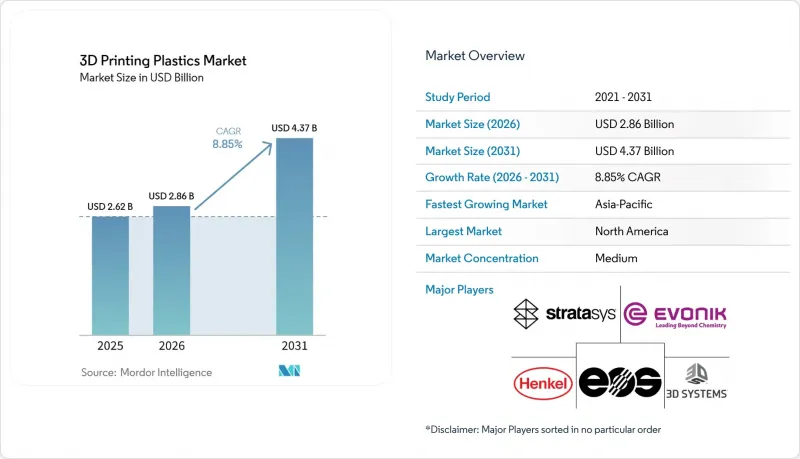
Mordor Intelligence에 의하면, 3D 프린팅용 플라스틱 시장은 2025년에 26억 2,000만 달러 규모로 평가되었고, 2026년 28억 6,000만 달러에서 2031년까지 43억 7,000만 달러에 이를 것으로 추정되고 있습니다.
예측 기간(2026-2031년) 동안 연평균 성장률(CAGR)은 8.85%를 나타낼 것으로 전망됩니다.
본 보고서는 형태별(필라멘트, 분말, 액체), 소재 유형별(포토폴리머, 아크릴로니트릴-부타디엔-스티렌(ABS) 등), 최종 이용 산업별(의료, 항공우주 및 방위, 자동차, 전기 및 전자 등) 및 지역별(아시아태평양, 북미, 유럽, 남미, 중동 및 아프리카)로 분류되어 있습니다. 시장 예측은 금액(달러) 기준으로 제시되어 있습니다.
세계의 3D 프린팅용 플라스틱 시장 동향 및 인사이트
신속 프로토타이핑에서 기능성 부품 생산으로의 전환이 진행 중
3D 프린팅용 플라스틱 시장은 설계 검증, 브리지 생산, 예비 부품 관리, 그리고 최종 용도 부품 생산에서 적층 가공의 활용 확대에 힘입어 성장하고 있습니다. 3D Systems사는 2026년 7월, 래피드 프로토타이핑이 더 이상 초기 설계 작업뿐만 아니라 제품의 전체 수명 주기를 지원하게 되었다고 밝혔습니다. 이러한 변화로 인해 폴리머 공급업체는 단일 프린팅에서 허용 가능한 성능을 보여줄 뿐만 아니라, 재현성 있는 결과와 문서화된 자재 관리를 제공해야 합니다. 3D 프린팅용 플라스틱 시장의 생산 사용자는 반복되는 주문이나 정해진 제조 일정을 통해 일관된 자재 거동을 신뢰할 수 있어야 하기 때문입니다. 또한, 생산 공정에서 3D 프린팅을 활용하는 제조업체에게는 추적성 및 업계 고유의 요구 사항을 지원하는 품질 관리 시스템도 필요합니다. 과거에는 프로토타이핑 연구소에 소량씩 공급되던 소재도, 이를 통해 더 대규모이며 예측 가능한 요구 사항을 수반하는 생산 일정에 따라 구매할 수 있게 되었습니다. 이러한 변화로 인해, 장기적인 생산 공정 전반에 걸쳐 신뢰할 수 있는 출력을 지원할 수 있는 공급업체가 유리해졌으며, 그 결과 공정 문서화와 소재의 일관성이 3D 프린팅용 플라스틱 시장에서 경쟁상의 중요한 요건이 되었습니다.
고성능 엔지니어링 열가소성 플라스틱에 대한 수요 증가
PEEK는 의료 및 항공우주 분야의 까다로운 용도에서의 역할을 반영하여, 2031년까지 연평균 성장률(CAGR) 10.21%를 나타낼 것으로 예측됩니다. ASTM F2026을 준수하는 임플란트용 PEEK는 환자 맞춤형 임플란트 및 수술 기구 제조에 있어 ISO 13485 품질 시스템 하에서 운영되는 의료기기 제조업체를 지원할 수 있습니다. ULTEM이라는 브랜드명으로 판매되는 경우가 많은 폴리에테르이미드(PEEK)는 항공기 내장 부품 및 기타 인증 부품에 내열성, 내화학성, 경량성을 제공합니다. 폴리페닐설폰(PPSU) 및 폴리카보네이트도 오토클레이브 처리를 견뎌야 하는 금형에 사용되며, 소량 생산이라 하더라도 부품당 부가가치는 여전히 높습니다. 따라서 3D 프린팅용 플라스틱 시장은 컴파운딩 능력에 더해 시험, 문서화, 인증 지원을 겸비한 소재 공급업체에 대한 의존도를 점점 더 높이고 있습니다. 이러한 요구 사항으로 인해 범용 폴리머만을 취급하는 공급업체에 비해 특수 화학제품 제조업체의 우위가 커지고 있습니다. 특히 3D 프린팅용 플라스틱 시장에서 규제된 제품 승인 절차 중에 심사 가능한 소재 기록을 고객이 요구할 경우 이러한 경향이 두드러집니다.
기존 폴리머 소재와 비교한 3D 프린팅용 플라스틱의 높은 비용
엔지니어링 등급의 프린팅 소재, 특히 PEEK, PPSU 및 생체 적합성 포토폴리머 수지는 사출 성형에 사용되는 동등한 범용 등급보다 비용이 높습니다. 이러한 비용은 소비재나 일반 산업 제조 등 부품당 경제성이 생산량과 밀접하게 연결되어 있는 경우, 도입을 제한하는 요인이 될 수 있습니다. 또한, 프린팅 등급 폴리머는 관리된 보관 환경이 필요하며, 일부 광중합 수지는 보관 기간이 짧은 특징도 있습니다. 습기에 민감한 나일론 분말은 특수한 취급이 필요한 경우가 있어, 이로 인해 기존의 폴리머 공급망에서는 발생하지 않는 물류 비용이 추가됩니다. 이러한 비용은 확립된 사출 성형 공급망이 여전히 경쟁력을 유지하고 있는 남미나 동남아시아 일부와 같은 신흥 시장에서 특히 높게 나타납니다. 따라서 3D 프린팅용 플라스틱 시장은 재료 가격이 비싸더라도 금형 필요성 감소, 리드타임 단축, 혹은 부품 맞춤화의 자유도 향상과 같은 가치를 입증하여, 구매 결정이 재료 비용에만 좌우되지 않도록 해야 합니다.
부문 분석
2025년, 필라멘트는 3D 프린팅용 플라스틱 시장 점유율의 45.31%를 차지했습니다. 이는 시제품 제작 실험실, 치과, 교육 기관, 제조 현장 등에 널리 도입된 FDM(용융 적층 방식) 및 FFF(용융 필라멘트 적층 방식) 시스템의 보급에 힘입은 결과입니다. 이러한 환경에서의 필라멘트 보급으로 인해, 설계, 교육, 금형 제작, 생산 지원 업무에서 필라멘트는 친숙한 소재가 되었습니다. 필라멘트는 폴리젖산(PLA)부터 PEEK 및 ULTEM에 이르기까지 폭넓은 소재를 지원합니다. 밀폐된 가열 챔버를 갖춘 산업용 FDM 시스템은 더 강인하고, 안정성이 높으며, 내열성이 뛰어난 부품을 필요로 하는 생산 지향적 용도로 그 활용 범위를 확대되고 있습니다. 필라멘트 3D 프린팅용 플라스틱 시장 규모는 난연성, 보강, 특정 작동 조건 하에서의 성능 등 용도에 특화된 특성을 지닌 등급에 대한 수요에 의해서도 뒷받침되고 있습니다. 스트라타시스(Stratasys)는 2026년 6월, 난연성 최종 용도 부품 및 예비 부품을 필요로 하는 철도 및 운송 분야 사용자를 위해 FDM PA6/66-GF30-FR을 출시했습니다.
분말 시장은 2031년까지 연평균 성장률(CAGR) 9.06%로 확대될 것으로 예측되며, 산업 사용자들이 소량 생산을 위한 실용적인 대안을 모색함에 따라 3D 프린팅용 플라스틱 시장에서 가장 빠르게 성장하는 형태가 될 전망입니다. 멀티젯 퓨전(MJF) 및 선택적 레이저 소결(SLS)은 기존의 금형 없이도 배치 생산이 가능하기 때문에 제조업체는 본래라면 금형에 대한 투자가 필요했던 상황에서도 적층 가공 방식의 도입을 검토할 수 있게 됩니다. 이러한 기능은 금형 비용의 정당화가 어려워지기 쉬운 소량 생산에서 특히 가치가 있습니다. 또한, 분말 시스템은 제조업체가 기존 기계 가공 공정에 대한 의존도를 낮추면서 복잡한 부품을 제조할 수 있게 해주며, 생산 팀이 기존 방법으로는 제조하기 어려운 형상에도 대응할 수 있도록 지원합니다. 분말 수요 증가는 생산 지향적인 적층 가공 워크플로로 전환되고 있음을 반영합니다. 또한, 3D 프린팅용 플라스틱 시장에서 생산 사용자는 반복 제조를 통해 품질과 비용을 관리해야 하므로, 가공 및 재사용 후에도 안정적인 특성을 유지하는 소재에 대한 수요도 창출하고 있습니다. 액체 수지는 스테레오리소그래피 및 디지털 라이트 프로세싱, 특히 치과 보철물, 보청기, 고해상도 산업용 부품 분야에서 여전히 중요한 역할을 하고 있습니다. 포토폴리머 배합 개발에서는 생체 적합성과 난연성에 점점 더 중점을 두고 있습니다.
지역별 분석
2025년, 북미는 3D 프린팅용 플라스틱 시장 점유율의 34.11%를 차지했습니다. 이 지역의 항공우주 및 방위 분야 조달에서는 엄격한 인증 절차를 충족하는 소재가 요구되고 있습니다. 또한, 이 지역에는 FDA 승인을 받은 생체적합성 수지 및 필라멘트를 사용하는 발전된 의료 제조거점이 구축되어 있습니다. 이러한 상황이 인증된 폴리머와 문서화된 제조 공정에 대한 수요를 뒷받침하고 있습니다. 스트라타시스(Stratasys)는 2026년 미네소타주 미네톤카에 20만 제곱피트 규모의 북미 본사를 개설하며, 산업용 적층 가공 도입에 있어 이 지역의 역할을 강조했습니다. 또한 캐나다와 멕시코도 항공우주 공급망의 니어쇼어 거점으로서 그 중요성이 높아지고 있습니다.
아시아태평양은 일부 선진국 및 신흥국에서 제조 활동이 증가하고 있어 2031년까지 연평균 성장률(CAGR) 9.25%를 나타낼 것으로 예측되며, 이는 3D 프린팅용 플라스틱 시장에서 지역별 가장 높은 성장률입니다. 중국은 전략적 산업 분야에서 적층 가공를 확대하고 있으며, 현지 프린터 제조업체와 특수 화학제품 제조업체들은 증가하는 산업용 시스템 도입 대수에 대응하기 위해 PA12 및 포토폴리머의 생산 능력을 강화하고 있습니다. 일본의 자동차 및 항공우주 분야에서는 적층 가공 워크플로우의 활용이 확대되고 있으며, 이는 인증된 생산 용도에 적합한 폴리머에 대한 수요를 뒷받침하고 있습니다. 한국의 전자기기 제조 거점은 고정밀 광경화 수지 부품 및 정전기 방전(ESD) 대책이 적용된 폴리머 하우징에 대한 수요를 뒷받침하고 있습니다. 인도는 도입 초기 단계에 있지만, ‘메이크 인 인디아(Make in India)’ 프로그램과 관련된 제조 투자가 항공우주 및 의료기기 분야의 활동을 뒷받침하고 있습니다. 이러한 시장에서는 도입된 프린터 대수가 증가함에 따라 양산에 대응 가능한 폴리머 시스템에 대한 수요가 발생하고 있습니다.
유럽에서는 독일과 프랑스가 주도적인 역할을 하고 있으며, 산업용 프린터에 대한 전문 지식, 연구 역량 및 항공우주 분야 수요가 첨단 폴리머 용도를 뒷받침하고 있습니다. 독일에서는 산업용 프린터에 대한 전문 지식과 폴리머 제조 방법에 대한 연구 활동이 융합되어 있습니다. 프랑스에서는 에어버스와 사프란을 포함한 항공우주 산업 기반이 고부가가치 폴리머 소재에 대한 수요를 뒷받침하고 있습니다. 에어버스의 연간 생산량이 25,000개를 넘는 항공용 폴리머 부품이라는 사실은 이 지역의 인증된 수요 규모가 얼마나 큰지를 보여줍니다. 화학물질의 등록, 평가, 허가 및 제한에 관한 규정(REACH) 및 EU 의료기기 규정에서는 재료의 추적 가능성과 물질 규정 준수가 요구되고 있으며, 이로 인해 신규 공급업체의 인증 비용은 증가하는 반면, 확립된 인증 역량의 중요성은 더욱 높아지고 있습니다. 남미, 중동 및 아프리카는 여전히 소규모 시장이지만, 브라질과 사우디아라비아에서는 석유 및 가스 및 산업용 유지보수 용도를 위한 적층 가공 역량 구축이 진행되고 있습니다.
기타 혜택 :
- 엑셀 형식 시장 예측(ME) 시트
- 3개월간의 애널리스트 지원
자주 묻는 질문
목차
제1장 서론
제2장 조사 방법
제3장 개요
제4장 시장 구도
제5장 시장 규모 및 성장 예측
제6장 경쟁 구도
제7장 시장 기회 및 향후 전망
AJY 26.09.01According to Mordor Intelligence, the 3D printing plastics market was valued at USD 2.62 billion in 2025 and is estimated to grow from USD 2.86 billion in 2026 to reach USD 4.37 billion by 2031, at a CAGR of 8.85% during the forecast period (2026-2031).
This report is Segmented by Form (Filament, Powder, and Liquid), Material Type (Photopolymer, Acrylonitrile Butadiene Styrene (ABS), and More), End-Use Industry (Healthcare, Aerospace & Defense, Automotive, Electrical & Electronics, and More), and Geography (Asia-Pacific, North America, Europe, South America, and Middle-East and Africa). The Market Forecasts are Provided in Terms of Value (USD).
Global 3D Printing Plastics Market Trends and Insights
Growing Shift from Rapid Prototyping to Functional Parts Production
The 3D printing plastics market is supported by wider use of additive manufacturing across design validation, bridge production, spare-parts management, and end-use component production. 3D Systems stated in July 2026 that rapid prototyping now supports the full product lifecycle rather than only early design work. This change requires polymer suppliers to provide repeatable results and documented material control, not only acceptable performance in a single print, because production users must be able to rely on the same material behavior across recurring orders and defined manufacturing schedules in the 3D printing plastics market. Manufacturers using printing in production also need quality systems that support traceability and sector-specific requirements. Materials that once moved in small volumes to prototyping laboratories can therefore be purchased under production schedules with larger and more predictable requirements. The shift favors suppliers that can support reliable output across extended production runs, which makes process documentation and material consistency central competitive requirements in the 3D printing plastics market.
Rising Demand for High-Performance Engineering Thermoplastics
PEEK is projected to grow at a 10.21% CAGR through 2031, reflecting its role in demanding medical and aerospace uses. Implant-grade PEEK that conforms to ASTM F2026 can support medical device producers working within ISO 13485 quality systems for patient-specific implants and surgical instruments. Polyetherimide, often sold under the ULTEM brand, and PEEK provide heat resistance, chemical resistance, and low weight for aircraft interior parts and other qualified components. Polyphenylsulfone (PPSU) and polycarbonate are also being used for tooling that must withstand autoclaving, where small production runs can still have high value per part. The 3D printing plastics market, therefore, depends increasingly on material suppliers that combine compounding capability with testing, documentation, and certification support. These requirements strengthen the position of specialty chemical producers relative to suppliers focused only on general-purpose polymers, especially when customers need material records that can be reviewed during a regulated product approval process within the 3D printing plastics market.
High Cost of 3D Printing Plastics Compared with Conventional Polymer Materials
Engineering-grade printing materials, especially PEEK, PPSU, and biocompatible photopolymer resins, cost more than comparable commodity grades used in injection molding. This cost can limit adoption when per-part economics are strongly tied to production volume, including consumer goods and general industrial manufacturing. Print-grade polymers also need controlled storage, while some photopolymers have shorter shelf lives. Moisture-sensitive nylon powders can require specialized handling, which adds logistics costs that conventional polymer supply chains may not carry. These costs are particularly high in emerging markets across South America and parts of Southeast Asia, where established injection molding supply chains remain competitive. The 3D printing plastics market must therefore demonstrate value through lower tooling needs, shorter lead times, or greater part customization when material prices are high, rather than relying on material cost alone to support the purchasing decision.
Other drivers and restraints analyzed in the detailed report include:
- Increasing Development of Application-Specific Polymer Formulations by 3D Printer Manufacturers
- Expanding Use of Lightweight Polymer Components in Aerospace and Automotive Industries
- Limited Material Compatibility Across Different 3D Printing Technologies
For complete list of drivers and restraints, kindly check the Table Of Contents.
Segment Analysis
Filament held 45.31% of the 3D printing plastics market share in 2025, supported by the wide installed base of fused deposition modeling and fused filament fabrication systems in prototyping laboratories, dental clinics, educational settings, and manufacturing locations. Their presence across these settings has made filament a familiar input for design, training, tooling, and production-support work. Filament supports a broad range of materials, from polylactic acid (PLA) to PEEK and ULTEM. Industrial FDM systems with enclosed heated chambers are extending their use into production-oriented applications that need stronger, more stable, and more heat-resistant components. The 3D printing plastics market size for filament is also supported by demand for grades with application-specific properties, including flame resistance, reinforcement, and performance under defined operating conditions. Stratasys introduced FDM PA6/66-GF30-FR in June 2026 for rail and transportation users who need flame-retardant end-use parts and spare parts.
Powder is projected to expand at a 9.06% CAGR through 2031, making it the fastest-growing form in the 3D printing plastics market as industrial users seek practical alternatives for smaller production batches. Multi Jet Fusion and selective laser sintering can support batch production without conventional tooling, allowing manufacturers to consider additive methods where mold investment would otherwise be required. This capability is valuable for short production runs, where the cost of tooling can be difficult to justify. Powder systems also help manufacturers produce complex parts with less dependence on traditional machining steps and allow production teams to address geometries that can be difficult to make through conventional methods. Growth in powder demand reflects the move toward production-oriented additive workflows. It also creates demand for materials that retain stable properties after processing and reuse, because production users need to control quality and cost across repeat builds in the 3D printing plastics market. Liquid resins remain important for stereolithography and digital light processing, particularly for dental prosthetics, hearing aids, and high-resolution industrial parts. Photopolymer formulation work is increasingly focused on biocompatibility and flame resistance.
Complete Report Scope:
- By Form
- Filament
- Powder
- Liquid
- By Material Type
- Photopolymer
- Acrylonitrile Butadiene Styrene (ABS)
- Polylactic Acid (PLA)
- Polyamide (Nylon)
- Polycarbonate (PC)
- Polyether Ether Ketone (PEEK)
- Polyethylene Terephthalate Glycol (PETG)
- Polyphenylsulfone (PPSU)
- Thermoplastic Polyurethane (TPU)
- Other Material Types
- By End-Use Industry
- Healthcare
- Aerospace & Defense
- Automotive
- Electrical & Electronics
- Consumer Goods
- Industrial Manufacturing
- Other End-use Industries
- By Geography
- Asia-Pacific
- China
- India
- Japan
- South Korea
- Rest of Asia-Pacific
- North America
- United States
- Canada
- Mexico
- Europe
- Germany
- United Kingdom
- France
- Italy
- Russia
- Rest of Europe
- South America
- Brazil
- Argentina
- Rest of South America
- Middle-East and Africa
- Saudi Arabia
- South Africa
- Rest of Middle-East and Africa
- Asia-Pacific
Geography Analysis
North America held 34.11% of the 3D printing plastics market share in 2025. Aerospace and defense procurement in the region requires materials that meet rigorous qualification processes. The region also has a developed healthcare manufacturing base that uses FDA-cleared biocompatible resins and filaments. These conditions support demand for certified polymers and documented production processes. Stratasys opened a 200,000-square-foot Americas Regional Corporate Headquarters in Minnetonka, Minnesota, in 2026, underscoring the region's role in industrial additive manufacturing deployment. Canada and Mexico are also becoming more relevant as nearshore locations for aerospace supply chains.
Asia-Pacific is forecast to grow at a 9.25% CAGR through 2031, the fastest regional rate in the 3D printing plastics market, as manufacturing activity increases across several established and emerging economies. China is expanding additive manufacturing in strategic industrial sectors, while local printer and specialty chemical companies are adding PA12 and photopolymer capacity for a growing installed base of industrial systems. Japan's automotive and aerospace sectors are increasing their use of additive manufacturing workflows, which can support demand for polymers suited to qualified production applications. South Korea's electronics manufacturing base supports demand for precision photopolymer parts and ESD-safe polymer housings. India is at an earlier stage of adoption, but manufacturing investment linked to the Make in India program is supporting aerospace and medical device activity. These markets create demand for production-capable polymer systems as installed printer fleets expand.
Europe is led by Germany and France, where industrial printer expertise, research capability, and aerospace demand support advanced polymer applications. Germany combines industrial printer expertise with research activity on polymer production methods. France's aerospace base, including Airbus and Safran, supports demand for high-value polymer materials. Airbus's annual output of more than 25,000 flight-ready polymer parts shows the depth of qualified demand within the region. Registration, Evaluation, Authorisation and Restriction of Chemicals (REACH) and the EU Medical Device Regulation require material traceability and substance compliance, which increases qualification costs for new suppliers and makes established certification capabilities more important. South America, and Middle-East and Africa remain smaller markets, although Brazil and Saudi Arabia are building additive manufacturing capability for oil and gas and industrial maintenance applications.
- 3D Systems, Inc.
- Arkema
- CRP Technology S.r.l.
- dsm-firmenich
- EOS GmbH
- Evonik Industries AG
- Henkel AG & Co. KGaA
- Lubrizol
- Materialise NV
- SABIC
- Solvay
- Stratasys Ltd.
- Victrex plc
Additional Benefits:
- The market estimate (ME) sheet in Excel format
- 3 months of analyst support
TABLE OF CONTENTS
1 Introduction
- 1.1 Study Assumptions and Market Definition
- 1.2 Scope of the Study
2 Research Methodology
3 Executive Summary
4 Market Landscape
- 4.1 Market Overview
- 4.2 Market Drivers
- 4.2.1 Growing Shift from Rapid Prototyping to Functional Parts Production
- 4.2.2 Rising Demand for High-Performance Engineering Thermoplastics
- 4.2.3 Increasing Development of Application-Specific Polymer Formulations by 3D Printer Manufacturers
- 4.2.4 Expanding Use of Lightweight Polymer Components in Aerospace and Automotive Industries
- 4.2.5 Growing Adoption of On-Demand Manufacturing to Reduce Tooling Costs and Lead Times
- 4.3 Market Restraints
- 4.3.1 High Cost of 3D Printing Plastics Compared with Conventional Polymer Materials
- 4.3.2 Limited Material Compatibility Across Different 3D Printing Technologies
- 4.3.3 Stringent Material Qualification and Certification Requirements for Critical Applications
- 4.4 Value Chain Analysis
- 4.5 Porter's Five Forces Analysis
- 4.5.1 Threat of New Entrants
- 4.5.2 Bargaining Power of Suppliers
- 4.5.3 Bargaining Power of Buyers
- 4.5.4 Threat of Substitutes
- 4.5.5 Competitive Rivalry
5 Market Size and Growth Forecasts (Value)
- 5.1 By Form
- 5.1.1 Filament
- 5.1.2 Powder
- 5.1.3 Liquid
- 5.2 By Material Type
- 5.2.1 Photopolymer
- 5.2.2 Acrylonitrile Butadiene Styrene (ABS)
- 5.2.3 Polylactic Acid (PLA)
- 5.2.4 Polyamide (Nylon)
- 5.2.5 Polycarbonate (PC)
- 5.2.6 Polyether Ether Ketone (PEEK)
- 5.2.7 Polyethylene Terephthalate Glycol (PETG)
- 5.2.8 Polyphenylsulfone (PPSU)
- 5.2.9 Thermoplastic Polyurethane (TPU)
- 5.2.10 Other Material Types
- 5.3 By End-Use Industry
- 5.3.1 Healthcare
- 5.3.2 Aerospace & Defense
- 5.3.3 Automotive
- 5.3.4 Electrical & Electronics
- 5.3.5 Consumer Goods
- 5.3.6 Industrial Manufacturing
- 5.3.7 Other End-use Industries
- 5.4 By Geography
- 5.4.1 Asia-Pacific
- 5.4.1.1 China
- 5.4.1.2 India
- 5.4.1.3 Japan
- 5.4.1.4 South Korea
- 5.4.1.5 Rest of Asia-Pacific
- 5.4.2 North America
- 5.4.2.1 United States
- 5.4.2.2 Canada
- 5.4.2.3 Mexico
- 5.4.3 Europe
- 5.4.3.1 Germany
- 5.4.3.2 United Kingdom
- 5.4.3.3 France
- 5.4.3.4 Italy
- 5.4.3.5 Russia
- 5.4.3.6 Rest of Europe
- 5.4.4 South America
- 5.4.4.1 Brazil
- 5.4.4.2 Argentina
- 5.4.4.3 Rest of South America
- 5.4.5 Middle-East and Africa
- 5.4.5.1 Saudi Arabia
- 5.4.5.2 South Africa
- 5.4.5.3 Rest of Middle-East and Africa
- 5.4.1 Asia-Pacific
6 Competitive Landscape
- 6.1 Market Concentration
- 6.2 Strategic Moves
- 6.3 Market Share (%)/Ranking Analysis
- 6.4 Company Profiles (includes Global Overview, Market Overview, Core Segments, Financials as available, Strategic Information, Products and Services, and Recent Developments)
- 6.4.1 3D Systems, Inc.
- 6.4.2 Arkema
- 6.4.3 CRP Technology S.r.l.
- 6.4.4 dsm-firmenich
- 6.4.5 EOS GmbH
- 6.4.6 Evonik Industries AG
- 6.4.7 Henkel AG & Co. KGaA
- 6.4.8 Lubrizol
- 6.4.9 Materialise NV
- 6.4.10 SABIC
- 6.4.11 Solvay
- 6.4.12 Stratasys Ltd.
- 6.4.13 Victrex plc
7 Market Opportunities and Future Outlook
- 7.1 White-Space and Unmet-Need Assessment