

|
시장보고서
상품코드
2118875
의료용 세라믹 시장 : 시장 점유율 분석, 업계 동향 및 통계, 성장 예측(2026-2031년)Medical Ceramics - Market Share Analysis, Industry Trends & Statistics, Growth Forecasts (2026 - 2031) |
||||||
 Mordor Intelligence
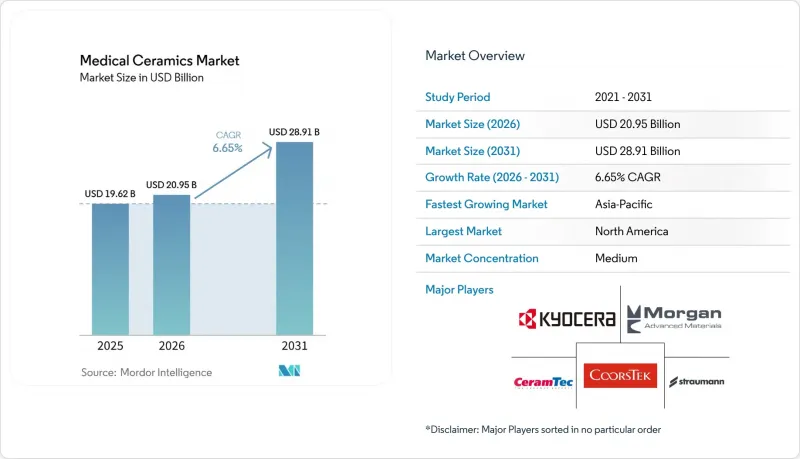
Mordor Intelligence에 의하면, 의료용 세라믹 시장 규모는 2025년에 196억 2,000만 달러로 평가되었고, 2026년 209억 5,000만 달러에서 2031년까지 289억 1,000만 달러에 이를 것으로 예측되며, 예측 기간(2026-2031년) CAGR은 6.65%를 나타낼 전망입니다.
본 보고서는 소재별(생체 비활성 세라믹, 생체 활성 세라믹 등), 용도별(치과, 정형외과, 심혈관, 성형외과), 최종 사용자 산업별(병원 및 진료소, 외래수술센터(ASC), 전문 의료 센터), 지역별(아시아태평양, 북미, 유럽, 남미, 중동 및 아프리카)로 분류되어 있습니다. 시장 예측은 금액(달러) 기준으로 제시되어 있습니다.
세계의 의료용 세라믹 시장 동향 및 인사이트
정형외과 및 치과용 세라믹 임플란트에 대한 수요 증가
정형외과 및 치과용 세라믹 임플란트에 대한 수요는 인구 고령화 이외의 요인에 의해서도 견인되고 있습니다. 관절 치환술이나 치과 치료에는 가혹한 사용 환경에서도 확립된 임상 성능을 갖춘 재료가 요구됩니다. 내마모성이나 생체적합성이 치료법 선택에 영향을 미치는 경우, 세라믹 베어링 시스템과 치과 수복재는 여전히 중요한 역할을 수행하고 있습니다. 또한, 시술 비용의 하락으로 인해 그동안 치료를 미루던 환자들이 치료를 받기 쉬워지면 의료용 세라믹 시장도 혜택을 받게 됩니다. 보험 환급 제도와 조달 방침은 병원이 세라믹 부품이나 경쟁 소재 중 무엇을 선택할지에 영향을 미칩니다. 시술 건수, 지불 구조, 임상 요건이 복합적으로 작용하여 의료용 세라믹 시장의 정형외과 및 치과 치료 전반에 걸쳐 지속적인 수요를 뒷받침하고 있습니다.
첨단 제조 기술을 통한 환자 맞춤형 세라믹 임플란트의 채택 확대
디지털 설계 및 제조 워크플로우의 발전에 따라, 환자 맞춤형 세라믹 임플란트는 제한된 고급 이용 사례의 범위를 넘어 보급되고 있습니다. 탐페레 대학은 2025년에 400마이크로미터의 기공 직경과 45%의 다공성을 가진 3D 프린팅 바이오 세라믹 스캐폴드가 임상적으로 의미 있는 정밀도로 해면골 구조를 재현할 수 있다고 보고했습니다. 이러한 설계 제어 기능은 해부학적 구조에 부합하는 구조가 필요한 골 재생 용도 분야를 지원할 수 있습니다. 개발과 생산의 통합을 통해 소재 개발자, 설계자, 제조업체 간의 업무 이관이 간소화됩니다. 또한, ISO 13485:2016 품질 경영 인증 획득은 환자 맞춤형 시스템 공급업체의 조달 절차를 간소화합니다. 따라서 의료용 세라믹 시장에서는 맞춤형 생산 능력과 문서화된 공정 관리, 안정적인 품질 시스템을 모두 갖춘 제조업체가 높이 평가받고 있습니다.
규제 승인, 재료 시험 및 클린룸 제조에 수반되는 높은 비용
규제 준수는 소규모 세라믹 제조업체나 신생 제조업체에게 큰 비용 부담이 되고 있습니다. MedTech Europe의 보고서에 따르면, 조사 대상인 거의 모든 제조업체에서 의료기기 규정(MDR) 인증 비용은 기존 의료기기 지침에 비해 최대 100% 증가했습니다. 이 협회는 또한 5년에 걸친 유지 관리 및 재인증 비용이 초기 비용보다 50% 더 높을 것으로 예상된다고 밝혔습니다. 대규모 종합 기업은 이러한 비용을 더 광범위한 제품 포트폴리오에 분산시킬 수 있지만, 특정 분야에 특화된 혁신 기업은 더 좁은 수익 기반에서 이러한 비용을 부담해야 합니다. 클린룸 요건은 오염 한계치가 엄격한 생체활성 소재나 압전 세라믹 제품에 설비 투자 비용을 추가합니다. 미국 및 유럽의 요건으로 인해 전체 개발 프로그램에 걸쳐 생체적합성, 마모 시험, 추적성에 대한 요구가 높아짐에 따라, 의료용 세라믹 시장은 더 높은 진입 장벽에 직면하고 있습니다.
부문 분석
생체 흡수성 세라믹은 2031년까지 연평균 성장률(CAGR) 8.33%로 가장 빠른 성장이 예상됩니다. 이러한 소재는 분해 속도와 조직 형성 속도가 적절하게 일치할 경우, 골 결손이나 척추 고정술 적용 시 재수술의 필요성을 줄일 수 있습니다. 2025년 기준, 생체 불활성 세라믹는 의료용 세라믹 시장 점유율의 57.83%를 차지했습니다. 이는 알루미나, 지르코니아 및 관련 복합재료가 인공 관절 치환술 및 치과 보철 분야에서 오랜 임상 실적을 보유하고 있기 때문입니다. 의료용 세라믹 시장에서 이러한 재료들의 위상은 세라믹 대 세라믹 및 세라믹 대 폴리에틸렌 베어링 시스템에 대한 내구성 데이터로 뒷받침되고 있습니다. 하이드록시아파타이트 및 칼슘실리케이트를 포함한 생체활성 세라믹는 골이식재의 대체재 및 임플란트 코팅 분야에서 각각 다른 역할을 수행하고 있습니다.
피에조 세라믹는 초음파 수술 기구, 혈관 내 결석 분쇄 카테터 및 이식형 센서를 위한 특수 소재로 계속 사용되고 있습니다. 이 소재의 선정은 임플란트에 대한 선호도보다는 주로 기기의 성능 요구 사항에 기반합니다. 이 분야는 수동적인 구조 재료에서 생물학적 활동을 지원하도록 설계된 계면으로 전환되고 있습니다. 2025년 연구에 따르면, 신속한 성형, 생분해성 제어 및 미세 환경 조절을 목적으로 개량된 인산칼슘 시멘트는 전임상시험에서 골유착 및 골 재생을 촉진한 것으로 보고되었습니다. 생체 불활성 소재 공급업체는 확립된 기계적 성능을 유지하면서 재생 기능을 추가한 생체 활성 표면층을 제공함으로써 이러한 요구에 부응할 수 있습니다.
지역별 분석
2025년, 북미는 의료용 세라믹 시장의 38.22%를 차지했습니다. 이 지역은 성숙한 정형외과 및 치과 치료 체계, 세라믹 베어링 시스템에 대한 보험 환급 지원, 그리고 의료기기 및 전문 부품 공급업체의 밀집된 네트워크라는 이점을 가지고 있습니다. MatOrtho사의 전 세라믹 고관절 표면 치환 시스템 ‘ReCerf’는 이전에 FDA로부터 ‘획기적 의료기기 지정’을 받은 데 이어, 2025년 7월 유럽의 CE 마크를 획득했으며, CeramTec사의 ‘BIOLOX delta’ 소재를 사용하고 있습니다. 이러한 진전은 첨단 세라믹 시스템의 임상 검증 및 조기 상용화에서 해당 지역이 중요한 역할을 하고 있음을 반영합니다. 캐나다에서는 정형외과 프로그램의 확대로 수요가 견인되고 있으며, 멕시코에서는 도시 지역의 자비 진료 치과 임플란트 수요가 기여하고 있습니다.
유럽은 고성능 기술 세라믹 및 의료 기술 제조 분야에서 독일이 보유한 풍부한 노하우에 힘입어 시장에서 중요한 위치를 차지하고 있습니다. SPECTARIS의 보고에 따르면, 독일의 의료 기술 부문에는 약 1,500개의 제조업체가 존재하며, 2024년에는 413억 유로(약 470억 3,000만 달러)의 매출을 기록하여 아시아 시장 수출의 16%를 차지했습니다. 의료기기 규정(MDR)의 유지 및 재인증에 드는 비용이 유럽의 소규모 전문 기업들에 부담을 주며, 업계 재편을 촉진하고 있습니다. 남미 수요는 브라질과 아르헨티나에 집중되어 있는 반면, 중동 및 아프리카는 자금 조달 제약과 전문 의료 체계의 부족으로 인해 여전히 초기 단계 시장에 머물러 있습니다.
아시아태평양은 2031년까지 연평균 성장률(CAGR)이 7.81%를 나타낼 것으로 예측되며, 의료용 세라믹 시장에서 가장 빠르게 성장하는 지역이 될 것으로 전망됩니다. 인구 고령화, 현지 생산 정책, 의료 체계 확충이 이 지역의 주요 경제권 내 수요를 견인하고 있습니다. 또한, 이 시장은 공공 및 민간 치료 체계의 확충으로부터도 혜택을 받고 있습니다. 일본의 확립된 규제 체계, 인도의 국내 의료기기 개발, 그리고 한국의 치과용 세라믹 기술은 지역별 성장을 위한 다양한 경로를 제공합니다. 아시아태평양의 의료용 세라믹 시장 공급업체들은 생체 적합성, 추적성, 그리고 재현성 있는 소재 가공 측면에서 여전히 높은 기준을 충족해야 합니다.
기타 혜택 :
- 엑셀 형식 시장 예측(ME) 시트
- 3개월간의 애널리스트 지원
자주 묻는 질문
목차
제1장 서론
제2장 조사 방법
제3장 개요
제4장 시장 구도
제5장 시장 규모 및 성장 예측
제6장 경쟁 구도
제7장 시장 기회 및 향후 전망
AJY 26.09.01According to Mordor Intelligence, the medical ceramics market size was valued at USD 19.62 billion in 2025 and is estimated to grow from USD 20.95 billion in 2026 to reach USD 28.91 billion by 2031, at a CAGR of 6.65% during the forecast period (2026-2031).
This report is Segmented by Material (Bioinert Ceramics, Bioactive Ceramics, and More), Application (Dental, Orthopedic, Cardiovascular, and Plastic Surgery), End-User Industry (Hospitals and Clinics, Ambulatory Surgical Centers, Specialty Centers), and Geography (Asia-Pacific, North America, Europe, South America, and Middle-East and Africa). The Market Forecasts are Provided in Terms of Value (USD).
Global Medical Ceramics Market Trends and Insights
Increasing Demand for Orthopedic and Dental Ceramic Implants
Demand for orthopedic and dental ceramic implants is driven by factors beyond population aging. Joint replacement and dental procedures require materials with established clinical performance in demanding applications. Ceramic bearing systems and dental restorations remain relevant where wear resistance and biocompatibility influence treatment choices. The medical ceramics market also benefits when lower procedure costs broaden patient access for those who previously deferred treatment. Reimbursement and procurement policies affect whether hospitals select ceramic components or competing materials. This combination of procedure volume, payment structures, and clinical requirements supports sustained demand across orthopedic and dental care in the medical ceramics market.
Growing Adoption of Patient-Specific Ceramic Implants Through Advanced Manufacturing Technologies
Patient-specific ceramic implants are moving beyond a narrow premium use case as digital design and manufacturing workflows develop. Tampere University reported in 2025 that 3D-printed bioceramic scaffolds with 400-micrometer pores and 45% porosity could replicate cancellous bone architecture with clinically relevant fidelity. Such design control can support bone regeneration applications that require anatomy-specific structures. Integrated development and production capabilities reduce handoffs between material developers, designers, and manufacturers. ISO 13485:2016 quality management certification also simplifies procurement for suppliers of patient-specific systems. The medical ceramics market therefore rewards manufacturers that pair customization capabilities with documented process control and stable quality systems.
High Costs Associated with Regulatory Approval, Material Testing, and Cleanroom Manufacturing
Regulatory compliance creates a significant cost burden for smaller and emerging ceramic manufacturers. MedTech Europe reported that Medical Device Regulation (MDR) certification costs increased by up to 100% for nearly all manufacturers surveyed, compared with the former Medical Device Directive. The association also found that maintenance and recertification costs over five years were expected to exceed initial fees by 50%. Larger integrated companies can distribute these expenses across broader portfolios, while focused innovators carry them against narrower revenue bases. Cleanroom requirements add capital costs for bioactive and piezoceramic products with tight contamination limits. The medical ceramics market faces higher entry barriers as U.S. and European requirements increase demands for biocompatibility, wear testing, and traceability across development programs.
Other drivers and restraints analyzed in the detailed report include:
- Expanding Use of Additive Manufacturing in Medical Ceramics Production
- Advancements in Bioactive Surface Engineering for Enhanced Osseointegration and Tissue Regeneration
- Limited Long-Term Clinical Evidence for Emerging Bio-Ceramic Materials
For complete list of drivers and restraints, kindly check the Table Of Contents.
Segment Analysis
Bioresorbable ceramics are projected to grow at the fastest pace, with an 8.33% CAGR through 2031. These materials can reduce the need for revision procedures in bone-defect and spinal-fusion applications when degradation and tissue formation remain well-matched. Bioinert ceramics held 57.83% of the medical ceramics market share in 2025, as alumina, zirconia, and related composites have long clinical records in arthroplasty and dental prosthetics. Their position in the medical ceramics market rests on durability data for ceramic-on-ceramic and ceramic-on-polyethylene bearing systems. Bioactive ceramics, including hydroxyapatite and calcium silicate, serve distinct roles in bone-graft substitution and implant coatings.
Piezoceramics remain specialized materials for ultrasonic surgical tools, intravascular lithotripsy catheters, and implantable sensors. Their selection depends mainly on device performance requirements rather than implant preference. The segment is shifting from passive structural materials toward interfaces designed to support biological activity. A 2025 study reported that calcium phosphate cement modified for fast shaping, biodegradation control, and microenvironment modulation improved osseointegration and bone regeneration in preclinical work. Bioinert suppliers can respond through bioactive surface layers that retain established mechanical performance while adding regenerative functions.
Complete Report Scope:
- By Material
- Bioinert Ceramics
- Bioactive Ceramics
- Bioresorbable Ceramics
- Piezoceramics
- By Application
- Dental
- Orthopedic
- Cardiovascular
- Plastic Surgery
- By End-User Industry
- Hospitals and Clinics
- Ambulatory Surgical Centers
- Specialty Centers
- By Geography
- Asia-Pacific
- China
- India
- Japan
- South Korea
- Rest of Asia-Pacific
- North America
- United States
- Canada
- Mexico
- Europe
- Germany
- United Kingdom
- France
- Italy
- Russia
- Rest of Europe
- South America
- Brazil
- Argentina
- Rest of South America
- Middle-East and Africa
- Saudi Arabia
- South Africa
- Rest of Middle-East and Africa
- Asia-Pacific
Geography Analysis
North America accounted for 38.22% of the medical ceramics market share in 2025. The region benefits from mature orthopedic and dental procedure capacity, reimbursement support for ceramic bearing systems, and a dense network of medical device and specialist component suppliers. MatOrtho's ReCerf all-ceramic hip resurfacing system received European CE marking in July 2025, following an earlier FDA Breakthrough Device Designation, and uses CeramTec's BIOLOX delta material. This progression reflects the region's importance for clinical validation and early commercialization of advanced ceramic systems. Canada contributes demand through orthopedic program expansion, while Mexico benefits from private-pay dental implant activity in urban areas.
Europe holds a significant position in the market, supported by Germany's depth in high-performance technical ceramics and medical technology manufacturing. SPECTARIS reported that Germany's medical technology sector included nearly 1,500 manufacturers, generated EUR 41.3 billion (~USD 47.03 billion) in revenue in 2024, and accounted for 16% of exports to Asian markets. Medical Device Regulation (MDR) maintenance and recertification costs are putting pressure on smaller European specialists and encouraging consolidation. South American demand is concentrated in Brazil and Argentina, while the Middle-East and Africa remain early-stage markets, constrained by financing limitations and specialist care capacity.
Asia-Pacific is projected to be the fastest-growing medical ceramics market, with a CAGR of 7.81% through 2031. Population aging, localized manufacturing policies, and healthcare capacity expansion are driving demand across major regional economies. The market also benefits from growing public and private treatment capacity. Japan's established regulatory framework, India's domestic device development, and South Korea's dental ceramics capabilities offer varied routes to regional growth. Suppliers in the Asia-Pacific medical ceramics market are still required to meet high standards for biocompatibility, traceability, and reproducible materials processing.
- 3M
- Ceramaret SA
- CeramTec GmbH
- CoorsTek Inc.
- Institut Straumann AG
- Ivoclar Vivadent
- KYOCERA Corporation
- Morgan Advanced Materials plc
- NGK Spark Plug Co., Ltd.
- Nishimura Advanced Ceramics Co., Ltd.
- Precision Ceramics Limited
- Rauschert GmbH
- Saint-Gobain Ceramics
- Tosoh Corporation
- Zimmer Biomet Holdings, Inc.
Additional Benefits:
- The market estimate (ME) sheet in Excel format
- 3 months of analyst support
TABLE OF CONTENTS
1 Introduction
- 1.1 Study Assumptions and Market Definition
- 1.2 Scope of the Study
2 Research Methodology
3 Executive Summary
4 Market Landscape
- 4.1 Market Overview
- 4.2 Market Drivers
- 4.2.1 Increasing Demand for Orthopedic and Dental Ceramic Implants
- 4.2.2 Growing Adoption of Patient-Specific Ceramic Implants Through Advanced Manufacturing Technologies
- 4.2.3 Expanding Use of Additive Manufacturing in Medical Ceramics Production
- 4.2.4 Advancements in Bioactive Surface Engineering for Enhanced Osseointegration and Tissue Regeneration
- 4.2.5 Growing Demand for Miniaturized Piezoceramic Components in Advanced Medical Devices
- 4.3 Market Restraints
- 4.3.1 High Costs Associated with Regulatory Approval, Material Testing, and Cleanroom Manufacturing
- 4.3.2 Limited Long-Term Clinical Evidence for Emerging Bioceramic Materials
- 4.3.3 Dependence on High-Purity Raw Materials and Specialized High-Temperature Processing Equipment
- 4.4 Value Chain Analysis
- 4.5 Porter's Five Forces Analysis
- 4.5.1 Threat of New Entrants
- 4.5.2 Bargaining Power of Suppliers
- 4.5.3 Bargaining Power of Buyers
- 4.5.4 Threat of Substitutes
- 4.5.5 Competitive Rivalry
5 Market Size and Growth Forecasts (Value)
- 5.1 By Material
- 5.1.1 Bioinert Ceramics
- 5.1.2 Bioactive Ceramics
- 5.1.3 Bioresorbable Ceramics
- 5.1.4 Piezoceramics
- 5.2 By Application
- 5.2.1 Dental
- 5.2.2 Orthopedic
- 5.2.3 Cardiovascular
- 5.2.4 Plastic Surgery
- 5.3 By End-User Industry
- 5.3.1 Hospitals and Clinics
- 5.3.2 Ambulatory Surgical Centers
- 5.3.3 Specialty Centers
- 5.4 By Geography
- 5.4.1 Asia-Pacific
- 5.4.1.1 China
- 5.4.1.2 India
- 5.4.1.3 Japan
- 5.4.1.4 South Korea
- 5.4.1.5 Rest of Asia-Pacific
- 5.4.2 North America
- 5.4.2.1 United States
- 5.4.2.2 Canada
- 5.4.2.3 Mexico
- 5.4.3 Europe
- 5.4.3.1 Germany
- 5.4.3.2 United Kingdom
- 5.4.3.3 France
- 5.4.3.4 Italy
- 5.4.3.5 Russia
- 5.4.3.6 Rest of Europe
- 5.4.4 South America
- 5.4.4.1 Brazil
- 5.4.4.2 Argentina
- 5.4.4.3 Rest of South America
- 5.4.5 Middle-East and Africa
- 5.4.5.1 Saudi Arabia
- 5.4.5.2 South Africa
- 5.4.5.3 Rest of Middle-East and Africa
- 5.4.1 Asia-Pacific
6 Competitive Landscape
- 6.1 Market Concentration
- 6.2 Strategic Moves
- 6.3 Market Share (%)/Ranking Analysis
- 6.4 Company Profiles (includes Global Overview, Market Overview, Core Segments, Financials as available, Strategic Information, Products and Services, and Recent Developments)
- 6.4.1 3M
- 6.4.2 Ceramaret SA
- 6.4.3 CeramTec GmbH
- 6.4.4 CoorsTek Inc.
- 6.4.5 Institut Straumann AG
- 6.4.6 Ivoclar Vivadent
- 6.4.7 KYOCERA Corporation
- 6.4.8 Morgan Advanced Materials plc
- 6.4.9 NGK Spark Plug Co., Ltd.
- 6.4.10 Nishimura Advanced Ceramics Co., Ltd.
- 6.4.11 Precision Ceramics Limited
- 6.4.12 Rauschert GmbH
- 6.4.13 Saint-Gobain Ceramics
- 6.4.14 Tosoh Corporation
- 6.4.15 Zimmer Biomet Holdings, Inc.
7 Market Opportunities and Future Outlook
- 7.1 White-Space and Unmet-Need Assessment


