|
시장보고서
상품코드
2118895
콘크리트 섬유 : 시장 점유율 분석, 업계 동향과 통계, 성장 예측(2026-2031년)Concrete Fiber - Market Share Analysis, Industry Trends & Statistics, Growth Forecasts (2026 - 2031) |
||||||
 Mordor Intelligence
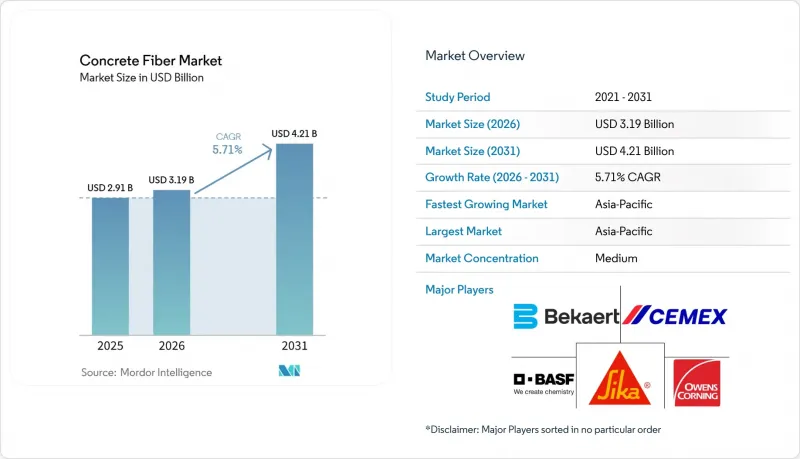
Mordor Intelligence에 따르면 콘크리트 섬유 시장은 2025년에 29억 1,000만 달러 규모이며, 2026년 31억 9,000만 달러에서 2031년까지 42억 1,000만 달러에 달할 것으로 예측되고 있으며, 예측 기간(2026-2031년)에 CAGR은 5.71%에 달할 전망입니다.
이 보고서는 제품 유형(강섬유, 합성섬유, 유리섬유 등), 형태(모노필라멘트, 멀티필라멘트 등), 최종 용도 산업(교통 인프라, 주택 건설, 상업용 건설 등) 및 지역(아시아태평양, 북미, 유럽, 남미, 중동 및 아프리카)별로 분류되어 있습니다. 시장 예측은 금액(달러) 기준으로 제시되어 있습니다.
글로벌 콘크리트 섬유 시장의 동향 및 인사이트
균열 억제 및 내구성 향상을 위한 콘크리트 섬유 채택 확대
인프라 소유주들은 균열 발생 후의 시정 조치로 섬유 보강재를 사용하는 대신, 설계 단계부터 섬유 보강재를 사양으로 지정하는 경우가 늘고 있습니다. 소유주들은 가혹한 환경에 노출된 자산에서 균열을 관리하고 내구성을 높이기 위해 섬유 보강재를 활용하고 있습니다. 이를 통해 소유주들은 초기 자재비뿐만 아니라 유지 관리 비용과의 비교도 고려하여 자재를 평가할 수 있게 되어, 콘크리트 섬유 시장이 활성화되고 있습니다. 일부 유럽 지방 자치단체의 도로 당국에서는 장기 무유지보수 보증을 시공사에게 요구하는 조건으로 섬유 보강 콘크리트의 사용을 의무화하기 시작했으며, 이로 인해 섬유 사용이 장기적인 조달 요건의 일부가 될 가능성이 있습니다. 또한 프로젝트 실적이 축적됨에 따라 컨설팅 엔지니어가 느끼는 사양상의 위험도 감소하여, 표준 프로젝트 템플릿에 섬유 보강을 반영하기가 용이해집니다. 그 결과 발생하는 수요는 단순한 보수 공사에 기반한 수요에 비해 단기적인 원자재 가격 변동에 덜 영향을 받게 됩니다.
고성능 포장 및 산업용 바닥재 솔루션에 대한 수요 증가
성숙한 건설 시장에서는 내구성이 뛰어난 산업용 바닥에 강섬유 보강 콘크리트가 사용되고 있습니다. 독일에서는 독일 콘크리트 협회의 지침에 따라 강섬유 보강 또는 하이브리드 보강 시스템을 활용한 산업용 바닥이 연간 약 1,000만 제곱미터 규모로 시공되고 있습니다. 데이터센터 역시 수요원 중 하나이며, 이음매 없는 슬래브는 고밀도 서버 랙의 하중 요건을 충족시킬 수 있습니다. 이음매 없는 바닥 시스템에 관한 지침에서는 강섬유의 배합량을 40-45 kg/m³로 규정하고 있으며, 완성된 바닥 1제곱미터당 섬유 수요를 지원하고 있습니다. 인도의 가티 샤크티 국가 마스터플랜 또한 포장 및 화물 회랑 건설을 지원하며, 강섬유 및 폴리프로필렌 섬유의 수요를 견인하고 있습니다. 그 결과, 콘크리트 섬유 시장은 대규모 포장 프로젝트와 구조적 요구 사항이 수반되는 고부가가치 바닥재 용도 모두에 기여하고 있습니다. 또한 신뢰성 높은 타설, 이음매 제어 및 긴 수명이 요구되는 프로젝트를 위해 제조업체가 배합 개발 및 기술 지원을 수행하도록 장려하고 있습니다. 이러한 용도가 여전히 중요하게 여겨지는 이유는 배합량의 미세한 변화조차도 광범위한 바닥 및 포장 구역 전체에 필요한 섬유량에 영향을 미칠 수 있기 때문입니다.
기존 보강 방식에 비해 높은 초기 자재비
20-40kg/m³의 강섬유를 배합할 경우, 동등한 구조 용도에서 용접 철망에 비해 자재 비용이 15-30% 높아질 가능성이 있습니다. 이러한 비용 차이는 주로 최저 초기 입찰가를 기준으로 계약을 체결하는 공공 사업에서 여전히 중요한 고려 사항으로 남아 있습니다. 섬유 보강된 산업용 슬래브는 메쉬 보강된 대체재에 비해 20년 동안 이음매 보수 횟수가 30-40% 감소할 가능성이 있으며, 초기 비용 차이를 상쇄할 수 있습니다. 그러나 많은 신흥 시장의 조달 시스템에서는 입찰 평가시 수명 주기 비용 절감에 할당되는 비중이 제한적입니다. 세계은행의 인프라 조달 지침에 대한 노력은 가치와 수명 주기 비용에 대한 보다 광범위한 고려를 지원하고 있지만, 그 도입 상황은 시장마다 다릅니다. 이러한 관행이 더욱 정착되기 전까지는 높은 초기 가격이 가격에 민감한 콘크리트 섬유 시장 부문에서의 전환을 제한하고, 시장 전체로의 보급을 저해할 것입니다.
부문 분석
2025년, 강섬유는 총매출의 44.51%를 차지했습니다. 콘크리트 섬유 시장에서의 이러한 위상은 산업용 바닥재, 터널 내벽 가공제 및 고내구성 포장 분야에서 오랜 기간 사용되어 온 실적을 반영합니다. 요구 사항이 까다로운 프로젝트의 사양서에는 인장 강도나 종횡비에 관한 요건이 종종 명시되어 있지만, 강섬유는 익숙한 비용 수준에서 이러한 요건을 충족할 수 있습니다. 폴리프로필렌, 나일론, 폴리에스테르 및 기타 폴리머 등급을 포함한 합성섬유는 두 번째로 큰 제품 범주를 형성하고 있습니다. 이들은 구조 보강보다 내식성이 더 중요시되는 상황에서 사용됩니다. 기존의 철근은 부식 위험에 노출될 가능성이 있으므로, 저수 구조물이나 연안 프로젝트가 대표적인 용도입니다. 유리섬유는 건축용 프리캐스트 및 커튼월 공사에서 특별한 위치를 차지하고 있습니다. 천연 섬유는 여전히 시장 규모가 작고 특정 지역에 집중되어 있으며, 현지 공급 상황과 비용에 대한 민감도가 콘크리트 배합 선택에 영향을 미치고 있습니다.
현무암 섬유는 2031년까지 연평균 성장률(CAGR) 7.44%로 확대될 것으로 예측됩니다. 현무암 섬유는 화산암을 원료로 하며, 내식성 및 700°C 부근의 온도에서의 열안정성 때문에 선택됩니다. 2026년 Springer Nature의 연구에 따르면 표면 처리가 최적화된 경우, 단방향 현무암 섬유로 보강된 고분자계 재료가 내력 부족 구조 부재의 굽힘 내력을 5.5-26.8% 향상시켰다고 보고되었습니다. 2026년 Multidisciplinary Digital Publishing Institute(MDPI)의 연구에 따르면 부피비 2.5%의 현무암 섬유를 첨가함으로써 30회의 염수 건습 사이클 후 재생 골재 콘크리트 복합재의 충격 인성이 최대 83.7% 향상되는 것으로 밝혀졌습니다. 이러한 결과는 가혹한 화학적 환경이나 연안 환경에서 콘크리트 섬유 시장에 대한 수요를 지원하는 것입니다. 중국과 러시아가 전 세계 현무암 섬유 생산 능력의 대부분을 차지하고 있으며, 이들 국가의 공급업체에게는 비용 면에서 우위가 생기고 있습니다. 반면, 이러한 집중 현상은 유럽 및 미국의 구매자들에게 공급 지속성에 대한 위험을 초래할 가능성이 있으며, 유럽과 북미에서의 생산 투자를 촉진하는 요인이 될 수도 있습니다.
지역별 분석
아시아태평양은 2025년에 총매출의 43.57%를 차지하며, 2031년까지 연평균 성장률(CAGR) 6.34%로 성장할 것으로 전망됩니다. 이 콘크리트 섬유 시장의 위상은 동남아시아의 대규모 건설 수요와 동북아시아의 더 높은 성능 사양이 결합된 결과입니다. 중국의 수요는 고속철도, 도시 지하철, 수리 프로젝트에 의해 지원되고 있습니다. 인도는 가티 샤크티 계획에 따른 고속도로 건설, 1급 및 2급 도시의 지하철망 확장, 그리고 저렴한 주택 건설에 힘입어 가장 빠르게 성장하는 국가별 시장입니다. 1층 및 지하실 용도에서 섬유 보강 슬래브의 채택이 점점 더 많이 지정되고 있습니다. 일본과 한국에서는 대규모 신규 개발 프로젝트보다는 인프라 개보수가 수요를 창출하고 있습니다. 노후된 교량 데크와 터널 내벽은 보수용 오버레이나 분사 콘크리트를 이용한 보수 공사에 대한 수요를 창출하고 있습니다.
북미와 유럽은 공급업체들이 수량보다 성능과 지속가능성을 중시하며 경쟁하는 확고한 수요 거점입니다. 북미 연방 정부의 인프라 지출은 고사양 포장 및 교량 데크 프로젝트를 지원하고 있습니다. 유럽에서는 물류 시설 건설이 탄소 배출량 감축 실적이 입증된 이음매 없는 섬유 보강 바닥재를 지속적으로 지원하고 있습니다. KrampeHarex사는 2024년, 독일 보트로프에 위치한 Prologis Logistics Parc에서 BEG Standard 4의 지속가능성 요건에 따라 약 50,000 m²의 바닥재에 사용되는 강섬유를 공급했습니다. 프랑스, 독일, 영국은 강섬유 보강 산업용 바닥재에 관한 기준과 도입 실적이 확립된 성숙한 지역 시장입니다. 이탈리아와 러시아에서는 터널 공사 및 프리캐스트 공사를 통해 수요가 확대되고 있습니다. EU 택소노미 및 북미의 유사한 프레임워크 하에서 환경 제품 선언(EPD)은 고품질 사양에 있으며, 실질적인 요건으로 자리 잡고 있습니다.
남미, 중동 및 아프리카는 각각 서로 다른 수요 상황을 보이는 지역입니다. 브라질과 아르헨티나는 남미내 주요 수요 거점입니다. 브라질의 인프라 컨세션 사업과 항만 물류는 중급 등급 섬유 수요를 지원하고 있는 반면, 아르헨티나의 리튬 채굴 프로젝트에서는 지하 공사용 스프레이 콘크리트 섬유가 요구되고 있습니다. 합성 섬유 보강재에 관한 미국재료시험협회(ASTM) 규격 C1116은 중동 및 아프리카의 사양 수립에 영향을 미치고 있으며, 해당 지역에서는 국제적인 개발업자와 엔지니어링 도급업체들이 보다 공식적인 규정 준수 요건을 채택하고 있습니다. 사우디아라비아의 대규모 건설 프로그램은 도로 인프라, 유틸리티 터널, 도시 개발에 대한 수요를 지원하고 있습니다. 남아프리카에서는 백금 및 금광에서 발생하는 샷크리트 수요가 안정적인 기반을 형성하고 있습니다.
기타 혜택:
- 엑셀 형식의 시장 전망(ME) 시트
- 3개월간의 애널리스트 지원
자주 묻는 질문
목차
제1장 서론
제2장 조사 방법
제3장 개요
제4장 시장 구도
제5장 시장 규모와 성장 예측
제6장 경쟁 구도
제7장 시장 기회와 향후 전망
KSAAccording to Mordor Intelligence, the concrete fiber market was valued at USD 2.91 billion in 2025 and is estimated to grow from USD 3.19 billion in 2026 to reach USD 4.21 billion by 2031, at a CAGR of 5.71% during the forecast period (2026-2031).
This report is Segmented by Product Type (Steel Fibers, Synthetic Fibers, Glass Fibers, and More), Form (Monofilament, Multifilament, and More), End-Use Industry (Transportation Infrastructure, Residential Construction, Commercial Construction, and More), and Geography (Asia-Pacific, North America, Europe, South America, and Middle-East and Africa). The Market Forecasts are in Terms of Value (USD).
Global Concrete Fiber Market Trends and Insights
Increasing Adoption of Concrete Fibers for Crack Control and Enhanced Durability
Infrastructure owners are increasingly specifying fiber reinforcement during design instead of using it as a corrective measure after cracking occurs. Owners use fiber reinforcement to manage cracking and increase durability in demanding assets. This supports the concrete fiber market because owners can evaluate the material against maintenance costs rather than initial material cost alone. Some European municipal road authorities have started to require fiber-reinforced concrete for extended maintenance-free contractor guarantees, which can make fiber use part of long-term procurement requirements. A longer project record also lowers the perceived specification risk for consulting engineers and makes fiber reinforcement easier to include in standard project templates. The resulting demand is less tied to short-term raw material price movements than demand based only on remedial repair work.
Growing Demand for High-Performance Pavements and Industrial Flooring Solutions
Steel fiber-reinforced concrete is used for heavy-duty industrial floors in mature construction markets. Germany installs around 10 million square meters of industrial floors each year, using steel fiber-reinforced or hybrid reinforcement systems in accordance with the guidance of the German Concrete Association. Data centers represent another source of demand, as jointless slabs can meet the load requirements of high-density server racks. Guidance for jointless floor systems sets steel fiber dosage at 40-45 kg/m3, supporting fiber demand per square meter of completed floor. India's Gati Shakti National Master Plan also supports pavement and freight-corridor construction, driving demand for steel and polypropylene fibers. As a result, the concrete fiber market serves both large-scale pavement projects and higher-value flooring applications with structural requirements. It also encourages producers to develop mixes and technical support for projects that require reliable placement, joint control, and long service life. These applications remain relevant because even a minor change in dosage can affect the required fiber quantity across a large floor or pavement area.
Higher Initial Material Costs Compared to Conventional Reinforcement Methods
Steel fiber dosages of 20-40 kg/m3 can result in a 15-30% premium in material cost over welded-wire mesh in comparable structural applications. This premium remains a key consideration in public programs that award contracts primarily on the basis of the lowest initial bid. Fiber-reinforced industrial slabs may require 30-40% fewer joint repairs over 20 years than mesh-reinforced alternatives, potentially offsetting the initial cost difference. However, many emerging-market procurement systems assign limited weight to lifecycle savings when assessing tenders. The World Bank's work on infrastructure procurement guidelines supports broader consideration of value and lifecycle cost, but adoption varies across markets. Until these practices become more established, the upfront price premium will limit conversion in price-sensitive parts of the concrete fiber market and constrain broader market adoption.
Other drivers and restraints analyzed in the detailed report include:
- Expanding Use of Fiber-Reinforced Concrete in Tunnel Lining and Shotcrete Applications
- Rising Adoption of Precast Concrete and Modular Construction Techniques
- Challenges Related to Fiber Dispersion and Concrete Workability During Installation
For complete list of drivers and restraints, kindly check the Table Of Contents.
Segment Analysis
Steel fibers held 44.51% of total revenue in 2025. Their position in the concrete fiber market reflects long-established use in industrial flooring, tunnel linings, and heavy-duty pavements. Specifications for demanding projects often define tensile strength and aspect-ratio requirements that steel fibers can meet at familiar cost levels. Synthetic fibers, including polypropylene, nylon, polyester, and other polymer grades, form the second-largest product category. They are used where corrosion resistance is more important than maximum structural reinforcement. Water-retaining structures and coastal projects are prominent applications because conventional steel reinforcement can face corrosion risk. Glass fibers retain a specialized place in architectural precast and curtain wall work. Natural fibers remain small and regionally concentrated, where local supply and cost sensitivity affect concrete mix choices.
The basalt fibers are forecast to expand at a 7.44% CAGR through 2031. Basalt fibers are made from volcanic rock and are selected for corrosion resistance and thermal stability at temperatures near 700 °C. A 2026 Springer Nature study reported that unidirectional basalt textile-reinforced polymer systems raised flexural capacity by 5.5-26.8% for deficient structural members when surface preparation was optimized. A 2026 Multidisciplinary Digital Publishing Institute (MDPI) study found that 2.5% vol. basalt fibers increased impact toughness by up to 83.7% in recycled aggregate concrete composite assemblies after 30 saltwater dry-and-wet cycles. These results support the concrete fiber market in aggressive chemical and coastal environments. China and Russia hold most global basalt fiber production capacity, creating a cost advantage for suppliers in those countries. The same concentration creates continuity risk for Western buyers and may support investment in European and North American production.
Complete Report Scope:
- By Product Type
- Steel Fibers
- Synthetic Fibers
- Polypropylene (PP)
- Nylon
- Polyester
- Other Synthetic Fibers
- Glass Fibers
- Basalt Fibers
- Natural Fibers
- By Form
- Monofilament
- Multifilament
- Chopped Fiber
- Continuous Fiber
- By End-Use Industry
- Transportation Infrastructure
- Residential Construction
- Commercial Construction
- Industrial Construction
- Mining and Tunneling
- Oil and Gas
- Water Infrastructure
- Agriculture
- Other End-Use Industries
- By Geography
- Asia-Pacific
- China
- India
- Japan
- South Korea
- Rest of Asia-Pacific
- North America
- United States
- Canada
- Mexico
- Europe
- Germany
- United Kingdom
- France
- Italy
- Russia
- Rest of Europe
- South America
- Brazil
- Argentina
- Rest of South America
- Middle-East and Africa
- Saudi Arabia
- South Africa
- Rest of Middle-East and Africa
- Asia-Pacific
Geography Analysis
Asia-Pacific held 43.57% of the total revenue in 2025 and is forecast to grow at a 6.34% CAGR through 2031. This concrete fiber market position combines high-volume construction in Southeast Asia with more advanced performance specifications in Northeast Asia. China's demand is supported by high-speed rail, urban metro, and water conservancy projects. India is the fastest-growing national market, driven by expressway construction under Gati Shakti, metro expansion in Tier 1 and Tier 2 cities, and affordable housing construction. Fiber-reinforced slabs are increasingly specified for ground-floor and basement applications. Japan and South Korea generate demand from infrastructure renewal rather than large greenfield programs. Aging bridge decks and tunnel linings create demand for repair overlays and sprayed concrete rehabilitation.
North America and Europe are established demand centers where suppliers compete more on performance and sustainability than volume. Federal infrastructure spending in North America supports high-specification pavement and bridge deck projects. In Europe, logistics construction continues to support jointless fiber-reinforced floors with documented carbon credentials. KrampeHarex supplied steel fibers for around 50,000 m2 of flooring at Prologis Logistics Parc in Bottrop, Germany, under BEG Standard 4 sustainability requirements in 2024. France, Germany, and the United Kingdom are mature regional markets with standards and installed bases of steel fiber-reinforced industrial floors. Italy and Russia add demand through tunneling and precast activity. Environmental Product Declarations are becoming a practical requirement for premium specifications under the EU Taxonomy and similar North American frameworks.
South America and Middle-East and Africa are regions with different demand conditions. Brazil and Argentina are the main South American demand centers. Brazil's infrastructure concessions and port logistics support mid-grade fiber demand, while Argentina's lithium mining projects require shotcrete fibers for underground work. American Society for Testing and Materials (ASTM) C1116 for synthetic fiber reinforcement is influencing specifications in the Middle-East and Africa, where international developers and engineering contractors are adopting more formal compliance requirements. Saudi Arabia's large construction programs support demand for road infrastructure, utility tunnels, and urban developments. South Africa provides a steady base of shotcrete demand from platinum and gold mining.
- BASF
- ABC Polymer Industries LLC
- Bekaert
- Belgian Fibers
- CEMEX S.A.B. de C.V.
- Fibercon International Inc.
- Forta Corporation
- Ganzhou Daye Metallic Fibres Co.,Ltd
- KrampeHarex GmbH & Co. KG
- Nycon Corporation
- Owens Corning
- Propex Global
- Sika AG
- The Euclid Chemical Company
Additional Benefits:
- The market estimate (ME) sheet in Excel format
- 3 months of analyst support
TABLE OF CONTENTS
1 Introduction
- 1.1 Study Assumptions and Market Definition
- 1.2 Scope of the Study
2 Research Methodology
3 Executive Summary
4 Market Landscape
- 4.1 Market Overview
- 4.2 Market Drivers
- 4.2.1 Increasing Adoption of Concrete Fibers for Crack Control and Enhanced Durability
- 4.2.2 Growing Demand for High-Performance Pavements and Industrial Flooring Solutions
- 4.2.3 Expanding Use of Fiber-Reinforced Concrete in Tunnel Lining and Shotcrete Applications
- 4.2.4 Rising Adoption of Precast Concrete and Modular Construction Techniques
- 4.2.5 Growing Preference for Corrosion-Resistant Synthetic and Non-Metallic Fibers in Aggressive Environments
- 4.3 Market Restraints
- 4.3.1 Higher Initial Material Costs Compared to Conventional Reinforcement Methods
- 4.3.2 Challenges Related to Fiber Dispersion and Concrete Workability During Installation
- 4.3.3 Limited Standardization and Industry Acceptance of Natural and Basalt Fiber Reinforcement
- 4.4 Value Chain Analysis
- 4.5 Porter's Five Forces Analysis
- 4.5.1 Threat of New Entrants
- 4.5.2 Bargaining Power of Suppliers
- 4.5.3 Bargaining Power of Buyers
- 4.5.4 Threat of Substitutes
- 4.5.5 Competitive Rivalry
5 Market Size and Growth Forecasts (Value)
- 5.1 By Product Type
- 5.1.1 Steel Fibers
- 5.1.2 Synthetic Fibers
- 5.1.2.1 Polypropylene (PP)
- 5.1.2.2 Nylon
- 5.1.2.3 Polyester
- 5.1.2.4 Other Synthetic Fibers
- 5.1.3 Glass Fibers
- 5.1.4 Basalt Fibers
- 5.1.5 Natural Fibers
- 5.2 By Form
- 5.2.1 Monofilament
- 5.2.2 Multifilament
- 5.2.3 Chopped Fiber
- 5.2.4 Continuous Fiber
- 5.3 By End-Use Industry
- 5.3.1 Transportation Infrastructure
- 5.3.2 Residential Construction
- 5.3.3 Commercial Construction
- 5.3.4 Industrial Construction
- 5.3.5 Mining and Tunneling
- 5.3.6 Oil and Gas
- 5.3.7 Water Infrastructure
- 5.3.8 Agriculture
- 5.3.9 Other End-Use Industries
- 5.4 By Geography
- 5.4.1 Asia-Pacific
- 5.4.1.1 China
- 5.4.1.2 India
- 5.4.1.3 Japan
- 5.4.1.4 South Korea
- 5.4.1.5 Rest of Asia-Pacific
- 5.4.2 North America
- 5.4.2.1 United States
- 5.4.2.2 Canada
- 5.4.2.3 Mexico
- 5.4.3 Europe
- 5.4.3.1 Germany
- 5.4.3.2 United Kingdom
- 5.4.3.3 France
- 5.4.3.4 Italy
- 5.4.3.5 Russia
- 5.4.3.6 Rest of Europe
- 5.4.4 South America
- 5.4.4.1 Brazil
- 5.4.4.2 Argentina
- 5.4.4.3 Rest of South America
- 5.4.5 Middle-East and Africa
- 5.4.5.1 Saudi Arabia
- 5.4.5.2 South Africa
- 5.4.5.3 Rest of Middle-East and Africa
- 5.4.1 Asia-Pacific
6 Competitive Landscape
- 6.1 Market Concentration
- 6.2 Strategic Moves
- 6.3 Market Share (%)/Ranking Analysis
- 6.4 Company Profiles (includes Global Overview, Market Overview, Core Segments, Financials as available, Strategic Information, Products and Services, and Recent Developments)
- 6.4.1 BASF
- 6.4.2 ABC Polymer Industries LLC
- 6.4.3 Bekaert
- 6.4.4 Belgian Fibers
- 6.4.5 CEMEX S.A.B. de C.V.
- 6.4.6 Fibercon International Inc.
- 6.4.7 Forta Corporation
- 6.4.8 Ganzhou Daye Metallic Fibres Co.,Ltd
- 6.4.9 KrampeHarex GmbH & Co. KG
- 6.4.10 Nycon Corporation
- 6.4.11 Owens Corning
- 6.4.12 Propex Global
- 6.4.13 Sika AG
- 6.4.14 The Euclid Chemical Company
7 Market Opportunities and Future Outlook
- 7.1 White-Space and Unmet-Need Assessment