

|
시장보고서
상품코드
2118918
부동 단백질 시장 : 시장 점유율 분석, 업계 동향 및 통계, 성장 예측(2026-2031년)Antifreeze Protein - Market Share Analysis, Industry Trends & Statistics, Growth Forecasts (2026 - 2031) |
||||||
 Mordor Intelligence
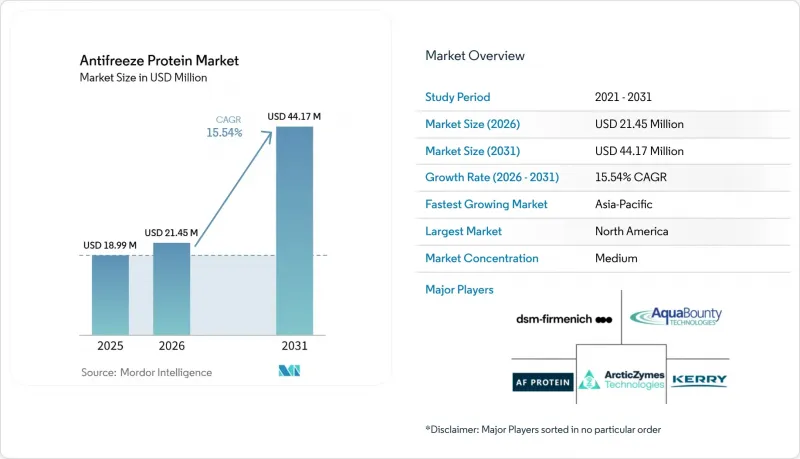
에 의하면, 부동 단백질 시장 규모는 2025년 1,899만 달러로 평가되었고, 2026년에는 2,145만 달러로 추정되고, 2026-2031년 CAGR 15.54%로 성장을 지속할 전망이며, 2031년에는 4,417만 달러에 이를 것으로 예측됩니다.
본 보고서는 원료별(어류, 곤충, 식물, 미생물), 제조 방법별(천연 추출, 재조합 생산, 합성 생산), 용도별(식품 및 음료, 의약품·생명공학, 농업, 기타 용도), 지역별(북미, 유럽, 아시아태평양, 남미, 중동 및 아프리카)로 분류되어 있습니다. 시장 예측은 금액(달러) 기준으로 제시되어 있습니다.
세계의 부동 단백질 시장 동향 및 인사이트
세포 및 유전자 치료 분야의 동결보존 수요 증가
세포 및 유전자 치료 프로그램에서는 해동 후에도 세포 생존율을 유지할 수 있는 동결보존제가 필요했습니다. 연구자들은 DMSO를 널리 계속 사용해 왔지만, 그 세포 독성 및 줄기세포 분화에 미치는 잠재적 영향으로 인해 더 안전하고 효과적인 대안에 대한 관심이 높아졌습니다. 2024년 연구에 따르면, 부동 단백질에서 영감을 받은 나노 입자 시스템을 사용하여 동결보존된 T 세포를 투여한 결과, 마우스 림프종 모델에서 77.5%의 종양 억제 효과가 보고되었습니다. 이 결과는 해당 연구에서 DMSO를 사용했을 때보다 2배 높은 비율을 기록했으며, 해동 후 기능적 성능이 더 우수함을 보여줍니다. 2025년 연구에서는 친수성 개질을 통해 Marinomonas primoryensis의 부동 단백질의 면역원성을 48% 감소시켰으며, 해동 후 NIH/3T3 세포의 생존율이 96%에 달했다고 보고되었습니다. 이러한 연구 결과는 GMP 준수 세포 치료 공급망에서 동결 방지 단백질 시장에 대한 수요를 뒷받침하는 한편, 장기 및 조직, 재생 의학 연구가 장기적인 고객 기반을 확대할 가능성을 보여주었습니다.
고급 냉동 식품으로의 활용 확대
냉동 식품에 대한 용도는 부동 단백질 시장에 있어 확고한 수익 기반이 되고 있습니다. 부동 단백질은 저농도에서도 얼음의 재결정을 억제하며, 보관 중이나 반복되는 온도 변화 시에도 식감을 유지하는 데 도움이 됩니다. 2026년 연구에 따르면, 합성 알라닌·글루탐산 폴리펩타이드가 무독성, 생분해성, 소화성이며, 마이크로그램/밀리리터 농도 범위에서 활성을 나타내는 것으로 보고되었습니다. 2025년에 발표된 조사에서는 글라시오지마(Glaciozyma) 단백질이 아이스크림, 육류, 유제품 등의 용도에서 맛의 변화가 보고되지 않은 채 식품을 보호한다는 사실이 밝혀졌습니다. 또한, 닭껍질 및 남극 크릴 유래 펩타이드에 대한 연구에서도 동결-해동 주기 중 근원섬유 단백질의 응집에 대한 보호 효과가 나타났습니다. 따라서, 부동 단백질 시장은 프리미엄 냉동 식품 분야에서 더 깨끗한 성분 표기와 식감 유지 향상을 추구하는 가공업체에 기여할 수 있습니다.
높은 생산 및 정제 비용
천연 유래 추출 수율이 낮고 정제 비용이 높기 때문에 동결 방지 단백질 시장은 제약을 받아 왔습니다. 특히 인클루전체가 형성되는 경우, 반복 서열이 풍부한 단백질은 발현 및 다운스트림 공정에서의 정제를 복잡하게 만들어 제조업체들이 추가적인 과제에 직면하게 했습니다. 의약품 등급 단백질과 글리세롤, DMSO 등의 기존 동결 방지제 사이에는 여전히 큰 비용 격차가 존재하여, 비용을 중시하는 용도에서의 상업적 보급을 제한하고 있었습니다. 효모 시스템은 수율 향상의 길을 제시했지만, 생산자들은 성능 및 규제 요건을 충족하기 위해 여전히 신중한 정제 및 품질 관리가 필요했습니다. 2026년에 Ginkgo Bioworks와 Invaio Sciences가 체결한 제휴는 펩타이드 기반 농업용 투입 자재를 위한 산업용 발효에 대한 지속적인 투자를 보여주었습니다. 비용 절감을 위해서는 확장 가능한 발현, 간소화된 정제, 그리고 생산 설비를 지속적으로 가동하기 위한 충분한 수요가 필수적이었습니다.
부문 분석
2025년, 어류 유래 부문은 부동 단백질 시장 점유율의 47.61%를 차지하며 전체 시장 매출에서 가장 큰 기여를 했습니다. 어류 유래 부동 단백질은 분자 구조가 충분히 규명되어 있고 동결 방지 특성도 입증되었기 때문에 오랫동안 가장 확립되고 상업적으로 이용되어 온 공급원입니다. 이러한 단백질은 식품 보존, 냉동 수산물 가공, 그리고 얼음 결정 형성에 대한 효과적인 보호가 필수적인 생명공학 분야에서 널리 사용되고 있습니다. 냉수성 어종에서 얻는 천연 부동 단백질의 가용성은 안정적인 상업적 공급과 산업적 채택을 뒷받침해 왔습니다.
미생물 유래 부문은 2031년까지 16.89%라는 가장 높은 연평균 성장률(CAGR)을 보일 것으로 예상되며, 이는 확장 가능하고 지속 가능한 생산 방식에 대한 관심이 높아지고 있음을 반영합니다. 세균, 균류, 효모와 같은 미생물 유래 원료는 배양 제어, 재현성, 그리고 비용 효율적인 대규모 제조 측면에서 큰 이점을 제공합니다. 재조합 기술 및 미생물 발효의 발전으로 인해, 부동 단백질의 생산 수율 향상과 기능적 성능 개선이 가능해졌습니다.
지역별 분석
2025년, 북미는 비동결 단백질 시장 매출의 37.81%를 차지하며 최대 지역 시장이 되었습니다. 이 지역은 확립된 생명공학 및 제약 생태계, 탄탄한 연구 인프라, 그리고 특수 단백질의 강력한 상업화 능력이라는 강점을 보유하고 있습니다. 미국은 선진적인 바이오의약품 제조 부문, 동결보존 기술에 대한 투자 확대, 그리고 고부가가치 식품 보존 솔루션의 광범위한 채택을 통해 지역 내 수요를 주도하고 있습니다. 북미 전역에서 비동결 단백질은 냉동 식품, 의학 연구, 장기 보존 및 산업용 생명공학 분야에서 점점 더 널리 활용되고 있습니다.
아시아태평양은 중국, 일본, 한국, 인도 등 주요 경제권에서 바이오기술, 제약, 식품 가공 산업의 확장에 힘입어 2031년까지 연평균 성장률(CAGR) 17.04%라는 가장 높은 성장률을 보일 것으로 예측됩니다. 급속한 산업화와 생명과학 연구에 대한 투자 확대에 힘입어, 제약 제조, 동결보존, 농업 생명공학 분야에서 부동 단백질의 채택이 가속화되고 있습니다. 또한, 이 지역에서는 냉동식품 및 가공식품에 대한 수요가 증가하고 있어, 식품 보존 및 콜드체인 시스템에서 부동 단백질의 활용에 대한 추가적인 기회가 창출되고 있습니다.
유럽은 견고한 생명공학 연구 기반, 선진적인 식품 가공 산업, 그리고 지속 가능한 바이오 유래 원료에 대한 중시 덕분에 중요한 시장으로 자리매김하고 있습니다. 남미는 수산 양식, 농업, 냉동 식품 생산의 성장에 힘입어 점차 시장을 확대되고 있습니다. 한편, 중동 및 아프리카는 여전히 비교적 소규모 시장이지만, 의료 인프라 개선과 식품 보존에 대한 투자를 통해 주목을 받고 있습니다. 이 지역 전반에 걸친 연구 협력 및 생명공학 개발 노력의 증대가 예측 기간 동안 꾸준한 시장 확장을 뒷받침할 것으로 예측됩니다.
기타 혜택 :
- 엑셀 형식 시장 예측(ME) 시트
- 3개월간의 애널리스트 지원
자주 묻는 질문
목차
제1장 서론
제2장 조사 방법
제3장 개요
제4장 시장 구도
제5장 시장 규모 및 성장 예측
제6장 경쟁 구도
제7장 시장 기회 및 향후 전망
AJY 26.09.01According to Mordor Intelligence, the antifreeze protein market size is expected to grow from USD 18.99 million in 2025 to USD 21.45 million in 2026 and is forecast to reach USD 44.17 million by 2031 at 15.54% CAGR over 2026-2031.
This report is Segmented by Source (Fish, Insect, Plant, Microbial), Production Method (Natural Extraction, Recombinant Production, Synthetic Production), Application (Food and Beverages, Pharmaceuticals and Biotechnology, Agriculture, Other Applications), and Geography (North America, Europe, Asia-Pacific, South America, Middle East and Africa). The Market Forecasts are Provided in Terms of Value (USD).
Global Antifreeze Protein Market Trends and Insights
Rising demand for cryopreservation in cell and gene therapy
Cell and gene therapy programs required cryopreservation agents that maintained cell viability after thawing. Researchers continued to use DMSO widely; however, its cytotoxicity and potential effects on stem cell differentiation increased interest in safer and more effective alternatives. A 2024 study reported 77.5% tumor suppression in a mouse lymphoma model after researchers administered cryopreserved T cells using an antifreeze protein-inspired nanoparticle system. This result reached twice the rate achieved with DMSO in the same study, indicating stronger post-thaw functional performance. A 2025 study reduced the immunogenicity of Marinomonas primoryensis antifreeze proteins by 48% through hydrophilic modification and reported 96% NIH/3T3 cell viability after thawing. These findings supported demand in the antifreeze protein market from GMP-oriented cell therapy supply chains, while organ, tissue, and regenerative medicine research could have expanded the long-term customer base.
Increasing use in premium frozen food products
Frozen food applications provide an established revenue base for the antifreeze protein market. Antifreeze proteins suppress ice recrystallization at low concentrations, helping preserve texture during storage and repeated temperature changes. A 2026 study reported that a synthetic alanine-glutamic acid polypeptide was non-toxic, biodegradable, digestible, and active at microgram-per-milliliter concentrations. Research published in 2025 found that Glaciozyma proteins protected food products without reported taste changes across ice cream, meat, and dairy applications. Studies on chicken-skin and Antarctic-krill peptides also showed protection against myofibrillar protein aggregation during freeze-thaw cycles. Therefore, the antifreeze protein market can serve processors that require cleaner labels and improved texture retention in premium frozen products.
High production and purification costs
Low natural extraction yields and high purification costs constrained the antifreeze protein market. Manufacturers faced added complexity because repeat-rich proteins complicated expression and downstream purification, especially when inclusion bodies formed. The cost gap remained wide between pharmaceutical-grade proteins and conventional cryoprotectants, such as glycerol or DMSO, which limited broader commercial adoption in cost-sensitive applications. Yeast systems offered a pathway to higher yields, but producers still required careful purification and quality control to meet performance and regulatory requirements. A 2026 collaboration between Ginkgo Bioworks and Invaio Sciences showed continued investment in industrial fermentation for peptide-based agricultural inputs. Cost reduction depended on scalable expression, simplified purification, and sufficient demand to keep production assets well utilized.
Other drivers and restraints analyzed in the detailed report include:
- Advances in recombinant antifreeze protein production
- Rising biologics and vaccine cold-chain requirements
- Limited commercial-scale manufacturing capacity
For complete list of drivers and restraints, kindly check the Table Of Contents.
Segment Analysis
Fish segment accounted for 47.61% of the antifreeze protein market share in 2025, making it the largest contributor to overall market revenue. Fish-derived antifreeze proteins have long been the most established and commercially utilized source due to their well-characterized molecular structures and proven cryoprotective properties. These proteins are extensively used in food preservation, frozen seafood processing, and biotechnology applications where effective protection against ice crystal formation is essential. The availability of naturally occurring antifreeze proteins from cold-water fish species has supported consistent commercial supply and industrial adoption.
The microbial segment is projected to grow at the fastest CAGR of 16.89% through 2031, reflecting increasing interest in scalable and sustainable production methods. Microbial sources, including bacteria, fungi, and yeast, offer significant advantages in terms of controlled cultivation, reproducibility, and cost-effective large-scale manufacturing. Advances in recombinant technology and microbial fermentation are enabling higher production yields and improved functional performance of antifreeze proteins.
Complete Report Scope:
- By Source
- Fish
- Insect
- Plant
- Microbial
- By Production Method
- Natural Extraction
- Recombinant Production
- Synthetic Production
- By Application
- Food and Beverages
- Pharmaceuticals & Biotechnology
- Agriculture
- Other Applications
- Geography
- North America
- United States
- Canada
- Mexico
- Rest of North America
- Europe
- Germany
- United Kingdom
- Italy
- France
- Spain
- Rest of Europe
- Asia-Pacific
- China
- India
- Japan
- Australia
- Rest of Asia-Pacific
- South America
- Brazil
- Argentina
- Rest of South America
- Middle East and Africa
- South Africa
- Saudi Arabia
- Rest of Middle East and Africa
- North America
Geography Analysis
North America accounted for 37.81% of the antifreeze protein market revenue in 2025, making it the largest regional market. The region benefits from a well-established biotechnology and pharmaceutical ecosystem, extensive research infrastructure, and strong commercialization capabilities for specialty proteins. The United States leads regional demand due to its advanced biopharmaceutical manufacturing sector, increasing investment in cryopreservation technologies, and widespread adoption of high-value food preservation solutions. Antifreeze proteins are increasingly used in frozen food products, medical research, organ preservation, and industrial biotechnology applications across North America.
Asia-Pacific is projected to grow at the fastest CAGR of 17.04% through 2031, driven by expanding biotechnology, pharmaceutical, and food processing industries across major economies such as China, Japan, South Korea, and India. Rapid industrialization and increasing investments in life sciences research are accelerating the adoption of antifreeze proteins in pharmaceutical manufacturing, cryopreservation, and agricultural biotechnology applications. The region is also witnessing rising demand for frozen and processed food products, creating additional opportunities for antifreeze protein use in food preservation and cold-chain systems.
Europe represents a significant market due to its strong biotechnology research base, advanced food processing industry, and emphasis on sustainable bio-based ingredients. South America is gradually expanding, supported by growth in aquaculture, agriculture, and frozen food production, while the Middle East and Africa remain relatively smaller markets but are gaining attention through improving healthcare infrastructure and food preservation investments. Increasing research collaborations and biotechnology development initiatives across these regions are expected to support steady market expansion over the forecast period.
- A/F Protein, Inc.
- AquaBounty Technologies, Inc.
- ArcticZymes Technologies ASA
- Novozymes A/S
- DSM-Firmenich AG
- Chr. Hansen Holding A/S
- Kerry Group plc
- Ingredion Incorporated
- Lallemand Inc.
- Ginkgo Bioworks Holdings, Inc.
- BASF SE
- Merck KGaA
- Thermo Fisher Scientific Inc.
- Sartorius AG
- Lonza Group AG
- Corning Incorporated
- Takara Bio Inc.
- Bio-Rad Laboratories, Inc.
- QIAGEN N.V.
- FUJIFILM Holdings Corporation
Additional Benefits:
- The market estimate (ME) sheet in Excel format
- 3 months of analyst support
TABLE OF CONTENTS
1 INTRODUCTION
- 1.1 Study Assumptions and Market Definition
- 1.2 Scope of the Study
2 RESEARCH METHODOLOGY
3 EXECUTIVE SUMMARY
4 MARKET LANDSCAPE
- 4.1 Market Overview
- 4.2 Market Drivers
- 4.2.1 Rising demand for cryopreservation in cell and gene therapy
- 4.2.2 Growth in organ and tissue preservation research
- 4.2.3 Increasing use in premium frozen food products
- 4.2.4 Expansion of regenerative medicine applications
- 4.2.5 Advances in recombinant antifreeze protein production
- 4.2.6 Rising biologics and vaccine cold-chain requirements
- 4.3 Market Restraints
- 4.3.1 High production and purification costs
- 4.3.2 Limited commercial-scale manufacturing capacity
- 4.3.3 Stringent regulatory approval requirements
- 4.3.4 Protein instability during processing
- 4.4 Value Chain Analysis
- 4.5 Regulatory Landscape
- 4.6 Technological Outlook
- 4.7 Porter's Five Forces
- 4.7.1 Threat of New Entrants
- 4.7.2 Bargaining Power of Suppliers
- 4.7.3 Bargaining Power of Buyers
- 4.7.4 Threat of Substitutes
- 4.7.5 Competitive Rivalry
5 MARKET SIZE AND GROWTH FORECASTS (VALUE)
- 5.1 By Source
- 5.1.1 Fish
- 5.1.2 Insect
- 5.1.3 Plant
- 5.1.4 Microbial
- 5.2 By Production Method
- 5.2.1 Natural Extraction
- 5.2.2 Recombinant Production
- 5.2.3 Synthetic Production
- 5.3 By Application
- 5.3.1 Food and Beverages
- 5.3.2 Pharmaceuticals & Biotechnology
- 5.3.3 Agriculture
- 5.3.4 Other Applications
- 5.4 Geography
- 5.4.1 North America
- 5.4.1.1 United States
- 5.4.1.2 Canada
- 5.4.1.3 Mexico
- 5.4.1.4 Rest of North America
- 5.4.2 Europe
- 5.4.2.1 Germany
- 5.4.2.2 United Kingdom
- 5.4.2.3 Italy
- 5.4.2.4 France
- 5.4.2.5 Spain
- 5.4.2.6 Rest of Europe
- 5.4.3 Asia-Pacific
- 5.4.3.1 China
- 5.4.3.2 India
- 5.4.3.3 Japan
- 5.4.3.4 Australia
- 5.4.3.5 Rest of Asia-Pacific
- 5.4.4 South America
- 5.4.4.1 Brazil
- 5.4.4.2 Argentina
- 5.4.4.3 Rest of South America
- 5.4.5 Middle East and Africa
- 5.4.5.1 South Africa
- 5.4.5.2 Saudi Arabia
- 5.4.5.3 Rest of Middle East and Africa
- 5.4.1 North America
6 COMPETITIVE LANDSCAPE
- 6.1 Market Concentration
- 6.2 Strategic Moves
- 6.3 Market Ranking Analysis
- 6.4 Company Profiles (includes Global level Overview, Market level overview, Core Segments, Financials as available, Strategic Information, Market Rank/Share for key companies, Products & Services, and Recent Developments)
- 6.4.1 A/F Protein, Inc.
- 6.4.2 AquaBounty Technologies, Inc.
- 6.4.3 ArcticZymes Technologies ASA
- 6.4.4 Novozymes A/S
- 6.4.5 DSM-Firmenich AG
- 6.4.6 Chr. Hansen Holding A/S
- 6.4.7 Kerry Group plc
- 6.4.8 Ingredion Incorporated
- 6.4.9 Lallemand Inc.
- 6.4.10 Ginkgo Bioworks Holdings, Inc.
- 6.4.11 BASF SE
- 6.4.12 Merck KGaA
- 6.4.13 Thermo Fisher Scientific Inc.
- 6.4.14 Sartorius AG
- 6.4.15 Lonza Group AG
- 6.4.16 Corning Incorporated
- 6.4.17 Takara Bio Inc.
- 6.4.18 Bio-Rad Laboratories, Inc.
- 6.4.19 QIAGEN N.V.
- 6.4.20 FUJIFILM Holdings Corporation


