

|
시장보고서
상품코드
2118923
경직 치료 시장 : 시장 점유율 분석, 업계 동향 및 통계, 성장 예측(2026-2031년)Spasticity Treatment - Market Share Analysis, Industry Trends & Statistics, Growth Forecasts (2026 - 2031) |
||||||
 Mordor Intelligence
Mordor Intelligence에 의하면, 경직 치료 시장 규모는 2025년 30억 6,000만 달러로 평가되었고, 2026년에는 33억 달러로 추정되고, 2026-2031년 CAGR 7.86%로 성장을 지속할 전망이며, 2031년까지 48억 2,000만 달러에 이를 것으로 예측됩니다.
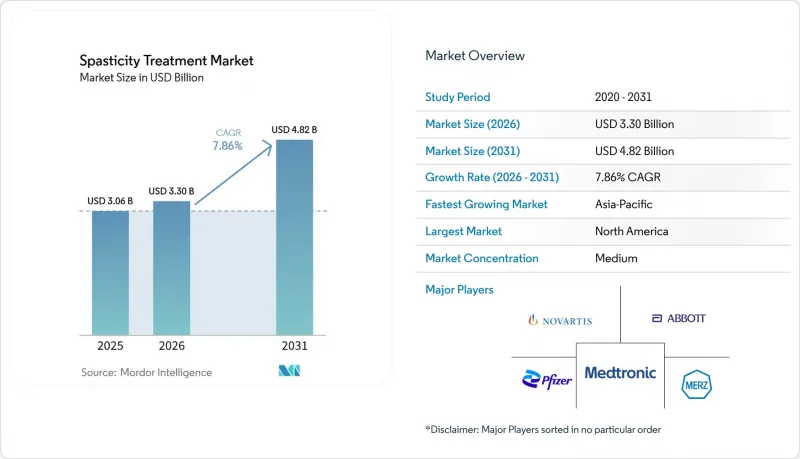
본 보고서는 치료법별(약물 요법 등), 약물 분류별별(GABA 작용제 등), 적응증별(다발성 경화증, 뇌성마비 등), 투여 경로별(경구, 비경구), 최종 사용자별(병원, 기타), 유통 채널별(병원 약국 등), 연령대별(소아 등), 지역별(북미 등)로 분류되어 있습니다. 시장 전망은 금액(달러) 기준으로 제시되어 있습니다.
세계의 경직 치료 시장 동향 및 인사이트
뇌졸중, 다발성 경화증, 뇌성마비 및 척수 손상으로 인한 부담 증가
경련 치료 시장은 외상이나 질환 후 장기적인 관리가 필요한 경우가 많은 신경 질환에 의해 주도되고 있습니다. 세계 뇌졸중 기구(World Stroke Organization)의 보고에 따르면, 2024년에는 전 세계적으로 1,190만 건의 신규 뇌졸중 사례가 확인되었으며, 평생 뇌졸중 발병 위험은 지난 20년 동안 50% 증가했습니다. 뇌졸중 생존자의 25%-43%가 발병 후 1년 이내에 경직을 경험하며, 뇌성마비 환자의 90% 이상, 다발성 경화증 환자의 37%-78%가 경직의 영향을 받고 있습니다. 미국에서는 어린이 1,000명 중 3.1명이 뇌성마비를 앓고 있으며, 척수 손상 또한 여전히 치료가 필요한 환자군으로, 영향을 받은 25만 9,000명의 미국인 중 68%가 어느 정도의 경련을 겪고 있습니다.
국소성 경직에 대한 보툴리눔툭신(보톡스)의 사용 확대
임상의들은 국소성 경련에 대해 보툴리눔툭신(보톡스) A형을 점점 더 많이 사용하고 있습니다. 이는 지속적인 전신 투여가 필요 없이, 환부의 근육에 직접 작용하기 때문입니다. 입센(Ipsen)사는 2026년 5월, 미국, 프랑스, 캐나다의 72개 기관에서 성인 464명을 대상으로 디스포트(Dysport)와 보톡스(Botox)를 비교한 제4상 DIRECTION 임상시험 결과를 발표했습니다. 이 임상시험에서 치료 중 발생한 이상반응 발생률은 디스포트가 20.3%, 보톡스가 23.0%였으며, 효과 지속 기간은 각각 14.2주와 13.8주였던 것으로 보고되었습니다. 또한, 2026년 연구에 따르면 뇌졸중 발병 후 1년 이내에 보툴리눔툭신(보톡스) 치료를 시작한 경우, 치료가 지연된 경우에 비해 목표 달성률이 높은 것으로 밝혀졌으며, 이는 의뢰 체계 강화, 전문의에 의한 평가, 주사 일정 수립 및 사후 관리를 통해 시장 성장을 뒷받침할 것으로 보입니다.
높은 치료비, 시술비 및 장기 모니터링 비용
치료비, 시술비 및 장기 모니터링 비용의 높음은 특히 보험 환급이 불충분한 의료 제도에서 고품질 치료 옵션에 대한 접근을 제한하고 있습니다. 오나보툴리눔톡신 A 200단위 바이알의 정가는 1,244달러입니다. 따라서 최대 400단위가 필요한 상지 치료 과정의 비용은 2,488달러에 달할 수 있지만, 이 치료에 대한 메디케어(Medicare)의 보상액은 2,482.80달러로, 제품 자체의 비용을 약간 밑돌고 있습니다. 프로그래밍 가능한 척수강내 바클로펜 펌프 시스템의 비용은 일반적으로 대당 20,000-30,000달러이지만, 여기에는 이식 수술비 및 지속적인 관리비는 포함되어 있지 않습니다. 경직이 있는 뇌졸중 생존자의 직접 의료비는 경직이 없는 생존자에 비해 첫해에 4배나 더 높기 때문에 이것이 경직 치료 시장에서 본 시스템의 도입을 제약하고 있습니다. 이는 보험 급여 결정 시 광범위한 장애, 간병인, 입원 비용보다 즉각적인 치료나 제품 비용이 우선시되는 경우가 많기 때문입니다.
부문 분석
2025년, 약물 요법은 경련 치료 시장의 34.55% 점유율을 차지했습니다. 이는 주요 적응증에서 경구용 항경련제 및 주사용 보툴리눔툭신(보톡스)의 사용이 지속된 데 기인합니다. 임상의들은 필요에 따라 주사와 엄격하게 관리되는 경구용 GABA 작용제를 결합한 병용 요법을 점점 더 많이 활용하게 되었습니다. 이러한 접근 방식을 통해 치료 강도를 높이는 한편, 임상의들은 기능 장애에 따라 약물 투여, 국소 주사, 운동 요법, 보조 기구를 조정할 수 있게 되었습니다. 물리치료 및 재활 시장은 2026년부터 2031년까지 연평균 성장률(CAGR) 8.93%를 나타낼 것으로 예측되며, 이는 의약품 및 주사와 함께 체계적인 재활이 더욱 널리 활용될 것임을 반영합니다.
보조기 및 보조 기구는 특히 보상 제도가 확립된 북미와 유럽에서 뇌성마비 및 뇌졸중 환자의 치료비를 지속적으로 뒷받침하고 있습니다. 선택적 후근 절제술이나 정형외과적 건 절개술과 같은 외과적 치료법은 경직으로 인해 발생하는 구조적 합병증을 가진 환자에게 도움이 되고 있습니다. 보툴리눔툭신(보톡스)는 소아 의료 분야에서 여전히 중요한 역할을 하고 있으며, 2026년에 실시된 892명의 참가자를 대상으로 한 18건의 무작위 대조 시험에 대한 메타분석에서는 뇌성마비 아동의 발목 경련이 유의미하게 완화되는 것으로 확인되었습니다. 이러한 연구 결과는 약물 치료의 지속적인 역할을 뒷받침하며, 재활 및 수술을 핵심으로 하는 치료 경로를 보완하고 있습니다.
GABA 작용제는 여러 적응증에 대한 경구 및 척수강내 투여용 바클로펜의 광범위한 사용과 제네릭 의약품의 폭넓은 접근성에 힘입어, 2025년에는 경련 치료 시장 점유율의 39.56%를 차지했습니다. 또한, 척수강내 투여로 인해 펌프 유지보수 및 약물 보충과 같은 지속적인 수요도 발생했습니다. α-2 아드레날린 작용제는 2026년부터 2031년까지 연평균 성장률(CAGR) 9.67%를 나타낼 것으로 예측됩니다. 다발성 경화증 및 뇌졸중과 관련된 경직에 대한 다제 병용 요법에서 임상의에 의한 티자니딘 사용이 증가하는 추세이지만, 진정 작용이나 혈압에 미치는 영향, 간 기능에 대한 안전성 모니터링이 필요하기 때문에 더 광범위한 사용에는 여전히 제약이 있습니다.
보툴리눔툭신(보톡스)는 여전히 독자적인 약물 분류에 속하며, 브랜드 간 경쟁이 활발한 가운데, 오나보툴리눔톡신 A, 아보보툴리눔톡신 A, 인코보툴리눔톡신 A는 성인의 상지 경직에 대해 확립된 치료제로 자리 잡고 있습니다. 2026년 6월, 메르츠 테라퓨틱스(Merz Therapeutics)는 뇌성마비와 관련된 상지 경련이 있는 2세 이상의 소아 및 청소년을 대상으로 한 ‘XEOMIN’에 대해 FDA로부터 첨부 문서 갱신 승인을 받았습니다. 칸나비노이드 기반 요법은 유럽 및 캐나다에서 승인된 환경에서 다발성 경화증과 관련된 경련에 대한 비교적 제한된 치료 옵션으로 남아 있었습니다. 단트로렌은 선별된 중증 사례에 대해 계속 사용되었으나, 간독성에 대한 우려와 경쟁적인 치료 옵션의 존재로 인해 그 사용이 제한되었습니다.
2025년, 다발성 경화증은 경련 치료 시장 점유율의 36.77%를 차지했습니다. 이는 해당 환자 집단에서 경련의 발생 빈도가 높고, 확립된 투여 경로가 있었기 때문입니다. 환자들은 종종 장기적인 관리가 필요했으며, 이는 반복적인 처방, 주사 및 재활을 뒷받침했습니다. 뇌성마비 시장은 2026-2031년 연평균 성장률(CAGR) 10.35%를 나타낼 것으로 예측됩니다. 소아 적응증의 확대와 조기 개입이 이러한 성장을 뒷받침하고 있으며, 2025년 연구에 따르면 양측성 경직성 뇌성마비를 가진 유아의 경우 보툴리눔툭신(보톡스) A형의 반복 치료와 집중적인 재활을 병행함으로써 보행 운동학의 개선 및 변형 진행 지연이 확인되었습니다.
뇌졸중 관련 경직도 여전히 주요 적응증 중 하나인데, 이는 뇌졸중 생존자들이 급성기를 지나도 지속적인 관리가 필요한 경우가 많기 때문입니다. 척수 손상 및 외상성 뇌손상 역시 복잡한 재활 수요로 인해 안정적인 수요를 창출했습니다. 유전성 경직성 대마비는 규모는 작지만 장기적인 모니터링이 필요한 명확한 적응증으로 남아 있으며, 2025년 총설에서는 특히 유럽에서 원격 의료를 활용한 모니터링과 디지털 바이오뱅크에 대한 관심이 높아지고 있음을 강조했습니다. 이러한 적응증의 조합이 병원, 클리닉, 재택 환경 등 각 설정에서 수요를 뒷받침했습니다.
지역별 분석
2025년 북미는 경련 치료 시장의 40.84%를 차지했습니다. 이는 확립된 임상 프로토콜, 보툴리눔툭신(보톡스) 주사 및 척수강 내 바클로펜 펌프에 대한 보험 적용, 그리고 탄탄한 전문의 기반에 힘입은 결과입니다. 미국에서는 연간 79만 5,000건의 뇌졸중이 보고되었으며, 약 140만 명의 미국인이 뇌졸중과 관련된 경련을 앓으며 생활하고 있었습니다. 다발성 경화증 및 뇌성마비의 경우, 약물 치료 및 재활에 대한 수요가 지속적으로 나타났습니다. 유럽은 여전히 중요한 지역이며, 독일, 프랑스, 영국이 주요 국내 시장으로 꼽힙니다. 또한, 29개국에서 ‘사티벡스’가 승인됨에 따라 다발성 경화증과 관련된 경련에 대한 칸나비노이드계 치료가 강화되었습니다.
아시아태평양은 2026-2031년 연평균 성장률(CAGR) 8.56%를 나타낼 것으로 예측되며, 이는 경련 치료 시장에서 지역별 가장 높은 성장률입니다. 중국과 일본에서 뇌졸중의 부담이 증가하고, 인도에서 뇌성마비 재활 체계가 확충되며, 한국과 호주에서 전문의 양성이 이루어진 것이 이러한 성장을 뒷받침했습니다. 중국에서는 2026년 4월, 광시 좡족 자치구에서 뇌졸중 재활을 위해 뇌-컴퓨터 인터페이스, 척수 자극 및 로봇 외골격 시스템을 통합한 시스템이 도입되었습니다. 중국 의학회는 뇌졸중 후 편마비에 대한 척수 자극 요법에 관한 2025년 전문가 합의문을 발표했으며, 호주 및 뉴질랜드에서는 척수 손상 관리에 관한 2025년 물리치료 지침이 발간되었습니다.
중동 및 아프리카, 남미 시장 점유율은 작지만, 장기적인 성장 지역으로서 여전히 중요합니다. 중동에서는 GCC(걸프협력회의)가 전문 재활센터 및 펌프를 이용한 치료의 수용 능력 확대를 통해 도입을 주도하고 있습니다. 한편, 남아프리카공화국 및 기타 아프리카 시장에서는 전문의에 대한 접근성이 제한적이며, 민간 보험 이외의 보툴리눔툭신(보톡스) 보험 적용도 미흡합니다. 남미에서는 경련 치료에 대한 공적 보험 적용이 확대되고 있는 브라질이 중심적인 역할을 하고 있으며, 아르헨티나에서는 민간 재활 부문이 성장하고 있습니다. 치료받지 못한 환자 수가 방대하기 때문에 중소 도시나 농촌 지역에서 체계적인 치료를 확대하기 위해서는 의료 접근성, 인재 양성, 그리고 합리적인 가격의 치료 모델이 필수적입니다.
기타 혜택 :
- 엑셀 형식 시장 예측(ME) 시트
- 3개월간의 애널리스트 지원
자주 묻는 질문
목차
제1장 서론
제2장 조사 방법
제3장 개요
제4장 시장 구도
제5장 시장 규모 및 성장 예측
제6장 경쟁 구도
제7장 시장 기회 및 향후 전망
AJY 26.09.01According to Mordor Intelligence, the spasticity treatment market size is expected to grow from USD 3.06 billion in 2025 to USD 3.30 billion in 2026 and is forecast to reach USD 4.82 billion by 2031 at 7.86% CAGR over 2026-2031.
This report is Segmented by Treatment Modality (Drug Therapy, and More), Drug Class (GABA Agonists, and More), Indication (MS, Cerebral Palsy, and More), Route of Administration (Oral, Parenteral), End User (Hospitals, Others), Distribution Channel (Hospital Pharmacies, Oand More), Age Group (Pediatric, and More), and Geography (North America, and More). The Market Forecasts are Provided in Terms of Value (USD).
Global Spasticity Treatment Market Trends and Insights
Rising Burden of Stroke, Multiple Sclerosis, Cerebral Palsy, and Spinal Cord Injury
The spasticity treatment market is driven by neurological conditions that often require long-term care after injury or disease. The World Stroke Organization reported 11.9 million new stroke cases worldwide in 2024, and the lifetime stroke risk increased by 50% over the previous two decades. Spasticity develops in 25%-43% of stroke survivors within the first year after stroke and affects more than 90% of people with cerebral palsy and 37%-78% of people with multiple sclerosis. Cerebral palsy affected 3.1 per 1,000 children in the United States, and spinal cord injury also remains a treatment-intensive group, with 68% of 259,000 affected Americans developing some degree of spasticity.
Increasing Adoption of Botulinum Toxin for Focal Spasticity
Clinicians increasingly use botulinum toxin type A for focal spasticity because it targets affected muscles without requiring continuous systemic dosing. Ipsen presented the Phase IV DIRECTION study in May 2026, comparing Dysport and Botox in 464 adults across 72 sites in the United States, France, and Canada. The study reported treatment-emergent adverse event rates of 20.3% for Dysport and 23.0% for Botox, with durations of effect of 14.2 weeks and 13.8 weeks, respectively. A 2026 study also found that starting botulinum toxin within one year of stroke was associated with better goal attainment than delayed care, supporting market growth through stronger referral, specialist assessment, injection scheduling, and follow-up.
High Treatment, Procedure, and Long-Term Monitoring Costs
High treatment, procedure, and long-term monitoring costs limit access to premium options, particularly in healthcare systems with incomplete reimbursement. A 200-unit vial of onabotulinumtoxinA has a list price of USD 1,244; therefore, an upper-limb treatment course requiring up to 400 units could cost USD 2,488, while Medicare reimbursement for this treatment was USD 2,482.80, slightly below the product-only cost. Programmable intrathecal baclofen pump systems typically cost USD 20,000-USD 30,000 per unit, excluding implantation and ongoing management costs. Direct medical costs for stroke survivors with spasticity were four times higher in the first year than those for survivors without spasticity, constraining adoption in the spasticity treatment market as reimbursement decisions often prioritize immediate procedure and product expenses over broader disability, caregiver, and hospitalization costs.
Other drivers and restraints analyzed in the detailed report include:
- Expansion of Multidisciplinary Rehabilitation and Goal-Based Care
- Greater Use of Targeted Intrathecal Baclofen Therapy in Refractory Generalized Spasticity
- Adverse Effects and Dose-Limiting Tolerability of Oral Antispasticity Drugs
For complete list of drivers and restraints, kindly check the Table Of Contents.
Segment Analysis
Drug therapy held 34.55% of the spasticity treatment market share in 2025, supported by the continued use of oral antispasmodics and injectable botulinum toxin across major indications. Clinicians increasingly used combination care, pairing injections with closely managed oral GABA agonists when appropriate. This approach helped increase treatment intensity while allowing clinicians to adjust medication, focal injection, exercise, and supportive equipment based on functional impairment. Physical therapy and rehabilitation is projected to grow at an 8.93% CAGR from 2026 to 2031, reflecting wider use of structured rehabilitation alongside medicines and injections.
Orthoses and assistive devices continued to support treatment spending for patients with cerebral palsy and stroke, especially in North America and Europe, where reimbursement is more established. Surgical options, including selective dorsal rhizotomy and orthopedic tendon-release procedures, served patients with structural complications caused by spasticity. Botulinum toxin remained important in pediatric care, and a 2026 meta-analysis of 18 randomized trials involving 892 participants found a significant reduction in ankle spasticity in children with cerebral palsy. These findings supported the continued role of drug treatment, with rehabilitation and surgery complementing the core treatment pathway.
GABA agonists held 39.56% of the spasticity treatment market share in 2025, supported by the broad use of oral and intrathecal baclofen across several indications and the wide availability of generic products. Intrathecal use also created recurring demand for pump maintenance and refills. Alpha-2 adrenergic agonists are projected to grow at a 9.67% CAGR from 2026 to 2031. Clinicians increasingly used tizanidine in multidrug regimens for multiple sclerosis-related and stroke-related spasticity, although sedation, blood pressure, and liver safety monitoring continued to limit broader use.
Botulinum toxins remained a separate drug class with active branded competition, with onabotulinumtoxinA, abobotulinumtoxinA, and incobotulinumtoxinA established for adult upper-limb spasticity. In June 2026, Merz Therapeutics received an FDA label update for XEOMIN in children and adolescents aged 2 years and older with cerebral palsy-related upper-limb spasticity. Cannabinoid-based therapy remained a smaller option for multiple sclerosis-related spasticity in approved European and Canadian settings. Dantrolene continued to serve selected severe cases, but hepatotoxicity concerns and competing options limited its use.
Multiple sclerosis accounted for 36.77% of the spasticity treatment market share in 2025, driven by the high frequency of spasticity in this population and established medication pathways. Patients often required long-term management, which supported repeated prescriptions, injections, and rehabilitation. Cerebral palsy is projected to grow at a 10.35% CAGR from 2026 to 2031. Pediatric label expansions and earlier intervention supported this growth, while a 2025 study linked repeated botulinum toxin type A treatment plus intensive rehabilitation with improved gait kinematics and delayed deformity development in young children with bilateral spastic cerebral palsy.
Stroke-related spasticity remained another large indication, as stroke survivors often required ongoing care after the acute event. Spinal cord injury and traumatic brain injury also created consistent demand due to complex rehabilitation needs. Hereditary spastic paraplegia remained a smaller but distinct indication requiring long-term monitoring, with a 2025 review highlighting growing interest in telemedicine-enabled monitoring and digital biobanks, especially in Europe. This indication mix supported demand across hospital, clinic, and home-based settings.
Complete Report Scope:
- By Treatment Modality
- Drug Therapy
- Physical Therapy and Rehabilitation
- Orthoses and Assistive Devices
- Surgical Treatment
- Selective Dorsal Rhizotomy
- Orthopaedic and Tendon-Release Surgery
- Other Interventional Treatments
- By Drug Class
- GABA Agonists
- Alpha-2 Adrenergic Agonists
- Tizanidine
- Botulinum Toxins
- Dantrolene Sodium
- Cannabinoid-Based Therapies
- Other Drug Classes
- By Indication
- Cerebral Palsy
- Multiple Sclerosis
- Stroke
- Spinal Cord Injury
- Traumatic Brain Injury
- Hereditary Spastic Paraplegia
- Other Neurological Indications
- By Route of Administration
- Oral
- Parenteral
- By End User
- Hospitals
- Specialty Clinics
- Rehabilitation Centers
- Ambulatory Surgical Centers
- Others
- By Distribution Channel
- Hospital Pharmacies
- Retail Pharmacies
- Online Pharmacies
- Others
- By Age Group
- Pediatric Patients
- Adult Patients
- Geriatric Patients
- By Geography
- North America
- United States
- Canada
- Mexico
- Europe
- Germany
- United Kingdom
- France
- Italy
- Spain
- Rest of Europe
- Asia-Pacific
- China
- India
- Japan
- Australia
- South Korea
- Rest of Asia-Pacific
- Middle East and Africa
- GCC
- South Africa
- Rest of Middle East and Africa
- South America
- Brazil
- Argentina
- Rest of South America
- North America
Geography Analysis
North America held 40.84% of the spasticity treatment market share in 2025, supported by mature clinical protocols, payment coverage for botulinum toxin injections and intrathecal baclofen pumps, and a strong specialist base. The United States recorded 795,000 strokes annually, while an estimated 1.4 million Americans lived with stroke-related spasticity. Multiple sclerosis and cerebral palsy sustained recurring demand for medication and rehabilitation. Europe remained a key region, with Germany, France, and the United Kingdom among the larger national markets, while Sativex approvals across 29 countries strengthened cannabinoid-based treatment for multiple sclerosis-related spasticity.
Asia-Pacific is projected to grow at a CAGR of 8.56% from 2026 to 2031, the fastest regional rate in the spasticity treatment market. The rising stroke burden in China and Japan, expanding cerebral palsy rehabilitation capacity in India, and specialist training in South Korea and Australia supported this growth. China deployed an integrated brain-computer interface, spinal cord stimulation, and robotic exoskeleton system for stroke rehabilitation in Guangxi in April 2026. The Chinese Medical Association published a 2025 expert consensus on spinal cord stimulation for post-stroke hemiplegia, while Australia and New Zealand issued a 2025 physiotherapy guideline for spinal cord injury management.
The Middle East, Africa, and South America hold smaller shares but remain important long-term growth areas. The GCC leads adoption in the Middle East through specialized rehabilitation centers and expanding pump-based therapy capacity, while South Africa and other African markets face limited specialist access and weak botulinum toxin reimbursement outside private insurance. Brazil anchors South America as public coverage for spasticity care expands, and Argentina has a growing private rehabilitation sector. Large untreated patient pools make access, workforce development, and affordable treatment models critical for expanding structured care in smaller cities and rural communities.
- Abbvie
- Acorda Therapeutics
- Amneal Pharmaceuticals
- Azurity Pharmaceuticals
- Boston Scientific
- Cipla
- Dr. Reddy's Laboratories
- Roche
- Flowonix Medical Inc.
- Hikma Pharmaceuticals
- Ipsen
- Lupin
- Medtronic
- Merz Therapeutics GmbH
- Metacel Pharmaceuticals, LLC
- Novartis
- Pfizer
- Piramal Group
- Saol Therapeutics, Inc.
- Sun Pharmaceuticals Industries
- Teva Pharmaceutical Industries
- Tricumed Medizintechnik
- Viatris
- Zydus Lifesciences Limited
Additional Benefits:
- The market estimate (ME) sheet in Excel format
- 3 months of analyst support
TABLE OF CONTENTS
1 INTRODUCTION
- 1.1 Study Assumptions and Market Definition
- 1.2 Scope of the Study
2 RESEARCH METHODOLOGY
3 EXECUTIVE SUMMARY
4 MARKET LANDSCAPE
- 4.1 Market Overview
- 4.2 Market Drivers
- 4.2.1 Rising Burden of Stroke, Multiple Sclerosis, Cerebral Palsy, and Spinal Cord Injury
- 4.2.2 Increasing Adoption of Botulinum Toxin for Focal Spasticity
- 4.2.3 Expansion of Multidisciplinary Rehabilitation and Goal-Based Care
- 4.2.4 Greater Use of Targeted Intrathecal Baclofen Therapy in Refractory Generalized Spasticity
- 4.2.5 Standardization of Spasticity Assessment and Treatment Pathways
- 4.2.6 Underdiagnosis and Untreated Patient Pools in Emerging Markets
- 4.3 Market Restraints
- 4.3.1 High Treatment, Procedure, and Long-Term Monitoring Costs
- 4.3.2 Adverse Effects and Dose-Limiting Tolerability of Oral Antispasticity Drugs
- 4.3.3 Short Treatment Durability and Immunogenicity Risk of Botulinum Toxin
- 4.3.4 Specialist Infrastructure, Pump Maintenance, and Withdrawal Risks in Intrathecal Therapy
- 4.4 Value/Supply-Chain Analysis
- 4.5 Regulatory Landscape
- 4.6 Technological Outlook
- 4.7 Porter's Five Forces Analysis
- 4.7.1 Threat of New Entrants
- 4.7.2 Bargaining Power of Suppliers
- 4.7.3 Bargaining Power of Buyers
- 4.7.4 Threat of Substitutes
- 4.7.5 Competitive Rivalry
5 MARKET SIZE AND GROWTH FORECASTS (VALUE, USD)
- 5.1 By Treatment Modality
- 5.1.1 Drug Therapy
- 5.1.2 Physical Therapy and Rehabilitation
- 5.1.3 Orthoses and Assistive Devices
- 5.1.4 Surgical Treatment
- 5.1.5 Selective Dorsal Rhizotomy
- 5.1.6 Orthopaedic and Tendon-Release Surgery
- 5.1.7 Other Interventional Treatments
- 5.2 By Drug Class
- 5.2.1 GABA Agonists
- 5.2.2 Alpha-2 Adrenergic Agonists
- 5.2.3 Tizanidine
- 5.2.4 Botulinum Toxins
- 5.2.5 Dantrolene Sodium
- 5.2.6 Cannabinoid-Based Therapies
- 5.2.7 Other Drug Classes
- 5.3 By Indication
- 5.3.1 Cerebral Palsy
- 5.3.2 Multiple Sclerosis
- 5.3.3 Stroke
- 5.3.4 Spinal Cord Injury
- 5.3.5 Traumatic Brain Injury
- 5.3.6 Hereditary Spastic Paraplegia
- 5.3.7 Other Neurological Indications
- 5.4 By Route of Administration
- 5.4.1 Oral
- 5.4.2 Parenteral
- 5.5 By End User
- 5.5.1 Hospitals
- 5.5.2 Specialty Clinics
- 5.5.3 Rehabilitation Centers
- 5.5.4 Ambulatory Surgical Centers
- 5.5.5 Others
- 5.6 By Distribution Channel
- 5.6.1 Hospital Pharmacies
- 5.6.2 Retail Pharmacies
- 5.6.3 Online Pharmacies
- 5.6.4 Others
- 5.7 By Age Group
- 5.7.1 Pediatric Patients
- 5.7.2 Adult Patients
- 5.7.3 Geriatric Patients
- 5.8 By Geography
- 5.8.1 North America
- 5.8.1.1 United States
- 5.8.1.2 Canada
- 5.8.1.3 Mexico
- 5.8.2 Europe
- 5.8.2.1 Germany
- 5.8.2.2 United Kingdom
- 5.8.2.3 France
- 5.8.2.4 Italy
- 5.8.2.5 Spain
- 5.8.2.6 Rest of Europe
- 5.8.3 Asia-Pacific
- 5.8.3.1 China
- 5.8.3.2 India
- 5.8.3.3 Japan
- 5.8.3.4 Australia
- 5.8.3.5 South Korea
- 5.8.3.6 Rest of Asia-Pacific
- 5.8.4 Middle East and Africa
- 5.8.4.1 GCC
- 5.8.4.2 South Africa
- 5.8.4.3 Rest of Middle East and Africa
- 5.8.5 South America
- 5.8.5.1 Brazil
- 5.8.5.2 Argentina
- 5.8.5.3 Rest of South America
- 5.8.1 North America
6 COMPETITIVE LANDSCAPE
- 6.1 Market Concentration
- 6.2 Market Share Analysis
- 6.3 Company Profiles (includes Global Level Overview, Market Level Overview, Core Segments, Financials as available, Strategic Information, Market Rank/Share, Products and Services, Recent Developments)
- 6.3.1 AbbVie Inc.
- 6.3.2 Acorda Therapeutics, Inc.
- 6.3.3 Amneal Pharmaceuticals, Inc.
- 6.3.4 Azurity Pharmaceuticals, Inc.
- 6.3.5 Boston Scientific Corporation
- 6.3.6 Cipla Limited
- 6.3.7 Dr. Reddy's Laboratories Ltd.
- 6.3.8 F. Hoffmann-La Roche Ltd.
- 6.3.9 Flowonix Medical Inc.
- 6.3.10 Hikma Pharmaceuticals PLC
- 6.3.11 Ipsen Pharma
- 6.3.12 Lupin Limited
- 6.3.13 Medtronic plc
- 6.3.14 Merz Therapeutics GmbH
- 6.3.15 Metacel Pharmaceuticals, LLC
- 6.3.16 Novartis AG
- 6.3.17 Pfizer Inc.
- 6.3.18 Piramal Enterprises Limited
- 6.3.19 Saol Therapeutics, Inc.
- 6.3.20 Sun Pharmaceutical Industries Ltd.
- 6.3.21 Teva Pharmaceutical Industries Ltd.
- 6.3.22 Tricumed Medizintechnik GmbH
- 6.3.23 Viatris Inc.
- 6.3.24 Zydus Lifesciences Limited
7 MARKET OPPORTUNITIES AND FUTURE OUTLOOK
- 7.1 White-Space and Unmet-Need Assessment


