
|
시장보고서
상품코드
2118950
위기 커뮤니케이션 서비스 시장 : 시장 점유율 분석, 업계 동향 및 통계, 성장 예측(2026-2031년)Crisis Communication Services - Market Share Analysis, Industry Trends & Statistics, Growth Forecasts (2026 - 2031) |
||||||
 Mordor Intelligence
Mordor Intelligence에 의하면, 위기 커뮤니케이션 서비스 시장 규모는 2025년 61억 8,000만 달러로 평가되었고, 2026년 67억 달러에서 2031년까지 100억 9,000만 달러로 확대될 것으로 예측되며, 2026-2031년 연평균 성장률(CAGR)은 8.53%를 나타낼 전망입니다.
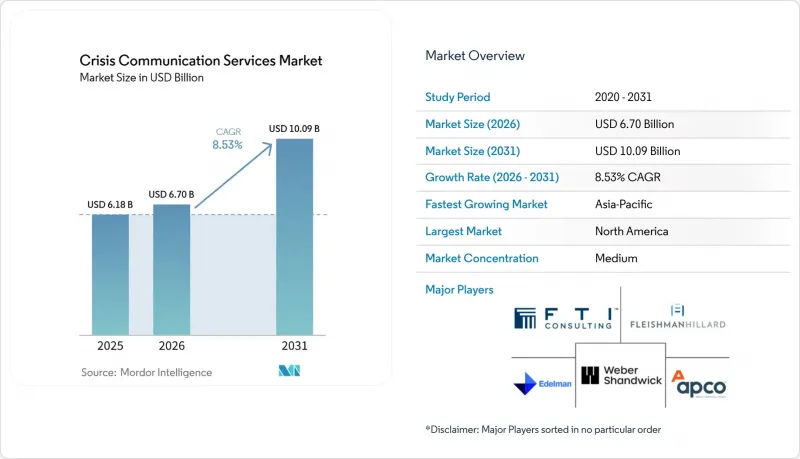
본 보고서는 서비스 유형별(위기 커뮤니케이션 자문, 모니터링 및 경보 서비스, 미디어 및 이해관계자 관계, 위기 시뮬레이션 및 훈련, 평판 회복 및 측정, 기타), 구축 모델별(클라우드 기반, 온프레미스형, 하이브리드형), 최종 사용자별(미디어 및 엔터테인먼트, 기타), 지역별로 분류되어 있습니다. 시장 예측은 금액(달러)으로 표시되어 있습니다.
세계의 위기 커뮤니케이션 서비스 시장 동향 및 인사이트
브랜드로 인한 위기 사건 발생 빈도 증가
위기 커뮤니케이션 서비스 시장은 브랜드 관련 사건 발생부터 광범위한 평판 훼손에 이르기까지 소요되는 시간이 단축되고 있는 상황에 대응하고 있으며, 사내 사실 확인 및 메시지 승인에 할애되는 시간이 줄어들고 있습니다. 소셜 플랫폼과 AI 생성 컨텐츠는 몇 시간 만에 공식, 비공식, 그리고 소규모 채널을 통해 주장을 확산시킬 수 있어, 서로 다른 청중이 동일한 사건에 대해 상반된 견해를 접하게 될 수 있습니다. 세계경제포럼(WEF) 보고서에 따르면, 대기업의 70%가 위협 인텔리전스에 대한 관심을 높이고 있는 반면, 중소기업의 비율은 30%에 그치고 있습니다. 이러한 차이로 인해 소규모 조직은 문제가 확산된 후 사후 대응에 의존할 수밖에 없게 되어, 대기업과 소규모 고용주 간에 위기 대비에 있어 뚜렷한 격차가 발생하고 있습니다. 2025년에는 주요 플랫폼의 컨텐츠 관리 활동이 축소됨에 따라 조직적으로 확산되는 허위 정보에 노출될 위험이 높아지고, 일부 유해한 컨텐츠를 제한하던 외부 규제가 사라지게 될 것입니다. 따라서 기업은 의심스러운 활동이 언론인, 고객, 투자자 또는 직원에게 전달되기 전, 그리고 부정확한 정보에 따라 대응이 결정되기 전에 이를 식별할 수 있는 모니터링 체계를 갖추어야 합니다.
규제 대상 부문의 공시 의무 기한
위기 커뮤니케이션 서비스 시장은 대응 시기를 단순한 홍보팀의 문제가 아닌 거버넌스상의 과제로 삼는 공시 요건의 혜택을 받고 있습니다. 상장 기업은 사이버 보안 사고가 중요하다고 판단한 후 4영업일 이내에 양식 8-K를 제출해야 합니다. NIS2 지침은 중요 사업체에 대해 사고를 인지한 후 24시간 이내에 조기 경보를 발령하고, 72시간 이내에 상세한 통지를할 것을 의무화하고 있습니다. 또한, DORA(데이터 보호법)에서는 금융 기관에 대해 중대한 ICT 사고를 4시간에서 24시간 이내의 초기 대응 기간 내에 보고할 것을 의무화하고 있습니다. 이러한 요건에 따라 법무 부서, IR(투자자 관계) 부서, 기술 부서, 컴플라이언스 부서, 홍보 부서 등 각 팀은 우선순위나 증거 기준이 다르더라도 단일 대응 프로세스로 통합됩니다. 전문 고문은 사고 발생 전에 메시지 승인 절차, 사고 대응 시의 역할 분담, 공개 워크플로우 및 실무적인 리허설 절차의 수립을 지원할 수 있습니다.
경험이 풍부한 위기 관리 자문가의 부족
경험이 풍부한 실무자의 수가 제한적이라는 점은 위기 커뮤니케이션 서비스 시장을 제약하는 요인이 될 수 있습니다. 왜냐하면 복잡한 사안은 기술팀이나 경험이 부족한 팀만으로는 대응할 수 없기 때문입니다. 효과적인 자문을 제공하려면 업계 지식, 미디어에 대한 판단력, 법적 식견, 규제에 대한 정통성, 그리고 시간적 압박 속에서 리더가 어려운 결정을 내릴 수 있도록 지원하는 능력이 요구됩니다. 이러한 기술은 비교적 소수의 선임 전문가에게 집중되어 있으며, 이를 습득하기 위해서는 수년에 걸친 다양한 사고 대응 경험이 필요합니다. AKCG는 2026년 5월에 헤네스 커뮤니케이션즈를, PPHC는 2026년 7월에 탱크레디 지능형 커뮤니케이션즈를 인수했으며, 각사가 M&A를 통해 확립된 역량과 전문 실무 인력을 보강하고 있음을 알 수 있습니다. 이러한 인력 부족은 특히 중견급에서 두드러지며, 이 계층의 전문가들은 제한된 감독 하에서 복잡한 고객 현황을 관리하고 사내 여러 부서를 조율해야 합니다. 또한 동남아시아와 아프리카에서는 수요가 현지 인적 자원 공급을 초과하는 속도로 증가하고 있어, 국제 기업들은 인력 배치 및 육성 모델을 조정해야 할 가능성이 있습니다.
부문 분석
2025년 전체 시장 수요의 32.62%를 위기 커뮤니케이션 자문 서비스가 차지했습니다. 대규모 조직은 규제상 공시, 업계 고유의 위험, 그리고 고객, 직원, 투자자, 공공 기관의 기대를 이해하고 있는 고위 자문가를 찾고 있기 때문에 이 분야는 위기 커뮤니케이션 서비스 시장에서 여전히 중요한 위치를 차지하고 있습니다. 사전에 계약을 체결해 둔 자문가는 리더가 새로운 문제를 평가하고, 책임 분담에 대해 합의하며, 공식적인 대응이 필요해지기 전에 의사결정을 내릴 수 있도록 지원할 수 있습니다. 미디어 및 이해관계자와의 관계 구축, 비상 상황 조정, 평판 회복 서비스는 첫 경보부터 사후 재건에 이르기까지 사건의 모든 단계를 포괄할 수 있습니다. 이러한 광범위한 대응 범위를 통해 서비스 제공업체는 단일 대응 서비스가 아닌 연계된 지원을 제공할 수 있으며, 고객은 압박이 가장 심해지는 상황에서도 신뢰할 수 있는 전문가의 지원을 지속적으로 받을 수 있습니다.
모니터링 및 경보 서비스는 2026-2031년 연평균 성장률(CAGR) 9.32%를 기록하며, 서비스 유형 중 가장 높은 성장률을 보일 것으로 예측됩니다. 위기 커뮤니케이션 서비스 시장 수요는 소셜 플랫폼, 뉴스 보도, 비공개 채널, 다크웹 및 기타 디지털 위협 환경에 걸친 지속적인 모니터링의 필요성을 반영하고 있습니다. 웨버 샌드위크의 ‘RADIUS’와 멜트워터의 ‘Mira AI’는 위기 시뮬레이션 및 훈련을 지원하는 도구에 주력하고 있으며, 금융 서비스 및 의료 기관이 모의 훈련, 홍보 담당자 준비, 대응 훈련을 체계화해 나가는 과정에서 이러한 도구들도 주목을 받고 있습니다. 모니터링 데이터와 고위 경영진의 조언을 결합하는 제공업체는 고객의 다양한 서비스 요구에 대응할 수 있을 뿐만 아니라, 사태가 급속히 전개되는 상황에서 담당자 교대를 최소화할 수 있습니다.
지역별 분석
2025년, 북미는 전 세계 수요의 36.93%를 차지했습니다. 위기 커뮤니케이션 서비스 시장에서 이 지역의 위상은 엄격한 정보 공개 요건, 상장 기업의 높은 집중도, 그리고 확립된 세계 커뮤니케이션 네트워크와 전문 제공업체 기반에 의해 형성되고 있습니다. 미국은 금융 서비스, 기술, 소비재, 헬스케어 분야 수요를 주도하고 있습니다. 이러한 분야에서는 사고가 발생하면 법적, 운영적, 평판상의 영향이 동시에 발생할 가능성이 있습니다. 각 부문은 특정 공개 및 거버넌스 요건 하에서 운영되므로, 대응 계획 수립 시 법무, IT, IR(투자자 관계), 홍보 팀의 의견이 필요한 경우가 많습니다. 캐나다와 멕시코는 규모가 작은 지역 시장이지만, 사업 연속성에 관한 지침과 국경을 넘는 기업 활동 증가에 따라 공식적인 프로토콜, 현지 사정에 대한 이해, 명확한 에스컬레이션 절차의 필요성이 높아지고 있습니다.
아시아태평양은 2026-2031년 연평균 성장률(CAGR) 9.12%로 확대될 것으로 예측됩니다. 위기 커뮤니케이션 서비스 시장에서 인도, 한국, 호주 및 동남아시아 국가들은 디지털 활동의 활성화, 기업 지배 구조 관행의 성숙, 그리고 시기적절한 정보 전달에 대한 대중의 기대감 고조와 함께 중요한 수요 거점으로 부상하고 있습니다. 이러한 시장에서 사업을 전개하는 기업들은 대개 서로 다른 언어, 규제 환경, 미디어 환경 및 이해관계자의 기대에 따라 메시지를 조정해야 합니다. 일본은 공식적인 사과 관행과 경영진의 설명 책임이 현지 위기 관리에서 중요한 역할을 하고 있다는 점에서 여전히 독특한 위치를 차지하고 있습니다. 2025년 IHH 헬스케어가 지역 커뮤니케이션 담당자를 임명한 것은 지역 전체적으로 규제 및 경쟁 압력이 높아지는 가운데 의료 기관들이 접근 방식을 체계화하고 있음을 보여줍니다.
유럽은 다층적인 규제 구조로 인해 보고 기한이 엄격하게 정해져 있어, 위기 커뮤니케이션 서비스 시장에서 여전히 중요한 위치를 차지하고 있습니다. NIS2, DORA 및 ESMA가 2026년 2월에 실시한 내부 정보 공개 지연에 관한 협의는 사전 커뮤니케이션 프로세스의 중요성을 다시금 부각시켰습니다. 독일에서는 식품, 에너지, 헬스케어, 금융 서비스 분야에 걸쳐 성숙한 위기 커뮤니케이션 자문 기반이 구축되어 있으며, Bully Pulpit International은 2026년 5월 365 Sherpas를 인수하여 대서양을 아우르는 기업 홍보 서비스 제공 체계를 강화했습니다. 남미, 중동 및 아프리카는 여전히 발전 중인 시장이지만, 전문 인력 부족과 인프라 격차로 인해 이들 지역 중 일부에서는 도입 속도가 둔화될 가능성이 있습니다.
기타 혜택 :
- 엑셀 형식 시장 예측(ME) 시트
- 3개월간의 애널리스트 지원
자주 묻는 질문
목차
제1장 서론
제2장 조사 방법
제3장 개요
제4장 시장 구도
제5장 시장 규모 및 성장 예측
제6장 경쟁 구도
제7장 시장 기회 및 향후 전망
AJY 26.09.01According to Mordor Intelligence, the crisis communication services market size is projected to expand from USD 6.18 billion in 2025 and USD 6.70 billion in 2026 to USD 10.09 billion by 2031, registering a CAGR of 8.53% between 2026 and 2031.
This report is Segmented by Service Type (Crisis Communication Advisory, Monitoring and Alerting Services, Media and Stakeholder Relations, Crisis Simulation and Training, Reputation Recovery and Measurement, and More), Deployment Model (Cloud-Based, On-Premises, and Hybrid), End User (Media and Entertainment, and More), and Geography. The Market Forecasts are Provided in Terms of Value (USD).
Global Crisis Communication Services Market Trends and Insights
Rising Frequency of Brand-Led Crisis Events
The crisis communication services market is responding to a shorter time between a brand incident and wider reputational damage, leaving less time for internal fact-finding and message approval. Social platforms and AI-generated content can carry a claim across public, private, and fringe channels within hours, allowing separate audiences to see competing versions of the same event. The World Economic Forum reported that 70% of large employers increased their attention to threat intelligence, compared with 30% of small organizations. This difference leaves smaller organizations more reliant on reactive support after an issue has spread, creating a clear divide in preparedness between large and smaller employers. Reduced moderation activity on major platforms in 2025 adds to exposure to coordinated false narratives and removes external controls that had limited some harmful content. Companies, therefore, need monitoring that identifies unusual activity before it reaches journalists, customers, investors, or employees and before a response is shaped by inaccurate information.
Mandatory Disclosure Timelines in Regulated Sectors
The crisis communication services market benefits from disclosure requirements that make response timing a governance concern rather than a matter for communications teams alone. Public companies must file a Form 8-K within 4 business days after determining that a cybersecurity incident is material. The NIS2 Directive requires essential entities to issue an early warning within 24 hours and a detailed notification within 72 hours of becoming aware of an incident. DORA also requires financial entities to report major ICT incidents within an initial window of 4 to 24 hours. These requirements bring together the legal, investor relations, technology, compliance, and communications teams into a single response process, even when they have different priorities and evidence standards. Specialized advisors can help clients establish message approvals, incident roles, disclosure workflows, and practical rehearsal processes before an incident occurs.
Limited Supply of Senior Crisis Counsel
A limited supply of experienced practitioners can constrain the crisis communication services market, as complex assignments cannot be handled solely by technology or junior teams. Effective counsel requires sector knowledge, media judgment, legal awareness, regulatory familiarity, and the ability to work under time pressure while helping leaders make difficult choices. These skills are concentrated among a relatively small group of senior professionals, and they take years of varied incident experience to develop. AKCG acquired Hennes Communications in May 2026, while PPHC acquired Tancredi Intelligent Communication in July 2026, showing that firms are using acquisitions to add established capabilities and specialized practitioners. The shortfall is especially visible at the mid-career level, where professionals must manage complex client situations with limited supervision and coordinate multiple internal functions. Demand is also rising faster than local talent supply in Southeast Asia and Africa, where international firms may need to adapt their staffing and development models.
Other drivers and restraints analyzed in the detailed report include:
- Always-On AI Monitoring and Alert Orchestration
- Enterprise Resilience Program Expansion
- Weak Return on Investment Measurement
For complete list of drivers and restraints, kindly check the Table Of Contents.
Segment Analysis
Crisis communication advisory accounted for 32.62% of the total market demand in 2025. It remains important in the crisis communication services market because larger organizations seek senior counsel that understands regulatory disclosures, sector-specific risks, and the expectations of customers, employees, investors, and public authorities. Pre-retained advisors can help leaders assess an emerging issue, agree on responsibilities, and make decisions before a public response is required. Media and stakeholder relations, emergency coordination, and reputation recovery services can cover the stages of an event from the first alert through post-event rebuilding. This breadth allows providers to offer connected support rather than a single response service, while clients retain access to trusted specialists when pressure is greatest.
Monitoring and alerting services are projected to record the highest service-type growth at a 9.32% CAGR from 2026 to 2031. In the crisis communication services market, demand reflects the need for continuous monitoring across social platforms, news coverage, private channels, the dark web, and other digital threat environments. Weber Shandwick's RADIUS and Meltwater's Mira AI illustrate a focus on tools that support crisis simulation and training, which are also gaining attention as financial services and healthcare organizations formalize exercises, spokesperson preparation, and response drills. Providers who join monitoring data with senior advice can support clients across multiple service needs and reduce handoffs during fast-moving situations.
Complete Report Scope:
- By Service Type
- Crisis Communication Advisory
- Monitoring and Alerting Services
- Media and Stakeholder Relations
- Crisis Simulation and Training
- Reputation Recovery and Measurement
- Emergency Response Coordination
- By Deployment Model
- Cloud-Based
- On-Premises
- Hybrid
- By End User
- Retail and E-commerce
- Media and Entertainment
- Healthcare and Life Sciences
- Travel and Hospitality
- Consumer Goods
- Other End Users
- By Geography
- North America
- United States
- Canada
- Mexico
- South America
- Brazil
- Argentina
- Chile
- Rest of South America
- Europe
- Germany
- United Kingdom
- France
- Italy
- Spain
- Rest of Europe
- Asia-Pacific
- China
- Japan
- India
- South Korea
- Australia
- Rest of Asia-Pacific
- Middle East
- Saudi Arabia
- United Arab Emirates
- Qatar
- Rest of Middle East
- Africa
- South Africa
- Egypt
- Nigeria
- Rest of Africa
- North America
Geography Analysis
North America accounted for 36.93% of global demand in 2025. The region's position in the crisis communication services market is shaped by strict disclosure requirements, a high concentration of listed companies, and an established base of global communications networks and specialist providers. The United States drives demand in financial services, technology, consumer goods, and healthcare, where incidents can simultaneously create legal, operational, and reputational consequences. Each of these sectors operates under specific disclosure and governance requirements, so response plans often require input from legal, technology, investor relations, and communications teams. Canada and Mexico are smaller regional markets, but operational resilience guidance and cross-border corporate activity are increasing the need for formal protocols, local understanding, and clear escalation procedures.
Asia-Pacific is projected to expand at a 9.12% CAGR from 2026 to 2031. Within the crisis communication services market, India, South Korea, Australia, and Southeast Asian countries are becoming important demand centers as digital activity rises, corporate governance practices mature, and public expectations for timely communication increase. Companies operating across these markets must often coordinate messages across different languages, regulatory settings, media environments, and stakeholder expectations. Japan remains distinct because formal apology practices and executive accountability have a significant role in local crisis management. IHH Healthcare's regional communications appointment in 2025 shows how health organizations are formalizing their approach amid increasing regulatory and competitive pressure across the region.
Europe retains a substantial position in the crisis communication services market because its layered regulatory architecture creates tight reporting timelines. NIS2, DORA, and ESMA's February 2026 consultation on delayed disclosure of inside information reinforces the importance of prepared communication processes. Germany has a mature crisis communication advisory base across food, energy, healthcare, and financial services, and Bully Pulpit International acquired 365 Sherpas in May 2026 to strengthen its corporate affairs offering across the Atlantic. South America, the Middle East, and Africa remain developing markets, though limited specialist talent and infrastructure gaps can slow adoption in parts of those regions.
- Edelman Holdings, Inc.
- Weber Shandwick, LLC
- FleishmanHillard, Inc.
- APCO Worldwide LLC
- FTI Consulting, Inc.
- Teneo Holdings, LLC
- Control Risks Group Holdings Limited
- Finn Partners, Inc.
- Ketchum, Inc.
- Hill & Knowlton Strategies LLC
- Porter Novelli, Inc.
- MSL Group
- Golin, LLC
- Ruder Finn, Inc.
- Allison Worldwide
- Cision Ltd.
- Meltwater Group AS
- Sprinklr, Inc.
Additional Benefits:
- The market estimate (ME) sheet in Excel format
- 3 months of analyst support
TABLE OF CONTENTS
1 INTRODUCTION
- 1.1 Study Assumptions and Market Definition
- 1.2 Scope of the Study
2 RESEARCH METHODOLOGY
3 EXECUTIVE SUMMARY
4 MARKET LANDSCAPE
- 4.1 Market Overview
- 4.2 Market Drivers
- 4.2.1 Rising Frequency of Brand-Led Crisis Events
- 4.2.2 Mandatory Disclosure Timelines In Regulated Sectors
- 4.2.3 Always-On AI Monitoring and Alert Orchestration
- 4.2.4 Enterprise Resilience Program Expansion
- 4.2.5 Executive Exposure To Deepfakes and Employee-Generated Content
- 4.2.6 Third-Party Reputation Spillover Risk
- 4.3 Market Restraints
- 4.3.1 Limited Supply Of Senior Crisis Counsel
- 4.3.2 Weak Return On Investment Measurement
- 4.3.3 Cross-Functional Approval Bottlenecks
- 4.3.4 Data Privacy and Archiving Constraints
- 4.4 Industry Value Chain Analysis
- 4.5 Impact of Macroeconomic Factors on the Market
- 4.6 Regulatory Landscape
- 4.7 Technological Outlook
- 4.8 Porter's Five Forces Analysis
- 4.8.1 Threat of New Entrants
- 4.8.2 Bargaining Power of Buyers
- 4.8.3 Bargaining Power of Suppliers
- 4.8.4 Threat of Substitutes
- 4.8.5 Industry Rivalry
5 MARKET SIZE AND GROWTH FORECASTS (VALUE)
- 5.1 By Service Type
- 5.1.1 Crisis Communication Advisory
- 5.1.2 Monitoring and Alerting Services
- 5.1.3 Media and Stakeholder Relations
- 5.1.4 Crisis Simulation and Training
- 5.1.5 Reputation Recovery and Measurement
- 5.1.6 Emergency Response Coordination
- 5.2 By Deployment Model
- 5.2.1 Cloud-Based
- 5.2.2 On-Premises
- 5.2.3 Hybrid
- 5.3 By End User
- 5.3.1 Retail and E-commerce
- 5.3.2 Media and Entertainment
- 5.3.3 Healthcare and Life Sciences
- 5.3.4 Travel and Hospitality
- 5.3.5 Consumer Goods
- 5.3.6 Other End Users
- 5.4 By Geography
- 5.4.1 North America
- 5.4.1.1 United States
- 5.4.1.2 Canada
- 5.4.1.3 Mexico
- 5.4.2 South America
- 5.4.2.1 Brazil
- 5.4.2.2 Argentina
- 5.4.2.3 Chile
- 5.4.2.4 Rest of South America
- 5.4.3 Europe
- 5.4.3.1 Germany
- 5.4.3.2 United Kingdom
- 5.4.3.3 France
- 5.4.3.4 Italy
- 5.4.3.5 Spain
- 5.4.3.6 Rest of Europe
- 5.4.4 Asia-Pacific
- 5.4.4.1 China
- 5.4.4.2 Japan
- 5.4.4.3 India
- 5.4.4.4 South Korea
- 5.4.4.5 Australia
- 5.4.4.6 Rest of Asia-Pacific
- 5.4.5 Middle East
- 5.4.5.1 Saudi Arabia
- 5.4.5.2 United Arab Emirates
- 5.4.5.3 Qatar
- 5.4.5.4 Rest of Middle East
- 5.4.6 Africa
- 5.4.6.1 South Africa
- 5.4.6.2 Egypt
- 5.4.6.3 Nigeria
- 5.4.6.4 Rest of Africa
- 5.4.1 North America
6 COMPETITIVE LANDSCAPE
- 6.1 Market Concentration
- 6.2 Strategic Moves
- 6.3 Market Share Analysis
- 6.4 Company Profiles (includes Global Level Overview, Market Level Overview, Core Segments, Financials as available, Strategic Information, Market Rank/Share, Products and Services, Recent Developments)
- 6.4.1 Edelman Holdings, Inc.
- 6.4.2 Weber Shandwick, LLC
- 6.4.3 FleishmanHillard, Inc.
- 6.4.4 APCO Worldwide LLC
- 6.4.5 FTI Consulting, Inc.
- 6.4.6 Teneo Holdings, LLC
- 6.4.7 Control Risks Group Holdings Limited
- 6.4.8 Finn Partners, Inc.
- 6.4.9 Ketchum, Inc.
- 6.4.10 Hill & Knowlton Strategies LLC
- 6.4.11 Porter Novelli, Inc.
- 6.4.12 MSL Group
- 6.4.13 Golin, LLC
- 6.4.14 Ruder Finn, Inc.
- 6.4.15 Allison Worldwide
- 6.4.16 Cision Ltd.
- 6.4.17 Meltwater Group AS
- 6.4.18 Sprinklr, Inc.
7 MARKET OPPORTUNITIES AND FUTURE OUTLOOK
- 7.1 White-Space and Unmet-Need Assessment