

|
시장보고서
상품코드
2118953
법률 AI 검증 소프트웨어 시장 : 시장 점유율 분석, 업계 동향 및 통계, 성장 예측(2026-2031년)Legal AI Verification Software - Market Share Analysis, Industry Trends & Statistics, Growth Forecasts (2026 - 2031) |
||||||
 Mordor Intelligence
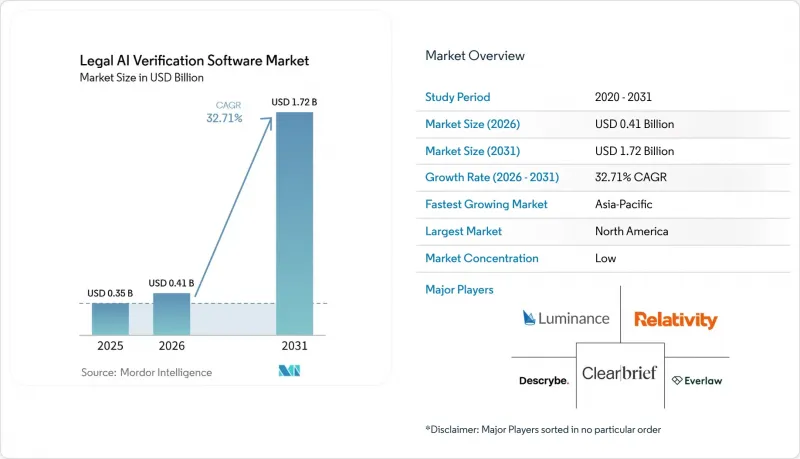
법률 AI 검증 소프트웨어 시장 규모는 2025년에 3억 5,000만 달러로 평가되었고, 2026년 4억 1,000만 달러에서 2031년까지 17억 2,000만 달러에 이를 것으로 예측되며, 2026-2031년 예측 기간 CAGR은 32.71%를 나타낼 전망입니다.
본 보고서는 제공 형태별(소프트웨어 및 서비스), 검증 기능별(인용 및 권위 검증, 법적 사실 및 증거 검증, 계약 및 조항 검증 등), 도입 형태별(클라우드 기반, 온프레미스형, 하이브리드형), 최종 사용자별(법률 사무소, 기업 법무 부서 등) 및 지역별로 분류되어 있습니다. 시장 예측은 금액(달러) 기준으로 제시되어 있습니다.
세계의 법률 AI 검증 소프트웨어 시장 동향 및 인사이트
AI에 의해 생성되는 법률 산출물의 확대
법무 업무는 생성형 AI의 제한적인 시범 운영 단계를 넘어 발전하고 있습니다. Harvey사의 보고서에 따르면, 2026년 3월 시점에서 1,300개 이상의 조직에 소속된 10만 명 이상의 법무 전문가가 중요한 업무에 해당 회사의 플랫폼을 이용하고 있었습니다. ACC와 Everlaw의 보고서에 따르면, 사내 변호사의 생성형 AI 적극 활용률이 1년 만에 23%에서 52%로 상승했다고 합니다. 조사, 초안 작성, 계약서 검토, 증거 개시 등 각 도구에는 각각 다른 오류가 발생할 가능성이 있어, 산출물을 공개하기 전에 개별적인 검증이 필요합니다. 에이전트형 시스템은 인간의 검토를 최소화하면서 여러 법률 업무를 수행하고, 각 단계 간에 결과물을 인계받기 때문에 이러한 점검의 필요성을 더욱 높입니다. 따라서 검증이 단순한 선택적 최종 점검이 아니라 법률 워크플로우의 표준 관리 프로세스가 됨에 따라, 법률 AI 검증 소프트웨어 시장은 그 혜택을 누리게 될 것입니다.
인용 및 출처 오류로 인한 비용 증가
날조된 인용이나 근거 없는 인용은 변호사에게 금전적 및 직업적 불이익을 초래할 가능성이 있습니다. Sterne Kessler사가 2025년에 실시한 조사에서는 제출 서류에서 AI에 의한 ‘환각’에 대한 제재 조치와 법원이 제안하는 대응책이 기록되어 있습니다. 법원은 자료의 일부가 도구에 의해 작성된 경우라도, 변호사가 자신의 명의로 제출된 업무에 대해 책임을 져야 함을 명확히 하고 있습니다. 이러한 위험은 단일 문서에 그치지 않고, 단 한 번의 오류로 인해 동일한 로펌에서 이후 제출하는 서류에 대해 더 엄격한 심사가 이루어질 수도 있습니다. 법무 팀은 제출 전에 인용 내용이나 근거가 되는 판례를 확인했음을 입증하기 위해 검증 기록을 활용할 수 있습니다. 이를 통해 법률 AI 검증 소프트웨어 시장에서 개별 변호사의 재량에 의존하는 것보다 조직 차원의 검증이 더 설득력을 갖게 될 것입니다.
불완전하고 불균일한 성문법의 포괄성
검증 결과는 플랫폼이 색인화한 법률 정보 출처에 의해 제한을 받습니다. 스탠퍼드 대학교 연구진은 주요 법률 조사 도구가 테스트한 쿼리의 17%에서 33%에 걸쳐 잘못된 정보를 생성하고 있음을 발견했습니다. 이 문제는 영어 이외의 자료, 지방 행정 규정, 그리고 신흥 시장의 규제에서 더욱 심각합니다. 신뢰할 수 있는 법률 코퍼스를 구축하려면 라이선스를 취득한 컨텐츠, 편집 작업, 그리고 지속적인 업데이트가 필요합니다. 소규모 공급업체는 모델 튜닝만으로는 광범위한 포괄성 격차를 해소할 수 없습니다. 이로 인해 국경을 초월한 법무 업무에서 현지 1차 법률에 대한 확실한 접근이 요구되는 ‘법률 AI 검증 소프트웨어 시장’의 성장이 제한되고 있습니다.
부문 분석
2025년 ‘법률 AI 검증 소프트웨어 시장’ 매출의 70.12%를 소프트웨어가 차지했습니다. 구독형 플랫폼은 변호사 및 법률 사무소를 대상으로 인용 확인, 계약 조항 타당성 검토, 그리고 AI가 생성한 결과물에 대한 검토 서비스를 제공합니다. 이러한 점유율은 팀 전체가 도입하기 쉬운 SaaS(Software-as-a-Service) 제품을 통한 조기 도입을 반영하고 있습니다. 서비스 부문은 2031년까지 연평균 성장률(CAGR) 35.04%를 나타낼 것으로 예측됩니다.
고객이 여러 기능을 단일 법무 워크플로우로 통합할 때, 자문, 도입 지원 및 관리형 검증 업무의 중요성이 높아집니다. 대형 로펌에서는 소프트웨어 라이선스와 관리형 검증 지원을 결합하는 사례가 늘고 있습니다. 이러한 접근 방식은 소프트웨어 단독의 이익률을 낮출 가능성은 있지만, 벤더와 고객 간의 보다 견고한 관계를 구축하는 데에도 기여합니다. 현재 기업에서의 도입 범위는 단순한 인용 확인이라는 단일 작업에 그치지 않고, 증거 개시, 계약서 검토, 규정 준수 및 법무 조사에까지 미치고 있습니다. 이러한 도입에는 맞춤화, 데이터 준비, 지속적인 조정, 그리고 기밀성이 높은 사건이나 특수한 법역에서의 인적 검토가 필요합니다.
인용 및 권위 정보 검증은 2025년 매출의 44.21%를 차지했습니다. 이 부문은 법원 제출 서류에서 허위 인용 위험과 밀접한 관련이 있습니다. 이를 통해 법무 팀은 생성된 인용을 권위 있는 정보원과 즉시 대조할 수 있게 됩니다. 법적 사실 및 증거 검증은 2031년까지 연평균 성장률(CAGR) 34.38%를 나타낼 것으로 예측됩니다.
이는 법적 조사뿐만 아니라 사실 진술 및 증거 요약 분야에서도 생성형 AI의 활용이 확산되고 있음을 반영합니다. 계약 및 조항 검증은 M&A(인수합병) 과정의 실사(due diligence) 및 공급업체 리스크 관리에서 입증 가능한 계약 검토를 지원합니다. 법무 팀이 주나 국가를 넘나드는 규정을 관리함에 따라, 규제 및 규정 준수 검증은 점점 더 중요해지고 있습니다. 2026년 『Scientific Reports』지에 게재된 연구에 따르면, AI를 활용한 계약 리스크 자동화를 통해 복잡한 상업 환경에서의 규제상 리스크를 줄일 수 있는 것으로 밝혀졌습니다. 법적 추론 및 출력 검증 분야는 여전히 발전 단계에 있지만, 법률 AI 검증 소프트웨어 시장에서 AI 시스템이 권고 사항과 인용 자료 모두에 대한 검토가 필요한 다단계 작업을 수행하게 된다면 그 잠재력은 더욱 커질 것입니다.
지역별 분석
2025년 ‘법률 AI 검증 소프트웨어 시장’ 매출 중 북미가 35.16%를 차지했습니다. 이 지역에서는 법무 업무에 생성형 AI 도입이 집중되고 있으며, 책임 있는 이용에 관한 전문가들의 지도도 활발히 이루어지고 있습니다. 법원 규칙 및 주 정부의 지침에 따라 규정 준수에 대한 시급한 필요성이 대두되고 있어, 미국은 여전히 주요 수익원으로 자리 잡고 있습니다. 캐나다도 유사한 추세를 보이고 있으나, 활동 수준은 미국보다 낮은 임베디드니다. 한편, 멕시코는 도입 초기 단계에 있지만, 미국에 기반을 둔 로펌이 다루는 국경을 초월한 사건을 통해 시장 노출을 확대되고 있습니다.
아시아태평양은 2031년까지 연평균 성장률(CAGR) 34.02%를 나타낼 것으로 예측됩니다. 이 지역의 법률 AI 검증 소프트웨어 시장은 상업 계약 거래량, 디지털화 프로그램, 그리고 기업의 법률 기술에 대한 투자에 힘입어 성장하고 있습니다. 이 지역의 도입은 소송에서의 판례 인용 확인보다 계약 및 규정 준수에 중점을 두고 있습니다. 일본의 법조 시장 단계적 자유화, 한국 기업의 기술 투자, 그리고 호주의 AI 거버넌스 노력이 이 지역 수요를 뒷받침하고 있습니다. 많은 법률 데이터베이스가 관련 국내 정보원을 모두 색인화하고 있지 않기 때문에 지역별 포괄성은 여전히 제약 요인으로 남아 있습니다.
유럽, 남미, 중동 및 아프리카에서는 검증 도구의 도입 속도가 지역마다 다릅니다. EU AI법에 따라 유럽의 법무 팀은 인증된 플랫폼 및 관련 적합성 요건에 대한 평가를 촉진하고 있습니다. 브라질과 아르헨티나는 남미의 초기 시장으로, 계약 검증을 활용하는 다국적 기업의 법무 부서에 의해 뒷받침되고 있습니다. 아랍에미리트(UAE)와 사우디아라비아는 국가 차원의 디지털화 프로그램의 혜택을 받고 있는 반면, 남아프리카공화국과 나이지리아는 아프리카 내에서 상업적으로 더 발전된 시장으로 자리 잡고 있습니다. 이러한 지역에서는 ‘법률 AI 검증 소프트웨어 시장’의 세계 플랫폼을 활용할 수 있을 뿐만 아니라, 현지 법률 코퍼스의 포괄 범위도 지속적으로 확대되고 있습니다.
기타 혜택 :
- 엑셀 형식 시장 예측(ME) 시트
- 3개월간의 애널리스트 지원
자주 묻는 질문
목차
제1장 서론
제2장 조사 방법
제3장 주요 요약
제4장 시장 구도
제5장 시장 규모 및 성장 예측
제6장 경쟁 구도
제7장 시장 기회 및 향후 전망
AJY 26.09.03According to Mordor Intelligence, the legal AI verification software market size was valued at USD 0.35 billion in 2025 and estimated to grow from USD 0.41 billion in 2026 to reach USD 1.72 billion by 2031, at a CAGR of 32.71% during the forecast period 2026-2031.
This report is Segmented by Offering (Software, and Services), Verification Capability (Citation and Authority Verification, Legal Fact and Evidence Verification, Contract and Clause Verification, and More), Deployment Mode (Cloud-Based, On-Premises, and Hybrid), End User (Law Firms, Corporate Legal Departments, and More), and Geography. The Market Forecasts are Provided in Terms of Value (USD).
Global Legal AI Verification Software Market Trends and Insights
Expansion of AI-Generated Legal Work Product
Legal work is moving beyond limited trials of generative AI. Harvey reported that more than 100,000 legal professionals across over 1,300 organizations used its platform for critical work in March 2026. The ACC and Everlaw report described active generative AI use among in-house counsel rising from 23% to 52% in 1 year. Each research, drafting, contract review, or discovery tool can introduce different errors that need independent checking before work is released. Agentic systems add to this need when they perform multiple legal tasks with limited human review and pass outputs from step to step. The Legal AI Verification Software Market therefore benefits as verification becomes a normal control within legal workflows rather than an optional final check.
Rising Cost of Citation and Authority Errors
Fabricated citations and unsupported quotations can create financial and professional consequences for attorneys. A 2025 review from Sterne Kessler documented sanctions and proposed court responses to AI hallucinations in filings. Courts have made clear that lawyers remain responsible for the work submitted in their names, even if a tool prepared part of the material. The resulting risk extends beyond a single document, as an error can prompt a stronger review of later submissions from the same firm. Legal teams can use verification records to show that they reviewed citations and supporting authority before filing. This makes organization-wide verification more compelling than relying on individual lawyers' discretion in the Legal AI Verification Software Market.
Incomplete and Uneven Primary-Law Coverage
A verification result is limited by the legal sources the platform indexes. Stanford researchers found that leading legal research tools produced hallucinations on 17% to 33% of tested queries. The issue is more difficult for non-English materials, subnational administrative rules, and emerging-market regulations. Building a reliable legal corpus requires licensed content, editorial work, and continual updates. Smaller suppliers cannot solve broad coverage gaps through model tuning alone. This limits the Legal AI Verification Software Market, where cross-border legal work requires dependable access to local primary law.
Other drivers and restraints analyzed in the detailed report include:
- Demand for Defensible Audit Trails in Legal Workflows
- Integration Into Microsoft Word and Legal Platforms
- Privilege, Confidentiality, and Data Sovereignty Concerns
For complete list of drivers and restraints, kindly check the Table Of Contents.
Segment Analysis
Software held 70.12% of 2025 revenue in the Legal AI Verification Software Market. Subscription platforms provide citation checking, contract clause validation, and review of AI-generated outputs for lawyers and firms. Their share reflects early adoption through software-as-a-service products that are easy to deploy across teams. Services are projected to grow at a 35.04% CAGR through 2031.
Advisory, implementation, and managed verification work become more important when clients connect multiple capabilities into a single legal workflow. Large firms increasingly combine software licenses with managed verification support. This approach can reduce pure software margins but also create a more durable relationship between a vendor and its client. Enterprise deployments now cover discovery, contract review, compliance, and legal research rather than a single citation-checking task. These deployments require customization, data preparation, continuing calibration, and human review for sensitive matters or unusual jurisdictions.
Citation and authority verification accounted for 44.21% of 2025 revenue. The segment is closely tied to the risk of fabricated citations in court submissions. It provides an immediate way for legal teams to compare generated citations with authoritative sources. Legal fact and evidence verification is projected to grow at a 34.38% CAGR through 2031.
This reflects broader use of generative AI for factual narratives and evidence summaries, not only legal research. Contract and clause verification supports attestable contract review in M&A due diligence and supplier risk work. Regulatory and compliance verification becomes more relevant as legal teams manage rules across states and countries. A 2026 study in Scientific Reports found that AI-driven contract risk automation can reduce regulatory exposure in complex commercial settings. Legal reasoning and output verification remain less developed, but their potential grows when AI systems carry out multi-step tasks that need review of both recommendations and cited material in the Legal AI Verification Software Market.
Complete Report Scope:
- By Offering
- Software
- Services
- By Verification Capability
- Citation and Authority Verification
- Legal Fact and Evidence Verification
- Contract and Clause Verification
- Regulatory and Compliance Verification
- Legal Reasoning and Output Verification
- By Deployment Mode
- Cloud-Based
- On-Premises
- Hybrid
- By End User
- Law Firms
- Corporate Legal Departments
- Courts and Government Legal Agencies
- Legal Process Outsourcing Firms
- Other End Users
- By Geography
- North America
- United States
- Canada
- Mexico
- South America
- Brazil
- Argentina
- Rest of South America
- Europe
- Germany
- United Kingdom
- France
- Italy
- Spain
- Russia
- Rest of Europe
- Asia-Pacific
- China
- Japan
- India
- South Korea
- Australia and New Zealand
- Rest of Asia-Pacific
- Middle East
- Saudi Arabia
- United Arab Emirates
- Turkey
- Rest of Middle East
- Africa
- South Africa
- Nigeria
- Rest of Africa
- North America
Geography Analysis
North America held 35.16% of 2025 revenue in the Legal AI Verification Software Market. The region has a high concentration of generative AI adoption in legal work and active professional guidance on responsible use. The United States remains the main revenue source because court rules and state directives create urgent compliance needs. Canada follows a similar path at a lower level of activity, while Mexico is at an earlier stage but gains exposure through cross-border matters handled by U.S.-based firms.
Asia-Pacific is projected to grow at a 34.02% CAGR through 2031. Commercial contract volumes, digitalization programs, and enterprise legal technology investment support the Legal AI Verification Software Market in the region. Adoption in the region is more focused on contracts and compliance than on litigation citation checks. Japan's gradual legal market liberalization, South Korea's enterprise technology investment, and Australia's AI governance approach add to regional demand. Local coverage remains a constraint because many legal databases do not yet index all relevant domestic sources.
Europe, South America, the Middle East, and Africa are adopting verification tools at different rates. The EU AI Act is encouraging European legal teams to assess certified platforms and related conformity requirements. Brazil and Argentina are early South American markets, supported by multinational legal departments using contract verification. The UAE and Saudi Arabia benefit from national digitalization programs, while South Africa and Nigeria are the more commercially advanced African markets. These regions can leverage global platforms in the Legal AI Verification Software Market, while local legal corpus coverage continues to expand.
- Clearbrief, Inc.
- LawCatch, Inc. dba BriefCatch
- Ark Legal AI, Inc.
- LitigatorsAi, Inc.
- Everlaw, Inc.
- Relativity ODA LLC
- Reveal Data Corporation
- Luminance Technologies Ltd
- LegalSifter, Inc.
- Ironclad, Inc.
- Harvey AI Corp.
- Icertis, Inc.
- SirionLabs, Inc.
- ContractPod Technologies, Inc.
- Litera Corp.
- vLex Group Limited
- Fastcase, Inc.
- Descrybe, Inc.
- Evatt AI Private Limited
- Manupatra Information Solutions Private Limited
Additional Benefits:
- The market estimate (ME) sheet in Excel format
- 3 months of analyst support
TABLE OF CONTENTS
1 INTRODUCTION
- 1.1 Study Assumptions and Market Definition
- 1.2 Scope of the Study
2 RESEARCH METHODOLOGY
3 EXECUTIVE SUMMARY
4 MARKET LANDSCAPE
- 4.1 Market Overview
- 4.2 Market Drivers
- 4.2.1 Expansion of AI-Generated Legal Work Product
- 4.2.2 Rising Cost of Citation and Authority Errors
- 4.2.3 Demand for Defensible Audit Trails in Legal Workflows
- 4.2.4 Integration of Verification Into Microsoft Word and Legal Platforms
- 4.2.5 Growth of Multijurisdictional Contract and Regulatory Complexity
- 4.2.6 Court and Client Pressure for Human-Verified AI Outputs
- 4.3 Market Restraints
- 4.3.1 Incomplete and Uneven Primary-Law Coverage
- 4.3.2 Privilege, Confidentiality, and Data-Sovereignty Concerns
- 4.3.3 Ambiguous Accountability for AI-Assisted Legal Errors
- 4.3.4 Limited Availability of High-Quality Evaluation Benchmarks
- 4.4 Industry Value Chain Analysis
- 4.5 Regulatory Landscape
- 4.6 Technological Outlook
- 4.7 Impact of Macroeconomic Factors on the Market
- 4.8 Porter's Five Forces Analysis
- 4.8.1 Threat of New Entrants
- 4.8.2 Bargaining Power of Suppliers
- 4.8.3 Bargaining Power of Buyers
- 4.8.4 Threat of Substitutes
- 4.8.5 Intensity of Competitive Rivalry
5 MARKET SIZE AND GROWTH FORECASTS (VALUE)
- 5.1 By Offering
- 5.1.1 Software
- 5.1.2 Services
- 5.2 By Verification Capability
- 5.2.1 Citation and Authority Verification
- 5.2.2 Legal Fact and Evidence Verification
- 5.2.3 Contract and Clause Verification
- 5.2.4 Regulatory and Compliance Verification
- 5.2.5 Legal Reasoning and Output Verification
- 5.3 By Deployment Mode
- 5.3.1 Cloud-Based
- 5.3.2 On-Premises
- 5.3.3 Hybrid
- 5.4 By End User
- 5.4.1 Law Firms
- 5.4.2 Corporate Legal Departments
- 5.4.3 Courts and Government Legal Agencies
- 5.4.4 Legal Process Outsourcing Firms
- 5.4.5 Other End Users
- 5.5 By Geography
- 5.5.1 North America
- 5.5.1.1 United States
- 5.5.1.2 Canada
- 5.5.1.3 Mexico
- 5.5.2 South America
- 5.5.2.1 Brazil
- 5.5.2.2 Argentina
- 5.5.2.3 Rest of South America
- 5.5.3 Europe
- 5.5.3.1 Germany
- 5.5.3.2 United Kingdom
- 5.5.3.3 France
- 5.5.3.4 Italy
- 5.5.3.5 Spain
- 5.5.3.6 Russia
- 5.5.3.7 Rest of Europe
- 5.5.4 Asia-Pacific
- 5.5.4.1 China
- 5.5.4.2 Japan
- 5.5.4.3 India
- 5.5.4.4 South Korea
- 5.5.4.5 Australia and New Zealand
- 5.5.4.6 Rest of Asia-Pacific
- 5.5.5 Middle East
- 5.5.5.1 Saudi Arabia
- 5.5.5.2 United Arab Emirates
- 5.5.5.3 Turkey
- 5.5.5.4 Rest of Middle East
- 5.5.6 Africa
- 5.5.6.1 South Africa
- 5.5.6.2 Nigeria
- 5.5.6.3 Rest of Africa
- 5.5.1 North America
6 COMPETITIVE LANDSCAPE
- 6.1 Market Concentration
- 6.2 Strategic Moves
- 6.3 Market Share Analysis
- 6.4 Company Profiles (includes Global Level Overview, Market Level Overview, Core Segments, Financials as available, Strategic Information, Market Rank/Share, Products and Services, Recent Developments)
- 6.4.1 Clearbrief, Inc.
- 6.4.2 LawCatch, Inc. dba BriefCatch
- 6.4.3 Ark Legal AI, Inc.
- 6.4.4 LitigatorsAi, Inc.
- 6.4.5 Everlaw, Inc.
- 6.4.6 Relativity ODA LLC
- 6.4.7 Reveal Data Corporation
- 6.4.8 Luminance Technologies Ltd
- 6.4.9 LegalSifter, Inc.
- 6.4.10 Ironclad, Inc.
- 6.4.11 Harvey AI Corp.
- 6.4.12 Icertis, Inc.
- 6.4.13 SirionLabs, Inc.
- 6.4.14 ContractPod Technologies, Inc.
- 6.4.15 Litera Corp.
- 6.4.16 vLex Group Limited
- 6.4.17 Fastcase, Inc.
- 6.4.18 Descrybe, Inc.
- 6.4.19 Evatt AI Private Limited
- 6.4.20 Manupatra Information Solutions Private Limited
7 MARKET OPPORTUNITIES AND FUTURE OUTLOOK
- 7.1 White-Space and Unmet-Need Assessment


