|
시장보고서
상품코드
2118966
의료용 생체 모방 재료 시장 : 시장 점유율 분석, 업계 동향 및 통계, 성장 예측(2026-2031년)Medical Biomimetic Materials - Market Share Analysis, Industry Trends & Statistics, Growth Forecasts (2026 - 2031) |
||||||
 Mordor Intelligence
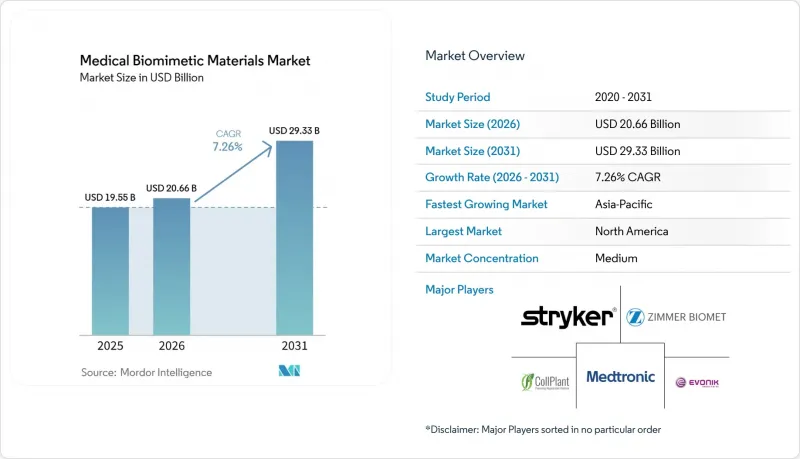
Mordor Intelligence에 의하면, 의료용 생체 모방 재료 시장 규모는 2025년에 195억 5,000만 달러로 평가되었고, 2026년 206억 6,000만 달러에서 2031년까지 293억 3,000만 달러에 이를 것으로 예측되며, 예측 기간(2026-2031년) CAGR은 7.26%를 나타낼 전망입니다.
본 보고서는 재료 유형별(금속계 생체모방 소재 등), 용도별(조직공학 및 재생의학 등), 형태별(다공성 스캐폴드 및 격자 등), 기술별(분자 자기조립 등), 최종 사용자별(병원, 전문 클리닉 등), 지역별(북미, 유럽 등)로 분류되어 있습니다. 시장 전망은 금액(달러) 기준으로 제시되어 있습니다.
세계의 의료용 생체모방 소재 시장 동향 및 인사이트
생체적합성 임플란트 및 인공 장기에 대한 수요 증가
생체 적합성은 단순한 규제 기준이 아닌, 설계상의 중요한 목표로 자리 잡고 있습니다. 정형외과용 임플란트 표면에는 단백질 흡착을 제어하고 섬유성 피막 형성을 억제하기 위해 나노 구조의 하이드록시아파타이트 및 지르코니아 코팅이 점점 더 많이 채택되고 있습니다. 이러한 코팅은 임플란트의 기능적 수명을 연장하는 데에도 기여합니다. Zimmer Biomet사는 2025년 10월, 양극 산화 처리와 전기영동을 이용하여 임플란트 표면에 서방형 요오드층을 내장한 요오드 처리된 인공 고관절 치환 시스템에 대해 FDA의 ‘획기적 의료기기(Breakthrough Device) 지정’을 획득했습니다. 의지의 인터페이스 분야에서도 생체 모방 설계의 적용 범위가 경조직에 대한 고정에서 말초 신경 및 연조직과의 통합으로 확대되고 있습니다. 이에 따라 사용되는 재료는 기존의 금속 및 세라믹 계열에서 폴리머·하이드로겔 복합재료로 확대되는 추세를 보이고 있습니다.
조직 공학 및 재생 의학의 확대
조직 공학 및 재생 의학은 의료용 생체 모방 소재 시장에서 가장 큰 용도 점유율과 가장 빠른 용도 성장률을 동시에 기록하고 있습니다. 2026년 대형 동물을 대상으로 한 연구에서는 전층 자가 유래의 공학적으로 제작된 식도 이식편의 기능적 통합이 보고되었으며, 자율적인 연동 운동이 확인되었습니다. 이 결과는 조직 연구와 외과적 응용 사이의 실용적 격차를 좁히는 것입니다. 또한, 1/2상 임상시험에서는 파킨슨병 환자를 대상으로 한 다능성 줄기세포 유래 도파민 작용성 임플란트에 대한 12개월간의 안전성 데이터가 보고되었습니다. 여기에는 이식편의 생존을 시사하는 피질하부에서의 (18F)F-DOPA 섭취의 국소적 증가도 포함되어 있었습니다. 제약사들은 신약 개발 과정에서 오가노이드, 장기-온-칩 시스템 및 3D 조직 모델을 활용하고 있습니다. 이로 인해 시술 건수나 보험 환급 결정에 대한 의존도가 낮은 지지체 재료에 대한 수요 채널이 생겨나고 있습니다.
여러 지역에서의 규제 및 임상 검증 부담
미국, 유럽, 중국, 일본 간의 규제 차이는 생체 모방 제품 시장 진입을 지연시킬 가능성이 있습니다. 유럽 의료기기 규정(MDR)에서는 이전 프레임워크 하에서 문헌에 근거한 동등성이 인정되었던 경우라도, 이식형 의료기기에 대해서는 전향적 임상 데이터 제출이 의무화되어 있습니다. 이 요건으로 인해 특정 제품의 시판 전 절차 소요 기간이 12-24개월 연장되고 있습니다. 중국에서는 일반적으로 새로운 이식형 생체 재료를 클래스 III 의료기기로 취급하며, 엄격한 시판 후 감시 요건을 적용하고 있습니다. 이러한 절차는 규제 대응 자원이 부족한 중소 혁신 기업에 더 큰 영향을 미칩니다. 그 결과, 확립된 규정 준수 체계와 임상 증거 구축 능력을 갖춘 기업에게는 단기적인 우위가 주어집니다.
부문 분석
2025년 시점에서 고분자 및 스마트 폴리머는 소재 유형별 매출의 26.46%를 차지하며, 가장 폭넓은 소재 기반을 형성했습니다. 의료용 생체 모방 소재 시장에서 이러한 소재가 차지하는 위상은 기계적 조정성, 확립된 제조 방법, 그리고 사출 성형 및 적층 가공와의 호환성에 기반을 두고 있습니다. 이 범주에는 PLGA, PCL, PEG 시스템 외에도 pH나 온도에 따라 강성이나 다공성을 변화시킬 수 있는 반응성 폴리머가 포함됩니다.
하이드로겔, 펩타이드 및 세포외 기질 모방 소재는 2031년까지 연평균 성장률(CAGR) 11.83%를 나타낼 것으로 예측됩니다. 이러한 소재는 주사 가능하고 3D 프린팅이 가능한 형태를 갖추고 있어, 최소 침습 수술 및 상처 치료 용도를 지원합니다. 2026년 리뷰에서는 주사 가능한 세포외 기질 모방 하이드로겔이 임상 요구 사항에 따라 분해 속도, 다공성 및 생체 기능화를 조절할 수 있다는 점이 지적되었습니다.
2025년 기준으로, 조직 공학 및 재생 의학은 의료용 생체 모방 소재 시장의 용도별 매출의 30.23%를 차지하며 가장 큰 점유율을 기록했습니다. 이 부문 역시 2031년까지 연평균 성장률(CAGR) 11.45%를 나타낼 것으로 예측됩니다. 의료용 생체 모방 재료 시장에서는 뼈 및 연골 재생, 피부 및 연조직 복구, 혈관 및 심장 복구가 각각 서로 다른 개발 경로를 통해 확대되고 있습니다. 2026년 논문에서는 치유 초기에는 강성을 띠고, 뼈가 성숙함에 따라 탄성을 띠게 되는 이중층 막에 대해 기술하고 있습니다. 약물 전달 및 제어 방출은 치료법 제공 방식에 영향을 미치는 생체 재료의 설계 선택과 밀접하게 관련되어 있습니다. 또한, 신경학 및 감각운동 재활 분야도 인간을 대상으로 한 임상 데이터가 축적됨에 따라 더욱 빠른 성장이 예상됩니다.
지역별 분석
2025년, 북미는 의료용 생체모방 소재 시장 점유율의 39.35%를 차지했습니다. 이 지역의 우위는 수술 건수, 확립된 병원 시스템, 그리고 집중된 의료 기술 기반에 기인합니다. 미국에서는 연간 약 2만 건의 승모판 치환술이 시행되고 있습니다.
2025년에는 유럽이 2위 지역이 되었습니다. 독일, 영국, 프랑스는 확립된 의료 기술 클러스터와 자금력이 풍부한 병원 네트워크를 통해 지역 내 수요를 뒷받침하고 있습니다. 아시아태평양은 2031년까지 연평균 성장률(CAGR) 11.63%를 나타낼 것으로 예측되며, 이는 지역별로는 가장 높은 성장률입니다. 이러한 성장은 인구 통계학적 압력, 의료 인프라에 대한 투자, 그리고 중국, 인도, 일본, 한국에서의 제조 지원을 반영한 것입니다.
기타 혜택 :
- 엑셀 형식 시장 예측(ME) 시트
- 3개월간의 애널리스트 지원
자주 묻는 질문
목차
제1장 서론
제2장 조사 방법
제3장 개요
제4장 시장 구도
제5장 시장 규모 및 성장 예측
제6장 경쟁 구도
제7장 시장 기회 및 향후 전망
AJY 26.09.01According to Mordor Intelligence, the medical biomimetic materials market size was valued at USD 19.55 billion in 2025 and is estimated to grow from USD 20.66 billion in 2026 to reach USD 29.33 billion by 2031, at a CAGR of 7.26% during the forecast period (2026-2031).
This report is Segmented by Material Type (Metallic Biomimetics and More), Application (Tissue Engineering and Regenerative Medicine and More), Form (Porous Scaffolds and Lattices and More), Technology (Molecular Self-Assembly and More), End User (Hospitals, Specialty Clinics, and More), and Geography (North America, Europe, and More). The Market Forecasts are Provided in Terms of Value (USD).
Global Medical Biomimetic Materials Market Trends and Insights
Rising Demand for Biocompatible Implants and Prostheses
Biocompatibility is becoming an active design target rather than only a regulatory threshold. Orthopedic surfaces increasingly use nanostructured hydroxyapatite and zirconia coatings to influence protein adsorption and reduce fibrous encapsulation. These coatings can also support longer functional life for implants. Zimmer Biomet received FDA Breakthrough Device Designation in October 2025 for an iodine-treated total hip replacement system that uses anodization and electrophoresis to embed a controlled-release iodine layer in the implant surface. Prosthetic limb interfaces are also extending biomimetic design from hard-tissue fixation to peripheral nerve and soft-tissue integration. This broadens the materials used beyond established metal and ceramic systems toward polymer-hydrogel composites.
Expansion of Tissue Engineering and Regenerative Medicine
Tissue engineering and regenerative medicine combine the largest application share with the fastest application growth in the medical biomimetic materials market. A 2026 large-animal study reported functional integration of a full-thickness autologous engineered esophageal graft and recorded autonomous peristalsis. The result narrows the practical gap between tissue research and surgical use. A Phase 1/2 study also reported 12-month safety data for pluripotent stem-cell-derived dopaminergic implants in Parkinson's disease patients, including focal increases in putaminal [18F]F-DOPA uptake that indicated graft survival. Pharmaceutical companies are using organoids, organ-on-chip systems, and 3D tissue models in drug discovery. This creates a demand channel for scaffold materials that is less dependent on procedural volumes and reimbursement decisions.
Multi-Region Regulatory and Clinical Validation Burden
Differences among the United States, Europe, China, and Japan can delay market access for biomimetic products. Europe's Medical Device Regulation requires prospective clinical data for implantable devices in cases where literature-based equivalence had been used under the earlier framework. This requirement has added 12-24 months to premarket timelines for certain products. China generally treats novel implantable biomaterials as Class III devices and applies demanding postmarket surveillance requirements. These processes affect smaller innovators more heavily because they have fewer regulatory resources. The result is a short-term advantage for companies with established compliance systems and clinical evidence capabilities.
Other drivers and restraints analyzed in the detailed report include:
- Nanostructured Surfaces Improving Osseointegration and Healing
- Biomimetic Drug Delivery for Targeted and Long-Acting Therapies
- High Manufacturing and Customization Costs
For complete list of drivers and restraints, kindly check the Table Of Contents.
Segment Analysis
Polymeric and smart polymers held 26.46% of material-type revenue in 2025, representing the broadest material base. In the medical biomimetic materials market, their position rests on mechanical tunability, established manufacturing methods, and compatibility with injection molding and additive manufacturing. The category includes PLGA, PCL, and PEG systems, as well as responsive polymers that can alter stiffness or porosity with pH or temperature.
Hydrogel, peptide, and extracellular matrix-mimetic materials are forecast to grow at an 11.83% CAGR through 2031. Their injectable and 3D-printable formats support minimally invasive procedures and wound-care uses. A 2026 review noted that injectable extracellular matrix-mimetic hydrogels can be tailored for degradation, porosity, and biofunctionalization according to clinical requirements.
Tissue engineering and regenerative medicine held 30.23% of application revenue in 2025, the largest application share in the medical biomimetic materials market. The segment is also projected to grow at an 11.45% CAGR through 2031. Within the medical biomimetic materials market, bone and cartilage regeneration, skin and soft-tissue repair, and vascular and cardiac repair are expanding through separate development pathways. A 2026 paper described a bilayer membrane that moves from rigidity in early healing toward elasticity as bone matures. Drug delivery and controlled release remain connected to biomaterial design choices that affect how therapies are delivered. Neurology and sensorimotor rehabilitation also have scope for faster growth as human clinical data accumulates.
Complete Report Scope:
- By Material Type
- Metallic Biomimetics
- Polymeric and Smart Polymers
- Ceramic and Bioactive Glass
- Natural and Bio-Derived Materials
- Composite Biomimetic Materials
- Hydrogel, Peptide, and ECM-Mimetic Materials
- Others (Carbon-Based Biomimetic Materials, Nanostructured Biomimetic Materials)
- By Application
- Tissue Engineering and Regenerative Medicine
- Bone and Cartilage Regeneration
- Skin and Soft-Tissue Repair
- Vascular and Cardiac Repair
- Neural and Spinal Repair
- Wound Healing and Advanced Wound Care
- Plastic and Reconstructive Surgery
- Orthopedic and Sports Medicine
- Cardiovascular Repair and Vascular Access
- Dental Restoration and Oral Regeneration
- Ophthalmic Repair and Vision Restoration
- Others (Drug Delivery and Controlled Release, Neurology and Sensorimotor Rehabilitation)
- Tissue Engineering and Regenerative Medicine
- By Form
- Bulk and Load-Bearing Components
- Porous Scaffolds and Lattices
- Hydrogels, Bioinks, and Injectable Pastes
- Films, Membranes, Fibers, and Sutures
- Others (Coatings, Powders, and Suspensions)
- By Technology
- Biomimetic Surface Engineering
- Molecular Self-Assembly
- Electrospinning and Nanofabrication
- Additive Manufacturing and 3D Bioprinting
- Decellularization and ECM Processing
- Controlled Release and Microfluidic Delivery
- Others (Sensors, Actuators, and Smart Implant Electronics)
- By End User
- Hospitals
- Specialty Clinics
- Ambulatory Surgical Centers
- Medical Device Manufacturers
- Pharmaceutical and Biotechnology Companies
- Others (Research and Academic Institutes, CDMO)
- By Geography
- North America
- United States
- Canada
- Mexico
- Europe
- Germany
- United Kingdom
- France
- Italy
- Spain
- Rest of Europe
- Asia-Pacific
- China
- India
- Japan
- Australia
- South Korea
- Rest of Asia-Pacific
- Middle East and Africa
- GCC
- South Africa
- Rest of Middle East and Africa
- South America
- Brazil
- Argentina
- Rest of South America
- North America
Geography Analysis
North America held 39.35% of the medical biomimetic materials market share in 2025. The region's position comes from procedural volumes, established hospital systems, and a concentrated medical technology base. The United States accounted for nearly 20,000 surgical mitral valve replacements annually.
Europe was the second-largest geography in 2025. Germany, the United Kingdom, and France support regional demand through established medical technology clusters and well-capitalized hospital networks. Asia-Pacific is forecast to grow at an 11.63% CAGR through 2031, the fastest regional rate. Growth reflects demographic pressure, healthcare infrastructure investment, and manufacturing support in China, India, Japan, and South Korea.
- AVINENT Science and Technology
- Berkeley Advanced Biomaterials, Inc.
- BioHorizons Implant Systems, Inc.
- Biomatlante
- Biomimetic Innovations Ltd / PBC Biomed Ltd
- Botiss Biomaterials
- CollPlant Biotechnologies Ltd.
- CorNeat Vision Inc.
- Curasan AG
- Evonik Industries
- Geistlich Pharma
- Johnson & Johnson
- Medtronic
- Orthofix
- Osteopore International Pte Ltd
- Promimic AB
- Stryker
- Zimmer Biomet
Additional Benefits:
- The market estimate (ME) sheet in Excel format
- 3 months of analyst support
TABLE OF CONTENTS
1 Introduction
- 1.1 Study Assumptions & Market Definition
- 1.2 Scope of the Study
2 Research Methodology
3 Executive Summary
4 Market Landscape
- 4.1 Market Overview
- 4.2 Market Drivers
- 4.2.1 Rising Demand for Biocompatible Implants and Prostheses
- 4.2.2 Expansion of Tissue Engineering and Regenerative Medicine
- 4.2.3 Nanostructured Surfaces Improving Osseointegration and Healing
- 4.2.4 Biomimetic Drug Delivery for Targeted and Long-Acting Therapies
- 4.2.5 Patient-Specific Biofabrication and 3D Bioprinting
- 4.2.6 Smart Implant Interfaces for Real-Time Biological Feedback
- 4.3 Market Restraints
- 4.3.1 Multi-Region Regulatory and Clinical Validation Burden
- 4.3.2 High Manufacturing and Customization Costs
- 4.3.3 Batch Variability in Bio-Derived and Self-Assembled Materials
- 4.3.4 Uncertain Reimbursement for Novel Biomimetic Procedures
- 4.4 Supply Chain Analysis
- 4.5 Regulatory Landscape
- 4.6 Technological Outlook
- 4.7 Porter's Five Forces Analysis
- 4.7.1 Threat of New Entrants
- 4.7.2 Bargaining Power of Suppliers
- 4.7.3 Bargaining Power of Buyers
- 4.7.4 Threat of Substitutes
- 4.7.5 Industry Rivalry
5 Market Size & Growth Forecasts (Value, USD)
- 5.1 By Material Type
- 5.1.1 Metallic Biomimetics
- 5.1.2 Polymeric and Smart Polymers
- 5.1.3 Ceramic and Bioactive Glass
- 5.1.4 Natural and Bio-Derived Materials
- 5.1.5 Composite Biomimetic Materials
- 5.1.6 Hydrogel, Peptide, and ECM-Mimetic Materials
- 5.1.7 Others (Carbon-Based Biomimetic Materials, Nanostructured Biomimetic Materials)
- 5.2 By Application
- 5.2.1 Tissue Engineering and Regenerative Medicine
- 5.2.1.1 Bone and Cartilage Regeneration
- 5.2.1.2 Skin and Soft-Tissue Repair
- 5.2.1.3 Vascular and Cardiac Repair
- 5.2.1.4 Neural and Spinal Repair
- 5.2.2 Wound Healing and Advanced Wound Care
- 5.2.3 Plastic and Reconstructive Surgery
- 5.2.4 Orthopedic and Sports Medicine
- 5.2.5 Cardiovascular Repair and Vascular Access
- 5.2.6 Dental Restoration and Oral Regeneration
- 5.2.7 Ophthalmic Repair and Vision Restoration
- 5.2.8 Others (Drug Delivery and Controlled Release, Neurology and Sensorimotor Rehabilitation)
- 5.2.1 Tissue Engineering and Regenerative Medicine
- 5.3 By Form
- 5.3.1 Bulk and Load-Bearing Components
- 5.3.2 Porous Scaffolds and Lattices
- 5.3.3 Hydrogels, Bioinks, and Injectable Pastes
- 5.3.4 Films, Membranes, Fibers, and Sutures
- 5.3.5 Others (Coatings, Powders, and Suspensions)
- 5.4 By Technology
- 5.4.1 Biomimetic Surface Engineering
- 5.4.2 Molecular Self-Assembly
- 5.4.3 Electrospinning and Nanofabrication
- 5.4.4 Additive Manufacturing and 3D Bioprinting
- 5.4.5 Decellularization and ECM Processing
- 5.4.6 Controlled Release and Microfluidic Delivery
- 5.4.7 Others (Sensors, Actuators, and Smart Implant Electronics)
- 5.5 By End User
- 5.5.1 Hospitals
- 5.5.2 Specialty Clinics
- 5.5.3 Ambulatory Surgical Centers
- 5.5.4 Medical Device Manufacturers
- 5.5.5 Pharmaceutical and Biotechnology Companies
- 5.5.6 Others (Research and Academic Institutes, CDMO)
- 5.6 By Geography
- 5.6.1 North America
- 5.6.1.1 United States
- 5.6.1.2 Canada
- 5.6.1.3 Mexico
- 5.6.2 Europe
- 5.6.2.1 Germany
- 5.6.2.2 United Kingdom
- 5.6.2.3 France
- 5.6.2.4 Italy
- 5.6.2.5 Spain
- 5.6.2.6 Rest of Europe
- 5.6.3 Asia-Pacific
- 5.6.3.1 China
- 5.6.3.2 India
- 5.6.3.3 Japan
- 5.6.3.4 Australia
- 5.6.3.5 South Korea
- 5.6.3.6 Rest of Asia-Pacific
- 5.6.4 Middle East and Africa
- 5.6.4.1 GCC
- 5.6.4.2 South Africa
- 5.6.4.3 Rest of Middle East and Africa
- 5.6.5 South America
- 5.6.5.1 Brazil
- 5.6.5.2 Argentina
- 5.6.5.3 Rest of South America
- 5.6.1 North America
6 Competitive Landscape
- 6.1 Market Concentration
- 6.2 Market Share Analysis
- 6.3 Company Profiles {(includes Global level Overview, Market level overview, Core Segments, Financials as available, Strategic Information, Market Rank/Share for key companies, Products & Services, and Recent Developments)}
- 6.3.1 AVINENT Science and Technology
- 6.3.2 Berkeley Advanced Biomaterials, Inc.
- 6.3.3 BioHorizons Implant Systems, Inc.
- 6.3.4 Biomatlante
- 6.3.5 Biomimetic Innovations Ltd / PBC Biomed Ltd
- 6.3.6 Botiss Biomaterials GmbH
- 6.3.7 CollPlant Biotechnologies Ltd.
- 6.3.8 CorNeat Vision Inc.
- 6.3.9 Curasan AG
- 6.3.10 Evonik Industries AG
- 6.3.11 Geistlich Pharma AG
- 6.3.12 Johnson & Johnson (DePuy Synthes)
- 6.3.13 Medtronic plc
- 6.3.14 Orthofix Medical Inc.
- 6.3.15 Osteopore International Pte Ltd
- 6.3.16 Promimic AB
- 6.3.17 Stryker Corporation
- 6.3.18 Zimmer Biomet
7 Market Opportunities & Future Outlook
- 7.1 White-space & unmet-need assessment