

|
시장보고서
상품코드
2118967
치과용 수동 기구 : 시장 점유율 분석, 업계 동향 및 통계, 성장 예측(2026-2031년)Dental Hand Tools - Market Share Analysis, Industry Trends & Statistics, Growth Forecasts (2026 - 2031) |
||||||
 Mordor Intelligence
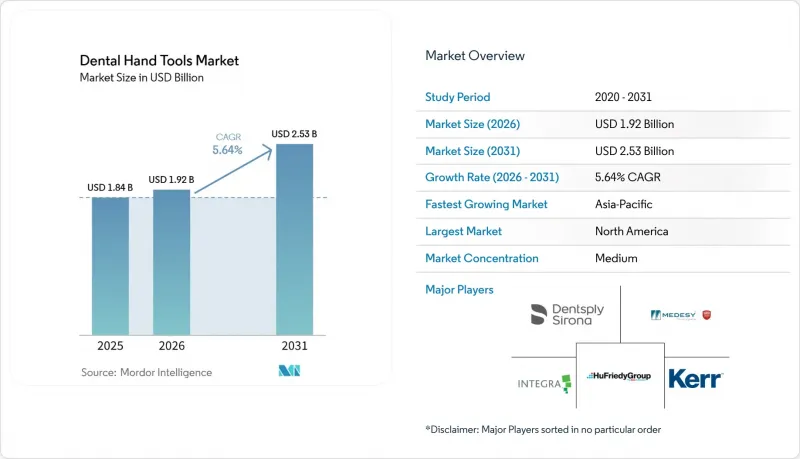
치과용 수동 기구 시장 규모는 2025년 18억 4,000만 달러로 평가되었습니다. 2026년에는 19억 2,000만 달러로 확대되어 2031년까지 25억 3,000만 달러에 이를 것으로 예측되며, 2026년부터 2031년에 걸쳐 CAGR 5.64%로 성장할 전망입니다.
본 보고서는 제품 유형(검사용, 절삭용, 치주용, 수복용, 발치용, 교정용, 치내치료용 기구), 재사용성(재사용 가능, 일회용), 최종 사용자(치과, 병원, 검사실, 기타),및 지역(북미, 유럽, 아시아태평양, 중동 및 아프리카, 남미)별로 분류되어 있습니다. 시장 예측은 금액(미 달러)으로 제시되어 있습니다.
세계의 치과용 수동 기구 시장 동향 및 인사이트
전 세계 충치 및 치주질환 부담 증가
2026년 분석에 따르면, 인구 증가와 고령화에 따라 2035년까지 충치 및 치주질환은 계속 증가할 것으로 예측됩니다. 따라서 치과용 기구 시장에는 진단용 및 치주질환 치료용 기구에 대한 견고한 임상 기반이 마련되어 있습니다. 남아시아 및 동남아시아에서는 높은 질병 부담과 치과 인프라 확충이 맞물려 있으며, 이러한 조합으로 인해 초급 수준의 검사 키트와 일상적인 치주질환 관리에 사용되는 기구 모두에 대한 수요가 증가하고 있습니다. 세계보건기구(WHO)의 ‘2023-2030년 세계 구강보건 행동 계획’ 또한 치료되지 않은 충치를 줄이고 구강보건 서비스를 확충하기 위한 정부의 이니셔티브을 뒷받침하고 있습니다.
고령화 및 수복 치료 증가
2025년 시점에서 65세 이상 성인은 미국 인구의 16.5%를 차지했으며, 2034년까지는 21.6%를 나타낼 것으로 예측됩니다. 고령 환자들은 한 번의 내원 시 여러 유형의 기구를 사용하는 수복 치료, 발치, 임플란트 관련 치료가 필요한 경우가 많습니다. 따라서 동일한 진료 키트 내에 절삭 기구, 발치 집게, 임플란트 유지 관리용 기구가 필요할 수 있습니다. 2026년 1월까지 1년 동안 미국의 치과 관련 소비 지출은 4% 증가했습니다. 또한, 임플란트 지지형 보철물의 보급에 따라 티타늄 프로브, 플라스틱 스케일러, 인접면 세정 기구에 대한 수요가 증가하고 있어 치과용 수동 기구 업계도 그 혜택을 보고 있습니다. 이러한 카테고리로 인해 기존의 발치 키트에만 국한되지 않는 조달이 필요해지면서, 진료소가 보유한 전문 제품의 수가 증가하고 있습니다.
고급 기구의 높은 가격과 총 소유 비용
프리미엄 인체공학 기반의 큐렛, 정밀 절삭 세트, 카세트 일체형 치주 치료 키트는 표준 스테인리스품보다 비쌉니다. 이러한 가격 차이는 환자가 치과 치료비의 대부분을 본인 부담해야 하는 지역에서는 장벽이 됩니다. 비용에는 멸균용 소모품, 생물학적 지표에 의한 검사, 카세트 유지보수, 그리고 합금의 피로로 인한 교체 비용도 포함됩니다. 단체 구매 제도에 참여하지 않는 독립 치과에서는 이러한 경비 계획을 수립하기 어려울 수 있습니다. 디지털 워크플로우와 CAD/CAM은 생산성을 향상시킬 수 있지만, 고가 제품 구매의 이점은 단독 진료소보다는 대규모 네트워크에서 더욱 두드러집니다. 따라서 치과용 수동 기구 시장에서는 고가 시스템에 대한 수요와 저비용 재사용 가능 기구에 대한 수요 사이에 앞으로도 차이가 나타날 것입니다.
부문별 분석
2025년 기준, 검사용 기구 시장 점유율은 22.45%를 차지했습니다. 미러, 익스플로러, 프로브는 모든 치과 전문 분야에서 환자 진료의 첫 단계에서 사용됩니다. 치주질환의 병기 분류나 치은 가장자리 평가에서 이러한 기구의 역할은 첨단 스캔 시스템을 도입한 클리닉이라 하더라도 안정적인 사용을 뒷받침하고 있습니다. 교정된 수동 프로브는 디지털 영상으로는 대체할 수 없는 촉각적 피드백을 제공합니다.
근관 치료용 기구는 2031년까지 연평균 성장률(CAGR) 6.89%를 나타낼 것으로 예측되며, 이는 제품 유형 중 가장 높은 성장률입니다. 이 카테고리는 임상의가 발치를 선택하기보다는 근관 치료를 통해 치아를 보존할 때 혜택을 받게 됩니다. 또한, 니켈-티타늄 파일 시스템은 정기적으로 교체되기 때문에 재구매 수요를 창출하고 있습니다. 교정용 기구 및 부속 기구는 체계적인 교정치과 진료 네트워크의 확장에 따라 시장이 확대되고 있습니다. ‘스마일 닥터스’는 2025년에 580곳 이상의 진료소를 운영하고 있어, 이로 인해 전문 기구에 대한 수요 기반이 확대되었습니다.
지역별 분석
2025년 시점에서 북미의 점유율은 43.67%를 차지했습니다. 2024년 미국의 치과 관련 총 지출액은 1,890억 달러에 달했으며, 2026년 1월까지 1년 동안 소비자의 치과 관련 지출은 4% 증가했습니다. 치과 서비스 기관은 대규모 진료 네트워크 전반에 걸쳐 브랜드 선정 및 구매를 표준화하고 있습니다. 하트랜드 덴탈은 2025년 기준으로 1,900개 이상의 진료소를 지원하고 있었습니다. 캐나다의 연방 치과 프로그램은 대상 주민들의 예방 및 기본 구강 보건 서비스 접근성을 확대되고 있습니다. FDA의 의료기기 규제로 인해 규정 준수 요건이 추가되는 한편, 기관 구매자가 요구하는 품질 인증도 제공되고 있습니다.
유럽은 치과용 수동 기구 시장에서 두 번째로 큰 규모를 자랑하는 지역입니다. 독일, 프랑스, 이탈리아, 스페인, 영국에서는 탄탄한 예방 및 수복 치료 체계를 통해 고품질 제품의 조달이 촉진되고 있습니다. 아시아태평양은 2031년까지 연평균 성장률(CAGR) 7.56%를 나타낼 것으로 예측됩니다. 지역 내 클리닉 네트워크가 확대됨에 따라 내구성이 뛰어나고 비용 대비 효율이 높은 재사용 가능한 세트에 대한 수요가 증가하고 있습니다. 2025년, Clove Dental은 인도에서 650개 이상의 클리닉을 운영했으며, 이는 조직화된 클리닉을 통한 구매 규모가 확대되고 있음을 보여주었습니다.
기타 혜택 :
- 엑셀 형식 시장 예측(ME) 시트
- 3개월간 애널리스트 지원
자주 묻는 질문
목차
제1장 서론
제2장 조사 방법
제3장 주요 요약
제4장 시장 구도
제5장 시장 규모 및 성장 예측
제6장 경쟁 구도
제7장 시장 기회 및 향후 전망
KTH 26.09.04According to Mordor Intelligence, the dental hand tools market size is expected to increase from USD 1.84 billion in 2025 to USD 1.92 billion in 2026 and reach USD 2.53 billion by 2031, growing at a CAGR of 5.64% over 2026-2031.
This report is Segmented by Product Type (Examination, Cutting, Periodontal, Restorative, Extraction, Orthodontic, and Endodontic Instruments), Reusability (Reusable, Disposable), End User (Dental Clinics, Hospitals, Laboratories, Others), and Geography (North America, Europe, Asia-Pacific, Middle East and Africa, South America). The Market Forecasts are Provided in Terms of Value (USD).
Global Dental Hand Tools Market Trends and Insights
Rising Global Burden of Dental Caries and Periodontal Disease
A 2026 analysis projects continuing increases in dental caries and periodontal disease through 2035 as populations grow and age. The dental hand tools market, therefore, has a durable clinical base for diagnostic and periodontal instruments. South Asia and Southeast Asia combine a high disease burden with expanding dental infrastructure. This combination raises demand for both entry-level examination sets and instruments used in routine periodontal care. The World Health Organization's Global Oral Health Action Plan for 2023-2030 also supports government action to reduce untreated caries and expand oral health services.
Aging Population and Growth in Restorative Procedures
Adults aged 65 and older represented 16.5% of the U.S. population in 2025 and are projected to represent 21.6% by 2034. Older patients often need restorative, extraction, and implant-related care that uses several instrument types in one appointment. Cutting instruments, extraction forceps, and implant maintenance tools can therefore be required within the same practice kit. U.S. consumer dental spending rose 4% in the year ending January 2026. The dental hand tools industry also benefits as implant-supported restorations increase the need for titanium probes, plastic scalers, and interproximal cleaning instruments. These categories extend procurement beyond conventional extraction kits and increase the number of specialized products held by a practice.
High Cost of Premium Instruments and Total Cost of Ownership
Premium ergonomic curettes, precision cutting sets, and cassette-integrated periodontal kits cost more than standard stainless-steel alternatives. The price difference is a barrier in regions where patients pay directly for much of their dental care. Costs also include sterilization consumables, biological indicator testing, cassette maintenance, and replacement after alloy fatigue. Independent practices outside group purchasing arrangements may find these expenses difficult to plan for. Digital workflows and CAD/CAM can improve productivity, but the case for premium purchases is stronger in large networks than in single-practice settings. The dental hand tools market will therefore continue to show a difference between demand for premium systems and demand for lower-cost reusable tools.
Other drivers and restraints analyzed in the detailed report include:
- Expansion of Dental Clinics and Organized Dental Service Networks
- Growing Demand for Preventive, Cosmetic, and Minimally Invasive Dentistry
- Sterilization, Validation, and Regulatory Compliance Burden
For complete list of drivers and restraints, kindly check the Table Of Contents.
Segment Analysis
Examination instruments held 22.45% share in 2025. Mirrors, explorers, and probes are used at the start of every patient encounter across dental specialties. Their role in periodontal staging and margin evaluation supports steady use even in clinics with advanced scanning systems. A calibrated manual probe provides tactile feedback that a digital image does not replace.
Endodontic instruments are forecast to grow at a 6.89% CAGR through 2031, the fastest rate among product types. The category benefits when clinicians preserve teeth through root canal treatment rather than choose extraction. Nickel-titanium file systems also create repeat purchasing needs because they are replaced regularly. Orthodontic and accessory instruments are expanding alongside organized orthodontic practice networks. Smile Doctors had more than 580 locations in 2025, which broadened the institutional base for specialty tools.
Complete Report Scope:
- By Product Type
- Examination Instruments
- Cutting Instruments
- Periodontal Instruments
- Restorative Instruments
- Extraction Instruments
- Orthodontic Instruments
- Endodontic Instruments
- Other Product Types
- By Reusability
- Reusable Instruments
- Disposable Instruments
- By End User
- Dental Clinics
- Dental Hospitals
- Dental Laboratories
- Others (Mobile and Community Dental Services, Academic and Research Institutes)
- By Geography
- North America
- United States
- Canada
- Mexico
- Europe
- Germany
- United Kingdom
- France
- Italy
- Spain
- Rest of Europe
- Asia-Pacific
- China
- India
- Japan
- Australia
- South Korea
- Rest of Asia-Pacific
- Middle East and Africa
- GCC
- South Africa
- Rest of Middle East and Africa
- South America
- Brazil
- Argentina
- Rest of South America
- North America
Geography Analysis
North America held 43.67% share in 2025. U.S. national dental spending reached USD 189 billion in 2024, while consumer dental spending rose 4% in the year ending January 2026. Dental service organizations are standardizing brand selection and purchasing across large practice networks. Heartland Dental supported more than 1,900 practices in 2025. Canada's federal dental program is expanding access to preventive and basic oral health services for eligible residents. FDA device regulation adds compliance requirements and also provides quality credentials sought by institutional buyers.
Europe is the second-largest regional area for the dental hand tools market. Germany, France, Italy, Spain, and the U.K. support premium procurement through strong preventive and restorative care frameworks. Asia-Pacific is forecast to grow at a 7.56% CAGR through 2031. Regional clinic networks are expanding and increasing demand for durable, cost-effective reusable sets. Clove Dental operated more than 650 clinics in India in 2025, which illustrates the growing scale of organized clinic purchasing.
- American Eagle Instruments, Inc.
- ASA Dental S.p.A.
- B. Braun
- Brasseler USA
- Carl Martin
- Coltene Holding
- Dentsply Sirona
- Harfins Instruments LLP
- Helmut Zepf Medizintechnik GmbH
- HuFriedyGroup
- Integra LifeSciences
- Jakobi Dental Instruments GmbH
- Kerr
- LM-Instruments Oy
- Medesy S.r.l.
- Nordent Manufacturing, Inc.
- Power Dental Group
- Premier Dental
- Young Innovations, Inc.
Additional Benefits:
- The market estimate (ME) sheet in Excel format
- 3 months of analyst support
TABLE OF CONTENTS
1 Introduction
- 1.1 Study Assumptions & Market Definition
- 1.2 Scope of the Study
2 Research Methodology
3 Executive Summary
4 Market Landscape
- 4.1 Market Overview
- 4.2 Market Drivers
- 4.2.1 Rising Global Burden of Dental Caries and Periodontal Disease
- 4.2.2 Aging Population and Growth in Restorative Procedures
- 4.2.3 Expansion of Dental Clinics and Organized Dental Service Networks
- 4.2.4 Growing Demand for Preventive, Cosmetic, and Minimally Invasive Dentistry
- 4.2.5 Instrument Tracking and Digital Reprocessing Workflows
- 4.2.6 Demand for High-Tactility Instruments in Digitally Planned Procedures
- 4.3 Market Restraints
- 4.3.1 High Cost of Premium Instruments and Total Cost of Ownership
- 4.3.2 Sterilization, Validation, and Regulatory Compliance Burden
- 4.3.3 Counterfeit and Low-Quality Instrument Leakage Through Fragmented Distribution
- 4.3.4 SKU-Level Supply Volatility for Specialty Alloys and Replacement Tips
- 4.4 Supply-Chain Analysis
- 4.5 Regulatory Landscape
- 4.6 Technological Outlook
- 4.7 Porter's Five Forces Analysis
- 4.7.1 Threat of New Entrants
- 4.7.2 Bargaining Power of Suppliers
- 4.7.3 Bargaining Power of Buyers
- 4.7.4 Threat of Substitutes
- 4.7.5 Industry Rivalry
5 Market Size & Growth Forecasts (Value, USD)
- 5.1 By Product Type
- 5.1.1 Examination Instruments
- 5.1.2 Cutting Instruments
- 5.1.3 Periodontal Instruments
- 5.1.4 Restorative Instruments
- 5.1.5 Extraction Instruments
- 5.1.6 Orthodontic Instruments
- 5.1.7 Endodontic Instruments
- 5.1.8 Other Product Types
- 5.2 By Reusability
- 5.2.1 Reusable Instruments
- 5.2.2 Disposable Instruments
- 5.3 By End User
- 5.3.1 Dental Clinics
- 5.3.2 Dental Hospitals
- 5.3.3 Dental Laboratories
- 5.3.4 Others (Mobile and Community Dental Services, Academic and Research Institutes)
- 5.4 By Geography
- 5.4.1 North America
- 5.4.1.1 United States
- 5.4.1.2 Canada
- 5.4.1.3 Mexico
- 5.4.2 Europe
- 5.4.2.1 Germany
- 5.4.2.2 United Kingdom
- 5.4.2.3 France
- 5.4.2.4 Italy
- 5.4.2.5 Spain
- 5.4.2.6 Rest of Europe
- 5.4.3 Asia-Pacific
- 5.4.3.1 China
- 5.4.3.2 India
- 5.4.3.3 Japan
- 5.4.3.4 Australia
- 5.4.3.5 South Korea
- 5.4.3.6 Rest of Asia-Pacific
- 5.4.4 Middle East and Africa
- 5.4.4.1 GCC
- 5.4.4.2 South Africa
- 5.4.4.3 Rest of Middle East and Africa
- 5.4.5 South America
- 5.4.5.1 Brazil
- 5.4.5.2 Argentina
- 5.4.5.3 Rest of South America
- 5.4.1 North America
6 Competitive Landscape
- 6.1 Market Concentration
- 6.2 Market Share Analysis
- 6.3 Company Profiles {(includes Global level Overview, Market level overview, Core Segments, Financials as available, Strategic Information, Market Rank/Share for key companies, Products & Services, and Recent Developments)}
- 6.3.1 American Eagle Instruments, Inc.
- 6.3.2 ASA Dental S.p.A.
- 6.3.3 B. Braun SE
- 6.3.4 Brasseler USA
- 6.3.5 Carl Martin GmbH
- 6.3.6 COLTENE Holding AG
- 6.3.7 Dentsply Sirona
- 6.3.8 Harfins Instruments LLP
- 6.3.9 Helmut Zepf Medizintechnik GmbH
- 6.3.10 HuFriedyGroup
- 6.3.11 Integra LifeSciences Corporation
- 6.3.12 Jakobi Dental Instruments GmbH
- 6.3.13 Kerr Corporation
- 6.3.14 LM-Instruments Oy
- 6.3.15 Medesy S.r.l.
- 6.3.16 Nordent Manufacturing, Inc.
- 6.3.17 Power Dental Group
- 6.3.18 Premier Dental Co.
- 6.3.19 Young Innovations, Inc.
7 Market Opportunities & Future Outlook
- 7.1 White-space & unmet-need assessment


