
|
시장보고서
상품코드
2118970
합성지 시장 : 시장 점유율 분석, 업계 동향 및 통계, 성장 예측(2026-2031년)Synthetic Paper - Market Share Analysis, Industry Trends & Statistics, Growth Forecasts (2026 - 2031) |
||||||
 Mordor Intelligence
Mordor Intelligence에 의하면, 합성지 시장 규모는 2025년에 11억 3,000만 달러로 평가되었고, 2026년 11억 8,000만 달러에서 2031년까지 15억 9,000만 달러에 이를 것으로 예측됩니다. 예측 기간(2026-2031년) CAGR은 6.15%를 나타낼 전망입니다.
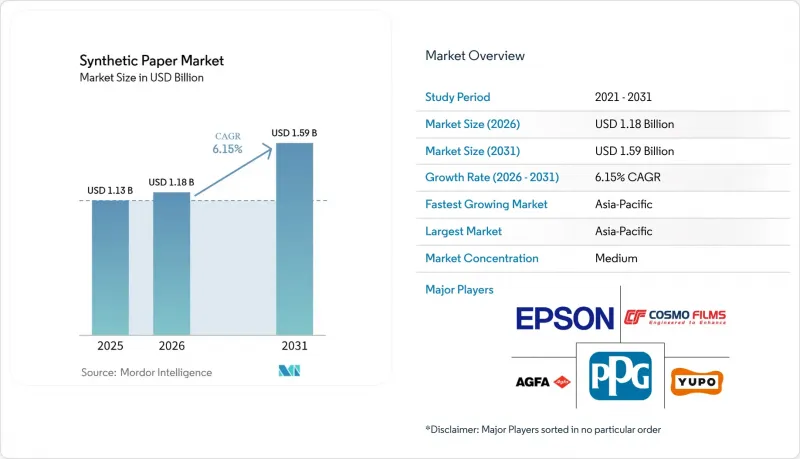
본 보고서는 소재 유형별(폴리프로필렌(PP), 폴리에틸렌(PE) 등), 두께별(얇은 두께, 중간 두께 등), 용도별(라벨, 포장, 인쇄 등), 최종 사용자 산업별(식품 및 음료, 소비재 등), 지역별(아시아태평양, 북미, 유럽, 남미, 중동 및 아프리카)로 분류되어 있습니다. 시장 예측은 금액(달러) 기준으로 제시되어 있습니다.
세계의 합성지 시장 동향 및 인사이트
기존 종이에서 내수성 및 내화학성을 갖춘 합성 기판으로의 전환이 진행되고 있습니다.
라벨이 습기, 기계적 마모 또는 화학 물질과의 접촉에 노출되는 경우, 기존의 셀룰로오스 종이는 적합하지 않습니다. 폴리프로필렌 및 고밀도 폴리에틸렌 등급은 콜드체인 취급, 화학 처리, 실외 사용 시 내구성이 뛰어난 인쇄와 안정적인 접착력이 요구되는 상황에서 사용됩니다. 구매자가 라벨의 구매 가격뿐만 아니라 라벨 결함으로 인한 비용도 고려하게 되면, 합성지 시장은 그 혜택을 누리게 됩니다. 재인쇄, 수선, 출하 지연, 규정 준수 위험 등을 고려할 때, 내구성이 더 뛰어난 소재를 채택하는 것이 상업적으로 타당해집니다. Avery Dennison은 도축장 태그, 원예용 루프 어라운드 태그, 가스통 식별 등 내구성이 뛰어난 라벨이 필요한 광범위한 용도에 대응하는 ‘Fasson’ 합성지 제품을 제공합니다. 이러한 요건은 운송, 보관, 반복적인 취급 과정에서도 가독성을 유지해야 하는 산업용 공급망에서 특히 중요합니다.
식품, 음료, 퍼스널케어, 소비재 포장에서 프리미엄 라벨의 채택 확대
식품 및 음료는 제품당 라벨 사용량이 많으며, 까다로운 유통 조건에 직면해 있습니다. 냉장 상품은 결로, 온도 변화, 취급 시 마찰에 노출되며, 이러한 요인들이 종이 라벨을 열화시켜 바코드 판독률을 저하시킬 수 있습니다. 합성 기판은 식품, 음료, 퍼스널케어, 가정용품 포장에서 시각적 품질과 실용적인 성능을 뒷받침합니다. 이러한 요구 사항은 제조부터 창고 내 취급, 소매점 진열에 이르기까지 라벨의 판독 가능성을 유지해야 하는 경우에 특히 두드러집니다. 코스모 퍼스트(Cosmo First)는 2025 회계연도에 포토앨범 용도로 사용되는 HP Indigo 호환 합성지를 출시했습니다. 이는 인쇄 품질 향상에 대한 수요가 사진과 같은 사실적인 표현이 요구되는 소비자용 제품 분야로도 확대되고 있음을 보여줍니다. 또한, 습기에 노출되는 용기 위에서도 내구성을 유지하는 프리미엄 마감 처리를 원하는 브랜드 소유자들의 존재 역시 합성지 시장의 성장에 기여하고 있습니다.
기존 종이 제품에 비해 높은 생산 비용
합성지의 생산 비용은 동등한 중량의 코팅 셀룰로오스 용지에 비해 2배에서 4배 더 높습니다. 이 차이는 에너지를 대량으로 소비하는 이축 연신 가공, 석유화학 수지의 투입, 그리고 인쇄에 필요한 표면 처리에 기인합니다. 이러한 제약은 남아시아, 동남아시아 및 사하라 이남 아프리카에서 가장 두드러지며, 이 지역에서는 변환업체들이 종종 좁은 이익 마진으로 운영되고 있어 구매자들이 단가에 세심한 주의를 기울이고 있습니다. 총 비용을 면밀히 검토하면, 라벨 교체, 재작업 및 불량으로 인한 비용을 고려함으로써, 언뜻 비싸게 보이는 비용 차이를 줄일 수 있습니다. 그러나 많은 조달 프로세스에서는 여전히 이러한 운영 비용이 고려되기 전에 자재 비교가 이루어지고 있습니다. Avery Dennison은 2025 회계연도 결산 보고서에서 무역 정책의 불확실성과 그로 인한 영향을 잠재적 위험으로 지목했으며, 이로 인해 수지 조달 계획은 더욱 복잡해지고 있습니다.
부문별 분석
2025년, 폴리프로필렌(PP)은 합성지 시장 매출의 56.82%를 차지하며 최대 소재 카테고리가 되었습니다. 이러한 위상은 오프셋, 플렉소, 디지털 인쇄 등 다양한 인쇄 방식을 아우르는 컨버터들 사이에서 널리 선호되고 있다는 점에 기인합니다. 또한, PP는 포장 용도에서 폴리프로필렌 재활용 흐름에 대한 선호도가 높아지는 추세와도 부합합니다. Nan Ya Plastics사는 두께 35μm에서 800μm에 이르는 PEPA 및 CAPA PP 합성지 등급을 제공합니다. 이 회사는 ISO 9001, ISO 14001 및 ISO 45001 인증을 획득했습니다. 이러한 폭넓은 제품 라인업을 통해 단일 소재 플랫폼으로 라벨, 시트, 산업용 문서 및 두꺼운 용도까지 대응할 수 있습니다.
PET는 2031년까지 연평균 성장률(CAGR) 6.93%를 나타낼 것으로 예측되며, 이는 합성지 시장에서 소재 유형 중 가장 높은 성장률입니다. PET는 의약품 일련번호 관리, 자동차 엔진룸 내 태그, 그리고 고온 환경에서도 치수 안정성이 필수적인 고급 라벨에 적합합니다. TOYOBO, LINTEC 및 Polyart는 잉크의 접착력을 향상시키는 코팅 제품을 통해 PET 기반의 특수 용도에 대응하고 있습니다. PE는 소프트 스퀴즈 용기용 라벨 및 저온 콜드체인 용도에서 여전히 중요한 위치를 차지하고 있습니다. PVC의 경우, 고객들이 PVC가 포함되지 않은 대체재를 요구하는 움직임이 강해지면서 압박을 받고 있습니다. 코스모 퍼스트는 2025년도에 정전기 방지 및 블록 방지 기능을 갖춘 PVC 프리 합성지 등급을 시장에 출시했습니다. 다층 하이브리드를 포함한 기타 소재는 성능이 가격 프리미엄을 정당화하는 틈새 보안 용도 및 산업용도에서 계속해서 활용되고 있습니다.
2025년, 중후 두께 등급은 합성지 시장 점유율의 41.33%를 차지했습니다. 이러한 위상은 컷 앤 스택 라벨, 감압식 표면재 및 단매 상업 인쇄 분야에서 강도, 인쇄 적합성, 비용의 균형이 잘 잡혀 있음을 반영합니다. 이러한 등급은 큰 변형 없이 기계적 다이 커팅을 견딜 수 있어, 대량 생산되는 식품 및 음료 라벨에서 1제곱미터당 재료 사용량을 절감합니다. 두꺼운 등급은 옥외 간판, 라미네이팅 처리된 보안 문서 및 산업용 작업 지시서에 사용됩니다. PPG 테슬린(Teslin)과 폴리아트(Polyart)는 더 두꺼운 소재가 필요한 성능을 뒷받침하는 사양 주도형 용도와 관련이 있습니다.
얇은 등급은 2031년까지 연평균 성장률(CAGR) 6.57%로 확대될 것으로 예측됩니다. 디지털 인쇄의 보급과 더 가벼운 기판이면서도 필름과 같은 외관을 원하는 수요가 이러한 성장을 뒷받침하고 있습니다. 60μm 미만의 등급은 표면 외관이나 곡면 용기와의 밀착성이 중요한 ‘라벨리스 스타일’의 와인, 증류주, 퍼스널케어 제품 포장에 사용됩니다. 또한 소매업 및 외식 산업에서 사용되는 ‘진열대 진열용’ 포맷에도 대응하고 있습니다. 이러한 추세로 인해 기존 시트나 라벨 형식에 최적화되어 있던 중두께 등급은 압박을 받고 있습니다. 따라서 합성지 시장에서의 제품 개발은 최신 인쇄 장비로 얇은 소재를 처리할 수 있는 코팅 및 표면 처리에 중점을 두고 있습니다.
지역별 분석
아시아태평양은 2025년 합성지 시장 매출의 43.61%를 차지한 것으로 평가되었으며, 2031년까지 연평균 성장률(CAGR) 7.03%로 확대될 것으로 전망됩니다. 중국은 BOPP 및 HDPE 필름의 생산 거점, 활발한 전자상거래, 콜드체인 구축, 그리고 소비재 라벨에 대한 막대한 수요로 인해 이 지역 수요를 주도하고 있습니다. 인도에서는 인쇄 품질과 내구성을 겸비한 소재가 요구되는 규정 준수 라벨, 식품 라벨,및 의약품 수출 요건으로 인해 시장이 확대되고 있습니다. 이러한 요인들로 인해 단순한 경제 성장률만으로는 예측할 수 없는 수준 수요가 발생하고 있습니다. Cosmo First의 보고서에 따르면, 2025년도 총 매출액 중 수출이 52%를 차지하고 있어, 해당 지역이 제조 거점인 동시에 수출 플랫폼으로서의 역할도 수행하고 있음이 부각되고 있습니다.
북미와 유럽은 각각 2위와 3위의 규모를 자랑하는 지역으로, 보다 고급화된 용도 구성과 더 복잡한 규제 환경이 특징입니다. 북미의 RFID 대응 라벨 수요는 소매업의 재고 가시화 요건과 의약품 일련번호 부여 요건에 의해 뒷받침되고 있습니다. 에이버리 데니슨의 머티리얼 그룹은 2025 회계연도에 60억 9,330만 달러의 순매출을 기록했으며, 2024-2025년 미국, 유럽, 아시아태평양에서 제조 역량에 대한 투자를 진행했습니다. 2025년 11월 인도에 RFID 인레이 및 라벨 생산 거점이 개설된 것은 해당 지역의 라벨 수요 증가에 대응하기 위한 노력을 반영한 것입니다. 유럽에서는 ‘포장 및 포장 폐기물 규정(PPWR)’이 이중의 효과를 가져오고 있습니다. 즉, 재활용이 불가능한 다층 소재의 선택지를 제한하는 한편, 재활용이 가능한 PP 등급의 합성 기재를 지원하고 있습니다.
남미, 중동 및 아프리카는 수요 규모는 작지만, 그 용도는 전략적으로 중요할 수 있습니다. 브라질은 식품 가공, 소비재, 농산물의 라벨링을 통해 남미의 소비를 주도하고 있습니다. 수지 수입 비용의 상승과 현지 셀룰로오스계 대체재의 확보 어려움이 해당 지역의 성장을 제약하고 있습니다. 중동 및 아프리카에서는 석유 및 가스 자산 태그, 건설 관련 문서, 항만 물류 라벨 등 인프라 관련 용도에 대한 의존도가 높습니다. 라벨은 열, 마모, 가혹한 취급 조건에 노출될 가능성이 있으므로, 이러한 용도에서는 실외 내구성이 매우 중요합니다. 사우디아라비아의 물류 프로그램과 아프리카 도시 지역의 콜드체인 시스템 확대는 내구성이 뛰어난 라벨 소재가 향후 채택될 수 있는 여건을 마련하고 있습니다.
기타 혜택 :
- 엑셀 형식 시장 예측(ME) 시트
- 3개월간의 애널리스트 지원
자주 묻는 질문
목차
제1장 서론
제2장 조사 방법
제3장 개요
제4장 시장 구도
제5장 시장 규모 및 성장 예측
제6장 경쟁 구도
제7장 시장 기회 및 향후 전망
AJY 26.09.01According to Mordor Intelligence, the synthetic paper market size was estimated at USD 1.13 billion in 2025 and is estimated to grow from USD 1.18 billion in 2026 to reach USD 1.59 billion by 2031, at a CAGR of 6.15% during the forecast period (2026-2031).
This report is Segmented by Material Type (Polypropylene (PP), Polyethylene (PE), and More), Thickness (Thin, Medium, and More), Application (Labels, Packaging, Printing, and More), End-User Industry (Food and Beverage, Consumer Goods, and More) and Geography (Asia-Pacific, North America, Europe, South America, and Middle-East and Africa). The Market Forecasts are Provided in Terms of Value (USD).
Global Synthetic Paper Market Trends and Insights
Increasing Shift from Conventional Paper to Waterproof and Chemical-Resistant Synthetic Substrates
Conventional cellulose paper becomes unsuitable when labels are exposed to moisture, mechanical wear, or chemical contact. Polypropylene and high-density polyethylene grades are used in settings that require durable print and stable adhesion during cold-chain handling, chemical processing, and outdoor use. The synthetic paper market benefits when buyers consider the cost of a failed label rather than the facestock purchase price alone. Replacement printing, rework, delayed shipment, and compliance risk can make a more durable material commercially justified. Avery Dennison offers Fasson synthetic paper products for applications including slaughterhouse tags, horticultural loop-around tags, and gas bottle identification, demonstrating the breadth of applications that require durable labeling. These requirements are strongest in industrial supply chains where legibility must remain intact through transport, storage, and repeated handling.
Rising Adoption of Premium Labels in Food, Beverage, Personal Care, and Consumer Goods Packaging
Food and beverages account for high label use per product and face challenging distribution conditions. Refrigerated goods are exposed to condensation, temperature changes, and handling friction, which can weaken paper labels and reduce barcode readability. Synthetic substrates support visual quality and practical performance in packaging for food, beverages, personal care, and household goods. The need is particularly clear when a label must remain readable from production through warehouse handling and retail display. Cosmo First introduced HP Indigo-printable synthetic paper for photo album applications in Fiscal Year (FY) 2025, indicating that demand for enhanced print quality also extends to photo-realistic consumer formats. The synthetic paper market also benefits from brand owners seeking premium finishes that remain durable on containers exposed to moisture.
Higher Production Costs Compared with Conventional Paper Products
Synthetic paper carries a production cost premium of 2x to 4x over comparable-weight coated cellulose paper. This difference reflects energy-intensive biaxial orientation, petrochemical resin inputs, and surface treatments required for printing. This constraint is most significant in South Asia, Southeast Asia, and Sub-Saharan Africa, where converters often operate with narrow margins and buyers focus closely on unit prices. A total-cost review can narrow the apparent premium when it accounts for replacement labels, rework, and failure costs. However, many procurement processes still compare materials before those operational costs are considered. Avery Dennison identified trade-policy uncertainty and related effects as potential risks in its FY2025 filing, further complicating resin procurement planning.
Other drivers and restraints analyzed in the detailed report include:
- Expanding Use of Synthetic Paper in Outdoor, Industrial, and Harsh Environmental Applications
- Increasing Adoption of Digital Printing and Short-Run Customized Printing Applications
- Limited Recyclability of Certain Polymer-Based Synthetic Paper Grades
For complete list of drivers and restraints, kindly check the Table Of Contents.
Segment Analysis
Polypropylene accounted for 56.82% of the synthetic paper market revenue in 2025, making it the largest material category. Its position is supported by wide familiarity among converters across offset, flexographic, and digital printing formats. PP also aligns with the growing preference for polypropylene recycling streams in packaging applications. Nan Ya Plastics offers PEPA and CAPA PP synthetic paper grades across thicknesses from 35 μm to 800 μm. The company holds ISO 9001, ISO 14001, and ISO 45001 certifications. This range allows a single material platform to serve labels, sheets, industrial documents, and heavier applications.
PET is projected to grow at a 6.93% CAGR through 2031, the highest rate among material types in the synthetic paper market. It is suited to pharmaceutical serialization, automotive underhood tags, and luxury labels where dimensional stability under heat is essential. TOYOBO, LINTEC, and Polyart address PET-based specialty applications through coated products that improve ink adhesion. PE remains relevant for soft-squeezed container labels and low-temperature cold-chain use. PVC faces pressure as customers seek PVC-free alternatives; Cosmo First introduced static-free and block-free PVC-free synthetic paper grades in FY2025. Other materials, including multilayer hybrids, continue to serve narrow security and industrial applications where performance justifies a price premium.
Medium grades held 41.33% of the synthetic paper market share in 2025. Their position reflects a balance of strength, runnability, and cost for cut-and-stack labels, pressure-sensitive facestocks, and sheet-fed commercial print. They can withstand mechanical die-cutting without substantial distortion and limit material use per square meter in high-volume food and beverage labeling. Thick grades are used for outdoor signage, laminated security documents, and industrial job cards. PPG Teslin and Polyart are associated with specification-driven applications where higher material thickness supports the required performance.
Thin grades are forecast to expand at a 6.57% CAGR through 2031. Digital printing adoption and demand for a film-like appearance at lower substrate weight support this growth. Grades below 60 μm are used for no-label-look wine, spirits, and personal care packaging, where surface appearance and conformance to curved containers are important. They also support shelf-ready formats used in retail and food service. This trend places pressure on medium grades that were optimized for conventional sheet and label formats. Product development in the synthetic paper market is accordingly focused on coatings and surfaces that support thin materials on contemporary printing equipment.
Complete Report Scope:
- By Material Type
- Polypropylene (PP)
- Polyethylene (PE)
- Polyethylene Terephthalate (PET)
- Polyvinyl Chloride (PVC)
- Other Material Types
- By Thickness
- Thin
- Medium
- Thick
- Ultra-Thick
- By Application
- Labels
- Packaging
- Printing
- Stationery
- Other Applications
- By End-User Industry
- Food and Beverage
- Consumer Goods
- Pharmaceuticals
- Electronics
- Industrial
- Commercial & Retail
- Logistics and Transportation
- Other End-User Industries
- By Geography
- Asia-Pacific
- China
- India
- Japan
- South Korea
- Rest of Asia-Pacific
- North America
- United States
- Canada
- Mexico
- Europe
- Germany
- United Kingdom
- France
- Italy
- Russia
- Rest of Europe
- South America
- Brazil
- Argentina
- Rest of South America
- Middle-East and Africa
- Saudi Arabia
- South Africa
- Rest of Middle-East and Africa
- Asia-Pacific
Geography Analysis
Asia-Pacific accounted for 43.61% of the synthetic paper market revenue in 2025 and is projected to expand at a 7.03% CAGR through 2031. China is central to regional demand due to its BOPP and HDPE film manufacturing base, extensive e-commerce activity, cold-chain development, and high consumer-goods label volumes. India is growing through compliance labeling, food labeling, and pharmaceutical export requirements that demand print-quality, durable materials. These factors drive demand beyond what broad economic growth alone would indicate. Cosmo First reported that exports accounted for 52% of total FY2025 sales, underscoring the region's role as both a manufacturing center and an export platform.
North America and Europe are the second- and third-largest regions, with a more premium application mix and greater regulatory complexity. North American demand for RFID-enabled labels is supported by retail inventory visibility requirements and pharmaceutical serialization requirements. Avery Dennison's Materials Group reported net sales of USD 6,093.3 million in FY2025 and invested in manufacturing capacity across the United States, Europe, and Asia-Pacific during 2024 and 2025. The opening of an RFID inlay and label production site in India in November 2025 reflects efforts to serve growing label demand in the region. In Europe, the Packaging and Packaging Waste Regulation (PPWR) has a dual effect: it limits non-recyclable multilayer options while supporting recyclable PP-grade synthetic substrates.
South America, the Middle East, and Africa represent smaller demand bases, though their applications can be strategically significant. Brazil drives South American consumption through food processing, consumer goods, and agricultural-product labeling. Higher resin import costs and the availability of local cellulose alternatives constrain regional growth. The Middle East and Africa rely more heavily on infrastructure-related applications, including oil and gas asset tags, construction documents, and port logistics labels. Outdoor durability is central to these applications, as labels may be exposed to heat, abrasion, and difficult handling conditions. Logistics programs in Saudi Arabia and the expansion of cold-chain systems across African urban centers create conditions for future adoption of durable labeling materials.
- Agfa-Gevaert Group
- Avery Dennison Corporation
- Cosmo Films
- Dai Nippon Printing Co., Ltd.
- HOP Industries Corporation
- LINTEC Corporation
- Mativ Inc.
- Nan Ya Plastics Corporation
- Polyart
- PPG Industries, Inc.
- Profol GmbH
- Seiko Epson Corporation
- Sihl GmbH
- TOYOBO CO., LTD.
- UPM Specialty Papers
- YUPO Co., Ltd.
Additional Benefits:
- The market estimate (ME) sheet in Excel format
- 3 months of analyst support
TABLE OF CONTENTS
1 Introduction
- 1.1 Study Assumptions and Market Definition
- 1.2 Scope of the Study
2 Research Methodology
3 Executive Summary
4 Market Landscape
- 4.1 Market Overview
- 4.2 Market Drivers
- 4.2.1 Increasing Shift from Conventional Paper to Waterproof and Chemical-Resistant Synthetic Substrates
- 4.2.2 Rising Adoption of Premium Labels in Food, Beverage, Personal Care, and Consumer Goods Packaging
- 4.2.3 Expanding Use of Synthetic Paper in Outdoor, Industrial, and Harsh Environmental Applications
- 4.2.4 Growing Preference for Sustainable and PVC-Free Synthetic Paper Solutions
- 4.2.5 Increasing Adoption of Digital Printing and Short-Run Customized Printing Applications
- 4.3 Market Restraints
- 4.3.1 Higher Production Costs Compared with Conventional Paper Products
- 4.3.2 Limited Recyclability of Certain Polymer-Based Synthetic Paper Grades
- 4.3.3 Availability of Lower-Cost Conventional Paper and Plastic Alternatives
- 4.4 Value Chain Analysis
- 4.5 Porter's Five Forces Analysis
- 4.5.1 Threat of New Entrants
- 4.5.2 Bargaining Power of Suppliers
- 4.5.3 Bargaining Power of Buyers
- 4.5.4 Threat of Substitutes
- 4.5.5 Competitive Rivalry
5 Market Size and Growth Forecasts (Value)
- 5.1 By Material Type
- 5.1.1 Polypropylene (PP)
- 5.1.2 Polyethylene (PE)
- 5.1.3 Polyethylene Terephthalate (PET)
- 5.1.4 Polyvinyl Chloride (PVC)
- 5.1.5 Other Material Types
- 5.2 By Thickness
- 5.2.1 Thin
- 5.2.2 Medium
- 5.2.3 Thick
- 5.2.4 Ultra-Thick
- 5.3 By Application
- 5.3.1 Labels
- 5.3.2 Packaging
- 5.3.3 Printing
- 5.3.4 Stationery
- 5.3.5 Other Applications
- 5.4 By End-User Industry
- 5.4.1 Food and Beverage
- 5.4.2 Consumer Goods
- 5.4.3 Pharmaceuticals
- 5.4.4 Electronics
- 5.4.5 Industrial
- 5.4.6 Commercial & Retail
- 5.4.7 Logistics and Transportation
- 5.4.8 Other End-User Industries
- 5.5 By Geography
- 5.5.1 Asia-Pacific
- 5.5.1.1 China
- 5.5.1.2 India
- 5.5.1.3 Japan
- 5.5.1.4 South Korea
- 5.5.1.5 Rest of Asia-Pacific
- 5.5.2 North America
- 5.5.2.1 United States
- 5.5.2.2 Canada
- 5.5.2.3 Mexico
- 5.5.3 Europe
- 5.5.3.1 Germany
- 5.5.3.2 United Kingdom
- 5.5.3.3 France
- 5.5.3.4 Italy
- 5.5.3.5 Russia
- 5.5.3.6 Rest of Europe
- 5.5.4 South America
- 5.5.4.1 Brazil
- 5.5.4.2 Argentina
- 5.5.4.3 Rest of South America
- 5.5.5 Middle-East and Africa
- 5.5.5.1 Saudi Arabia
- 5.5.5.2 South Africa
- 5.5.5.3 Rest of Middle-East and Africa
- 5.5.1 Asia-Pacific
6 Competitive Landscape
- 6.1 Market Concentration
- 6.2 Strategic Moves
- 6.3 Market Share (%)/Ranking Analysis
- 6.4 Company Profiles (includes Global Overview, Market Overview, Core Segments, Financials as available, Strategic Information, Products and Services, and Recent Developments)
- 6.4.1 Agfa-Gevaert Group
- 6.4.2 Avery Dennison Corporation
- 6.4.3 Cosmo Films
- 6.4.4 Dai Nippon Printing Co., Ltd.
- 6.4.5 HOP Industries Corporation
- 6.4.6 LINTEC Corporation
- 6.4.7 Mativ Inc.
- 6.4.8 Nan Ya Plastics Corporation
- 6.4.9 Polyart
- 6.4.10 PPG Industries, Inc.
- 6.4.11 Profol GmbH
- 6.4.12 Seiko Epson Corporation
- 6.4.13 Sihl GmbH
- 6.4.14 TOYOBO CO., LTD.
- 6.4.15 UPM Specialty Papers
- 6.4.16 YUPO Co., Ltd.
7 Market Opportunities and Future Outlook
- 7.1 White-Space and Unmet-Need Assessment