

|
시장보고서
상품코드
2118973
아세토니트릴 시장 : 시장 점유율 분석, 업계 동향 및 통계, 성장 예측(2026-2031년)Acetonitrile - Market Share Analysis, Industry Trends & Statistics, Growth Forecasts (2026 - 2031) |
||||||
 Mordor Intelligence
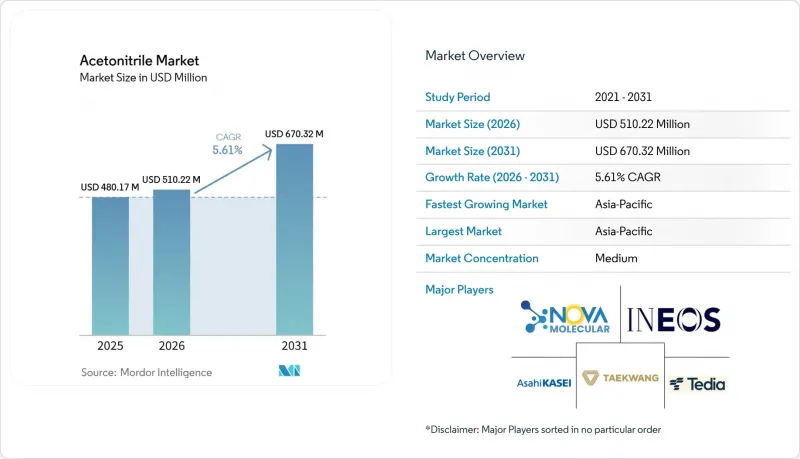
Mordor Intelligence에 의하면, 아세토니트릴 시장 규모는 2025년 4억 8,017만 달러로 평가되었고, 2026년에는 5억 1,022만 달러로 추정되고, 2026-2031년 CAGR 5.61%로 성장을 지속할 전망이며, 2031년에는 6억 7,032만 달러에 이를 것으로 예상되고 있습니다.
본 보고서는 등급별(산업용 등급, 전자용 등급 등), 순도 수준별(무수, 표준 순도 등), 용도별(용매, 시약 등), 최종 사용자 산업별(제약, 화학 제조 등), 지역별(아시아태평양, 북미, 유럽, 남미, 중동 및 아프리카)로 분류되어 있습니다. 시장 전망은 금액(달러) 기준으로 제시되어 있습니다.
세계의 아세토니트릴 시장 동향 및 인사이트
의약품 제조 및 합성 분야에서 고순도 아세토니트릴 수요 증가
제약 제조 분야에서 아세토니트릴에 대한 수요는 기존의 고속 액체 크로마토그래피(HPLC) 및 원료의약품(API) 용도를 넘어 확대되고 있습니다. 글루카곤 유사 펩티드-1(GLP-1) 수용체 작용제 및 안티센스 요법에 관한 연구를 포함한 고체상 올리고뉴클레오티드 합성에는 대량의 고순도 용매가 필요합니다. 이러한 워크플로우에서 아세토니트릴의 사용량은 많은 기존 저분자 공정과 비교하여 생산량 1Kg당 더 높은 수준입니다. SK Pharmteco, Ionis Pharmaceuticals 및 GEA는 올리고뉴클레오티드 합성 공정에서 발생하는 아세토니트릴의 산업적 회수 및 재사용 방법을 평가하고 있으며, 그 공급 확보가 제약 제조업체에게 제조상의 우려 사항이 되고 있음이 밝혀졌습니다. 위탁 개발 및 제조 기관(CDMO) 역시 일관된 품질 등급, 추적성 및 완벽한 현행 우수 제조 기준(cGMP) 문서를 필요로 합니다. 용매 잔류물에 관한 미국 식품의약국(FDA) 및 유럽의약품청(EMA)의 요구 사항으로 인해, 규제 사양을 충족하는 의약품 등급 및 HPLC 등급에 대한 수요가 더욱 증가하고 있습니다.
HPLC 및 분석 실험실용도에서의 아세토니트릴 채택 확대
아세토니트릴 시장은 HPLC 및 액체 크로마토그래피-질량 분석(LC-MS) 분석에서 확립된 역할 덕분에 혜택을 보고 있습니다. 자외선 투과성, 낮은 점도, 물과의 호환성 덕분에 의약품 및 바이오 분석법에서 이동상으로 적합합니다. 초고속 액체 크로마토그래피(UHPLC)로의 전환에 따라 분석 사이클당 용매 사용량이 증가하고 있습니다. 이는 이러한 장비가 더 높은 압력 하에서 더 미세한 입자의 컬럼을 사용하여 작동하기 때문입니다. 규제 대상 연구소에서는 검증된 분석법에서 일관된 성능을 발휘하는 고순도 물질을 사용해야 합니다. 이러한 요건으로 인해 일회성 구매는 제한되며, 적합성 평가 절차를 완료한 공급업체가 우선적으로 선정됩니다. 인도 및 한국의 제약 품질 관리 연구소 증가가 분석용 등급 아세토니트릴 수요를 견인하고 있습니다.
아세토니트릴 취급 및 보관에 관한 엄격한 보건·안전·환경 규제
유럽연합(EU) 규정에서는 아세토니트릴을 제2류 가연성 액체로 분류하고 있으며, 경구, 경피 및 흡입에 의한 급성 위험성이 지적되고 있습니다. 이러한 요건으로 인해 보관, 근로자 보호, 취급 장비 및 폐기물 처리에 드는 비용이 증가합니다. 소규모 연구소의 경우, 중앙 집중식 용매 회수 시스템을 이용할 수 없다면 더 높은 비용을 부담하게 됩니다. 북미 및 유럽의 많은 제약 시설에서는 이미 확립된 회수 및 규정 준수 프로그램이 운영되고 있으므로, 이러한 부담은 지역에 따라 다릅니다. 신규 공급업체는 인증을 받기 전에 화학 물질 관련 문서 및 유해 물질 규정 준수 증빙 자료를 제출해야 하며, 이로 인해 리드 타임이 길어지고 인증 공급업체에 대한 의존도가 높아질 가능성이 있습니다.
부문 분석
2025년 기준, 산업용 등급은 아세토니트릴 시장 점유율의 46.52%를 차지했습니다. 이 등급은 비용과 안정적인 공급이 중요한 화학 합성, 농약 추출 및 전기화학 공정에 사용됩니다. 많은 산업용도에서는 불순물 수준을 가능한 한 낮게 유지할 필요가 없기 때문에 이 등급은 여전히 아세토니트릴 시장의 기반을 이루고 있습니다. 이러한 폭넓은 용도 기반이 화학 처리가 이루어지는 각 지역 수요를 뒷받침하고 있습니다. 그러나 산업용 등급 제품은 아시아 생산자들이 공급하는 표준 등급 제품과 직접 경쟁하고 있어, 구매자가 특별한 인증서를 요구하지 않는 경우 이익 마진을 압박할 가능성이 있습니다. 따라서 산업용 공급업체는 판매량과 업무 효율성을 높이기 위한 투자 간의 균형을 맞추어야 합니다. 이 등급은 아세토니트릴 시장에서 실질적인 수요의 상당 부분을 계속 차지하고 있습니다.
전자용 등급은 2026-2031년 연평균 성장률(CAGR) 6.47%를 나타낼 것으로 예측됩니다. 이 등급은 금속 불순물이 1 ppb 미만이어야 하는 반도체 용도에 대응하는 것으로, 이러한 사양은 전용 정제 및 품질 관리 시스템 없이는 표준 산업용 등급 제품으로는 충족할 수 없습니다. 밀리포어 시그마(Millipore Sigma)는 배터리 용도로 미량 금속 순도 99.999%의 전자 등급 아세토니트릴을 판매하고 있습니다. 인증된 품질 기록과 용도별 보증을 통해 이 소재는 더 높은 판매 가격을 실현하고 있습니다. 전자 등급 생산 능력을 갖춘 제조업체는 규모는 작더라도 더 엄격한 요구 사항을 가진 고객층을 대응할 수 있습니다. 이처럼 아세토니트릴 시장은 대량 생산형 산업용 공급과 고부가가치형 특수 용도용 공급으로 양분되어 있으며, 이러한 구분은 생산 능력 배분, 고객 인증 및 가격 책정에 영향을 미치고 있습니다.
순도 99.9% 이상의 고순도 아세토니트릴은 2025년에 순도 수준별 부문의 44.61%를 차지했습니다. 이는 높은 신뢰성과 재현성이 요구되는 제약 제조업체 및 분석 연구소에서 널리 사용되고 있습니다. 이러한 주도적인 지위는 규제 대상 용도가 아세토니트릴 시장에 크게 기여하고 있음을 반영합니다. 표준 및 기타 순도 수준은 추출 및 산업용 합성 분야에서 여전히 중요하며, 이러한 용도에서는 구매자가 가격에 민감하고 서브 ppm 수준의 사양이 반드시 요구되지 않는 경우가 있습니다. 이로 인해 표준 등급 수요를 충족시키는 공급업체에게는 다른 경쟁 환경이 조성되고 있습니다. 따라서 고순도 제품은 아세토니트릴 시장의 수익 품질에 있어 여전히 핵심적인 역할을 하고 있습니다.
무수 아세토니트릴 시장은 2031년까지 연평균 성장률(CAGR) 6.22%를 나타낼 것으로 예측됩니다. 올리고뉴클레오티드 의약품의 합성에서는 수분이 커플링 효율과 수율을 저하시킬 가능성이 있으므로 수분 함량을 엄격하게 관리해야 하며, 이러한 제조 공정에서 무수 아세토니트릴을 대체하기는 어렵습니다. 표준 순도의 아세토니트릴은 특정 산업용도에서 대체 용매와 경쟁하지만, 이러한 치료용 제조 공정에서는 무수 아세토니트릴을 대체할 실용적인 대안이 거의 없는 것이 현실입니다. 제약 업계의 고객은 ICH Q3C에 기반한 잔류 용매 지침을 준수해야 하므로, 순도, 일관성 및 문서화된 취급 절차를 입증할 수 있는 공급업체가 우위를 점하게 됩니다. 따라서 무수 아세토니트릴 시장은 첨단 의약품 제조의 확대뿐만 아니라, 충분한 정제 능력과 물류 능력을 유지하는 생산자의 존재와도 밀접한 관련이 있습니다.
지역별 분석
아시아태평양은 2025년에 아세토니트릴 시장 점유율의 43.55%를 차지했으며, 2031년까지 연평균 성장률(CAGR) 6.04%를 나타낼 것으로 예측됩니다. 중국은 업스트림 공정에서 막대한 생산 능력을 보유하고 있으며, 인도와중국, 한국은 원료의약품(API)의 대규모 제조 거점을 뒷받침하고 있습니다. 중국의 생산자들은 지역 전체의 상품 등급 제품 가격 형성에 영향을 미치고 있습니다. 인도에서는 의약품 및 원료의약품(API) 생산이 확대됨에 따라 주요 수요 거점으로 부상하고 있습니다. 일본과 한국에서는 반도체 제조 및 첨단 배터리 제조를 통해 고부가가치 수요를 창출하고 있습니다. 아사히카세이의 전해질 기술 라이선싱을 통해 일본은 아세토니트릴의 새로운 용도 발상지로서의 입지를 확립하고 있습니다. 이 지역 시장은 생명공학 연구 및 제조에 대한 투자 증가의 혜택을 받고 있습니다. 전자 및 제약 업계의 고객들은 각각 다른 등급과 서류를 요구하기 때문에 공급 적격성 평가는 여전히 중요합니다.
북미는 지역 시장 중 두 번째로 큰 시장입니다. 미국에서는 의약품 제조, 실험실 인프라, 그리고 국내 니트릴 생산을 통해 수요가 뒷받침되고 있습니다. 어센드 퍼포먼스 머티리얼즈(Ascend Performance Materials)는 2026년 2월 4일, 텍사스주 알빈의 초콜릿 바이유에 고순도 아세토니트릴 회수 및 정제 시설을 개장했습니다. 이 시설에서는 제품별로 회수하여 의약품 및 분석용 규격에 부합하도록 정제하고 있습니다. 이러한 개발을 통해 지역공급 탄력성이 향상되었으며, 수입되는 특수 등급 소재에 대한 의존도가 낮아졌습니다. 유럽은 여전히 규제가 엄격한 프리미엄 시장이며, REACH 및 분류·표시·포장(CLP) 의무로 인해 공급업체에게는 규정 준수라는 과제가 부과되고 있습니다. INEOS Nitriles는 유럽 유일의 생산자로서, 인증된 공급을 매우 중요시하는 시장에 제품을 공급하고 있습니다.
남미, 중동 및 아프리카는 아세토니트릴 시장에서 여전히 수요가 초기 단계에 있는 지역입니다. 브라질과 아르헨티나에서는 제네릭 의약품 및 농약 제조를 통해 수요가 뒷받침되고 있습니다. 남아프리카에서는 의약품 및 광업용 화학제품 부문이 해당 지역 수요의 대부분을 차지하고 있습니다. 사우디아라비아는 특수 화학제품의 생산 능력을 확대하고 있으며, 의약품의 현지 생산을 목표로 하고 있습니다. 두 지역 모두 초고순도 등급 제품에 대해서는 수입에 크게 의존하고 있어, 유통, 서류 작성, 기술 지원, 그리고 안정적인 재고 공급이 가능한 공급업체에게 비즈니스 기회가 창출되고 있습니다. 단기적인 수요는 적지만, 제약 및 산업 시설이 가동 규모에 도달함에 따라 지속적인 수요로 이어질 가능성이 있습니다. 수입 의존도는 검증된 고순도 소재가 필요한 연구소나 제조업체의 리드 타임을 길게 만들며, 현지 창고 보관 및 기술 지원의 중요성을 높이고 있습니다. 이 지역에 진출하기 위해서는 단순히 제품 공급 체계를 갖추는 것만으로는 불충분합니다. 구매자들은 품질 실적과 안전한 취급에 관한 지원을 요구합니다. 제네릭 의약품 생산은 장기적으로 의약품 등급 및 분석용 등급 수요를 끌어올릴 가능성이 있는 반면, 작물 보호제 제조는 표준 등급 및 추출용 등급 수요라는 또 다른 기반을 뒷받침하고 있습니다. 공급 격차가 가장 두드러지는 분야는 실험실 및 전자 제품 용도로 사용되는 초고순도 소재입니다.
기타 혜택 :
- 엑셀 형식 시장 예측(ME) 시트
- 3개월간의 애널리스트 지원
자주 묻는 질문
목차
제1장 서론
제2장 조사 방법
제3장 개요
제4장 시장 구도
제5장 시장 규모 및 성장 예측
제6장 경쟁 구도
제7장 시장 기회 및 향후 전망
AJY 26.09.01According to Mordor Intelligence, the acetonitrile market size is expected to increase from USD 480.17 million in 2025 to USD 510.22 million in 2026 and reach USD 670.32 million by 2031, at a CAGR of 5.61% over 2026-2031.
This report is Segmented by Grade (Industrial Grade, Electronic Grade, and More), Purity Level (Anhydrous, Standard Purity, and More), Application (Solvent, Reagent, and More), End-User Industry (Pharmaceuticals, Chemical Manufacturing, and More), and Geography (Asia-Pacific, North America, Europe, South America, and Middle-East and Africa). The Market Forecasts are Provided in Terms of Value (USD).
Global Acetonitrile Market Trends and Insights
Growing Demand for High-Purity Acetonitrile in Pharmaceutical Manufacturing and Drug Synthesis
Pharmaceutical manufacturing demand for acetonitrile is expanding beyond established high-performance liquid chromatography (HPLC) and active pharmaceutical ingredient applications. Solid-phase oligonucleotide synthesis, including work on glucagon-like peptide-1 (GLP-1) receptor agonists and antisense therapies, requires large volumes of high-purity solvent. Acetonitrile use per kilogram of output is higher in these workflows than in many conventional small-molecule processes. SK Pharmteco, Ionis Pharmaceuticals, and GEA have assessed industrial recovery and reuse methods for acetonitrile from oligonucleotide synthesis streams, indicating that supply availability has become a manufacturing concern for drug producers. Contract development and manufacturing organizations also require consistent grades, traceability, and complete current Good Manufacturing Practice (cGMP) documentation. FDA and European Medicines Agency requirements for solvent residues reinforce demand for pharmaceutical and HPLC grades that meet regulated specifications.
Increasing Adoption of Acetonitrile in HPLC and Analytical Laboratory Applications
The acetonitrile market benefits from its established role in HPLC and liquid chromatography-mass spectrometry (LC-MS) testing. Its ultraviolet transparency, low viscosity, and compatibility with water make it suitable as a mobile phase in pharmaceutical and bioanalytical methods. The shift toward ultra-high-performance liquid chromatography (UHPLC) increases solvent use per analysis cycle, as these instruments operate at higher pressure with smaller-particle columns. Regulated laboratories must use high-purity material that performs consistently across validated methods. This requirement limits spot purchasing and favors suppliers that have completed qualification processes. The growing number of pharmaceutical quality-control laboratories in India and South Korea is driving demand for analytical-grade acetonitrile.
Stringent Health, Safety, and Environmental Regulations for Acetonitrile Handling and Storage
European Union rules classify acetonitrile as a Category 2 flammable liquid and identify acute oral, dermal, and inhalation hazards. These requirements increase costs for storage, worker protection, handling equipment, and waste disposal. Smaller laboratories face higher costs when they lack access to centralized solvent recovery systems. The burden differs by region, as many North American and European pharmaceutical facilities already operate established recovery and compliance programs. New suppliers must provide chemical documentation and evidence of hazardous-substance compliance before qualification, which can lengthen lead times and increase reliance on approved suppliers.
Other drivers and restraints analyzed in the detailed report include:
- Rising Use of Acetonitrile in Agrochemical Production and Chemical Extraction Processes
- Expanding Demand from the Electronics and Semiconductor Industries for High-Purity Solvents
- Supply Constraints Due to Dependence on Acrylonitrile Production
For complete list of drivers and restraints, kindly check the Table Of Contents.
Segment Analysis
Industrial grade held 46.52% of the acetonitrile market share in 2025. It serves chemical synthesis, agrochemical extraction, and electrochemical processes where cost and reliable availability are important. This grade remains the foundation of the acetonitrile market, as many industrial applications do not require the lowest possible impurity levels. Its broad application base supports demand across chemical-processing regions. However, industrial-grade material competes directly with standard-grade supplies from Asian producers, which can constrain margins when buyers do not require specialized documentation. Industrial suppliers must therefore balance sales volume with investments that improve operational efficiency. This grade continues to account for a large share of physical demand in the acetonitrile market.
Electronic grade is forecast to grow at a 6.47% CAGR from 2026 to 2031. This grade addresses semiconductor applications that require metallic impurities below 1 ppb, a specification that standard industrial material cannot meet without dedicated purification and quality-control systems. MilliporeSigma lists electronic-grade acetonitrile at 99.999% trace-metals purity for battery applications. Certified quality records and application-specific assurance support higher realized prices for this material. Producers with electronic-grade capacity can serve a smaller but more demanding customer group. The acetonitrile market is thus separating into high-volume industrial supply and higher-value specialty supply, a distinction that affects capacity allocation, customer qualification, and pricing.
High-purity acetonitrile, with a purity of at least 99.9%, held 44.61% of the purity-level segment in 2025. It is widely used by pharmaceutical manufacturers and analytical laboratories that require dependable and repeatable performance. This leading position reflects the large contribution of regulated applications to the acetonitrile market. Standard and other purity levels remain important for extraction and industrial synthesis, where buyers are more price-sensitive and sub-ppm specifications are not always required. This creates a different competitive environment for suppliers serving standard-grade demand. High-purity material, therefore, remains central to revenue quality in the acetonitrile market.
Anhydrous acetonitrile is projected to grow at a 6.22% CAGR through 2031. Oligonucleotide drug synthesis requires tight control of water content, as moisture can reduce coupling efficiency and yield, making anhydrous material difficult to replace in these workflows. While standard-purity acetonitrile competes with alternative solvents in certain industrial uses, anhydrous acetonitrile has fewer practical substitutes in this therapeutic manufacturing process. Pharmaceutical customers also require compliance with residual solvent guidelines under ICH Q3C, which favors suppliers able to demonstrate purity, consistency, and documented handling. The acetonitrile market for anhydrous material is therefore tied to the expansion of advanced drug manufacturing, as well as to producers maintaining sufficient purification and logistics capacity.
Complete Report Scope:
- By Grade
- Industrial Grade
- Electronic Grade
- Pharmaceutical Grade
- Analytical/Reagent Grade
- By Purity Level
- High Purity (greater than or equal to 99.9%)
- Anhydrous
- Standard Purity
- Other Purity Levels
- By Application
- Solvent
- Reagent
- Extraction
- Chromatography
- Electrochemistry
- By End-User Industry
- Pharmaceuticals
- Chemical Manufacturing
- Agrochemicals
- Electronics and Semiconductors
- Biotechnology
- Analytical Laboratories and Research Institutes
- Other End-User Industries
- By Geography
- Asia-Pacific
- China
- India
- Japan
- South Korea
- Rest of Asia-Pacific
- North America
- United States
- Canada
- Mexico
- Europe
- Germany
- United Kingdom
- France
- Italy
- Russia
- Rest of Europe
- South America
- Brazil
- Argentina
- Rest of South America
- Middle-East and Africa
- Saudi Arabia
- South Africa
- Rest of Middle-East and Africa
- Asia-Pacific
Geography Analysis
Asia-Pacific held 43.55% of the acetonitrile market share in 2025 and is forecast to grow at a 6.04% CAGR through 2031. China has significant upstream production capacity, while India, China, and South Korea support large pharmaceutical active ingredient manufacturing bases. Chinese producers influence commodity-grade pricing throughout the region. India is becoming a key demand center as pharmaceutical and active pharmaceutical ingredient (API) production expands. Japan and South Korea generate high-value demand through semiconductor fabrication and advanced battery manufacturing. Asahi Kasei's electrolyte technology licensing positions Japan as the origin of a new acetonitrile application. The regional market benefits from rising investment in biotechnology research and manufacturing. Supply qualification remains important because electronics and pharmaceutical customers require different grades and documentation.
North America is the second-largest regional market. The United States supports demand through pharmaceutical manufacturing, laboratory infrastructure, and local nitrile production. Ascend Performance Materials opened a high-purity acetonitrile recovery and purification facility at Chocolate Bayou in Alvin, Texas, on February 4, 2026. The site recovers co-produced material and refines it to pharmaceutical and analytical specifications. This development has improved regional supply resilience and reduced dependence on imported specialty-grade material. Europe remains a regulated premium market where REACH and Classification, Labeling and Packaging (CLP) obligations create a compliance threshold for suppliers. INEOS Nitriles is Europe's sole producer and serves a market that places strong value on qualified supply.
South America, the Middle-East, and Africa remain early-stage demand regions for the acetonitrile market. Brazil and Argentina support demand through generic drug and crop-protection manufacturing. South Africa's pharmaceutical and mining chemical sectors account for much of the regional demand. Saudi Arabia is expanding specialty chemical capacity and has pharmaceutical localization goals. Both regions rely substantially on imports for ultra-high-purity grades, creating an opening for suppliers that can provide distribution, documentation, technical support, and dependable inventory. Near-term demand is smaller but can become recurring as pharmaceutical and industrial sites reach operating scale. Reliance on imports lengthens lead times for laboratories and manufacturers requiring validated high-purity materials and increases the importance of local warehousing and technical support. Regional entry requires more than product availability, as buyers need quality records and support for safe handling. Generic drug production can raise demand for pharmaceutical and analytical grades over time, while crop-protection manufacturing supports a separate base of standard and extraction-grade demand. The supply gap is most visible for ultra-high-purity material used in laboratory and electronics applications.
- Alkyl Amines Chemicals Limited
- Alzchem Group AG
- Asahi Kasei Corporation
- Avantor, Inc.
- Concord Technology (Tianjin) Co., Ltd.
- Henan GP Chemicals Co., Ltd
- Imperial Chemical Corporation
- INEOS
- Nova Molecular Technologies
- TAEKWANG INDUSTRIAL CO., LTD.
- Tedia Company, LLC.
- Thermo Fisher Scientific Inc.
- Vizag Chemical
Additional Benefits:
- The market estimate (ME) sheet in Excel format
- 3 months of analyst support
TABLE OF CONTENTS
1 Introduction
- 1.1 Study Assumptions and Market Definition
- 1.2 Scope of the Study
2 Research Methodology
3 Executive Summary
4 Market Landscape
- 4.1 Market Overview
- 4.2 Market Drivers
- 4.2.1 Growing Demand for High-Purity Acetonitrile in Pharmaceutical Manufacturing and Drug Synthesis
- 4.2.2 Increasing Adoption of Acetonitrile in HPLC and Analytical Laboratory Applications
- 4.2.3 Rising Use of Acetonitrile in Agrochemical Production and Chemical Extraction Processes
- 4.2.4 Expanding Demand from the Electronics and Semiconductor Industries for High-Purity Solvents
- 4.2.5 Increasing Quality and Purity Requirements Across Pharmaceutical and Specialty Chemical Applications
- 4.3 Market Restraints
- 4.3.1 Stringent Health, Safety, and Environmental Regulations for Acetonitrile Handling and Storage
- 4.3.2 Supply Constraints Due to Dependence on Acrylonitrile Production
- 4.3.3 Limited Availability of Ultra-High-Purity Acetonitrile in Regional Markets
- 4.4 Value Chain Analysis
- 4.5 Porter's Five Forces Analysis
- 4.5.1 Threat of New Entrants
- 4.5.2 Bargaining Power of Suppliers
- 4.5.3 Bargaining Power of Buyers
- 4.5.4 Threat of Substitutes
- 4.5.5 Competitive Rivalry
5 Market Size and Growth Forecasts (Value)
- 5.1 By Grade
- 5.1.1 Industrial Grade
- 5.1.2 Electronic Grade
- 5.1.3 Pharmaceutical Grade
- 5.1.4 Analytical/Reagent Grade
- 5.2 By Purity Level
- 5.2.1 High Purity (greater than or equal to 99.9%)
- 5.2.2 Anhydrous
- 5.2.3 Standard Purity
- 5.2.4 Other Purity Levels
- 5.3 By Application
- 5.3.1 Solvent
- 5.3.2 Reagent
- 5.3.3 Extraction
- 5.3.4 Chromatography
- 5.3.5 Electrochemistry
- 5.4 By End-User Industry
- 5.4.1 Pharmaceuticals
- 5.4.2 Chemical Manufacturing
- 5.4.3 Agrochemicals
- 5.4.4 Electronics and Semiconductors
- 5.4.5 Biotechnology
- 5.4.6 Analytical Laboratories and Research Institutes
- 5.4.7 Other End-User Industries
- 5.5 By Geography
- 5.5.1 Asia-Pacific
- 5.5.1.1 China
- 5.5.1.2 India
- 5.5.1.3 Japan
- 5.5.1.4 South Korea
- 5.5.1.5 Rest of Asia-Pacific
- 5.5.2 North America
- 5.5.2.1 United States
- 5.5.2.2 Canada
- 5.5.2.3 Mexico
- 5.5.3 Europe
- 5.5.3.1 Germany
- 5.5.3.2 United Kingdom
- 5.5.3.3 France
- 5.5.3.4 Italy
- 5.5.3.5 Russia
- 5.5.3.6 Rest of Europe
- 5.5.4 South America
- 5.5.4.1 Brazil
- 5.5.4.2 Argentina
- 5.5.4.3 Rest of South America
- 5.5.5 Middle-East and Africa
- 5.5.5.1 Saudi Arabia
- 5.5.5.2 South Africa
- 5.5.5.3 Rest of Middle-East and Africa
- 5.5.1 Asia-Pacific
6 Competitive Landscape
- 6.1 Market Concentration
- 6.2 Strategic Moves
- 6.3 Market Share (%)/Ranking Analysis
- 6.4 Company Profiles (includes Global Overview, Market Overview, Core Segments, Financials as available, Strategic Information, Products and Services, and Recent Developments)
- 6.4.1 Alkyl Amines Chemicals Limited
- 6.4.2 Alzchem Group AG
- 6.4.3 Asahi Kasei Corporation
- 6.4.4 Avantor, Inc.
- 6.4.5 Concord Technology (Tianjin) Co., Ltd.
- 6.4.6 Henan GP Chemicals Co., Ltd
- 6.4.7 Imperial Chemical Corporation
- 6.4.8 INEOS
- 6.4.9 Nova Molecular Technologies
- 6.4.10 TAEKWANG INDUSTRIAL CO., LTD.
- 6.4.11 Tedia Company, LLC.
- 6.4.12 Thermo Fisher Scientific Inc.
- 6.4.13 Vizag Chemical
7 Market Opportunities and Future Outlook
- 7.1 White-Space and Unmet-Need Assessment


