

|
시장보고서
상품코드
2118989
성인용 백신 : 시장 점유율 분석, 업계 동향 및 통계, 성장 예측(2026-2031년)Adult Vaccines - Market Share Analysis, Industry Trends & Statistics, Growth Forecasts (2026 - 2031) |
||||||
 Mordor Intelligence
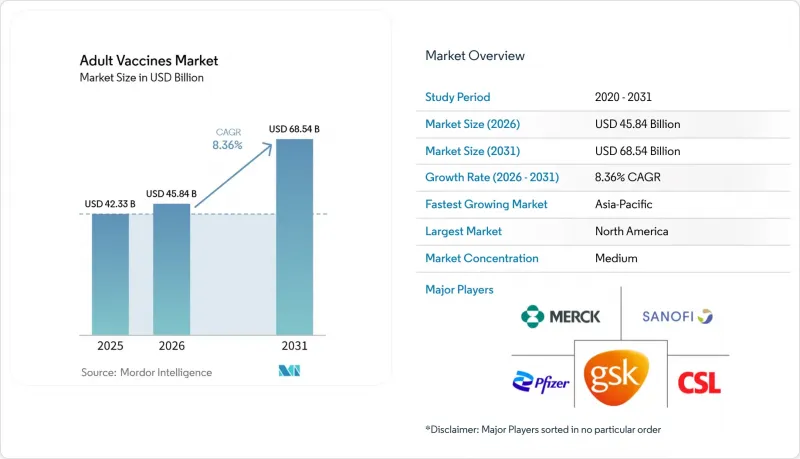
성인용 백신 시장 규모는 2025년에 423억 3,000만 달러로 평가되었습니다. 2026년 458억 4,000만 달러에서 2031년까지 685억 4,000만 달러에 이를 것으로 예상되며, 예측 기간(2026-2031년) CAGR은 8.36%를 나타낼 전망입니다.
본 보고서는 백신 유형(불활성화 바이러스·세균 백신 등), 적응증(인플루엔자, 코로나19 등), 연령대(18-49세, 50-64세, 기타),투여 경로별(근육 내 주사, 기타), 최종 사용자별(헬스케어 관련 기업·병원, 기타), 지역별(북미, 유럽, 기타)로 분류되어 있습니다. 시장 전망은 금액(달러) 기준으로 제시되어 있습니다.
세계의 성인용 백신 시장 동향 및 인사이트
성인 예방접종 일정의 확대에 따라 대상 인구가 증가하고 있습니다.
mRNA 개발은 COVID-19 제품에 그치지 않고, 더 광범위한 호흡기 백신 포트폴리오로 확대되고 있습니다. 모더나(Moderna)는 계절성 인플루엔자 후보 백신인 mRNA-1010에 대해 미국, 캐나다, 호주 및 유럽의 규제 당국에 신청 절차를 완료했으며, 2026년 이후에 승인될 가능성이 있습니다. 화이자의 파이프라인에는 2상 임상시험 단계에 있는 mRNA 인플루엔자 후보, 2상 임상시험 단계에 있는 코로나19 및 인플루엔자 병용 mRNA 후보, 그리고 1상 임상시험 단계에 있는 자가 증폭형 RNA(SARNA) 인플루엔자 후보가 포함되어 있습니다. 플랫폼의 유연성 덕분에 달걀 기반 인플루엔자 백신 제조와 비교하여 항원 서열을 업데이트하는 데 필요한 시간을 단축할 수 있습니다. 각 개발사는 또한 열 안정성 향상을 목표로 하고 있으며, 이를 통해 콜드체인에 대한 의존도를 낮추고 저소득 지역의 접근성 향상에 기여할 가능성이 있습니다. 2026년 조사 결과, 35건 이상의 진행 중인 mRNA 치료제 및 백신 프로그램이 확인되었으며, 그중 6건은 개발 후기 단계에 있는 것으로 나타났습니다. 성인용 백신 시장은 제품 개발이 실질적인 공급 및 조달 요건과 부합할 경우, 이러한 플랫폼의 혜택을 누릴 가능성이 있습니다.
고령화 및 중증 감염병 부담 증가
65세 이상 성인은 면역 반응성이 저하되어 있기 때문에 기존 백신 범주에서 보조제 배합이나 고용량 제제에 대한 수요가 증가하고 있습니다. 이 연령층은 미자극 T세포의 생성량이 적고, 표준 용량의 백신 제제에 대한 반응도 약해지는 경향이 있습니다. 미국에서는폐렴구균성 폐렴으로 인한 성인의 연간 입원자 수는 약 22만 5,000명에 달하며, 2022년 침습성 폐렴구균 감염증 발생률은 65세 이상 성인에서 10만 명당 17.2, 50-64세 성인에서 10만 명당 13.2였습니다. 흑인 성인의 침습성 폐렴구균 질환 발생률은 55-59세에 정점을 보이며, 비흑인 집단보다 이른 시기에 정점에 도달하는데, 이러한 경향에는 PCV13에 포함되지 않은 혈청형이 기여하고 있습니다. PCV21은 50-64세 성인의 침습성 폐렴구균 감염증 사례의 83%를 커버하고 있어, 이 연령층을 대상으로 한 보다 집중적인 임상적 접근이 효과적임을 뒷받침하고 있습니다. 성인용 백신 시장에서는 이러한 조기 질병 부담과 고령화에 접어드는 성인의 요구를 반영한 인식 제고 활동을 통해 시장의 성장이 기대됩니다.
백신 접종에 대한 주저함과 잘못된 정보가 실제 접종률을 억제하고 있습니다.
성인용 백신 시장은 행동적 장벽에 직면해 있습니다. 신뢰도가 낮은 건강 정보에 노출됨으로써 권장되는 제품을 수용하려는 의지가 약화될 가능성이 있기 때문입니다. 2025년 추적 조사에 따르면, 건강 정보를 얻기 위해 적어도 주 1회 소셜 미디어를 이용했던 성인은 비이용자에 비해 백신과 자폐증을 연결 짓는 허위 주장을 지지하는 경향이 더 강한 것으로 나타났습니다. 또한 2025년 연구에서는 제도에 대한 신뢰나 허위 정보에 대한 민감도가 백신에 대한 회의감을 독립적으로 예측하는 요인임이 밝혀졌으나, 사전 건강 지식은 이러한 영향을 유의미하게 상쇄하지는 못했습니다. 코로나19 백신 접종을 받은 성인이라도, 여러 차례 접종 일정이나 그 후의 추가 접종의 가치에 의문을 품는 경우, 호흡기 세포융합 바이러스(RSV)나 대상포진 백신 접종을 주저할 수 있습니다. 한 무작위 대조 시험에서는 허위 정보에 노출되기 전에 적절한 정보를 제공함으로써 백신 접종 의지를 높일 수 있음이 밝혀졌습니다. 약국은 성인이 백신 접종에 대해 반복적으로 접할 기회를 제공하고, 허위 정보가 결정적인 영향력을 행사하기 전에 명확하고 시기적절한 의사소통을 지원할 수 있으므로 중요한 장소가 됩니다.
부문별 분석
2025년, 재조합 백신 및 단백질 아단위 백신은 성인용 백신 시장 점유율의 32.34%를 차지하며 가장 큰 백신 유형이 되었습니다. 성인 대상 대상포진, 인유두종바이러스(HPV), B형 간염 제품군이 이러한 위치를 뒷받침하고 있습니다. GSK의 ‘Shingrix’는 2026년 2분기에 9억 파운드의 매출을 기록하며 전년 동기 대비 3% 증가했습니다. mRNA 백신은 인플루엔자 및 호흡기 질환 후보 백신이 매년 발생하는 코로나19 부스터 접종 수요를 보완함에 따라 2031년까지 연평균 성장률(CAGR) 12.38%를 나타낼 것으로 예측됩니다. 불활성화 바이러스 백신 및 불활성화 세균 백신은 인플루엔자, B형 간염, 장티푸스 예방 접종에서 여전히 중요한 위치를 차지하고 있습니다.
2024년에 예방접종 대상이 50세 이상 성인으로 확대됨에 따라, 결합형 백신은 성인 폐렴구균 백신 접종에서 중심적인 역할을 하고 있습니다. 생백신 제품은 홍역, 유행성 이하선염, 풍진의 추가 접종 및 특정 성인을 대상으로 한 수두 백신 접종에서 안정적인 틈새 시장을 유지하고 있습니다. 자가 증폭형 RNA 및 바이러스 벡터를 포함한 기타 플랫폼은 여전히 임상 개발 단계에 있으며, 2028년 이전에 상당한 상업적 수익을 창출할 가능성은 낮은 것으로 보입니다. 재조합 제품의 성인용 백신 시장 규모는 반복 접종이나 여러 차례의 접종이 필요한 확립된 접종 일정에 힘입어 유지되고 있습니다. mRNA 백신의 보급은 규제 당국의 결정, 계절적 수요, 그리고 코로나19 이외의 분야에서 그 가치를 입증할 수 있는지 여부에 좌우될 것입니다.
2025년 성인용 백신 시장 규모 중 인플루엔자 백신이 34.19%를 차지했습니다. 이는 정부, 고용주, 약국, 여행자 대상 의료 채널을 통한 연간 조달에 힘입은 결과입니다. 2024-25년 및 2025-26년 시즌에는 세계보건기구(WHO)의 최신 균주 권장 사항을 준수한 3가 백신이 사용되었으며, 공급에 큰 차질은 없었습니다. 호흡기 세포융합 바이러스(RSV) 시장은 2031년까지 연평균 성장률(CAGR) 11.47%를 나타낼 것으로 예측됩니다. 2026년 4월 기준, 미국 내 50세 이상 성인을 대상으로 한 누적 접종 횟수는 1,780만 회에 달했습니다. 2026년 2월 기준 75세 이상 성인의 접종률은 43.20%로, 동 연령대에서 인플루엔자 백신 접종이 정착된 일반적인 수준인 70% 이상을 밑돌고 있습니다.
코로나19 백신은 여전히 중요한 수익원이 되고 있지만, 2025년의 적응증 제한으로 인해 보편적 권장 기간에 비해 정기적인 수요는 감소했습니다. 대상포진, 폐렴구균 감염증, 인유두종바이러스(HPV), A형 및 B형 간염 백신은 자발적 구매 비율이 높아 부가가치가 더 높은 예방 그룹을 형성하고 있습니다. 성인용 백신 시장은 의료 제공업체가 접종 대상 요건을 적절히 설명하고, 여러 차례에 걸친 접종 일정을 확실하게 완료하도록 하는지 여부에 따라 좌우됩니다. 호흡기 세포융합 바이러스(RSV) 백신공급은 여전히 충분하지만, 수요는 대상 전체 인구에 아직 미치지 못하고 있습니다. 성인용 백신 시장에서는 새로운 제품 카테고리가 등장하기를 기다리지 않고도, 의료 제공업체, 약국 및 제조업체가 접종률을 높일 여지가 남아 있습니다.
지역별 분석
2025년, 북미는 성인용 백신 시장 점유율의 43.17%를 차지하며 지역별로는 가장 큰 기여도를 보였습니다. 이 지역은 ACIP(미국 예방접종자문위원회)의 권고, 메디케어 및 민간 보험의 보상, 그리고 광범위한 약국 접종 네트워크의 혜택을 받고 있습니다. 미국에서는 고용주가 제공하는 인플루엔자 및 COVID-19 예방접종 프로그램이 공공 자금 지원 기반에 더해 수요를 끌어올리고 있습니다. 브리티시컬럼비아주는 2025년 7월, 공공 자금 지원 인유두종 바이러스(HPV) 백신 접종 대상자를 19세에서 26세까지의 모든 대상자 및 45세까지의 특정 대상자로 확대했습니다. 이러한 변경은 고소득 지역에서 성인에 대한 접종 대상 확대라는 광범위한 추세와 일치합니다.
유럽에서는 성인 예방접종 제도와 접종률에 여전히 편차가 나타나고 있습니다. 잉글랜드의 경우, 2025-26 시즌 1분기 동안 새로 접종 대상이 된 70세 연령층의 Shingrix 1차 접종률이 27.00%였던 것으로 보고되었습니다. 2026년 7월, 유럽집행위원회는 2026-27 시즌을 위해 화이자 및 BioNTech사의 XFG 적응형 코로나19 백신을 승인했습니다. 이는 시즌에 앞서 업데이트된 호흡기 백신 처방에 대응할 수 있는 역량을 보여줍니다. 남유럽 및 동유럽 국가에서는 인플루엔자 이외의 성인용 백신 부문에서 접종률이 낮은 임베디드니다. 이러한 격차로 인해 성인 백신 시장에는 지역적 유통 역량을 갖춘 대형 제조업체들이 진입할 여지가 남아 있습니다.
아시아태평양은 2031년까지 연평균 성장률(CAGR) 11.45%를 나타낼 것으로 예측되며, 성인용 백신 시장에서 지역별 가장 높은 성장률을 보이고 있습니다. 일본에서는 국가와 지방 자치단체의 재정 지원 체계가 분절되어 있어, 인구 고령화가 진행되고 있음에도 불구하고 성인용 백신률은 제한적인 수준에 머물고 있습니다. 호주에서는 전국적인 프로그램 시행 첫해에 65세 이상 대상 성인의 3분의 1 가까이가 Shingrix를 최소 1회 접종한 것으로 보고되었으나, 외딴 지역에 거주하거나 원주민인 경우 형평성 격차와 관련이 있는 것으로 밝혀졌습니다. 중국에서는 도시 지역의 민간 클리닉을 통해 시장이 확대되고 있는 반면, 인도에서는 민간 의료비 증가와 B형 간염 및 인유두종바이러스(HPV) 백신 접종에 대한 인식 제고가 성장 동력이 되고 있습니다.
기타 혜택 :
- 엑셀 형식 시장 예측(ME) 시트
- 3개월간의 애널리스트 지원
자주 묻는 질문
목차
제1장 서론
제2장 조사 방법
제3장 주요 요약
제4장 시장 구도
제5장 시장 규모 및 성장 예측
제6장 경쟁 구도
제7장 시장 기회 및 향후 전망
KTH 26.09.04According to Mordor Intelligence, the adult vaccines market size was valued at USD 42.33 billion in 2025 and is estimated to grow from USD 45.84 billion in 2026 to reach USD 68.54 billion by 2031, at a CAGR of 8.36% during the forecast period (2026-2031).
This report is Segmented by Vaccine Type (Inactivated Viral or Bacterial Vaccines, and More), by Indication (Influenza, COVID-19, and More), by Age Group (18-49 Years, 50-64 Years, and More), by Route of Administration (Intramuscular and More), by End User (Healthcare Firms and Hospitals and More), and Geography (North America, Europe, and More). The Market Forecasts are Provided in Terms of Value (USD).
Global Adult Vaccines Market Trends and Insights
Expansion of Adult Immunization Schedules Widens the Eligible Population
mRNA development is moving beyond COVID-19 products toward broader respiratory vaccine portfolios. Moderna completed regulatory submissions for mRNA-1010, a seasonal influenza candidate, in the United States, Canada, Australia, and Europe, with potential approvals beginning in 2026. Pfizer's pipeline included an mRNA influenza candidate in Phase 2, a combined COVID-19 and influenza mRNA candidate in Phase 2, and a self-amplifying RNA influenza candidate in Phase 1. Platform agility can reduce the time required to update antigen sequences compared with egg-based influenza production. Developers also aim to improve thermostability, which could reduce cold-chain dependence and support access in lower-income settings. A 2026 review identified more than 35 active mRNA therapeutic and vaccine programs, including 6 in late-stage development. The Adult vaccines market could gain from these platforms where product development is matched with practical delivery and procurement requirements.
Aging Population and Higher Burden of Severe Infection
Adults aged 65 years and older have reduced immune responsiveness, which increases the need for adjuvanted and high-dose formulations within established vaccine categories. This group has lower naive T-cell output and can respond less strongly to standard-dose vaccine formulations. Pneumococcal pneumonia accounted for an estimated 225,000 adult hospitalizations annually in the United States, while invasive pneumococcal disease incidence in 2022 was 17.2 per 100,000 among adults aged 65 years and older and 13.2 per 100,000 among adults aged 50-64 years. Black adults had peak invasive pneumococcal disease rates at ages 55-59 years, earlier than the non-Black population, with non-PCV13 serotypes contributing to the pattern. PCV21 covered 83% of invasive pneumococcal disease cases in adults aged 50-64 years, which supports a more targeted clinical approach for this cohort. The Adult vaccines market can benefit where outreach reflects this earlier disease burden and the needs of adults approaching older age.
Vaccine Hesitancy and Misinformation Suppress Realized Uptake
The Adult vaccines market faces a behavioral barrier because exposure to unreliable health information can weaken willingness to receive recommended products. Adults who used social media for health information at least weekly were more likely to endorse the false claim linking vaccines and autism than non-users in a 2025 tracking poll. A 2025 study found that institutional trust and susceptibility to misinformation independently predicted vaccine skepticism, while prior health knowledge did not significantly offset those effects. Adults vaccinated against COVID-19 can still be hesitant about respiratory syncytial virus or zoster vaccines if they question the value of multi-dose schedules or later boosters. A randomized controlled trial found that messaging delivered before misinformation exposure could improve vaccination willingness. Pharmacy settings are important because they provide repeated adult vaccine encounters and can support clear, timely communication before misinformation becomes the deciding influence.
Other drivers and restraints analyzed in the detailed report include:
- Growth in RSV, Zoster, Pneumococcal, Influenza, and HPV Vaccination Sustains Broad Demand
- New Product Launches and Platform Innovation Redefine the Competitive Baseline
- Affordability, Reimbursement, and Cold-Chain Constraints Limit Access Breadth
For complete list of drivers and restraints, kindly check the Table Of Contents.
Segment Analysis
Recombinant and protein-subunit vaccines held 32.34% of Adult vaccines market share in 2025, making them the largest vaccine type. Mature zoster, human papillomavirus, and hepatitis B franchises support this position. GSK's Shingrix generated GBP 0.90 billion in second-quarter 2026 sales, an increase of 3% year over year. mRNA vaccines are forecast to grow at a 12.38% CAGR through 2031 as influenza and respiratory candidates supplement annual COVID-19 booster demand. Inactivated viral and bacterial vaccines remain relevant across influenza, hepatitis B, and typhoid vaccination.
Conjugate vaccines are central to adult pneumococcal vaccination after the 2024 schedule expansion to adults aged 50 years and older. Live-attenuated products retain a stable niche for measles, mumps, and rubella catch-up and varicella vaccination in selected adults. Other platforms, including self-amplifying RNA and viral vectors, remain in clinical development and are unlikely to generate substantial commercial revenue before 2028. The Adult vaccines market size for recombinant products benefits from established schedules that require repeated or multi-dose use. mRNA uptake will depend on regulatory decisions, seasonal demand, and the ability to demonstrate value beyond COVID-19.
Influenza represented 34.19% of the Adult vaccines market size in 2025, supported by annual procurement through government, employers, pharmacies, and travel health channels. The 2024-25 and 2025-26 seasons used trivalent formulations aligned with updated World Health Organization strain recommendations without meaningful supply disruption. Respiratory syncytial virus is forecast to grow at an 11.47% CAGR through 2031. Cumulative U.S. doses for adults aged 50 years and older reached 17.8 million through April 2026. Coverage among adults aged 75 years and older was 43.20% by February 2026, below the more than 70% levels common for established influenza vaccination in the same age group.
COVID-19 vaccines remain a material revenue category, although the 2025 label restriction reduced routine demand compared with the universal recommendation period. Zoster, pneumococcal disease, human papillomavirus, and hepatitis A and B vaccines form a higher-value prevention group with greater discretionary purchasing. The Adult vaccines market is influenced by whether providers explain eligibility and complete multi-dose schedules. Respiratory syncytial virus products remain supply-adequate, but demand has not yet matched the full eligible population. The Adult vaccines market retains room for providers, pharmacies, and manufacturers to improve coverage without waiting for another product category.
Complete Report Scope:
- By Vaccine Type
- Inactivated Viral or Bacterial Vaccines
- Recombinant and Protein-Subunit Vaccines
- Conjugate Vaccines
- mRNA Vaccines
- Live-Attenuated Vaccines
- Other Technology Platforms
- By Indication
- Influenza
- COVID-19
- Herpes Zoster
- Pneumococcal Disease
- Respiratory Syncytial Virus
- Human Papillomavirus and Cervical Cancer Prevention
- Hepatitis A and Hepatitis B
- Others
- By Age Group
- Adults Aged 18-49 Years
- Adults Aged 50-64 Years
- Adults Aged 65 Years and Above
- Pregnant Adults
- By Route of Administration
- Intramuscular Administration
- Subcutaneous Administration
- Intradermal Administration
- Others
- By End User
- Healthcare Firms and Hospitals
- Government Health Agencies
- Employers and Occupational Health Programs
- Travelers and Educational Institutions
- Others
- By Geography
- North America
- United States
- Canada
- Mexico
- Europe
- Germany
- United Kingdom
- France
- Italy
- Spain
- Rest of Europe
- Asia-Pacific
- China
- Japan
- India
- Australia
- South Korea
- Rest of Asia-Pacific
- Middle East and Africa
- GCC
- South Africa
- Rest of Middle East and Africa
- South America
- Brazil
- Argentina
- Rest of South America
- North America
Geography Analysis
North America held 43.17% of Adult vaccines market share in 2025, making it the largest regional contributor. The region benefits from ACIP-guided recommendations, Medicare and commercial insurance reimbursement, and extensive pharmacy vaccination networks. Employer-sponsored influenza and COVID-19 programs add demand beyond the public funding base in the United States. British Columbia expanded publicly funded human papillomavirus vaccination in July 2025 to all people aged 19-26 years and selected people through age 45 years. The change aligns with broader adult eligibility expansion in high-income jurisdictions.
Europe remains heterogeneous in its adult immunization systems and uptake levels. England reported 27.00% first-dose Shingrix coverage among newly eligible 70-year-olds in the first quarter of the 2025-26 season. In July 2026, the European Commission authorized Pfizer and BioNTech's XFG-adapted COVID-19 vaccine for the 2026-27 season, showing the ability to process updated respiratory formulations ahead of the season. Southern and eastern European countries have lower coverage for some non-influenza adult vaccines. This gap leaves the Adult vaccines market with room for established manufacturers that have regional distribution capabilities.
Asia-Pacific is forecast to grow at an 11.45% CAGR through 2031, the highest rate among regions in the Adult vaccines market. Japan faces fragmented national and local financing, which has limited adult vaccine uptake despite population aging. Australia reported that nearly one-third of eligible adults aged 65 years and older received at least 1 Shingrix dose in the first year of its national program, although remoteness and Indigenous status were linked with equity gaps. China is expanding through urban private clinics, while India is supported by higher private healthcare spending and greater awareness of hepatitis B and human papillomavirus vaccination.
- AstraZeneca
- Bavarian Nordic
- Bharat Biotech International Limited
- Biological E
- CSL Behring
- Daiichi Sankyo
- Dynavax Technologies
- GlaxoSmithKline
- Hualan Biological
- Indian Immunologicals
- Johnson & Johnson
- Merck
- Novavax
- Panacea Biotec Limited
- Pfizer
- Sanofi
- Serum Institute of India
- Shenzhen Kangtai Biological Products Co., Ltd.
- Sinovac Biotech
- Valneva
Additional Benefits:
- The market estimate (ME) sheet in Excel format
- 3 months of analyst support
TABLE OF CONTENTS
1 INTRODUCTION
- 1.1 Study Assumptions and Market Definition
- 1.2 Scope of the Study
2 RESEARCH METHODOLOGY
3 EXECUTIVE SUMMARY
4 MARKET LANDSCAPE
- 4.1 Market Overview
- 4.2 Market Drivers
- 4.2.1 Expansion of Adult Immunization Schedules
- 4.2.2 Aging Population and Higher Burden of Severe Infection
- 4.2.3 Growth in RSV, Zoster, Pneumococcal, Influenza, and HPV Vaccination
- 4.2.4 New Product Launches and Platform Innovation
- 4.2.5 Pharmacy-Led Vaccination and Adult-Care Integration
- 4.3 Market Restraints
- 4.3.1 Vaccine Hesitancy and Misinformation
- 4.3.2 Affordability, Reimbursement, and Cold-Chain Constraints
- 4.3.3 Fragmented Adult Immunization Records and Missed Clinical Opportunities
- 4.4 Supply Chain Analysis
- 4.5 Regulatory Landscape
- 4.6 Technological Outlook
- 4.7 Porter's Five Forces
- 4.7.1 Bargaining Power of Suppliers
- 4.7.2 Bargaining Power of Buyers
- 4.7.3 Threat of New Entrants
- 4.7.4 Threat of Substitutes
- 4.7.5 Competitive Rivalry
5 MARKET SIZE AND GROWTH FORECASTS (Value, USD)
- 5.1 By Vaccine Type
- 5.1.1 Inactivated Viral or Bacterial Vaccines
- 5.1.2 Recombinant and Protein-Subunit Vaccines
- 5.1.3 Conjugate Vaccines
- 5.1.4 mRNA Vaccines
- 5.1.5 Live-Attenuated Vaccines
- 5.1.6 Other Technology Platforms
- 5.2 By Indication
- 5.2.1 Influenza
- 5.2.2 COVID-19
- 5.2.3 Herpes Zoster
- 5.2.4 Pneumococcal Disease
- 5.2.5 Respiratory Syncytial Virus
- 5.2.6 Human Papillomavirus and Cervical Cancer Prevention
- 5.2.7 Hepatitis A and Hepatitis B
- 5.2.8 Others
- 5.3 By Age Group
- 5.3.1 Adults Aged 18-49 Years
- 5.3.2 Adults Aged 50-64 Years
- 5.3.3 Adults Aged 65 Years and Above
- 5.3.4 Pregnant Adults
- 5.4 By Route of Administration
- 5.4.1 Intramuscular Administration
- 5.4.2 Subcutaneous Administration
- 5.4.3 Intradermal Administration
- 5.4.4 Others
- 5.5 By End User
- 5.5.1 Healthcare Firms and Hospitals
- 5.5.2 Government Health Agencies
- 5.5.3 Employers and Occupational Health Programs
- 5.5.4 Travelers and Educational Institutions
- 5.5.5 Others
- 5.6 By Geography
- 5.6.1 North America
- 5.6.1.1 United States
- 5.6.1.2 Canada
- 5.6.1.3 Mexico
- 5.6.2 Europe
- 5.6.2.1 Germany
- 5.6.2.2 United Kingdom
- 5.6.2.3 France
- 5.6.2.4 Italy
- 5.6.2.5 Spain
- 5.6.2.6 Rest of Europe
- 5.6.3 Asia-Pacific
- 5.6.3.1 China
- 5.6.3.2 Japan
- 5.6.3.3 India
- 5.6.3.4 Australia
- 5.6.3.5 South Korea
- 5.6.3.6 Rest of Asia-Pacific
- 5.6.4 Middle East and Africa
- 5.6.4.1 GCC
- 5.6.4.2 South Africa
- 5.6.4.3 Rest of Middle East and Africa
- 5.6.5 South America
- 5.6.5.1 Brazil
- 5.6.5.2 Argentina
- 5.6.5.3 Rest of South America
- 5.6.1 North America
6 COMPETITIVE LANDSCAPE
- 6.1 Market Concentration
- 6.2 Market Share Analysis
- 6.3 Company Profiles (includes Global Level Overview, Market Level Overview, Core Segments, Financials as available, Strategic Information, Market Rank/Share, Products and Services, Recent Developments)
- 6.3.1 AstraZeneca plc
- 6.3.2 Bavarian Nordic A/S
- 6.3.3 Bharat Biotech International Limited
- 6.3.4 Biological E Limited
- 6.3.5 CSL Limited
- 6.3.6 Daiichi Sankyo Company, Limited
- 6.3.7 Dynavax Technologies Corporation
- 6.3.8 GSK plc.
- 6.3.9 Hualan Biological Engineering Inc.
- 6.3.10 Indian Immunologicals Limited
- 6.3.11 Johnson & Johnson
- 6.3.12 Merck & Co., Inc.
- 6.3.13 Novavax, Inc.
- 6.3.14 Panacea Biotec Limited
- 6.3.15 Pfizer Inc.
- 6.3.16 Sanofi
- 6.3.17 Serum Institute of India Pvt. Ltd.
- 6.3.18 Shenzhen Kangtai Biological Products Co., Ltd.
- 6.3.19 Sinovac Biotech Ltd.
- 6.3.20 Valneva SE
7 MARKET OPPORTUNITIES AND FUTURE OUTLOOK
- 7.1 White-Space and Unmet-Need Assessment


