|
시장보고서
상품코드
2119007
시멘트 산업용 대체 연료 및 원료(AFR) 시장 : 시장 점유율 분석, 산업 동향 및 통계 데이터, 성장 예측(2026-2031년)Alternate Fuel and Raw Materials (AFR) For Cement Industry - Market Share Analysis, Industry Trends & Statistics, Growth Forecasts (2026 - 2031) |
||||||
 Mordor Intelligence
Mordor Intelligence에 의하면, 시멘트 산업용 대체 연료 및 원료(AFR) 시장 규모는 2025년에 103억 1,000만 달러로 평가되었고, 2026년에 113억 2,000만 달러로 추정되고, 2031년까지 163억 6,000만 달러 달할 것으로 예측됩니다.
2026-2031년 연평균 성장률(CAGR)은 7.64%를 나타낼 전망입니다.
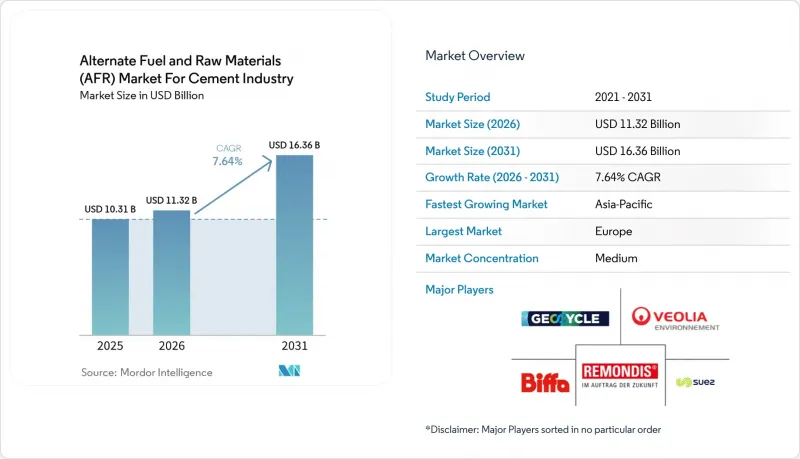
본 보고서는 연료 유형별(RDF, SRF, 기타), 원자재 유형별(비산재, 고로 슬래그, 기타), 용도별(1차 연소, 기타 용도) 및 지역별(북미, 유럽, 아시아태평양, 남미, 중동 및 아프리카)로 분류되어 있습니다. 시장 전망은 금액(달러) 기준으로 제시되어 있습니다.
시멘트 산업용 대체 연료 및 원료(AFR) 시장에 대한 인사이트 및 동향
탈탄소화 목표와 화석 연료 대체
탄소 가격 책정에 따라 연료 전환은 단순한 환경 목표에서 시멘트 제조업체의 재무적 운영 요건으로 변화하고 있습니다. 특히 탄소 배출권이 석탄, 석유 코크스 및 처리된 폐기물 연료의 상대적 비용에 영향을 미치는 경우, 이러한 경향은 더욱 두드러집니다. 시멘트용 대체 연료 및 원료(AFR)는 가마에서 화석 연료 사용에 높은 직접 비용이 발생하거나, 사업자가 연료 대체를 통한 배출 감축 효과를 반영할 수 있는 경우에 이점을 제공합니다. 유럽연합(EU)의 배출권 거래 제도(ETS) 및 탄소 국경 조정 메커니즘(CBAM)으로 인해 유럽 내 생산에서 연료 관련 배출량을 감축하는 것의 상업적 중요성이 더욱 높아지고 있으며, 이에 따라 조달 부서는 연료원을 다각화하기 위한 보다 명확한 재무적 근거를 확보하고 있습니다. 따라서 각 시멘트 제조업체는 더 높은 열 대체율을 약속하기 전에, 폐기물 유래 연료공급량을 확보해야 할 강력한 이유가 있습니다. 새로운 버너 시스템이나 자재 운반 설비에는 신뢰할 수 있는 원료가 필요하기 때문입니다. 세계 시멘트·콘크리트 협회(GCCA)의 보고서에 따르면, 전 세계 열 대체율은 10% 미만에 그치고 있어 2030년 목표인 22%에는 한참 못 미치는 상황입니다. 따라서 연료 대체에는 아직 큰 여지가 있습니다. 인도 및 동남아시아의 정책 방향성도 시멘트 제조업체, 폐기물 처리 사업자, 물류 사업자에게 보다 명확한 계획 수립 지침을 제시하고 있습니다. 다만, 각 지역별로 독자적인 수거·전처리 모델이 필요할 것입니다.
매립 방지, 폐기물 양 및 자원 회수
매립 규제로 인해 잔여 폐기물은 자원 회수 경로로 전환되며, 대체 연료 준비의 경제성이 향상됩니다. 이는 폐기물 보유자나 지자체에게 ‘처분’이라는 선택지의 매력이 떨어지기 때문입니다. 이로 인해 탄소 가격이 제한적이거나 아예 존재하지 않는 지역이라 하더라도, 폐기물 처리와 매립 회피의 가치가 공동 처리에 대한 독립적인 경제적 근거가 될 수 있으므로, 시멘트 산업용 대체 연료 및 원료(AFR)가 뒷받침될 것입니다. 2026년 4월부터 시행되는 인도의 건설·철거 폐기물 관련 규정에서는 재활용 목표가 2025-26 회계연도의 25%에서 2028-29 회계연도에는 100%로 상향 조정되어, 실용적인 회수 경로의 필요성이 높아지고 있습니다. 유럽에서 제안되고 있는 ‘순환 경제법’은 구속력 있는 순환성 요건을 강화하고, 폐기물 회수에 대한 투자에 대한 장기적인 전망을 개선하는 것입니다. 비캣(Vicat)사는 2025년에 전 세계적으로 170만 톤의 폐기물을 회수했으며, 유럽 사업에서는 76.1%의 대체율을 달성했습니다. 대도시의 막대한 폐기물량은 잠재적인 공급원이 되지만, 그 자재가 신뢰할 수 있는 소성로 투입 원료가 되려면 수거, 선별, 건조, 보관, 운송 능력이 갖춰져 있어야 합니다.
원료의 편차와 소성로 안정성에 관한 위험
연료의 불균일성으로 인해 시멘트 공장은 전처리, 보관 및 공정 제어에 대한 추가 투자 없이는 공동 처리율을 높이는 것이 어려워집니다. RDF의 수분 함량은 계절에 따라 변동할 수 있으며, 바이오매스의 발열량도 원료 공급원, 기상 조건, 보관 조건의 변화에 따라 변동할 가능성이 있습니다. 이러한 변동으로 인해 기존의 공정 제어 방식으로는 안정적인 연소를 유지하기 어려워져, 공장에서 공급량을 더 빈번하게 조정해야 할 수도 있습니다. 염소를 많이 함유한 연료 배치는 사이클론 막힘, 가마 내 침적, 부식, 클링커 품질 저하를 유발할 수 있으며, 이는 생산 차질과 유지보수 수요 증가로 이어집니다. 시멘트용 대체 연료 및 원료(AFR)는 연료 전처리 체계가 미성숙하고 품질 검사가 불충분한 경우, 가장 큰 운영상의 제약에 직면하게 됩니다. 열 대체율을 30% 이상으로 높이려는 공장의 경우, 다양한 폐기물 흐름을 대규모로 활용할 수 있게 되기 전에, 재료의 준비, 저장, 투입 및 연소 설정에 대한 보다 엄격한 관리가 필요합니다.
부문 분석
2025년 현재, RDF는 시멘트용 대체 연료 및 원료(AFR)의 연료 부문에서 33.8%의 점유율을 차지했으며, 이는 유럽의 확립된 기계적·생물학적 처리 능력을 반영합니다. SRF는 2031년까지 연평균 성장률(CAGR) 8.4%를 나타낼 것으로 예측되며, 이는 시장 전체를 웃도는 속도입니다. 이 차이는 시멘트 사업자들이 보다 명확한 품질 문서와 보다 안정적인 가동 성능을 갖춘 연료 등급을 원하고 있음을 나타냅니다. EN 15359 표준에 따른 분류를 통해 SRF의 열량, 수분, 회분, 염소 함량에 대한 명확한 기준이 정해져 있습니다. 시멘트 산업용 대체 연료 및 원료(AFR) 시장에서 SRF 시장 규모는 감사 가능하며 자금 조달 협상에도 활용할 수 있는 공급 계약에 대한 고객 수요에 의해 뒷받침되고 있습니다.
바이오매스와 폐플라스틱은 규모는 여전히 작지만 전략적으로 유용한 연료원입니다. 인도의 비재활용 가능 플라스틱 폐기물에 관한 프레임워크에서는 시멘트 가마에서의 공동 처리가 소각과 동등한 처분 방법으로 간주되고 있으며, 공동 연소 대상이 되는 물질의 범위가 확대되고 있습니다. 바이오매스 및 산업 폐기물에 대한 과학적 연구에 따르면, 이들의 열분해는 적절한 온도 범위 내에서 발생하므로 프리칼시네이터 조건과의 적합성이 입증되었습니다. 타이어 유래 연료, 하수 슬러지, 산업용 용제도 기여하고 있으며, 독일, 일본, 한국에서는 유해 폐기물의 공동 처리에 관한 규정이 충분히 마련되어 있습니다. 시멘트 산업용 대체 연료 및 원료(AFR) 시장에서는 RDF가 계속해서 널리 사용될 전망이지만, 가마에서 예측 가능한 연소 거동이 요구되는 경우, 더 높은 품질의 SRF의 중요성이 커지고 있습니다.
지역별 분석
2025년, 유럽은 시멘트용 대체 연료 및 원료(AFR) 시장의 41.5%를 차지했습니다. 이 지역의 역할은 수십 년에 걸친 탄소 규제, 매립세, 폐기물 분리 수거 요건, 확립된 공동 처리 능력, 그리고 폐기물 처리 시설과 주요 가마 운영자를 연결하는 상업적 협약을 반영합니다. 정보 출처의 초안에 따르면, 유럽 시멘트 공장의 열 대체율은 평균 52%였으나, 슬로바키아에서는 2024년 시멘트 업계 전체에서 75%에 달했습니다. 비캣(Vicat)사는 2025년 유럽 사업에서 76.1%의 대체율을 보고했습니다. 이러한 상황으로 인해 유럽은 규격에 부합하는 등급의 SRF, 추적 가능한 공급망, 그리고 장기적인 공장 인수 계약에서 주도적인 입지를 차지하고 있는 반면, 대형 시멘트 그룹에 공급을 목표로 하는 공급업체에 대해서는 품질 및 문서화 기준이 높아지고 있습니다.
하이델베르크 머티리얼즈는 3억 5,000만 유로(약 4억 255만 달러)가 넘는 투자를 통해 2026년 5월 프랑스 에어볼트에 새로운 가마 라인을 개장했습니다. 이 시설은 최대 90%의 대체 연료를 사용할 수 있도록 설계되었습니다. 이 공장의 건식 클링커 생산 능력은 연간 125만 톤이며, 현장의 이산화탄소 배출 강도를 30% 가까이 줄이는 것을 목표로 하고 있어, 대규모 자본 프로젝트와 대체 연료에 대한 장기적인 수요를 연결하는 역할을 합니다. 이러한 투자는 대체 연료 공급업체를 장기적으로 뒷받침할 수 있는 수요 기반을 확립하는 것입니다. 유럽에서 곧 시행될 ‘순환 경제법’ 및 EN 15359 분류 체계는 조달 기준과 문서화 요건에 더 큰 영향을 미칠 것입니다. 유럽의 시멘트용 대체 연료 및 원료(AFR) 시장은 보다 성숙해 있지만, 발전 중인 공동 처리 지역에 비해 더 높은 연료 품질이 요구됩니다.
아시아태평양은 2031년까지 연평균 성장률(CAGR) 9.4%를 나타낼 것으로 예측되며, 이는 각 지역 중 가장 높은 성장률입니다. 인도와 동남아시아에서는 시멘트 수요 증가에 더해, 폐기물 회수 및 대체 연료 이용을 촉진하기 위한 정책적 노력이 진행되고 있습니다. 한편, 일본과 호주에서는 공동 처리가 도입되면서 폐기물 관리 성숙도 측면에서 서로 다른 단계를 보이고 있습니다. 중국에서는 ‘이산화탄소 배출 정점 달성 및 탄소 중립’ 목표와 신규 가마 허가 제한으로 인해 연료 대체에 대한 관심이 높아지고 있습니다. 또한, 정보 출처의 초안에 따르면, 화신시멘트의 디웨이(Diwei) 클링커 생산 라인에서는 폐타이어, 고무, 섬유를 활용하여 60% 이상의 대체율을 달성했습니다. 북미, 남미, 중동 및 아프리카에서는 원료 전처리 체계의 강화가 필요하지만, 브라질의 샴비오아 공장에서는 열 치환율이 65%에 육박하고 있으며, 제미노르(Geminol)사는 노라드(NORAD)의 지원을 받아 남아프리카에 SRF 허브를 구축 중입니다.
기타 혜택 :
- Excel 형식 시장 예측(ME) 시트
- 3개월간의 애널리스트 지원
목차
제1장 서론
제2장 분석 방법
제3장 주요 요약
제4장 시장 구도
제5장 시장 규모 및성장률 예측
제6장 경쟁 구도
제7장 시장 기회 및 향후 전망
AJYAccording to Mordor Intelligence, the alternate fuel and raw materials market for cement industry size is projected to expand from USD 10.31 billion in 2025 and USD 11.32 billion in 2026 to USD 16.36 billion by 2031, at a CAGR of 7.64% between 2026 and 2031.
This report is Segmented by Fuel Type (RDF, SRF, and Others), Raw Material Type (Fly Ash, Blast Furnace Slag, and Others), Application (Primary Firing, and Other Applications), and Geography (North America, Europe, Asia-Pacific, South America, and the Middle East and Africa). The Market Forecasts are Provided in Terms of Value in USD.
Insights and Trends of Alternate Fuel and Raw Materials (AFR) Market For Cement Industry
Decarbonization Targets and Fossil-Fuel Substitution
Carbon pricing is changing fuel switching from an environmental objective into a financial operating requirement for cement producers, particularly where carbon allowances influence the relative cost of coal, petcoke, and prepared waste fuels. The alternate fuel and raw materials for the cement market benefit when fossil fuel use carries a higher direct cost at the kiln and when operators can account for the avoided emissions from fuel replacement. The European Union Emissions Trading System and the Carbon Border Adjustment Mechanism raise the commercial importance of lowering fuel-related emissions in European production, which gives procurement teams a clearer financial reason to diversify fuel sources. Cement groups, therefore, have a stronger reason to secure waste-derived fuel volumes before they commit to higher thermal substitution rates, since new burner systems and material handling equipment need dependable feedstock. The Global Cement and Concrete Association reported a global thermal substitution rate below 10%, compared with its 22% target for 2030, leaving substantial room for fuel replacement. Policy direction in India and Southeast Asia is also creating stronger planning signals for cement producers, waste operators, and logistics providers, although each location will need its own collection and pre-processing model.
Landfill Diversion, Waste Volumes, and Resource Recovery
Landfill restrictions redirect residual waste toward recovery pathways and improve the economics of alternative fuel preparation, because disposal options become less attractive for waste holders and municipalities. This supports the alternate fuel and raw materials for cement market, even where carbon prices are limited or absent, since the value of treating and diverting waste can provide a separate economic basis for co-processing. Construction and demolition waste rules in India, which take effect from April 2026, establish recycling targets that rise from 25% in 2025-26 to 100% in 2028-29, increasing the need for practical recovery routes. Europe's proposed Circular Economy Act would strengthen binding circularity requirements and improve longer-term visibility for waste recovery investments . Vicat recovered 1.7 million tonnes of waste worldwide in 2025, while its European operations reached a 76.1% substitution rate . Large urban waste volumes create potential supply, but collection, sorting, drying, storage, and transport capacity must be in place before material becomes a dependable kiln input.
Feedstock Variability and Kiln-Stability Risk
Fuel heterogeneity limits the ability of cement plants to increase co-processing rates without additional investment in preparation, storage, and process control. RDF moisture can shift between seasons, while biomass calorific value can change as material sources, weather, and storage conditions change. These variations make it harder to maintain stable combustion using conventional process controls and can require plants to adjust feed rates more often. Chlorine-rich fuel batches can cause cyclone blockages, kiln build-up, corrosion, and declines in clinker quality, which can disrupt production as well as increase maintenance needs. The alternate fuel and raw materials for the cement market faces its greatest operational constraint where fuel preparation is immature, and quality checks are inconsistent. Plants that seek thermal substitution above 30% need greater control over material preparation, storage, dosing, and combustion settings before they can rely on diverse waste streams at scale.
Other drivers and restraints analyzed in the detailed report include:
- Consistent High-Calorific Fuel and Kiln Compatibility
- Digital Sorting and Fuel-Quality Traceability
- Waste Segregation, Permitting, and Feedstock Competition
For complete list of drivers and restraints, kindly check the Table Of Contents.
Segment Analysis
RDF held 33.8% of the alternate fuel and raw materials for the cement market share in the fuel segment during 2025, reflecting established mechanical and biological treatment capacity in Europe. SRF is forecast to grow at an 8.4% CAGR through 2031, faster than the overall market. This difference indicates that cement operators are seeking fuel grades with clearer quality documentation and more stable operating performance. EN 15359 classification gives SRF a defined framework for calorific value, moisture, ash, and chlorine. The alternate fuel and raw materials for the cement market size for SRF are supported by customer demand for supply arrangements that can be audited and used in financing discussions.
Biomass and waste plastics remain smaller but strategically useful fuel streams. India's framework for non-recyclable plastic waste identifies cement kiln co-processing as a disposal pathway alongside incineration, expanding the material eligible for co-firing. Scientific work on biomass and industrial wastes supports their compatibility with precalciner conditions because their thermal breakdown occurs within a suitable temperature range. Tire-derived fuel, sewage sludge, and industrial solvents also contribute, where hazardous waste co-processing rules are well established in Germany, Japan, and South Korea. The alternate fuel and raw materials for cement market will continue to use RDF widely, but higher-quality SRF is becoming more important where kilns require predictable combustion behavior.
Complete Report Scope:
- By Fuel Type
- Refuse-Derived Fuel (RDF)
- Solid Recovered Fuel (SRF)
- Biomass
- Waste Plastics
- Other Fuel Types
- By Raw Material Type
- Fly Ash
- Blast Furnace Slag
- Foundry Sand
- Steel Slag
- Other Raw Material Types
- By Application
- Primary Firing
- Secondary Firing
- Other Applications
- By Geography
- North America
- United States
- Canada
- Mexico
- Europe
- Germany
- France
- Italy
- Spain
- United Kingdom
- Poland
- Russia
- Rest of Europe
- Asia-Pacific
- China
- India
- Japan
- South Korea
- Australia
- Indonesia
- Vietnam
- Thailand
- Rest of Asia-Pacific
- South America
- Brazil
- Argentina
- Chile
- Rest of South America
- Middle East
- Saudi Arabia
- United Arab Emirates
- Egypt
- South Africa
- Morocco
- Rest of Middle East and Africa
- North America
Geography Analysis
Europe held 41.5% of the alternate fuel and raw materials for cement market share in 2025. The region's role reflects decades of carbon regulation, landfill taxation, waste separation requirements, established co-processing capacity, and commercial arrangements that connect waste treatment facilities with major kiln operators. European cement plants averaged 52% thermal substitution, while Slovakia reached 75% across its cement industry in 2024, according to the source draft. Vicat reported a 76.1% substitution rate in its European operations during 2025. These conditions make Europe a leading location for specification-grade SRF, traceable supply chains, and long-term plant offtake agreements, while also raising the quality and documentation threshold for suppliers that seek to serve major cement groups.
Heidelberg Materials opened a new kiln line at Airvault, France, in May 2026 after an investment exceeding EUR 350 million (~USD 402.55 million), with the facility designed to use up to 90% alternative fuels. The plant has a dry-process clinker capacity of 1.25 million tonnes per year and is intended to reduce site carbon dioxide intensity by nearly 30%, linking a major capital project with long-term demand for alternative fuels. Such investments establish demand infrastructure that can support alternative fuel suppliers for extended periods. Europe's forthcoming Circular Economy Act and EN 15359 classification framework will further affect procurement standards and documentation needs. The alternate fuel and raw materials for cement market in Europe is more mature, but it also requires higher fuel quality than less developed co-processing locations.
Asia-Pacific is projected to grow at a 9.4% CAGR through 2031, the fastest rate among regions. India and Southeast Asia combine rising cement demand with policy efforts to improve waste recovery and alternative fuel use, while Japan and Australia are increasing co-processing adoption and demonstrate different stages of waste management maturity. China's dual-carbon targets and restrictions on new kiln permits are directing attention toward fuel substitution, while Huaxin Cement's Diwei clinker line achieved substitution above 60% using waste tires, rubber, and textiles, according to the source draft. North America, South America, and the Middle East and Africa need stronger feedstock preparation, while Brazil's Xambioa plant reached nearly 65% thermal substitution, and Geminor is developing a South African SRF hub with Norad support.
- Andusia Recovered Fuels Limited
- Averda International Limited
- BEUMER Group GmbH & Co. KG
- Biffa Limited
- Blue Phoenix Group B.V.
- CEMEX, S.A.B. de C.V.
- DCC Group
- Ecoserv
- EEW Energy from Waste GmbH
- Enva Group Limited
- Fomento de Construcciones y Contratas, S.A.
- Geminor AS
- Geocycle SA
- Heidelberg Materials AG
- Indaver NV
- Komptech GmbH
- PAPREC Group
- PreZero International GmbH
- Ragn-Sells AB
- REMONDIS SE & Co. KG
- Renewi plc
- SARIA SE & Co. KG
- SUEZ S.A.
- Veolia Environnement S.A.
- Vicat SA
- Viridor Limited
Additional Benefits:
- The market estimate (ME) sheet in Excel format
- 3 months of analyst support
TABLE OF CONTENTS
1 INTRODUCTION
- 1.1 Study Assumptions and Market Definition
- 1.2 Scope of the Study
2 RESEARCH METHODOLOGY
3 EXECUTIVE SUMMARY
4 MARKET LANDSCAPE
- 4.1 Market Overview
- 4.2 Market Drivers
- 4.2.1 Decarbonization Targets and Fossil-Fuel Substitution
- 4.2.2 Landfill Diversion and Circular-Economy Mandates
- 4.2.3 Industrial Demand for Consistent High-Calorific Fuel
- 4.2.4 Rising Waste Volumes and Local Resource Recovery
- 4.2.5 Cement-Kiln Compatibility with Mineral-Rich Waste Streams
- 4.2.6 AI-Enabled Sorting and Fuel-Quality Traceability
- 4.3 Market Restraints
- 4.3.1 Feedstock Variability and Kiln-Stability Risk
- 4.3.2 Inconsistent Waste Segregation and Collection Infrastructure
- 4.3.3 Permitting and Cross-Border Waste-Movement Complexity
- 4.3.4 Competition for High-Biogenic Residual Waste
- 4.4 Supply-Chain Analysis
- 4.5 Technological Outlook
- 4.6 Regulatory Landscape
- 4.7 Porter's Five Forces Analysis
- 4.7.1 Bargaining Power of Suppliers
- 4.7.2 Bargaining Power of Buyers
- 4.7.3 Threat of New Entrants
- 4.7.4 Threat of Substitutes
- 4.7.5 Competitive Rivalry
5 MARKET SIZE AND GROWTH FORECASTS
- 5.1 By Fuel Type
- 5.1.1 Refuse-Derived Fuel (RDF)
- 5.1.2 Solid Recovered Fuel (SRF)
- 5.1.3 Biomass
- 5.1.4 Waste Plastics
- 5.1.5 Other Fuel Types
- 5.2 By Raw Material Type
- 5.2.1 Fly Ash
- 5.2.2 Blast Furnace Slag
- 5.2.3 Foundry Sand
- 5.2.4 Steel Slag
- 5.2.5 Other Raw Material Types
- 5.3 By Application
- 5.3.1 Primary Firing
- 5.3.2 Secondary Firing
- 5.3.3 Other Applications
- 5.4 By Geography
- 5.4.1 North America
- 5.4.1.1 United States
- 5.4.1.2 Canada
- 5.4.1.3 Mexico
- 5.4.2 Europe
- 5.4.2.1 Germany
- 5.4.2.2 France
- 5.4.2.3 Italy
- 5.4.2.4 Spain
- 5.4.2.5 United Kingdom
- 5.4.2.6 Poland
- 5.4.2.7 Russia
- 5.4.2.8 Rest of Europe
- 5.4.3 Asia-Pacific
- 5.4.3.1 China
- 5.4.3.2 India
- 5.4.3.3 Japan
- 5.4.3.4 South Korea
- 5.4.3.5 Australia
- 5.4.3.6 Indonesia
- 5.4.3.7 Vietnam
- 5.4.3.8 Thailand
- 5.4.3.9 Rest of Asia-Pacific
- 5.4.4 South America
- 5.4.4.1 Brazil
- 5.4.4.2 Argentina
- 5.4.4.3 Chile
- 5.4.4.4 Rest of South America
- 5.4.5 Middle East
- 5.4.5.1 Saudi Arabia
- 5.4.5.2 United Arab Emirates
- 5.4.5.3 Egypt
- 5.4.5.4 South Africa
- 5.4.5.5 Morocco
- 5.4.5.6 Rest of Middle East and Africa
- 5.4.1 North America
6 COMPETITIVE LANDSCAPE
- 6.1 Market Concentration
- 6.2 Strategic Moves
- 6.3 Market Share (%)/Ranking Analysis
- 6.4 Company Profiles (includes Global Level Overview, Market Level Overview, Core Segments, Financials as available, Strategic Information, Market Rank/Share, Products and Services, Recent Developments)
- 6.4.1 Andusia Recovered Fuels Limited
- 6.4.2 Averda International Limited
- 6.4.3 BEUMER Group GmbH & Co. KG
- 6.4.4 Biffa Limited
- 6.4.5 Blue Phoenix Group B.V.
- 6.4.6 CEMEX, S.A.B. de C.V.
- 6.4.7 DCC Group
- 6.4.8 Ecoserv
- 6.4.9 EEW Energy from Waste GmbH
- 6.4.10 Enva Group Limited
- 6.4.11 Fomento de Construcciones y Contratas, S.A.
- 6.4.12 Geminor AS
- 6.4.13 Geocycle SA
- 6.4.14 Heidelberg Materials AG
- 6.4.15 Indaver NV
- 6.4.16 Komptech GmbH
- 6.4.17 PAPREC Group
- 6.4.18 PreZero International GmbH
- 6.4.19 Ragn-Sells AB
- 6.4.20 REMONDIS SE & Co. KG
- 6.4.21 Renewi plc
- 6.4.22 SARIA SE & Co. KG
- 6.4.23 SUEZ S.A.
- 6.4.24 Veolia Environnement S.A.
- 6.4.25 Vicat SA
- 6.4.26 Viridor Limited
7 MARKET OPPORTUNITIES AND FUTURE OUTLOOK
- 7.1 White-Space and Unmet-Need Assessment