
|
시장보고서
상품코드
2119017
산업용 공기 여과 : 시장 점유율 분석, 업계 동향 및 통계, 성장 예측(2026-2031년)Industrial Air Filtration - Market Share Analysis, Industry Trends & Statistics, Growth Forecasts (2026 - 2031) |
||||||
 Mordor Intelligence
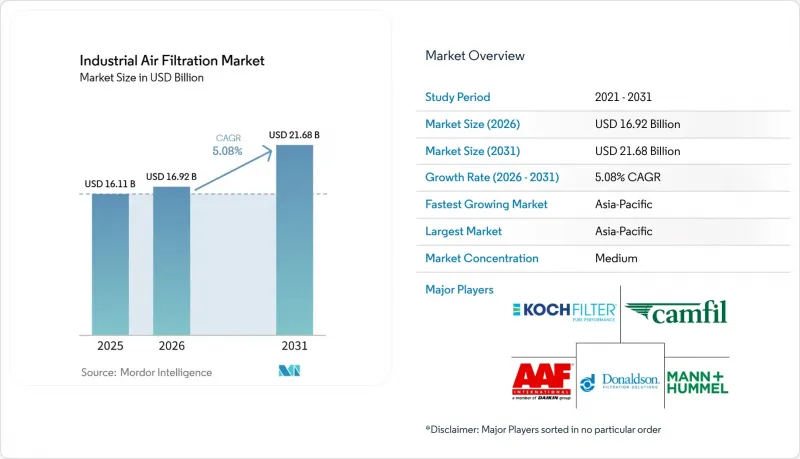
Mordor Intelligence에 의하면, 산업용 공기 여과 시장 규모는 2025년에 161억 1,000만 달러로 평가되었습니다. 2026년 169억 2,000만 달러에서 2031년까지 216억 8,000만 달러에 이를 것으로 예측됩니다.
예측 기간(2026-2031년) 동안 연평균 성장률(CAGR)은 5.08%를 나타낼 것으로 전망됩니다.
본 보고서는 제품 유형(집진 필터 등), 필터 매체(합성 폴리머 매체, 부직포 등), 여과 기술(기계적 여과, 천 여과 등), 최종 이용 산업(화학제품 및 석유화학제품, 시멘트 등), 지역(아시아태평양, 북미 등)별로 분류되어 있습니다. 시장 예측은 금액(달러) 기준으로 제시됩니다.
세계의 산업용 공기 여과 시장 동향 및 인사이트
엄격한 산업 배출 규제 및 산업 안전 규제가 공기 여과 시스템 도입을 촉진하고 있습니다.
배출 규제의 강화로 인해 지속 가능한 환경 및 작업장 성과를 입증해야 하는 산업 현장에서 여과 시스템 업그레이드는 지속적인 투자 수요로 대두되고 있습니다. 2025년에 발효된 유럽의 규제로 인해, 규제 대상 용도에서 사용되는 산업용 장비에 있어 검증된 고효율 여과 성능의 중요성이 높아지고 있습니다. 독일이 시멘트, 야금, 바이오매스 시설에 대해 정한 엄격한 미세먼지 배출 기준은 저배출을 유지할 수 있는 효율적인 백필터로 구형 시스템을 교체하는 것을 뒷받침하고 있습니다. 개정된 ‘산업 배출 지침’에 따라 오염 방지 설비의 평가나 기존 설비의 업그레이드를 검토해야 하는 시설의 범위도 확대되고 있습니다. 이에 따라 산업용 공기 여과 시장에서 신규 설비나 교체용 여과재를 포함한 규제 준수를 목적으로 한 수주 수요가 더욱 확대될 전망입니다. 또한, 칠레가 2026년 7월에 발표한 작업장 관련 지침은 남미의 산업 현장에서 확립된 고효율 여과 기준에 대한 광범위한 부합이 진행되고 있음을 보여줍니다.
분진이 많은 제조 및 산업 처리 활동의 확대
화학, 건축자재, 금속 가공 분야에서는 고농도 입자 부하에 대응할 수 있는 집진 시스템 및 천 재질 여과 시스템에 대한 수요가 계속해서 발생하고 있습니다. 남아시아 및 동남아시아의 시멘트 공장 증설과 중동의 철강·알루미늄 관련 프로젝트는 설비 수주 파이프라인을 확대하고, 신규 시스템 도입을 촉진하고 있습니다. 또한, 새로운 집진기가 도입될 때마다 그 가동 기간 동안 집진 효율을 유지하기 위해 필요한 여과재 교체를 포함하여 여과재 교체에 대한 지속적인 수요가 발생합니다. 이러한 지속적인 수요로 인해 수익이 단일 프로젝트의 시기에 좌우되기 어려워지며, 장비 공급업체에게는 지속적인 애프터마켓이 뒷받침되고 있습니다. 인도의 정밀 자동차 생산 분야에서는 공정 요건이 더욱 엄격한 금속 가공 시설에서 HEPA 등급의 카트리지식 여과 장치에 대한 수요가 증가하고 있습니다. 또한, 식품 및 음료 업계의 생산 현장에서도 여과가 필요하기 때문에 이에 따라 산업용 공기 여과 시장은 중공업 용도의 범위를 넘어 위생 관리가 중시되는 현장 수요도 증가하고 있습니다.
산업용 공기 여과 시스템의 높은 설치 비용, 에너지 소비 및 유지 관리 비용
라이프사이클 비용은 현장의 요건을 충족하기 위해 여과 시스템의 업그레이드가 필요한 경우에도 중소규모 산업 사업자에게 여전히 큰 장벽이 되고 있습니다. 시멘트 공장이나 화학 플랜트용 고효율 집진기의 경우, 지속적인 전력비 및 유지비에 더해 설치 비용만 50만 달러에서 200만 달러까지 소요될 수 있습니다. 압력 손실이 큰 천 필터 시스템의 경우, 에너지 소비가 수명 주기 비용의 15%에서 25%를 차지하는 경우가 있어, 운영 비용은 구매 가격만큼이나 중요한 요소가 됩니다. 또한, 에너지 효율에 관한 요건이 엄격해짐에 따라 제조업체는 모터나 팬을 재설계할 수밖에 없게 되었으며, 이는 설비 비용 증가나 구매자의 평가 과정 장기화로 이어질 가능성이 있습니다. 남미, 중동 및 아프리카의 구매자는 자금이 제한적이거나 구매 결정에 에너지 비용이 충분히 반영되지 않은 경우, 설비 교체를 미룰 수 있습니다. 이로 인해 산업용 공기 여과 시장의 수주가 지연되는 한편, 성능 부족, 유지보수 지연, 가동 중단 위험이 높아질 수 있습니다.
부문별 분석
2025년, 집진 필터는 산업용 공기 여과 시장에서 32.47%의 점유율을 차지하며 가장 큰 제품 부문이 되었습니다. 이러한 위상은 입자 부하가 높고 운영 허가에 직접적인 영향을 받는 시멘트, 철강, 화학, 식품 가공 플랜트에서의 광범위한 사용을 반영합니다. 구성 유형은 구형 플랜트에서 사용되는 단순한 셰이커식 시스템부터 최신 설비에서 사용되는 고효율 펄스 제트식 백하우스 및 카트리지 유닛에 이르기까지 다양합니다. 이러한 폭넓은 라인업을 통해 다양한 시설 유형의 교체 수요에 대응할 수 있을 뿐만 아니라, 공급업체는 신규 프로젝트와 기존 설비 모두에 서비스를 제공할 수 있게 됩니다. 미세먼지 제어가 규제 준수와 밀접하게 연관된 분야에서는 집진 장치가 여전히 중요시되고 있는 반면, 활성탄 필터는 휘발성 유기 화합물(VOC) 포집이 대기질 요건의 일부인 화학 처리 및 폐기물 에너지화 용도에서 활용되고 있습니다.
HEPA 필터는 2026년부터 2031년까지 연평균 성장률(CAGR) 6.21%를 나타낼 것으로 예측되며, 이는 제품 유형 중 가장 높은 성장률입니다. 이러한 수요는 시설 운영 및 인증의 일환으로 H13 및 H14 수준의 성능이 요구되는 바이오의약품용 클린룸과 반도체 시설에서 발생하고 있습니다. 미스트 집진 필터 및 흄 집진 필터는 아시아태평양(APAC)의 기계 가공 및 금속 가공 생산 능력 확대를 뒷받침하고 있습니다. 이 지역에서는 생산 현장에서 오일 미스트, 흄, 미세 입자의 관리가 요구되고 있습니다. 2026년 7월, MANN+HUMMEL사는 자체 개발한 층을 채택하여 99.98%의 입자 분리 효율을 달성한 상용차용 나노파이버 필터를 출시했습니다. 이러한 제품 전략은 나노파이버 기술이 수명을 희생하지 않으면서 더 높은 효율이 필요한 용도를 포함하여 필터의 각 카테고리에서 차별화된 제품으로 전개되고 있음을 보여줍니다.
2025년, 합성 폴리머 미디어는 전 세계 매출의 31.66%를 차지하며 산업용 공기 여과 시장에서 가장 큰 필터 미디어로서의 입지를 확고히 했습니다. 이 매체는 확립된 제조 능력과, 관리 가능한 비용으로 신뢰할 수 있는 입자 포집이 필요한 용도를 포함한 표준 산업용도에서 친숙한 가성비를 겸비하고 있습니다. 유리 섬유 매체는 시멘트 가마의 배기 가스나 발전소의 배기가스 처리와 같은 고온 용도에서 사용됩니다. 이는 이러한 환경에서 열 안정성이 중요하기 때문입니다. 부직포는 광범위한 일반 집진 용도에 사용되는 반면, 금속 및 세라믹 필터 매체는 고온이나 화학적으로 가혹한 공정에 적합합니다. 셀룰로오스계 필터 매체는 비용 압박에 직면해 있으며, 합성 대체재에 대한 기존의 가격 우위가 약화되고 있어, 고객이 초기 비용과 수명을 모두 비교하는 경우 필터 매체 선택에 영향을 미칠 수 있습니다.
나노섬유 코팅 필터 매체는 2026년부터 2031년까지 연평균 성장률(CAGR) 7.28%로 확대될 것으로 예측되며, 필터 매체 카테고리 중 가장 빠르게 성장할 것으로 보입니다. 이러한 성장은 더 낮은 압력 손실로 더 높은 입자 제거율을 실현하려는 요구와 밀접하게 관련되어 있으며, 이를 통해 기존 방식만큼 에너지 소비를 늘리지 않고도 집진 성능을 향상시킬 수 있습니다. 2026년 『Journal of Polymer Research』지의 조사에 따르면, 기공 직경을 제어할 수 있는 폴리비닐리덴플루오라이드/폴리아미드 66(PVDF/PA66) 나노섬유 막은 기존 필터 매체에 비해 입자 제거 효율을 높이는 동시에 압력 손실을 저감시키는 것으로 보고되었습니다. 유지보수 주기를 연장함으로써, 더욱 엄격한 배출 기준을 충족해야 하고, 필터 교체로 인한 가동 중단을 최소화해야 하는 사용자에게는 운영 비용 절감으로 이어집니다. 공급업체 입장에서는 나노섬유 코팅이 측정 가능한 효율성과 내구성의 이점을 제공할 경우 가격 인상이 가능해지며, 이는 산업용 에어필터 업계를 성능 면에서 차별화가 더욱 뚜렷한 제품으로 이끌게 됩니다.
지역별 분석
아시아태평양은 2025년 산업용 공기 여과 시장의 41.93% 점유율을 차지했으며, 2031년까지 연평균 성장률(CAGR) 5.91%를 나타낼 것으로 예측됩니다. 중국은 대규모 중공업 기반과 엄격한 배출 규제를 모두 갖추고 있어, 시멘트,철강, 화학 및 기타 고배출 활동 분야에서 기존 설비의 개보수 및 신규 건설을 위한 구매가 지속되고 있습니다. 인도의 ‘국가 청정 공기 프로그램’은 대기질 기준을 충족하지 못한 도시에서의 미세먼지 규제에 대한 추가적인 노력을 뒷받침하고 있으며, 규정을 준수하는 산업용 장비의 중요성을 높이고 있습니다. 2026년 5월, 캠필(Camfil)사는 지역 생산 역량을 강화하기 위해 말레이시아 복합 시설 인근에 14,400 m² 규모의 제조 거점 확장을 시작했습니다. 일본과 한국에서는 엄격한 클린룸 요건과 일관되게 검증된 고효율 필터에 대한 수요가 있는 반도체 및 정밀 전자기기 시설에서 수요가 발생하고 있습니다.
북미에서는 정유시설, 화학 플랜트, 식품 가공 시설의 설비 교체 및 개보수 공사가, 장기간의 가동 주기에 걸쳐 설비 성능이 평가되는 이 지역의 노후화된 설비 기반 전반에 걸친 수요를 뒷받침하고 있습니다. 연방 정부의 대기질 규제는 중공업 구매자들에게 지속적인 규정 준수의 기반을 제공하며, 필요한 대책의 이행을 지연시킬 여지를 좁히고 있습니다. 또한 북미에서는 산업 자동화가 충분히 정착되어 있어, 다른 많은 지역보다 빠르게 커넥티드 모니터링 및 예측 유지보수 시스템이 도입되고 있습니다. 유럽 시장은 독일, 영국, 프랑스가 주도하고 있으며, 이들 국가에서는 환경 규제 및 노동 환경 요건에 따라 산업 시설에서 고효율 기술에 대한 평가 및 개보수 필요성이 검토되고 있습니다. 유럽 수요에는 사업자가 기존 시설을 업그레이드하고, 검증된 여과 성능을 지속하기 위한 내구성 있는 방법을 모색하는 과정에서 프리미엄 막 시스템이나 나노섬유 강화 매체 등이 포함됩니다.
남미, 중동 및 아프리카는 산업용 공기 여과 시장에서 규모는 작지만 중요한 성장 지역을 형성하고 있습니다. 브라질과 아르헨티나는 광업, 농업 가공, 에너지 프로젝트 분야에서 남미의 주요 수요 거점이며, 이 지역의 산업 사업자들은 분진, 연기 및 공정 공기의 제어가 필요합니다. 페루가 2025년에 도입한 대기질 대책은 시설이 변화하는 요건에 적응함에 따라 산업용 오염 방지에 대한 투자로 이어질 가능성이 있는 정책 방향을 제시하고 있습니다. 중동 및 아프리카에서는 사우디아라비아의 산업 다각화와 남아프리카공화국, 콩고민주공화국, 가나에서의 광업 활동과 관련된 대규모 프로젝트가 전개되고 있습니다. 2026년 SABIC의 주바이르 사업장에서 발생한 공급 차질은 지역 구매자들에게 자재 조달을 어렵게 만들었으며, 특수 필터 매체의 안정적인 공급 체계의 중요성을 부각시켰습니다. 프로젝트 주도형 수요, 불균일한 규제, 공급 리스크가 겹치는 이러한 상황에서 공급업체는 신뢰할 수 있는 현지 지원, 실용적인 교체 부품 확보 수단 및 서비스 체계를 유지해야 합니다.
기타 혜택 :
- 엑셀 형식 시장 전망(ME) 시트
- 3개월간의 애널리스트 지원
자주 묻는 질문
목차
제1장 서론
제2장 조사 방법
제3장 개요
제4장 시장 구도
제5장 시장 규모 및 성장 예측
제6장 경쟁 구도
제7장 시장 기회 및 향후 전망
KTH 26.09.02According to Mordor Intelligence, the industrial air filtration market was valued at USD 16.11 billion in 2025 and is estimated to grow from USD 16.92 billion in 2026 to reach USD 21.68 billion by 2031, at a CAGR of 5.08% during the forecast period (2026-2031).
This report is Segmented by Product Type (Dust Collection Filters, and More), Filter Media (Synthetic Polymer Media, Nonwoven Fabric, and More), Filtration Technology (Mechanical Filtration, Fabric Filtration, and More), End-Use Industry (Chemical and Petrochemical, Cement, and More), and Geography (Asia-Pacific, North America, and More). The Market Forecasts are Provided in Terms of Value (USD).
Global Industrial Air Filtration Market Trends and Insights
Stringent Industrial Emission and Workplace Safety Regulations Driving Air Filtration Adoption
Tighter emission rules are turning filtration upgrades into continuing investment needs across industrial sites that must demonstrate sustained environmental and workplace performance. European requirements that took effect in 2025 have increased the importance of validated high-efficiency filtration performance for industrial equipment used in regulated applications. Germany's strict particulate limits for cement, metallurgy, and biomass facilities support the replacement of older systems with efficient bag filters that can maintain low emissions. The revised Industrial Emissions Directive also broadens the group of facilities that need to evaluate their pollution-control equipment and consider upgrades to existing installations. This creates a larger pool of compliance-led orders for the industrial air filtration market, including both new equipment and replacement media. Chile's July 2026 workplace guidance also signals wider alignment with established high-efficiency filtration standards in South American industrial settings.
Expansion of Dust-Intensive Manufacturing and Industrial Processing Activities
Chemicals, construction materials, and metals processing continue to create demand for dust collection and fabric filtration systems that can manage high particulate loads. Cement additions in South and Southeast Asia, along with steel and aluminum projects in the Middle-East, extend equipment order pipelines and support new system installations. Each new dust collector also creates recurring demand for replacement filters during its operating life, including media changes that are necessary to maintain collection efficiency. This recurring requirement makes revenue less dependent on the timing of a single project and supports an ongoing aftermarket for equipment suppliers. Precision automotive production in India is adding demand for HEPA-grade cartridge filtration in metalworking facilities where process requirements are more exacting. Food and beverage operations also require filtration in production areas, which broadens the industrial air filtration market beyond heavy industrial applications and adds demand from hygiene-sensitive sites.
High Installation, Energy Consumption, and Maintenance Costs of Industrial Air Filtration Systems
Lifecycle cost remains a key barrier for small and midsized industrial operators, even when a filtration upgrade is needed to meet a site requirement. A high-efficiency dust collector for a cement or chemical site can require an installation cost from USD 500,000 to USD 2 million before continuing power and maintenance expenses. Energy use can account for 15% to 25% of lifetime cost in pressure-drop-intensive fabric filtration systems, making operating economics as important as the purchase price. Tighter energy-efficiency requirements have also led manufacturers to redesign motors and fans, which can increase equipment costs and extend the evaluation process for buyers. Buyers in South America, and Middle-East and Africa may defer replacements when funding is limited or energy costs are not fully reflected in purchasing decisions. This can delay orders in the industrial air filtration market while increasing the risk of performance shortfalls, deferred maintenance, and operating disruption.
Other drivers and restraints analyzed in the detailed report include:
- Growing Demand for Cleanroom Air Filtration in Pharmaceutical, Semiconductor, and Food Processing Industries
- Increasing Retrofit and Modernization of Industrial Air Filtration Systems Across Cement, Steel, and Power Plants
- Intense Price Competition from Low-Cost Regional Manufacturers
For complete list of drivers and restraints, kindly check the Table Of Contents.
Segment Analysis
The dust collection filters held 32.47% of the industrial air filtration market share in 2025, making them the largest product segment. Their position reflects broad use in cement, steel, chemical, and food-processing plants with high particulate loads and direct exposure to operating permits. Configurations range from simple shaker systems used in legacy plants to high-efficiency pulse-jet baghouses and cartridge units used in modern installations. This range supports replacement demand across different facility types and allows suppliers to serve both new projects and installed equipment. Dust collectors remain important where particulate control is tied to compliance, while activated carbon filters serve chemical-processing and waste-to-energy applications where volatile organic compound (VOC) capture is part of air-quality requirements.
HEPA filters are projected to grow at a 6.21% CAGR from 2026 to 2031, the highest rate among product types. Their demand comes from biopharmaceutical cleanrooms and semiconductor facilities that require H13 and H14 performance as part of facility operation and qualification. Mist collection filters and fume collection filters support machining and metalworking capacity additions in APAC, where producers need to manage oil mist, fumes, and fine particles in production areas. In July 2026, MANN+HUMMEL launched commercial-vehicle nanofiber filters with in-house-developed layers that achieved 99.98% particle separation efficiency. This product direction shows how nanofiber technology is moving into differentiated offerings across filter categories, including applications that need higher efficiency without giving up service life.
Synthetic polymer media accounted for 31.66% of global revenue in 2025, giving it the largest filter-media position in the industrial air filtration market. It combines established manufacturing capacity with a familiar cost-performance profile for standard industrial use, including applications that need reliable particle collection at manageable cost. Fiberglass media is used in high-temperature applications such as cement kiln exhaust and power-station flue-gas treatment because thermal stability is important in those settings. Nonwoven fabric serves a broad group of general dust-collection uses, while metal and ceramic media are selected for high-temperature and chemically aggressive processes. Cellulose-based media faces cost pressure that weakens its historic price advantage over synthetic alternatives and can affect media choices where customers compare both initial cost and operating life.
Nanofiber-coated media is projected to expand at a 7.28% CAGR from 2026 to 2031, making it the fastest-growing filter media category. Its growth is tied to the need for higher particle removal with lower pressure drop, which can improve collection performance without raising energy use to the same extent as conventional approaches. A 2026 Journal of Polymer Research study reported that Polyvinylidene Fluoride/Polyamide 66 (PVDF/PA66)nanofiber membranes with controllable pore size improved particle removal while reducing pressure drop compared with conventional media. Longer service intervals can improve operating economics for users who must also meet tighter emission requirements and minimize interruptions for filter changeouts. For suppliers, nanofiber coatings can support higher prices when they provide measurable efficiency and durability benefits, moving the industrial air filtration industry toward products with clearer performance differentiation.
Complete Report Scope:
- By Product Type
- Dust Collection Filters
- Mist Collection Filters
- Fume Collection Filters
- HEPA Filters
- Activated Carbon Filters
- Other Product Types
- By Filter Media
- Synthetic Polymer Media
- Nonwoven Fabric
- Fiberglass
- Cellulose
- Activated Carbon
- Metal and Ceramic Media
- Nanofiber-Coated Media
- By Filtration Technology
- Mechanical Filtration
- Fabric Filtration
- Electrostatic Precipitation
- Wet Scrubbing
- Activated Carbon Adsorption
- Membrane and Nanofiber Filtration
- Hybrid Filtration Systems
- By End-Use Industry
- Chemical and Petrochemical
- Cement
- Food and Beverage
- Metal and Mining
- Power Generation
- Pharmaceutical and Biotechnology
- Oil and Gas
- Other End-Use Industries
- By Geography
- Asia-Pacific
- China
- India
- Japan
- South Korea
- Rest of Asia-Pacific
- North America
- United States
- Canada
- Mexico
- Europe
- Germany
- United Kingdom
- France
- Italy
- Russia
- Rest of Europe
- South America
- Brazil
- Argentina
- Rest of South America
- Middle-East and Africa
- Saudi Arabia
- South Africa
- Rest of Middle-East and Africa
- Asia-Pacific
Geography Analysis
Asia-Pacific held 41.93% of the industrial air filtration market share in 2025 and is forecast to grow at a 5.91% CAGR through 2031. China combines a large heavy-industrial base with strict emission enforcement, sustaining retrofit and new-build purchases across cement, steel, chemicals, and other high-emission activities. India's National Clean Air Programme supports further attention to particulate control in non-attainment cities and raises the importance of compliant industrial equipment. In May 2026, Camfil began a 14,400 m2 manufacturing expansion next to its Malaysian complex to strengthen regional capacity. Japan and South Korea add demand from semiconductor and precision-electronics facilities with stringent cleanroom requirements and a need for consistently validated high-efficiency filters.
In North America, replacement and retrofit work at refineries, chemical plants, and food-processing facilities supports demand across the region's aging installed base, where equipment performance is evaluated over long operating cycles. Federal air-quality requirements provide a continuing compliance foundation for heavy industrial buyers and reduce the scope for delaying necessary controls. North America also adopts connected monitoring and predictive maintenance systems earlier than many other regions because industrial automation is well established. Europe is supported by Germany, the United Kingdom, and France, where industrial facilities are evaluating higher-efficiency technologies and retrofit needs under environmental and workplace requirements. European demand includes premium membrane systems and nanofiber-enhanced media as operators upgrade existing facilities and seek durable ways to sustain documented filtration performance.
South America, and the Middle-East and Africa form a smaller but important growth area for the industrial air filtration market. Brazil and Argentina are central South American demand centers for mining, agri-processing, and energy projects, where industrial operators need dust, fume, and process-air controls. Peru's 2025 air-quality measures indicate a policy direction that can lead to industrial pollution-control investment as facilities adapt to changing requirements. In the Middle-East and Africa, large projects are linked to Saudi industrial diversification and mining activity in South Africa, the Democratic Republic of the Congo, and Ghana. The 2026 supply disruption at SABIC's Jubail site complicated materials procurement for regional buyers and highlighted the value of secure supply arrangements for specialized media. This combination of project-led demand, uneven regulation, and supply exposure requires suppliers to maintain reliable local support, practical replacement access, and service capacity.
- American Air Filter Company, Inc.
- Atlas Copco AB
- Camfil
- CECO Environmental Corp.
- Donaldson Company, Inc.
- Filtration Group Industrial
- Freudenberg Filtration Technologies GmbH & Co
- Koch Filter Corporation
- MANN+HUMMEL
- Nederman Holding AB
- PARKER HANNIFIN CORP
- Thermax Limited
Additional Benefits:
- The market estimate (ME) sheet in Excel format
- 3 months of analyst support
TABLE OF CONTENTS
1 Introduction
- 1.1 Study Assumptions and Market Definition
- 1.2 Scope of the Study
2 Research Methodology
3 Executive Summary
4 Market Landscape
- 4.1 Market Overview
- 4.2 Market Drivers
- 4.2.1 Stringent Industrial Emission and Workplace Safety Regulations Driving Air Filtration Adoption
- 4.2.2 Expansion of Dust-Intensive Manufacturing and Industrial Processing Activities
- 4.2.3 Growing Demand for Cleanroom Air Filtration in Pharmaceutical, Semiconductor, and Food Processing Industries
- 4.2.4 Increasing Retrofit and Modernization of Industrial Air Filtration Systems Across Cement, Steel, and Power Plants
- 4.2.5 Rising Adoption of Smart Air Filtration Systems with Digital Monitoring and Predictive Maintenance
- 4.3 Market Restraints
- 4.3.1 High Installation, Energy Consumption, and Maintenance Costs of Industrial Air Filtration Systems
- 4.3.2 Intense Price Competition from Low-Cost Regional Manufacturers
- 4.3.3 Supply Chain Risks for Advanced Filter Media and Electronic Components
- 4.4 Value Chain Analysis
- 4.5 Porter's Five Forces Analysis
- 4.5.1 Threat of New Entrants
- 4.5.2 Bargaining Power of Suppliers
- 4.5.3 Bargaining Power of Buyers
- 4.5.4 Threat of Substitutes
- 4.5.5 Competitive Rivalry
5 Market Size and Growth Forecasts (Value)
- 5.1 By Product Type
- 5.1.1 Dust Collection Filters
- 5.1.2 Mist Collection Filters
- 5.1.3 Fume Collection Filters
- 5.1.4 HEPA Filters
- 5.1.5 Activated Carbon Filters
- 5.1.6 Other Product Types
- 5.2 By Filter Media
- 5.2.1 Synthetic Polymer Media
- 5.2.2 Nonwoven Fabric
- 5.2.3 Fiberglass
- 5.2.4 Cellulose
- 5.2.5 Activated Carbon
- 5.2.6 Metal and Ceramic Media
- 5.2.7 Nanofiber-Coated Media
- 5.3 By Filtration Technology
- 5.3.1 Mechanical Filtration
- 5.3.2 Fabric Filtration
- 5.3.3 Electrostatic Precipitation
- 5.3.4 Wet Scrubbing
- 5.3.5 Activated Carbon Adsorption
- 5.3.6 Membrane and Nanofiber Filtration
- 5.3.7 Hybrid Filtration Systems
- 5.4 By End-Use Industry
- 5.4.1 Chemical and Petrochemical
- 5.4.2 Cement
- 5.4.3 Food and Beverage
- 5.4.4 Metal and Mining
- 5.4.5 Power Generation
- 5.4.6 Pharmaceutical and Biotechnology
- 5.4.7 Oil and Gas
- 5.4.8 Other End-Use Industries
- 5.5 By Geography
- 5.5.1 Asia-Pacific
- 5.5.1.1 China
- 5.5.1.2 India
- 5.5.1.3 Japan
- 5.5.1.4 South Korea
- 5.5.1.5 Rest of Asia-Pacific
- 5.5.2 North America
- 5.5.2.1 United States
- 5.5.2.2 Canada
- 5.5.2.3 Mexico
- 5.5.3 Europe
- 5.5.3.1 Germany
- 5.5.3.2 United Kingdom
- 5.5.3.3 France
- 5.5.3.4 Italy
- 5.5.3.5 Russia
- 5.5.3.6 Rest of Europe
- 5.5.4 South America
- 5.5.4.1 Brazil
- 5.5.4.2 Argentina
- 5.5.4.3 Rest of South America
- 5.5.5 Middle-East and Africa
- 5.5.5.1 Saudi Arabia
- 5.5.5.2 South Africa
- 5.5.5.3 Rest of Middle-East and Africa
- 5.5.1 Asia-Pacific
6 Competitive Landscape
- 6.1 Market Concentration
- 6.2 Strategic Moves
- 6.3 Market Share (%)/Ranking Analysis
- 6.4 Company Profiles (includes Global Overview, Market Overview, Core Segments, Financials as available, Strategic Information, Products and Services, and Recent Developments)
- 6.4.1 American Air Filter Company, Inc.
- 6.4.2 Atlas Copco AB
- 6.4.3 Camfil
- 6.4.4 CECO Environmental Corp.
- 6.4.5 Donaldson Company, Inc.
- 6.4.6 Filtration Group Industrial
- 6.4.7 Freudenberg Filtration Technologies GmbH & Co
- 6.4.8 Koch Filter Corporation
- 6.4.9 MANN+HUMMEL
- 6.4.10 Nederman Holding AB
- 6.4.11 PARKER HANNIFIN CORP
- 6.4.12 Thermax Limited
7 Market Opportunities and Future Outlook
- 7.1 White-Space and Unmet-Need Assessment
- 7.2 Low-Emission Filter Media With Reduced Embodied Carbon