

|
시장보고서
상품코드
2119031
HDPE 파이프 시장 : 점유율 분석, 산업 동향 및 통계 데이터, 성장 예측(2026-2031년)HDPE Pipes - Market Share Analysis, Industry Trends & Statistics, Growth Forecasts (2026 - 2031) |
||||||
 Mordor Intelligence
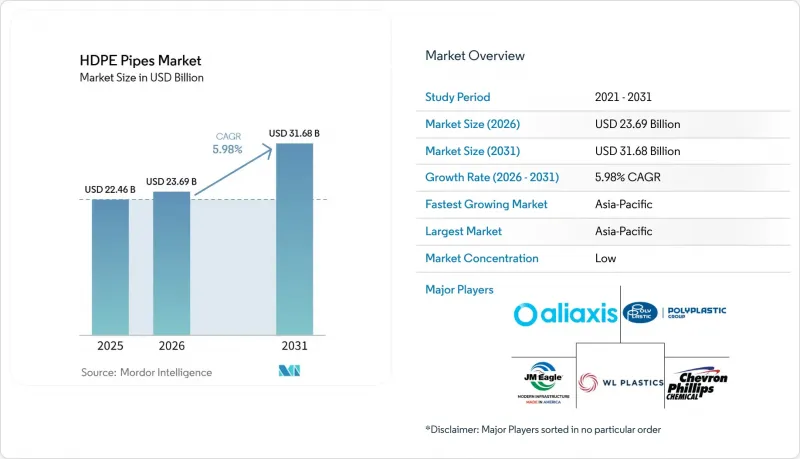
Mordor Intelligence에 의하면, HDPE 파이프 시장 규모는 2025년에 224억 6,000만 달러로 평가되었고 2026년 236억 9,000만 달러에서 2031년까지 316억 8,000만 달러에 이를 것으로 추정되고 있어 예측 기간(2026-2031년)에서 CAGR은 5.98%를 나타낼 전망입니다.
본 보고서는 등급(PE 100, PE 63, PE 80), 직경(110mm 미만, 110-500mm, 500mm 이상), 용도(급수·배수, 폐수·하수·배수, 관개 등),최종 이용 산업(지자체·유틸리티, 농업 등), 지역(아시아태평양, 북미 등)에 따라 분류되어 있습니다. 시장 예측은 금액(달러) 기준으로 제시되어 있습니다.
전 세계 HDPE 파이프 시장 동향 및 인사이트
지자체 상하수도 인프라 확충
지자체들의 상수도·하수 처리 투자야말로 HDPE 파이프 시장의 최대 수요 기반입니다. 미국 환경보호청(EPA)은 2025년 조사에서 향후 20년 동안의 배수 및 송수 인프라 개보수 수요가 4,229억 달러에 달할 것으로 추정했습니다. ‘인프라 투자 및 고용법’에서는 식수 투자 및 납제 급수관 교체를 지원하기 위해 ‘식수 주 회전 기금(Drinking Water State Revolving Fund)’을 통해 310억 달러가 배정되었습니다. 인도의 ‘잘-지반 미션(Jal-Jivan Mission)’에서는 농촌 지역의 급수 본관에 PE 100 규격, 치수비(SDR) 17, 공칭 압력(PN) 10의 파이프 사용을 규정하고 있습니다. 이러한 공공 프로그램을 통해 규제, 공중 보건, 기후 변화 대응에 관한 요건이 확실한 조달로 이어지고 있습니다. 그 결과, HDPE 파이프 시장이 민간 건설 사이클의 영향을 받을 위험이 완화됩니다.
노후화 및 부식이 쉬운 배관 인프라의 교체
주철관, 석면 시멘트관 및 부식이 진행된 연성 주철관의 교체는 성숙한 경제권에서 HDPE 파이프 시장 수요를 뒷받침하고 있습니다. 미국 토목학회(ASCE)는 2025년 보고서에서 미국에 설치된 상수도 본관의 약 20%가 수명을 초과했다고 지적했습니다. 이 평가에서는 또한 노후화된 네트워크로 인해 연간 33조 3,000억 갤런의 물 손실과 1,870억 달러를 초과하는 상수도 유틸리티 수입 손실도 언급하고 있습니다. EYDAP는 2025년, 아테네의 600-700km에 달하는 상수도망을 대상으로 5억 유로 규모의 배관 교체 프로그램을 시작했습니다. 유나이티드 유틸리티즈(United Utilities)는 2025년, 총 길이 150 km에 달하는 호스워터(Hosewater) 상수도를 개보수하기 위해 30억 파운드 규모의 계약을 체결했으며, 2026년에 공사에 착수할 예정입니다. 부식으로 인한 고장이 반복되면서 물 손실이 증가하고 있어, 수명 주기 관점에서 HDPE로 교체하는 것이 점점 더 중요해지고 있습니다.
열팽창 및 온도 사용 제한
수지 가격 변동은 HDPE 파이프 시장에 여전히 시급한 운영상의 과제로 남아 있습니다. 장기 공공 인프라 계약은 제조업체가 원자재 비용 상승분을 회수하는 능력을 제한할 가능성이 있습니다. 이 위험은 선물 구매나 기타 가격 관리 조치를 취하지 않은 생산자에게 더 심각합니다. 아시아의 나프타 의존형 크래커의 수익성은 중동의 해상 운송 경로에 영향을 미치는 혼란에 여전히 민감합니다. 또한 HDPE는 지면에 노출되는 고온 산업용 분야에서 열적 성능에 한계가 있습니다. 이러한 한계로 인해 HDPE의 사용 요건을 초과하는 공정 조건에서는 대체 소재의 역할이 여전히 유지되고 있습니다.
부문 분석
PE 100은 2025년에 전 세계 시장 가치의 66.32%를 차지하며, 2031년까지 연평균 성장률(CAGR) 6.61%로 확대될 것으로 전망됩니다. PE 100은 ISO 4427에 기반한 10 MPa의 최소 요구 강도(MRS) 규격의 혜택을 받고 있습니다. 이 규격 덕분에 저급 제품에 비해 동등한 압력 수준에서 더 얇은 두께의 제품을 제작할 수 있습니다. 최신 바이모달 PE 100 컴파운드는 100년의 설계 기간에 걸친 느린 균열 성장 및 산화 노화를 해결합니다. 유럽 및 북미의 공공 조달 체계에서는 새로운 내압형 상수도 인프라에 PE 100을 지정하는 사례가 증가하고 있습니다.
MRS가 8 MPa인 PE 80은 가스 배관 및 저·중압 상수도 시스템에서 계속해서 사용되고 있습니다. PE 63은 가압 용도에서의 점유율이 줄어들고 있지만, 농업용 지선이나 저압 가정용 급수관에서는 여전히 중요한 역할을 수행하고 있습니다. 2025년 조사에 따르면, 두꺼운 벽 두께의 PE 100 맞대기 융착 기술의 발전으로 인해 해수 담수화, 화력 발전, 원자력 파이프라인 용도에서의 활용이 확대되고 있습니다. 이에 따라 기존에는 저등급 제품이 사용되던 분야에서도 PE 100의 채택이 확산되고 있습니다. 따라서 설계자들이 이음매의 품질에 확신을 갖게 됨에 따라, HDPE 파이프 시장은 더욱 고성능 등급으로 전환되고 있습니다.
2025년에는 110-500mm 범위가 전 세계 시장 가치의 47.24%를 차지했습니다. 이 범위의 파이프는 각 지역의 도시 상수도 배수, 하수 수집 및 농업용 관개 본관에서 HDPE 파이프 시장의 수익을 뒷받침하고 있습니다. 500 mm를 초과하는 파이프는 2031년까지 연평균 성장률(CAGR) 6.84%를 나타낼 것으로 예측됩니다. 대규모 송수관 및 해상 에너지 케이블의 보호가 이러한 성장을 뒷받침하고 있습니다. 110mm 미만의 파이프는 서비스 연결, 소구경 관개 지선 및 통신용 마이크로덕트 시스템에 사용됩니다.
대구경 파이프에 대한 수요는 해상 에너지 인프라에 대한 투자도 반영하고 있습니다. 폴레넬기아(Polenelgia)와 에퀴노르(Equinor)는 폴란드의 ‘발틱 2’ 및 ‘발틱 3’ 해상 풍력 발전소를 위해 총 길이 1.5km, 무게 200메트르톤이 넘는 HDPE 파이프 4개를 운송했습니다. 이 두 프로젝트의 총 발전 용량은 1,440 MW이며, 2028년 상업 운전이 시작되면 폴란드의 200만 가구 이상에 전력을 공급할 것으로 예측됩니다. 또한 2025년에는 사우디아라비아 지잔 산업도시의 해수 냉각 프로젝트를 위해 직경 3.5미터의 HDPE 해저 취수관이 설치되었습니다. 이러한 용도는 HDPE 파이프 시장에 또 다른 수요원을 제공합니다.
지역별 분석
아시아태평양은 2025년에 전 세계 시장 규모의 44.92%를 차지하며, 2031년까지 연평균 성장률(CAGR) 6.75%로 성장할 것으로 전망됩니다. 중국에서는 도시 지역의 파이프라인 현대화 및 산업 단지의 유틸리티 확장이 진행되고 있습니다. 인도의 ‘Jal Jeevan Mission’에서는 농촌 지역 급수용 파이프로 PE 100 SDR 17 파이프의 조달을 추진하고 있으며, 한편 ‘PM Krishi Sinchayee Yojana’는 농업용 관개 파이프 수요를 뒷받침하고 있습니다. 일본과 한국은 내진성 향상과 노후화된 금속 배관망의 교체에 주력하고 있습니다.
북미는 정책에 연계된 상수도 인프라 지출을 통해 HDPE 파이프 시장에서 중요한 위치를 차지하고 있습니다. EPA(미국 환경보호청)의 2025년판 갱신 보고서에서는 향후 20년간의 식수 투자 수요가 6,250억 달러로 추산되고 있으며, 이는 2018년 평가치보다 30% 증가한 수치입니다. 310억 달러 규모의 ‘식수 주 순환 기금(DWSRF)’ 예산 배분은 식수 배수 및 납제 급수관 개보수 공사를 지원하고 있습니다. 유럽에서는 20세기에 건설된 배관망의 교체와 ‘식수 지침’ 준수가 시장을 주도하고 있으며,유럽연합 집행위원회는 2021년부터 2027년까지의 ‘결속 정책’ 프로그램 하에서 물 접근성 및 지속 가능한 물 관리를 위해 3,920억 유로(약 4,461억 2,000만 달러)를 배정했습니다.
브라질을 필두로 한 남미에서는 농업 관련 산업의 관개 수요와 도시 인프라 현대화가 맞물려 있는 반면, 중동 및 아프리카에서는 급수, 지역 냉방용 덕트, 광섬유 인프라를 통해 프로젝트 주도형 비즈니스 기회가 더욱 두드러집니다. 사우디아라비아 국립 상수도 공사는 2025년, 직경 110-400mm의 HDPE 상수도관 97.66km를 포함한 2억 2,000만 달러 규모의 물 인프라 계약을 발주했습니다. 2026년 7월, 알와세일 인더스트리얼(Al-Waseel Industrial)은 킹 압둘라 경제 도시의 인프라 건설 각 단계를 위해 HDPE 파이프를 공급하는 계약을 1,282만 사우디 리얄(340만 달러 상당)에 체결했습니다. ‘사우디 비전 2030’ 프로젝트(NEOM, 레드시, 키디야 등)는 상수도, 지역 냉방용 덕트, 광섬유 인프라를 위해 수년에 걸친 HDPE 조달 프로젝트의 파이프라인을 제공합니다. 사하라 이남 아프리카의 상수도 정비 사업과 GCC 국가들의 해수 담수화 시설 확장은 염분 농도가 높고 건조한 환경에서 금속 파이프 시스템 사용에 어려움이 있는 지역에서 수요를 뒷받침하고 있습니다.
기타 혜택:
- Excel 형식 시장 예측(ME) 시트
- 3개월간의 애널리스트 지원
자주 묻는 질문
목차
제1장 서론
제2장 분석 방법
제3장 개요
제4장 시장 구도
제5장 시장 규모 및 성장률 예측
제6장 경쟁 구도
제7장 시장 기회와 향후 전망
JHS 26.09.15According to Mordor Intelligence, the HDPE pipes market size was valued at USD 22.46 billion in 2025 and estimated to grow from USD 23.69 billion in 2026 to reach USD 31.68 billion by 2031, at a CAGR of 5.98% during the forecast period (2026-2031).
This report is Segmented by Grade (PE 100, PE 63, and PE 80), Diameter (Less Than 110 Mm, 110-500 Mm, and Above 500 Mm), Application (Water Supply and Distribution, Wastewater, Sewage and Drainage, Irrigation, and More), End-Use Industry (Municipal and Public Utilities, Agriculture, and More), and Geography (Asia-Pacific, North America, and More). The Market Forecasts are Provided in Terms of Value (USD).
Global HDPE Pipes Market Trends and Insights
Expansion of Municipal Water Supply and Wastewater Infrastructure
Municipal water and wastewater investment provides the largest demand base for the HDPE pipes market. The U.S. Environmental Protection Agency identified USD 422.9 billion in distribution and transmission rehabilitation needs over 20 years in its 2025 survey. The Infrastructure Investment and Jobs Act appropriated USD 31 billion through the Drinking Water State Revolving Fund to support drinking water investment and lead service line replacement. India's Jal Jeevan Mission specifies PE 100 Standard Dimension Ratio (SDR) 17, Nominal Pressure (PN) 10 pipe for rural water distribution mains. These public programs turn regulatory, public-health, and climate-resilience requirements into committed procurement. The resulting work reduces the HDPE pipes market's exposure to private construction cycles.
Replacement of Aging and Corrosion-Prone Pipeline Infrastructure
Replacement of cast iron, asbestos cement, and corroding ductile iron pipelines supports the HDPE pipes market demand in mature economies. The American Society of Civil Engineers reported in 2025 that nearly 20% of installed U.S. water mains had exceeded their useful service lives. Its assessment also cited more than 33.3 trillion gallons of annual water loss and more than USD 187 billion in lost utility revenue from failing networks. EYDAP began a EUR 500 million pipeline replacement program for 600-700 km of network in Athens during 2025. United Utilities signed a GBP 3 billion agreement in 2025 to refurbish the 150 km Haweswater Aqueduct, with construction beginning in 2026. Repeated corrosion failures increase water losses and strengthen the life-cycle case for HDPE replacement.
Thermal Expansion and Temperature-Service Limitations
Resin price volatility remains an immediate operational challenge for the HDPE pipes market. Long-term public infrastructure contracts can limit the ability of manufacturers to recover feedstock cost increases. This exposure is more acute for producers without forward-purchase or other price-management arrangements. Naphtha-dependent cracker economics in Asia remain sensitive to disruptions affecting Middle-East shipping routes. HDPE also has thermal performance limits in above-grade, high-temperature industrial applications. These limits preserve a role for alternative materials in process conditions that exceed HDPE service requirements.
Other drivers and restraints analyzed in the detailed report include:
- Increasing Adoption of HDPE Pipes for Water-Efficient Irrigation Systems
- Growing Demand for High-Performance PE 100 Pipes and Fusion-Jointed Systems
- Competition from PVC, Ductile Iron, Steel, and Concrete Pipes
For complete list of drivers and restraints, kindly check the Table Of Contents.
Segment Analysis
PE 100 accounted for 66.32% of global value in 2025 and is projected to expand at a 6.61% CAGR through 2031. PE 100 benefits from its 10 MPa Minimum Required Strength (MRS) rating under ISO 4427. That rating permits thinner wall sections at comparable pressure levels than lower grades. Modern bimodal PE 100 compounds address slow crack growth and oxidative aging over a 100-year design horizon. Public procurement frameworks in Europe and North America increasingly specify PE 100 for new pressure-rated water infrastructure.
PE 80, with an MRS of 8 MPa, continues to serve gas distribution and low-to-medium-pressure water systems. PE 63 is losing ground in pressure applications but remains relevant in agricultural laterals and low-pressure domestic supply lines. A 2025 review found that butt fusion advancements for thick-wall PE 100 are extending its use in desalination, thermal power, and nuclear pipeline applications. This supports wider adoption of PE 100, where lower grades were previously used. The HDPE pipes market is therefore shifting toward higher-performance grades as designers gain confidence in joint quality.
The 110-500 mm range held 47.24% of the global value in 2025. This range anchors the HDPE pipes market revenue in municipal water distribution, wastewater collection, and agricultural irrigation mains across regions. Pipes above 500 mm are forecast to grow at a 6.84% CAGR through 2031. Large water transmission lines and offshore energy cable protection support this growth. Pipes below 110 mm are used in service connections, small-bore irrigation laterals, and telecom microduct systems.
Large-diameter demand also reflects investment in offshore energy infrastructure. Polenergia and Equinor transported 4 HDPE pipes, each 1.5 km long and weighing more than 200 metric tons, for the Baltyk 2 and Baltyk 3 offshore wind farms in Poland. The combined project has 1,440 MW capacity and is expected to supply electricity to more than 2 million Polish households at commercial start-up in 2028. A 3.5-meter-diameter HDPE submarine intake pipe was installed for the Jizan Industrial City seawater cooling project in Saudi Arabia during 2025. These applications provide a separate demand source for the HDPE pipes market.
Complete Report Scope:
- By Grade
- PE 100
- PE 63
- PE 80
- By Diameter
- Less Than 110 mm
- 110-500 mm
- Above 500 mm
- By Application
- Water Supply and Distribution
- Wastewater, Sewage and Drainage
- Irrigation
- Oil and Gas
- Industrial Process Piping
- Chemical Processing
- Stormwater Management
- Telecom and Power Ducting
- Other Applications
- By End-Use Industry
- Municipal and Public Utilities
- Agriculture
- Oil and Gas
- Industrial
- Construction
- Mining
- Renewable Energy
- Other End-Use Industries
- By Geography
- Asia-Pacific
- China
- India
- Japan
- South Korea
- Rest of Asia-Pacific
- North America
- United States
- Canada
- Mexico
- Europe
- Germany
- United Kingdom
- France
- Italy
- Russia
- Rest of Europe
- South America
- Brazil
- Argentina
- Rest of South America
- Middle-East and Africa
- Saudi Arabia
- South Africa
- Rest of Middle-East and Africa
- Asia-Pacific
Geography Analysis
Asia-Pacific accounted for 44.92% of global value in 2025 and is forecast to grow at 6.75% CAGR through 2031. China is pursuing urban pipeline modernization and industrial-park utility expansion. India's Jal Jeevan Mission directs rural distribution procurement toward PE 100 SDR 17 pipe, while the PM Krishi Sinchayee Yojana supports agricultural irrigation pipe demand. Japan and South Korea focus on earthquake-resilience upgrades and replacement of aging metallic networks.
North America is an important part of the HDPE pipes market because of policy-linked water infrastructure spending. The EPA's 2025 update identified USD 625 billion in 20-year drinking-water investment needs, a 30% increase from its 2018 assessment. The USD 31 billion Drinking Water State Revolving Fund (DWSRF) appropriation supports drinking-water distribution and lead service line work. Europe is driven by the replacement of 20th-century networks and Drinking Water Directive compliance, while the European Commission allocated EUR 392 billion (approximately USD 446.12 billion) under 2021-2027 Cohesion Policy programs for water access and sustainable water management.
South America, led by Brazil, combines agribusiness irrigation demand with municipal modernization, while Middle-East and Africa have a stronger project-led opportunity through water supply, district cooling ducting, and fiber infrastructure. Saudi Arabia's National Water Company awarded a USD 220 million water infrastructure contract in 2025 that included 97.66 km of HDPE water lines in 110-400 mm diameters. In July 2026, Alwasail Industrial Co. signed a SAR 12.82 million contract, equivalent to USD 3.4 million, to supply HDPE pipes for King Abdullah Economic City infrastructure phases. Saudi Vision 2030 projects, including NEOM, Red Sea, and Qiddiya, provide a multi-year HDPE procurement pipeline for water supply, district cooling ducting, and fiber infrastructure. Sub-Saharan piped-water programs and GCC desalination extensions support demand where saline and arid conditions challenge metallic pipe systems.
- Aliaxis Holdings SA
- Astral Limited
- Chevron Phillips Chemical Company LLC
- China Lesso
- Finolex Industries Limited
- GF Industry and Infrastructure Flow Solutions
- JM EAGLE, INC.
- KWH Pipe Oy
- Orbia
- Pipelife International GmbH
- POLYPLASTIC Group
- Prinsco, Inc.
- Radius Systems
- Supreme Industries Limited
- WL Plastics
Additional Benefits:
- The market estimate (ME) sheet in Excel format
- 3 months of analyst support
TABLE OF CONTENTS
1 Introduction
- 1.1 Study Assumptions and Market Definition
- 1.2 Scope of the Study
2 Research Methodology
3 Executive Summary
4 Market Landscape
- 4.1 Market Overview
- 4.2 Market Drivers
- 4.2.1 Expansion of Municipal Water Supply and Wastewater Infrastructure
- 4.2.2 Replacement of Aging and Corrosion-Prone Pipeline Infrastructure
- 4.2.3 Increasing Adoption of HDPE Pipes for Water-Efficient Irrigation Systems
- 4.2.4 Growing Demand for High-Performance PE100 Pipes in High-Pressure Applications
- 4.2.5 Increasing Adoption of Trenchless Pipeline Rehabilitation and Fusion-Jointed HDPE Systems
- 4.3 Market Restraints
- 4.3.1 Volatility in Polyethylene Resin Prices Affecting Production Costs
- 4.3.2 Competition from PVC, Ductile Iron, Steel and Concrete Pipes
- 4.3.3 Thermal Expansion and Temperature-Service Limitations
- 4.4 Value Chain Analysis
- 4.5 Porter's Five Forces Analysis
- 4.5.1 Threat of New Entrants
- 4.5.2 Bargaining Power of Suppliers
- 4.5.3 Bargaining Power of Buyers
- 4.5.4 Threat of Substitutes
- 4.5.5 Competitive Rivalry
5 Market Size and Growth Forecasts (Value)
- 5.1 By Grade
- 5.1.1 PE 100
- 5.1.2 PE 63
- 5.1.3 PE 80
- 5.2 By Diameter
- 5.2.1 Less Than 110 mm
- 5.2.2 110-500 mm
- 5.2.3 Above 500 mm
- 5.3 By Application
- 5.3.1 Water Supply and Distribution
- 5.3.2 Wastewater, Sewage and Drainage
- 5.3.3 Irrigation
- 5.3.4 Oil and Gas
- 5.3.5 Industrial Process Piping
- 5.3.6 Chemical Processing
- 5.3.7 Stormwater Management
- 5.3.8 Telecom and Power Ducting
- 5.3.9 Other Applications
- 5.4 By End-Use Industry
- 5.4.1 Municipal and Public Utilities
- 5.4.2 Agriculture
- 5.4.3 Oil and Gas
- 5.4.4 Industrial
- 5.4.5 Construction
- 5.4.6 Mining
- 5.4.7 Renewable Energy
- 5.4.8 Other End-Use Industries
- 5.5 By Geography
- 5.5.1 Asia-Pacific
- 5.5.1.1 China
- 5.5.1.2 India
- 5.5.1.3 Japan
- 5.5.1.4 South Korea
- 5.5.1.5 Rest of Asia-Pacific
- 5.5.2 North America
- 5.5.2.1 United States
- 5.5.2.2 Canada
- 5.5.2.3 Mexico
- 5.5.3 Europe
- 5.5.3.1 Germany
- 5.5.3.2 United Kingdom
- 5.5.3.3 France
- 5.5.3.4 Italy
- 5.5.3.5 Russia
- 5.5.3.6 Rest of Europe
- 5.5.4 South America
- 5.5.4.1 Brazil
- 5.5.4.2 Argentina
- 5.5.4.3 Rest of South America
- 5.5.5 Middle-East and Africa
- 5.5.5.1 Saudi Arabia
- 5.5.5.2 South Africa
- 5.5.5.3 Rest of Middle-East and Africa
- 5.5.1 Asia-Pacific
6 Competitive Landscape
- 6.1 Market Concentration
- 6.2 Strategic Moves
- 6.3 Market Share (%)/Ranking Analysis
- 6.4 Company Profiles (includes Global Overview, Market Overview, Core Segments, Financials as available, Strategic Information, Products and Services, and Recent Developments)
- 6.4.1 Aliaxis Holdings SA
- 6.4.2 Astral Limited
- 6.4.3 Chevron Phillips Chemical Company LLC
- 6.4.4 China Lesso
- 6.4.5 Finolex Industries Limited
- 6.4.6 GF Industry and Infrastructure Flow Solutions
- 6.4.7 JM EAGLE, INC.
- 6.4.8 KWH Pipe Oy
- 6.4.9 Orbia
- 6.4.10 Pipelife International GmbH
- 6.4.11 POLYPLASTIC Group
- 6.4.12 Prinsco, Inc.
- 6.4.13 Radius Systems
- 6.4.14 Supreme Industries Limited
- 6.4.15 WL Plastics
7 Market Opportunities and Future Outlook
- 7.1 White-Space and Unmet-Need Assessment


