

|
시장보고서
상품코드
2119048
고체 대체 연료 및 원자재 공동 처리 시스템 : 시장 점유율 분석, 산업 동향 및 통계 데이터, 성장 예측(2026-2031년)Solid Alternate Fuel and Raw Materials (AFR) Co-Processing Systems - Market Share Analysis, Industry Trends & Statistics, Growth Forecasts (2026 - 2031) |
||||||
 Mordor Intelligence
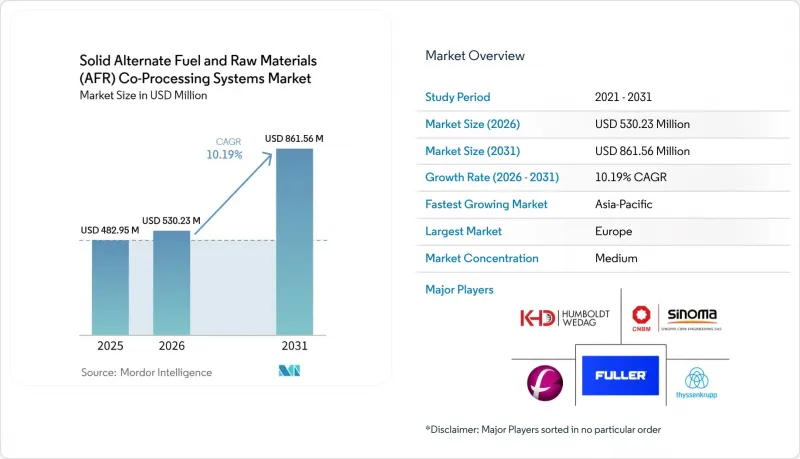
Mordor Intelligence에 의하면, 고체 대체 연료 및 원자재 공동 처리 시스템 시장 규모는 2025년에 4억 8,295만 달러로 평가되었습니다. 2026년에는 5억 3,023만 달러에 달하고, 2031년까지 8억 6,156만 달러에 이르며 2026년부터 2031년에 걸쳐 CAGR 10.19%를 나타낼 것으로 예측됩니다.
본 보고서는 시스템 유형(기계식 이송, 공압식 이송, 하이브리드, 중량식 계량, 기타), 연료 유형(RDF, SRF, 바이오매스, 기타),최종 사용자 산업(시멘트, 석회, 폐기물 처리 시설, 펄프·제지, 기타 가마), 지역(북미, 유럽, 아시아태평양, 남미, 중동 및 아프리카)별로 분류되어 있습니다. 시장 전망은 금액(달러) 기준으로 제시되어 있습니다.
세계의 고체 대체 연료 및 원자재 공동 처리 시스템 시장 동향 및 인사이트
탄소 비용 및 화석 연료 비용 절감
탄소 가격 책정으로 인해, 배출권 거래 시장에서 시멘트 공장에 있어 연료 대체는 중요한 투자 결정 요소가 되고 있습니다. 석탄을 RDF나 SRF로 대체함으로써 배출권 비용에 대한 노출을 줄이고, 화석 연료 구매에 대한 의존도를 낮출 수 있습니다. 이러한 경제적 이점이 연료 조제 투자와 가마 설비 갱신을 모두 뒷받침할 경우, 고체 AFR 공급 시스템 시장은 혜택을 받게 됩니다. 2025년에 발표된 조사에 따르면, RDF를 사용하면 이산화탄소 배출량을 20% 감축할 수 있는 반면, 바이오매스로 대체할 경우 연료 유형나 물류 상황에 따라 순 배출량을 30%에서 50%까지 감축할 수 있는 것으로 밝혀졌습니다. 중국에서는 톈진 진위우자 환경보호(天津金玉家環保)가 2024년에 폐섬유 및 바이오매스를 사용하여 25.1%의 연료 대체율을 달성했다고 보고했습니다. 이 노력을 통해 연간 1만 7,400톤의 이산화탄소 배출을 방지하고, 연료비를 700만 위안(100만 달러 상당) 절감했습니다. 브라질에서는 보토란팀(Votolantim)사가 2030년까지 열에너지의 50%를 대체하겠다는 목표를 세웠고, 시멘토 이탐베(Cimento Itambe)사가 67%의 시험적 대체율을 달성한 점에서도, 이와 유사한 비용 논리가 남미로도 확산되고 있음을 알 수 있습니다.
매립 폐기물 감축 및 순환형 경제에 관한 규제
폐기물 정책은 고체 대체 연료 및 원자재 공동 처리 시스템 시장에서 사용되는 연료의 업스트림 공급을 뒷받침하고 있습니다. 유럽연합(EU)은 회원국들에게 2025년까지 도시 폐기물의 55%, 2030년까지 60%를 재사용 또는 재활용하도록 의무화했으며, 2035년까지의 매립 처분 목표는 10%로 제한되어 있습니다. 이러한 규정에 따라 재활용이 불가능한 부분은 폐기되는 대신 RDF나 SRF 생산으로 활용됩니다. 그 결과 발생하는 물질 흐름은 시멘트 공장 및 석회 공장에서의 수취, 저장, 추출 및 기계적 이송 설비에 대한 수요를 창출하고 있습니다. 또한 매립세 인상으로 인해, 연료가 가마에 도달하기 전에 선별, 파쇄 및 밀도 관리를 개선하도록 처리 업체에 촉구되고 있습니다. 이러한 개선으로 인해 납품 시점의 연료 사양과, 조정된 자재를 안정적으로 공급하기 위해 필요한 설비에 대한 관심이 높아지고 있습니다. 인도네시아의 2025년 폐기물 재생에너지 처리 관련 규제는 안정적인 폐기물 공급량에 대한 정책 지원이 유럽을 넘어 확대되고 있음을 보여줍니다.
원료의 품질 및 발열량 편차
원료의 편차는 고체 대체 연료 및 원자재 공동 처리 시스템 시장에 있어 여전히 주요한 운영상의 제약 요인으로 남아 있습니다. 대체 연료의 순발열량은 10-25 MJ/kg 범위이지만, 수분, 입자 직경, 밀도는 수집 방법이나 전처리 품질에 따라 달라질 수 있습니다. 따라서 명목상 연료 분류가 동일하더라도 플랜트로 반입되는 연료의 연소 거동이 다를 수 있습니다. 2025년 조사에 따르면, 80%를 초과하는 열적 대체율을 달성하기 위해서는 업스트림 공정에서 연료 품질을 최적화해야 하며, 입자 직경의 미세한 편차만으로도 소성로에서의 연소 효율이 저하될 가능성이 있습니다. 섬유질이나 복합 연료 성분은 벨트 컨베어나 체인 컨베어 내에서 예측할 수 없는 움직임을 보이며 통과할 수 있습니다. 이로 인해 마모가 증가하거나, 가마로공급이 중단되거나, 설비 승인 시 사용되는 수명 주기 비용의 근거가 약화될 우려가 있습니다. 이러한 제약은 폐기물 선별 및 연료 조제 시스템이 미성숙한 지역에서 더욱 두드러집니다.
부문별 분석
2025년 시점에서 고체 대체 연료 및 원자재 공동 처리 시스템 시장 규모의 35.8%를 기계식 이송 시스템이 차지하고 있는 반면, 기계식·공압식 하이브리드 시스템은 2031년까지 연평균 성장률(CAGR) 11.1%를 나타낼 것으로 예측됩니다. 기계식 설비는 연료의 수취, 밀폐 저장, 인출, 중간 이송 및 가마 공정으로의 제어된 공급에 있어 계속해서 기반 시스템의 역할을 하고 있습니다. 이 시스템은 대용량 시멘트 공장에서 불규칙한 형상, 서로 다른 수분 함량, 변동하는 부피 밀도를 가질 수 있는 거대하고 불균일한 자재의 취급에 적합합니다. 또한, 이미 설치된 설비는 사업자가 열 대체 목표를 상향 조정할 때 정기적인 교체, 유지보수 및 업그레이드 작업에도 대응하고 있습니다. 고체 AFR 공급 시스템 시장에서 신뢰할 수 있는 자재 이송과 자본 효율성이 주요 조달 요인이 될 경우, 이러한 구성은 계속해서 선호되고 있습니다.
하이브리드 시스템은 기계식 이송과 공기 이송 방식의 장점을 하나의 공정 흐름에 통합하여, 연료 구성이 변경되더라도 운영자에게 더 큰 유연성을 제공합니다. 부피가 큰 파쇄물은 벨트 컨베이어, 체인 컨베이어 또는 스크류 컨베이어로 이송할 수 있는 반면, 미세한 RDF는 직접적인 기계적 이송이 적합하지 않은 경우, 공압식 이송을 통해 소성로 공급 지점까지 이송할 수 있습니다. 티센크루프 폴리시우스(ThyssenKrupp Polysius)는 자사의 ‘prepol Step Combustor’ 구성에서 스크류 컨베이어를 하중 지지 요소로 채택하고, 고온 구역에서는 에어 블라스트 주입을 실시했습니다. 수직 이송이나 제어된 상부 공급에는 여전히 공압식 이송 시스템이 필요하며, Coperion사의 AF 블로우스루식 로터리 밸브는 최대 350 mbar의 압력 하에서 불균일한 연료에 대응하도록 설계되었습니다. EN 15359 표준에 따라 연료의 일관성에 대한 기대가 높아짐에 따라, 중량식 계량의 중요성이 커지고 있습니다. 한편, 저장 홀, 크레인, 이동식 바닥, 트레일러 하역 시스템은 플랜트가 계절적인 공급 변동을 흡수하는 데 도움이 되고 있습니다.
지역별 분석
유럽은 2025년 고체 대체 연료 및 원자재 공동 처리 시스템 시장에서 38.2%의 점유율을 차지했습니다. 이는 오랜 기간에 걸친 폐기물 효율적 활용 정책, 성숙한 시멘트 공동 처리 관행, 그리고 확립된 RDF 및 SRF 공급 네트워크에 힘입은 결과입니다. 독일은 2024년 시멘트 생산에서 대체 연료의 비율이 77%에 달했으며, 2045년까지 90%를 목표로 하고 있습니다. 이러한 운영 수준의 변화에 따라 조달 대상은 초기 설치에서 개조, 염소 바이패스, 정밀한 중량식 계량 및 더욱 엄격한 연료 사양을 충족할 수 있는 설비로 전환되고 있습니다. 비캣(Vicat)사의 페일(Pail) 공장에서 A TEC사가 수행한 염소 바이패스 공사는 기본 가마의 역할을 변경하지 않으면서 더 높은 대체율을 실현하기 위해 기존 가마 라인을 업그레이드할 필요성을 반영하고 있습니다. 폴란드와 루마니아에서는 유럽의 재활용 및 매립 처분 관련 목표가 시행됨에 따라 RDF 공급 인프라가 정비되고 있습니다.
아시아태평양은 2031년까지 연평균 성장률(CAGR) 11.6%를 나타낼 것으로 예측되며, 이는 고체 대체 연료 및 원자재 공동 처리 시스템 시장에서 가장 높은 지역별 성장률입니다. 인도의 공동 처리 지침인 ‘2026년 고형 폐기물 관리 규정’과 NITI Aayog의 로드맵은 국내 열 대체율이 6년 이내에 7%에서 8%를 거쳐 15%로 상승할 것임을 시사하고 있습니다. 중국의 평균 대체 연료 사용률은 5%이며, 중국의 에너지 절약 실행 계획에 따르면 2025년 말까지 시멘트 생산 라인의 30%에 대체 연료 기술을 도입했습니다. 중국건축자재연합회는 중국의 장기적인 발전을 위한 참고 지표로서, 독일의 대체 연료 도입 실적을 참고한 기술 교류를 기록했습니다. 시노마 인터내셔널은 2024년 말까지 중국 국내에 11곳의 대체 연료 처리 센터를 건설하여 연간 총 처리 능력이 120만 톤에 달하며, 공장 차원의 공동 처리 설비 업그레이드를 뒷받침하는 연료 공급 인프라를 구축했습니다.
북미는 완만한 성장을 보이고 있는 지역으로, 현재 수주 활동의 상당 부분을 개보수 프로젝트가 차지하고 있습니다. 여기에는 2026년 하반기 완공을 예정하고 있는 완전한 대체 연료 시스템을 갖춘 이글 머티리얼즈(Eagle Materials)의 라라미(Laramie) 프로젝트도 포함됩니다. 현대화가 선호되는 배경으로는 해당 지역의 시멘트 산업이 성숙기에 접어들었으며, 신규 생산 능력을 건설하는 것보다 기존 가마 라인을 개선할 기회가 있다는 점을 들 수 있습니다. 남미에서는 브라질의 프로젝트를 중심으로 가속화가 진행되고 있으며, 그 예로 시멘토 이탐베(Cimento Itambe)사의 파라나주에 위치한 신규 가마를 들 수 있습니다. 이 가마는 2025년 시운전 당시 대체 연료를 통한 열 대체율 67%를 달성했습니다. 또한, 보토란팀(Votolantim)사의 9억 2,000만 달러 규모의 설비 갱신 프로그램도 2030년까지 열 대체율 50%라는 목표 달성을 뒷받침하고 있습니다. 중동 및 아프리카에서는 그린필드 프로젝트가 더 많이 나타납니다. 그 예로, 케냐에서 시노마 CBMI사의 2억 5,000만 달러 규모의 밤부리 시멘트 계약을 들 수 있으며, 이 프로젝트에는 현지 바이오매스와 도시 고형 폐기물을 활용하는 능력이 포함되어 있습니다.
기타 혜택 :
- 엑셀 형식 시장 예측(ME) 시트
- 3개월간의 애널리스트 지원
자주 묻는 질문
목차
제1장 서론
제2장 분석 방법
제3장 주요 요약
제4장 시장 구도
제5장 시장 규모 및 성장률 예측
제6장 경쟁 구도
제7장 시장 기회 및 향후 전망
KTH 26.09.04According to Mordor Intelligence, the solid alternate fuel and raw materials co-Processing systems market size is projected to be USD 482.95 million in 2025, USD 530.23 million in 2026, and reach USD 861.56 million by 2031, growing at a CAGR of 10.19% from 2026 to 2031.
This report is Segmented by System Type (Mechanical Conveying, Pneumatic Conveying, Hybrid, Gravimetric Dosing, Others), Fuel Type (RDF, SRF, Biomass, Others), End-User Industry (Cement, Lime, Wte Plants, Pulp & Paper, Other Kilns), and Geography (North America, Europe, Asia-Pacific, South America, and Middle East and Africa). The Market Forecasts are Provided in Terms of Value (USD).
Global Solid Alternate Fuel and Raw Materials (AFR) Co-Processing Systems Market Trends and Insights
Carbon and Fossil-Fuel Cost Avoidance
Carbon pricing has made fuel substitution a material investment consideration for cement plants in emissions-trading markets. Replacing coal with RDF or SRF can reduce exposure to allowance costs and reduce dependence on fossil fuel purchases. The Solid AFR feeding systems market benefits when this financial case supports both fuel-preparation investment and kiln-side equipment upgrades. Research published in 2025 found that RDF use can reduce carbon dioxide emissions by 20%, while biomass substitution can reduce net emissions by 30% to 50%, depending on fuel type and logistics. In China, Tianjin Jinyujia Huanbao reported a 25.1% fuel replacement rate using waste textiles and biomass in 2024. The operation avoided 17,400 tonnes of carbon dioxide annually and reduced fuel costs by CNY 7 million, equivalent to USD 1 million . In Brazil, Votorantim's target of 50% thermal substitution by 2030 and Cimento Itambe's 67% test substitution rate show that the same cost logic is extending into South America.
Landfill Diversion and Circular-Economy Mandates
Waste policy supports the upstream supply of fuels used by the Solid AFR feeding systems market. The European Union requires member states to prepare 55% of municipal waste for reuse or recycling by 2025 and 60% by 2030, while its landfill target is limited to 10% by 2035. These rules direct nonrecyclable fractions toward RDF and SRF preparation instead of disposal. The resulting material flow creates demand for reception, storage, extraction, and mechanical conveying equipment at cement and lime plants. Higher landfill taxes also encourage processors to improve sorting, shredding, and density control before fuel reaches the kiln. That improvement shifts more attention to fuel specifications at the point of delivery and to the equipment needed to dose prepared material consistently. Indonesia's 2025 regulation on waste processing into renewable energy indicates that policy support for dependable waste volumes is expanding beyond Europe.
Feedstock Quality and Calorific-Value Variability
Feedstock inconsistency remains the main operating constraint for the Solid AFR feeding systems market. Alternative fuels can range from 10 to 25 MJ/kg in net calorific value, while moisture, particle size, and density can change with collection patterns and pre-processing quality. A plant may therefore receive fuel with different combustion behavior even where nominal fuel categories remain unchanged. A 2025 study found that thermal substitution rates above 80% require optimized upstream fuel quality, and small deviations in particle size can reduce burnout efficiency in calciners . Fibrous and composite fuel fractions can move unpredictably through belt and chain conveyors. This can increase wear, interrupt kiln feeding, and weaken the lifecycle cost case used for equipment approvals. The constraint is more pronounced where waste sorting and fuel preparation systems remain immature.
Other drivers and restraints analyzed in the detailed report include:
- Cement Decarbonization and Thermal Substitution Targets
- AFR System Retrofits for Existing Kilns
- Permitting and Emissions-Compliance Complexity
For complete list of drivers and restraints, kindly check the Table Of Contents.
Segment Analysis
Mechanical conveying systems accounted for 35.8% of the Solid AFR feeding systems market size in 2025, while hybrid mechanical-pneumatic systems are forecast to grow at 11.1% CAGR through 2031. Mechanical equipment remains the base system for fuel reception, enclosed storage, extraction, intermediate transfer, and controlled delivery to the kiln process. It is well-suited to coarse and heterogeneous materials that may contain irregular shapes, different moisture levels, and variable bulk density at high-volume cement plants. The installed base also supports recurring replacement, maintenance, and upgrade work when operators raise their thermal substitution objectives. The Solid AFR feeding systems market continues to favor these configurations where reliable material movement and capital efficiency are primary procurement factors.
Hybrid systems combine the strengths of mechanical and pneumatic transport in one process flow, which gives operators more flexibility when their fuel mix changes. Bulky shredded materials can move through belt, chain, or screw conveyors, while fine RDF can move pneumatically to calciner feed points where direct mechanical transport is less suitable. thyssenkrupp Polysius uses screw conveyors as the load-bearing element within its prepol Step Combustor configuration, with air-blast injection at the hot zone. Pneumatic systems remain necessary for vertical transport and controlled top feeding, and Coperion's AF blow-through rotary valve is designed for nonhomogeneous fuels at pressures up to 350 mbar. Gravimetric dosing is becoming more relevant as EN 15359 raises expectations for fuel consistency, while storage halls, cranes, moving floors, and trailer unloading systems help plants buffer seasonal supply variation.
Complete Report Scope:
- By System Type
- Mechanical Conveying Systems
- Pneumatic Conveying Systems
- Hybrid Mechanical-Pneumatic Conveying Systems
- Gravimetric Dosing and Weighfeeder Systems
- Storage, Extraction, and Receiving Systems
- Others
- By Fuel Type
- Refuse-Derived Fuel (RDF)
- Solid Recovered Fuel (SRF)
- Biomass and Agricultural Residues
- Waste Plastics and Fluff
- Tire-Derived Fuel (TDF)
- Others
- By End-User Industry
- Cement Industry
- Lime Industry
- Waste-to-Energy Plants
- Pulp & Paper Industry
- Other Industrial Kilns and Furnaces
- By Geography
- North America
- United States
- Canada
- Mexico
- Europe
- Germany
- France
- Italy
- Spain
- United Kingdom
- Poland
- Russia
- Rest of Europe
- Asia-Pacific
- China
- India
- Japan
- South Korea
- Australia
- Indonesia
- Vietnam
- Thailand
- Rest of Asia-Pacific
- South America
- Brazil
- Argentina
- Chile
- Rest of South America
- Middle East and Africa
- Saudi Arabia
- United Arab Emirates
- Egypt
- South Africa
- Morocco
- Rest of Middle East and Africa
- North America
Geography Analysis
Europe held 38.2% of the Solid AFR feeding systems market share in 2025, supported by long-standing waste valorization policies, mature cement co-processing practices, and established RDF and SRF supply networks. Germany reached a 77% alternative fuel share in cement production during 2024 and is targeting 90% by 2045 . This operating level shifts procurement from initial installations toward retrofits, chlorine bypasses, precise gravimetric dosing, and equipment that can manage stricter fuel specifications. A TEC's chlorine bypass work at Vicat's Peille plant reflects the need to upgrade legacy kiln lines for higher substitution rates without changing the role of the underlying kiln. Poland and Romania are developing RDF supply infrastructure as European recycling and landfill targets take effect.
Asia-Pacific is forecast to grow at 11.6% CAGR through 2031, the fastest regional rate in the Solid AFR feeding systems market. India's co-processing guidance, Solid Waste Management Rules 2026, and NITI Aayog road map point to a rise in the national thermal substitution rate from 7% to 8% toward 15% within 6 years. China had an average fuel substitution rate of 5%, and its energy-conservation action plan targeted alternative fuel technology at 30% of cement production lines by the end of 2025. The China Building Materials Federation recorded technical exchanges that used Germany's substitution performance as a reference point for China's longer-term progress. Sinoma International had built 11 alternative fuel processing centers in China by the end of 2024, with combined annual capacity of 1.2 million tonnes, creating fuel supply infrastructure that can support plant-level co-processing upgrades.
North America is a moderate-growth region where retrofit projects account for much of the current order activity, including the Eagle Materials Laramie project with a full alternative fuel system that is scheduled for completion in the second half of 2026. The preference for modernization reflects the mature regional cement base and the opportunity to improve existing kiln lines rather than build new capacity. South America is accelerating through Brazilian projects, including Cimento Itambe's new kiln in Parana, which reached a 67% alternative-fuel thermal substitution rate in testing during 2025. Votorantim's USD 920 million upgrade program also supports a 50% thermal substitution target by 2030. The Middle East and Africa are more exposed to greenfield projects, including Sinoma CBMI's USD 250 million Bamburi Cement contract in Kenya, which includes capacity to use local biomass and municipal solid waste.
- A TEC Production & Services GmbH
- Beijing Triumph International Engineering Co., Ltd.
- BMH Technology Oy
- CNBM International Engineering Co., Ltd.
- Dynamis Ltd.
- Fives FCB S.A.
- Fuller Technologies, Inc.
- KHD Humboldt Wedag International AG
- SATAREM S.A.
- Sinoma International Engineering Co., Ltd.
- thyssenkrupp Polysius GmbH
- Unitherm Cemcon Feuerungsanlagen GmbH
Additional Benefits:
- The market estimate (ME) sheet in Excel format
- 3 months of analyst support
TABLE OF CONTENTS
1 INTRODUCTION
- 1.1 Study Assumptions and Market Definition
- 1.2 Scope of the Study
2 RESEARCH METHODOLOGY
3 EXECUTIVE SUMMARY
4 MARKET LANDSCAPE
- 4.1 Market Overview
- 4.2 Market Drivers
- 4.2.1 Carbon and Fossil-Fuel Cost Avoidance
- 4.2.2 Landfill Diversion and Circular-Economy Mandates
- 4.2.3 Cement Decarbonization and Thermal Substitution Targets
- 4.2.4 AFR System Retrofits for Existing Kilns
- 4.2.5 Quality-Adjusted Pricing of SRF and RDF
- 4.2.6 Local Waste-to-Fuel Ecosystem Integration
- 4.3 Market Restraints
- 4.3.1 Feedstock Quality and Calorific-Value Variability
- 4.3.2 Permitting and Emissions-Compliance Complexity
- 4.3.3 Chlorine, Alkali, and Trace-Metal Accumulation
- 4.3.4 Seasonal and Contractual Reliability of Waste Streams
- 4.4 Value Chain Analysis
- 4.5 Technology Outlook
- 4.6 Regulatory Landscape
- 4.7 Porter's Five Forces Analysis
- 4.7.1 Bargaining Power of Suppliers
- 4.7.2 Bargaining Power of Buyers
- 4.7.3 Threat of New Entrants
- 4.7.4 Threat of Substitutes
- 4.7.5 Competitive Rivalry
5 MARKET SIZE AND GROWTH FORECASTS
- 5.1 By System Type
- 5.1.1 Mechanical Conveying Systems
- 5.1.2 Pneumatic Conveying Systems
- 5.1.3 Hybrid Mechanical-Pneumatic Conveying Systems
- 5.1.4 Gravimetric Dosing and Weighfeeder Systems
- 5.1.5 Storage, Extraction, and Receiving Systems
- 5.1.6 Others
- 5.2 By Fuel Type
- 5.2.1 Refuse-Derived Fuel (RDF)
- 5.2.2 Solid Recovered Fuel (SRF)
- 5.2.3 Biomass and Agricultural Residues
- 5.2.4 Waste Plastics and Fluff
- 5.2.5 Tire-Derived Fuel (TDF)
- 5.2.6 Others
- 5.3 By End-User Industry
- 5.3.1 Cement Industry
- 5.3.2 Lime Industry
- 5.3.3 Waste-to-Energy Plants
- 5.3.4 Pulp & Paper Industry
- 5.3.5 Other Industrial Kilns and Furnaces
- 5.4 By Geography
- 5.4.1 North America
- 5.4.1.1 United States
- 5.4.1.2 Canada
- 5.4.1.3 Mexico
- 5.4.2 Europe
- 5.4.2.1 Germany
- 5.4.2.2 France
- 5.4.2.3 Italy
- 5.4.2.4 Spain
- 5.4.2.5 United Kingdom
- 5.4.2.6 Poland
- 5.4.2.7 Russia
- 5.4.2.8 Rest of Europe
- 5.4.3 Asia-Pacific
- 5.4.3.1 China
- 5.4.3.2 India
- 5.4.3.3 Japan
- 5.4.3.4 South Korea
- 5.4.3.5 Australia
- 5.4.3.6 Indonesia
- 5.4.3.7 Vietnam
- 5.4.3.8 Thailand
- 5.4.3.9 Rest of Asia-Pacific
- 5.4.4 South America
- 5.4.4.1 Brazil
- 5.4.4.2 Argentina
- 5.4.4.3 Chile
- 5.4.4.4 Rest of South America
- 5.4.5 Middle East and Africa
- 5.4.5.1 Saudi Arabia
- 5.4.5.2 United Arab Emirates
- 5.4.5.3 Egypt
- 5.4.5.4 South Africa
- 5.4.5.5 Morocco
- 5.4.5.6 Rest of Middle East and Africa
- 5.4.1 North America
6 COMPETITIVE LANDSCAPE
- 6.1 Market Concentration
- 6.2 Strategic Moves
- 6.3 Market Share Analysis
- 6.4 Company Profiles (includes Global Level Overview, Market Level Overview, Core Segments, Financials as available, Strategic Information, Market Rank/Share, Products and Services, Recent Developments)
- 6.4.1 A TEC Production & Services GmbH
- 6.4.2 Beijing Triumph International Engineering Co., Ltd.
- 6.4.3 BMH Technology Oy
- 6.4.4 CNBM International Engineering Co., Ltd.
- 6.4.5 Dynamis Ltd.
- 6.4.6 Fives FCB S.A.
- 6.4.7 Fuller Technologies, Inc.
- 6.4.8 KHD Humboldt Wedag International AG
- 6.4.9 SATAREM S.A.
- 6.4.10 Sinoma International Engineering Co., Ltd.
- 6.4.11 thyssenkrupp Polysius GmbH
- 6.4.12 Unitherm Cemcon Feuerungsanlagen GmbH
7 MARKET OPPORTUNITIES AND FUTURE OUTLOOK
- 7.1 White-Space and Unmet-Need Assessment


