|
시장보고서
상품코드
2119067
자동차 OEM용 코팅 : 시장 점유율 분석, 산업 동향 및 통계 데이터, 성장 예측(2026-2031년)Automotive OEM Coatings - Market Share Analysis, Industry Trends & Statistics, Growth Forecasts (2026 - 2031) |
||||||
 Mordor Intelligence
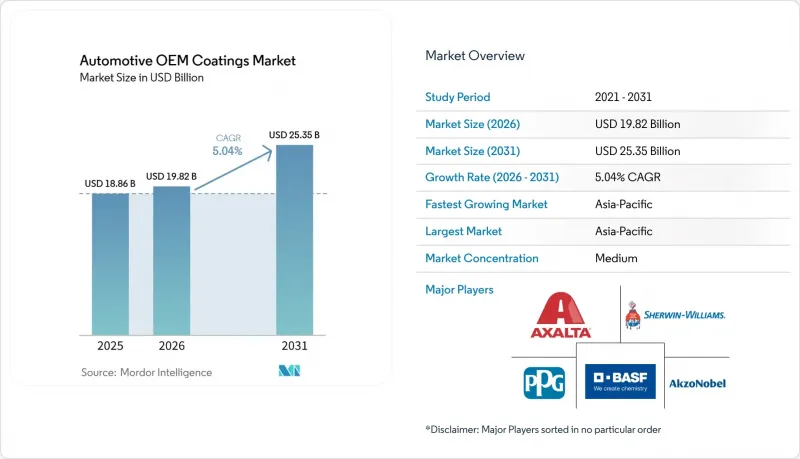
Mordor Intelligence에 따르면 자동차 OEM용 코팅 시장 규모는 2025년에 188억 6,000만 달러로 추계되고 있으며, 예측 기간(2026-2031년)에 CAGR 5.04%로 확대하며, 2026년 198억 2,000만 달러에서 2031년에는 253억 5,000만 달러에 달할 것으로 전망되고 있습니다.
이 보고서는 수지 유형(에폭시, 아크릴 등), 기술(수성, 용제계 등), 코팅 유형(전착 도장, 프라이머 등), 차종(승용차, 상용차 등) 및 지역(아시아태평양, 북미, 유럽, 남미, 중동 및 아프리카)별로 분류되어 있습니다. 시장 전망은 금액(달러) 기준으로 제시되어 있습니다.
전 세계 자동차 OEM용 코팅 시장의 동향 및 인사이트
전 세계 자동차 생산 대수 증가 및 차종 라인업 확대
자동차 생산 대수의 증가는 자동차 OEM용 코팅 시장에 있으며, 가장 직접적인 촉진요인입니다. 전 세계 소형차 생산 대수는 공급 상황의 개선에 따라 2024년에는 9,250만 대까지 회복되었으며, 2026년에는 9,500만 대를 넘어섰습니다. 각 차량에는 전착 도장, 프라이머, 베이스 코트, 클리어 코트로 구성된 완전한 도장 공정이 필요합니다. 인도에서 시행 중인 35억 달러 규모의 ‘생산 연계형 인센티브 제도’는 OEM의 생산 능력 확대를 통해 2027년까지 연간 18만 메트릭톤의 코팅 수요 증가를 가져올 것으로 예상됩니다. 차종 라인업의 확대에 따라 새로운 승인 주기가 필요해졌으며, 각 조립 공장에서 공급업체의 활동도 활발해지고 있습니다. 또한 인도와 동남아시아에서의 새로운 조립 활동 전개에 따라 공급업체는 현지에서 배합 능력을 확립하고 있으며, 이로 인해 관세와 리드타임은 감소하는 반면 물류 관리 요건은 증가하고 있습니다.
저VOC·저탄소 코팅 기술을 촉진하는 엄격한 규제
배출 규제로 인해 OEM 프로그램은 저배출 코팅 시스템으로 전환되고 있습니다. 미국에서는 2025년 1월부터 프라이머·서페이서의 VOC 상한선을 리터당 420그램, 탑코트는 리터당 250그램으로 정하고 있습니다. 중국의 GB 24409-2020 규격에서는 국내 배합 제조업체에 수지 시스템의 재설계를 요구하고 있습니다. 생태환경부의 ‘듀얼 카본’ 목표에 따라 산동성과 허베이성에서는 용제형 도료의 신규 생산 허가가 중단되었으며, 투자는 수성 및 분체 도료의 생산 능력으로 전환되고 있습니다. 규제 시행 일정은 미국, 유럽, 중국에서 통일되어 있지 않습니다. 그 결과, 고객들이 각기 다른 시기에 대응을 진행하는 가운데, 공급업체는 병행하여 제품 라인을 유지해야 하므로, 이로 인해 중소규모 배합 제조업체의 운전 자금 수요가 증가하고 있습니다.
수지·안료·용제·에너지 가격 변동
원가 투입의 불안정성은 자동차 OEM용 코팅 시장의 배합 제조업체에게 여전히 가장 큰 이익률 위험 요인으로 작용하고 있습니다. 2026년 초, 석유화학제품 공급망에 혼란이 발생함에 따라 에폭시 수지 가격은 일주일 만에 12% 이상 상승했습니다. 원유 가격에 연동되는 원료는 도료 총 생산 비용의 40%를 차지합니다. OEM 공급망에서 계약 조정 조항을 개정하는 데는 90일에서 180일이 소요될 수 있지만, 원자재 가격 변동이 이익률에 미치는 영향은 그보다 훨씬 더 빨리 나타납니다. 수지 생산 자산을 보유하지 않은 중소규모의 배합 제조업체들은 계약 기간 중 고객이 가격 인상에 저항하는 가운데 이러한 비용을 감당할 수밖에 없습니다. 이러한 불일치가 2차 공급업체 간의 통합을 가속화하고 있습니다.
부문 분석
에폭시 수지는 2025년 수요의 29.86%를 차지하며, 자동차 OEM용 코팅 시장에서 여전히 중심적인 위치를 차지하고 있습니다. 이 수지는 배터리 하우징, 도어 캐비티, 언더바디 구조 등 복잡한 3차원 부품에 대해 균일한 도막 형성을 실현합니다. 이러한 성능 덕분에 OEM 조립 공장 전반에서 전착 프라이머로 널리 사용되고 있습니다. 아크릴 수지는 안료와의 상용성 및 실외 내후성 덕분에 베이스 코트 배합을 지원하고 있습니다. 알키드 수지 및 폴리에스터 수지는 외장의 내구성이나 자외선 저항성이 그다지 중요하지 않은, 비용 효율을 중시하는 내장재 및 상용차 용도에 사용됩니다.
폴리우레탄은 2031년까지 연평균 성장률(CAGR)이 5.14%로 예측되어, 가장 빠르게 성장하는 수지 유형가 될 것으로 전망됩니다. 이는 배터리식 전기자동차에서 질량 증가 없이 경도, 광택 유지성, 내스크래치성이 요구되는 클리어 코트 용도로 사용되고 있습니다. 수성 폴리우레탄 분산액은 유럽 및 중국의 OEM 공장에서 주목을 받고 있습니다. 이들은 알킬 이소시아네이트계 도막 특유의 표면 보호 성능을 유지하면서, 저배출이라는 코팅 목표 달성을 지원합니다. 중국의 자동차 제조사들은 새로운 도장 공장이 수성 도료에 대응할 수 있는 인프라로 설계되었으므로 이러한 시스템을 더 신속하게 도입하고 있습니다. 반면, 유럽의 전통적 공장에서는 기존의 용제계 라인을 전환할 때 더 높은 비용이 발생할 가능성이 있습니다.
2025년, 자동차 OEM용 코팅 시장에서 수성 코팅은 48.61%를 차지했습니다. 이 점유율은 성숙 시장에서 저배출 베이스코트 시스템으로의 장기적인 전환을 반영하고 있습니다. 용제계 시스템은 경화 유연성이나 기판에 대한 적응성이 요구되는 상용차 및 중장비 용도에서 계속 사용되고 있습니다. 분체 도장은 전착 도장 및 차체 하부 도장 분야에서 점유율을 확대하고 있습니다. VOC가 전혀 발생하지 않는다는 특성은 전기자동차(EV)용 배터리 하우징에서 특히 중요합니다. 기술 선택은 도막층과 조립 공장의 가동 조건 모두에 따라 달라집니다.
UV 경화형 및 저온 소성 기술은 2031년까지 연평균 성장률(CAGR) 7.13%로 성장할 것으로 예측됩니다. 이러한 기술은 고온 소성을 저에너지 경화 방식으로 대체함으로써 도장 공장의 에너지 사용량을 줄이고, 공장의 에너지 소비 절감 및 탄소 배출 감축 목표 달성을 지원합니다. 인몰드 코팅 기술을 통해 일부 자동차 부품의 경우 도장 부스나 도장 후 건조로를 생략할 수 있습니다. 이러한 접근 방식 덕분에 자동차 OEM용 코팅 시장에서는 공정 설계가 코팅의 화학 조성만큼이나 중요해지고 있습니다.
지역별 분석
아시아태평양은 2025년에 수요의 52.44%를 차지하며, 2031년까지 연평균 성장률(CAGR) 5.89%로 성장할 것으로 전망됩니다. 중국에서는 2024년에 3,128만 대의 소형차가 생산되었습니다. 이 지역에서는 규제 요건의 변화에 따라 용제형 제품에서 수성 및 분체 도료로의 전환이 진행되고 있습니다. 중국의 ‘이산화탄소 배출 정점 달성 및 탄소 중립’ 목표에 따라 산동성과 허베이성에서는 용제형 도료의 사용이 금지되었습니다. 인도의 ‘생산 연계 인센티브(PLI)’ 제도에 따라 2027년까지 18만 메트릭톤의 도료 수요가 추가로 창출될 것으로 전망됩니다.
인도는 OEM의 사업 확대와 전기버스 조달에 힘입어 이 지역의 두 번째 성장 거점으로 부상하고 있습니다. 일본과 한국은 동남아시아 및 기타 지역의 조립 공정에 전환 가능한 저온 경화형 및 프리미엄 마감 시스템을 통해 기여하고 있습니다. 중국의 GB 24409-2020 규격과 일본의 탄소 중립 로드맵은 공급업체의 연구개발 우선순위에 영향을 미치고 있습니다. 자동차 생산 대수, 규제 요건, 기술 역량이 결합되어 아시아태평양은 자동차 OEM용 코팅 시장에서 중심적인 위치를 유지하고 있습니다.
북미와 유럽은 공장이 이미 구축되어 있고 규정 준수 요건도 더 엄격한 성숙한 지역입니다. 미국의 휘발성 유기 화합물(VOC) 규제로 인해 미시간주, 오하이오주, 테네시주의 OEM 시설에서는 수성 도료로의 전환이 가속화되고 있습니다. BASF는 2025년 11월, 독일 뮌스터에 새로운 자동차 OEM용 코팅 공장을 가동했습니다. 남미, 중동 및 아프리카는 여전히 시장 규모가 작지만, 브라질은 안정적인 기반을 제공하고 있으며, 새로운 조립 공장에 대한 투자를 통해 추가 수요가 발생할 가능성이 있습니다. 남아프리카와 모로코는 수출용 OEM 조립 사업이 확립되어 있으므로, 시장 진출의 발판이 될 가능성이 높다고 볼 수 있습니다.
기타 혜택:
- Excel 형식의 시장 예측(ME) 시트
- 3개월간의 애널리스트 지원
자주 묻는 질문
목차
제1장 서론
제2장 분석 방법
제3장 개요
제4장 시장 구도
제5장 시장 규모·성장률 예측
제6장 경쟁 구도
제7장 시장 기회와 향후 전망
KSA 26.09.02According to Mordor Intelligence, the automotive OEM coatings market size was estimated at USD 18.86 billion in 2025 and is estimated to grow from USD 19.82 billion in 2026 to USD 25.35 billion by 2031, at a CAGR of 5.04% during the forecast period (2026-2031).
This report is Segmented by Resin Type (Epoxy, Acrylic, and More), Technology (Waterborne, Solventborne, and More), Coat Type (E-Coat, Primer, and More), Vehicle Type (Passenger Cars, Commercial Vehicles, and More), and Geography (Asia-Pacific, North America, Europe, South America, and Middle-East and Africa). The Market Forecasts are Provided in Terms of Value (USD).
Global Automotive OEM Coatings Market Trends and Insights
Growth in Global Vehicle Production and Expansion of Vehicle Model Portfolios
Rising vehicle production is the most direct driver for the automotive OEM coatings market. Global light-vehicle production recovered to 92.5 million units in 2024 and surpassed 95 million units in 2026 as supply conditions improved. Each vehicle requires a complete sequence of electrocoat, primer, basecoat, and clearcoat applications. India's USD 3.5 billion Production-Linked Incentive scheme is expected to generate 180,000 metric tons of incremental annual coating demand by 2027 through OEM capacity expansion. A wider range of vehicle models requires new approval cycles and increases supplier activity at each assembly plant. New assembly activity in India and Southeast Asia is also encouraging suppliers to establish local blending capacity, which reduces tariffs and lead times but adds logistics management requirements.
Stringent Regulations Promoting Low-VOC and Low-Carbon Coating Technologies
Emission requirements are moving OEM programs toward low-emission coating systems. U.S. regulations set VOC limits of 420 grams per liter for primer surfacers and 250 grams per liter for topcoats, effective January 2025. China's GB 24409-2020 standard requires domestic formulators to redesign resin systems. The Ministry of Ecology and Environment's dual-carbon objectives have halted new solventborne production permits in Shandong and Hebei, shifting investment toward waterborne and powder capacity. Regulations do not follow the same schedule across the United States, Europe, and China. As a result, suppliers need to maintain parallel product lines while customers adjust at different times, which increases working-capital requirements for smaller formulators.
Volatility in Prices of Resins, Pigments, Solvents, and Energy
Input-cost instability remains the largest margin risk for formulators in the automotive OEM coatings market. Epoxy resin prices rose by more than 12% in one week during early 2026, following disruptions to petrochemical supply chains. Crude oil-linked feedstocks account for 40% of total coating production costs. Contract adjustment clauses in the OEM supply chain can take 90 to 180 days to revise, while raw material price movements affect margins much sooner. Smaller formulators without resin-production assets must absorb these costs while customers resist price increases during a contract period. This mismatch is driving consolidation among second-tier suppliers.
Other drivers and restraints analyzed in the detailed report include:
- Increasing Demand for Specialized Coatings for EV Battery Packs and Electric Vehicle Components
- Rising Adoption of Lightweight and Multi-Material Vehicle Structures
- High Qualification and Validation Costs for Advanced Automotive Coating Systems
For complete list of drivers and restraints, kindly check the Table Of Contents.
Segment Analysis
Epoxy accounted for 29.86% of demand in 2025 and remains central to the automotive OEM coatings market. It provides uniform deposition on complex three-dimensional parts, including battery enclosures, door cavities, and underbody structures. This performance supports its widespread use in electrocoat primers throughout OEM assembly facilities. Acrylic resins support basecoat formulations through pigment compatibility and outdoor weathering performance. Alkyd and polyester resins serve cost-sensitive interior and commercial vehicle applications where exterior durability and UV resistance are less critical.
Polyurethane is forecast to be the fastest-growing resin type, with a CAGR of 5.14% through 2031. It is used in clearcoat applications that require hardness, gloss retention, and scratch resistance without added mass for battery-electric vehicles. Waterborne polyurethane dispersions are gaining interest at European and Chinese OEM plants. They support lower-emission coating objectives while retaining the surface protection associated with aliphatic isocyanate-based layers. Chinese automakers have adopted these systems more quickly because newer paint shops were designed for waterborne infrastructure. Traditional European plants can face higher costs when converting legacy solventborne lines.
Waterborne coatings accounted for 48.61% of the automotive OEM coatings market in 2025. Their position reflects the long-term shift toward lower-emission basecoat systems in mature markets. Solventborne systems continue to be used in commercial vehicle and heavy equipment applications that require cure flexibility and substrate tolerance. Powder coatings are gaining ground in electrocoat and underbody applications. Their zero-VOC profile is particularly relevant for EV battery housings. Technology choice depends on both the coating layer and the operating conditions of the assembly plant.
UV-curable and low-bake technologies are forecast to grow at a CAGR of 7.13% through 2031. They reduce paint shop energy use by replacing high-temperature baking with lower-energy curing methods, supporting plants in reducing energy consumption and meeting carbon commitments. In-mold coating technology can eliminate the application booth and post-coating drying oven for some automotive components. Such approaches make process design as important as coating chemistry in the automotive OEM coatings market.
Complete Report Scope:
- By Resin Type
- Epoxy
- Acrylic
- Alkyd
- Polyurethane
- Polyester
- Other Resin Types
- By Technology
- Waterborne
- Solventborne
- Powder-Based
- UV-Curable and Low-Bake
- Other Technologies
- By Coat Type
- E-Coat
- Primer
- Basecoat
- Clearcoat
- Pretreatment
- By Vehicle Type
- Passenger Cars
- Commercial Vehicles
- Two-Wheelers
- By Geography
- Asia-Pacific
- China
- India
- Japan
- South Korea
- Rest of Asia-Pacific
- North America
- United States
- Canada
- Mexico
- Europe
- Germany
- United Kingdom
- France
- Italy
- Russia
- Rest of Europe
- South America
- Brazil
- Argentina
- Rest of South America
- Middle-East and Africa
- Saudi Arabia
- South Africa
- Rest of Middle-East and Africa
- Asia-Pacific
Geography Analysis
Asia-Pacific accounted for 52.44% of demand in 2025 and is projected to grow at a 5.89% CAGR through 2031. China produced 31.28 million light vehicles in 2024. The region is shifting from solventborne products to waterborne and powder alternatives as compliance requirements evolve. China's dual-carbon objectives have halted solventborne permits in Shandong and Hebei. India's Production Linked Incentive (PLI) scheme is expected to generate an additional 180,000 metric tons of coating demand by 2027.
India is emerging as a second regional growth center, driven by OEM expansion and electric bus procurement. Japan and South Korea contribute through low-temperature cure and premium finish systems, which can be transferred to assembly operations in Southeast Asia and other regions. China's GB 24409-2020 standard and Japan's carbon-neutrality roadmap influence supplier research and development priorities. The combination of vehicle production volume, regulatory requirements, and technology capacity keeps Asia-Pacific central to the automotive OEM coatings market.
North America and Europe are mature regions with established plants and stricter compliance requirements. U.S. Volatile Organic Compound (VOC) limits are accelerating the shift to waterborne coatings at OEM facilities in Michigan, Ohio, and Tennessee. BASF commissioned a new automotive OEM coatings plant in Munster, Germany, in November 2025. South America, the Middle East, and Africa remain smaller in value, though Brazil provides a stable base and new assembly investments could generate further demand. South Africa and Morocco are likely entry points due to their established OEM assembly operations for export.
- Akzo Nobel N.V.
- Asian Paints Limited
- Axalta Coating Systems, LLC
- BASF
- Beckers Group
- Berger Paints India Limited
- Covestro AG
- Hempel
- Jotun
- Kansai Paint Co., Ltd.
- KCC Corporation
- Nippon Paint Holdings Co., Ltd.
- PPG Industries, Inc.
- RPM International Inc.
- The Sherwin-Williams Company
- TOA Paint (Thailand) Public Company Limited
Additional Benefits:
- The market estimate (ME) sheet in Excel format
- 3 months of analyst support
TABLE OF CONTENTS
1 Introduction
- 1.1 Study Assumptions and Market Definition
- 1.2 Scope of the Study
2 Research Methodology
3 Executive Summary
4 Market Landscape
- 4.1 Market Overview
- 4.2 Market Drivers
- 4.2.1 Growth in Global Vehicle Production and Expansion of Vehicle Model Portfolios
- 4.2.2 Stringent Regulations Promoting Low-VOC and Low-Carbon Coating Technologies
- 4.2.3 Increasing Demand for Specialized Coatings for EV Battery Packs and Electric Vehicle Components
- 4.2.4 Rising Adoption of Lightweight and Multi-Material Vehicle Structures
- 4.2.5 Growing Consumer Preference for Premium Vehicle Finishes and Advanced Surface Aesthetics
- 4.3 Market Restraints
- 4.3.1 Volatility in Prices of Resins, Pigments, Solvents, and Energy
- 4.3.2 High Qualification and Validation Costs for Advanced Automotive Coating Systems
- 4.3.3 Substrate Compatibility and Repair Challenges in Multi-Material Vehicle Manufacturing
- 4.4 Value Chain Analysis
- 4.5 Porter's Five Forces Analysis
- 4.5.1 Threat of New Entrants
- 4.5.2 Bargaining Power of Suppliers
- 4.5.3 Bargaining Power of Buyers
- 4.5.4 Threat of Substitutes
- 4.5.5 Competitive Rivalry
- 4.6 Regulatory Landscape
5 Market Size and Growth Forecasts (Value)
- 5.1 By Resin Type
- 5.1.1 Epoxy
- 5.1.2 Acrylic
- 5.1.3 Alkyd
- 5.1.4 Polyurethane
- 5.1.5 Polyester
- 5.1.6 Other Resin Types
- 5.2 By Technology
- 5.2.1 Waterborne
- 5.2.2 Solventborne
- 5.2.3 Powder-Based
- 5.2.4 UV-Curable and Low-Bake
- 5.2.5 Other Technologies
- 5.3 By Coat Type
- 5.3.1 E-Coat
- 5.3.2 Primer
- 5.3.3 Basecoat
- 5.3.4 Clearcoat
- 5.3.5 Pretreatment
- 5.4 By Vehicle Type
- 5.4.1 Passenger Cars
- 5.4.2 Commercial Vehicles
- 5.4.3 Two-Wheelers
- 5.5 By Geography
- 5.5.1 Asia-Pacific
- 5.5.1.1 China
- 5.5.1.2 India
- 5.5.1.3 Japan
- 5.5.1.4 South Korea
- 5.5.1.5 Rest of Asia-Pacific
- 5.5.2 North America
- 5.5.2.1 United States
- 5.5.2.2 Canada
- 5.5.2.3 Mexico
- 5.5.3 Europe
- 5.5.3.1 Germany
- 5.5.3.2 United Kingdom
- 5.5.3.3 France
- 5.5.3.4 Italy
- 5.5.3.5 Russia
- 5.5.3.6 Rest of Europe
- 5.5.4 South America
- 5.5.4.1 Brazil
- 5.5.4.2 Argentina
- 5.5.4.3 Rest of South America
- 5.5.5 Middle-East and Africa
- 5.5.5.1 Saudi Arabia
- 5.5.5.2 South Africa
- 5.5.5.3 Rest of Middle-East and Africa
- 5.5.1 Asia-Pacific
6 Competitive Landscape
- 6.1 Market Concentration
- 6.2 Strategic Moves
- 6.3 Market Share (%)/Ranking Analysis
- 6.4 Company Profiles (includes Global Overview, Market Overview, Core Segments, Financials as available, Strategic Information, Products and Services, and Recent Developments)
- 6.4.1 Akzo Nobel N.V.
- 6.4.2 Asian Paints Limited
- 6.4.3 Axalta Coating Systems, LLC
- 6.4.4 BASF
- 6.4.5 Beckers Group
- 6.4.6 Berger Paints India Limited
- 6.4.7 Covestro AG
- 6.4.8 Hempel
- 6.4.9 Jotun
- 6.4.10 Kansai Paint Co., Ltd.
- 6.4.11 KCC Corporation
- 6.4.12 Nippon Paint Holdings Co., Ltd.
- 6.4.13 PPG Industries, Inc.
- 6.4.14 RPM International Inc.
- 6.4.15 The Sherwin-Williams Company
- 6.4.16 TOA Paint (Thailand) Public Company Limited
7 Market Opportunities and Future Outlook
- 7.1 White-Space and Unmet-Need Assessment
- 7.2 Low-Carbon and Bio-Based Resin Platforms