

|
시장보고서
상품코드
2119074
건설용 윤활유 : 시장 점유율 분석, 산업 동향 및 통계 데이터, 성장 예측(2026-2031년)Construction Lubricants - Market Share Analysis, Industry Trends & Statistics, Growth Forecasts (2026 - 2031) |
||||||
 Mordor Intelligence
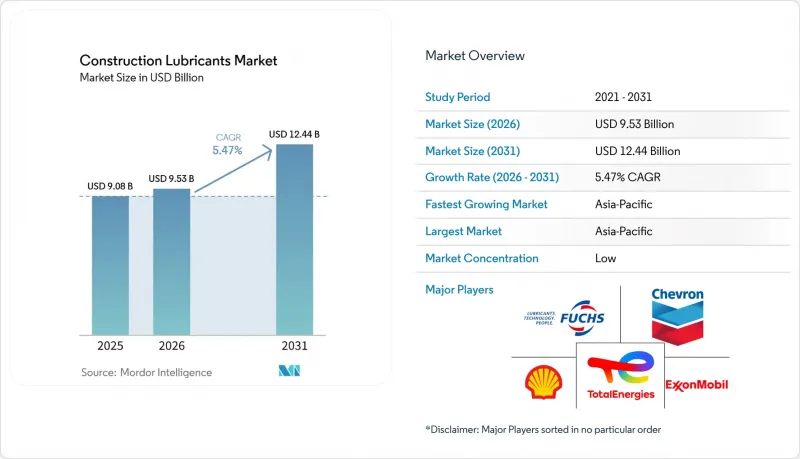
Mordor Intelligence에 따르면 건설용 윤활유 시장 규모는 2025년에 90억 8,000만 달러로 추계되고 있으며, 예측 기간(2026-2031년)에 CAGR 5.47%로 확대하며, 2026년 95억 3,000만 달러에서 2031년에는 124억 4,000만 달러에 달할 것으로 전망되고 있습니다.
이 보고서는 제품 유형(작동유, 엔진오일 등), 엔진오일(광물유, 합성유 등), 용도(상업용 건설 등), 최종사용자 산업(건설업체, 건설기계 임대업체 등) 및 지역(아시아태평양, 북미, 유럽, 남미, 중동 및 아프리카)별로 분류되어 있습니다. 시장 전망은 금액(달러) 기준으로 제시되어 있습니다.
전 세계 건설용 윤활유 시장의 동향 및 인사이트
인프라 개발 및 대규모 건설 프로젝트의 확대
토목 공사는 대규모 프로젝트에서 장기간 중장비가 필요하므로 건설용 윤활유 수요를 지원하고 있습니다. 도로, 철도 시스템, 교량, 항만, 터널 및 유틸리티 네트워크 건설에는 굴착기, 크레인, 로더, 운반 트럭 및 관련 기계가 사용됩니다. 이러한 중장비들은 프로젝트 주기 전반에 걸쳐 정기적인 오일 교환, 그리스 도포 및 작동유 모니터링이 필요합니다. 정부의 자금 지원 덕분에 토목 공사는 민간 건설 자금의 변동 영향을 덜 받게 되었습니다. 프로젝트 파이프라인이 장기적인 공공 인프라로 전환됨에 따라 건설용 윤활유 시장은 혜택을 보고 있습니다. 2026년 1월 인도의 고속철도 패키지와 2025년 12월 텍사스주 고속철도 합작 사업은 본 조사에서 인용된 주요 건설 프로그램의 지역적 범위를 보여주는 좋은 예입니다.
또한 인프라 프로젝트에서는 여러 건설 단계에 걸쳐 공급 체제가 구축되는 경향이 있습니다. 시공사들은 기계를 지속적으로 가동하고 장비 보증을 유지하기 위해 승인된 윤활유를 안정적으로 공급받아야 합니다. 따라서 여러 거점에서 서비스를 제공하고 일관된 제품 품질을 유지하는 공급업체가 유리할 수 있습니다. 작업은 대개 토공, 리프팅, 포장, 굴착, 자재 운반용 장비에 걸쳐 수행됩니다. 장비 범주별로 작동유, 엔진오일, 기어 오일, 그리스의 수요 구성이 다릅니다. 그 결과, 인프라 지출은 단일 제품 범주뿐만 아니라 건설용 윤활유 시장의 더 광범위한 부문을 지원하게 됩니다.
건설 기계의 기계화 진전
기계화가 진행되면 수작업이 아닌 동력이 장착된 기계에 의해 건설 작업의 상당 부분이 완료되므로 윤활유 소비량이 증가합니다. 인도의 기계 수요는 건설 지출 1,000달러당 5달러로 보고되고 있지만, 세계 평균은 1,000달러당 12달러입니다. 이 차이는 인도가 다른 국가 수준의 수준에 가까워짐에 따라 기계 도입 대수가 증가할 가능성이 있음을 시사합니다. 또한 제공된 자료에서는 광업 및 건설 기계 관련 부문에서 인도의 설비 투자 증가에 대해서도 언급되었습니다. 차량 도입 확대에 따라 일반적인 가동 주기에서 엔진, 유압 시스템, 변속기 및 그리스에 대한 수요가 증가하게 됩니다.
사하라 이남 아프리카와 동남아시아의 일부 지역에서도 기계화 격차가 존재합니다. 이러한 지역에 도입되는 신규 장비는 기존 수요를 대체하는 것이 아니라, 이에 더해 윤활유 수요를 창출합니다. 인도의 건설기계 수출은 2025-26 회계연도에 32% 증가했으나, 국내 출하량은 소폭 감소했습니다. 이러한 수출 양상은 장비 제조사들이 지역 수요에 부응하여 향후 도입 대수를 확대해 왔음을 보여줍니다. 각 기계는 가동 시작시 윤활유 주입이 필요하며, 이는 인증 제품에 대한 지속적인 수요를 창출합니다. 이러한 광범위한 장비 확대는 고성장을 달성하고 있는 개발도상 지역내 건설용 윤활유 시장을 지원하고 있습니다.
원유 및 기유 가격 변동이 윤활유 생산 비용에 영향을 미침
원유 및 기유 가격은 급격하게 변동할 가능성이 있으며, 윤활유 생산 비용에 부담을 주고 있습니다. 2026년 중동에서 발생한 공급 차질로 인해 브렌트유 가격은 4월 초에 배럴당 128달러 가까이까지 상승했으나, 6월 중순에는 배럴당 76달러까지 하락했습니다. 91일 동안 19개 윤활유 제조사가 37건의 가격 조정을 단행했습니다. 가격 상승률은 합성 등급의 경우 35%, 기존 등급의 경우 25-26%에 달했습니다. 비용의 급격한 변동으로 인해 공급업체는 장기 계약의 가격 책정이 어려워지고, 계약업체는 유지보수 비용을 예측하기 어려워집니다. 이러한 변동성으로 인해 구매자가 비필수 윤활유의 발주를 미루게 되면 구매가 위축될 가능성이 있습니다.
원유 가격이 안정된 후에도 기유 공급 상황은 여전히逼迫한 상태로 남아 있을 가능성이 있습니다. 특히 많은 합성 건설용 윤활유의 경우 그룹 III의 공급이 매우 중요합니다. 이러한 원료에 의존하는 공급업체는 비용이 완제품 가격보다 빠르게 상승할 경우, 이익률 압박에 직면할 우려가 있습니다. 윤활유 가격이 급변할 경우, 건설 도급업체들은 고정 가격 공급 조건의 완화를 요구할 가능성이 있습니다. 일부 구매자는 가격이 안정될 때까지 기다리는 동안 재고를 줄이기도 합니다. 이러한 대응은 구매 패턴에 영향을 미쳐, 건설용 윤활유 시장의 일반적인 발주 시기를 교란시킬 수 있습니다.
부문 분석
2025년, 건설용 윤활유 시장에서 작동유는 32.64%의 점유율을 차지하며 가장 큰 제품 카테고리가 되었습니다. 이 제품은 인프라 건설 현장에서 사용되는 굴착기, 크레인, 로더, 덤프트럭 및 기타 기계에서 동력을 전달합니다. 이러한 기계들은 대개 가혹한 부하 조건에서 장시간 가동됩니다. 해당 유압 시스템에는 안정적인 점도, 마모 방지 성능 및 내산화성을 갖춘 작동유가 요구됩니다. 고압 시스템으로의 전환에 따라 더욱 엄격한 작동 허용 범위에서도 확실하게 성능을 발휘하는 배합에 대한 수요가 증가하고 있습니다. 작동유의 수요는 주요 토공·하역 기계의 도입 현황과 연동되어 있습니다. 이러한 기종은 토목 공사 전반에 걸쳐 널리 사용되고 있으므로 이 카테고리는 건설용 윤활유 시장에서 여전히 중심적인 위치를 차지하고 있습니다. 쉘(Shell)사의 ‘Tellus S4 VE’는 이러한 용도에 맞춰 개발되었으며, 적절한 조건 하에서는 에너지 효율 향상과 오일 교환 주기 연장에 기여하는 것으로 알려져 있습니다.
그리스 시장 규모는 2031년까지 연평균 성장률(CAGR) 6.13%로 확대될 것으로 예측되며, 이는 제품 유형 중 가장 높은 성장률입니다. 도시 지역의 터널 공사에서 사용되는 대형 굴착기는 핀-부시 접합부에 반복적인 하중을 가합니다. 이러한 용도에서는 압력 하, 작동 중 및 오염 물질이 존재하는 상황에서도 효과를 유지할 수 있는 그리스가 요구됩니다. 잦은 가동 주기로 인해 그리스의 품질은 유지보수시 중요한 고려 사항이 되고 있습니다. CITGO사는 2026년 3월, 가혹한 건설 및 광업 용도를 위해 ‘Mystik JT-6 HD SynBlend 460 Moly Plus 2’를 출시했습니다. 이 제품은 굴착기, 휠 로더, 굴절식 덤프트럭, 크롤러 도저 등의 장비를 위해 설계되었습니다. 이는 가혹한 오프로드 조건을 위한 지속적인 배합 개발의 성과를 반영한 것입니다.
압축기 오일은 굴착 및 터널 공사 프로젝트와 관련된 분야로, 여전히 비교적 작은 카테고리에 머물러 있습니다. 그 성능은 먼지가 많은 환경에서 연속 가동될 가능성이 있는 공압 시스템에 좌우됩니다. 셰브론은 2024년 10월, 아시아태평양에서 ‘Rykon’ 칼슘 설포네이트 복합 그리스 시리즈를 출시했습니다. 이 제품 라인은 리튬 증점제의 비용 압박 및 중장비에 대한 요구 사항에 대응하기 위한 것으로 자리매김하고 있습니다. 이러한 제품 변경은 공급업체가 성능상의 요구 사항과 원자재 제약 조건을 모두 해결하고 있음을 보여줍니다. 건설용 윤활유 구매자는 초기 구매 가격뿐만 아니라 수명 주기 비용을 바탕으로 제품을 선택할 가능성이 높습니다. 건설용 윤활유 시장에서는 장비 설계 및 가동 조건의 변화에 따라 앞으로도 특수 제품에 대한 수요가 지속될 것입니다.
2025년 엔진오일 매출에서 광물성 오일이 차지하는 비중은 66.41%로, 이는 비용 효율성을 중시하는 건설 차량에서 광물성 오일이 널리 사용되고 있음을 반영합니다. 신흥 시장의 건설업체들은 관리 가능한 비용으로 장비 요건을 충족하는 제품을 우선적으로 선택하는 경우가 많습니다. 구형 Tier 3 및 이에 상응하는 엔진 역시 아시아, 아프리카, 남미 전역에서 미네랄 오일의 지속적인 사용을 지원하고 있습니다. 미네랄 오일의 배합은 정비 팀에게 익숙하며, 현지 유통망을 통해 널리 구할 수 있습니다. 이러한 요인들이 건설용 윤활유 시장에서 광물유의 입지를 공고히 하고 있습니다. 또한 이 범주는 고급 오일 사양이 필요하지 않은 방대한 기존 장비에도 사용되고 있습니다. 따라서 그 우위는 가격과 차량의 노후화 모두와 관련이 있습니다.
바이오 기반 오일은 2031년까지 연평균 성장률(CAGR) 8.36%로 확대될 것으로 예상되며, 이는 엔진오일 유형 중 가장 높은 성장률입니다. 유럽과 북미에서는 공공 조달 요건에 따라 장비 선정시 생분해성이 고려되고 있습니다. 제시된 조사에서는 미국 농무부(USDA)의 ‘BioPreferred’ 요건과 EU의 에코라벨 기준이 계약 사양에 영향을 미치는 요인으로 꼽혔습니다. 또한 캘리포니아주와 뉴욕주도 공공 인프라 사양을 통해 생분해성 유체의 사용을 장려하고 있는 지역으로 언급되었습니다. 이러한 정책은 보다 광범위한 규제 요건이 의무화되기 전에 구매 결정을 변화시킬 가능성이 있습니다. 바이오 기반 제품은 수로 주변, 보호 구역 및 기타 환경을 고려해야 하는 건설 현장에서 중요하며, 건설용 윤활유 시장에서 가장 빠르게 성장하고 있는 분야를 지원하고 있습니다.
바이오 기반 오일은 전체 엔진오일 시장에서 차지하는 점유율이 제한적입니다. 그 성장은 제품 비용, 장비 승인 및 안정적인 공급 확보에 달려 있습니다. 토탈에너지(TotalEnergies)가 사용 후 오일 재생 기업 테코일(Tecoil)을 인수한 것은 순환형 기초유 공급을 자사의 윤활유 포트폴리오에 통합하려는 노력을 반영한 것입니다. 제시된 조사에 따르면 유럽의 장비 제조업체들도 특정 신형 기종에 대해 생분해성 유체를 출고시 충전하기 시작했습니다. 공장 출하시 충전은 기계의 수명 기간 중 선정되는 제품에 영향을 미칠 수 있으며, 승인된 지속가능한 배합 제품에 대한 지속적인 판매 경로를 창출합니다. 이러한 변화는 점진적이지만, 특정 건설 기계 차량군의 조달 체계를 변화시키고 있습니다.
지역별 분석
아시아태평양은 2025년 건설용 윤활유 시장 점유율의 43.95%를 차지하며, 2031년까지 연평균 성장률(CAGR) 6.27%로 확대될 것으로 예측됩니다. 이 지역은 대규모 인프라 계획과 건설 기계의 기계화 진전에 힘입고 있습니다. 중국은 지하철망 확장 및 쓰촨·티베트 철도 등 ‘제15차 5개년 계획’의 우선 과제를 통해 지역 성장을 지원하고 있습니다.
쉘(Shell)은 40개국 이상에 공급하기 위해 태국의 그리스 생산 능력을 연간 5,000톤에서 1만 5,000톤으로 확대했습니다. 또한 쉘은 연간 생산 능력 1만 2,000톤 규모의 그리스 공장을 인도네시아에 건설할 것이라고 발표했습니다. 이러한 투자는 해당 지역내 공급 및 유통의 중요성을 반영하고 있습니다. 일본과 한국은 첨단 장비 기준을 충족하는 고정밀 합성 제품에 대한 수요를 주도하고 있습니다. 인도네시아와 베트남은 민간 및 산업 건설 분야에서 고성장 시장으로 부상하고 있습니다. 비용에 민감한 지역에서는 지역 공급업체들이 가격 경쟁을 벌이고 있으며, 아시아태평양 전역에 걸쳐 다양한 시장 환경이 형성되고 있습니다.
북미와 유럽은 중장비 기준 및 텔레매틱스 활용이 더욱 정착된 프리미엄 제품 시장입니다. 2028년까지 시행될 5,500억 달러 규모의 미국 신규 인프라 지출과 1,330억 달러 규모의 캐나다 인프라 계획은 중장비 가동 및 관련 윤활유 수요를 지원할 것으로 예상됩니다. 북미의 차량 운영 사업자들은 유지보수 예산 및 기계 가동률 관리에 도움이 되는 제품을 우선시하고 있습니다. 유럽의 수요는 환경 규제와 바이오 유래 제품의 도입에도 영향을 받고 있습니다. 매출 점유율 면에서는 아시아태평양이 여전히 가장 크지만, 이들 지역은 건설용 윤활유 시장에서 큰 가치 창출 기회를 제공하고 있습니다.
쉘은 2024년, 독일 베셀링 정유소에서 그룹 III 기유 생산 설비 건설을 시작했습니다. 이 시설의 연간 생산 능력은 30만 톤이 될 예정이며, 2028년 가동을 목표로 하고 있습니다. 이 투자는 합성 윤활유 생산을 위한 지역적 공급 기반을 지원하는 것입니다. 남미, 중동 및 아프리카에서는 수요 추세가 더욱 다양해지고 있습니다.
기타 혜택:
- Excel 형식의 시장 예측(ME) 시트
- 3개월간의 애널리스트 지원
자주 묻는 질문
목차
제1장 서론
제2장 분석 방법
제3장 개요
제4장 시장 구도
제5장 시장 규모·성장률 예측
제6장 경쟁 구도
제7장 시장 기회와 향후 전망
KSA 26.09.02According to Mordor Intelligence, the construction lubricants market size was estimated at USD 9.08 billion in 2025 and is estimated to grow from USD 9.53 billion in 2026 to USD 12.44 billion by 2031, at a CAGR of 5.47% during the forecast period (2026-2031).
This report is Segmented by Product Type (Hydraulic Fluids, Engine Oils, and More), Engine Oil (Mineral Oil, Synthetic Oil, and More), Application (Commercial Construction and More), End-User Industry (Contractors, Equipment Rental Fleets, and More), and Geography (Asia-Pacific, North America, Europe, South America, and Middle-East and Africa). The Market Forecasts are Provided in Terms of Value (USD).
Global Construction Lubricants Market Trends and Insights
Expansion of Infrastructure Development and Large-Scale Construction Projects
Civil engineering activity supports construction lubricant demand because large projects require heavy equipment for extended periods. Roads, rail systems, bridges, ports, tunnels, and utility networks use excavators, cranes, loaders, haul trucks, and related machinery. These equipment fleets require scheduled oil changes, grease application, and fluid monitoring throughout the project cycle. Government funding makes civil works less exposed to changes in private building finance. The construction lubricants market benefits as project pipelines shift toward long-duration public infrastructure. India's January 2026 high-speed rail package and the December 2025 Texas High-Speed Rail joint venture illustrate the geographic range of major construction programs cited in the supplied research.
Infrastructure projects also tend to create supply arrangements that span multiple construction phases. Contractors need a reliable supply of approved lubricants to keep machinery operational and to maintain equipment warranties. This can favor suppliers that serve multiple locations and maintain consistent product quality. Work is often spread across earthmoving, lifting, paving, drilling, and material-handling equipment. Each equipment category creates a different mix of hydraulic fluid, engine oil, gear oil, and grease demand. As a result, infrastructure spending can support a broader segment of the construction lubricants market rather than just one product category.
Increasing Mechanization of Construction Equipment Fleets
Mechanization increases lubricant consumption because more construction work is completed by powered equipment rather than manual labor. India's machinery demand was cited at USD 5 per USD 1,000 of construction spending, compared with a global average of USD 12 per USD 1,000. This gap indicates that equipment deployment could rise as the country moves toward peer levels. The supplied material also cited rising Indian capital expenditure in mining and construction equipment-linked sectors. Greater fleet deployment would increase engine, hydraulic, transmission, and grease requirements during normal service cycles.
Mechanization gaps also exist in parts of sub-Saharan Africa and Southeast Asia. New equipment placed in these regions adds lubricant requirements alongside existing demand rather than replacing it. India's construction equipment exports rose 32% in FY2025-26, even while domestic dispatches declined marginally. This export pattern indicates equipment manufacturers were serving regional demand and building a future installed base. Each machine requires lubricant service upon entering operation, creating a recurring need for authorized products. This broad equipment expansion supports the construction lubricants market in high-growth developing regions.
Volatility in Crude Oil and Base Oil Prices Affects Lubricant Production Costs
Crude oil and base oil costs can change rapidly, creating pressure on lubricant production costs. A 2026 Middle-East supply disruption drove Brent crude to nearly USD 128 per barrel in early April before it retreated to USD 76 per barrel by mid-June. Over 91 days, 19 lubricant companies implemented 37 pricing actions. Price increases reached 35% for synthetic grades and 25-26% for conventional grades. Rapid cost movements make it harder for suppliers to price long-term contracts and for contractors to forecast maintenance spending. This volatility can slow purchases when buyers defer nonessential fluid orders.
Base oil availability can remain tight even after crude prices stabilize. Group III supply is particularly important for many synthetic construction lubricants. Suppliers that depend on these inputs can face margin pressure when costs rise faster than finished-product prices. Construction contractors may seek relief from fixed-price supply terms when lubricant prices move sharply. Some buyers reduce inventories while waiting for prices to stabilize. These responses affect buying patterns and can disrupt normal order timing in the construction lubricants market.
Other drivers and restraints analyzed in the detailed report include:
- Growing Demand for Extended Drain Intervals and Enhanced Equipment Uptime
- Rising Adoption of Telematics, Automation, and Condition-Based Lubrication Monitoring
- High Cost of Synthetic and Bio-Based Lubricant Formulations
For complete list of drivers and restraints, kindly check the Table Of Contents.
Segment Analysis
Hydraulic fluids held 32.64% of the construction lubricants market share in 2025, making them the largest product category. They transfer power in excavators, cranes, loaders, dump trucks, and other machinery used on infrastructure sites. These machines often operate under heavy loads and for sustained periods. Their hydraulic systems require fluids with stable viscosity, wear protection, and oxidation resistance. The shift toward high-pressure systems increases the need for formulations that perform reliably under tighter operating tolerances. Hydraulic fluid demand follows the deployment of major earthmoving and lifting fleets. The category remains central to the construction lubricants market because these equipment types are widely used across civil works. Shell's Tellus S4 VE is positioned for this application and is stated to support energy efficiency and longer drain intervals under relevant conditions.
Greases are forecast to grow at a 6.13% CAGR through 2031, the fastest rate among product types. Large excavators used in urban tunneling place repeated loads on pin-and-bush joints. Those applications require greases that remain effective under pressure, in motion, and in the presence of contamination. Frequent duty cycles make grease quality an important maintenance consideration. CITGO launched Mystik JT-6 HD SynBlend 460 Moly Plus 2 in March 2026 for severe construction and mining applications. The product was designed for equipment including excavators, wheel loaders, articulated dump trucks, and track dozers. This reflects continued formulation work for demanding off-highway conditions.
Compressor oils remain a smaller category, although they are relevant to drilling and tunneling projects. Their performance is tied to pneumatic systems that may work continuously in dust-intensive environments. Chevron introduced its Rykon calcium sulfonate complex grease line in Asia-Pacific in October 2024. The product range was described as a response to lithium thickener cost pressure and heavy-duty equipment requirements. Product changes of this type indicate that suppliers are addressing both performance needs and raw-material constraints. Construction lubricant buyers may select products based on lifecycle cost rather than initial purchase price alone. The construction lubricants market will continue to require specialized products as equipment designs and operating conditions change.
Mineral oil accounted for 66.41% of engine oil revenue in 2025, reflecting its broad use in cost-sensitive construction fleets. Contractors in emerging markets often prioritize products that meet equipment requirements at a manageable cost. Older Tier 3 and similar engines also support continued use of mineral oil across Asia, Africa, and South America. Mineral formulations remain familiar to maintenance teams and are widely available through local distribution networks. These factors reinforce mineral oil's position in the construction lubricants market. The category also serves the large installed base of equipment that does not require advanced oil specifications. Its lead is therefore linked to both price and fleet age.
Bio-based oil is forecast to expand at an 8.36% CAGR through 2031, the strongest rate among engine oil types. Public procurement requirements are bringing biodegradability into equipment decisions in Europe and North America. USDA BioPreferred requirements and EU Ecolabel criteria were identified in the supplied research as factors influencing contract specifications. California and New York were also cited as locations where public infrastructure specifications encourage the use of biodegradable fluids. These policies can shift purchasing decisions before wider regulatory requirements become mandatory. Bio-based products are relevant around waterways, protected land, and other sensitive construction settings, supporting the fastest-growing portion of the construction lubricants market.
Bio-based oils represent a limited share of total engine oil. Their growth depends on product cost, equipment approval, and consistent supply availability. TotalEnergies' acquisition of used-oil regeneration company Tecoil reflects an effort to integrate circular base oil supply into its lubricant portfolio. European equipment manufacturers are also beginning to factory-fill certain new machines with biodegradable fluids, according to the supplied research. Factory fill can influence the product selected throughout a machine's service life, creating a sustained channel for approved sustainable formulations. The shift is gradual but is changing the procurement framework for selected construction fleets.
Complete Report Scope:
- By Product Type
- Hydraulic Fluids
- Engine Oils
- Gear Oils
- Automatic Transmission Fluids (ATF)
- Greases
- Compressor Oils
- Other Product Types
- By Engine Oil
- Mineral Oil
- Synthetic Oil
- Bio-Based Oil
- By Application
- Commercial Construction
- Personal and Small-Contractor Construction
- Mining and Quarrying Support
- Infrastructure and Civil Works
- By End-User Industry
- Contractors
- Equipment Rental Fleets
- Construction Equipment OEMs
- Mining and Quarrying Operators
- By Geography
- Asia-Pacific
- China
- India
- Japan
- South Korea
- Rest of Asia-Pacific
- North America
- United States
- Canada
- Mexico
- Europe
- Germany
- United Kingdom
- France
- Italy
- Russia
- Rest of Europe
- South America
- Brazil
- Argentina
- Rest of South America
- Middle-East and Africa
- Saudi Arabia
- South Africa
- Rest of Middle-East and Africa
- Asia-Pacific
Geography Analysis
Asia-Pacific accounted for 43.95% of the construction lubricants market share in 2025 and is projected to expand at a CAGR of 6.27% through 2031. The region benefits from large infrastructure programs and increasing mechanization of equipment. China supports regional growth through its 15th Five-Year Plan priorities, including metro expansion and the Sichuan-Tibet Railway.
Shell expanded its grease manufacturing capacity in Thailand from 5,000 tons to 15,000 tons per year to serve more than 40 countries. The company also announced a grease plant in Indonesia with a capacity of 12,000 tons per year. These investments reflect the importance of regional supply and distribution. Japan and South Korea drive demand for high-precision synthetic products that meet advanced equipment standards. Indonesia and Vietnam are high-growth markets in civil and industrial construction. Regional suppliers compete on price in cost-sensitive locations, creating a varied market environment across Asia-Pacific.
North America and Europe are markets for premium products, where equipment standards and telematics use are more established. USD 550 billion in new U.S. infrastructure spending through 2028 and Canada's USD 133 billion infrastructure plan are expected to support heavy equipment activity and related lubricant demand. North American fleet operators prioritize products that help manage maintenance budgets and machine availability. European demand is also influenced by environmental requirements and the adoption of bio-based products. These regions offer significant value opportunities in the construction lubricants market, even though Asia-Pacific remains the largest by revenue share.
Shell began construction of a Group III base oil unit at its Wesseling refinery in Germany in 2024. The facility is planned to have a capacity of 300,000 tons per year, with commissioning targeted for 2028. This investment supports the regional supply base for synthetic lubricant production. South America, the Middle-East, and Africa present a more varied demand profile.
- BP p.l.c.
- Chevron Corporation
- ENEOS Corporation
- ExxonMobil Corporation
- FUCHS
- Gulf Oil International Ltd.
- Idemitsu Kosan Co., Ltd.
- Indian Oil Corporation Ltd.
- Petro-Canada Lubricants Inc.
- PetroChina Company Limited
- Petronas Lubricants International
- Phillips 66 Company
- Repsol
- Shell plc
- TotalEnergies
- Valvoline
Additional Benefits:
- The market estimate (ME) sheet in Excel format
- 3 months of analyst support
TABLE OF CONTENTS
1 Introduction
- 1.1 Study Assumptions and Market Definition
- 1.2 Scope of the Study
2 Research Methodology
3 Executive Summary
4 Market Landscape
- 4.1 Market Overview
- 4.2 Market Drivers
- 4.2.1 Expansion of Infrastructure Development and Large-Scale Construction Projects
- 4.2.2 Increasing Mechanization of Construction Equipment Fleets
- 4.2.3 Growing Demand for Extended Drain Intervals and Enhanced Equipment Uptime
- 4.2.4 Rising Adoption of Telematics, Automation, and Condition-Based Lubrication Monitoring
- 4.2.5 Stringent OEM Specifications for High-Performance Hydraulic Systems and Low-Emission Engines
- 4.3 Market Restraints
- 4.3.1 Volatility in Crude Oil and Base Oil Prices Affecting Lubricant Production Costs
- 4.3.2 High Cost of Synthetic and Bio-Based Lubricant Formulations
- 4.3.3 Inconsistent Equipment Maintenance Practices and Availability of Counterfeit Lubricants
- 4.4 Value Chain Analysis
- 4.5 Porter's Five Forces Analysis
- 4.5.1 Threat of New Entrants
- 4.5.2 Bargaining Power of Suppliers
- 4.5.3 Bargaining Power of Buyers
- 4.5.4 Threat of Substitutes
- 4.5.5 Competitive Rivalry
5 Market Size and Growth Forecasts (Value)
- 5.1 By Product Type
- 5.1.1 Hydraulic Fluids
- 5.1.2 Engine Oils
- 5.1.3 Gear Oils
- 5.1.4 Automatic Transmission Fluids (ATF)
- 5.1.5 Greases
- 5.1.6 Compressor Oils
- 5.1.7 Other Product Types
- 5.2 By Engine Oil
- 5.2.1 Mineral Oil
- 5.2.2 Synthetic Oil
- 5.2.3 Bio-Based Oil
- 5.3 By Application
- 5.3.1 Commercial Construction
- 5.3.2 Personal and Small-Contractor Construction
- 5.3.3 Mining and Quarrying Support
- 5.3.4 Infrastructure and Civil Works
- 5.4 By End-User Industry
- 5.4.1 Contractors
- 5.4.2 Equipment Rental Fleets
- 5.4.3 Construction Equipment OEMs
- 5.4.4 Mining and Quarrying Operators
- 5.5 By Geography
- 5.5.1 Asia-Pacific
- 5.5.1.1 China
- 5.5.1.2 India
- 5.5.1.3 Japan
- 5.5.1.4 South Korea
- 5.5.1.5 Rest of Asia-Pacific
- 5.5.2 North America
- 5.5.2.1 United States
- 5.5.2.2 Canada
- 5.5.2.3 Mexico
- 5.5.3 Europe
- 5.5.3.1 Germany
- 5.5.3.2 United Kingdom
- 5.5.3.3 France
- 5.5.3.4 Italy
- 5.5.3.5 Russia
- 5.5.3.6 Rest of Europe
- 5.5.4 South America
- 5.5.4.1 Brazil
- 5.5.4.2 Argentina
- 5.5.4.3 Rest of South America
- 5.5.5 Middle-East and Africa
- 5.5.5.1 Saudi Arabia
- 5.5.5.2 South Africa
- 5.5.5.3 Rest of Middle-East and Africa
- 5.5.1 Asia-Pacific
6 Competitive Landscape
- 6.1 Market Concentration
- 6.2 Strategic Moves
- 6.3 Market Share (%)/Ranking Analysis
- 6.4 Company Profiles (includes Global Overview, Market Overview, Core Segments, Financials as available, Strategic Information, Products and Services, and Recent Developments)
- 6.4.1 BP p.l.c.
- 6.4.2 Chevron Corporation
- 6.4.3 ENEOS Corporation
- 6.4.4 ExxonMobil Corporation
- 6.4.5 FUCHS
- 6.4.6 Gulf Oil International Ltd.
- 6.4.7 Idemitsu Kosan Co., Ltd.
- 6.4.8 Indian Oil Corporation Ltd.
- 6.4.9 Petro-Canada Lubricants Inc.
- 6.4.10 PetroChina Company Limited
- 6.4.11 Petronas Lubricants International
- 6.4.12 Phillips 66 Company
- 6.4.13 Repsol
- 6.4.14 Shell plc
- 6.4.15 TotalEnergies
- 6.4.16 Valvoline
7 Market Opportunities and Future Outlook
- 7.1 White-Space and Unmet-Need Assessment


