

|
시장보고서
상품코드
2119083
초전도체 : 시장 점유율 분석, 업계 동향 및 통계, 성장 예측(2026-2031년)Superconductors - Market Share Analysis, Industry Trends & Statistics, Growth Forecasts (2026 - 2031) |
||||||
 Mordor Intelligence
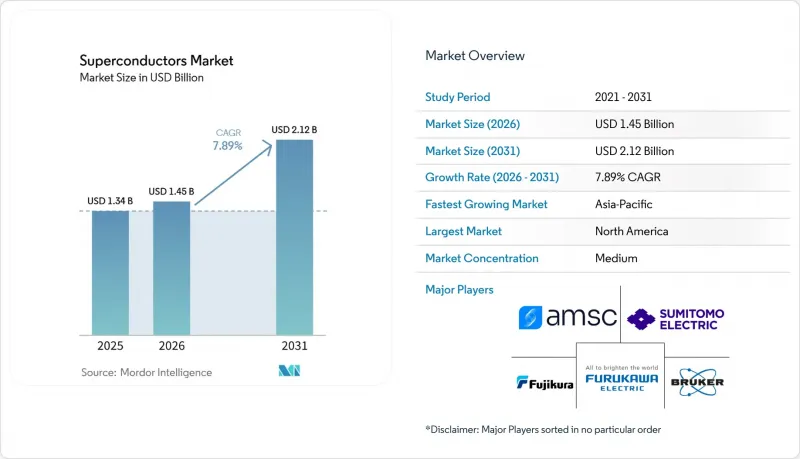
Mordor Intelligence에 의하면, 초전도체 시장 규모는 2025년에 13억 4,000만 달러로 평가되었습니다. 2026년 14억 5,000만 달러에서 2031년까지 21억 2,000만 달러에 이를 것으로 예상되며, 예측 기간(2026-2031년) CAGR은 7.89%를 나타낼 전망입니다.
본 보고서는 유형별(저온 초전도체(LTS) 등), 소재별(구리 산화물계 초전도체 등), 용도별(의료용 영상 진단 등), 최종 사용자 산업별(헬스케어, 에너지 및 전력 등),및 지역별(아시아태평양, 북미, 유럽, 남미, 중동 및 아프리카)로 분류되어 있습니다. 시장 예측은 금액(달러) 기준으로 제시되어 있습니다.
세계의 초전도체 시장 동향 및 인사이트
고자기장 MRI 시스템 수요 증가 및 노후화된 의료용 영상 진단 인프라의 교체
초전도체 시장은 2000년부터 2010년 사이에 도입된 1.5T 및 3.0T MRI 시스템의 교체로 인해 혜택을 보고 있습니다. 이러한 시스템의 상당수는 수명이 다해가고 있으며, 이는 교체용 자석 및 관련 도체에 대한 수요를 뒷받침하고 있습니다. 고자기장 장비는 기능적 영상 진단, 암 병기 분류 및 신경혈관 평가에서 신호 품질을 향상시킵니다. 2026년 1월, 브루커(Bruker)는 두 개의 세계 헬스케어 기업과 MRI용 초전도체에 관한 총액 5억 달러 규모의 다년 공급 계약을 체결했다고 발표했습니다. 여기에는 7년간의 계약도 포함되어 있습니다. 또한, 브루커(Bruker)는 자사의 ‘Ascend Evo 700’ 및 ‘800’ 자석을 통해 헬륨 소비량을 33%에서 40%까지 줄이고, 보충 주기를 180일에서 240일로 연장했다고 보고했습니다. 이러한 요건으로 인해 일관된 와이어 성능의 가치가 높아져, 초전도체 시장의 기존 공급업체들이 혜택을 받게 될 것입니다.
송전망 현대화 및 대용량 송전 네트워크에 대한 투자 확대
초전도체 시장은 인구 밀집 도시 지역의 송전망 제약에 의해서도 뒷받침되고 있습니다. 유럽, 북미, 동아시아의 전력 회사는 가공 송전선로 확장이 어려운 경로에서 추가적인 송전 용량을 필요로 하고 있습니다. 고온 초전도 케이블은 기존 가교 폴리에틸렌(XLPE) 케이블보다 3-5배 많은 전력을 전송할 수 있는 반면, 폭이 최대 10분의 1에 불과한 경로에 설치할 수 있습니다. 이를 통해 새로운 가공 송전 노선 건설에 필요한 장기간의 인가 절차를 거치지 않고도 지하 송전선을 업그레이드할 수 있는 선택지가 생깁니다. 『Superconductor Science and Technology』지가 발표한 2026년 기술 로드맵에서는 고출력 초전도 케이블의 개발과 미래 전력 시스템에서의 역할에 대해 검토하고 있습니다. 이러한 비즈니스 기회는 단순한 전선 공급뿐만 아니라, 도체, 극저온 피복, 케이블 종단부, 그리고 고장 전류 보호를 결합한 통합 시스템에 달려 있습니다.
극저온 냉각 시스템의 복잡성과 헬륨 공급 제한
극저온 냉각은 여전히 많은 초전도 시스템에 있어 핵심적인 운영상의 제약으로 남아 있습니다. 이미 설치된 임상용 및 물리학용 자석의 대부분은 4.2 K 부근에서 작동하며, 액체 헬륨이 필요한 저온 초전도체를 사용하고 있습니다. 따라서 서비스의 지속성은 헬륨의 저장, 보충 및 유지보수 계획에 좌우됩니다. 헬륨 소비량을 줄이는 설계를 통해 의존도를 낮출 수는 있지만, 이미 설치된 시스템 전체에서 전용 냉각 시스템의 필요성을 완전히 없앨 수는 없습니다. 브루커(Bruker)사가 2025년에 발표한 자석은 고자기장 성능을 유지하면서 헬륨 사용량을 줄이는 것의 실용적 가치를 입증했습니다. 30 K 이상에서 작동하는 고온 초전도 시스템에서는 대체 냉각 방식을 채택할 수 있지만, 이러한 장비로의 광범위한 전환에는 시간이 걸릴 것입니다.
부문별 분석
2025년, 고온 초전도체는 초전도체 시장 점유율의 52.82%를 차지했습니다. 이 부문은 핵융합용 자석, 고장 전류 제한기, 데이터센터용 케이블 시범 프로젝트에 힘입어 2026년부터 2031년까지 연평균 성장률(CAGR) 9.47%를 나타낼 것으로 예측됩니다. 희토류 바륨 구리 산화물(REBCO) 도체는 강한 자기장 하에서 높은 전류 밀도가 필요한 용도에 적합합니다. 고온에서 작동이 가능하기 때문에 특정 설계에서 액체 헬륨에 대한 의존도를 낮출 수 있습니다. 고객이 소형이며 대용량의 전기 시스템을 요구함에 따라 시장은 이러한 용도로 전환되고 있습니다. 생산 능력과 도체의 균일성이 공급업체가 그로 인해 발생하는 수요에 대응할 수 있는지 여부를 좌우하게 될 것입니다.
저온 초전도체는 MRI, NMR 및 입자 가속기의 설치 기반 대부분에서 여전히 필수적인 존재입니다. 이러한 확립된 용도로 인해, 고온 초전도체의 대체재가 확대되고 있음에도 불구하고 꾸준한 교체 및 유지보수 수요가 발생하고 있습니다. 의료 시스템은 인증 주기가 길기 때문에 승인된 도체 설계는 장기간에 걸쳐 계속 사용됩니다. IEC 61788 시리즈 표준은 의료 및 연구 개발 분야의 전선 특성 평가와 조달 결정에 계속해서 영향을 미치고 있습니다. 따라서 이 유형 부문은 확대되는 고온 초전도체의 기회와 견고한 저온 초전도체의 기존 설비 기반을 모두 갖추고 있습니다. 이러한 균형 덕분에 새로운 용도가 개발되는 와중에도 초전도체 시장은 수익의 안정성을 유지할 수 있습니다.
2025년 시점에서 구리 산화물계 초전도체는 초전도체 시장 규모의 55.71%를 차지했습니다. 이러한 위상은 임상용 전선 분야의 비스무트-스트론튬-칼슘-구리 산화물(BSCCO)과 자석 및 전력망 분야의 이트륨-바륨-구리 산화물(YBCO) 또는 REBCO가 확립한 역할을 반영합니다. 이러한 소재들은 소규모 소재나 신소재로는 아직 산업 규모에서 충족할 수 없는 성능 요건에 힘입어, 까다로운 용도에서 광범위한 인증 실적을 쌓아왔습니다. 피복 도체 제조에 관한 노력은 긴 길이의 성능과 생산 신뢰성 향상에 계속해서 초점을 맞추었습니다. 철계 초전도체는 양산 규모 및 균일성에 관한 요건이 여전히 해결되지 않아 개발이 초기 단계에 머물러 있습니다.
이보화 마그네슘 초전도체는 2026년부터 2031년에 걸쳐 연평균 성장률(CAGR) 9.42%를 나타낼 것으로 예측됩니다. 이 소재는 20 K에서 39 K의 온도 범위에서 작동 가능하며, 액체 헬륨에 직접 의존하지 않고 크라이오쿨러 기반의 설계를 지원합니다. 이를 통해 해당 온도 범위가 허용 가능한 용도에서 부대 설비를 간소화할 수 있습니다. 이탈리아 국립핵물리연구소(INFN)는 AI 데이터센터의 전력 공급을 위해 설계된 MgB2 케이블에 관한 ‘SURE’ 프로젝트에서 ASG Superconductors사와 공동 연구를 수행했다고 보고했습니다. 이 소재는 특정 전력 용도에서 비용 및 운영 측면의 이점을 제공합니다. 이 소재의 채택 여부는 시스템 검증, 케이블 설계, 그리고 장기 운영에 대한 최종 사용자의 신뢰도에 좌우될 것입니다.
지역별 분석
2025년, 북미는 초전도체 시장 점유율의 37.44%를 차지했습니다. 이 지역은 미국의 자기공명영상(MRI) 시스템 조달, 고에너지 물리학 시설, 해군 프로그램, 그리고 민간 부문의 핵융합 투자로부터 혜택을 받고 있습니다. 핵융합 및 양자 기술에 관한 정부 프로그램은 특수 장비에 대해 보다 장기적인 계획 기간을 제공합니다. 미국 에너지부는 2025년에 ‘핵융합 과학기술 로드맵’을 발표하여 이 분야의 연구 개발 우선순위를 개괄했습니다. 이러한 프로그램들은 도체, 자석 및 관련 극저온 시스템에 대한 수요 전망을 뒷받침하고 있습니다. 또한 북미의 대학 및 국립 연구소들도 초전도 하드웨어의 연구 용도를 유지하고 있습니다.
아시아태평양은 2026년부터 2031년까지 연평균 성장률(CAGR) 9.27%를 나타낼 것으로 예측됩니다. 일본은 테이프, 자석, 모터, 의료용 부품에 이르는 수직 통합형 고온 초전도 생태계를 보유하고 있습니다. 중국, 일본, 한국은 소재 생산, 연구개발, 핵융합 개발 분야에서 각각 다른 역할을 수행하고 있습니다. 이 지역의 제조업체들은 전자기기, 운송, 전력 장비의 주요 공급망과 인접해 있다는 이점을 누리고 있습니다. 아시아태평양의 초전도체 시장은 국내 소재 개발 능력과 대용량 전력 인프라에 대한 투자로부터도 혜택을 받을 가능성이 있습니다. 성장은 인증받은 생산 능력의 확대와 에너지 및 산업 사용자로부터의 프로젝트 수준 수요에 좌우될 것입니다.
유럽도 초전도체 시장에서 일정한 위치를 차지하고 있으며, 독일에는 산업 연구 클러스터가, 프랑스에는 ITER 프로젝트가 거점을 두고 있습니다. ITER 프로그램은 유럽공급업체와 전 세계 핵융합용 자석 공급망을 지속적으로 연결하고 있습니다. 또한 유럽에서는 초전도 전력 케이블 및 송전망 기술 개발도 진행되고 있습니다. 이 지역의 비즈니스 기회는 에너지 전환 목표와 도시 지역의 송전 회랑 제약에 의해 뒷받침되고 있습니다. 남미, 중동 및 아프리카는 초전도체 시장에서 여전히 소규모의 점유율에 그치고 있습니다. 이 지역들 수요 잠재력은 향후 산업의 전기화, 연구 인프라, 그리고 전력 시스템에 대한 투자에 좌우될 것입니다.
기타 혜택 :
- 엑셀 형식 시장 예측(ME) 시트
- 3개월간의 애널리스트 지원
자주 묻는 질문
목차
제1장 서론
제2장 조사 방법
제3장 개요
제4장 시장 구도
제5장 시장 규모 및 성장 예측
제6장 경쟁 구도
제7장 시장 기회 및 향후 전망
KTH 26.09.02According to Mordor Intelligence, the superconductors market size was valued at USD 1.34 billion in 2025 and is estimated to grow from USD 1.45 billion in 2026 to reach USD 2.12 billion by 2031, at a CAGR of 7.89% during the forecast period (2026-2031).
This report is Segmented by Type (Low-Temperature Superconductors (LTS) and More), Material Type (Cuprate Superconductors and More), Application (Medical Imaging and More), End-User Industry (Healthcare, Energy and Power, and More), and Geography (Asia-Pacific, North America, Europe, South America, and Middle-East and Africa). The Market Forecasts are Provided in Terms of Value (USD).
Global Superconductors Market Trends and Insights
Rising Demand for High-Field MRI Systems and Replacement of Aging Medical Imaging Infrastructure
The superconductors market benefits from the replacement of 1.5 T and 3.0 T MRI systems installed between 2000 and 2010. Many of these systems are approaching the end of their operating lives, supporting demand for replacement magnets and related conductors. Higher-field equipment improves signal quality for functional imaging, cancer staging, and neurovascular assessment. In January 2026, Bruker announced USD 500 million in multi-year supply agreements with two global healthcare companies for MRI superconductors, including a seven-year agreement. Bruker also reported that its Ascend Evo 700 and 800 magnets reduced helium consumption by 33% to 40% and extended refill intervals to 180 to 240 days. These requirements increase the value of consistent wire performance and support established suppliers in the superconductors market.
Increasing Investments in Grid Modernization and High-Capacity Power Transmission Networks
The superconductors market is also supported by grid constraints in dense urban areas. Utilities in Europe, North America, and East Asia require additional capacity in corridors where overhead line expansion is difficult. High-temperature superconducting cables can carry 3 to 5 times the power of conventional cross-linked polyethylene (XLPE) cables while using corridors up to 10 times narrower. This provides an option for upgrading underground links without the extended approvals required for new overhead transmission routes. A 2026 technology roadmap from Superconductor Science and Technology reviewed the development of high-power superconducting cables and their role in future electricity systems. The opportunity depends on integrated systems that combine conductors, cryogenic envelopes, cable terminations, and fault-current protection, rather than wire supply alone.
Complexity of Cryogenic Cooling Systems and Limited Helium Availability
Cryogenic cooling remains a central operating constraint for many superconducting systems. Most installed clinical and physics magnets use low-temperature superconductors that operate near 4.2 K and require liquid helium. This makes service continuity dependent on helium storage, replenishment, and maintenance planning. Helium-saving designs can reduce exposure, but they do not eliminate the need for specialized cooling systems across the installed base. Bruker's 2025 magnet launch demonstrated the practical value of reducing helium use while maintaining high-field capability. High-temperature superconducting systems that operate above 30 K can use alternative cooling approaches, yet a broad transition to such equipment will take time.
Other drivers and restraints analyzed in the detailed report include:
- Growing Deployment of Superconducting Magnets in Fusion Energy and Particle Accelerator Projects
- Expansion of HTS Manufacturing Capacity and Long-Length Tape Production
- Manufacturing Challenges Related to REBCO Tape Yield, Uniformity, and Long-Length Production
For complete list of drivers and restraints, kindly check the Table Of Contents.
Segment Analysis
High-temperature superconductors captured 52.82% of the superconductors market share in 2025. The segment is forecast to grow at a 9.47% CAGR between 2026 and 2031, supported by fusion magnets, fault-current limiters, and data center cable pilots. Rare Earth Barium Copper Oxide (REBCO) conductors are suited to applications requiring high current density in strong magnetic fields. Their ability to operate at higher temperatures can reduce dependence on liquid helium in selected designs. The market has shifted toward these applications as customers seek compact, high-capacity electrical systems. Manufacturing capacity and conductor uniformity will determine whether suppliers can meet the resulting demand.
Low-temperature superconductors remain essential for much of the installed base of MRI, NMR, and particle accelerators. Their established use creates steady replacement and service demand even as high-temperature alternatives expand. Medical systems have long qualification cycles, which keep approved conductor designs in use for extended periods. The IEC 61788 series of standards continues to influence wire characterization and procurement decisions in medical and research settings. The type segment, therefore, combines a growing high-temperature opportunity with a durable low-temperature installed base. This balance helps the superconductors market maintain revenue stability while new applications develop.
Cuprate superconductors accounted for 55.71% of the superconductors market size in 2025. Their positions reflect the established roles of Bismuth Strontium Calcium Copper Oxide (BSCCO) in clinical wire and Yttrium Barium Copper Oxide (YBCO) or REBCO in magnet and grid applications. These materials have accumulated a large qualification base in demanding applications, supported by performance requirements that smaller or newer materials may not yet meet at an industrial scale. Work on coated-conductor manufacturing continues to focus on improving long-length performance and production reliability. Iron-based superconductors remain at an earlier stage, as production-scale and uniformity requirements remain unresolved.
Magnesium diboride superconductors are forecast to grow at a 9.42% CAGR from 2026 to 2031. The material can operate at 20 K to 39 K, which supports cryocooler-based designs rather than direct reliance on liquid helium. This can simplify supporting equipment in applications where those temperatures are acceptable. The Istituto Nazionale di Fisica Nucleare (INFN) reported work with ASG Superconductors on the SURE project for an MgB2 cable designed for AI data center power supply. The material offers cost and operational advantages in selected power applications. Its adoption will depend on system validation, cable design, and end-user confidence in long-term operation.
Complete Report Scope:
- By Type
- Low-Temperature Superconductors (LTS)
- High-Temperature Superconductors (HTS)
- By Material Type
- Cuprate Superconductors
- Iron-Based Superconductors
- Magnesium Diboride (MgB2) Superconductors
- By Application
- Medical Imaging
- Power Transmission and Grid
- Fusion Energy and Particle Accelerators
- Transportation
- Industrial Equipment and Electronics
- By End-User Industry
- Healthcare
- Energy and Power
- Scientific Research
- Transportation
- Industrial Manufacturing
- Electronics and Quantum Technology
- By Geography
- Asia-Pacific
- China
- India
- Japan
- South Korea
- Rest of Asia-Pacific
- North America
- United States
- Canada
- Mexico
- Europe
- Germany
- United Kingdom
- France
- Italy
- Russia
- Rest of Europe
- South America
- Brazil
- Argentina
- Rest of South America
- Middle-East and Africa
- Saudi Arabia
- South Africa
- Rest of Middle-East and Africa
- Asia-Pacific
Geography Analysis
North America held 37.44% of the superconductors market share in 2025. The region benefits from the procurement of magnetic resonance imaging (MRI) systems, high-energy physics facilities, naval programs, and private fusion investment in the United States. Government programs in fusion and quantum technology provide longer planning horizons for specialized equipment. The U.S. Department of Energy published its Fusion Science and Technology Roadmap in 2025, outlining research and development priorities for the field. These programs support demand visibility for conductors, magnets, and related cryogenic systems. North American universities and national laboratories also sustain research use of superconducting hardware.
Asia-Pacific is forecast to grow at a 9.27% CAGR from 2026 to 2031. Japan has a vertically integrated high-temperature superconducting ecosystem spanning tape, magnets, motors, and medical components. China, Japan, and South Korea each play different roles in materials production, research, and fusion development. The region's manufacturers benefit from proximity to major supply chains for electronics, transport, and power equipment. The superconductors market in Asia-Pacific may also benefit from investment in domestic material capability and high-capacity electricity infrastructure. Growth will depend on qualified production expansion and project-level demand from energy and industrial users.
Europe holds a position in the superconductors market, with Germany hosting industrial research clusters and France hosting the ITER project. The ITER program continues to connect European suppliers with a global fusion magnet supply chain. Europe is also developing superconducting power cables and grid technologies. The regional opportunity is supported by energy-transition objectives and constrained urban transmission corridors. South America, the Middle-East, and Africa retain smaller positions in the superconductors market. Their demand potential is tied to future industrial electrification, research infrastructure, and power system investment.
- American Superconductor Corporation
- ASG Superconductors S.p.A.
- Bruker
- Cryomagnetics
- Fujikura Ltd.
- FURUKAWA ELECTRIC CO., LTD.
- JAPAN SUPERCONDUCTOR TECHNOLOGY,INC.
- Kiswire Advanced Technology Co., Ltd..
- Luvata
- NEXANS
- Sumitomo Electric Industries, Ltd.
- SuNAM Co., Ltd.
- THEVA Dunnschichttechnik GmbH
- Toshiba Corporation
- Western Superconducting Technologies Co., Ltd.
Additional Benefits:
- The market estimate (ME) sheet in Excel format
- 3 months of analyst support
TABLE OF CONTENTS
1 Introduction
- 1.1 Study Assumptions and Market Definition
- 1.2 Scope of the Study
2 Research Methodology
3 Executive Summary
4 Market Landscape
- 4.1 Market Overview
- 4.2 Market Drivers
- 4.2.1 Rising Demand for High-Field MRI Systems and Replacement of Aging Medical Imaging Infrastructure
- 4.2.2 Increasing Investments in Grid Modernization and High-Capacity Power Transmission Networks
- 4.2.3 Growing Deployment of Superconducting Magnets in Fusion Energy and Particle Accelerator Projects
- 4.2.4 Expansion of High-Temperature Superconductor (HTS) Manufacturing Capacity and Long-Length Tape Production
- 4.2.5 Increasing Adoption of Superconducting Power Components for AI Data Centers and High-Density Electrical Infrastructure
- 4.3 Market Restraints
- 4.3.1 Complexity of Cryogenic Cooling Systems and Limited Helium Availability
- 4.3.2 Manufacturing Challenges Related to REBCO Tape Yield, Uniformity, and Long-Length Production
- 4.3.3 Long Project Development Timelines and Lengthy Qualification Cycles for Superconducting Systems
- 4.4 Value Chain Analysis
- 4.5 Porter's Five Forces Analysis
- 4.5.1 Threat of New Entrants
- 4.5.2 Bargaining Power of Suppliers
- 4.5.3 Bargaining Power of Buyers
- 4.5.4 Threat of Substitutes
- 4.5.5 Competitive Rivalry
5 Market Size and Growth Forecasts (Value)
- 5.1 By Type
- 5.1.1 Low-Temperature Superconductors (LTS)
- 5.1.2 High-Temperature Superconductors (HTS)
- 5.2 By Material Type
- 5.2.1 Cuprate Superconductors
- 5.2.2 Iron-Based Superconductors
- 5.2.3 Magnesium Diboride (MgB2) Superconductors
- 5.3 By Application
- 5.3.1 Medical Imaging
- 5.3.2 Power Transmission and Grid
- 5.3.3 Fusion Energy and Particle Accelerators
- 5.3.4 Transportation
- 5.3.5 Industrial Equipment and Electronics
- 5.4 By End-User Industry
- 5.4.1 Healthcare
- 5.4.2 Energy and Power
- 5.4.3 Scientific Research
- 5.4.4 Transportation
- 5.4.5 Industrial Manufacturing
- 5.4.6 Electronics and Quantum Technology
- 5.5 By Geography
- 5.5.1 Asia-Pacific
- 5.5.1.1 China
- 5.5.1.2 India
- 5.5.1.3 Japan
- 5.5.1.4 South Korea
- 5.5.1.5 Rest of Asia-Pacific
- 5.5.2 North America
- 5.5.2.1 United States
- 5.5.2.2 Canada
- 5.5.2.3 Mexico
- 5.5.3 Europe
- 5.5.3.1 Germany
- 5.5.3.2 United Kingdom
- 5.5.3.3 France
- 5.5.3.4 Italy
- 5.5.3.5 Russia
- 5.5.3.6 Rest of Europe
- 5.5.4 South America
- 5.5.4.1 Brazil
- 5.5.4.2 Argentina
- 5.5.4.3 Rest of South America
- 5.5.5 Middle-East and Africa
- 5.5.5.1 Saudi Arabia
- 5.5.5.2 South Africa
- 5.5.5.3 Rest of Middle-East and Africa
- 5.5.1 Asia-Pacific
6 Competitive Landscape
- 6.1 Market Concentration
- 6.2 Strategic Moves
- 6.3 Market Share (%)/Ranking Analysis
- 6.4 Company Profiles (includes Global Overview, Market Overview, Core Segments, Financials as available, Strategic Information, Products and Services, and Recent Developments)
- 6.4.1 American Superconductor Corporation
- 6.4.2 ASG Superconductors S.p.A.
- 6.4.3 Bruker
- 6.4.4 Cryomagnetics
- 6.4.5 Fujikura Ltd.
- 6.4.6 FURUKAWA ELECTRIC CO., LTD.
- 6.4.7 JAPAN SUPERCONDUCTOR TECHNOLOGY,INC.
- 6.4.8 Kiswire Advanced Technology Co., Ltd..
- 6.4.9 Luvata
- 6.4.10 NEXANS
- 6.4.11 Sumitomo Electric Industries, Ltd.
- 6.4.12 SuNAM Co., Ltd.
- 6.4.13 THEVA Dunnschichttechnik GmbH
- 6.4.14 Toshiba Corporation
- 6.4.15 Western Superconducting Technologies Co., Ltd.
7 Market Opportunities and Future Outlook
- 7.1 White-Space and Unmet-Need Assessment


