

|
시장보고서
상품코드
2119111
지오텍스타일 튜브 : 시장 점유율 분석, 업계 동향 및 통계, 성장 예측(2026-2031년)Geotextile Tubes - Market Share Analysis, Industry Trends & Statistics, Growth Forecasts (2026 - 2031) |
||||||
 Mordor Intelligence
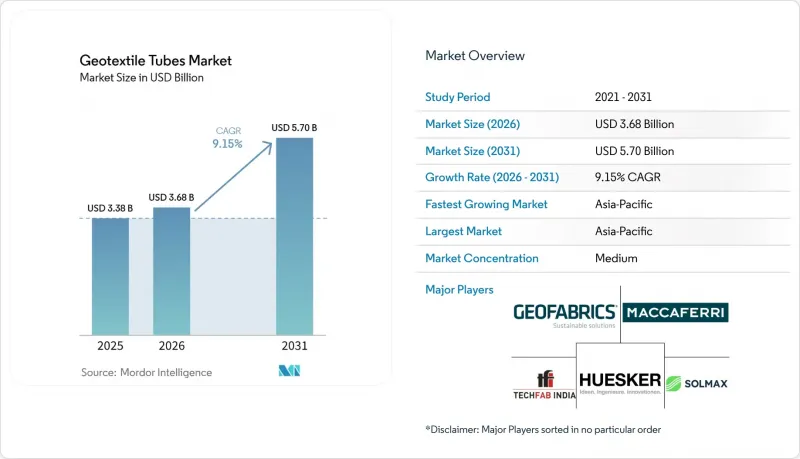
Mordor Intelligence에 의하면, 지오텍스타일 튜브 시장은 2025년에 33억 8,000만 달러 규모로 평가되었습니다. 2026년 36억 8,000만 달러에서 2031년까지 57억 달러에 이를 것으로 추정되고 예측 기간(2026-2031년) CAGR은 9.15%를 나타낼 전망입니다.
본 보고서는 유형별(직조 지오텍스타일 튜브 및 부직포 지오텍스타일 튜브), 최종 이용 산업별(해양·수력, 환경 공학, 농업 공학, 건설, 기타 최종 이용 산업), 지역별(아시아태평양, 북미, 유럽, 남미, 중동 및 아프리카)로 분류되어 있습니다. 시장 예측은 금액(달러)으로 표시되어 있습니다.
세계의 지오텍스타일 튜브 시장 동향 및 인사이트
해안 침식, 폭풍 해일 및 해수면 상승에 대한 방어
해수면 상승으로 인해 지오텍스타일 튜브 시장에서 단기적인 연안 인프라 조달 수요가 점점 더 높아지고 있습니다. 세계 기후 연구 계획(WCRP) 보고서에 따르면, 2024년 전 세계 해수면 상승폭은 5.9mm였으며, 2014년부터 2023년까지의 연간 상승률은 4.7mm였습니다. 기후 변화에 관한 정부간 패널(IPCC)의 보고서에 따르면, 2050년까지 전 세계 모래사장의 13.6%에서 15.2%가 심각한 침식을 겪을 가능성이 있으며, 고배출 시나리오 하에서는 2100년까지 그 범위가 35.7%에서 49.5%로 확대될 것으로 예측됩니다. 동 평가 보고서에서는 해수면이 20cm에서 40cm 상승하면, 많은 저지대에서 100년에 한 번 빈도로 발생하던 연안 홍수가 매년 발생하는 현상으로 바뀔 가능성이 있다고 지적하고 있습니다. 이러한 상황은 고정식 연안 방어 시설의 실질적인 건설 기간을 단축시킬 가능성이 있습니다. 지오텍스타일 튜브는 암석을 이용한 구조물에 필요한 채석 및 운송 공정이 필요하지 않고 현장에서 충진할 수 있으므로, 열대 및 몬순 기후의 연안 지역에서 사용하기에 적합합니다.
하수 및 슬러지 탈수 인프라의 확대
도시 하수 처리 능력 증강으로 인해 지오텍스타일 튜브 시장에서 수동적 슬러지 탈수에 대한 수요가 증가하고 있습니다. 이러한 시스템은 폴리머 처리된 슬러지를 유지하면서 물이 텍스타일을 통해 배수되는 방식으로, 원심분리기나 벨트 프레스에 필요한 에너지 소비와 유지보수를 피할 수 있습니다. 국제 토목합성재료 학회 회의 자료에 따르면, 지오텍스타일 튜브를 이용한 탈수 후 슬러지의 부피가 8.5배 감소한 것으로 보고되었습니다. 이러한 부피 감소를 통해 부지나 예산에 제약이 있는 지자체 운영자에게는 운송 및 처리 비용을 절감할 수 있게 됩니다. 건설 초기부터 튜브 시스템을 도입하는 신규 처리 시설에서는 연안 지역에서의 일회성 건설 및 구매가 아닌, 반복적으로 수행되는 충진 및 배수 작업을 통해 수요를 창출할 수 있습니다. 또한, 조사 결과 응집 효과 향상 측면에서 폴리머의 선정과 투여량이 중요한 역할을 한다는 사실이 입증되었으며, 이에 따라 수동형 텍스타일 시스템으로 처리 가능한 슬러지의 유형가 확대되고 있습니다.
폴리프로필렌 및 폴리에스터 원자재 가격 변동
폴리프로필렌 및 폴리에스터 가격 변동은 지오텍스타일 튜브 시장에 여전히 직접적인 비용 위험 요인으로 작용하고 있습니다. 2026년에 발생한 업스트림 프로파일렌 공급 차질로 인해 석유화학 원료 확보 상황이 어려워지면서 폴리프로필렌 가격에 대한 압박이 커졌습니다. 지오텍스타일 튜브 시장공급업체들은 대개 경쟁이 치열한 정부 입찰을 통해 판매를 진행하고 있어, 원자재 가격 급등을 구매자에게 전가할 수 있는 능력이 제한적일 수 있습니다. 에너지 비용의 상승은 폴리머의 압출 성형 및 가공 공정에 추가적인 압박을 가할 가능성이 있습니다. 원자재 가격의 급등은 처리 대상 재료 1㎥당 폴리머 사용량을 줄일 수 있는 대구경 튜브의 설계를 촉진할 가능성이 있습니다. 폴리머 공급을 자체적으로 일관되게 수행하거나 장기 조달 계약을 체결한 제조업체는 독립 제조업체에 비해 입고 비용 측면에서 우위를 유지할 수 있습니다. 이러한 격차는 표준 등급 공급업체 간의 통합을 촉진할 가능성이 있습니다.
부문별 분석
2025년, 직물 지오텍스타일 튜브는 지오텍스타일 튜브 시장 점유율의 68.45%를 차지했으며, 2031년까지 연평균 성장률(CAGR) 10.61%를 나타낼 것으로 예측됩니다. 이 제품의 인장 강도 덕분에 해안 및 산업 시설에 설치할 때 높은 충진 압력, 큰 원주, 그리고 긴 수명을 실현하고 있습니다. 2024년 한 공학 저널에 따르면, 직물 지오텍스타일의 인장 강도는 36 kN/m에서 201 kN/m인 반면, 동 저널에서 비교 대상으로 언급된 부직포 소재의 값은 50 kN/m 전후였습니다. 이러한 강도 특성 덕분에 준설 토사의 격리 및 해안가의 노출 구조물에서 사용할 수 있습니다. 뉴저지주 교통국은 수로 복구 공사에서 11만 입방야드를 넘는 준설 토사를 격리하고 탈수하기 위해 Solmax GEOTUBE GT500 직물 컨테이너를 사용했습니다. 이 프로젝트는 뉴저지주의 수질 배출 기준도 충족했습니다. 인도의 인증 체계에서는 제품의 품질과 실적을 문서로 입증할 수 있는 평판이 좋은 공급업체가 더욱 우대받습니다. 직물 구조는 이음매의 완전성이나 지속적인 하중이 설계상 주요 고려 사항이 되는 용도에서 프로젝트 엔지니어에게 재료 선택의 폭을 넓혀 줍니다. 또한 공급업체는 기술 제안서의 일환으로 성능 관련 문서를 제시할 수 있습니다. 그 결과, 규제 대상인 연안, 준설 및 격리 프로젝트에서 이 직물 구조에 대한 선호도가 가장 높습니다.
부직포 튜브는 최고의 인장 강도보다 투수성이나 배수성이 더 중요시되는 프로젝트에 적합합니다. 하수 처리 슬러지, 소규모 호수 복원 프로젝트 및 임시 봉쇄 공사가 일반적인 용도입니다. 2026년 연구에서는 부직포 튜브 구조를 이용한 호수 바닥 퇴적물의 탈수 과정에서 바이오 폴리머의 적용과 고효율 파이프 내 유동 혼합이 검토되었습니다. 이 접근 방식은 입자가 미세한 퇴적물이나 유기물 함량이 높은 퇴적물에 효과적입니다. HUESKER사 또한 소재 선정 및 가공 성능에 대한 관심 증가를 반영하여 천연섬유 및 고용량 패브릭 제품 라인업을 확충하고 있습니다. 이 분야에서는 용도 구분이 점점 더 명확해지고 있습니다. 직물 튜브는 여전히 대규모 구조물 용도에 적합한 반면, 부직포 튜브는 여과 및 지속가능성을 중시한 개발을 통해 그 역할을 확대되고 있습니다. 그 배수 특성은 프로젝트 조건상 여과액의 신속한 배출이 요구되는 경우에 유용합니다. 따라서 재료 선정은 고형물의 특성, 필요한 보유율, 그리고 예상되는 사용 조건에 따라 결정됩니다. 이러한 전문화로 인해 두 유형의 튜브 간 직접적인 대체는 어려워지고 있습니다.
지역별 분석
아시아태평양은 2025년에 지오텍스타일 튜브 시장 점유율의 38.63%를 차지했으며, 2031년까지 연평균 성장률(CAGR) 10.15%로 성장할 것으로 전망됩니다. 이 지역은 낮은 고도의 연안 지역, 활발한 매립 사업, 그리고 공공 토목합성재료 프로그램이 결합되어 있습니다. 아시아개발은행(ADB)이 마하라슈트라 주에 제공한 4,200만 달러 규모의 대출은 연안 지역의 회복력 강화에 있어 다자간 대출이 수행하는 역할을 보여줍니다. 말레이시아에서는 GEOTUBE Marine 제품이 세리 탄중 피난 2B 단계에서 외곽 제방을 형성하여 퇴적물의 확산을 억제했습니다. 2025년 EuroGeo8의 조사에 따르면, 싱가포르의 해양 시료(설치 후 6년 경과)에서 자외선 노출 방향에 따라 인장 강도 유지율이 18%에서 80%인 것으로 밝혀졌습니다.
북미 및 유럽 수요는 인프라 갱신, 환경 복원, 그리고 규제에 따른 슬러지 관리에 의해 뒷받침되고 있습니다. 영국에서는 2024년에 일반 정부 차원의 인프라 투자액이 289억 파운드(약 385억 4,000만 달러)를 기록했습니다. 미국의 항만 유지 관리 분야에서는 준설 토사의 탈수 처리에 대한 지속적인 수요가 발생하고 있습니다. 유럽의 CE 마킹, EN 13249 및 건설 제품 규정의 요건에 따라 제조 관리 및 설계 문서의 중요성이 높아지고 있습니다.
남미, 중동 및 아프리카는 각각 고유한 수요 요인을 가진 시장입니다. 브라질에서는 광업 사고로 인해 발생한 오염 퇴적물에 대한 대응 경험이 연안 및 항만 용도로 확대되고 있습니다. 사우디아라비아의 ‘비전 2030’에 부합하는 연안 프로젝트와 남아프리카의 광업 분야에서는 해상 보호 및 광미 봉쇄에 대한 지원이 요구되고 있습니다. 이러한 시장의 성장은 자금 조달, 기술력, 그리고 지오텍스타일 튜브 설계에 대한 이해의 확산에 달려 있습니다.
기타 혜택 :
- 엑셀 형식 시장 예측(ME) 시트
- 3개월간의 애널리스트 지원
자주 묻는 질문
목차
제1장 서론
제2장 조사 방법
제3장 개요
제4장 시장 구도
제5장 시장 규모 및 성장 예측
제6장 경쟁 구도
제7장 시장 기회 및 향후 전망
KTH 26.09.02According to Mordor Intelligence, the geotextile tubes market was valued at USD 3.38 billion in 2025 and is estimated to grow from USD 3.68 billion in 2026 to reach USD 5.70 billion by 2031, at a CAGR of 9.15% during the forecast period (2026-2031).
This report is Segmented by Type (Woven Geotextile Tubes and Nonwoven Geotextile Tubes), End-Use Industry (Marine and Hydraulic, Environmental Engineering, Agricultural Engineering, Construction, and Other End-Use Industries), and Geography (Asia-Pacific, North America, Europe, South America, and Middle-East and Africa). The Market Forecasts are Provided in Terms of Value (USD).
Global Geotextile Tubes Market Trends and Insights
Coastal Erosion, Storm Surge, and Sea-Level-Rise Protection
Sea-level rise is increasingly triggering near-term coastal infrastructure procurement in the geotextile tubes market. The World Climate Research Programme reported a 5.9 mm global sea-level increase in 2024, while the annual rate was 4.7 mm from 2014 to 2023. The Intergovernmental Panel on Climate Change (IPCC) reported that 13.6% to 15.2% of global sandy beaches could face severe erosion by 2050, with the range increasing to 35.7% to 49.5% by 2100 under high-emissions pathways. The same assessment stated that 20 cm to 40 cm of sea-level rise can turn a 1-in-100-year coastal flood into an annual event at many low-lying locations. These conditions can shorten the practical construction period for fixed coastal defenses. Geotextile tubes can be filled on site without the quarrying and transport process required for rock-based structures, which supports their use in tropical and monsoonal coastal settings.
Expansion of Wastewater and Sludge-Dewatering Infrastructure
Municipal wastewater capacity additions are strengthening demand for passive sludge dewatering in the geotextile tubes market. These systems retain polymer-conditioned sludge while water drains through the textile, avoiding the energy use and maintenance needs of centrifuges and belt presses. International Geosynthetics Society conference material reported an 8.5-times reduction in sludge volume after dewatering in geotextile tubes. This reduction can lower transport and disposal costs for municipal operators with constrained land and budgets. New treatment plants that specify tube systems at the outset can create repeated fill-and-drain demand rather than a single coastal construction purchase. Research also supports the role of polymer selection and dosing in improving consolidation, which broadens the range of sludges that passive textile systems can process.
Polypropylene and Polyester Feedstock Price Volatility
Polypropylene and polyester price changes remain a direct cost risk for the geotextile tubes market. Upstream propylene supply disruptions in 2026 tightened petrochemical feedstock availability and increased pressure on polypropylene pricing. Geotextile tubes market suppliers often sell through competitive government tenders and may have limited ability to pass higher material costs to buyers. Energy cost inflation can add further pressure during polymer extrusion and fabrication. Higher material prices can encourage larger-diameter tube designs that use less polymer per cubic meter of treated material. Producers with integrated polymer supply or long-term sourcing contracts can retain a landed-cost advantage over independent manufacturers. This gap may support consolidation among standard-grade suppliers.
Other drivers and restraints analyzed in the detailed report include:
- Infrastructure Investment in Ports, Roads, Bridges, and Land Reclamation
- Polymer-Dosing and High-Capacity Tube Design Improvements
- Product Accreditation, Design Liability, and Quality-Control Requirements
For complete list of drivers and restraints, kindly check the Table Of Contents.
Segment Analysis
Woven geotextile tubes held 68.45% of the geotextile tubes market share in 2025 and are projected to grow at a 10.61% CAGR through 2031. Their tensile strength supports high fill pressures, large circumferences, and long service life in coastal and industrial installations. A 2024 engineering publication reported woven geotextile tensile strengths of 36 kN/m to 201 kN/m, compared with values near 50 kN/m for nonwoven material in the cited comparison. This strength profile supports their use in dredged-material containment and exposed coastal works. The New Jersey Department of Transportation used Solmax GEOTUBE GT500 woven containers to contain and dewater more than 110,000 cubic yards of dredged material during channel restoration. The project also met New Jersey water-quality discharge requirements. India's certification framework further favors established suppliers that can demonstrate product quality and documented performance. Woven construction gives project engineers a material option for applications where seam integrity and sustained loading are central design concerns. It also allows suppliers to position performance documentation as part of their technical offer. The resulting preference is strongest in regulated coastal, dredging, and containment projects.
Nonwoven tubes serve projects where permeability and drainage are more important than the highest tensile strength. Water treatment sludge, small lake remediation projects, and temporary containment works are common uses. A 2026 study examined biobased polymer application and high-efficiency pipe-flow mixing for lake-sediment dewatering in nonwoven tube configurations. The approach is relevant for fine-grained and high-organic sediments. HUESKER has also expanded its natural-fiber and high-capacity fabric offering, reflecting interest in material selection and processing performance. The category is moving toward a clearer division. Woven tubes remain suited to large structural applications, while nonwoven tubes are extending their role through filtration and sustainability-oriented development. Their drainage properties can be useful where project conditions favor rapid filtrate release. Material selection, therefore, depends on the solids profile, required retention, and expected service conditions. This specialization reduces direct substitution between the two tube types.
Complete Report Scope:
- By Type
- Woven Geotextile Tubes
- Nonwoven Geotextile Tubes
- By End-Use Industry
- Marine and Hydraulic
- Environmental Engineering
- Agricultural Engineering
- Construction
- Other End-Use Industries (including Wastewater Treatment, Mining and Mineral Processing, Pulp and Paper Mills, and Aquaculture)
- By Geography
- Asia-Pacific
- China
- India
- Japan
- South Korea
- ASEAN Countries
- Rest of Asia-Pacific
- North America
- United States
- Canada
- Mexico
- Europe
- Germany
- United Kingdom
- France
- Italy
- NORDIC Countries
- Russia
- Rest of Europe
- South America
- Brazil
- Argentina
- Rest of South America
- Middle-East and Africa
- Saudi Arabia
- South Africa
- Rest of Middle-East and Africa
- Asia-Pacific
Geography Analysis
Asia-Pacific held 38.63% of the geotextile tubes market share in 2025 and is forecast to grow at a 10.15% CAGR through 2031. The region combines low-elevation coastal exposure, active land reclamation, and public geosynthetics programs. The Asian Development Bank's USD 42 million Maharashtra loan shows the role of multilateral financing in coastal resilience. In Malaysia, GEOTUBE Marine units formed a perimeter dike at Seri Tanjung Pinang Phase 2B and limited sediment plumes. A 2025 EuroGeo8 study found retained tensile strength of 18% to 80% in 6-year-old Singapore marine samples, depending on UV exposure direction.
Demand in North America and Europe is supported by infrastructure renewal, environmental remediation, and regulated sludge management. The United Kingdom recorded GBP 28.9 billion (approximately USD 38.54 billion) in general government infrastructure investment in 2024. United States harbor maintenance creates recurring dewatering demand for dredged sediment. European CE marking, EN 13249, and Construction Products Regulation obligations increase the value of manufacturing control and design documentation.
South America, and the Middle-East and Africa are markets with distinctive demand drivers. Brazil's contaminated-sediment experience following mining incidents is transferring to coastal and port applications. Saudi Arabia's Vision 2030 coastal projects and South African mining needs support for offshore protection and tailings containment. Their growth depends on financing, engineering capability, and wider familiarity with geotextile tube design.
- Ace Geosynthetics
- CeTeau
- FlexiTuff Ventures International Ltd
- Flint Technical Geosolutions (FTG).
- Geofabrics Australasia Pty Ltd.
- Geo-Synthetics Systems LLC (GSI)
- Global Synthetics Pty Ltd
- HUESKER International
- Naue GmbH & Co. KG
- Officine Maccaferri Spa
- Solmax
- TECHFABINDIA
- Thrace Group
- Titan Environmental
Additional Benefits:
- The market estimate (ME) sheet in Excel format
- 3 months of analyst support
TABLE OF CONTENTS
1 Introduction
- 1.1 Study Assumptions and Market Definition
- 1.2 Scope of the Study
2 Research Methodology
3 Executive Summary
4 Market Landscape
- 4.1 Market Overview
- 4.2 Market Drivers
- 4.2.1 Coastal Erosion, Storm Surge, and Sea-Level-Rise Protection
- 4.2.2 Expansion of Wastewater and Sludge-Dewatering Infrastructure
- 4.2.3 Infrastructure Investment in Ports, Roads, Bridges, and Land Reclamation
- 4.2.4 Contaminated Sediment and Mining-Waste Containment Requirements
- 4.2.5 Polymer-Dosing and High-Capacity Tube Design Improvements
- 4.2.6 Circular Reuse of Dewatered Sediment and Bio-Based Textile Development
- 4.3 Market Restraints
- 4.3.1 Polypropylene and Polyester Feedstock Price Volatility
- 4.3.2 Product Accreditation, Design Liability, and Quality-Control Requirements
- 4.3.3 Site-Specific Filtrate, Polymer, and Residual-Solids Compliance Risk
- 4.3.4 UV, Abrasion, and Microplastic-Release Risk in Long-Life Installations
- 4.4 Value Chain Analysis
- 4.5 Porter's Five Forces Analysis
- 4.5.1 Threat of New Entrants
- 4.5.2 Bargaining Power of Suppliers
- 4.5.3 Bargaining Power of Buyers
- 4.5.4 Threat of Substitutes
- 4.5.5 Rivalry Among Existing Competitors
5 Market Size and Growth Forecasts (Value)
- 5.1 By Type
- 5.1.1 Woven Geotextile Tubes
- 5.1.2 Nonwoven Geotextile Tubes
- 5.2 By End-Use Industry
- 5.2.1 Marine and Hydraulic
- 5.2.2 Environmental Engineering
- 5.2.3 Agricultural Engineering
- 5.2.4 Construction
- 5.2.5 Other End-Use Industries (including Wastewater Treatment, Mining and Mineral Processing, Pulp and Paper Mills, and Aquaculture)
- 5.3 By Geography
- 5.3.1 Asia-Pacific
- 5.3.1.1 China
- 5.3.1.2 India
- 5.3.1.3 Japan
- 5.3.1.4 South Korea
- 5.3.1.5 ASEAN Countries
- 5.3.1.6 Rest of Asia-Pacific
- 5.3.2 North America
- 5.3.2.1 United States
- 5.3.2.2 Canada
- 5.3.2.3 Mexico
- 5.3.3 Europe
- 5.3.3.1 Germany
- 5.3.3.2 United Kingdom
- 5.3.3.3 France
- 5.3.3.4 Italy
- 5.3.3.5 NORDIC Countries
- 5.3.3.6 Russia
- 5.3.3.7 Rest of Europe
- 5.3.4 South America
- 5.3.4.1 Brazil
- 5.3.4.2 Argentina
- 5.3.4.3 Rest of South America
- 5.3.5 Middle-East and Africa
- 5.3.5.1 Saudi Arabia
- 5.3.5.2 South Africa
- 5.3.5.3 Rest of Middle-East and Africa
- 5.3.1 Asia-Pacific
6 Competitive Landscape
- 6.1 Market Concentration
- 6.2 Strategic Moves
- 6.3 Market Share (%)/Ranking Analysis
- 6.4 Company Profiles (includes Global Overview, Market Overview, Core Segments, Financials as available, Strategic Information, Products and Services, and Recent Developments)
- 6.4.1 Ace Geosynthetics
- 6.4.2 CeTeau
- 6.4.3 FlexiTuff Ventures International Ltd
- 6.4.4 Flint Technical Geosolutions (FTG).
- 6.4.5 Geofabrics Australasia Pty Ltd.
- 6.4.6 Geo-Synthetics Systems LLC (GSI)
- 6.4.7 Global Synthetics Pty Ltd
- 6.4.8 HUESKER International
- 6.4.9 Naue GmbH & Co. KG
- 6.4.10 Officine Maccaferri Spa
- 6.4.11 Solmax
- 6.4.12 TECHFABINDIA
- 6.4.13 Thrace Group
- 6.4.14 Titan Environmental
7 Market Opportunities and Future Outlook
- 7.1 White-Space and Unmet-Need Assessment


