

|
시장보고서
상품코드
2119116
통신 네트워크 자산 관리 소프트웨어 : 시장 점유율 분석, 업계 동향 및 통계, 성장 예측(2026-2031년)Telecom Network Inventory Management Software - Market Share Analysis, Industry Trends & Statistics, Growth Forecasts (2026 - 2031) |
||||||
 Mordor Intelligence
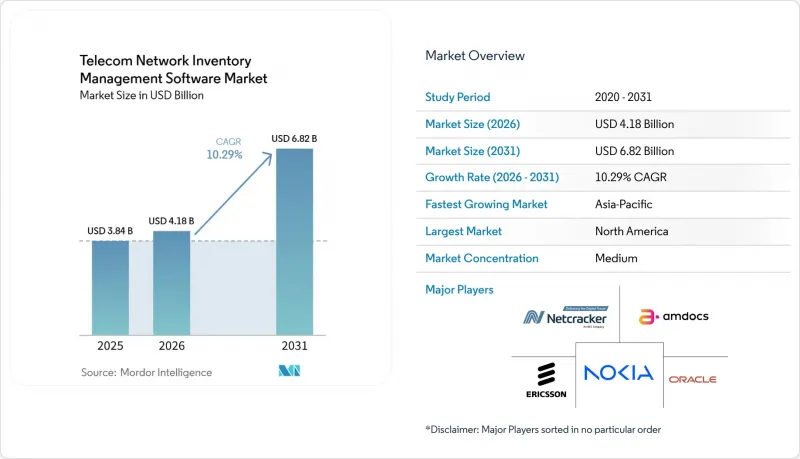
Mordor Intelligence에 의하면, 통신 네트워크 자산 관리 소프트웨어 시장 규모는 2025년에 38억 4,000만 달러로 평가되었습니다. 2026년 41억 8,000만 달러에서 2031년까지 68억 2,000만 달러에 이를 것으로 예상되며, 예측 기간(2026-2031년) CAGR은 10.29%를 나타낼 전망입니다.
본 보고서는 구성 요소(소프트웨어 및 서비스), 도입 형태(클라우드 기반 및 On-Premise형), 네트워크 계층(물리적 네트워크 자산 등), 용도(자산 관리 등), 조직 규모(대기업 및 중소기업), 최종 사용자(통신 사업자 등), 그리고 지역별로 분류되어 있습니다. 시장 예측은 금액(달러) 기준으로 제시되어 있습니다.
세계의 통신 네트워크 자산 관리 소프트웨어 시장 동향 및 인사이트
5G, 오픈 RAN 및 네트워크 슬라이싱의 복잡성
Open RAN에서는 중앙 집중형 유닛, 분산형 유닛 및 무선 유닛이 분리되므로, 통신 사업자는 더 많은 네트워크 요소와 공급업체에 걸친 기록을 관리해야 합니다. 이 모델에서는 통신 사업자가 서비스를 계획하거나 변경하기 전에 각 관계를 시각화해야 하므로, 인벤토리의 정확성이 더욱 중요해집니다. 노키아는 2026년 6월, 자사의 ‘Autonomous Networks Suite’가 실증 환경에서 90% 이상의 자동화율을 달성하고, 슬라이스 배포 시간을 최대 85% 단축했다고 발표했습니다. 이러한 성과는 무선, 전송, 코어 영역을 연결하는 최신 인벤토리 계층에 기반을 두고 있습니다. O-RAN 소프트웨어 커뮤니티의 프레임워크 또한 네트워크 슬라이스의 수명 주기를 관리하기 위한 토폴로지 및 인벤토리 요구 사항을 정의하고 있습니다. 따라서 멀티 벤더 기반의 5G 스탠드얼론 도입은 통신 사업자들이 기존 네트워크 업그레이드 시보다 더 이른 시점에 구형 인벤토리 플랫폼을 교체하거나 확장하도록 촉진할 것입니다.
클라우드 네이티브 및 하이브리드 네트워크의 확장
클라우드 네이티브 네트워크 기능은 물리적 네트워크 장비보다 훨씬 더 신속하게 시작, 변경 및 종료할 수 있습니다. 일련 번호나 랙의 설치 위치를 중심으로 설계된 인벤토리 시스템으로는 이러한 변화하는 워크로드를 종합적으로 파악할 수 없습니다. 물리적 인프라와 가상 및 클라우드 네이티브 네트워크 기능을 병행하여 운영하는 통신 사업자는 물리적 정보, 논리적 정보, 서비스 정보를 통합적으로 연결할 수단이 필요합니다. 노키아는 2026년 6월, 통합된 자산 관리, 오케스트레이션, 보증 기능을 갖춘 ‘Autonomous Networks Fabric’이 AWS에서 네이티브로 작동한다고 발표했습니다. 이 발표는 공급업체들이 제품 개발을 클라우드 호스팅형 네트워크 운영 플랫폼으로 점점 더 방향을 전환하고 있음을 보여줍니다. 데이터 주권, 보안 또는 맞춤형 모델이 필요한 상황에서는 On-Premise형 시스템의 중요성이 여전히 남아 있지만, 각 벤더들은 클라우드 네이티브 제품 개발을 위한 자원을 더욱 확대되고 있습니다.
레거시 OSS 및 BSS 통합의 복잡성
많은 통신 사업자는 여전히 모바일, 유선 및 전송 네트워크별로 별도의 인벤토리 시스템을 사용하고 있습니다. 이러한 시스템은 유연하고 이벤트 기반의 인터페이스가 아닌, 포인트-투-포인트 인터페이스를 통해 다른 OSS나 BSS 도구와 연결되는 경우가 많습니다. 복잡한 통합 및 테스트 주기는 운영 중인 통신 사업자 환경에서 변경을 지연시키는 요인이 될 수 있습니다. 이러한 환경에서는 변경할 때마다 서비스 중단 위험이 따릅니다. Netcracker가 2026년 3월에 달성한 BICS 현대화의 주요 성과에는 리소스 인벤토리, 서비스 인벤토리, 감지 및 대조, 계획, 설계 각 기능의 업그레이드가 포함되었습니다. 이러한 프로젝트는 통신 사업자가 완전한 교체가 아닌 단계적 현대화를 선택하는 경우가 많은 이유를 여실히 보여줍니다. 이 접근 방식은 서비스 위험을 억제하지만, 완전히 통합된 인벤토리 아키텍처의 이점을 누리는 시기를 늦출 가능성이 있습니다.
부문별 분석
2025년, 통신 네트워크 자산 관리 소프트웨어 시장에서 소프트웨어가 69.42%의 점유율을 차지했습니다. 주요 통신 사업자들은 수년에 걸친 네트워크 프로그램을 지원하는 지속적인 인벤토리 기록 및 데이터 모델을 제공하는 소프트웨어 플랫폼을 선호하여 채택하고 있습니다. 이러한 플랫폼은 구독 또는 라이선스 계약을 통해 제공되므로, 통신 사업자는 예산 편성 시 예측 가능한 기반을 확보할 수 있습니다. 소프트웨어 부문에서 통신 네트워크 자산 관리 소프트웨어 시장 규모는 일시적인 프로젝트 도구가 아닌 운영 기반으로서의 역할을 반영하고 있습니다. 고객은 지속적인 자산 감지, 계획, 활성화 및 보증을 위해 플랫폼에 의존하고 있으므로, 입지를 다진 공급업체들은 이러한 역할로부터 혜택을 받고 있습니다. 또한, 소프트웨어 플랫폼의 모델과 인터페이스가 여러 네트워크 도메인에 통합되면 이를 교체하기가 더욱 어려워집니다.
서비스 시장은 2026년부터 2031년까지 연평균 성장률(CAGR) 11.42%를 나타낼 것으로 예측됩니다. 마이그레이션, 데이터 정제, 대조, 어댑터 구성 및 클라우드 네이티브 기능 모델링은 대규모 변혁 프로젝트의 주요 구성 요소입니다. 복잡한 인벤토리 마이그레이션에 대한 충분한 경험이 사내 팀에 부족한 경우가 있으므로, 통신 사업자는 종종 외부 지원을 필요로 합니다. Accenture, Infosys Limited 및 Tata Consultancy Services Limited는 서비스 주도형 프로젝트에서 기존 OSS 벤더들과 경쟁하고 있습니다. 이는 통신 사업자가 소프트웨어를 직접 소유하는 것보다 관리형 서비스를 선호하는 경우에 특히 해당됩니다. 이러한 추세로 인해 전문 OSS 벤더들은 자사 소프트웨어에 도입 역량을 결합해야 한다는 압박을 더욱 강하게 느끼고 있습니다.
2025년에는 클라우드 기반 도입이 매출의 61.84%를 차지했습니다. 이러한 우위는 클라우드 네이티브 인벤토리 아키텍처와 TM 포럼의 ‘컴포저블 오픈 디지털 아키텍처(Open Digital Architecture)’ 접근 방식 간의 일관성을 반영합니다. 클라우드를 통한 제공은 모델의 정기적인 업데이트와 운영 팀 간의 공유 액세스를 지원합니다. 또한, 부하가 높은 대조 및 감지 작업을 수행하는 동안 처리 능력을 확장할 수도 있게 해줍니다. 노키아가 2026년 6월에 발표한 AWS 관련 발표에서는 통합 인벤토리를 인벤토리, 오케스트레이션 및 어슈어런스(보증)를 위한 클라우드 네이티브 패브릭의 일부로 규정했습니다. 이러한 기능들은 통신 네트워크 자산 관리 소프트웨어 시장에서 클라우드 도입의 역할을 강화합니다.
클라우드 플랫폼은 통신 사업자가 이용하는 데이터, AI 및 자동화 서비스와 보다 용이하게 통합될 수 있습니다. 또한 분산형 운영을 수행하는 조직을 위한 멀티테넌트 액세스도 지원할 수 있습니다. 데이터 주권 요건, 고도화된 보안 환경, 혹은 고도로 맞춤화된 모델을 보유한 사업자의 경우, On-Premise 배포가 여전히 필요합니다. 또한, 시스템을 교체할 경우 높은 통합 위험이 발생하는 경우에도 이러한 배포 방식이 유지될 가능성이 있습니다. 그러나 기존의 On-Premise 기반은 성장 기회라기보다는 고객 유지의 기회로 인식되고 있습니다. 공급업체의 개발 동향을 살펴보면, 새로운 기능은 점점 더 클라우드 네이티브 제품에 우선적으로 도입되는 경향이 있음을 알 수 있습니다.
지역별 분석
2025년, 북미는 통신 네트워크 자산 관리 소프트웨어 시장의 34.72% 점유율을 차지했습니다. 이 지역은 Tier 1 5G 독립형(SA) 프로그램의 규모와 성숙한 OSS 교체 주기의 혜택을 받고 있습니다. AT&T는 2026년 3월, 광섬유 확장, 5G, AI를 활용한 서비스를 통해 미국 내 4,000만 가구를 대상으로 하는 총액 2,500억 달러 규모의 다년간 연결 계획을 발표했습니다. 미국 BEAD 프로그램에서는 2029년까지의 광대역 구축에 424억 5,000만 달러가 배정되었습니다. 이러한 투자로 인해 도시, 농촌 및 서비스가 미치지 않는 지역에서 실외 설비 재고 수요가 증가하고 있습니다. 또한, 이전 3G 및 4G 프로그램으로 인해 노후화된 플랫폼 역시 업데이트 활동을 촉진하고 있습니다.
본 분석에서 유럽은 여전히 두 번째로 큰 규모를 자랑하는 지역으로 나타났습니다. 광섬유 확장, 구리선 네트워크 폐지, 그리고 성숙한 통신 사업자의 현대화 프로그램으로 인해 물리적 네트워크 기록 및 통합 서비스에 대한 수요가 발생하고 있습니다. 유럽의 통신 사업자들은 구식 OSS 시스템이 집중되어 있다는 과제에 직면해 있으며, 단계적인 업데이트가 일반적인 접근 방식이 되고 있습니다. 데이터 주권이 강조됨에 따라 특정 시장에서는 On-Premise 또는 하이브리드형 도입에 대한 수요가 지속될 가능성이 있습니다. 동시에, 유선 통신과 모바일 통신 자산을 연계해야 할 필요성으로 인해 통합된 자산 관리 플랫폼이 요구되고 있습니다. 또한, 이 지역의 경험이 풍부한 운영 팀은 자율형 네트워크 모델로의 전환에도 적극적으로 나서고 있습니다.
아시아태평양은 2026년부터 2031년까지 연평균 성장률(CAGR) 11.94%를 나타낼 것으로 예측됩니다. 제공된 자료에 따르면, 중국에는 420만 기의 5G 기지국이 도입되어 있으며, 인도의 고정 광대역 가입자 수는 2029년까지 2배인 9,580만 건에 달할 것으로 예측됩니다. 한국의 5G 스탠드얼론(SA) 조기 상용화는 네트워크 자동화에 기여하는 인벤토리 시스템에 대한 수요를 뒷받침하고 있습니다. 노키아와 NTT 도코모는 슬라이싱 및 자율적인 RAN 관리를 위한 비실시간 RIC 기능을 포함하여 SMO 주도의 자율화에 주력해 왔습니다. 남미, 중동 및 아프리카는 현재 시장 점유율은 작지만, 광섬유, 클라우드, AI, 멀티테넌트 연결 프로젝트를 통해 성장하고 있습니다. 이 지역에서는 재정적 제약이 있는 통신 사업자의 초기 투자 부담을 줄일 수 있기 때문에 클라우드 호스팅 방식의 제공 방식이 유리합니다.
기타 혜택 :
- 엑셀 형식 시장 예측(ME) 시트
- 3개월간의 애널리스트 지원
자주 묻는 질문
목차
제1장 서론
제2장 조사 방법
제3장 개요
제4장 시장 구도
제5장 시장 규모 및 성장 예측
제6장 경쟁 구도
제7장 시장 기회 및 향후 전망
KTH 26.09.02According to Mordor Intelligence, the telecom network inventory management software market size was valued at USD 3.84 billion in 2025 and estimated to grow from USD 4.18 billion in 2026 to reach USD 6.82 billion by 2031, at a CAGR of 10.29% during the forecast period (2026-2031).
This report is Segmented by Component (Software, and Services), Deployment Mode (Cloud-Based, and On-Premises), Network Layer (Physical Network Inventory, and More), Application (Asset Management, and More), Organization Size (Large Enterprises, and SMEs), End-User (Telecommunications Operators, and More), and Geography. The Market Forecasts are Provided in Terms of Value (USD).
Global Telecom Network Inventory Management Software Market Trends and Insights
5G, Open RAN, and Network Slicing Complexity
Open RAN separates the centralized, distributed, and radio units, so operators must maintain records across more network elements and suppliers. This model makes inventory accuracy more important because each relationship must be visible before an operator can plan or change a service. Nokia stated in June 2026 that its Autonomous Networks Suite achieved automation rates above 90% and reduced slice rollout time by up to 85% in its demonstration environment. These outcomes depend on a current inventory layer that connects the radio, transport, and core domains. The O-RAN Software Community framework also defines topology and inventory requirements for managing the lifecycle of network slices. Multi-vendor 5G standalone deployments, therefore, encourage operators to replace or extend older inventory platforms sooner than they would have during previous network upgrades.
Cloud-Native and Hybrid Network Expansion
Cloud-native network functions can start, change, and end much faster than physical network equipment. Inventory systems designed around serial numbers and rack locations do not provide a complete view of these changing workloads. Operators running physical infrastructure alongside virtual and cloud-native network functions need a unified way to connect physical, logical, and service information. Nokia announced in June 2026 that its Autonomous Networks Fabric, which includes unified inventory, orchestration, and assurance, will run natively on AWS. The announcement shows that suppliers are increasingly directing product development toward cloud-hosted network operations platforms. On-premises systems remain relevant where data sovereignty, security, or customized models require them, but vendors are placing more development resources behind cloud-native offerings.
Legacy OSS and BSS Integration Complexity
Many operators still use separate inventory systems for mobile, fixed, and transport networks. These systems often connect to other OSS and BSS tools via point-to-point interfaces rather than flexible, event-driven ones. Complex integrations and testing cycles can slow changes in live operator environments, where each change carries a risk of service disruption. Netcracker's BICS modernization milestone in March 2026 included upgrades to resource inventory, service inventory, discovery and reconciliation, planning, and design. Such projects illustrate why operators often opt for phased modernization rather than a full replacement. This approach controls service risk but can delay the benefits of a fully integrated inventory architecture.
Other drivers and restraints analyzed in the detailed report include:
- Demand for Autonomous Network Operations
- AI-Ready Inventory Data for Agentic Operations
- Data Quality and Inventory Reconciliation Gaps
For complete list of drivers and restraints, kindly check the Table Of Contents.
Segment Analysis
Software held 69.42% of the Telecom Network Inventory Management Software Market share in 2025. Large operators favor software platforms because they provide persistent inventory records and data models that support multi-year network programs. These platforms can be delivered through subscription or license arrangements, which gives operators a predictable basis for budgeting. The Telecom Network Inventory Management Software Market size for software reflects its role as an operating foundation rather than a temporary project tool. Established suppliers benefit from this role because customers depend on their platforms for ongoing discovery, planning, activation, and assurance. A software platform also becomes harder to replace after its models and interfaces are embedded across multiple network domains.
Services are projected to grow at an 11.42% CAGR from 2026 to 2031. Migration, data cleansing, reconciliation, adapter configuration, and cloud-native function modeling are major parts of a large transformation project. Operators often need external support because internal teams may lack sufficient experience with complex inventory migrations. Accenture, Infosys Limited, and Tata Consultancy Services Limited compete with traditional OSS vendors for services-led projects. This is especially relevant where operators prefer managed services over direct software ownership. The trend places greater pressure on dedicated OSS vendors to pair their software with implementation capability.
Cloud-based deployments accounted for 61.84% of revenue in 2025. This lead reflects the alignment between cloud-native inventory architectures and TM Forum's composable Open Digital Architecture approach. Cloud delivery supports regular model updates and shared access across operational teams. It also allows capacity to expand during demanding reconciliation and discovery tasks. Nokia's June 2026 AWS announcement positioned unified inventory as part of a cloud-native fabric for inventory, orchestration, and assurance. These capabilities strengthen the role of cloud deployment in the Telecom Network Inventory Management Software Market.
Cloud platforms can more readily integrate with the data, AI, and automation services used by telecommunications operators. They can also support multi-tenant access for organizations with distributed operations. On-premises deployments remain necessary for operators with data sovereignty requirements, high-security environments, or deeply customized models. These deployments may also stay in place where replacement creates a high integration risk. However, the installed on-premises base is becoming more of a retention opportunity than a growth opportunity. The direction of supplier development indicates that new capabilities will increasingly arrive first in cloud-native products.
Complete Report Scope:
- By Component
- Software
- Services
- By Deployment Mode
- Cloud-Based
- On-Premises
- By Network Layer and Inventory Type
- Physical Network Inventory
- Active Network Equipment
- Service Inventory
- By Application
- Asset and Resource Management
- Configuration Management
- Network Planning and Design
- Capacity and Utilization Management
- Service Provisioning and Fulfillment
- Other Applications
- By Organization Size
- Large Enterprises
- Small and Medium-Sized Enterprises
- By End-User
- Telecommunications Operators
- Internet Service Providers
- Cable and Broadband Service Providers
- Mobile Network Operators
- Fixed-Line Network Operators
- Other End-Users
- By Geography
- North America
- United States
- Canada
- Mexico
- South America
- Brazil
- Argentina
- Rest of South America
- Europe
- Germany
- United Kingdom
- France
- Italy
- Spain
- Russia
- Rest of Europe
- Asia-Pacific
- China
- Japan
- India
- South Korea
- Australia
- Rest of Asia-Pacific
- Middle East
- Saudi Arabia
- United Arab Emirates
- Turkey
- Rest of Middle East
- Africa
- South Africa
- Egypt
- Rest of Africa
- North America
Geography Analysis
North America held 34.72% of the Telecom Network Inventory Management Software Market share in 2025. The region benefits from the scale of Tier-1 5G standalone programs and mature OSS replacement cycles. AT&T announced a USD 250 billion multi-year connectivity plan in March 2026 targeting 40 million U.S. homes through fiber expansion, 5G, and AI-enabled services. The U.S. BEAD program allocates USD 42.45 billion for broadband deployment through 2029. These investments increase outside-plant inventory requirements in urban, rural, and underserved areas. Aging platforms from earlier 3G and 4G programs also support replacement activity.
Europe remained the second-largest region in the supplied analysis. Fiber expansion, copper network retirement, and mature operator modernization programs create demand for physical network records and integration services. European operators also face a high concentration of older OSS systems, which makes phased replacement a common approach. The emphasis on data sovereignty can preserve demand for on-premises or hybrid deployments in specific markets. At the same time, the need to coordinate fixed and mobile assets favors unified inventory platforms. The region's established operations teams are also active in the shift toward autonomous network models.
Asia-Pacific is expected to grow at an 11.94% CAGR from 2026 to 2031. China had deployed 4.2 million 5G base stations, and India's fixed broadband subscriptions were projected to double to 95.8 million by 2029 in the supplied material. South Korea's early 5G standalone commercialization supports demand for inventory systems that contribute to network automation. Nokia and NTT DOCOMO have worked on SMO-driven autonomy, including non-real-time RIC functionality for slicing and autonomous RAN management. South America, the Middle East, and Africa have smaller current shares but are supported by fiber, cloud, AI, and multi-tenant connectivity projects. These regions can benefit from cloud-hosted delivery because it reduces upfront capital requirements for operators with constrained balance sheets.
- Telefonaktiebolaget LM Ericsson
- Nokia Corporation
- Amdocs Limited
- Netcracker Technology Corporation
- Oracle Corporation
- Ciena Corporation
- Huawei Technologies Co., Ltd.
- Comarch S.A.
- ServiceNow, Inc.
- Cisco Systems, Inc.
- International Business Machines Corporation
- SAP SE
- NEC Corporation
- Fujitsu Limited
- Hewlett Packard Enterprise Company
- Infosys Limited
- Tata Consultancy Services Limited
- Accenture plc
- Cerillion plc
- Sunvizion Sp. z o.o.
- FNT GmbH
- VertiGIS GmbH
- VC4 B.V.
- Enghouse Systems Limited
Additional Benefits:
- The market estimate (ME) sheet in Excel format
- 3 months of analyst support
TABLE OF CONTENTS
1 INTRODUCTION
- 1.1 Study Assumptions and Market Definition
- 1.2 Scope of the Study
2 RESEARCH METHODOLOGY
3 EXECUTIVE SUMMARY
4 MARKET LANDSCAPE
- 4.1 Market Overview
- 4.2 Market Drivers
- 4.2.1 5G, Open RAN, and Network Slicing Complexity
- 4.2.2 Cloud-Native and Hybrid Network Expansion
- 4.2.3 Demand for Autonomous Network Operations
- 4.2.4 Fiber and Fixed Access Network Rollouts
- 4.2.5 Network-as-a-Service and Multi-Tenant Resource Management
- 4.2.6 AI-Ready Inventory Data for Agentic Operations
- 4.3 Market Restraints
- 4.3.1 Legacy OSS and BSS Integration Complexity
- 4.3.2 Data Quality and Inventory Reconciliation Gaps
- 4.3.3 Cybersecurity Exposure from Centralized Network Topology Data
- 4.3.4 Shortage of Telecom Inventory Modernization Expertise
- 4.4 Supply-Chain Analysis
- 4.5 Regulatory Landscape
- 4.6 Technological Outlook
- 4.7 Porter's Five Forces Analysis
- 4.7.1 Threat of New Entrants
- 4.7.2 Bargaining Power of Suppliers
- 4.7.3 Bargaining Power of Buyers
- 4.7.4 Threat of Substitutes
- 4.7.5 Competitive Rivalry
5 MARKET SIZE AND GROWTH FORECASTS (VALUE)
- 5.1 By Component
- 5.1.1 Software
- 5.1.2 Services
- 5.2 By Deployment Mode
- 5.2.1 Cloud-Based
- 5.2.2 On-Premises
- 5.3 By Network Layer and Inventory Type
- 5.3.1 Physical Network Inventory
- 5.3.2 Active Network Equipment
- 5.3.3 Service Inventory
- 5.4 By Application
- 5.4.1 Asset and Resource Management
- 5.4.2 Configuration Management
- 5.4.3 Network Planning and Design
- 5.4.4 Capacity and Utilization Management
- 5.4.5 Service Provisioning and Fulfillment
- 5.4.6 Other Applications
- 5.5 By Organization Size
- 5.5.1 Large Enterprises
- 5.5.2 Small and Medium-Sized Enterprises
- 5.6 By End-User
- 5.6.1 Telecommunications Operators
- 5.6.2 Internet Service Providers
- 5.6.3 Cable and Broadband Service Providers
- 5.6.4 Mobile Network Operators
- 5.6.5 Fixed-Line Network Operators
- 5.6.6 Other End-Users
- 5.7 By Geography
- 5.7.1 North America
- 5.7.1.1 United States
- 5.7.1.2 Canada
- 5.7.1.3 Mexico
- 5.7.2 South America
- 5.7.2.1 Brazil
- 5.7.2.2 Argentina
- 5.7.2.3 Rest of South America
- 5.7.3 Europe
- 5.7.3.1 Germany
- 5.7.3.2 United Kingdom
- 5.7.3.3 France
- 5.7.3.4 Italy
- 5.7.3.5 Spain
- 5.7.3.6 Russia
- 5.7.3.7 Rest of Europe
- 5.7.4 Asia-Pacific
- 5.7.4.1 China
- 5.7.4.2 Japan
- 5.7.4.3 India
- 5.7.4.4 South Korea
- 5.7.4.5 Australia
- 5.7.4.6 Rest of Asia-Pacific
- 5.7.5 Middle East
- 5.7.5.1 Saudi Arabia
- 5.7.5.2 United Arab Emirates
- 5.7.5.3 Turkey
- 5.7.5.4 Rest of Middle East
- 5.7.6 Africa
- 5.7.6.1 South Africa
- 5.7.6.2 Egypt
- 5.7.6.3 Rest of Africa
- 5.7.1 North America
6 COMPETITIVE LANDSCAPE
- 6.1 Market Concentration
- 6.2 Strategic Moves
- 6.3 Market Share Analysis
- 6.4 Company Profiles (includes Global Level Overview, Market Level Overview, Core Segments, Financials as available, Strategic Information, Market Rank/Share, Products and Services, Recent Developments)
- 6.4.1 Telefonaktiebolaget LM Ericsson
- 6.4.2 Nokia Corporation
- 6.4.3 Amdocs Limited
- 6.4.4 Netcracker Technology Corporation
- 6.4.5 Oracle Corporation
- 6.4.6 Ciena Corporation
- 6.4.7 Huawei Technologies Co., Ltd.
- 6.4.8 Comarch S.A.
- 6.4.9 ServiceNow, Inc.
- 6.4.10 Cisco Systems, Inc.
- 6.4.11 International Business Machines Corporation
- 6.4.12 SAP SE
- 6.4.13 NEC Corporation
- 6.4.14 Fujitsu Limited
- 6.4.15 Hewlett Packard Enterprise Company
- 6.4.16 Infosys Limited
- 6.4.17 Tata Consultancy Services Limited
- 6.4.18 Accenture plc
- 6.4.19 Cerillion plc
- 6.4.20 Sunvizion Sp. z o.o.
- 6.4.21 FNT GmbH
- 6.4.22 VertiGIS GmbH
- 6.4.23 VC4 B.V.
- 6.4.24 Enghouse Systems Limited
7 MARKET OPPORTUNITIES AND FUTURE OUTLOOK
- 7.1 White-Space and Unmet-Need Assessment


