|
시장보고서
상품코드
2119118
특수 폴리아미드 시장 : 시장 점유율 분석, 업계 동향 및 통계, 성장 예측(2026-2031년)Specialty Polyamides - Market Share Analysis, Industry Trends & Statistics, Growth Forecasts (2026 - 2031) |
||||||
 Mordor Intelligence
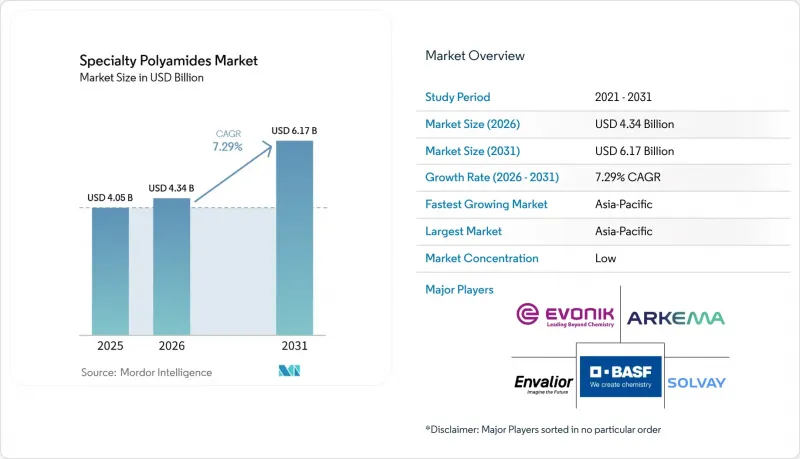
Mordor Intelligence에 의하면, 특수 폴리아미드 시장 규모는 2025년에 40억 5,000만 달러로 평가되었고, 2026년 43억 4,000만 달러에서 2031년까지 61억 7,000만 달러에 이를 것으로 예측되며, 예측 기간(2026-2031년) CAGR은 7.29%를 나타낼 전망입니다.
본 보고서는 제품 유형별(내열성 특수 폴리아미드, MXD6 및 PARA 등), 형태별(수지 및 펠릿, 분말 등), 최종 사용자 산업별(자동차 및 운송, 전기 및 전자 등), 지역별(아시아태평양, 북미, 유럽, 남미, 중동 및 아프리카)로 분류되어 있습니다. 시장 전망은 금액(달러) 기준으로 제시되어 있습니다.
세계의 특수 폴리아미드 시장 동향 및 인사이트
자동차 및 운송 분야에서의 경량 특수 폴리아미드 채택 확대
특수 폴리아미드는 현재 보닛 내부의 주변 부품에 사용되는 데 그치지 않고, 전동 파워트레인 설계에서 하중 지지 기능도 담당하고 있습니다. 유리 섬유 강화 PA66/6T 컴파운드는 배터리 모듈 캐리어 및 전력 전자 장치 하우징에 사용되고 있습니다. 이러한 소재는 금속 대체재에 비해 부품 무게를 20-50% 줄일 수 있어 차량의 주행 거리 향상에 기여하고 있습니다. 800V 전기차 시스템으로의 전환에 따라, 커넥터 및 하우징에 대해 표준 PA66에서 폴리프탈아미드(PPA) 등급으로의 재인증이 필요해졌습니다. BASF는 고전압 자동차 용도를 위해 50유형 이상의 컴파운드화된 ‘Ultramid Advanced N’ 등급을 제공하고 있으며, 이는 800V 시스템에 대한 OEM(주문자 상표 제조업체)의 엄격한 소재 요구 사항을 반영한 것입니다. 2025년에는 전 세계 전기차 생산 대수가 2,200만 대를 넘어설 것으로 예상되며, 이는 특수 폴리아미드 시장 전체의 조달 수요를 뒷받침하고 있습니다.
전기차에서 고성능 열·전기 절연재에 대한 수요 증가
배터리식 전기차에는 습도가 높은 작동 조건에서도 150°C 이상에서 성능을 유지할 수 있는 소재가 요구됩니다. 이러한 요건으로 인해 많은 기존 엔지니어링 플라스틱은 고전압 부품 사양에서 제외되고 있습니다. BASF는 2025년 6월, 열변형 온도 265°C, 두께 0.25 mm에서 UL 94 V-0 성능을 갖춘 PA9T 등급 ‘Ultramid Advanced N3U42G6’을 출시했습니다. KOSTAL사는 이 등급을 자사의 KS22 클래스 4 고전류·고전압 커넥터 모듈에 채택했습니다. 유럽의 무할로겐 요건에 따라 금속 접점의 전기 부식을 유발할 가능성이 있는 난연 첨가제의 사용이 제한되고 있습니다. 아사히카세에 따르면, 자사의 ‘레오나 PN’ 시리즈는 비교 트래킹 지수가 600V로, 이를 통해 고전압 인덕터에서 더 짧은 표면 거리를 확보할 수 있습니다. 이러한 요건으로 인해 특수 폴리아미드 시장에 진입하는 공급업체에게 기술적 장벽이 높아지고 있습니다.
특수 모노머 및 원자재 가격 변동
특수 폴리아미드 생산에는 아디핀산, 카프로락탐, ω-라우로락탐 및 11-아미노운데칸산이 필수적입니다. 각 전구체에는 고유한 공급 리스크가 있어, 컴파운더 및 가공업체의 원자재 비용에 영향을 미칠 수 있습니다. 에보닉(Evonik)의 마르 케미컬 파크(Mar Chemical Park)에는 최대 규모의 라우로락탐 생산 클러스터가 집중되어 있어, PA12 공급망은 집중 위험에 직면해 있습니다. 해당 거점에서 공급 차질이 발생할 경우, 자동차, 석유 및 가스 용도의 PA12 공급에 영향을 미칠 가능성이 있습니다. PA11의 원료인 피마자유는 인도, 중국, 브라질에 집중되어 있어, 작황 변동이 해당 소재공급 상황에 영향을 미치고 있습니다. 고정 가격 계약의 경우, 계약 재협상이 이루어지기 전에 원료 비용이 변동할 경우, 하류의 컴파운더나 OEM 파트너가 위험에 노출될 수 있습니다.
부문별 분석
2025년 현재, 장쇄 특수 폴리아미드는 특수 폴리아미드 시장의 47.74%를 차지했으며, 2031년까지 연평균 성장률(CAGR) 8.15%를 나타낼 것으로 예측됩니다. 이 부문은 유체 처리, 자동차용 튜브, 적층 가공 및 전기차의 열 관리 분야에서 확고한 입지를 다지고 있습니다. PA11과 PA12는 이 그룹의 주요 상용 등급입니다. 아르케마(Arkema)의 ‘릴산(Rilsan)’ 및 에보닉(Evonik)의 ‘베스타미드(VESTAMID)’ 플랫폼은 이러한 장쇄 용도 분야에서 확고한 입지를 구축하고 있습니다. PA12는 흡습성이 낮고 치수 안정성이 뛰어나 수소 연료 라인이나 전기차의 냉각수 통로에 적합합니다. 이러한 특성은 부품이 압력 사이클이나 온도 변화에 노출될 때 중요합니다. 이 등급들은 표준 나일론 소재로는 충분한 안정성을 얻을 수 없는 특수 폴리아미드 시장에서 사용되고 있습니다.
에보닉은 2025년 11월, 상하이에 위치한 제2 폴리아미드 반응기에서 시험 생산을 완료했습니다. 이 프로젝트를 통해 동사의 아시아 내 장쇄 폴리아미드 생산 능력은 2배로 늘어났습니다. 2025년 12월에는 신에너지 차량 및 스포츠 용품을 대상으로 본격적인 생산이 시작되었습니다. PA9T, PA6T, PA4T 및 관련 PPA 등급을 포함한 내열성 특수 폴리아미드는 수요 점유율은 작지만 확대 추세에 있습니다. 이러한 소재는 5G 커넥터 어셈블리, 자동차용 고전압 부품, 반도체 패키지 등에 사용되고 있습니다. 쿠라레의 ‘GENESTAR PA9T’는 첨단 배터리 및 커넥터 용도를 목표로 하고 있습니다. MXD6 및 PARA 등급은 배리어 포장 및 구조용 광학 용도로 사용되는 반면, 코폴리아미드, 투명 등급, PEBA 엘라스토머는 소비자용 전자기기, 의료기기, 고성능 신발 등의 분야에서 활용되고 있습니다.
지역별 분석
2025년, 아시아태평양은 특수 폴리아미드 시장의 45.87%를 차지했으며, 2031년까지 연평균 성장률(CAGR) 8.11%를 나타낼 것으로 예측됩니다. 중국은 전기차 생산 및 전자기기 제조의 거점인 만큼, 이 지역에서 가장 큰 수요 기반을 형성하고 있습니다. 2025년, 중국은 전 세계 전기차 판매 대수의 60%를 차지했습니다. 중국의 각 자동차 제조업체는 차량 플랫폼 전체의 소재 효율을 높이기 위해 특수 폴리아미드 복합 소재의 인증을 추진하고 있습니다. 커넥터 및 배터리의 구조 부품 분야에서 PA12, PA46 및 반방향족 폴리아미드를 사용한 고급 용도가 부상하고 있습니다.
에보닉은 2025년 상하이 공장의 제2 반응기 프로젝트를 통해 장쇄 폴리아미드의 생산 능력을 두 배로 늘렸습니다. 일본과 한국은 정밀 커넥터 제조 및 반도체 제조를 통해 수요를 뒷받침하고 있습니다. 동남아시아의 전기차 판매 대수는 2025년에 2배 이상 증가하여 시장 점유율이 20%에 육박했습니다. 이에 따라 소재 수요 기반은 확대되고 있지만, 그 규모는 여전히 장기적인 잠재력에는 미치지 못하고 있습니다. 아시아태평양의 통합된 공급망 덕분에 이 지역은 특수 폴리아미드 시장의 핵심으로 자리매김하고 있습니다.
북미와 유럽은 각각 2위와 3위 지역 시장으로, 각기 다른 수요 패턴을 보이고 있습니다. 북미는 자동차 경량화, 국내 반도체 투자, 그리고 석유 및 가스 인프라 분야의 플렉서블 파이프용 PA11 수요에 힘입고 있습니다. 2026년 1분기, 정책 불확실성으로 인해 미국의 전기차 판매는 부진했으나, 같은 기간 유럽의 전기차 판매는 전년 동기 대비 30% 가까이 증가했습니다. 유럽에서는 무할로겐, 추적성, 질량 균형 및 재활용 소재를 포함한 공급망에 대한 요구 사항이 공급업체 선정에 있어 중요한 요소로 작용하고 있습니다. 독일, 프랑스, 이탈리아는 자동차 업계의 조달 활동과 화학제품의 통합 생산을 통해 계속해서 유럽의 핵심 시장으로 자리 잡고 있습니다.
남미, 중동 및 아프리카는 특수 폴리아미드 시장에서 규모는 작지만 성장세가 두드러지는 지역입니다. 브라질은 자동차 조립 및 엔지니어링 플라스틱의 현지 조달을 통해 남미 수요를 주도하고 있습니다. 중동 및 아프리카에서는 사우디아라비아의 ‘비전 2030’에 포함된 석유화학 산업 다각화 프로그램이 향후 고부가가치 폴리머 유도체 분야에서 사우디아라비아의 역할을 뒷받침할 가능성이 있습니다. 남아프리카에서는 광업용 장비 및 산업 제조 분야에서 제한적인 수요가 나타나고 있습니다. 이 지역들은 모두 케이블 피복재, 유체 처리 시스템, 그리고 현지화된 자동차 공급망에 대한 인프라 수요의 혜택을 받을 것으로 예상되며, 주요 제조 지역을 넘어 특수 폴리아미드 시장의 기반을 다지게 될 것입니다.
기타 혜택 :
- 엑셀 형식 시장 예측(ME) 시트
- 3개월간의 애널리스트 지원
목차
제1장 서론
제2장 조사 방법
제3장 주요 요약
제4장 시장 구도
제5장 시장 규모 및 성장 예측
제6장 경쟁 구도
제7장 시장 기회 및 향후 전망
AJYAccording to Mordor Intelligence, the specialty polyamides market size was valued at USD 4.05 billion in 2025 and is estimated to grow from USD 4.34 billion in 2026 to reach USD 6.17 billion by 2031, at a CAGR of 7.29% during the forecast period (2026-2031).
This report is Segmented by Product Type (High Temperature Specialty Polyamides, MXD6 and PARA, and More), Form (Resin and Pellets, Powders, and More), End-User Industry (Automotive and Transportation, Electrical and Electronics, and More), and Geography (Asia-Pacific, North America, Europe, South America, and Middle-East and Africa). The Market Forecasts are Provided in Terms of Value (USD).
Global Specialty Polyamides Market Trends and Insights
Increasing Adoption of Lightweight Specialty Polyamides in Automotive and Transportation
Specialty polyamides now support load-bearing functions in electrified powertrain designs, rather than only peripheral under-hood applications. Glass-fiber-reinforced PA66/6T compounds are used in battery module carriers and power electronics enclosures. These materials can reduce component weight by 20-50% compared with metallic alternatives, supporting vehicle range. The shift toward 800 V electric vehicle systems has increased the need to requalify connectors and housings from standard PA66 to polyphthalamide (PPA) grades. BASF offers more than 50 compounded Ultramid Advanced N grades for high-voltage automotive applications, reflecting the depth of original equipment manufacturer (OEM) material requirements for 800 V systems. Global electric car production exceeded 22 million units in 2025, supporting procurement demand across the specialty polyamides market.
Rising Demand for High-Performance Thermal and Electrical Insulation in Electrified Vehicles
Battery-electric vehicles require materials that maintain performance above 150°C in humid operating conditions. This combination excludes many conventional engineering plastics from high-voltage component specifications. BASF launched Ultramid Advanced N3U42G6, a PA9T grade, in June 2025 with a heat distortion temperature of 265°C and UL 94 V-0 performance at a 0.25 mm wall thickness. KOSTAL adopted the grade for its KS22 Class 4 high-current high-voltage connector module. European halide-free requirements limit the use of flame-retardant additives that may cause electrocorrosion of metal contacts. Asahi Kasei states that its Leona PN series has a comparative tracking index of 600 V, which can permit shorter creepage distances in high-voltage inductors. These requirements raise the technical threshold for suppliers entering the specialty polyamides market.
Volatility in Specialty Monomer and Raw Material Prices
Specialty polyamide production relies on adipic acid, caprolactam, ω-laurolactam, and 11-aminoundecanoic acid. Each precursor carries distinct supply risks that can affect material costs for compounders and processors. The PA12 supply chain faces concentration risk, as Evonik's Marl Chemical Park hosts the largest laurolactam production cluster. A disruption at this site could affect PA12 supply for automotive and oil-and-gas applications. Castor oil feedstock for PA11 is concentrated in India, China, and Brazil, adding crop-yield variability to the material's supply conditions. Fixed-price agreements leave downstream compounders and OEM partners exposed when feedstock costs change before contracts can be renegotiated.
Other drivers and restraints analyzed in the detailed report include:
- Growing Miniaturization of Electronic Devices and Demand for High-Temperature Components
- Expanding Adoption of Bio-Based and Sustainable Specialty Polyamides
- High Processing Complexity and Product Qualification Costs
For complete list of drivers and restraints, kindly check the Table Of Contents.
Segment Analysis
Long-chain specialty polyamides accounted for 47.74% of the specialty polyamides market in 2025 and are forecast to grow at a 8.15% CAGR through 2031. The segment is established in fluid handling, automotive tubing, additive manufacturing, and electric vehicle thermal management. PA11 and PA12 are the major commercial grades within this group. Arkema's Rilsan and Evonik's VESTAMID platforms hold positions in these long-chain applications. PA12 has low moisture absorption and stable dimensions, making it suitable for hydrogen fuel lines and electric coolant channels. These characteristics are important when components experience pressure cycling and thermal change. These grades are used in the specialty polyamides market, where standard nylon materials do not provide adequate stability.
Evonik completed trial production at a second polyamide reactor in Shanghai in November 2025. The project doubled the company's long-chain polyamide production capacity in Asia. Commercial operations began in December 2025, targeting new energy vehicles and sports products. High-temperature specialty polyamides, including PA9T, PA6T, PA4T, and related PPA grades, occupy a smaller but expanding share of demand. These materials are used in 5G connector assemblies, high-voltage automotive components, and semiconductor packaging. Kuraray's GENESTAR PA9T targets advanced battery and connector applications. MXD6 and PARA grades serve barrier packaging and structural optical uses, while copolyamides, transparent grades, and PEBA elastomers address consumer electronics, medical devices, and performance footwear.
Complete Report Scope:
- By Product Type
- High Temperature Specialty Polyamides
- Long Chain Specialty Polyamides
- MXD6 and PARA
- Other Specialty Polyamides
- By Form
- Resin and Pellets
- Compounds and Reinforced Grades
- Powders
- Films and Semi-Finished Shapes
- By End-User Industry
- Automotive and Transportation
- Electrical and Electronics
- Industrial Manufacturing
- Aerospace and Defense
- Consumer Goods
- Energy
- Healthcare and Medical
- Packaging
- Other End-User Industries
- By Geography
- Asia-Pacific
- China
- India
- Japan
- South Korea
- Rest of Asia-Pacific
- North America
- United States
- Canada
- Mexico
- Europe
- Germany
- United Kingdom
- France
- Italy
- Russia
- Rest of Europe
- South America
- Brazil
- Argentina
- Rest of South America
- Middle-East and Africa
- Saudi Arabia
- South Africa
- Rest of Middle-East and Africa
- Asia-Pacific
Geography Analysis
Asia-Pacific accounted for 45.87% of the specialty polyamides market in 2025 and is forecast to grow at an 8.11% CAGR through 2031. China is the largest demand center in the region due to its electric vehicle production and electronics manufacturing base. China accounted for 60% of global electric car sales in 2025. Chinese vehicle manufacturers are qualifying specialty polyamide composites to improve material efficiency across vehicle platforms. High-end applications for PA12, PA46, and semi-aromatic polyamides are emerging in connectors and battery structural components.
Evonik doubled capacity for long-chain polyamides at its Shanghai site through a second reactor project in 2025. Japan and South Korea support demand through precision connector manufacturing and semiconductor fabrication. Southeast Asian electric vehicle sales more than doubled in 2025 and approached 20% market share, creating an expanding material demand base that remains below its longer-term potential. Asia-Pacific's integrated supply chains make the region central to the specialty polyamides market.
North America and Europe are the second- and third-largest regional markets, with distinct demand patterns. North America is supported by automotive lightweighting, domestic semiconductor investment, and PA11 demand for flexible pipes in oil and gas infrastructure. U.S. electric vehicle sales were subdued in the first quarter of 2026 amid policy uncertainty, while European electric vehicle sales rose nearly 30% year on year during the same period. Europe's requirements for halogen-free, traceable, mass-balanced, and recycled-content supply chains are important factors in supplier selection. Germany, France, and Italy remain core European markets due to automotive procurement and integrated chemical production.
South America, the Middle-East, and Africa represent smaller but growing areas within the specialty polyamides market. Brazil leads South American demand through automotive assembly and local sourcing of engineering plastics. In the Middle-East and Africa, Saudi Arabia's Vision 2030 petrochemical diversification program could support a future role in higher-value polymer derivatives. South Africa has selective demand from mining equipment and industrial manufacturing. Both regions stand to benefit from infrastructure demand for cable sheathing, fluid-handling systems, and localized automotive supply chains, providing a foundation for the specialty polyamides market beyond the major manufacturing regions.
- Arkema
- Asahi Kasei Corporation
- BASF
- Celanese Corporation
- DOMO Chemicals
- EMS-CHEMIE HOLDING AG
- Envalior
- Eurostar Engineering Plastics
- Evonik Industries AG
- INVISTA
- Kuraray Co., Ltd.
- Mitsubishi Chemical Group Corporation
- Radici Novacips SpA
- ShanDong DongChen Engineering Plastic Co., Ltd.
- Solvay
- Syensqo
- UBE Corporation
Additional Benefits:
- The market estimate (ME) sheet in Excel format
- 3 months of analyst support
TABLE OF CONTENTS
1 Introduction
- 1.1 Study Assumptions and Market Definition
- 1.2 Scope of the Study
2 Research Methodology
3 Executive Summary
4 Market Landscape
- 4.1 Market Overview
- 4.2 Market Drivers
- 4.3 Market Drivers
- 4.3.1 Increasing Adoption of Lightweight Specialty Polyamides in Automotive and Transportation
- 4.3.2 Rising Demand for High-Performance Thermal and Electrical Insulation in Electrified Vehicles
- 4.3.3 Growing Miniaturization of Electronic Devices and Demand for High-Temperature Components
- 4.3.4 Expanding Adoption of Bio-Based and Sustainable Specialty Polyamides
- 4.3.5 Increasing Demand from Semiconductor, Connector, and Battery Component Manufacturing
- 4.4 Market Restraints
- 4.4.1 Volatility in Specialty Monomer and Raw Material Prices
- 4.4.2 High Processing Complexity and Product Qualification Costs
- 4.4.3 Limited Recycling Infrastructure for Reinforced and Multi-Material Specialty Polyamides
- 4.5 Value Chain Analysis
- 4.6 Porter's Five Forces Analysis
- 4.6.1 Threat of New Entrants
- 4.6.2 Bargaining Power of Suppliers
- 4.6.3 Bargaining Power of Buyers
- 4.6.4 Threat of Substitutes
- 4.6.5 Competitive Rivalry
5 Market Size and Growth Forecasts (Value)
- 5.1 By Product Type
- 5.1.1 High Temperature Specialty Polyamides
- 5.1.2 Long Chain Specialty Polyamides
- 5.1.3 MXD6 and PARA
- 5.1.4 Other Specialty Polyamides
- 5.2 By Form
- 5.2.1 Resin and Pellets
- 5.2.2 Compounds and Reinforced Grades
- 5.2.3 Powders
- 5.2.4 Films and Semi-Finished Shapes
- 5.3 By End-User Industry
- 5.3.1 Automotive and Transportation
- 5.3.2 Electrical and Electronics
- 5.3.3 Industrial Manufacturing
- 5.3.4 Aerospace and Defense
- 5.3.5 Consumer Goods
- 5.3.6 Energy
- 5.3.7 Healthcare and Medical
- 5.3.8 Packaging
- 5.3.9 Other End-User Industries
- 5.4 By Geography
- 5.4.1 Asia-Pacific
- 5.4.1.1 China
- 5.4.1.2 India
- 5.4.1.3 Japan
- 5.4.1.4 South Korea
- 5.4.1.5 Rest of Asia-Pacific
- 5.4.2 North America
- 5.4.2.1 United States
- 5.4.2.2 Canada
- 5.4.2.3 Mexico
- 5.4.3 Europe
- 5.4.3.1 Germany
- 5.4.3.2 United Kingdom
- 5.4.3.3 France
- 5.4.3.4 Italy
- 5.4.3.5 Russia
- 5.4.3.6 Rest of Europe
- 5.4.4 South America
- 5.4.4.1 Brazil
- 5.4.4.2 Argentina
- 5.4.4.3 Rest of South America
- 5.4.5 Middle-East and Africa
- 5.4.5.1 Saudi Arabia
- 5.4.5.2 South Africa
- 5.4.5.3 Rest of Middle-East and Africa
- 5.4.1 Asia-Pacific
6 Competitive Landscape
- 6.1 Market Concentration
- 6.2 Strategic Moves
- 6.3 Market Share (%)/Ranking Analysis
- 6.4 Company Profiles (includes Global Overview, Market Overview, Core Segments, Financials as available, Strategic Information, Products and Services, and Recent Developments)
- 6.4.1 Arkema
- 6.4.2 Asahi Kasei Corporation
- 6.4.3 BASF
- 6.4.4 Celanese Corporation
- 6.4.5 DOMO Chemicals
- 6.4.6 EMS-CHEMIE HOLDING AG
- 6.4.7 Envalior
- 6.4.8 Eurostar Engineering Plastics
- 6.4.9 Evonik Industries AG
- 6.4.10 INVISTA
- 6.4.11 Kuraray Co., Ltd.
- 6.4.12 Mitsubishi Chemical Group Corporation
- 6.4.13 Radici Novacips SpA
- 6.4.14 ShanDong DongChen Engineering Plastic Co., Ltd.
- 6.4.15 Solvay
- 6.4.16 Syensqo
- 6.4.17 UBE Corporation
7 Market Opportunities and Future Outlook
- 7.1 White-Space and Unmet-Need Assessment