

|
시장보고서
상품코드
2119119
석유화학 : 시장 점유율 분석, 업계 동향 및 통계, 성장 예측(2026-2031년)Petrochemical - Market Share Analysis, Industry Trends & Statistics, Growth Forecasts (2026 - 2031) |
||||||
 Mordor Intelligence
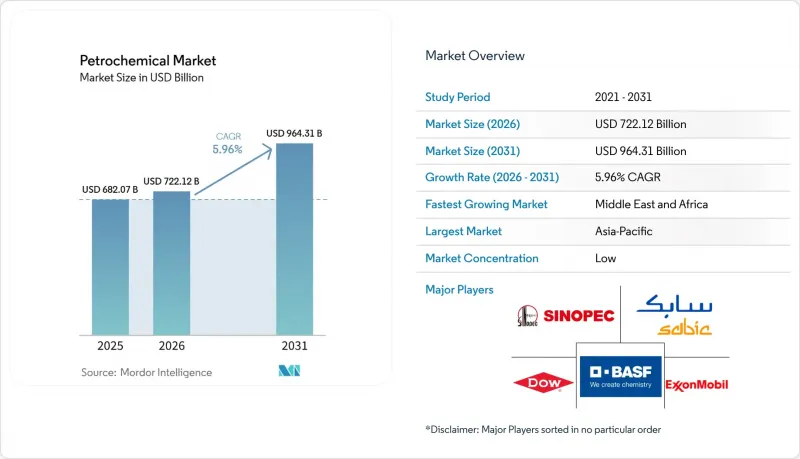
Mordor Intelligence에 의하면, 석유화학 시장 규모는 2025년에 6,820억 7,000만 달러로 평가되었습니다. 예측 기간(2026-2031년) CAGR 5.96%로 확대되어 2026년 7,221억 2,000만 달러에서 2031년에는 9,643억 1,000만 달러에 이를 전망입니다.
본 보고서는 원료(나프타, 에탄 등), 제품(에틸렌, 프로파일렌 등), 제조 공정(스팀 크래킹, 유동 접촉 분해(FCC) 등), 최종 사용자 산업(포장, 건축 및 건설 등),및 지역(아시아태평양, 북미, 유럽, 남미, 중동 및 아프리카)별로 분류되어 있습니다. 시장 전망은 금액(달러) 기준으로 제시되어 있습니다.
세계의 석유화학 시장 동향 및 인사이트
경량 포장재에 대한 수요 증가와 플라스틱 대체재의 발전
포장은 식품, 음료, 의약품 및 물류 공급망을 뒷받침하는 석유화학 시장의 안정적인 수요원으로 계속해서 자리 잡고 있습니다. 폴리에틸렌, 폴리프로필렌 및 PET 유도체는 유연 필름, 경질 용기, 다층 배리어 라미네이트에 사용되어 제품을 보호하는 동시에 운송 효율 향상에 기여하고 있습니다. 포장 형태는 차단성이나 내구성을 저해하지 않으면서 재활용이 용이한, 더 얇고 단일 소재로 된 디자인으로 전환되고 있습니다. 이러한 디자인에는 더 엄격한 기술 사양을 충족하는 폴리머가 필요하며, 이로 인해 가공되는 수지 1kg당 가치가 높아질 가능성이 있습니다. 테크닙 에너지스(Technip Energies), 알테라(Altera), 네스테(Neste)의 보고서에 따르면, 2024년 플라스틱 생산량은 4억 3,100만 메트에 달했으나, 순환 경제의 발전은 소비량 증가를 따라잡지 못하고 있습니다. 이러한 격차로 인해 첨단 재활용 기술과 인증된 재생 재료가 포함된 폴리머에 대한 수요가 증가하고 있습니다. 특히 식품 접촉이나 의약품 순도 기준으로 인해 기계적 재활용 재료의 사용이 제한되는 분야에서는 일관된 품질을 갖춘 검증된 순환형 원료에 대한 수요가 발생하고 있습니다.
신흥 경제국에서의 제조 활동 확대 및 인프라 개발
인도, 동남아시아 및 사하라 이남 아프리카의 인프라 건설은 열가소성 수지 파이프, PVC 프로파일, 폴리머 개질 코팅, 경질 단열재 및 기타 내구성 있는 건축자재에 대한 수요를 뒷받침하고 있습니다. 이러한 수요는 단기적인 개인 소비가 아닌, 건설 활동 및 공공 인프라에 대한 투자와 밀접하게 관련되어 있습니다. 2025년 10월, BPCL과 오일 인디아 리미티드는 안드라프라데시 주 라마야파트남 인근에 110억 달러 규모의 정유시설 및 석유화학 복합 단지를 개발하기 위한 구속력 없는 양해각서에 서명했습니다. 이 프로젝트에는 인도 남부 최초의 연간 150만 미터톤 생산 규모의 에틸렌 크래커가 포함되어 있으며, 2030년까지 상업 가동을 목표로 하고 있습니다. 또한, 중국의 새로운 통합 생산 능력 확대로 인해 파생 제품공급이 증가하고 있으며, 이는 지역 현물 가격에 압박을 가하는 한편, 하류 가공업체에게는 저비용 원료 조달 경로를 제공합니다. 따라서 석유화학 시장은 여전히 국내 탄화수소 소비, 수입 대체, 그리고 여러 신흥 경제국의 산업 개발 정책과 밀접하게 연결되어 있으며, 이들 국가에서는 현지 공급 안정성과 고부가가치 가공이 점점 더 중요한 정책 목표로 대두되고 있습니다.
원유, 천연가스 및 석유화학 원료 가격 변동
원료 비용의 변동은 석유화학 시장에 여전히 뿌리 깊은 이익률 위험 요인으로 작용하고 있습니다. 특히, 크래커가 원유 연동형 나프타나 액화석유 및 가스(LPG)에 의존하고, 분기별 계약에 따라 판매되는 경우에는 이러한 경향이 두드러집니다. 원유 가격 변동은 몇 주 이내에 나프타나 LPG 비용에 영향을 미칠 가능성이 있으며, 생산자가 계약 가격을 조정할 시간은 거의 없습니다. 국제에너지기구(IEA)는 2026년 5월, 중동 공급 차질을 배경으로 석유화학 원료의 확보가 점점 더 어려워지고 있다고 밝혔습니다. 또한 이 기관은 공급 차질이 지속되는 동안 석유 소비 산업 중 석유화학 부문이 수요 측면에서 가장 큰 손실을 입었다고 보고했습니다. 미국의 에탄 수출 증가는 장기적으로 국내 천연가스 액체(NGL) 공급을 압박하여, 수년간 지속되어 온 북미의 비용 우위를 축소시킬 가능성이 있습니다. 각 생산 기업들은 고정된 단일 원료 구성 대신, 다원료 크래커 도입, 열분해유 공동 처리, 에탄 수입 등의 대응책을 마련하고 있습니다.
부문별 분석
2025년, 나프타는 석유화학 시장의 42.83% 점유율을 차지했습니다. 이는 유럽, 일본, 한국의 스팀 크래커 설비 기반을 반영한 것으로, 이들 지역에서는 원유 연동형 처리 시스템에 대해 수십 년에 걸쳐 설비 투자가 이루어져 왔습니다. 이러한 시설은 확립된 정유시설와의 연계, 저장 시스템 및 운영 노하우에 의존하고 있으며, 그 결과 나프타는 많은 성숙한 화학 산업 허브에서 핵심 원료가 되었습니다. 에탄은 두 번째로 큰 원료 범주이며, 미국의 셰일 천연가스 액체의 혜택을 받고 있습니다. 또한, 장기 공급 계약을 통해 그 이용 범위는 북미와 중동을 넘어 확대되고 있습니다. 미국 에너지 정보국(EIA)은 2026년에 미국의 에탄 수출이 16% 증가하여 에탄공급 범위가 해외 사업자로도 확대될 것으로 예측했습니다. 프로판과 부탄은 중규모 크래커에 계절적 유연성을 제공하는 한편, 석탄은 여전히 중국의 석탄에서 메탄올(CTM), 메탄올에서 올레핀(MTO), 메탄올에서 프로파일렌(MTP)을 생산하는 지역에서 주요 원료로 자리 잡고 있습니다.
재활용 원료 및 재생 가능 원료는 2031년까지 연평균 성장률(CAGR) 11.82%로 확대될 것으로 예측됩니다. 이러한 성장은 기존 크래커에서 나프타의 드롭인 대체재로서의 열분해유의 상업적 도입 및 인증된 물질 수지 시스템에서의 바이오나프타 활용과 관련이 있습니다. BASF는 2025년 이후 재활용 원료 및 폐기물 유래 원료를 연간 25만 메트르톤으로 늘리는 목표를 세웠습니다. 클라리언트, 보레알리스, 그리고 SINTEF는 2026년 3월, 고품질 폴리올레핀 원료를 얻기 위한 열분해유의 업그레이드 공정 실증에 성공했습니다. 또한, 연구 결과 귀금속이나 외부 수소를 필요로 하지 않으면서 탄소 수율을 총 79%까지 높이는 동시에 폴리에틸렌을 에틸렌 및 프로파일렌으로 직접 전환하는 경로도 제시되었습니다. 이러한 진전은 재활용 원료의 선택 폭을 넓힐 뿐만 아니라, 석유화학 시장에서 기계적 재활용의 한계에 대한 장기적인 해결책을 제시합니다.
에틸렌은 폴리에틸렌, 에틸렌옥사이드, 염화비닐 및 광범위한 범용·특수 폴리머의 전구체이기 때문에 2025년 석유화학 시장 규모의 28.77%를 차지했습니다. 중국은 정제, 크래킹, 하류 폴리머 생산을 연계한 대규모 통합 프로젝트를 통해 에틸렌 생산 능력 확충을 계속하고 있습니다. 중국석유천연가스그룹(CNPC)은 2026년 7월, 연간 120만 메트르톤을 생산하는 두산즈(Du Shanzi) 그린 에틸렌 프로젝트를 가동했습니다. 이 프로젝트로 인해 해당 복합 시설의 총 생산 능력은 연간 300만 메트르톤을 넘어섰으며, 총 투자액은 256억 5,600만 위안(36억 달러)에 달했습니다. 프로파일렌의 경우, 프로판 탈수소법이나 유동 접촉 분해법을 통해 직접 생산할 수 있게 됨에 따라 스팀 크래커에 대한 의존도가 점차 낮아지고 있습니다. 한편, 부타디엔, 벤젠, 크실렌, 톨루엔에 대해서는 자동차, 수지, 폴리에스터, 용제 등의 용도에서 지속적인 수요가 예상됩니다.
메탄올은 2031년까지 연평균 성장률(CAGR) 7.84%를 나타낼 것으로 예측되며, 이는 제품 카테고리 중 가장 높은 성장률입니다. 중국의 MTO(메탄올에서 올레핀 생산) 및 MTP(메탄올에서 폴리에스터 생산) 수요 기반은 연간 3,000만-3,300만 메트르톤의 메탄올을 흡수하고 있으며, 세계 최대의 석탄 화학제품 전환 회랑을 형성하고 있습니다. 해운사들이 저탄소 연료 대안을 모색함에 따라, 메탄올 연료 선박에 대한 수요는 신규 공급의 두 번째 판로가 되고 있습니다. 이러한 이중 용도로 인해 메탄올은 석유화학 시장과 운송용 연료 계획 모두와 연관되어 있으며, 프로젝트 자금 조달 및 설비 가동률에도 영향을 미치고 있습니다. 동아시아의 과잉 생산 능력으로 인해 일반 방향족 화합물은 압박을 받고 있지만, 남아시아 및 동남아시아 가공 시장의 수지 및 폴리에스터 섬유 수요가 그 활용을 지속적으로 뒷받침하고 있습니다.
지역별 분석
2025년, 아시아태평양은 전 세계 석유화학 생산량의 52.64%를 차지했습니다. 중국, 인도, 한국, 일본은 대규모 정제, 폴리머 가공, 전자, 자동차, 건설과 같은 밸류체인을 통해 이 지역의 생산 능력과 하류 수요의 기반을 형성하고 있습니다. 중국일보에 따르면, 중국석유천연가스그룹(CNPC)의 두산즈(杜山子) 프로젝트는 연간 생산 능력 300만 메트르톤을 넘는 중국 최초의 내륙 에틸렌 거점을 구축했을 뿐만 아니라, 중국은 전 세계 에틸렌 설비 용량의 30% 이상을 차지하고 있습니다. 인도는 계획 중인 통합 프로젝트를 통해 국내 생산 능력을 확대하고 있는 반면, 한국과 일본은 비용이 크래커의 수익성을 압박하고 있어 구형 나프타 기반 자산의 합리화를 추진하고 있습니다. BASF의 잔장(Zhanjiang) 베르분트(Verbund)에 대한 투자는 중국의 대규모 하류 폴리머 생산 거점 근처에 생산 거점을 마련하려는 이 회사의 지속적인 노력을 반영하고 있습니다.
북미는 셰일 유래 에탄의 혜택을 받고 있으며, 이를 통해 지역 생산자들은 많은 나프타를 원료로 하는 사업에 대해 지속적인 비용 우위를 확보하고 있습니다. 미국의 에탄 수출량은 2025년에 14% 증가한 후, 2026년에는 16% 증가할 것으로 예측됩니다. 다우는 2026년 1월, 앨버타주에서 75억 달러 규모의 ‘Path2Zero’ 에틸렌 프로젝트 건설을 재개했으며, 1단계는 2029년 하반기 가동을 목표로 하고 있습니다. 유럽에서는 나프타를 원료로 하는 자산의 비용 경쟁력이 저하되고 있어, 범용 올레핀 생산 능력의 재편이 진행되고 있습니다. 리욘 베셀은 2026년 5월, 유럽 내 4곳의 올레핀 및 폴리올레핀 생산 거점 매각을 완료하고 ‘Velogy’ 플랫폼을 출범시켰습니다. 유럽의 사업자들은 범용 크래커의 생산 능력보다는 특수 폴리머, 순환형 화학, 그리고 부가가치가 높은 용도로 자본을 전환하고 있습니다.
중동 및 아프리카는 2031년까지 연평균 성장률(CAGR) 6.92%를 나타낼 것으로 예측되며, 이는 석유화학 시장에서 지역별 가장 높은 성장률입니다. 저비용 에탄이 사우디아라비아, 쿠웨이트, 오만에서 수익성 우위를 뒷받침하고 있으며, 이들 국가에서는 정부 지원 프로젝트를 통해 현지 탄화수소를 고부가가치 파생 제품으로 전환하려는 노력이 확대되고 있습니다. 남미에서는 브라켐(Braskem)사가 2025년 10월, 리우데자네이루의 에틸렌 복합 시설을 연간 22만 메트르톤 규모로 확장하기 위해 42억 브라질 레알(약 8억 1,000만 달러)의 예산을 승인했습니다. 한편, 페트로브라스(Petrobras)는 2026년 6월, 석유화학 분야에 대한 투자 계획을 재개했습니다. 이러한 프로젝트들은 해당 지역의 생산 전략이 현지 원료의 확보 가능성, 수입 대체 목표, 그리고 폴리머 및 특수 화학제품에 대한 국내 수요에 의해 형성되고 있음을 보여줍니다.
기타 혜택 :
- 엑셀 형식 시장 예측(ME) 시트
- 3개월간의 애널리스트 지원
자주 묻는 질문
목차
제1장 서론
제2장 조사 방법
제3장 개요
제4장 시장 구도
제5장 시장 규모 및 성장 예측
제6장 경쟁 구도
제7장 시장 기회 및 향후 전망
KTH 26.09.02According to Mordor Intelligence, the petrochemical market size was estimated at USD 682.07 billion in 2025 and is estimated to grow from USD 722.12 billion in 2026 to USD 964.31 billion by 2031, at a CAGR of 5.96% during the forecast period (2026-2031).
This report is Segmented by Feedstock (Naphtha, Ethane, and More), Product (Ethylene, Propylene, and More), Manufacturing Process (Steam Cracking, Fluid Catalytic Cracking (FCC), and More), End-User Industry (Packaging, Building and Construction, and More), and Geography (Asia-Pacific, North America, Europe, South America, and Middle-East and Africa). The Market Forecasts are Provided in Terms of Value (USD).
Global Petrochemical Market Trends and Insights
Growing Demand for Lightweight Packaging Materials and Plastic Substitution
Packaging remains a stable source of demand for the petrochemical market, serving the food, beverage, pharmaceutical, and logistics supply chains. Polyethylene, polypropylene, and PET derivatives are used in flexible films, rigid containers, and multi-layer barrier laminates, where they protect products and support transport efficiency. Packaging formats are shifting toward thinner, mono-material designs that are easier to recycle without compromising barrier and durability performance. These designs require polymers with more demanding technical specifications, which can increase value per kilogram of resin processed. Technip Energies, Alterra, and Neste reported that plastics production reached 431 million metric tons in 2024, while circularity did not keep pace with consumption growth. This gap supports demand for advanced recycling and certified recycled-content polymers, particularly where food-contact and pharmaceutical purity standards limit the use of mechanically recycled material and create a need for verified circular inputs with consistent quality.
Expanding Manufacturing Activities and Infrastructure Development in Emerging Economies
Infrastructure construction in India, Southeast Asia, and sub-Saharan Africa supports demand for thermoplastic pipes, PVC profiles, polymer-modified coatings, rigid insulation, and other durable construction inputs. This demand is tied to construction activity and public infrastructure investment rather than short-term consumer spending. In October 2025, BPCL and Oil India Limited signed a non-binding memorandum to develop a USD 11 billion refinery and petrochemical complex near Ramayapatnam, Andhra Pradesh. The project includes a 1.5 million metric tons per year ethylene cracker, the first in southern India, and targets commercial operations by 2030. New Chinese integrated capacity is also adding derivative supply that can pressure regional spot prices while providing lower-cost input channels for downstream processors. The petrochemical market, therefore, remains tied to domestic hydrocarbon use, import substitution, and industrial development policies across several emerging economies, where local supply security and value-added processing are increasingly important policy objectives.
Volatility in Crude Oil, Natural Gas, and Petrochemical Feedstock Prices
Feedstock cost volatility remains a persistent margin risk for the petrochemical market, particularly where crackers are tied to crude-linked naphtha or liquefied petroleum gas (LPG) and sell under quarterly contracts. Crude oil price changes can affect naphtha and LPG costs within weeks, leaving producers little time to adjust contract pricing. The International Energy Agency stated in May 2026 that petrochemical feedstock availability had become increasingly constrained amid Middle-East supply disruptions. It also reported that the petrochemical sector recorded the steepest demand-side losses among oil-consuming industries during the disruption cycle. Rising U.S. ethane exports can tighten domestic natural gas liquids supply over time and narrow a long-standing North American cost advantage. Producers are responding with multi-feed crackers, co-processing pyrolysis oil, and ethane import options rather than fixed single-feedstock configurations.
Other drivers and restraints analyzed in the detailed report include:
- Increasing Investments in Integrated Refinery-to-Chemicals Complexes
- Rising Adoption of Methanol-to-Olefins Technology and Low-Carbon Marine Fuels
- Stringent Carbon Emission, Plastic Waste, and Environmental Regulations
For complete list of drivers and restraints, kindly check the Table Of Contents.
Segment Analysis
Naphtha held 42.83% of the petrochemical market share in 2025, reflecting the installed base of steam crackers in Europe, Japan, and South Korea, where crude-linked processing systems represent decades of capital investment. These sites rely on established refining links, storage systems, and operating expertise that make naphtha the central feedstock for many mature chemical hubs. Ethane is the second-largest feedstock category and benefits from US shale natural gas liquids, while long-term supply arrangements are extending its use beyond North America and the Middle-East. The Energy Information Administration (EIA) expects US ethane exports to grow 16% in 2026, extending ethane's reach to overseas operators. Propane and butane give mid-sized crackers seasonal flexibility, while coal remains a key input for China's Coal-to-Methanol (CTM), Methanol-to-Olefins (MTO), and Methanol-to-Propylene (MTP) production corridor.
Recycled and renewable inputs are forecast to grow at an 11.82% CAGR through 2031. Their growth is linked to the commercial deployment of pyrolysis oil as a drop-in substitute for naphtha in existing crackers, as well as the use of bio-naphtha in certified mass-balance systems. BASF targeted 250,000 metric tons per year of recycled and waste-based raw materials from 2025. Clariant, Borealis, and SINTEF demonstrated a pyrolysis oil-upgrading pathway in March 2026 for high-quality polyolefin feedstocks. Research has also shown a route to convert polyethylene directly into ethylene and propylene with combined carbon yields of up to 79% without noble metals or external hydrogen. These developments broaden the pool of recycled feedstock and offer a longer-term response to mechanical recycling limitations in the petrochemical market.
Ethylene accounted for 28.77% of the petrochemical market size in 2025 because it is a precursor for polyethylene, ethylene oxide, vinyl chloride, and a broad range of commodity and specialty polymers. China continues to add ethylene capacity through large integrated projects that connect refining, cracking, and downstream polymer production. China National Petroleum Corporation (CNPC) commissioned the 1.2 million metric tons per year Dushanzi green ethylene project in July 2026. The project brought total complex capacity above 3 million metric tons per year and involved CNY 25.656 billion (USD 3.6 billion). Propylene is becoming less dependent on steam crackers because propane dehydrogenation and fluid catalytic cracking can produce it directly, while butadiene, benzene, xylene, and toluene retain demand across automotive, resin, polyester, and solvent applications.
Methanol is forecast to grow at a 7.84% CAGR through 2031, the highest rate among product categories. China's MTO and MTP base absorbs 30 to 33 million metric tons of methanol per year and has created the world's largest coal-to-chemicals conversion corridor. Demand from methanol-fueled vessels adds a second outlet for new supply as shipping companies seek lower-carbon fuel options. This dual use makes methanol relevant to both the petrochemical market and transport fuel planning, with implications for project financing and capacity utilization. Commodity aromatics face pressure from East Asian surplus capacity, although resin and polyester fiber demand in South and Southeast Asian processing markets continues to support their use.
Complete Report Scope:
- By Feedstock
- Naphtha
- Ethane
- Propane
- Butane
- Coal
- Natural Gas
- Recycled and Renewable Feedstocks
- By Product
- Ethylene
- Propylene
- Butadiene
- Benzene
- Xylene
- Toluene
- Methanol
- Other Petrochemical Products
- By Manufacturing Process
- Steam Cracking
- Fluid Catalytic Cracking (FCC)
- Catalytic Reforming
- Methanol-to-Olefins (MTO) and Methanol-to-Propylene (MTP)
- Propane Dehydrogenation (PDH)
- Coal-to-Methanol (CTM)
- Renewable and Circular Feedstock Routes
- By End-User Industry
- Packaging
- Building and Construction
- Automotive and Transportation
- Electrical and Electronics
- Consumer Goods
- Agriculture
- Healthcare and Pharmaceuticals
- Textile and Apparel
- Industrial Manufacturing
- Other End-User Industries
- By Geography
- Asia-Pacific
- China
- India
- Japan
- South Korea
- Rest of Asia-Pacific
- North America
- United States
- Canada
- Mexico
- Europe
- Germany
- United Kingdom
- France
- Italy
- Russia
- Rest of Europe
- South America
- Brazil
- Argentina
- Rest of South America
- Middle-East and Africa
- Saudi Arabia
- South Africa
- Rest of Middle-East and Africa
- Asia-Pacific
Geography Analysis
Asia-Pacific accounted for 52.64% of global petrochemical output in 2025. China, India, South Korea, and Japan anchor the region's capacity and downstream demand through large refining, polymer processing, electronics, automotive, and construction value chains. China National Petroleum Corporation (CNPC)'s Dushanzi project established China's first inland ethylene base with a capacity of more than 3 million metric tons per year, while China holds more than 30% of global installed ethylene capacity, according to China Daily. India is expanding domestic capacity through planned integrated projects, while South Korea and Japan are rationalizing older naphtha-based assets as costs constrain cracker economics. BASF's Zhanjiang Verbund investment reflects a continued commitment to producing close to China's large downstream polymer base.
North America benefits from shale-derived ethane, which gives regional producers a durable cost advantage over many naphtha-based operations. U.S. ethane exports are forecast to rise 16% in 2026 after 14% growth in 2025. Dow restarted construction on its USD 7.5 billion Path2Zero ethylene project in Alberta in January 2026, with Phase 1 targeted for late 2029. Europe is consolidating commodity olefins capacity as its naphtha-based assets face a weaker cost position. LyondellBasell completed the sale of 4 European olefins and polyolefins sites in May 2026, creating the Velogy platform. European operators are redirecting capital toward specialty polymers, circular chemistry, and value-added applications rather than commodity cracker capacity.
Middle-East and Africa are forecast to grow at a CAGR of 6.92% through 2031, the highest regional growth rate in the petrochemical market. Low-cost ethane supports margin advantages in Saudi Arabia, Kuwait, and Oman, where state-supported projects are expanding the conversion of local hydrocarbons into higher-value derivatives. In South America, Braskem approved BRL 4.2 billion (~USD 0.81 billion) for a 220,000 metric tons per year expansion of its Rio de Janeiro ethylene complex in October 2025, while Petrobras resumed petrochemical investment planning in June 2026. These projects indicate that regional production strategies are shaped by local feedstock availability, import substitution goals, and domestic demand for polymers and specialty chemicals.
- BASF
- Chevron Phillips Chemical Company LLC
- China Petroleum & Chemical Corporation
- Dow
- Exxon Mobil Corporation
- Formosa Plastics Corporation
- INEOS Group
- LG Chem
- LyondellBasell Industries N.V.
- PetroChina Company Limited
- Reliance Industries Limited
- SABIC
- Saudi Arabian Oil Company
- Shell
- Sumitomo Chemical Co., Ltd.
- TotalEnergies
Additional Benefits:
- The market estimate (ME) sheet in Excel format
- 3 months of analyst support
TABLE OF CONTENTS
1 Introduction
- 1.1 Study Assumptions and Market Definition
- 1.2 Scope of the Study
2 Research Methodology
3 Executive Summary
4 Market Landscape
- 4.1 Market Overview
- 4.2 Market Drivers
- 4.2.1 Growing Demand for Lightweight Packaging Materials and Plastic Substitution
- 4.2.2 Expanding Manufacturing Activities and Infrastructure Development in Emerging Economies
- 4.2.3 Increasing Investments in Integrated Refinery-to-Chemicals (RTC) Complexes
- 4.2.4 Rising Adoption of Methanol-to-Olefins (MTO) Technology and Low-Carbon Marine Fuels
- 4.2.5 Improved Feedstock Flexibility Supported by Shale Gas and Alternative Hydrocarbon Sources
- 4.3 Market Restraints
- 4.3.1 Volatility in Crude Oil, Natural Gas, and Petrochemical Feedstock Prices
- 4.3.2 Stringent Carbon Emission, Plastic Waste, and Environmental Regulations
- 4.3.3 High Capital Investment Requirements and Lengthy Project Approval Timelines
- 4.4 Value Chain Analysis
- 4.5 Porter's Five Forces Analysis
- 4.5.1 Threat of New Entrants
- 4.5.2 Bargaining Power of Suppliers
- 4.5.3 Bargaining Power of Buyers
- 4.5.4 Threat of Substitutes
- 4.5.5 Competitive Rivalry
5 Market Size and Growth Forecasts (Value)
- 5.1 By Feedstock
- 5.1.1 Naphtha
- 5.1.2 Ethane
- 5.1.3 Propane
- 5.1.4 Butane
- 5.1.5 Coal
- 5.1.6 Natural Gas
- 5.1.7 Recycled and Renewable Feedstocks
- 5.2 By Product
- 5.2.1 Ethylene
- 5.2.2 Propylene
- 5.2.3 Butadiene
- 5.2.4 Benzene
- 5.2.5 Xylene
- 5.2.6 Toluene
- 5.2.7 Methanol
- 5.2.8 Other Petrochemical Products
- 5.3 By Manufacturing Process
- 5.3.1 Steam Cracking
- 5.3.2 Fluid Catalytic Cracking (FCC)
- 5.3.3 Catalytic Reforming
- 5.3.4 Methanol-to-Olefins (MTO) and Methanol-to-Propylene (MTP)
- 5.3.5 Propane Dehydrogenation (PDH)
- 5.3.6 Coal-to-Methanol (CTM)
- 5.3.7 Renewable and Circular Feedstock Routes
- 5.4 By End-User Industry
- 5.4.1 Packaging
- 5.4.2 Building and Construction
- 5.4.3 Automotive and Transportation
- 5.4.4 Electrical and Electronics
- 5.4.5 Consumer Goods
- 5.4.6 Agriculture
- 5.4.7 Healthcare and Pharmaceuticals
- 5.4.8 Textile and Apparel
- 5.4.9 Industrial Manufacturing
- 5.4.10 Other End-User Industries
- 5.5 By Geography
- 5.5.1 Asia-Pacific
- 5.5.1.1 China
- 5.5.1.2 India
- 5.5.1.3 Japan
- 5.5.1.4 South Korea
- 5.5.1.5 Rest of Asia-Pacific
- 5.5.2 North America
- 5.5.2.1 United States
- 5.5.2.2 Canada
- 5.5.2.3 Mexico
- 5.5.3 Europe
- 5.5.3.1 Germany
- 5.5.3.2 United Kingdom
- 5.5.3.3 France
- 5.5.3.4 Italy
- 5.5.3.5 Russia
- 5.5.3.6 Rest of Europe
- 5.5.4 South America
- 5.5.4.1 Brazil
- 5.5.4.2 Argentina
- 5.5.4.3 Rest of South America
- 5.5.5 Middle-East and Africa
- 5.5.5.1 Saudi Arabia
- 5.5.5.2 South Africa
- 5.5.5.3 Rest of Middle-East and Africa
- 5.5.1 Asia-Pacific
6 Competitive Landscape
- 6.1 Market Concentration
- 6.2 Strategic Moves
- 6.3 Market Share (%)/Ranking Analysis
- 6.4 Company Profiles (includes Global Overview, Market Overview, Core Segments, Financials as available, Strategic Information, Products and Services, and Recent Developments)
- 6.4.1 BASF
- 6.4.2 Chevron Phillips Chemical Company LLC
- 6.4.3 China Petroleum & Chemical Corporation
- 6.4.4 Dow
- 6.4.5 Exxon Mobil Corporation
- 6.4.6 Formosa Plastics Corporation
- 6.4.7 INEOS Group
- 6.4.8 LG Chem
- 6.4.9 LyondellBasell Industries N.V.
- 6.4.10 PetroChina Company Limited
- 6.4.11 Reliance Industries Limited
- 6.4.12 SABIC
- 6.4.13 Saudi Arabian Oil Company
- 6.4.14 Shell
- 6.4.15 Sumitomo Chemical Co., Ltd.
- 6.4.16 TotalEnergies
7 Market Opportunities and Future Outlook
- 7.1 White-Space and Unmet-Need Assessment


