

|
시장보고서
상품코드
2119144
인도의 도시형 마이크로 창고 시장 : 시장 점유율 분석, 업계 동향 및 통계, 성장 예측(2026-2031년)India Urban Micro-Warehousing - Market Share Analysis, Industry Trends & Statistics, Growth Forecasts (2026 - 2031) |
||||||
 Mordor Intelligence
Mordor Intelligence에 의하면, 인도의 도시형 마이크로 창고 시장 규모는 2025년에 5억 9,000만 달러로 평가되었고, 2026년에는 7억 1,000만 달러로 추정되고, 2031년까지 16억 7,000만 달러에 이를 것으로 예상되며, 2026-2031년 CAGR 18.63%로 성장할 전망입니다.
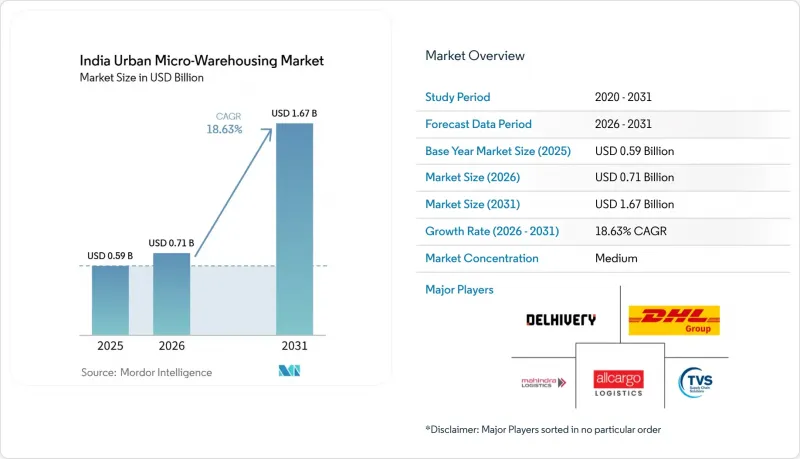
인도의 도시형 마이크로 창고 시장이 확대되고 있는 배경에는 주요 도시의 배송 수요가 더 이상 교외의 대형 창고에만 의존하는 것이 아니라, 소비자와 가까운 곳에 재고를 배치하는 것이 필수적이 되었기 때문입니다. 본 보고서에서는 시설 유형별(다크 스토어형, MFC형 등), 온도 관리별(온도 관리형, 비온도 관리형), 자동화 수준별(수동, 반자동, 완전 자동), 최종 이용 산업별(전자상거래, 퀵커머스, 식품 및 음료 등), 지역별(북부, 중부, 서부 등)로 분류되어 있습니다. 시장 전망은 금액(달러)으로 표시되어 있습니다.
인도의 도시형 마이크로 창고 시장 동향 및 인사이트
증가하는 퀵커머스 주문 밀도
퀵커머스는 신흥 배송 형태에서 인도 도시형 마이크로 창고 시장의 주요 수요 동력으로 변모했습니다. Blinkit, Swiggy Instamart, Zepto의 다크 스토어 네트워크 총 거점은 2026년 5월 기준 5,026곳에 달하고, 전년 동월의 3,405곳에서 증가한 것으로 나타나, 도시 지역의 풀필먼트 인프라가 얼마나 급속히 확충되고 있는지를 여실히 보여주고 있습니다. 인도 도시형 마이크로 창고 시장에 가해지는 압박은 단순히 점포 수 증가 때문만은 아닙니다. 각 거점에서는 점점 더 폭넓은 상품 구색 속에서 매일 막대한 주문량을 처리해야 하기 때문입니다. 주문 밀도가 높아짐에 따라 재고 회전율을 높이고 SKU 구색을 지속적으로 확충할 수 있는 사업자일수록, 더 대규모이고 입지 조건이 좋은 도시 지역 거점을 확보할 정당성이 생깁니다. 소규모 사업자의 경우, 주문 처리량이 손익분기점을 밑돌면 고정비가 급격히 증가하기 때문에 더욱 어려운 환경에 직면해 있습니다. 이 때문에 인도의 도시형 마이크로 창고 시장은 단순한 네트워크 확대보다 밀도, 처리 속도, 규정 준수가 더 중요시되는 보다 선별적인 운영 모델로 전환되고 있습니다.
Tier 1 및 Tier 2 도시에서의 다크 스토어 네트워크 확대
인도의 도시형 마이크로 창고 시장은 더 이상 최대 규모의 대도시권에만 집중되어 있지 않습니다. 네트워크 확장이 현재는 Tier 2 도시의 더 깊은 곳까지 진행되고 있기 때문입니다. Flipkart Minutes는 2026년 6월, 고락푸르에 1,000번째 마이크로 풀필먼트 센터를 개설했습니다. 또한, 이 회사가 사업을 전개하는 130개 도시 중 90개 도시는 이미 대도시권 외 지역이며, 이는 주요 대도시권 이외의 지역에서 수요가 이미 형성되고 있음을 뒷받침합니다. 인도의 도시형 마이크로 창고 시장은 이처럼 광범위한 도시 전역으로 커버 범위가 확대됨에 따라 혜택을 보고 있습니다. 왜냐하면 새로운 서비스 지역마다 현지 수요에 가까운 곳에 재고를 보유해야 하기 때문입니다. 과제가 되는 점은 소규모 도시에서는 안정적인 전력 공급, 방화 허가, 이용 가능한 접근 조건을 갖춘 기준을 충족하는 소형 창고 자산이 부족한 경우가 많다는 것입니다. 그로 인해 수요가 존재하더라도 사업자가 사업을 확장할 수 있는 속도에는 제한이 생깁니다. 그 결과, 인도 도시 지역의 마이크로 창고 시장은 지리적으로 확대되고 있습니다. 그러나 확장 속도는 여전히 적절한 운영 비용으로 적합한 도시 공간을 확보할 수 있는지 여부에 좌우됩니다.
도시 지역의 주요 마이크로 입지에 대한 높은 토지 가격과 임대료
높은 임대료는 인도 도시형 마이크로 창고 시장에서 가장 뚜렷한 운영상의 제약 중 하나입니다. 2026년,인도 대도시권의 창고 임대료는 1제곱피트당 월 18-60루피(0.19-0.63달러) 범위이며, 델리·NCR 회랑에서도 시간이 지남에 따라 임대료가 대폭 상승하여 도시 지역 물류 거점이 얼마나 비싸졌는지를 여실히 보여주고 있습니다. 인도의 도시형 마이크로 창고 시장에서는 점유 비용의 상승으로 인해, 더 넓은 부지를 확보하면 SKU 구성이나 피킹 효율이 향상됨에도 불구하고, 사업자는 실질적으로 가능한 최소한의 부지 면적을 사용해야만 하는 상황에 내몰리는 경우가 많습니다. 이로 인해 고정 입지 비용을 낮은 처리량으로 분산시키기가 어려워지므로, 주문 처리의 수익성은 수요 변동에 더욱 민감해집니다. 재정력이 있는 사업자는 이러한 압박을 더 오랫동안 흡수할 수 있지만, 소규모 네트워크에서는 그럴 수 없습니다. 그 결과, 인도의 도시형 마이크로 창고 시장은 수요 측면에서는 여전히 매력적이지만, 경제성 측면에서는 여전히 선별적인 상황이 지속되고 있습니다.
부문 분석
2025년, 인도의 도시형 마이크로 창고 시장 규모 중 다크 스토어 방식의 풀필먼트가 38.11%를 차지했으며, 이러한 형태가 현재의 도시 수요 동향에 부합하고 있음이 두드러지게 나타나고 있습니다. 이러한 시설은 속도를 최우선으로 설계되었으며, 일반적으로 배송 범위가 좁고 일일 주문량이 집중되며 상품 회전율이 높은 지역에 대응하고 있습니다. 인도 도시형 마이크로 창고 시장에서 다크 스토어가 주요 시설 유형이 된 이유는 지역 공유 창고보다 ‘30분 이내 배송’이라는 약속을 더 정확하게 이행할 수 있기 때문입니다. 또한 단일 목적의 레이아웃 덕분에 사업자는 더 효율적인 피킹 업무를 수행하고 서비스 수준을 더 엄격하게 관리할 수 있습니다. 소매 매장을 거점으로 한 풀필먼트나 하이브리드 모델도 여전히 중요한데, 이는 기존 매장 네트워크를 지역 재고 거점으로 활용할 수 있기 때문입니다. 이러한 형태는 다크 스토어만큼 전문적이지는 않지만, 옴니채널 소매업체가 완전히 독립된 풀필먼트 거점을 마련해야 할 필요성을 피하는 데 도움이 됩니다.
MFC(멀티 브랜드 풀필먼트 센터)를 활용한 풀필먼트는 2031년까지 연평균 성장률(CAGR) 25.54%를 나타낼 것으로 예측되며, 인도의 도시형 마이크로 창고 시장에서 가장 빠르게 확대될 시설 유형이 될 전망입니다. MFC의 매력은 더 폭넓은 SKU 조합을 지원할 수 있다는 점과, 동일한 도시 클러스터 내에서 여러 브랜드나 판매업체가 풀필먼트 인프라를 공유할 수 있다는 점에 있습니다. Flipkart Minutes는 2026년 6월 기준 MFC 수가 1,000곳을 넘어섰으며, 매달 75-100곳을 추가하고 있다고 발표하여 이 모델이 얼마나 빠르게 확대되고 있는지를 입증하고 있습니다. Amazon India도 도시형 풀필먼트 센터의 확장을 추진하고 있어, 인도의 도시형 마이크로 창고 업계가 식료품 중심의 포맷에만 머물지 않고 그 범위를 넓혀가고 있음을 엿볼 수 있습니다. 이러한 변화가 중요한 이유는 처리량이 적절히 관리된다면 멀티클라이언트 허브가 단일 브랜드의 다크 스토어보다 제곱피트당 수익을 더 높일 수 있기 때문입니다. 또한, 각 브랜드가 도시 지역 소비자에게 신속하게 도달할 수 있는 자본 효율이 높은 방법을 모색함에 따라, 3PL(제3자 물류)이 인도 도시형 마이크로 창고 시장에서 더욱 중요한 역할을 담당하게 될 것입니다.
2025년, 인도 도시형 마이크로 창고 시장 점유율의 65.68%를 비온도 관리 시설이 차지했으며, 상온 식품 및 FMCG(일용소비재)의 취급량이 여전히 큰 비중을 차지하고 있음을 알 수 있습니다. 일일 주문의 대부분은 여전히 엄격한 냉장 관리가 필요하지 않은 카테고리에 속하고 있어, 현재의 구성에서는 상온 보관 공간이 주류를 이루고 있습니다. 하지만 신선식품, 유제품, 냉동식품 및 일부 헬스케어 상품의 배송이 신속 배송 주문 구성에서 더 큰 비중을 차지하게 되면서, 인도의 도시형 마이크로 창고 시장은 변화하고 있습니다. 이에 따라 온도 관리 시설은 2031년까지 연평균 성장률(CAGR) 22.20%를 나타낼 것으로 예측됩니다. 사업자들은 더 이상 냉장실을 일부 거점에서만 이용되는 프리미엄 기능으로 취급하지 않습니다. 광범위한 퀵커머스 서비스를 지원하는 도시 지역 시설에서 냉장실이 표준 요건으로 계획되는 사례가 늘고 있습니다.
인도의 도시형 마이크로 창고 시장에서 온도 관리형 창고의 규모는 여전히 상온 창고 규모보다 작지만, 운영상의 중요성은 훨씬 더 빠른 속도로 높아지고 있습니다. 인도의 냉장 창고 공급 부족은 여전히 구조적인 제약으로 남아 있으며, 이는 규격에 부합하는 도시 지역의 냉장실 및 라스트 마일용 냉장 허브에 대한 수요 증가를 뒷받침하고 있습니다. 콜드체인 사업자들은 도시 지역의 배송 업무에 첨단 기술적 제어 시스템을 도입하고 있으며, 이는 풀필먼트의 품질이 운송 단계에 그치지 않고 창고 자체에도 미치고 있음을 보여줍니다. 인도의 도시형 마이크로 창고 시장에서 이는 온도 관리의 확실성과 콤팩트한 도시형 운영을 동시에 실현할 수 있는 사업자에게 유리하게 작용합니다. 또한, 기본적인 상온 시설과 신선 식품 카테고리의 성장을 뒷받침할 수 있는 고사양 도시형 시설 사이에는 더욱 뚜렷한 경쟁 격차가 나타나고 있습니다. 퀵 커머스 플랫폼이 신선식품의 품목 구색을 확대함에 따라, 콜드체인 기능은 좁은 틈새 시장이 아닌 구조적인 차별화 요소로 자리 잡고 있습니다.
기타 혜택 :
- 엑셀 형식 시장 예측(ME) 시트
- 3개월간의 애널리스트 지원
자주 묻는 질문
목차
제1장 서론
제2장 조사 방법
제3장 주요 요약
제4장 시장 구도
제5장 시장 규모 및 성장 예측(금액, 2026-2031년)
제6장 경쟁 구도
제7장 시장 기회 및 향후 전망
AJY 26.09.03According to Mordor Intelligence, the India urban micro-warehousing market size was valued at USD 0.59 billion in 2025 and is expected to reach USD 0.71 billion in 2026 and reach USD 1.67 billion by 2031, growing at a CAGR of 18.63% over 2026-2031.
The India urban micro-warehousing market is expanding because delivery expectations in major cities now depend on inventory being placed very close to consumers, rather than in large peripheral warehouses alone. This report is Segmented by Facility Type (Dark Store-Based, MFC-Based, and More), by Temperature (Temperature-Controlled, Non-Temperature Controlled), by Automation Level (Manual, Semi-Automated, and Fully Automated), by End-Use Industry (E-Commerce, Quick Commerce, Food and Beverage, and More), and by Region (North, Central, West, and More). The Market Forecasts are Provided in Terms of Value (USD).
India Urban Micro-Warehousing Market Trends and Insights
Rising Quick Commerce Order Density
Quick commerce has moved from an emerging delivery format to the main demand engine for the India urban micro-warehousing market. The combined dark-store networks of Blinkit, Swiggy Instamart, and Zepto reached 5,026 locations by May 2026, up from 3,405 a year earlier, underscoring how quickly city-based fulfillment infrastructure is being added. The pressure on the India urban micro-warehousing market does not come from store count alone, because each node is expected to process heavy daily order volumes from increasingly broad assortments. As order density rises, operators that can sustain faster inventory turns and fuller SKU depth can justify larger, better-located urban sites. Smaller operators face a more challenging environment because fixed costs rise quickly when order throughput falls below breakeven levels. This is pushing the India urban micro-warehousing market toward a more selective operating model where density, execution speed, and compliance matter more than simple network expansion.
Dark Store Network Expansion in Tier 1 and Tier 2 Cities
The India urban micro-warehousing market is no longer centered only on the largest metros, because network expansion is now moving deeper into Tier-2 cities. Flipkart Minutes opened its 1,000th micro-fulfillment center in Gorakhpur in June 2026, and 90 of its 130 active cities were already non-metro locations, which confirms that demand formation outside major metros is now material. The India urban micro-warehousing market is benefiting from this broader citywide coverage because every new service area requires inventory held close to local demand. The challenge is that smaller cities often have fewer compliant small-format warehousing assets with reliable power, fire approvals, and workable access conditions. That limits how quickly operators can scale, even when demand is present. As a result, the India urban micro-warehousing market is expanding geographically. However, the pace of rollout still depends on whether suitable urban space can be secured at the right operating cost.
High Land and Rental Costs in Prime Urban Micro-Locations
High rent is one of the clearest operating restraints on the India urban micro-warehousing market. Warehouse rentals in Indian metros ranged from INR 18 to INR 60 (USD 0.19 TO USD 0.63) per ft2 per month in 2026, and the Delhi-NCR corridors also saw meaningful rent increases over time, underscoring how expensive urban logistics locations have become. In the India urban micro-warehousing market, rising occupancy costs often force operators to use the smallest workable footprint, even when a larger site would improve SKU depth or picking efficiency. This makes fulfillment economics more sensitive to demand volatility because fixed location costs are harder to spread across lower throughput. Well-funded operators can absorb that pressure for longer, but smaller networks cannot. The result is that the India urban micro-warehousing market remains attractive in demand terms, while still being selective in economic terms.
Other drivers and restraints analyzed in the detailed report include:
- Urban Store Replenishment Speed Requirements
- Fresh and Temperature-Sensitive SKU Expansion
- Fragmented Compliance Across Municipal and Fire Norms
For complete list of drivers and restraints, kindly check the Table Of Contents.
Segment Analysis
Dark-store-based fulfillment accounted for 38.11% of the India urban micro-warehousing market size in 2025, underscoring the format's alignment with the current shape of urban demand. These facilities were built for speed first, and they typically serve narrow delivery radii with dense daily order flow and high item turnover. In the Indian urban micro-warehousing market, dark stores became the leading facility type because they better meet the sub-30-minute promise than shared regional warehouses. Their single-purpose layout also helps operators run tighter picking routines and maintain closer control over service levels. Retail store-based fulfillment and hybrid models remain relevant, as existing store networks can double as local inventory points. Those formats help omnichannel retailers avoid a fully separate fulfillment footprint, although they are less specialized than dark stores.
MFC-based fulfillment is projected to grow at a 25.54% CAGR through 2031, making it the fastest-expanding facility type in the India urban micro-warehousing market. The appeal of MFCs is that they support a broader SKU mix and allow several brands or sellers to share fulfillment infrastructure within the same city cluster. Flipkart Minutes crossed 1,000 MFCs in June 2026 and said it was adding 75 to 100 more each month, which underlines how quickly this model is scaling. Amazon India also moved ahead with the rollout of urban fulfillment centers, showing that the Indian urban micro-warehousing industry is broadening beyond grocery-led formats alone. This shift matters because multi-client hubs can generate higher revenue per ft2 than single-brand dark stores when throughput is well managed. It also gives 3PLs a stronger role in the Indian urban micro-warehousing market as brands seek capital-light ways to reach urban consumers faster.
Non-temperature-controlled facilities accounted for 65.68% of the India urban micro-warehousing market share in 2025, reflecting the still-large role of ambient grocery and FMCG volumes. Most daily orders still sit in categories that do not need strict cold handling, which keeps ambient space dominant in the current mix. Even so, the Indian urban micro-warehousing market is changing, as fresh food, dairy, frozen products, and selected healthcare deliveries are taking a larger share of rapid-delivery baskets. That is why temperature-controlled facilities are forecast to grow at a 22.20% CAGR through 2031. Operators are no longer treating cold rooms as a premium feature used only in a few sites. They are increasingly being planned as a standard requirement in urban facilities that serve a broad range of quick commerce offerings.
The India urban micro-warehousing market size for temperature-controlled capacity is still smaller than ambient capacity, but its operational importance is rising much faster. India's cold storage supply gap remains a structural constraint, which supports stronger demand for compliant urban cold rooms and last-mile cold hubs. Cold chain providers are also adding greater technical controls to urban delivery operations, indicating that fulfillment quality now extends beyond transport into the warehouse itself. In the India urban micro-warehousing market, this favors operators that can combine temperature integrity with small-footprint city operations. It also creates a clearer competitive gap between basic ambient facilities and higher-spec urban sites that can support fresh category growth. As quick commerce platforms expand their fresh offerings, cold chain capabilities are becoming a structural differentiator rather than a narrow niche.
Complete Report Scope:
- By Facility Type
- Dark Store-Based Fulfillment
- Micro-Fulfillment Center (MFC)-Based Fulfillment
- Retail Store-Based Fulfillment
- Hybrid Facility and Others
- By Temperature Type
- Temperature Controlled
- Non-Temperature Controlled
- By Automation Level
- Manual Operations
- Semi-Automated Facilities
- Fully Automated Facilities
- By End-Use Industry
- E-commerce
- Quick Commerce
- Grocery Retail
- FMCG
- Food and Beverage
- Pharmaceuticals and Healthcare
- Consumer Electronics and Household Appliances
- Fashion and Lifestyle (Accessories, Apparel, Footwear)
- Industrial and B2B Distribution
- Others
- By Region
- North
- Central
- West
- East
- South
List of Companies Covered in this Report:
- DHL Group
- Mahindra Logistics Ltd.
- TVS Supply Chain Solutions Ltd.
- Delhivery Ltd.
- Allcargo Supply Chain Pvt. Ltd.
- DP World Logistics India
- FM Logistic India Pvt. Ltd.
- AWL India Pvt. Ltd.
- Safexpress Pvt. Ltd.
- Prozo Integrated Supply Chain Solutions
- Blue Dart Express Ltd.
- TCI Supply Chain Solutions
- CEVA Logistics (CMA CGM Group)
- DSV Air and Sea Pvt. Ltd.
- KSH Integrated Logistics Pvt. Ltd.
- Holisol Logistics Pvt. Ltd.
- Kuehne+Nagel
- Xpressbees Logistics Pvt. Ltd.
- Edgistify
- Om Logistics Ltd.
- CJ Darcl Logistics Ltd.
- Snowman Logistics Ltd.
Additional Benefits:
- The market estimate (ME) sheet in Excel format
- 3 months of analyst support
TABLE OF CONTENTS
1 Introduction
- 1.1 Study Assumptions and Market Definition
- 1.2 Scope of the Study
2 Research Methodology
3 Executive Summary
4 Market Landscape
- 4.1 Market Overview and Role of Urban Micro-Warehousing in Urban Logistics
- 4.2 Market Drivers
- 4.2.1 Rising Quick Commerce Order Density
- 4.2.2 Urban Store Replenishment Speed Requirements
- 4.2.3 Dark Store Network Expansion in Tier 1 and Tier 2 Cities
- 4.2.4 Fresh and Temperature-Sensitive SKU Expansion
- 4.2.5 Densification of Last-Mile Fulfillment Footprints
- 4.2.6 Modular Lease Models for Small Urban Parcels
- 4.3 Market Restraints
- 4.3.1 High Land and Rental Costs in Prime Urban Micro-Locations
- 4.3.2 Limited Availability of Suitable Small-Format Warehousing Assets
- 4.3.3 Fragmented Compliance Across Municipal and Fire Norms
- 4.3.4 Power Reliability and Cold-Chain Continuity Constraints
- 4.4 Regulatory Framework
- 4.5 Value Chain and Distribution Channel Architecture Analysis
- 4.6 Technology Innovations Outlook
- 4.7 Porter's Five Forces Analysis
- 4.7.1 Threat of New Entrants
- 4.7.2 Bargaining Power of Suppliers
- 4.7.3 Bargaining Power of Buyers
- 4.7.4 Threat of Substitutes
- 4.7.5 Rivalry Among Competitors
- 4.8 Evolution of Urban Micro-Warehousing Requirements
- 4.9 Pricing and Cost Structure Analysis
- 4.10 Real Estate and Infrastructure Analysis
- 4.11 Consumer Behavior and Delivery Preferences Analysis
- 4.12 Sustainable Delivery Solutions and Green Logistics Initiatives
- 4.13 Impact of Geo-Political Events on Supply Chain Shifts
5 Market Size and Growth Forecasts (Value, 2026-2031)
- 5.1 By Facility Type
- 5.1.1 Dark Store-Based Fulfillment
- 5.1.2 Micro-Fulfillment Center (MFC)-Based Fulfillment
- 5.1.3 Retail Store-Based Fulfillment
- 5.1.4 Hybrid Facility and Others
- 5.2 By Temperature Type
- 5.2.1 Temperature Controlled
- 5.2.2 Non-Temperature Controlled
- 5.3 By Automation Level
- 5.3.1 Manual Operations
- 5.3.2 Semi-Automated Facilities
- 5.3.3 Fully Automated Facilities
- 5.4 By End-Use Industry
- 5.4.1 E-commerce
- 5.4.2 Quick Commerce
- 5.4.3 Grocery Retail
- 5.4.4 FMCG
- 5.4.5 Food and Beverage
- 5.4.6 Pharmaceuticals and Healthcare
- 5.4.7 Consumer Electronics and Household Appliances
- 5.4.8 Fashion and Lifestyle (Accessories, Apparel, Footwear)
- 5.4.9 Industrial and B2B Distribution
- 5.4.10 Others
- 5.5 By Region
- 5.5.1 North
- 5.5.2 Central
- 5.5.3 West
- 5.5.4 East
- 5.5.5 South
6 Competitive Landscape
- 6.1 Market Concentration
- 6.2 Key Strategic Moves
- 6.3 Market Share Analysis
- 6.4 Company Profiles (includes Global level Overview, Market level overview, Core Segments, Financials as available, Strategic Information, Market Rank/Share for key companies, Products & Services, and Recent Developments)
- 6.4.1 DHL Group
- 6.4.2 Mahindra Logistics Ltd.
- 6.4.3 TVS Supply Chain Solutions Ltd.
- 6.4.4 Delhivery Ltd.
- 6.4.5 Allcargo Supply Chain Pvt. Ltd.
- 6.4.6 DP World Logistics India
- 6.4.7 FM Logistic India Pvt. Ltd.
- 6.4.8 AWL India Pvt. Ltd.
- 6.4.9 Safexpress Pvt. Ltd.
- 6.4.10 Prozo Integrated Supply Chain Solutions
- 6.4.11 Blue Dart Express Ltd.
- 6.4.12 TCI Supply Chain Solutions
- 6.4.13 CEVA Logistics (CMA CGM Group)
- 6.4.14 DSV Air and Sea Pvt. Ltd.
- 6.4.15 KSH Integrated Logistics Pvt. Ltd.
- 6.4.16 Holisol Logistics Pvt. Ltd.
- 6.4.17 Kuehne+Nagel
- 6.4.18 Xpressbees Logistics Pvt. Ltd.
- 6.4.19 Edgistify
- 6.4.20 Om Logistics Ltd.
- 6.4.21 CJ Darcl Logistics Ltd.
- 6.4.22 Snowman Logistics Ltd.
7 Market Opportunities and Future Outlook
- 7.1 White-space and Unmet-Need Assessment


