

|
시장보고서
상품코드
2119160
염화칼륨 : 시장 점유율 분석, 업계 동향 및 통계, 성장 예측(2026-2031년)Potassium Chloride - Market Share Analysis, Industry Trends & Statistics, Growth Forecasts (2026 - 2031) |
||||||
 Mordor Intelligence
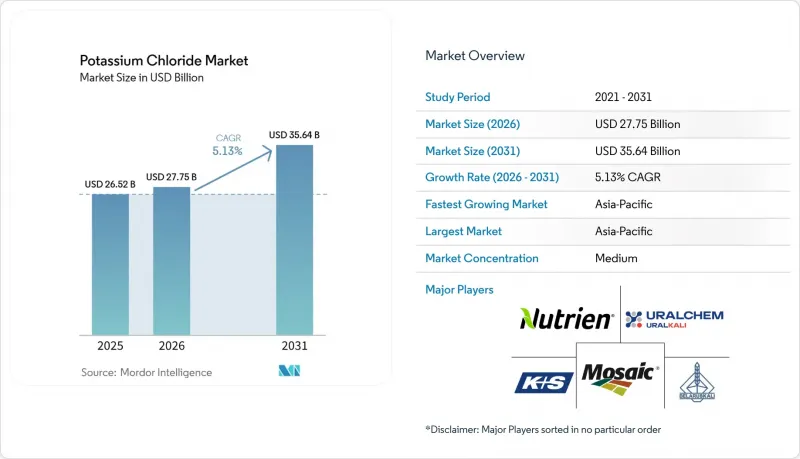
Mordor Intelligence에 의하면, 염화칼륨 시장 규모는 2025년에 265억 2,000만 달러로 평가되었습니다. 예측 기간(2026-2031년) CAGR 5.13%로 확대되어 2026년 277억 5,000만 달러에서 2031년에는 356억 4,000만 달러에 이를 전망입니다.
본 보고서는 제품별(농업용 등급, 화학·공업용 등급 등), 작물별(곡물, 과일 및 채소 등), 형태별(입상, 분말 등),용도별(비료, 화학제품 제조 등), 지역별(아시아태평양, 북미, 유럽, 남미, 중동 및 아프리카)로 분류되어 있습니다. 시장 예측은 금액(미 달러) 기준으로 제시되어 있습니다.
세계의 염화칼륨 시장 동향 및 인사이트
작물 생산량 증가에 힘입어 전 세계 칼륨 비료 수요가 증가하고 있습니다.
염화칼륨 시장은 집약적으로 경작된 토양에서 손실된 칼륨을 농가가 보충하는 데 의존하고 있습니다. 미국 옥수수 벨트의 일부 지역에서 옥수수 수확량이 증가함에 따라 2024년과 2025년에는 K2O 유출량이 증가했고, 이에 따라 농업 지도 기관은 칼륨 시비에 더 중점을 두게 되었습니다. 2025년 전 세계 칼륨 비료 소비량은 K2O 환산 기준으로 4,160만 톤에 달할 것으로 예상되며, 아시아와 남미에서 가장 강력한 수요 증가세가 나타났습니다. 이용 가능한 농지 확대 속도를 웃도는 속도로 작물 생산량이 증가하면 헥타르당 칼륨 사용량이 더욱 중요해지기 때문에 염화칼륨 시장은 그 혜택을 받게 됩니다. 이러한 영향은 반복적인 영양분 보충이 필요한 곡물, 유지종자 및 수출용 작물의 재배 체계에서 가장 두드러집니다. 또한, 이는 공급업체에게 제품 공급과 농업적 지원 및 토양 검사 프로그램을 연계할 수 있는 기회가 되기도 합니다.
작물 수확량과 토양 비옥도를 향상시키기 위한 농업용 염화칼륨의 활용 확대
농업용 KCl은 칼륨이 수분 이용, 기공 기능 및 식물 내부의 당 이동에 영향을 미치기 때문에 작물 관리를 지원합니다. 2025년 『Agronomy Journal』에 발표된 연구에 따르면, 토양 검사를 통해 확인된 칼륨 함량이 밭마다 크게 다른 경우, 가변 시비율을 통한 칼륨 시비가 수확량의 편차를 줄이는 것으로 밝혀졌습니다. 염화칼륨 시장은 대규모 곡물 및 유지종자 농장에서 KCl이 황산칼륨보다 여전히 비용이 저렴하기 때문에 광범위한 농업 기반을 유지하고 있습니다. 인도의 ‘영양소 기반 보조금 제도’는 다수의 소규모 농가가 인산계 및 칼륨계 비료를 이용할 수 있도록 지원하고 있습니다. 수확량 목표가 높아짐에 따라, 경작 면적에 큰 변화가 없더라도 시비량 증가가 수요를 뒷받침할 가능성이 있습니다. 안정적인 공급과 적절한 입상 제품을 보유한 생산자들은 이러한 지속적인 수요에 대응할 준비가 되어 있습니다.
칼륨 가격 변동이 비료의 가격 경쟁력과 구매 결정에 영향을 미침
염화칼륨 시장은 수입국이 주요 공급원을 신속하게 대체할 수 있는 능력이 제한적이기 때문에 여전히 가격 변동에 취약한 상황에 놓여 있습니다. 중국의 2025년 연간 수입 계약은 CFR(운임·보험료 포함) 기준 톤당 346달러로 체결되어, 세계 비용 기준을 끌어올렸습니다. 2024년 한 해 동안 캐나다는 미국의 칼륨 수입량의 79%를 공급했으며, 이는 북미가 공급에 얼마나 의존하고 있는지를 반영합니다. 가격이 급등하면, 공공 지원이 없는 경우 농가의 구매력이 저하되고, 비료 보조금을 유지하고 있는 정부의 재정 부담이 증가할 가능성이 있습니다. 계획된 생산 능력 확대로 인해 공급 압박은 완화될 수 있지만, 일부 주요 프로젝트는 2029년까지 생산을 시작하지 않을 전망입니다.
부문별 분석
2025년, 농업용 KCl은 염화칼륨 시장 점유율의 61.74%를 차지했습니다. 황산칼륨에 비해 비용 면에서 우위를 점하고 있으며, NPK 복합비료와의 호환성이 뛰어나 아시아, 남미, 사하라 이남 아프리카 전역에서 널리 사용되고 있습니다. 농업용 제품은 농장의 대량 구매자들이 영양가, 취급 용이성 및 운송 비용을 우선시하기 때문에 여전히 염화칼륨 시장에서 중심적인 위치를 차지하고 있습니다. 중국의 농업용 염화칼륨 생산은 칭하이성과 신장 위구르 자치구에 집중되어 있습니다. 광대한 농지에서 곡물과 유지종자를 생산하는 농가에서는 염화물에 대한 민감도가 농학적으로 중대한 우려 사항이 되지 않는 경우, 계속해서 KCl을 선호하여 사용하고 있습니다.
화학 및 산업용 등급 부문은 2026년부터 2031년까지 연평균 성장률(CAGR) 6.04%를 나타낼 것으로 예측됩니다. 수산화칼륨 생산, 클로르 알칼리 공정, 시추 유체 및 배터리 관련 화학 용도에서의 수요가 이 부문의 염화칼륨 시장을 지탱하고 있습니다. 더 높은 순도 기준, 미량 금속 요건 및 계약 공급 체제로 인해 범용 농업 자재에 비해 가격 프리미엄이 유지되고 있습니다. 비료용과 산업용 모두에 KCl을 정제할 수 있는 생산자는 제품 포트폴리오 구성에 있어 더 큰 유연성을 갖습니다. 벨라루스칼리, ICL, K+S는 이러한 광범위한 제품 구성을 충족할 수 있는 사업 체계를 갖추고 있습니다. 특수 용도 수요가 농업 수요보다 빠르게 증가함에 따라 이러한 역량은 더욱 중요해질 가능성이 있습니다.
2025년에는 곡물이 이 부문 매출의 38.63%를 차지했습니다. 밀, 옥수수, 쌀은 전 세계적으로 재배 면적이 넓기 때문에 절대량 기준으로 대량의 칼륨을 필요로 하며, 이 부문이 염화칼륨 시장의 주요 기반을 형성하고 있습니다. 곡물 생산 규모가 크기 때문에 식량 생산 시스템에서 비용 효율적인 염화칼륨에 대한 접근이 중요합니다. 수요는 재배 주기, 작물 가격, 토양 내 영양분 고갈, 그리고 정부의 비료 정책에 따라 좌우됩니다.
과일 및 채소 수요는 2026년부터 2031년까지 연평균 성장률(CAGR) 6.07%로 확대될 것으로 예측됩니다. 칼륨은 당분의 이동, 세포의 장력, 수확 후 품질 유지를 지원하며, 이는 상업 원예에서 중요합니다. 동남아시아와 걸프 연안 국가들의 도시화가 진행되는 경제권이 신선 농산물 및 비료 수요 증가를 주도하고 있습니다. 유지종자도, 특히 브라질의 대두 생산 지역에서 수요의 또 다른 원천이 되고 있습니다. 모자이크사는 2025년 7월, 토칸칭스주 팔메이란테에 혼합 시설을 개설하여 MATOPIBA(마라냥, 토칸칭스, 피아우이, 바이아) 회랑에서 확대되는 농업 활동에 대응하고 있습니다. 섬유작물 및 사탕작물 분야에서도 수확량과 자당 품질을 향상시킬 수 있는 칼륨 시비 프로그램이 채택되고 있습니다.
지역별 분석
아시아태평양은 2025년에 지역 매출의 45.22%를 차지했으며, 2026년부터 2031년까지 연평균 성장률(CAGR) 6.15%로 성장할 것으로 전망됩니다. 중국의 대규모 집약적인 농업 기반과 전략적 비축량이 이 지역 수요를 뒷받침하고 있습니다. 중국의 연간 KCl 소비량은 약 1,300만 톤으로 추정되며, 이는 아시아 전체의 47%를 차지합니다. 2025년 수입 계약 가격(톤당 346달러, CFR)은 해당 지역의 조달 기준이 되었습니다. 인도의 소비량은 약 310만 톤으로, 세계 가격 변동의 영향을 완화하기 위해 보조금 제도를 활용하고 있습니다. 2026년 칼리 배정량은 비료 접근성 확보를 위한 정책적 노력이 지속되고 있음을 뒷받침합니다.
북미는 지역별 기준으로 두 번째로 큰 염화칼륨 시장입니다. 캐나다는 2025년에 추정 1만 5,000메트르톤의 K2O를 생산했으며, 이는 전 세계 칼륨 공급량의 30%를 차지합니다. 유럽 시장은 독일과 캐나다의 K+S 사의 생산에 더해, 벨라루스산 칼륨에 대한 지속적인 규제로 형성되어 있습니다. K+S사는 베툰(Bethune) 공장의 생산 확대 및 베라 2060(Werra 2060) 프로그램을 추진하고 있으며, 이는 해당 기업공급망에 있어 중요한 생산 능력에 대한 투자입니다.
브라질이 수입 칼리에 크게 의존하고 있기 때문에 남미는 염화칼륨 시장에서 성장 지역으로 부상하고 있습니다. 모자이크(Mosaic)사는 경작 면적 확대와 작물 수확량에 따른 토양 영양분 수준 회복에 힘입어, 2026년에는 브라질의 비료 수요가 사상 최고치를 기록할 것으로 전망하고 있습니다. 아르헨티나 수요는 대두와 옥수수의 재배 주기에 좌우되지만, 콜롬비아와 페루에서는 원예 및 커피 생산이 발전하고 있습니다. 중동 및 아프리카는 매출 점유율 측면에서 여전히 가장 작은 규모를 차지하는 지역입니다. 비료 지원 프로그램과 과거 칼륨 시비량이 적었던 점으로 미루어 볼 때, 장기적인 기회가 기대됩니다. 성장은 농촌 인프라, 농업 기술 서비스, 그리고 신뢰할 수 있는 비료 유통에 달려 있습니다.
기타 혜택 :
- 엑셀 형식 시장 예측(ME) 시트
- 3개월간의 애널리스트 지원
자주 묻는 질문
목차
제1장 서론
제2장 조사 방법
제3장 주요 요약
제4장 시장 구도
제5장 시장 규모 및 성장 예측
제6장 경쟁 구도
제7장 시장 기회 및 향후 전망
KTH 26.09.04According to Mordor Intelligence, the potassium chloride market size was estimated at USD 26.52 billion in 2025 and is estimated to grow from USD 27.75 billion in 2026 to USD 35.64 billion by 2031, at a CAGR of 5.13% during the forecast period (2026-2031).
This report is Segmented by Product (Agricultural Grade, Chemical and Industrial Grade, and More), Crop (Cereals, Fruits and Vegetables, and More), Form (Granular, Powder, and More), Application (Fertilizers, Chemical Manufacturing, and More), and Geography (Asia-Pacific, North America, Europe, South America, and Middle-East and Africa). The Market Forecasts are Provided in Terms of Value (USD).
Global Potassium Chloride Market Trends and Insights
Rising Global Demand for Potassium Fertilizers Driven by Increasing Crop Production
The potassium chloride market depends on growers replacing potassium removed from intensively farmed soils. Higher corn yields in parts of the U.S. Corn Belt increased K2O removal during 2024 and 2025, which led extension guidance to place greater emphasis on potassium application. Global potash fertilizer consumption reached 41.6 million tons of K2O in 2025, with Asia and South America posting the strongest incremental demand. The potassium chloride market benefits when crop output rises faster than available farmland, as potassium use per hectare becomes more important. This effect is strongest in cereal, oilseed, and export crop systems that require repeated nutrient replacement. It also gives suppliers an opportunity to link product availability with agronomic support and soil-testing programs.
Expanding Use of Agricultural-Grade Potassium Chloride to Improve Crop Yield and Soil Fertility
Agricultural-grade KCl supports crop management because potassium affects water use, stomatal function, and the movement of sugars within plants. A 2025 Agronomy Journal study found that variable-rate potassium application reduced yield variability where soil-test potassium differed substantially across fields. The potassium chloride market retains a broad agricultural base because KCl remains less costly than sulfate of potash for large cereal and oilseed farms. India's Nutrient Based Subsidy system supports access to phosphatic and potassic fertilizers for a large smallholder base. As yield targets increase, higher application rates can support demand even when planted acreage changes little. Producers with dependable supply and suitable granular products are positioned to serve this continuing need.
Volatility in Potash Prices Affects Fertilizer Affordability and Purchasing Decisions
The potassium chloride market remains sensitive to price changes because importing countries have limited ability to quickly replace major supply sources. China's 2025 annual import contract settled at USD 346 per ton Cost and Freight (CFR), raising the global cost baseline. Canada supplied 79% of U.S. potash imports through 2024, reflecting the scale of North American supply dependence. Higher prices can reduce farmers' purchasing power in the absence of public support and increase the fiscal burden on governments that maintain fertilizer subsidies. Planned capacity growth may ease supply pressure, but several major projects are not expected to begin production before 2029.
Other drivers and restraints analyzed in the detailed report include:
- Government Food Security Initiatives Supporting Fertilizer Consumption
- Growing Adoption of Precision Agriculture and Balanced Nutrient Management Practices
- Environmental Concerns Regarding Excessive Use of Chloride-Based Fertilizers
For complete list of drivers and restraints, kindly check the Table Of Contents.
Segment Analysis
Agricultural-grade KCl held 61.74% of the potassium chloride market share in 2025. Its cost advantage over sulfate of potash and its compatibility with blended NPK fertilizers support use across Asia, South America, and Sub-Saharan Africa. Agricultural-grade products remain central to the potassium chloride market because bulk farm buyers prioritize nutrient value, handling, and delivered cost. China's agricultural-grade production is concentrated in Qinghai and Xinjiang. Broad-acre cereal and oilseed producers continue to favor KCl where chloride sensitivity is not a material agronomic concern.
The chemical and industrial grade segment is projected to grow at a CAGR of 6.04% from 2026 to 2031. Demand from potassium hydroxide production, chlor-alkali processes, drilling fluids, and battery-related chemical applications supports the potassium chloride market in this segment. Higher purity standards, trace-metal requirements, and contracted supply arrangements support a price premium over commodity agricultural material. Producers that can refine KCl for both fertilizer and industrial uses have greater flexibility in product placement. Belaruskali, ICL, and K+S have operations capable of serving this broader product mix. This capability may become more important as specialty demand grows faster than agricultural demand.
Cereals accounted for 38.63% of segment revenue in 2025. Wheat, corn, and rice require large absolute quantities of potash due to their extensive global acreage, making this segment the primary base for the potassium chloride market. The scale of cereal production makes access to cost-effective KCl important for food production systems. Demand is driven by planting cycles, crop prices, soil nutrient removal, and public fertilizer policy.
Fruits and vegetables are forecast to grow at a 6.07% CAGR from 2026 to 2031. Potassium supports sugar movement, cell turgor, and post-harvest quality, which are important for commercial horticulture. Urbanizing economies in Southeast Asia and the Gulf markets are driving increased demand for fresh produce and fertilizer. Oilseeds provide another source of demand, particularly in Brazil's soybean areas. Mosaic opened a blending facility in Palmeirante, Tocantins, in July 2025 to serve expanding agricultural activity in the MATOPIBA (Maranhao, Tocantins, Piaui, and Bahia) corridor. Fiber and sugar crops also use potassium programs that can improve yield and sucrose performance.
Complete Report Scope:
- By Product
- Agricultural Grade
- Chemical and Industrial Grade
- By Crop
- Cereals
- Fruits and Vegetables
- Oilseeds
- Fiber and Sugar
- By Form
- Granular
- Powder
- Crystalline
- Other Forms
- By Application
- Fertilizers
- Chemical Manufacturing
- Food and Beverage
- Water Treatment
- Pharmaceutical
- Industrial Processing
- Other Applications
- By Geography
- Asia-Pacific
- China
- India
- Japan
- South Korea
- Rest of Asia-Pacific
- North America
- United States
- Canada
- Mexico
- Europe
- Germany
- United Kingdom
- France
- Italy
- Russia
- Rest of Europe
- South America
- Brazil
- Argentina
- Rest of South America
- Middle-East and Africa
- Saudi Arabia
- South Africa
- Rest of Middle-East and Africa
- Asia-Pacific
Geography Analysis
Asia-Pacific held 45.22% of regional revenue in 2025 and is projected to grow at a 6.15% CAGR from 2026 to 2031. China's large intensive farming base and strategic stockpiling support regional demand. China consumed an estimated 13 million tons of KCl annually, representing 47% of the Asian total. Its 2025 import contract at USD 346 per ton Cost and Freight (CFR) set the regional procurement benchmark. India consumed an estimated 3.1 million tons and uses subsidies to reduce exposure to global price fluctuations. Its Kharif 2026 allocation confirms a continuing policy commitment to fertilizer access.
North America is the second-largest regional potassium chloride market. Canada produced an estimated 15,000 metric tons of K2O in 2025, accounting for 30% of global potash supply. The European market is shaped by K+S production in Germany and Canada, as well as continuing restrictions on Belarusian potash. K+S is advancing the Bethune ramp-up and the Werra 2060 program, which represent significant capacity investments for its supply network.
South America is a growth area for the potassium chloride market, as Brazil relies heavily on imported potash. Mosaic expects Brazilian fertilizer demand to reach a record high in 2026 as planted acreage expands and crop yields rebuild soil nutrient levels. Argentina's demand follows soybean and corn planting cycles, while Colombia and Peru are developing horticulture and coffee production. The Middle-East and Africa remain the smallest region by revenue share. Fertilizer support programs and lower historical potassium application rates present a longer-term opportunity. Growth depends on rural infrastructure, agronomic services, and reliable fertilizer distribution.
- Arab Potash Company
- Belaruskali
- Borealis AG
- Compass Minerals
- Coromandel International Limited
- EuroChem Group
- Gujarat State Fertilizers & Chemicals Ltd. (GSFC)
- ICL
- Intrepid Potash, Inc.
- K+S Aktiengesellschaft
- Nutrien
- SINOCHEM GROUP CO., LTD.
- SQM
- The Mosaic Company
- Uralkali PJSC
- Yara International ASA
Additional Benefits:
- The market estimate (ME) sheet in Excel format
- 3 months of analyst support
TABLE OF CONTENTS
1 Introduction
- 1.1 Study Assumptions and Market Definition
- 1.2 Scope of the Study
2 Research Methodology
3 Executive Summary
4 Market Landscape
- 4.1 Market Overview
- 4.2 Market Drivers
- 4.2.1 Rising Global Demand for Potassium Fertilizers Driven by Increasing Crop Production
- 4.2.2 Expanding Use of Agricultural-Grade Potassium Chloride to Improve Crop Yield and Soil Fertility
- 4.2.3 Government Food Security Initiatives Supporting Fertilizer Consumption
- 4.2.4 Growing Adoption of Precision Agriculture and Balanced Nutrient Management Practices
- 4.2.5 Increasing Industrial Demand for High-Purity Potassium Chloride Across Chemical and Food Applications
- 4.3 Market Restraints
- 4.3.1 Volatility in Potash Prices Affecting Fertilizer Affordability and Purchasing Decisions
- 4.3.2 Environmental Concerns Regarding the Excessive Use of Chloride-Based Fertilizers
- 4.3.3 Trade Restrictions And Sanctions Affecting Cross-Border Supply
- 4.4 Value Chain Analysis
- 4.5 Porter's Five Forces Analysis
- 4.5.1 Threat of New Entrants
- 4.5.2 Bargaining Power of Suppliers
- 4.5.3 Bargaining Power of Buyers
- 4.5.4 Threat of Substitutes
- 4.5.5 Competitive Rivalry
5 Market Size and Growth Forecasts (Value)
- 5.1 By Product
- 5.1.1 Agricultural Grade
- 5.1.2 Chemical and Industrial Grade
- 5.2 By Crop
- 5.2.1 Cereals
- 5.2.2 Fruits and Vegetables
- 5.2.3 Oilseeds
- 5.2.4 Fiber and Sugar
- 5.3 By Form
- 5.3.1 Granular
- 5.3.2 Powder
- 5.3.3 Crystalline
- 5.3.4 Other Forms
- 5.4 By Application
- 5.4.1 Fertilizers
- 5.4.2 Chemical Manufacturing
- 5.4.3 Food and Beverage
- 5.4.4 Water Treatment
- 5.4.5 Pharmaceutical
- 5.4.6 Industrial Processing
- 5.4.7 Other Applications
- 5.5 By Geography
- 5.5.1 Asia-Pacific
- 5.5.1.1 China
- 5.5.1.2 India
- 5.5.1.3 Japan
- 5.5.1.4 South Korea
- 5.5.1.5 Rest of Asia-Pacific
- 5.5.2 North America
- 5.5.2.1 United States
- 5.5.2.2 Canada
- 5.5.2.3 Mexico
- 5.5.3 Europe
- 5.5.3.1 Germany
- 5.5.3.2 United Kingdom
- 5.5.3.3 France
- 5.5.3.4 Italy
- 5.5.3.5 Russia
- 5.5.3.6 Rest of Europe
- 5.5.4 South America
- 5.5.4.1 Brazil
- 5.5.4.2 Argentina
- 5.5.4.3 Rest of South America
- 5.5.5 Middle-East and Africa
- 5.5.5.1 Saudi Arabia
- 5.5.5.2 South Africa
- 5.5.5.3 Rest of Middle-East and Africa
- 5.5.1 Asia-Pacific
6 Competitive Landscape
- 6.1 Market Concentration
- 6.2 Strategic Moves
- 6.3 Market Share (%)/Ranking Analysis
- 6.4 Company Profiles (includes Global Overview, Market Overview, Core Segments, Financials as available, Strategic Information, Products and Services, and Recent Developments)
- 6.4.1 Arab Potash Company
- 6.4.2 Belaruskali
- 6.4.3 Borealis AG
- 6.4.4 Compass Minerals
- 6.4.5 Coromandel International Limited
- 6.4.6 EuroChem Group
- 6.4.7 Gujarat State Fertilizers & Chemicals Ltd. (GSFC)
- 6.4.8 ICL
- 6.4.9 Intrepid Potash, Inc.
- 6.4.10 K+S Aktiengesellschaft
- 6.4.11 Nutrien
- 6.4.12 SINOCHEM GROUP CO., LTD.
- 6.4.13 SQM
- 6.4.14 The Mosaic Company
- 6.4.15 Uralkali PJSC
- 6.4.16 Yara International ASA
7 Market Opportunities and Future Outlook
- 7.1 White-Space and Unmet-Need Assessment


