|
시장보고서
상품코드
2119161
염화칼슘 : 시장 점유율 분석, 업계 동향 및 통계, 성장 예측(2026-2031년)Calcium Chloride - Market Share Analysis, Industry Trends & Statistics, Growth Forecasts (2026 - 2031) |
||||||
 Mordor Intelligence
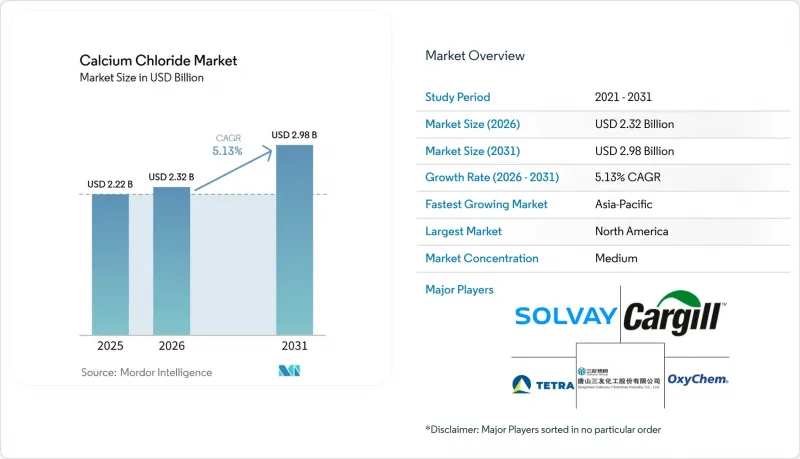
Mordor Intelligence에 의하면, 염화칼슘 시장은 2025년에 22억 2,000만 달러 규모로 평가되었습니다. 2026년 23억 2,000만 달러에서 2031년까지 29억 8,000만 달러에 이를 것으로 예상되며, 예측 기간(2026-2031년) CAGR은 5.13%를 나타낼 전망입니다.

본 보고서는 등급(산업용 등급, 식품용 등급, 의약품용 등급), 제품 유형(플레이크, 펠릿 및 프리일 등), 용도(제빙·방진, 식품 및 음료 가공 등), 최종 이용 산업(지방자치단체 및 공공 인프라 등), 지역(아시아태평양, 북미 등)별로 분류되어 있습니다. 시장 전망은 금액(달러) 기준으로 제시되어 있습니다.
세계의 염화칼슘 시장 동향 및 인사이트
석유 및 가스 시추 및 유정 완공 작업에서 염화칼슘의 이용 확대
염화칼슘 시장은 기존, 해양 및 비전통 유정에서의 시추, 완공 및 개보수 작업에 사용되는 투명한 염수에 대한 수요의 혜택을 받고 있습니다. 미국 에너지 정보국(EIA) 보고서에 따르면, 2026년 1월 미국의 원유 및 천연가스용 로터리 시추 장비의 평균 대수는 546대로, 이는 퍼미안 분지 및 애팔래치아 지역의 완공용 유체 수요를 뒷받침하고 있습니다. TETRA Technologies는 2025년 ‘완공용 유체 및 제품’ 부문의 매출액이 6억 3,100만 달러, 조정 후 EBITDA(이자·세금·감가상각비·상각비 차감 전 이익)가 1억 1,360만 달러였다고 보고했으며, 매출액은 2024년 대비 5% 증가했고, 조정 후 EBITDA는 14% 증가했습니다. 보고된 실적은 유체의 품질과 공급의 지속성이 중요한 심해 및 비전통적 완공 공사에서 발생하는 지속적인 수요를 반영하고 있습니다. 멕시코만에서의 해양 활동 외에도 인도와 중국에서의 활동으로 인해 수요 기반은 북미 이외의 지역으로 확대되고 있습니다. 시추 완료 일정은 보고되는 시추 활동의 변화에 따라 지연될 수 있으므로, 재고 계획에 있어 여전히 중요한 요소로 남아 있습니다.
고성능 제설 및 방진 솔루션에 대한 수요 증가
염화칼슘 시장은 특히 오대호 지역, 캐나다, 북유럽에서 겨울철 도로 결빙 방지 처리에 계속해서 의존하고 있습니다. 미국 환경보호청(EPA)은 도로 결빙 방지용 소금이 담수의 염분 농도에 기여하는 요인 중 하나라고 지적하며, 관련 위험을 줄이기 위한 소금 관리 정보를 제공합니다. 이러한 정책의 초점은 일관된 성능을 발휘하면서도 관련 기관이 살포량을 보다 적절하게 관리할 수 있는 실적이 입증된 제품을 뒷받침하는 것입니다. 지자체 구매 담당자들은 도로 안전 요건과, 영향을 받기 쉬운 유역 및 인근 수역에서의 염화물 부하 감축을 위한 노력 간의 균형을 맞추고 있습니다. 이러한 제품은 비포장 광산 도로나 건설 현장의 분진 억제에도 도움이 되며, 이러한 장소에서는 작업자가 부유 입자와 노면 상태를 관리해야 합니다. 이에 따라 공급업체는 단순히 건조 재료를 제공하는 것뿐만 아니라 살포 지침, 액체 시스템, 보관 지원 및 배합에 관한 문서를 제공해야 할 이유가 생겼습니다.
인프라 및 교통 자산의 높은 부식 위험과 이에 따른 유지 관리 비용
부식 위험은 도로, 교량, 공항, 주차장, 파이프라인 및 차량 용도의 염화칼슘 시장에 여전히 제약 요인으로 작용하고 있습니다. 미국 교통연구위원회(TRB)는 염화물계 제설제와 관련된 비용 및 이것이 인프라에 미치는 영향에 대해 보고하고 있습니다. 2024년 연구에서는 염화물 침투에 노출된 철근 콘크리트의 보수 비용에 대한 불확실성이 조사되었습니다. 이러한 비용으로 인해 조달 담당자들은 특히 교량 데크, 활주로, 주차장 구조물, 공공 자산에서 내식 성능을 더욱 중시하게 되었습니다. 공급업체는 부식 억제제가 첨가된 제품을 제공하거나 보다 명확한 제품 자료를 제시함으로써 대응할 수 있지만, 이러한 조치는 비용 증가로 이어져 대체품과의 가격 격차를 좁힐 가능성이 있습니다. 지자체에서 자산 보호, 유출수 문제, 장기적인 유지 관리 비용을 더욱 중시하는 지역에서는 대체 제설제가 주목받을 가능성이 있습니다.
부문별 분석
2025년, 산업용 등급은 염화칼슘 시장 점유율의 62.71%를 차지했으며, 이는 제빙, 분진 억제, 유전용 염수, 건설 분야에서의 폭넓은 이용을 반영하고 있습니다. 이러한 용도에서는 일반적으로 의약품 수준의 순도보다 기능적 성능, 대량 이용 가능성 및 실용적인 농도 허용 범위가 우선시됩니다. 의약품 등급은 약전 규격, 무균 제조 조건 및 관리된 취급이 필요한 의료 용도에 힘입어 2031년까지 연평균 성장률(CAGR) 5.82%를 나타낼 것으로 예측됩니다. 식품 등급 및 의약품 등급은 고부가가치 판매와 계절적 변동이 적은 수요 기반을 추구하는 공급업체에게 중요합니다.
미국 식품의약국(FDA)의 21 CFR §184.1193에 기반한 프레임워크와 코덱스 E509에 등재됨에 따라, 식품 가공업체들은 염화칼슘 사용에 대한 명확한 근거를 확보하게 되었습니다. 이를 통해 유제품, 양조, 채소 통조림, 두부 및 관련 가공 활동에서 수요가 뒷받침되고 있습니다. 솔베이(Solvay)는 2025년 2월, 독일 라인베르크에서 식품 등급 및 의약품 등급 염화칼슘공급을 확대하여, 유럽의 유제품 및 의약품 업계 고객을 대상으로 EN 233 및 영국 약전(BP)/미국 약전(USP) 인증을 받은 염화칼슘 이수화물을 공급하기 시작했습니다. 토쿠야마는 일본 슈난시에서 소다회 제품군의 일환으로 염화칼슘을 생산하고 있으며, 국내 네트워크를 통해 산업용 및 식품 관련 용도로 공급하고 있습니다.
플레이크 형태의 염화칼슘은 제설, 건설, 분진 억제에 널리 사용되고 있어, 2025년에는 염화칼슘 시장 점유율의 43.86%를 차지했습니다. 용해 속도가 빠르고 취급이 용이하며 구하기도 쉬워 대량 사용에 적합합니다. 펠릿 및 프리일의 경우, 유전, 식품 가공, 제약 분야의 사용자들이 분진이 적은 제품을 엄격하게 관리해야 하기 때문에 2031년까지 연평균 성장률(CAGR) 5.24%를 나타낼 것으로 예측됩니다. 제품 선정은 투여 정확도, 보관 요건, 운송 조건 및 사용 현장의 운영 환경에 점점 더 의존하고 있습니다.
Nedmag사는 산업용 및 식품 관련 용도를 위해 액체 및 프리루 형태의 염화칼슘을 공급하고 있습니다. 프릴은 균일한 형상과 예측 가능한 용해성을 통해 중요한 작업을 지원합니다. 액상 염화칼슘은 강설 전 동결 방지에 사용되며, 노면에 남는 건조 잔류물을 줄일 수 있습니다. 분말은 미세한 입자 분포와 관리된 취급이 필요한 보다 제한적인 용도로 사용됩니다.
지역별 분석
2025년, 북미는 염화칼슘 시장 점유율의 36.22%를 차지했으며, 이는 지방 자치 단체의 제설 수요와 유전 활동에 힘입은 결과입니다. 오대호 지역, 미국 북동부, 캐나다 프레리 지역, 텍사스주, 뉴멕시코주, 앨버타주는 한랭 지역의 도로 유지 관리 수요와 활발한 에너지 사업이 결합되어 있어 중요한 수요 지역으로 자리 잡고 있습니다. 미시간주와 캘리포니아주의 천연 염수 자원은 이를 활용할 수 있는 생산자들에게 현지 공급 및 비용 측면에서의 우위를 뒷받침하고 있습니다. TETRA가 보고한 2025년 완제품으로서의 성능은 겨울철 제설 시즌을 넘어선 수요를 반영하고 있습니다. 또한, 미국 환경보호청(EPA)의 염분 관리 관련 자료는 담수에 미치는 영향, 제품 성능 및 염화물 부하 결과에 초점을 맞추고 있어 지자체 조달에도 영향을 미치고 있습니다.
아시아태평양은 2031년까지 연평균 성장률(CAGR) 6.11%를 나타낼 것으로 예측됩니다. 중국과 인도의 건설 사업은 특히 프로젝트 공사 기간 동안 추운 기후나 어려운 지반 조건에 직면한 경우, 콘크리트 경화 촉진 및 지반 안정화를 뒷받침하고 있습니다. 일본과 한국의 식품 등급 수요는 별도 수요 기반을 형성하고 있는 반면, 동남아시아의 의료 및 주사제 제조는 의약품 등급 요건을 뒷받침하고 있습니다. 중국의 생산자들은 소다회 병산을 활용하여 국내 건설 사용자 및 수출 시장을 대상으로 비용 경쟁력이 있는 산업용 자재를 공급하고 있습니다. 인도에서는 고속도로, 콘크리트 공사, 유제품 가공 및 기타 식품 용도에 걸친 수요가 있어 공급업체들에게 성장을 위한 여러 경로가 열려 있습니다.
유럽 수요는 독일, 영국, 북유럽 국가들이 주도하고 있으며, 이들 지역은 제설제 및 고순도 제품 수요의 주요 거점이 되고 있습니다. 솔베이(Solvay)가 2025년 2월 라인베르크에서 제품을 출시함에 따라, 유럽의 유제품 및 제약 업계 고객들에게 인증된 염화칼슘 이수화물이 공급되게 되었습니다. 동유럽의 도로망 확장은 유통망이 제한된 지역에서 제설제 사용을 더욱 촉진할 가능성이 있습니다. 독일 및 중부 유럽의 반도체 제조는 특수 산업용 가공 재료에 대한 수요를 창출하고 있습니다. 남미에서는 브라질과 아르헨티나에서 광업 분야의 분진 억제 및 식품 가공에 염화칼슘이 사용되고 있습니다. 지역별 특성의 차이로 인해 공급업체는 현지 등급 요건, 물류망, 계절적 판매 패턴에 대응해야 합니다.
기타 혜택 :
- 엑셀 형식 시장 예측(ME) 시트
- 3개월간의 애널리스트 지원
자주 묻는 질문
목차
제1장 서론
제2장 조사 방법
제3장 주요 요약
제4장 시장 구도
제5장 시장 규모 및 성장 예측
제6장 경쟁 구도
제7장 시장 기회 및 향후 전망
KTH 26.09.04According to Mordor Intelligence, the calcium chloride market was valued at USD 2.22 billion in 2025 and is estimated to grow from USD 2.32 billion in 2026 to reach USD 2.98 billion by 2031, at a CAGR of 5.13% during the forecast period (2026-2031).
This report is Segmented by Grade (Industrial Grade, Food Grade, and Pharmaceutical Grade), Product Type (Flakes, Pellets and Prills, and More), Application (De-Icing and Dust Control, Food and Beverage Processing, and More), End-Use Industry (Municipal and Public Infrastructure, and More), and Geography (Asia-Pacific, North America, and More). The Market Forecasts are Provided in Terms of Value (USD).
Global Calcium Chloride Market Trends and Insights
Growing Use of Calcium Chloride in Oil and Gas Drilling and Well Completion Operations
The calcium chloride market benefits from demand for clear brines used in drilling, completion, and workover work across conventional, offshore, and unconventional wells. The U.S. Energy Information Administration reported that U.S. crude oil and natural gas rotary rigs averaged 546 in January 2026, supporting completion-fluid demand in the Permian Basin and Appalachia. TETRA Technologies reported USD 631.0 million in 2025 revenue and USD 113.6 million in adjusted Earnings Before Interest, Taxes, Depreciation, and Amortization (EBITDA) for its Completion Fluids & Products division, with revenue up 5% and adjusted EBITDA up 14% from 2024. The reported performance reflects continued demand from deepwater and unconventional completions, where fluid quality and supply continuity are important. Offshore activity in the Gulf of Mexico, together with activity in India and China, broadens the demand base beyond North America. Completion schedules remain important for inventory planning because they can lag changes in reported drilling activity.
Increasing Preference for High-Performance De-Icing and Dust Control Solutions
The calcium chloride market continues to depend on winter road treatment, especially in the Great Lakes region, Canada, and Northern Europe. The U.S. Environmental Protection Agency identifies road-treatment salt as a contributor to freshwater salinization and provides salt-management information for reducing related risks. This policy focus favors documented products that can deliver consistent performance while allowing agencies to better control applications. Municipal buyers are balancing road-safety requirements with efforts to reduce chloride loading in sensitive watersheds and nearby water bodies. The same products support dust control on unpaved mining roads and construction sites where operators must manage airborne particles and surface conditions. This gives suppliers a reason to offer application guidance, liquid systems, storage support, and formulation documentation rather than only dry material.
High Corrosion Risks and Associated Maintenance Costs in Infrastructure and Transportation Assets
Corrosion risk remains a constraint on the calcium chloride market in road, bridge, airport, parking, pipeline, and vehicle applications. The Transportation Research Board documented the costs associated with chloride-based de-icers and their effects on infrastructure. A 2024 study examined repair-cost uncertainty for reinforced concrete exposed to chloride ingress. These costs make procurement teams more attentive to corrosion performance, especially for bridge decks, runways, parking structures, and public assets. Suppliers can respond with inhibited formulations and clearer product documentation, but these measures add cost and may narrow the difference with alternatives. Alternative de-icers can gain attention where municipalities give greater weight to asset protection, runoff concerns, and long-term maintenance expenses.
Other drivers and restraints analyzed in the detailed report include:
- Expanding Application of Calcium Chloride in Construction for Concrete Acceleration and Soil Stabilization
- Growing Demand from the Food Processing Industry as a Firming, Preserving, and Coagulating Agent
- Storage, Handling, and Packaging Challenges Due to the Hygroscopic Nature of Calcium Chloride
For complete list of drivers and restraints, kindly check the Table Of Contents.
Segment Analysis
Industrial grade held 62.71% of the calcium chloride market share in 2025, reflecting its wide use in de-icing, dust control, oilfield brines, and construction. These uses generally prioritize functional performance, large available volume, and practical concentration tolerances over pharmaceutical-level purity. Pharmaceutical grade is forecast to grow at a 5.82% CAGR through 2031, supported by medical applications that need pharmacopoeia specifications, sterile manufacturing conditions, and controlled handling. Food grade and pharmaceutical grade are important to suppliers seeking higher-value sales and a less seasonal demand base.
The U.S. Food and Drug Administration framework under 21 CFR §184.1193 and the Codex E509 listing give food processors a defined basis for calcium chloride use. This supports demand from dairy, brewing, canned vegetables, tofu, and related processing activities. Solvay launched expanded food grade and pharmaceutical grade calcium chloride from Rheinberg, Germany, in February 2025, with EN 233 and British Pharmacopoeia (BP)/United States Pharmacopeia (USP)-certified calcium chloride dihydrate for European dairy and pharmaceutical customers. Tokuyama produces calcium chloride as a soda-ash co-product at Shunan City in Japan and supplies industrial and food-related uses through its domestic network.
Flakes held 43.86% of the calcium chloride market share in 2025 because they are widely used in de-icing, construction, and dust control. Their rapid dissolution, familiar handling profile, and broad availability make them suitable for high-volume applications. Pellets and Prills are projected to grow at a 5.24% CAGR through 2031 because oilfield, food-processing, and pharmaceutical users need controlled, lower-dust products. Product selection increasingly depends on dosing precision, storage needs, transportation conditions, and the operating environment at the point of use.
Nedmag supplies calcium chloride in liquid and prill forms for industrial and food-related applications. Prills can support operations where a consistent form and predictable dissolution are important. Liquid calcium chloride is used for anti-icing before snowfall and can reduce dry residue on road surfaces. Powder serves narrower uses that need fine particle distribution and controlled handling.
Complete Report Scope:
- By Grade
- Industrial Grade
- Food Grade
- Pharmaceutical Grade
- By Product Type
- Flakes
- Pellets and Prills
- Liquid
- Powder
- By Application
- De-Icing and Dust Control
- Construction and Concrete Acceleration
- Food and Beverage Processing
- Oil and Gas (Drilling and Completion Fluids)
- Water Treatment
- Chemical Processing and Refrigeration
- By End-Use Industry
- Municipal and Public Infrastructure
- Construction
- Food and Beverage
- Oil and Gas
- Chemical
- By Geography
- Asia-Pacific
- China
- India
- Japan
- South Korea
- Rest of Asia-Pacific
- North America
- United States
- Canada
- Mexico
- Europe
- Germany
- United Kingdom
- France
- Italy
- Russia
- Rest of Europe
- South America
- Brazil
- Argentina
- Rest of South America
- Middle-East and Africa
- Saudi Arabia
- South Africa
- Rest of Middle-East and Africa
- Asia-Pacific
Geography Analysis
North America held 36.22% of the calcium chloride market share in 2025, supported by municipal de-icing demand and oilfield activity. The Great Lakes, the Northeastern United States, the Canadian Prairies, Texas, New Mexico, and Alberta are important demand areas because they combine cold-weather road needs with active energy operations. Natural brine resources in Michigan and California support local supply and cost advantages for producers with access to them. TETRA's reported 2025 completion-fluid performance reflects demand beyond the winter de-icing season. U.S. Environmental Protection Agency salt-management resources also influence municipal purchasing by focusing attention on freshwater impacts, product performance, and chloride-loading outcomes.
Asia-Pacific is projected to grow at a 6.11% CAGR through 2031. Construction in China and India supports concrete acceleration and soil stabilization, particularly where project schedules face cold-weather or difficult-soil conditions. Food grade demand in Japan and South Korea adds a separate base, while Southeast Asian healthcare and injectable-drug manufacturing support pharmaceutical grade requirements. Chinese producers use soda-ash co-production to supply cost-competitive industrial material for domestic construction users and export markets. India offers demand across highways, concrete work, dairy processing, and other food applications, which gives suppliers several routes to grow.
Europe's demand is led by Germany, the United Kingdom, and Nordic countries, serving as key centers for de-icing and high-purity demand. Solvay's February 2025 Rheinberg product launch supports European dairy and pharmaceutical customers with certified calcium chloride dihydrate. Eastern European road expansion can support further de-icing use in locations with limited distribution coverage. Semiconductor manufacturing in Germany and Central Europe creates demand for specialized industrial processing materials. In South America, Brazil and Argentina use calcium chloride for mining dust suppression and food processing. The contrast between regions requires suppliers to match local grade requirements, logistics coverage, and seasonal sales patterns.
- Aarti Industries Ltd.
- Cargill, Incorporated
- Gulbrandsen Chemicals Pvt. Ltd.
- Nedmag B.V.
- Occidental Chemical Corporation (OxyChem)
- Shandong Haihua Group Co., Ltd.
- Solvay
- TANGSHAN SANYOU CHEMICAL INDUSTRIES CO., LTD.
- TETRA Technologies, Inc.
- Tiger Calcium
- Tokuyama Corporation
- Ward Chemical
- Weifang Haibin Chemical Co., Ltd.
- Weifang Taize Chemical Industry Co., Ltd.
- Zirax
Additional Benefits:
- The market estimate (ME) sheet in Excel format
- 3 months of analyst support
TABLE OF CONTENTS
1 Introduction
- 1.1 Study Assumptions and Market Definition
- 1.2 Scope of the Study
2 Research Methodology
3 Executive Summary
4 Market Landscape
- 4.1 Market Overview
- 4.2 Market Drivers
- 4.2.1 Growing Use of Calcium Chloride in Oil and Gas Drilling and Well Completion Operations
- 4.2.2 Increasing Preference for High-Performance De-Icing and Dust Control Solutions
- 4.2.3 Expanding Application of Calcium Chloride in Construction for Concrete Acceleration and Soil Stabilization
- 4.2.4 Growing Demand from the Food Processing Industry as a Firming, Preserving, and Coagulating Agent
- 4.2.5 Increasing Adoption of Calcium Chloride in Industrial Refrigeration and Cold Storage Systems
- 4.3 Market Restraints
- 4.3.1 High Corrosion Risks and Associated Maintenance Costs in Infrastructure and Transportation Assets
- 4.3.2 Storage, Handling, and Packaging Challenges Due to the Hygroscopic Nature of Calcium Chloride
- 4.3.3 Availability of Alternative De-Icing Chemicals and Dust Control Products
- 4.4 Value Chain Analysis
- 4.5 Porter's Five Forces Analysis
- 4.5.1 Threat of New Entrants
- 4.5.2 Bargaining Power of Suppliers
- 4.5.3 Bargaining Power of Buyers
- 4.5.4 Threat of Substitutes
- 4.5.5 Competitive Rivalry
5 Market Size and Growth Forecasts (Value)
- 5.1 By Grade
- 5.1.1 Industrial Grade
- 5.1.2 Food Grade
- 5.1.3 Pharmaceutical Grade
- 5.2 By Product Type
- 5.2.1 Flakes
- 5.2.2 Pellets and Prills
- 5.2.3 Liquid
- 5.2.4 Powder
- 5.3 By Application
- 5.3.1 De-Icing and Dust Control
- 5.3.2 Construction and Concrete Acceleration
- 5.3.3 Food and Beverage Processing
- 5.3.4 Oil and Gas (Drilling and Completion Fluids)
- 5.3.5 Water Treatment
- 5.3.6 Chemical Processing and Refrigeration
- 5.4 By End-Use Industry
- 5.4.1 Municipal and Public Infrastructure
- 5.4.2 Construction
- 5.4.3 Food and Beverage
- 5.4.4 Oil and Gas
- 5.4.5 Chemical
- 5.5 By Geography
- 5.5.1 Asia-Pacific
- 5.5.1.1 China
- 5.5.1.2 India
- 5.5.1.3 Japan
- 5.5.1.4 South Korea
- 5.5.1.5 Rest of Asia-Pacific
- 5.5.2 North America
- 5.5.2.1 United States
- 5.5.2.2 Canada
- 5.5.2.3 Mexico
- 5.5.3 Europe
- 5.5.3.1 Germany
- 5.5.3.2 United Kingdom
- 5.5.3.3 France
- 5.5.3.4 Italy
- 5.5.3.5 Russia
- 5.5.3.6 Rest of Europe
- 5.5.4 South America
- 5.5.4.1 Brazil
- 5.5.4.2 Argentina
- 5.5.4.3 Rest of South America
- 5.5.5 Middle-East and Africa
- 5.5.5.1 Saudi Arabia
- 5.5.5.2 South Africa
- 5.5.5.3 Rest of Middle-East and Africa
- 5.5.1 Asia-Pacific
6 Competitive Landscape
- 6.1 Market Concentration
- 6.2 Strategic Moves
- 6.3 Market Share (%)/Ranking Analysis
- 6.4 Company Profiles (includes Global Overview, Market Overview, Core Segments, Financials as available, Strategic Information, Products and Services, and Recent Developments)
- 6.4.1 Aarti Industries Ltd.
- 6.4.2 Cargill, Incorporated
- 6.4.3 Gulbrandsen Chemicals Pvt. Ltd.
- 6.4.4 Nedmag B.V.
- 6.4.5 Occidental Chemical Corporation (OxyChem)
- 6.4.6 Shandong Haihua Group Co., Ltd.
- 6.4.7 Solvay
- 6.4.8 TANGSHAN SANYOU CHEMICAL INDUSTRIES CO., LTD.
- 6.4.9 TETRA Technologies, Inc.
- 6.4.10 Tiger Calcium
- 6.4.11 Tokuyama Corporation
- 6.4.12 Ward Chemical
- 6.4.13 Weifang Haibin Chemical Co., Ltd.
- 6.4.14 Weifang Taize Chemical Industry Co., Ltd.
- 6.4.15 Zirax
7 Market Opportunities and Future Outlook
- 7.1 White-Space and Unmet-Need Assessment