|
시장보고서
상품코드
2119164
유리 커튼월 : 시장 점유율 분석, 업계 동향 및 통계, 성장 예측(2026-2031년)Glass Curtain Wall - Market Share Analysis, Industry Trends & Statistics, Growth Forecasts (2026 - 2031) |
||||||
 Mordor Intelligence
Mordor Intelligence에 의하면, 유리 커튼월 시장 규모는 2025년에 568억 4,000만 달러로 평가되었습니다. 예측 기간(2026-2031년) CAGR 6.14%로 확대되어 2026년 602억 2,000만 달러에서 2031년에는 811억 4,000만 달러에 이를 것으로 추정되고 있습니다.
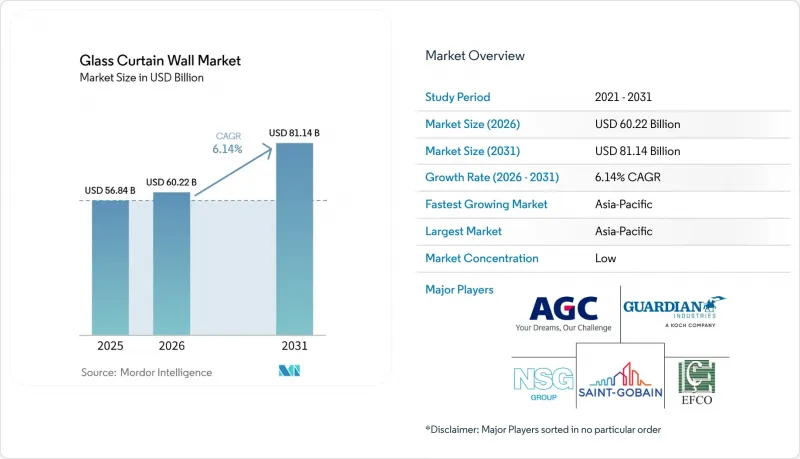
본 보고서는 시스템 유형(유닛형 시스템 및 스틱형 시스템), 유리 유형(복층 유리, 강화 유리, 접합 유리 등), 건설 유형(신축 및 리모델링), 최종 이용 산업(상업, 공공·기관, 주거), 지역(아시아태평양, 북미, 유럽 등)별로 분류되어 있습니다. 시장 전망은 금액(미 달러) 기준으로 제시되어 있습니다.
세계의 유리 커튼월 시장 동향 및 인사이트
에너지 효율이 뛰어나고 지속 가능한 건축 외피에 대한 수요 증가
에너지 규제가 강화됨에 따라 상업용 건축물의 유리 커튼월 시장 사양이 변화하고 있습니다. 유럽연합 집행위원회에 따르면, 건물은 EU 총 에너지 소비량의 40% 이상, 에너지 관련 온실가스 배출량의 3분의 1을 차지합니다. 유럽 집행위원회의 ‘회복 및 회복력 기금(RRF)’은 660억 유로(약 756억 달러)를 7,600만 제곱미터의 비주거용 바닥 면적 개보수에 할당할 방침을 밝혔습니다. 캘리포니아주의 2025년 건축 기준에 따라 신규 상업 프로젝트에서 더 낮은 U값과 일사열 획득 제어가 중요시되고 있습니다. 이러한 요건들은 단열 프레임, 복층 유리, 저방사율 코팅에 대한 수요를 뒷받침하고 있습니다. 또한, 유리 커튼월 시장은 자연 채광, 열 성능, 그리고 내재된 탄소가 프로젝트 선정의 요소가 되는 자발적인 건축 지침으로부터도 혜택을 받고 있습니다.
고층 상업 및 복합 용도 건물의 급속한 성장
고층 상업용 건물 및 복합 용도 건물의 건설은 아시아태평양과 중동에서 유리 커튼월 시장의 중요한 수요원으로 계속 자리 잡고 있습니다. 대규모 프로젝트에서는 바람, 열, 일사 제어 및 시공 요건을 대규모로 충족할 수 있는 파사드 시스템이 요구됩니다. 사우디아라비아의 ‘비전 2030’ 프로그램은 NEOM, 홍해 개발, 키디야를 포함한 1,500개 이상의 프로젝트에 걸쳐 인프라 구축에 1조 달러를 투자하겠다고 약속하고 있습니다. 이러한 계획은 대량 생산 및 시공이 가능한 공학적으로 설계된 모듈형 파사드에 대한 수요를 뒷받침하고 있습니다. 또한 인도와 동남아시아에서도 공인된 그린빌딩 인증 획득을 목표로 하는 복합 용도 프로젝트를 통해 수요가 증가하고 있습니다. UAE의 ‘알 사파트(Al Safat)’ 평가 시스템과 사우디아라비아의 건축 기준법에 따라, 이 지역 프로젝트의 사양에서 열교 차단 및 단열 유리가 더욱 중요시되고 있습니다.
유닛형 커튼월 및 고성능 유리 시스템의 높은 초기 비용
높은 초기 비용은 유리 커튼월 시장에 여전히 제약 요인으로 작용하고 있으며, 특히 개발업자가 프로젝트 지출의 초기 단계에 중점을 둘 때 더욱 두드러집니다. 유닛화 시스템의 경우, 일정상의 이점을 실현하기까지 제조 능력, 설계 작업, 운송 계획 및 전용 설치 설비가 필요합니다. 고성능 유리는 첨단 코팅, 진공 단열, 스마트 유리 기능 등으로 인해 추가 비용 증가를 초래할 가능성이 있습니다. 이는 인건비가 비교적 낮고 현장 시공의 대체 공법이 여전히 선호되는 가격에 민감한 지역에서 특히 큰 과제가 됩니다. 또한, 현지 건축 기준에서 더 높은 성능이 요구됨에도 불구하고 프로젝트 자금 조달 과정에서 수명 주기 전반에 걸친 이점이 충분히 평가되지 않는 경우, 개발사는 어려운 선택에 직면할 수도 있습니다. 따라서 이러한 지역에서는 유리 커튼월 시장이 플래그십급 상업시설, 공공시설, 호텔 및 고급 주택 프로젝트에 집중된 상태가 지속될 가능성이 있습니다.
부문별 분석
유닛화 시스템은 2025년 유리 커튼월 시장의 66.41% 점유율을 차지했으며, 2031년까지 연평균 성장률(CAGR) 6.84%를 나타낼 것으로 예측됩니다. 이러한 선도적인 위치는 고층 빌딩이나 복잡한 상업 프로젝트에서 공장 생산의 가치를 반영하고 있습니다. 유닛화 패널은 현장으로 반입되기 전에 설계, 조립, 품질 검사를 수행할 수 있습니다. 이를 통해 정렬, 내후성, 시각적 통일성을 보다 엄격하게 관리할 수 있습니다. 또한 이 시스템을 통해 고공에서 수행해야 하는 작업량을 줄일 수 있습니다. 이러한 이점은 공사 기간이 단축되고 현장 인력이 제한적인 경우에 특히 중요합니다.
기존 공법은 저층 건축물, 불규칙한 형태의 프로젝트, 그리고 현장 인건비가 비교적 저렴한 지역에서 여전히 중요한 역할을 하고 있습니다. 프로젝트의 반복 횟수가 적어 유닛화된 금형의 도입을 정당화할 수 없는 경우, 기존 공법은 유연성을 제공할 수 있습니다. 그러나 유리 커튼월 업계는 날씨에 노출되는 것을 줄이고 현장 설치를 간소화하는 시스템으로 전환하고 있습니다. 디지털 모델링은 곡면이나 맞춤형 건축 외피에서 패널 조정을 지원합니다. 설계 도구의 활용이 쉬워짐에 따라, 중규모 프로젝트에서도 유닛화 솔루션이 더욱 빈번하게 채택될 것입니다. 제조와 시공을 모두 관리하는 공급업체는 유리 커튼월 시장의 이 분야에서 더 유리한 입지를 차지할 것으로 보입니다.
2025년에는 복층 유리가 매출 점유율의 38.74%를 차지하며 유리 유형 중 1위를 기록했습니다. 단열 성능, 시인성, 비용의 균형이 뛰어나기 때문에 상업시설 및 공공시설 프로젝트에서 여전히 대표적인 선택지로 자리 잡고 있습니다. Low-E 유리는 2031년까지 연평균 성장률(CAGR) 7.57%를 나타낼 것으로 예측되며, 이는 언급된 유리 유형 중 가장 높은 성장률입니다. 이러한 성장은 열전달 및 일사 획득에 대해 더 엄격한 제한을 두는 건축 기준의 영향을 반영한 것입니다. 2025년판 캘리포니아주 에너지 기준에서는 상업용 및 주거용 건축물의 외피 요건이 강화되었습니다. 또한, 뉴욕시의 액티브 에너지 기준에서도 개구부의 성능이 설계상 보다 직접적인 고려 사항이 되고 있습니다.
강화유리와 접합유리는 커튼월 구조에서 각각 서로 다른 안전성 및 성능상의 요구 사항을 충족합니다. 강화유리는 열 응력 관리 및 파손 후 안전 요건 확보에 도움이 됩니다. 접합유리는 구조적 연속성을 높이고 차음 성능을 향상시킬 수 있습니다. 두 유리와 모두 천장 유리,대형 시야 패널, 그리고 안전 기준이 적용되는 영역에서 계속해서 중요한 역할을 수행하고 있습니다. 첨단 유리 제품은 유리의 두께를 대폭 늘리지 않고도 단열 성능을 향상시킬 수 있습니다. 이를 통해 파사드 설계자는 프레임의 깊이, 패널의 무게, 건축 외관을 조정해야 할 때 보다 유연하게 대응할 수 있게 됩니다. 건물 소유주들이 채광과 파사드 디자인의 선택권을 유지하면서 에너지 규제를 충족하는 유리를 요구하게 됨에 따라, 유리 커튼월 시장은 혜택을 볼 것입니다.
지역별 분석
아시아태평양은 2025년에 전 세계 매출의 45.61%를 차지했으며, 2031년까지 연평균 성장률(CAGR) 6.82%로 성장할 것으로 전망됩니다. 이에 따라 이 지역은 대상 지역 중 가장 큰 점유율과 가장 빠른 성장률을 모두 기록하게 될 것입니다. 이 지역의 유리 커튼월 시장은 상업용 고층 빌딩 건설, 복합 애플리케이션 개발 및 대규모 인프라 프로젝트에 의해 뒷받침되고 있습니다. 중국은 광범위한 상업 건축 기반을 바탕으로 계속해서 파사드 수요의 중요한 원천이 되고 있습니다. 인도는 대도시권의 상업 회랑 및 인프라 지출을 통해 성장을 주도하고 있습니다. 일본과 한국은 성숙한 시장으로, 리모델링 공사, 고사양 상업 프로젝트, 그리고 내진 성능이 시스템 선정에 영향을 미치고 있습니다.
북미에서는 미국이 상업용 고층 빌딩, 복합 용도 인필 개발, 생명과학 캠퍼스, 데이터센터 지역에서의 설치 활동을 주도하고 있습니다. 캘리포니아주의 에너지 규제는 2026년 1월에 시행되었으며, 뉴욕시의 규제는 2026년 3월 30일부터 적용되었습니다. 이러한 규제로 인해 주요 상업 지역의 사양에서 파사드의 열 성능이 핵심 요소로 부상하고 있습니다. 캐나다에서는 상업 건축 프로젝트 파이프라인을 통해 유닛화 시스템에 대한 수요가 발생하고 있습니다. 한편, 멕시코에서는 제조 및 산업 시설에서 수요가 더해지고 있습니다. 퍼마스틸리사(Permastilisa)는 26억 달러 규모의 리노베이션 및 확장 프로젝트의 일환으로, 샌프란시스코 국제공항 제3터미널에 30,157제곱피트 규모의 유닛화 커튼월을 설계 및 시공하고 있습니다. 이 프로젝트는 LEED 플래티넘 인증 획득을 목표로 하고 있으며, 해당 지역의 유리 커튼월 시장에서 공공 인프라가 제공하는 비즈니스 기회의 규모를 여실히 보여주고 있습니다.
유럽의 유리 커튼월 시장은 신규 상업 건축물보다 리모델링에 의해 주도되고 있습니다. EU 지침에 따르면 2030년 및 2033년까지 에너지 성능이 가장 낮은 비주거용 건축물의 리모델링이 의무화되어 있으며, 회복 기금은 대상 리모델링 사업에 660억 유로를 지원할 것을 약속하고 있습니다. 독일의 건축 기준에서는 신축 및 대규모 리모델링 시 열교를 억제하는 파사드 시스템을 권장하고 있습니다. 영국과 프랑스는 상업용 부동산 분야에서 여전히 중요한 리모델링 시장으로 자리 잡고 있습니다. 중동 및 아프리카는 사우디아라비아의 대규모 ‘비전 2030’ 프로젝트 파이프라인과 UAE의 지속적인 상업 개발에 힘입어 성장하고 있습니다. 남미는 여전히 규모가 작고, 수요가 주요 도시의 상업용 부동산에 집중되어 있으며, 거시경제의 변동성으로 인해 제약을 받고 있습니다.
기타 혜택 :
- 엑셀 형식 시장 전망(ME) 시트
- 3개월간 애널리스트 지원
자주 묻는 질문
목차
제1장 서론
제2장 조사 방법
제3장 개요
제4장 시장 구도
제5장 시장 규모 및 성장 예측
제6장 경쟁 구도
제7장 시장 기회 및 향후 전망
KTH 26.09.02According to Mordor Intelligence, the glass curtain wall market was valued at USD 56.84 billion in 2025 and is estimated to grow from USD 60.22 billion in 2026 to reach USD 81.14 billion by 2031, at a CAGR of 6.14% during the forecast period (2026-2031).
This report is Segmented by System Type (Unitized System and Stick System), Glass Type (Insulated Glass, Tempered Glass, Laminated Glass, and More), Construction Type (New Construction and Refurbishment), End-Use Industry (Commercial, Public and Institutional, and Residential), and Geography (Asia-Pacific, North America, Europe, and More). The Market Forecasts are Provided in Terms of Value (USD).
Global Glass Curtain Wall Market Trends and Insights
Growing Demand for Energy-Efficient and Sustainable Building Envelopes
Tighter energy codes are changing how the glass curtain wall market is specified in commercial construction. The European Commission states that buildings account for more than 40% of total EU energy use and one-third of energy-related greenhouse gas emissions. Its Recovery and Resilience Facility has directed EUR 66 billion (approximately USD 75.6 billion) toward renovating 76 million square meters of non-residential floor space. California's 2025 code is making lower U-factors and solar heat gain control more important in new commercial projects. These requirements support demand for thermally broken frames, insulating glass units, and low-emissivity coatings. The glass curtain wall market also gains from voluntary building frameworks because they make daylight, thermal performance, and embodied carbon part of project selection.
Rapid Growth in High-Rise Commercial and Mixed-Use Construction
High-rise commercial and mixed-use construction remains an important demand source for the glass curtain wall market in the Asia-Pacific and the Middle-East. Large projects require facade systems that can meet wind, heat, solar-control, and installation requirements at scale. Saudi Arabia's Vision 2030 program has committed USD 1 trillion to infrastructure across more than 1,500 projects, including NEOM, the Red Sea development, and Qiddiya. This pipeline supports demand for engineered unitized facades that can be produced and installed in large quantities. India and Southeast Asia also add demand through mixed-use projects that seek recognized green-building credentials. The UAE's Al Sa'fat rating system and Saudi Building Code make thermal breaks and insulated glazing more relevant to project specifications in the region.
High Initial Costs of Unitized Curtain Wall and High-Performance Glazing Systems
Higher initial costs remain a restraint for the glass curtain wall market, especially where developers focus on the earliest stage of project spending. Unitized systems require manufacturing capacity, engineering work, transport planning, and specialized installation equipment before their schedule benefits are realized. High-performance glass can add further expense through advanced coatings, vacuum insulation, and smart-glass functions. This is most challenging in price-sensitive locations where lower labor costs still support site-built alternatives. Developers may also face a difficult choice when local codes require stronger performance, but project financing does not recognize the full lifecycle benefit. The glass curtain wall market can therefore remain concentrated in flagship commercial, institutional, hotel, and premium residential projects in these locations.
Other drivers and restraints analyzed in the detailed report include:
- Increasing Adoption of Prefabricated Unitized Curtain Wall Systems
- Rising Preference for Glass Facades in Premium Commercial and Residential Developments
- Skilled Installation and Facade Engineering Constraints
For complete list of drivers and restraints, kindly check the Table Of Contents.
Segment Analysis
The unitized system held 66.41% of the glass curtain wall market share in 2025 and is forecast to grow at a 6.84% CAGR through 2031. This leading position reflects the value of factory production for tall buildings and complex commercial projects. Unitized panels can be designed, assembled, and quality-checked before they reach the site. This supports tighter control of alignment, weather resistance, and visual consistency. The system also reduces the amount of work that must be completed at height. These benefits matter when construction schedules are compressed, and site labor is limited.
Stick-built systems remain relevant for lower-rise buildings, projects with irregular geometry, and areas where site labor remains relatively economical. They can provide flexibility when project repetition is insufficient to justify unitized tooling. However, the glass curtain wall industry is moving toward systems that reduce weather exposure and simplify site installation. Digital modeling supports panel coordination for curved and customized building envelopes. As design tools become more accessible, medium-scale projects may use unitized solutions more often. Suppliers that manage both fabrication and installation should be better positioned in this part of the glass curtain wall market.
Insulated glass held 38.74% of the revenue share in 2025, giving it the leading position among glass types. It remains a familiar choice for commercial and institutional projects because it supports a practical combination of thermal performance, visibility, and cost. Low-E glass is forecast to grow at a 7.57% CAGR through 2031, the fastest rate among the listed glass types. This performance reflects the effect of codes that place tighter limits on heat transfer and solar gain. The 2025 California Energy Code has strengthened envelope requirements for commercial and non-residential buildings. New York City's active energy code also makes fenestration performance a more direct design consideration.
Tempered glass and laminated glass meet different safety and performance needs in a curtain wall assembly. Tempered glass helps manage thermal stress and post-breakage safety requirements. Laminated glass adds structural continuity and can improve acoustic performance. Both remain relevant for overhead glazing, large vision panels, and areas where safety codes apply. Advanced glazing products can improve thermal performance without requiring a major increase in glazing thickness. This gives facade designers more flexibility when they need to manage frame depth, panel weight, and architectural appearance. The glass curtain wall market can benefit as owners look for glazing that satisfies energy rules while preserving daylight and facade design options.
Complete Report Scope:
- By System Type
- Unitized System
- Stick System
- By Glass Type
- Insulated Glass
- Tempered Glass
- Laminated Glass
- Low-E Glass
- Other Glass Types
- By Construction Type
- New Construction
- Refurbishment
- By End-Use Industry
- Commercial
- Public and Institutional
- Residential
- By Geography
- Asia-Pacific
- China
- India
- Japan
- South Korea
- Rest of Asia-Pacific
- North America
- United States
- Canada
- Mexico
- Europe
- Germany
- United Kingdom
- France
- Italy
- Russia
- Rest of Europe
- South America
- Brazil
- Argentina
- Rest of South America
- Middle-East and Africa
- Saudi Arabia
- South Africa
- Rest of Middle-East and Africa
- Asia-Pacific
Geography Analysis
Asia-Pacific held 45.61% of the global revenue in 2025 and is forecast to grow at a 6.82% CAGR through 2031. This gives the region both the largest position and the fastest growth among the listed geographies. The regional glass curtain wall market is supported by commercial high-rise construction, mixed-use development, and large infrastructure projects. China remains an important source of facade demand because of its broad commercial construction base. India adds growth through metropolitan commercial corridors and infrastructure spending. Japan and South Korea are mature markets where renovation, high-specification commercial projects, and seismic performance influence system selection.
In North America, the United States leads installation activity in commercial towers, mixed-use infill, life sciences campuses, and data-center areas. California's energy code became effective in January 2026, and New York City's code was enforced from March 30, 2026. These rules make facade thermal performance a central part of specifications in major commercial locations. Canada contributes unitized-system demand through its commercial construction pipeline, while Mexico adds demand from manufacturing and industrial facilities. Permasteelisa is designing and installing 30,157 square feet of unitized curtain wall at San Francisco International Airport Terminal 3 as part of a USD 2.6 billion renovation and expansion project. The project targets LEED Platinum certification and demonstrates the scale of public infrastructure opportunities in the regional glass curtain wall market.
Europe's glass curtain wall market is driven more by renovation than by new commercial construction. The EU directive requires upgrades to the poorest-performing non-residential buildings by 2030 and 2033, and the recovery facility has committed EUR 66 billion to qualifying renovation activity. Germany's building rules favor facade systems that limit thermal bridging in new construction and deep renovation. The United Kingdom and France remain important renovation markets for commercial property. The Middle-East and Africa gain support from Saudi Arabia's large Vision 2030 project pipeline and continued commercial development in the UAE. South America remains smaller, with demand centered on commercial properties in major cities and constrained by macroeconomic volatility.
- AGC Inc.
- EFCO GROUP
- G. James Group
- Guardian Industries
- Jansen AG
- Kawneer Company, Inc.
- Nippon Sheet Glass Co., Ltd
- Oldcastle BuildingEnvelope
- Permasteelisa Group
- Saint-Gobain
- Schuco International KG
- Vitro S.A.B. de C.V.
- YKK AP Inc.
Additional Benefits:
- The market estimate (ME) sheet in Excel format
- 3 months of analyst support
TABLE OF CONTENTS
1 Introduction
- 1.1 Study Assumptions and Market Definition
- 1.2 Scope of the Study
2 Research Methodology
3 Executive Summary
4 Market Landscape
- 4.1 Market Overview
- 4.2 Market Drivers
- 4.2.1 Growing Demand for Energy-Efficient and Sustainable Building Envelopes
- 4.2.2 Rapid Growth in High-Rise Commercial and Mixed-Use Construction
- 4.2.3 Increasing Adoption of Prefabricated Unitized Curtain Wall Systems
- 4.2.4 Rising Preference for Glass Facades in Premium Commercial and Residential Developments
- 4.2.5 Increasing Adoption of Low-Carbon and Recyclable Facade Materials
- 4.3 Market Restraints
- 4.3.1 High Initial Costs of Unitized Curtain Wall and High-Performance Glazing Systems
- 4.3.2 Skilled Installation and Facade Engineering Constraints
- 4.3.3 Price Volatility and Supply Chain Disruptions for Architectural Glass, Aluminum, and Sealants
- 4.4 Value Chain Analysis
- 4.5 Porter's Five Forces Analysis
- 4.5.1 Threat of New Entrants
- 4.5.2 Bargaining Power of Suppliers
- 4.5.3 Bargaining Power of Buyers
- 4.5.4 Threat of Substitutes
- 4.5.5 Competitive Rivalry
5 Market Size and Growth Forecasts (Value)
- 5.1 By System Type
- 5.1.1 Unitized System
- 5.1.2 Stick System
- 5.2 By Glass Type
- 5.2.1 Insulated Glass
- 5.2.2 Tempered Glass
- 5.2.3 Laminated Glass
- 5.2.4 Low-E Glass
- 5.2.5 Other Glass Types
- 5.3 By Construction Type
- 5.3.1 New Construction
- 5.3.2 Refurbishment
- 5.4 By End-Use Industry
- 5.4.1 Commercial
- 5.4.2 Public and Institutional
- 5.4.3 Residential
- 5.5 By Geography
- 5.5.1 Asia-Pacific
- 5.5.1.1 China
- 5.5.1.2 India
- 5.5.1.3 Japan
- 5.5.1.4 South Korea
- 5.5.1.5 Rest of Asia-Pacific
- 5.5.2 North America
- 5.5.2.1 United States
- 5.5.2.2 Canada
- 5.5.2.3 Mexico
- 5.5.3 Europe
- 5.5.3.1 Germany
- 5.5.3.2 United Kingdom
- 5.5.3.3 France
- 5.5.3.4 Italy
- 5.5.3.5 Russia
- 5.5.3.6 Rest of Europe
- 5.5.4 South America
- 5.5.4.1 Brazil
- 5.5.4.2 Argentina
- 5.5.4.3 Rest of South America
- 5.5.5 Middle-East and Africa
- 5.5.5.1 Saudi Arabia
- 5.5.5.2 South Africa
- 5.5.5.3 Rest of Middle-East and Africa
- 5.5.1 Asia-Pacific
6 Competitive Landscape
- 6.1 Market Concentration
- 6.2 Strategic Moves
- 6.3 Market Share (%)/Ranking Analysis
- 6.4 Company Profiles (includes Global Overview, Market Overview, Core Segments, Financials as available, Strategic Information, Products and Services, and Recent Developments)
- 6.4.1 AGC Inc.
- 6.4.2 EFCO GROUP
- 6.4.3 G. James Group
- 6.4.4 Guardian Industries
- 6.4.5 Jansen AG
- 6.4.6 Kawneer Company, Inc.
- 6.4.7 Nippon Sheet Glass Co., Ltd
- 6.4.8 Oldcastle BuildingEnvelope
- 6.4.9 Permasteelisa Group
- 6.4.10 Saint-Gobain
- 6.4.11 Schuco International KG
- 6.4.12 Vitro S.A.B. de C.V.
- 6.4.13 YKK AP Inc.
7 Market Opportunities and Future Outlook
- 7.1 White-Space and Unmet-Need Assessment