

|
시장보고서
상품코드
2119185
아시아태평양의 5G 코어 네트워크 : 시장 점유율 분석, 업계 동향 및 통계, 성장 예측(2026-2031년)Asia-Pacific 5G Core Network - Market Share Analysis, Industry Trends & Statistics, Growth Forecasts (2026 - 2031) |
||||||
 Mordor Intelligence
Mordor Intelligence에 의하면, 아시아태평양의 5G 코어 네트워크 시장 규모는 2025년 20억 6,000만 달러로 평가되었습니다. 2026년 25억 달러에서 2031년까지 65억 9,000만 달러로 확대되며 2026년부터 2031년까지 연평균 성장률(CAGR)은 21.39%를 나타낼 전망입니다.
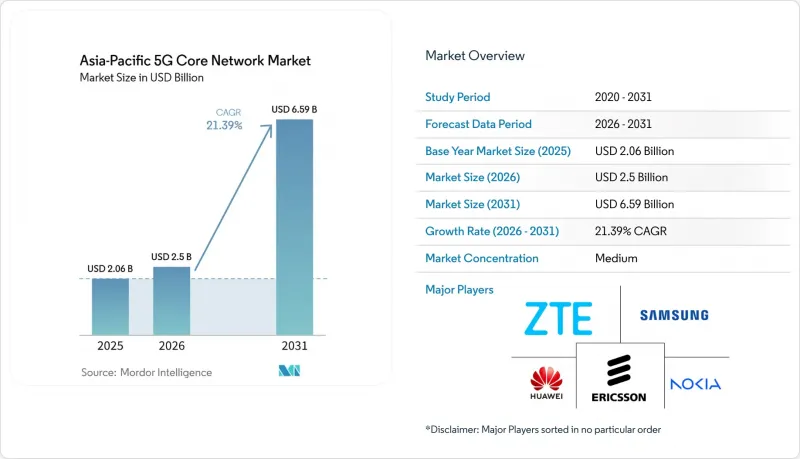
본 보고서는 구성 요소(솔루션 및 서비스),구축 모델(On-Premise/전용, 퍼블릭 클라우드, 하이브리드 및 텔레콤 엣지 클라우드), 최종 사용자(통신 사업자 및 기업), 네트워크 기능(네트워크 노출 기능, 사용자 플레인 기능, 용도 기능, 통합 데이터 관리 등), 국가별로 분류되어 있습니다. 시장 전망은 금액(달러) 기준으로 제시되어 있습니다.
아시아태평양의 5G 코어 네트워크 시장 동향 및 인사이트
5G 독립형 코어로의 전환 가속화
아시아태평양의 5G 코어 네트워크 시장에서 통신 사업자들은 고급 5G 서비스를 제공하기 위해서는 독립형(stand-alone) 코어가 필요하기 때문에 비독립형(non-stand-alone) 아키텍처에서 독립형 아키텍처로의 전환을 추진하고 있습니다. 네트워크 슬라이싱, 프라이빗 네트워크 및 저지연 API는 4G의 EPC(Evolved Packet Core)를 통해서는 본래의 기능을 제공할 수 없습니다. 이러한 요구 사항으로 인해 전환은 광범위한 소프트웨어, 인프라 및 통합 프로그램으로 발전하고 있으며, 상용 트래픽을 이전하기 전에 새로운 패킷 코어 기능, 라이프사이클 관리 도구, 데이터 마이그레이션, 테스트, 보안 검증 및 운영 준비가 필요합니다. NTT 도코모와 NEC는 2026년 2월 AWS 상에서 일본 최초의 상용 5G 코어 네트워크를 가동했습니다. 양사에 따르면, AI를 활용한 구축을 통해 도입 시간을 80% 단축했으며, AWS Graviton 2 프로세서 채택으로 전력 소비를 70% 절감할 수 있었다고 합니다. 릴라이언스 지오의 독립형 코어는 2025년에 1억 3,000만 명의 사용자를 지원하며, 해당 회사의 총 데이터 트래픽의 33%를 처리해, 마이그레이션이 완료되었을 때 실현 가능한 규모를 보여주었습니다.
Tier 1 통신 사업자의 네트워크에서 클라우드 네이티브 코어 현대화
클라우드 네이티브 현대화는 아시아태평양의 5G 코어 네트워크 시장에서 주요 통신 사업자들이 향후 네트워크 운영을 계획하는 데 있어 핵심적인 위치를 차지하게 되었습니다. 컨테이너화된 기능과 자동화된 오케스트레이션을 통해 네트워크 서비스 배포 및 업데이트에 소요되는 시간을 단축할 수 있습니다. 에릭슨은 2026년 3월, 소프트뱅크와 다년간의 계약을 체결하고 클라우드 네이티브 듀얼 모드 5G 코어를 활용해 전국 규모의 코어 기능을 현대화하기로 했습니다. 이 프로그램의 대상에는 액세스 및 모빌리티 관리, 모빌리티 관리 엔티티 기능, 음성 게이트웨이, 정책 제어가 포함됩니다. Tune Talk는 2026년 1월, 노키아와의 협력을 통해 클라우드 네이티브 코어 현대화의 1단계를 완료했으며, 동남아시아 통신 사업자로서는 최초로 이 아키텍처를 대규모로 도입했습니다. 이러한 도입을 통해 퍼블릭 클라우드 제공업체는 코어 네트워크 공급망에서 더욱 확고한 입지를 다지는 한편, 어떤 기능을 중앙 집중식으로 실행하고, 어떤 기능을 지연 시간, 내결함성 또는 데이터 제어의 관점에서 로컬에서 처리해야 할지 선택하는 책임은 여전히 통신 사업자에게 맡겨져 있습니다.
초기 통합 비용이 높고 투자 회수 기간이 길다.
완전한 독립형 코어 프로그램에는 소프트웨어 라이선스, 클라우드 인프라, 오케스트레이션 도구 및 수년에 걸친 통합 서비스에 대한 지출이 필요합니다. 이러한 부담은 동남아시아, 아시아태평양 및 남아시아의 소규모 통신 사업자에게 특히 큰 과제가 되고 있습니다. 사용자 1인당 평균 수익(ARPU)이 낮기 때문에 일반적인 투자 주기 내에서 비용을 상쇄할 수 있는 능력이 제한되기 때문입니다. 테스트, 멀티 벤더 오케스트레이션, 실제 트래픽 마이그레이션에 수반되는 통합 작업은 프로젝트 비용의 30-40%를 차지할 수 있습니다. 이러한 비용은 프로젝트 막바지에야 비로소 드러나는 경우가 있어, 엔터프라이즈 서비스 개시를 지연시키는 요인이 될 수 있습니다. 매니지드 서비스나 코어-어즈-어-서비스(CoaaS) 모델은 도입 및 운영 비용을 더 긴 기간에 분산함으로써 이러한 부담을 완화할 수 있지만, 현지 지원과 검증된 제공 파트너가 필요한 통신 사업자의 경우, 일본 및 호주 이외의 지역에서는 여전히 이용 가능성이 제한적입니다.
부문별 분석
2025년에는 솔루션이 아시아태평양의 5G 코어 네트워크 시장 점유율의 61.19%를 차지했습니다. 이 범주에는 패킷 코어 소프트웨어, 네트워크 기능 가상화(NFV) 인프라, 오케스트레이션 및 관리 도구가 포함됩니다. 패킷 코어 소프트웨어는 통신 사업자가 개별 기능에 대해 라이선스를 취득하고, 하드웨어의 모든 계층을 교체하지 않고도 업그레이드나 확장(스케일업)이 가능하기 때문에 매우 높은 가치를 지닙니다. 액세스 및 모빌리티 관리, 세션 관리, 사용자 플레인 기능 등은 이러한 분산된 기능의 예입니다. 시중에서 판매되는 서버와 쿠버네티스(Kubernetes) 플랫폼은 여전히 인프라 스택의 중요한 부분을 차지하고 있습니다. 그러나 퍼블릭 클라우드 계약으로 인해, 이전에는 자사 소유 플랫폼에 투입되던 인프라 투자의 일부가 점차 이동하고 있습니다.
아시아태평양의 5G 코어 네트워크 업계에서 서비스 시장은 2031년까지 연평균 성장률(CAGR) 23.44%로 확대될 것으로 예측됩니다. 이 범주에는 통합 및 도입, 컨설팅 및 자문 업무, 그리고 지원 및 유지보수가 포함됩니다. 인도의 신규 독립형(stand-alone) 도입 및 일본과 한국의 업그레이드 사례에서는 통합이 여전히 주요 서비스 활동으로 자리 잡고 있습니다. 레거시 코어와의 공존으로 인해 이러한 프로젝트에는 테스트 및 트래픽 전환 작업이 추가됩니다. 또한, 사내에 고도의 클라우드 엔지니어링 팀을 보유하지 않은 중견 통신 사업자에서도 컨설팅 수요가 증가하고 있습니다. 따라서 아시아태평양의 5G 코어 네트워크 시장에서 서비스 기회는 초기 구축 단계에 그치지 않고, 통신 사업자가 멀티 벤더 네트워크의 관리 및 최적화, 자동화 정책 조정, 그리고 클라우드 네이티브 환경에서 필요한 정기적인 소프트웨어 릴리스 대응을 수행하는 과정에서도 확대될 것으로 예측됩니다.
2025년에는 On-Premise 및 전용 아키텍처가 아시아태평양의 5G 코어 네트워크 시장 규모의 51.69%를 차지했습니다. 이러한 우위는 중국 Tier 1 통신 사업자의 규모와 국가 주도의 인프라 프로그램 하에서 관리되는 코어 환경을 선호하는 경향을 반영합니다. 차이나모바일, 차이나텔레콤, 차이나유니콤은 전국적으로 독립형 코어 네트워크를 도입하고 있습니다. 국내 벤더인 화웨이(Huawei)와 ZTE는 이러한 프로그램을 지원해 왔습니다. 전용 설치는 기밀 데이터나 실시간 처리를 자사 환경 내에 유지해야 하는 통신 사업자에게도 적합합니다. 이 모델은 주권 관련 요건이 엄격하거나 지연 보장이 서비스의 핵심이 되는 경우 여전히 중요한 위치를 차지하고 있습니다.
퍼블릭 클라우드는 2031년까지 연평균 성장률(CAGR) 26.50%로 확대될 것으로 예측됩니다. NTT 도코모의 AWS 상용 도입은 해당 지역의 동종 업계 경쟁사들에게 클라우드 호스팅형 코어 기능에 대한 통신사 규모의 참고 사례를 제공합니다. Tune Talk는 말레이시아에서 제어 플레인에 AWS를 활용하면서도, 사용자 플레인은 엣지 측의 AWS Outposts에 로컬로 유지하고 있습니다. 이러한 구성을 통해 지연 시간과 데이터 상주 요건 모두를 충족하고 있습니다. 하이브리드 모델과 통신 사업자용 엣지 모델도 일본, 한국, 호주에서 보급이 확대되고 있습니다. 이러한 모델을 통해 통신 사업자는 지연 시간에 민감도가 낮은 기능에는 클라우드 용량을 활용하면서도, 엔터프라이즈용 서비스에 대해서는 로컬에서 처리를 유지할 수 있게 됩니다.
기타 혜택 :
- 엑셀 형식 시장 예측(ME) 시트
- 3개월간의 애널리스트 지원
자주 묻는 질문
목차
제1장 서론
제2장 조사 방법
제3장 개요
제4장 시장 구도
제5장 시장 규모 및 성장 예측
제6장 경쟁 구도
제7장 시장 기회 및 향후 전망
KTH 26.09.02According to Mordor Intelligence, the Asia-Pacific 5G core network market size is projected to expand from USD 2.06 billion in 2025 and USD 2.5 billion in 2026 to USD 6.59 billion by 2031, registering a CAGR of 21.39% between 2026 to 2031.
This report is Segmented by Component (Solutions, and Services), Deployment Model (On-Premises/Dedicated, Public Cloud, and Hybrid and Telco Edge Cloud), End-User (Telecom Operators, and Enterprises), Network Function (Network Exposure Function, User Plane Function, Application Function, Unified Data Management, and More), and Country. The Market Forecasts are Provided in Terms of Value (USD).
Asia-Pacific 5G Core Network Market Trends and Insights
Accelerated 5G Standalone Core Migration
Operators across the Asia-Pacific 5G core network market are moving away from non-standalone architecture because advanced 5G services require a standalone core. Network slicing, private networks, and low-latency APIs cannot offer their intended capabilities through a 4G Evolved Packet Core. This requirement turns migration into a broad software, infrastructure, and integration program, involving new packet-core functions, lifecycle tools, data migration, testing, security validation, and operational preparation before commercial traffic can be moved. NTT DOCOMO and NEC launched Japan's first commercial 5G core on AWS in February 2026. The companies said AI-based construction cut deployment time by 80%, and AWS Graviton2 processors reduced power consumption by 70%. Reliance Jio's standalone core supported 130 million users and carried 33% of its total data traffic in 2025, showing the scale available once a migration is complete.
Cloud-Native Core Modernization in Tier-1 Operator Networks
Cloud-native modernization has become central to how large operators in the Asia-Pacific 5G core network market plan future network operations. Containerized functions and automated orchestration can reduce the time required to deploy and update network services. Ericsson signed a multiyear agreement with SoftBank in March 2026 to modernize nationwide core functions with a cloud-native dual-mode 5G Core. The program covers access and mobility management, mobility management entity functions, voice gateways, and policy control. Tune Talk completed the first phase of its cloud-native core modernization with Nokia in January 2026, becoming the first Southeast Asian telecommunications operator to deploy the architecture at scale. These deployments place public cloud providers more firmly within the core network supply chain, while leaving operators responsible for selecting which functions can run centrally and which require local processing for latency, resilience, or data control.
High Upfront Integration Cost and Long Payback Cycles
Full standalone core programs require spending on software licenses, cloud infrastructure, orchestration tools, and multiyear integration services. This burden is particularly difficult for smaller operators in Southeast Asia, Pacific markets, and South Asia. Lower average revenue per user limits their ability to absorb the cost within normal investment cycles. Integration work for testing, multi-vendor orchestration, and live traffic migration can account for 30-40% of the project cost. These expenses can emerge late in the project and postpone the launch of enterprise services. Managed service and core-as-a-service models can reduce this pressure by spreading implementation and operating costs over a longer period, but availability outside Japan and Australia remains limited for operators that need local support and proven delivery partners.
Other drivers and restraints analyzed in the detailed report include:
- Network Slicing Demand from Manufacturing and Industrial IoT
- Private Networks and Enterprise API Monetization
- Legacy EPC Coexistence Delays and Migration Complexity
For complete list of drivers and restraints, kindly check the Table Of Contents.
Segment Analysis
Solutions are expected to hold 61.19% of the Asia-Pacific 5G core network market share in 2025. This category includes packet-core software, network functions virtualization infrastructure, and orchestration and management tools. Packet-core software is highly valuable because operators license separate functions that they can upgrade and scale without replacing every hardware layer. Access and mobility management, session management, and user plane functions are examples of these disaggregated functions. Commercial off-the-shelf servers and Kubernetes platforms remain important parts of the infrastructure stack. However, public-cloud contracts are taking on some infrastructure spending that previously went to owned platforms.
Services are projected to expand at a CAGR of 23.44% through 2031 within the Asia-Pacific 5G core network industry. This category covers integration and deployment, consulting and advisory work, and support and maintenance. Integration remains the main service activity for greenfield standalone deployments in India and upgrades in Japan and South Korea. Legacy core coexistence adds testing and traffic cutover work to these projects. Consulting demand is also rising among mid-tier operators that lack deep internal cloud engineering teams. Therefore, the service opportunity in the Asia-Pacific 5G core network market extends beyond the initial buildout, as operators manage and optimize multi-vendor networks, adjust automation policies, and handle regular software releases required in a cloud-native environment.
On-premises and dedicated architectures are expected to account for 51.69% of the Asia-Pacific 5G core network market size in 2025. Their lead reflects the scale of Chinese Tier-1 operators and the preference for controlled core environments under state-directed infrastructure programs. China Mobile, China Telecom, and China Unicom use standalone core deployments at a national scale. Domestic suppliers Huawei and ZTE have supported these programs. Dedicated installations also suit operators who must keep sensitive data and real-time processing within their own environments. This model remains important where sovereignty requirements are strict or latency guarantees are central to the service.
Public cloud is projected to expand at a CAGR of 26.50% through 2031. NTT DOCOMO's commercial AWS deployment gives regional peers a carrier-scale reference point for cloud-hosted core functions. Tune Talk uses AWS in Malaysia for its control plane while retaining its user plane locally on AWS Outposts at the edge. This arrangement addresses both latency and data residency requirements. Hybrid and telco edge models are also gaining traction in Japan, South Korea, and Australia. These models allow operators to use cloud capacity for less latency-sensitive functions while retaining local processing for enterprise services.
Complete Report Scope:
- By Component
- Solutions
- Packet-Core Software
- NFV Infrastructure
- Orchestration and Management
- Services
- Integration and Deployment
- Consulting and Advisory
- Support and Maintenance
- Solutions
- By Deployment Model
- On-Premise/Dedicated
- Public Cloud
- Hybrid and Telco Edge Cloud
- By End-User
- Telecom Operators
- Enterprises
- Manufacturing
- Energy and Utilities
- Transportation and Logistics
- Public Safety and Emergency
- Smart Cities and Municipalities
- By Network Function
- Network Exposure Function (NEF)
- User Plane Function (UPF)
- Application Function (AF)
- Unified Data Management (UDM)
- Session Management Function (SMF)
- Network Slice Selection Function (NSSF)
- Policy Control Function (PCF)
- Network Repository Function (NRF)
- Authentication Server Function (AUSF)
- Access and Mobility Management (AMF)
- By Country
- China
- India
- Japan
- South Korea
- Rest of Asia-Pacific
List of Companies Covered in this Report:
- Telefonaktiebolaget LM Ericsson (publ)
- Huawei Technologies Co. Ltd.
- Nokia Corporation
- ZTE Corporation
- Samsung Electronics Co. Ltd.
- Mavenir Systems, Inc.
- Cisco Systems, Inc.
- Oracle Corporation
- NEC Corporation
- Hewlett Packard Enterprise Company
- Fujitsu Limited
- Druid Software Limited
- Athonet S.r.l.
- Cumucore Oy
- Red Hat, Inc.
- Intel Corporation
- Ribbon Communications Inc.
- Radisys Corporation
Additional Benefits:
- The market estimate (ME) sheet in Excel format
- 3 months of analyst support
TABLE OF CONTENTS
1 INTRODUCTION
- 1.1 Study Assumptions and Market Definition
- 1.2 Scope of the Study
2 RESEARCH METHODOLOGY
3 EXECUTIVE SUMMARY
4 MARKET LANDSCAPE
- 4.1 Market Overview
- 4.2 Market Drivers
- 4.2.1 Accelerated 5G Standalone Core Migration
- 4.2.2 Cloud Native Core Modernization in Tier One Operator Networks
- 4.2.3 Deterministic Network Slicing Demand from Manufacturing and Industrial IoT
- 4.2.4 Rising 5G Core Monetization Through Private Networks and Enterprise APIs
- 4.2.5 Energy Efficient Core Virtualization and Server Consolidation Pressure
- 4.2.6 Open RAN and Multi-Vendor Core Procurement Shifts
- 4.3 Market Restraints
- 4.3.1 High Upfront Integration Cost and Long Payback Cycles
- 4.3.2 Legacy EPC Coexistence Delays and Migration Complexity
- 4.3.3 Cloud Native Talent Shortage Across Telecom Operations
- 4.3.4 Security, Sovereignty, and Certification Friction for Cross Border Deployments
- 4.4 Value Chain Analysis
- 4.5 Regulatory Landscape
- 4.6 Technological Outlook
- 4.7 PESTLE Analysis
- 4.8 Porter's Five Forces Analysis
- 4.8.1 Threat of New Entrants
- 4.8.2 Bargaining Power of Buyers
- 4.8.3 Bargaining Power of Suppliers
- 4.8.4 Threat of Substitutes
- 4.8.5 Competitive Rivalry
5 MARKET SIZE AND GROWTH FORECASTS (VALUE)
- 5.1 By Component
- 5.1.1 Solutions
- 5.1.1.1 Packet-Core Software
- 5.1.1.2 NFV Infrastructure
- 5.1.1.3 Orchestration and Management
- 5.1.2 Services
- 5.1.2.1 Integration and Deployment
- 5.1.2.2 Consulting and Advisory
- 5.1.2.3 Support and Maintenance
- 5.1.1 Solutions
- 5.2 By Deployment Model
- 5.2.1 On-Premise/Dedicated
- 5.2.2 Public Cloud
- 5.2.3 Hybrid and Telco Edge Cloud
- 5.3 By End-User
- 5.3.1 Telecom Operators
- 5.3.2 Enterprises
- 5.3.2.1 Manufacturing
- 5.3.2.2 Energy and Utilities
- 5.3.2.3 Transportation and Logistics
- 5.3.2.4 Public Safety and Emergency
- 5.3.2.5 Smart Cities and Municipalities
- 5.4 By Network Function
- 5.4.1 Network Exposure Function (NEF)
- 5.4.2 User Plane Function (UPF)
- 5.4.3 Application Function (AF)
- 5.4.4 Unified Data Management (UDM)
- 5.4.5 Session Management Function (SMF)
- 5.4.6 Network Slice Selection Function (NSSF)
- 5.4.7 Policy Control Function (PCF)
- 5.4.8 Network Repository Function (NRF)
- 5.4.9 Authentication Server Function (AUSF)
- 5.4.10 Access and Mobility Management (AMF)
- 5.5 By Country
- 5.5.1 China
- 5.5.2 India
- 5.5.3 Japan
- 5.5.4 South Korea
- 5.5.5 Rest of Asia-Pacific
6 COMPETITIVE LANDSCAPE
- 6.1 Market Concentration
- 6.2 Strategic Moves
- 6.3 Market Share Analysis
- 6.4 Company Profiles (includes Global Level Overview, Market Level Overview, Core Segments, Financials as available, Strategic Information, Market Rank/Share, Products and Services, Recent Developments)
- 6.4.1 Telefonaktiebolaget LM Ericsson (publ)
- 6.4.2 Huawei Technologies Co. Ltd.
- 6.4.3 Nokia Corporation
- 6.4.4 ZTE Corporation
- 6.4.5 Samsung Electronics Co. Ltd.
- 6.4.6 Mavenir Systems, Inc.
- 6.4.7 Cisco Systems, Inc.
- 6.4.8 Oracle Corporation
- 6.4.9 NEC Corporation
- 6.4.10 Hewlett Packard Enterprise Company
- 6.4.11 Fujitsu Limited
- 6.4.12 Druid Software Limited
- 6.4.13 Athonet S.r.l.
- 6.4.14 Cumucore Oy
- 6.4.15 Red Hat, Inc.
- 6.4.16 Intel Corporation
- 6.4.17 Ribbon Communications Inc.
- 6.4.18 Radisys Corporation
7 MARKET OPPORTUNITIES AND FUTURE OUTLOOK
- 7.1 White-Space and Unmet-Need Assessment


