|
시장보고서
상품코드
2119205
황산마그네슘 시장 : 시장 점유율 분석, 업계 동향 및 통계, 성장 예측(2026-2031년)Magnesium Sulfate - Market Share Analysis, Industry Trends & Statistics, Growth Forecasts (2026 - 2031) |
||||||
 Mordor Intelligence
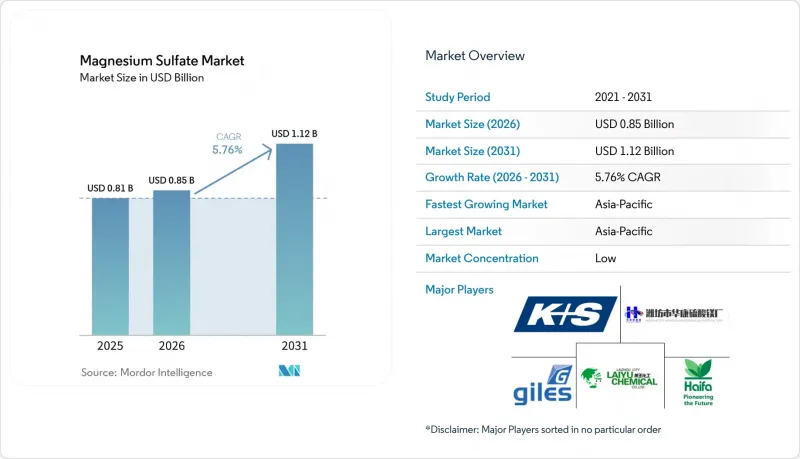
Mordor Intelligence에 의하면, 황산마그네슘 시장은 2025년에 8억 1,000만 달러 규모로 평가되었고, 2026년 8억 5,000만 달러에서 2031년까지 11억 2,000만 달러에 이를 것으로 예측되며, 예측 기간(2026-2031년) CAGR은 5.76%를 나타낼 전망입니다.
본 보고서는 제품 유형별(7수화물, 1수화물, 무수 황산마그네슘), 물리적 형태별(결정, 분말, 과립, 액체 용액), 등급별(농업용, 의약품용, 식품용, 기타), 최종 사용자 산업별(농업, 화학, 기타), 지역별(아시아태평양, 북미, 기타)로 분류되어 있습니다. 시장 예측은 금액(달러) 기준으로 제시되어 있습니다.
세계의 황산마그네슘 시장 동향 및 인사이트
토양 내 마그네슘 및 황의 고갈
많은 생산 시스템에서 집약적인 작물 생산으로 인해 자연 순환이 마그네슘과 황을 보충할 수 있는 속도를 능가하는 속도로 이들이 손실되고 있습니다. 2025년 리뷰에 따르면, 사하라 이남 아프리카의 시험지에서 황을 시비한 후 옥수수 수확량이 20%에서 260%까지 증가했다고 보고되었으며, 이는 기준선에서 황 결핍의 심각성을 보여줍니다. 또한, 장기간에 걸친 칼륨 비료 사용으로 인해 뿌리를 통한 마그네슘 흡수가 저하되어, 현재의 비료 지출로는 부분적으로만 해소되고 있는 구조적인 영양소 결핍이 발생하고 있습니다. 산성 토양은 경작 가능한 토지의 40%에서 50%에 영향을 미치고 있으며, 열대 및 아열대 생산 시스템에서 마그네슘의 침출을 가속화할 가능성이 있습니다. 과일, 채소, 사탕수수 생산의 경우 수확 주기가 반복되기 때문에 이러한 영양소 손실이 더욱 심각해질 우려가 있습니다. 생산자가 별도의 제품이 아닌 하나의 수용성 제품으로 두 영양소를 동시에 보충해야 하는 경우, 황산마그네슘 시장은 그 혜택을 볼 것입니다.
산모 및 신생아 의료 분야에서 의약품용 황산마그네슘 사용 확대
산모 및 신생아 의료 분야에서 황산마그네슘의 사용은 기존에 확립된 자간증 치료에 그치지 않고, 환자 1인당 투여량을 늘리는 프로토콜로 확대되고 있습니다. 2026년 리뷰에 따르면, 임신 30주 이전에 조산이 임박한 경우 태아의 신경 보호를 위해 산전 MgSO4 투여가 권장된다고 밝혔습니다. 이 리뷰에서는 이러한 사용으로 뇌성마비 발생률이 3분의 1 가까이 감소한 것으로 나타났습니다. 동일한 리뷰에서 인용된 바와 같이, 영국의 ‘National PreCePT Programme’은 조산 위험이 있는 사례에서 황산마그네슘(MgSO4)의 사용을 촉진하여 우수한 비용 대비 효과를 보여주었습니다. Piston Medical은 동아프리카 수요에 대응하기 위해 2026년 7월 우간다 최초의 현지 생산 황산마그네슘 주사제를 출시했습니다. 현지 생산을 통해 그동안 전적으로 수입에 의존해 온 지역의 의약품 소비량을 늘릴 수 있게 되었습니다.
엄격한 약전 및 오염 물질 관련 규격
여러 약전 규정을 준수해야 하기 때문에 규제 대상 의약품 구매자에게 공급할 수 있는 공급업체의 수는 제한적입니다. 미국 약전(USP) 규격에서는 무수 기준 98.0%-102.0%의 순도, 염화물 0.014% 미만, 비경구 제제에서 철, 셀레늄, 세균 내독소에 대한 엄격한 제한이 규정되어 있습니다. 이러한 규격을 충족하려면 전용 제조 라인, 검증된 세척 공정, 농업용 등급 생산과는 다른 절차가 필요합니다. 또한, 철분의 허용 한계치도 미국 약전(USP)과 유럽 약전(EP)에서 다르기 때문에 개별 재고 관리, 분석 증명서, 용도별 표시가 필요합니다. USP는 2024년 5월에 규격 개정 공고를 발표했으며, 이 변경 사항은 2025년 5월에 공식적으로 시행되었습니다. 생산자들은 수요가 확대되는 가운데, 검증 문서 및 분석 표준 물질의 갱신을 불가피하게 수행해야 했습니다. 이러한 비용 부담은 농업용 등급에서 의약품 등급으로의 전환을 목표로 하는 신흥 시장의 생산자들에게 특히 큰 과제가 되고 있습니다.
부문 분석
2025년, 황산마그네슘 시장 중 7수화물(엡솜염)이 56.78%를 차지했습니다. 이 형태는 상온 조건에서 안정적이며, 물에 완전히 용해되고 농업, 의약품, 퍼스널케어 용도로 사용되기 때문에 현재도 널리 사용되고 있습니다. 7분자의 결정수 분자를 포함하는 이 형태는 규격, 가격 책정, 거래 보고에 있어 기준 제품이 되고 있습니다. 일수화물(키제라이트)은 K+S Aktiengesellschaft가 독일의 지하 광상에서 건식 정전기 분리법을 이용하여 채굴하고, ‘ESTA Kieserit’ 브랜드로 공급하는 또 다른 제품 유형입니다. 이 회사는 이를 pH 중성이며, 토양에 살포한 직후 식물이 흡수할 수 있는 비료로 포지셔닝하고 있습니다.
무수 황산마그네슘은 2031년까지 연평균 성장률(CAGR) 6.36%를 나타낼 것으로 예측됩니다. 산업용 건조제, 수분 관리가 이루어진 의약품 고형 제제의 배합 성분, 전해질 요법의 유효 성분으로 사용되고 있습니다. 중국은 2025년에 일본과 독일로부터 1만 8,000톤의 고순도 무수 황산마그네슘을 수입했으나, 공급업체가 정밀 결정화 및 중금속 제거 능력을 보유하고 있었기 때문에 국내 가격의 2.3배에 달하는 가격을 지불했습니다. 2025년 황산마그네슘(MgSO4) 제조 공정 기술에 관한 전 세계 특허 출원 건수는 247건에 달하여 전년 대비 9% 증가했습니다. 이러한 활동은 결정 크기 제어, 중금속 제거, 수용성 마그네슘 염 제조에 집중되어 있습니다. 이러한 기술적 역량은 더 높은 사양의 의약품 및 원예 용도에서 마그네슘 황산염 산업을 뒷받침할 수 있습니다.
2025년, 황산마그네슘 시장에서 분말이 38.35%를 차지했습니다. 이는 비료용 원액 제조, 의약품 조제, 산업 공정에 사용될 수 있어 시장을 주도하고 있습니다. 그 활용은 기계식 살포기와의 호환성 및 복합 비료에 혼합이 가능하다는 점에 의해 뒷받침되고 있습니다. 결정 형태는 주로 퍼스널케어, 입욕제, 식품 등급 용도로 사용되며, 입자 크기가 크고 시각적 투명도가 높아 소매 시장에서의 입지를 공고히 하고 있습니다.
액체 용액은 2031년까지 연평균 성장률(CAGR) 6.62%를 나타낼 것으로 예측되며, 이는 물리적 형태 중 가장 높은 성장률입니다. 수요는 주로 유럽, 한국, 중국의 상업용 폐쇄형 원예 분야에서 발생하고 있으며, 이러한 시스템에서는 식물이 즉시 이용할 수 있는 미리 용해된 마그네슘 이온과 황산 이온이 필요합니다. 액체 제품은 전용 주입 채널을 통해 공급되고 유로 내에서 희석되므로, 고농도 분말 원액을 조제할 때 발생하기 쉬운 침전 위험을 줄일 수 있습니다. 공개된 시험 결과에 따르면, 이온 선택 전극을 통한 모니터링 기능을 갖춘 폐쇄 루프 시스템은 기존 개방형 시스템에 비해 물 이용 효율이 46% 향상되었습니다. 이러한 성능은 황산마그네슘 시장의 일부 상업용 온실 시설의 조달 사양에도 점차 반영되고 있습니다.
지역별 분석
아시아태평양은 2025년 황산마그네슘 시장 점유율의 41.78%를 차지했으며, 2031년까지 연평균 성장률(CAGR) 6.87%를 나타낼 것으로 예측됩니다. 중국에서는 푸젠성에서 실시된 토양 조사 결과, 검사 대상 구획의 81.5%가 마그네슘 적정 기준치인 120mg/kg 미만으로 나타났습니다. 또한, 조사 결과 중국 남부 경작지의 55%에서 마그네슘 결핍이 확인되었습니다. 중국의 토양 검사 및 혼합 비료 시비 프로그램은 10억 무(약 6,670만 헥타르) 이상의 경작지를 포괄하고 있으며, 황산마그네슘은 각 성의 2차 영양소 권장 기준에 포함되어 있습니다.
북미와 유럽은 황산마그네슘 시장에서 주요 프리미엄 등급 수요 거점이지만, 두 지역 공급 상황은 다릅니다. 2021년부터 2024년까지 미국의 황산마그네슘 수입량의 53%를 중국이 공급했으며, 그 다음으로 독일이 12%, 인도가 11%, 멕시코가 7%를 차지했습니다. 2026년 4월, 북미의 벤치마크 가격은 1kg당 0.41달러에 달하여, 동북아시아와 유럽의 1kg당 0.30달러 수준보다 37% 높았습니다. 유럽은 특수 등급의 황산마그네슘에 있어 거의 자급자족 상태이며, K+S Aktiengesellschaft는 자사의 ‘Werra 2060’ 프로젝트가 독일에서 EU의 황산마그네슘 수요 100%를 지속적으로 공급할 수 있는 능력을 유지하도록 설계되었다고 밝혔습니다.
남미 수요는 브라질과 아르헨티나에 집중되어 있으며, 열대 토양에서의 대두, 옥수수, 사탕수수 생산이 마그네슘과 유황에 대한 지속적인 수요를 뒷받침하고 있습니다. K+S Aktiengesellschaft는 계획 기간 동안 브라질이 칼륨 및 마그네슘 비료의 성장 지역으로 남아 있을 것으로 예상하고 있습니다. 중동 및 아프리카에서는 임산부 건강에 대한 투자로 인해 의약품 수요가 확대되고 있습니다. Piston Medical이 2026년 7월 우간다, 케냐, 탄자니아, 남수단,콩고민주공화국을 대상으로 현지 생산 주사제를 출시한 것은 이 지역공급 체계 구축이 진전되고 있음을 보여줍니다. 또한, 걸프협력회의(GCC) 회원국들도 식량 안보 프로그램 하에서 제어 환경 농업 및 정밀 관개 원예용에 대한 명확한 수요 지역을 형성하고 있습니다.
기타 혜택
- 엑셀 형식 시장 예측(ME) 시트
- 3개월간의 애널리스트 지원
자주 묻는 질문
목차
제1장 서론
제2장 조사 방법
제3장 주요 요약
제4장 시장 구도
제5장 시장 규모 및 성장 예측
제6장 경쟁 구도
제7장 시장 기회 및 향후 전망
AJY 26.09.03According to Mordor Intelligence, the magnesium sulfate market was valued at USD 0.81 billion in 2025 and is estimated to grow from USD 0.85 billion in 2026 to reach USD 1.12 billion by 2031, at a CAGR of 5.76% during the forecast period (2026-2031).
This report is Segmented by Product Type (Heptahydrate, Monohydrate, and Anhydrous Magnesium Sulfate), Physical Form (Crystals, Powder, Granules, and Liquid Solution), Grade (Agriculture Grade, Pharmaceutical Grade, Food Grade, and More), End-User Industry (Agriculture, Chemical, and More), and Geography (Asia-Pacific, North America, and More). The Market Forecasts are Provided in Terms of Value (USD).
Global Magnesium Sulfate Market Trends and Insights
Soil Magnesium and Sulfur Depletion
Intensive crop production removes magnesium and sulfur faster than natural cycles can restore them in many production systems. A 2025 review reported maize yield responses of 20% to 260% after sulfur application across Sub-Saharan African test sites, showing the severity of baseline sulfur deficiencies. Long-term potassium fertilizer use has also reduced root uptake of magnesium, creating a structural nutrient gap that current fertilizer spending only partly addresses. Acidic soils affect 40% to 50% of potentially cultivable land and can accelerate magnesium leaching in tropical and subtropical systems. Fruit, vegetable, and sugarcane production can intensify these nutrient losses because of repeated harvest cycles. The magnesium sulfate market benefits where growers need both nutrients in one soluble application rather than separate products.
Expansion of Pharmaceutical Magnesium Sulfate Use in Maternal Healthcare
Magnesium sulfate use in maternal medicine is expanding beyond established eclampsia treatment into protocols that increase dosage volumes per patient. A 2026 review stated that antenatal MgSO4 is recommended for fetal neuroprotection when preterm birth is imminent before 30 weeks of gestation. The review linked this use to a reduction in cerebral palsy incidence of nearly one-third. The National PreCePT Programme in England increased MgSO4 uptake for threatened preterm births and showed favorable cost-effectiveness, as cited in the same review. Piston Medical Limited launched Uganda's first locally manufactured magnesium sulfate injection in July 2026 for an East African demand pool. Local production can increase pharmaceutical consumption in places that previously relied fully on imports.
Stringent Pharmacopeial and Contaminant Specifications
Multi-pharmacopeia compliance limits the number of suppliers that can serve regulated pharmaceutical buyers. The United States Pharmacopeia (USP) monograph specifies 98.0% to 102.0% assay purity on an anhydrous basis, chloride below 0.014%, and strict limits for iron, selenium, and bacterial endotoxin in parenteral forms. These specifications require dedicated manufacturing lines, validated cleaning, and procedures that differ from agricultural grade production. Iron limits also differ between the USP and European Pharmacopoeia, requiring separate inventory, certificates of analysis, and use-specific labeling. The USP posted a notice to revise the monograph in May 2024, and the change became official in May 2025. Producers had to update validation documentation and analytical standards during a period of growing demand. The costs are especially difficult for emerging-market producers that want to move from agricultural to pharmaceutical grade.
Other drivers and restraints analyzed in the detailed report include:
- Crop-Specific Magnesium-Sulfur Formulation for Closed-Loop Horticulture
- Pharmaceutical Grade Supply Localization for Emergency-Care Formulations
- Compatibility and Precipitation Risk in Multi-Tank Fertigation Systems
For complete list of drivers and restraints, kindly check the Table Of Contents.
Segment Analysis
Heptahydrate (Epsom salt) accounted for 56.78% of the magnesium sulfate market in 2025. The form remains widely used because it is stable under ambient conditions, dissolves fully in water, and serves agricultural, pharmaceutical, and personal care uses. Its 7 molecules of crystallization make it the reference product for specifications, pricing, and trade reporting. Monohydrate (Kieserite) is another product type supplied by K+S Aktiengesellschaft under the ESTA Kieserit brand from German underground deposits using dry electrostatic separation. The company positions it as a pH-neutral and immediately plant-available input for soil application.
Anhydrous magnesium sulfate is forecast to grow at a 6.36% CAGR through 2031. It is used as an industrial desiccant, a compounding ingredient for moisture-controlled pharmaceutical solid-dose formulations, and an active ingredient in electrolyte therapies. China imported 18,000 metric tons of high-purity anhydrous magnesium sulfate from Japan and Germany in 2025 and paid 2.3 times its domestic price because the suppliers offer precision crystallization and heavy-metal-removal capabilities. Global filings in MgSO4 process technology reached 247 in 2025, up 9% from the prior year, with activity in crystal-size control, heavy-metal removal, and soluble magnesium-salt preparation. These technical capabilities can support the magnesium sulfate industry in higher-specification pharmaceutical and horticulture applications.
Powder accounted for 38.35% of the magnesium sulfate market in 2025. It leads because it can be used in fertigation stock preparation, pharmaceutical compounding, and industrial processes. Its use is supported by compatibility with mechanized spreaders and compound-fertilizer blending. Crystals are used mainly in personal care, bath products, and food grade applications, where larger particle size and visual clarity support retail positioning.
Liquid solution is forecast to grow at a 6.62% CAGR through 2031, the fastest rate among physical forms. Demand comes mainly from commercial closed-loop horticulture in Europe, South Korea, and China, where systems need pre-dissolved magnesium and sulfate ions that are immediately available to plants. A liquid product can be delivered through a dedicated injector channel and diluted in-stream, reducing the precipitation risk associated with concentrated powder stock preparation. In published trials, closed-loop systems with ion-selective electrode monitoring achieved 46% higher water productivity than conventional open systems. This performance is being incorporated into procurement specifications at some commercial greenhouse operations in the magnesium sulfate market.
Complete Report Scope:
- By Product Type
- Heptahydrate (Epsom Salt)
- Monohydrate (Kieserite)
- Anhydrous Magnesium Sulfate
- By Physical Form
- Crystals
- Powder
- Granules
- Liquid Solution
- By Grade
- Agriculture Grade
- Pharmaceutical Grade
- Food Grade
- Feed Grade
- Industrial Grade
- Consumer Grade
- By End-User Industry
- Agriculture
- Pharmaceutical and Healthcare
- Food and Beverage
- Personal Care and Cosmetics
- Animal Feed
- Pulp and Paper
- Textile and Leather
- Water Treatment
- Chemical
- Other End-User Industries
- By Geography
- Asia-Pacific
- China
- India
- Japan
- South Korea
- ASEAN Countries
- Rest of Asia-Pacific
- North America
- United States
- Canada
- Mexico
- Europe
- Germany
- United Kingdom
- France
- Italy
- NORDIC Countries
- Russia
- Rest of Europe
- South America
- Brazil
- Argentina
- Rest of South America
- Middle-East and Africa
- Saudi Arabia
- South Africa
- Rest of Middle-East and Africa
- Asia-Pacific
Geography Analysis
Asia-Pacific held 41.78% of the magnesium sulfate market share in 2025 and is forecast to grow at a 6.87% CAGR through 2031. In China, a soil assessment in Fujian Province found that 81.5% of tested plots were below the magnesium-sufficiency threshold of 120 mg/kg. Research also found magnesium deficiency across 55% of arable land in southern China. China's soil-testing and formula-fertilization program has covered more than 1 billion mu (approximately 66.7 million hectares) of cultivated land and has incorporated magnesium sulfate into provincial secondary-nutrient recommendations.
North America and Europe represent the main premium grade demand centers for the magnesium sulfate market, although their supply positions differ. China supplied 53% of U.S. magnesium sulfate imports from 2021 to 2024, followed by Germany at 12%, India at 11%, and Mexico at 7%. North American benchmark prices reached USD 0.41 per kg in April 2026, 37% above Northeast Asian and European levels of USD 0.30 per kg. Europe is largely self-sufficient in specialty grades, and K+S Aktiengesellschaft states that its Werra 2060 project is designed to maintain the capacity to supply 100% of EU magnesium sulfate demand from Germany.
South American demand is concentrated in Brazil and Argentina, where soybean, corn, and sugarcane production on tropical soils supports ongoing magnesium and sulfur demand, and K+S Aktiengesellschaft expects Brazil to remain a growth area for potassium and magnesium fertilizers during its planning period. In the Middle-East and Africa, pharmaceutical demand is growing because of maternal health investment. Piston Medical Limited's July 2026 launch of a locally manufactured injection for Uganda, Kenya, Tanzania, South Sudan, and the Democratic Republic of Congo shows the development of regional supply. Gulf Cooperation Council countries also form a distinct demand area for controlled-environment agriculture and precision-irrigated horticulture under food-security programs.
- ACURO ORGANICS LIMITED
- China Nafine Group International Co., Ltd.
- Haifa Negev technologies LTD
- ICL
- Industrias Penoles
- Jost Chemical Co.
- K+S Aktiengesellschaft
- Laizhou City Laiyu Chemical CO.,Ltd
- Laizhou Guangcheng Chemical Co., Ltd.
- SML Limited
- Tianjin Xingyu Fertilizer Industry Co., Ltd.
- UMAI CHEMICAL CO., LTD.
- Weifang City Huakang Magnesium Sulphate Factory
- Yingkou Magnesite Chemical Ind. Group Co., Ltd.
Additional Benefits:
- The market estimate (ME) sheet in Excel format
- 3 months of analyst support
TABLE OF CONTENTS
1 Introduction
- 1.1 Study Assumptions and Market Definition
- 1.2 Scope of the Study
2 Research Methodology
3 Executive Summary
4 Market Landscape
- 4.1 Market Overview
- 4.2 Market Drivers
- 4.2.1 Soil Magnesium and Sulfur Depletion
- 4.2.2 Food Security and Higher Crop Productivity Requirements
- 4.2.3 Expansion of Pharmaceutical Magnesium Sulfate Use in Maternal Healthcare
- 4.2.4 Crop-Specific Magnesium-Sulfur Formulation for Closed-Loop Horticulture
- 4.2.5 Pharmaceutical Grade Supply Localization for Emergency-Care Formulations
- 4.3 Market Restraints
- 4.3.1 Stringent Pharmacopeial and Contaminant Specifications
- 4.3.2 Natural Mineral Quality Variability Across Deposits
- 4.3.3 Compatibility and Precipitation Risk in Multi-Tank Fertigation Systems
- 4.4 Value Chain Analysis
- 4.5 Porter's Five Forces Analysis
- 4.5.1 Threat of New Entrants
- 4.5.2 Bargaining Power of Suppliers
- 4.5.3 Bargaining Power of Buyers
- 4.5.4 Threat of Substitutes
- 4.5.5 Competitive Rivalry
5 Market Size and Growth Forecasts (Value)
- 5.1 By Product Type
- 5.1.1 Heptahydrate (Epsom Salt)
- 5.1.2 Monohydrate (Kieserite)
- 5.1.3 Anhydrous Magnesium Sulfate
- 5.2 By Physical Form
- 5.2.1 Crystals
- 5.2.2 Powder
- 5.2.3 Granules
- 5.2.4 Liquid Solution
- 5.3 By Grade
- 5.3.1 Agriculture Grade
- 5.3.2 Pharmaceutical Grade
- 5.3.3 Food Grade
- 5.3.4 Feed Grade
- 5.3.5 Industrial Grade
- 5.3.6 Consumer Grade
- 5.4 By End-User Industry
- 5.4.1 Agriculture
- 5.4.2 Pharmaceutical and Healthcare
- 5.4.3 Food and Beverage
- 5.4.4 Personal Care and Cosmetics
- 5.4.5 Animal Feed
- 5.4.6 Pulp and Paper
- 5.4.7 Textile and Leather
- 5.4.8 Water Treatment
- 5.4.9 Chemical
- 5.4.10 Other End-User Industries
- 5.5 By Geography
- 5.5.1 Asia-Pacific
- 5.5.1.1 China
- 5.5.1.2 India
- 5.5.1.3 Japan
- 5.5.1.4 South Korea
- 5.5.1.5 ASEAN Countries
- 5.5.1.6 Rest of Asia-Pacific
- 5.5.2 North America
- 5.5.2.1 United States
- 5.5.2.2 Canada
- 5.5.2.3 Mexico
- 5.5.3 Europe
- 5.5.3.1 Germany
- 5.5.3.2 United Kingdom
- 5.5.3.3 France
- 5.5.3.4 Italy
- 5.5.3.5 NORDIC Countries
- 5.5.3.6 Russia
- 5.5.3.7 Rest of Europe
- 5.5.4 South America
- 5.5.4.1 Brazil
- 5.5.4.2 Argentina
- 5.5.4.3 Rest of South America
- 5.5.5 Middle-East and Africa
- 5.5.5.1 Saudi Arabia
- 5.5.5.2 South Africa
- 5.5.5.3 Rest of Middle-East and Africa
- 5.5.1 Asia-Pacific
6 Competitive Landscape
- 6.1 Market Concentration
- 6.2 Strategic Moves
- 6.3 Market Share (%)/Ranking Analysis
- 6.4 Company Profiles (includes Global Overview, Market Overview, Core Segments, Financials as available, Strategic Information, Products and Services, and Recent Developments)
- 6.4.1 ACURO ORGANICS LIMITED
- 6.4.2 China Nafine Group International Co., Ltd.
- 6.4.3 Haifa Negev technologies LTD
- 6.4.4 ICL
- 6.4.5 Industrias Penoles
- 6.4.6 Jost Chemical Co.
- 6.4.7 K+S Aktiengesellschaft
- 6.4.8 Laizhou City Laiyu Chemical CO.,Ltd
- 6.4.9 Laizhou Guangcheng Chemical Co., Ltd.
- 6.4.10 SML Limited
- 6.4.11 Tianjin Xingyu Fertilizer Industry Co., Ltd.
- 6.4.12 UMAI CHEMICAL CO., LTD.
- 6.4.13 Weifang City Huakang Magnesium Sulphate Factory
- 6.4.14 Yingkou Magnesite Chemical Ind. Group Co., Ltd.
7 Market Opportunities and Future Outlook
- 7.1 White-Space and Unmet-Need Assessment
- 7.2 Low-Carbon Magnesium Sulfate with Verified Product Footprints