|
시장보고서
상품코드
2119215
내연기관용 가스 연료 시장 : 시장 점유율 분석, 업계 동향 및 통계, 성장 예측(2026-2031년)Gaseous Fuels For Internal Combustion (IC) Engines - Market Share Analysis, Industry Trends & Statistics, Growth Forecasts (2026 - 2031) |
||||||
 Mordor Intelligence
Mordor Intelligence에 의하면, 내연기관용 가스 연료 시장 규모는 생산량 기반으로 2025년 1억 2,308만 톤으로 평가되었고, 2026년에는 1억 3,864만 톤으로 추정되고, 2026-2031년 CAGR 12.88%로 성장을 지속할 전망이며, 2031년에는 2억 5,411만 톤에 이를 것으로 예측됩니다.
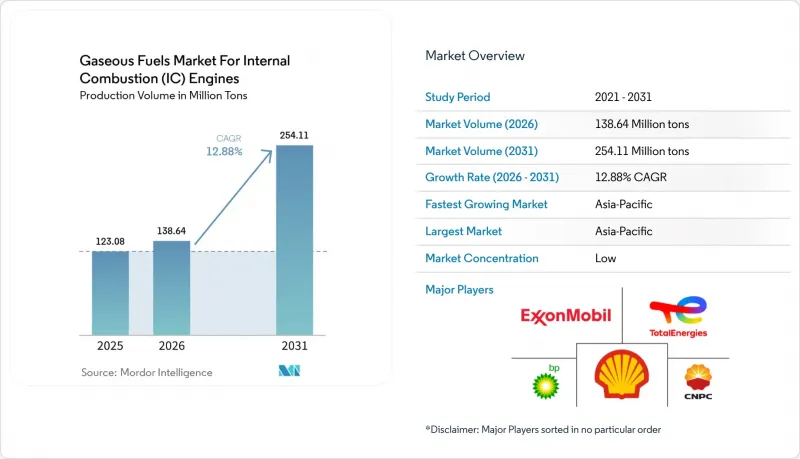
본 보고서는 연료 유형별(CNG, LNG, LPG/오토가스, 바이오가스/바이오메탄, 수소, 기타), 용도별(소형차, 중형·대형 상용차, 해상·수상 운송, 철도·비도로용 장비, 기타), 지역별(북미, 유럽, 아시아태평양, 남미, 중동 및 아프리카)로 분류되어 있습니다. 시장 예측은 수량(100만 톤)으로 제시되어 있습니다.
내연기관용 가스 연료 시장 동향 및 인사이트
디젤에 비해 총 소유 비용이 낮다는 점이 차량의 연료 전환을 결정하는 요인이 되고 있습니다.
CNG의 운영 비용 측면에서의 우위는 내연기관용 가스 연료 시장에서 차량 함대의 연료 전환을 이끄는 직접적인 이유가 되고 있습니다. 커민스(Cummins)는 2026년 5월, CNG의 평균 가격이 디젤 1갤런당 2.99달러인 반면, 디젤은 4.25달러이며, 이에 따라 1만 갤런을 소비할 경우 연간 1만 2,600달러의 연료비 절감 효과를 얻을 수 있다고 발표했습니다. 이러한 비교는 매일 주행 경로를 예측할 수 있고 연간 주행 거리가 긴 차량에 가장 중요하며, 이러한 운영 패턴은 내연기관용 가스 연료 시장을 뒷받침하는 요소이기도 합니다. 또한, CNG 엔진은 디젤 배기액(DEF) 시스템이나 디젤 미립자 필터(DPF)가 필요하지 않기 때문에 디젤 배기 후처리와 관련된 일부 유지보수 부담을 줄일 수 있습니다. 운영 비용이 낮고 투명성이 높으면, 차량 관리자는 연료비, 정비비, 충전소 계약에 대한 정당성을 더 쉽게 설명할 수 있게 됩니다. 이러한 이점은 전용 충전 시설이나 신뢰할 수 있는 공공 충전소를 유지할 수 있을 만큼 차량의 가동률이 충분히 높은 경우에 가장 두드러집니다.
대형 차량 및 도시 지역 차량에 대한 배기가스 규제가 강화되면서, 규제 준수를 원동력으로 하는 수요가 창출되고 있습니다.
배출 가스 규제로 인해 시스템의 복잡성을 줄이면서 차량단의 운영 요구를 충족시킬 수 있는 엔진 옵션의 가치가 높아지고 있습니다. 국제해사기구(IMO)는 2025년 4월 ‘IMO 넷제로 프레임워크’를 승인하고, MARPOL 부속서 VI에 따라 해운 분야의 온실가스 배출 성능에 대응하는 조치를 확립했습니다. 도로 운송 분야의 유사한 규제 동향은 도시 지역이나 화물 운송의 고정 노선에서 도입 가능한 연료와 엔진의 조합에 대한 수요를 뒷받침하고 있습니다. 규제 준수 요건은 대기질 규제가 엄격하게 모니터링되는 지역에서 운행되는 버스, 쓰레기 수거차, 배송 차량에게 특히 중요합니다. 사업자가 차량 교체가 필요하더라도 배터리 주행 거리, 적재량 또는 충전에 대한 제약을 수용할 수 없는 경우, 가스 엔진은 실용적인 해결책이 될 수 있습니다. 이러한 요건으로 인해 연료 가격 변동이 있더라도 내연기관용 가스 연료 시장에는 보다 안정적인 조달 기반이 형성됩니다.
충전소의 불균형한 분포와 높은 설비 투자 비용이 보급 확대를 저해하고 있습니다.
불규칙한 운행 노선이나 차량 대수가 적은 소규모 사업자에게는 충전소 투자가 여전히 어려운 상황입니다. 새로운 네트워크는 차량 운영자가 안심하고 이용할 수 있을 만큼 충분한 커버리지를 제공해야 하지만, 사업자는 자본을 투입하기 전에 확실한 차량 수요 증명을 요구하는 경우가 많습니다. 이러한 악순환은 CNG에 비해 저장 및 취급 요건이 더 엄격한 LNG의 경우 더욱 심각합니다. 또한, 가스 자원은 있지만 운송용 연료 네트워크가 제한된 지역에서는 인프라 미비가 내연기관용 가스 연료 시장의 확대를 저해하는 요인이 될 수도 있습니다. 대규모 차량 보유 기업은 전용 충전소 설치를 정당화할 수 있고, 운영 비용을 더 많은 차량에 분산시킬 수 있다는 이점이 있습니다. 따라서 초기 도입 기업 이외의 이용을 확대하기 위해서는 대중교통 노선의 확충이나 물류 사업자와의 협약이 중요합니다.
부문 분석
2025년, CNG는 내연기관용 가스 연료 시장에서 51.3%의 점유율을 차지했습니다. 이는 시내버스, 지자체 쓰레기 수거 차량, 지역 물류 업무에서 오랫동안 사용되어 온 데 힘입은 결과입니다. 도입된 차량 대수와 성숙한 충전 모델을 통해 사업자는 연료 및 유지보수 계획에 대한 명확한 출발점을 확보할 수 있습니다. CNG는 차량이 기지로 돌아와 매일 정해진 경로를 주행하는 상황에 특히 적합합니다. LNG는 압축 가스의 저장량에 따라 주행 거리가 제한될 가능성이 있는 장거리 트럭 운송이나 선박 운항과 같은 다양한 운영 요구에 대응하고 있습니다. LPG(오토가스)는 개조 기술, 세제, 소매 접근성이 확립된 승용차 및 소형 상용차에서 계속해서 사용되고 있습니다. 다치아(Dacia)는 2026년에 LPG 및 가솔린 바이퓨얼 차량 라인업을 확대했는데, 이는 각 OEM 업체들이 관련 유럽 차량 카테고리에서 이 연료 옵션을 지속적으로 지원하고 있음을 보여줍니다.
수소는 2031년까지 연평균 성장률(CAGR) 17.1%를 나타낼 것으로 예측되며, 내연기관용 가스 연료 시장에서 각 연료 유형 중 가장 높은 성장률을 보이고 있습니다. 2025년 기술 평가에 따르면, 수소 내연 시스템은 기존 엔진 제조 방식을 활용하면서도 동등한 연료전지 시스템보다 저렴한 비용으로 구현될 수 있는 것으로 밝혀졌습니다. 이는 일반 승용차에서의 광범위한 이용보다는 이용률, 주행 거리, 신속한 충전이 중시되는 운영 분야에서의 도입을 촉진하는 요인입니다. 바이오메탄은 기존의 가스 엔진 및 유통 시스템의 상당 부분을 활용할 수 있으므로, 또 다른 전개 경로를 제공합니다. 유럽의회는 ‘재생에너지 지침’의 틀 내 운송 관련 규정을 바이오메탄 도입을 위한 의미 있는 정책적 기반으로 언급하고 있습니다. 합성가스와 합성메탄은 여전히 개발이 진전되지 않고 있어, 예측 기간 동안 상업적 이용이 제한적일 것으로 전망됩니다.
지역별 분석
아시아태평양은 2025년에 지역별 매출 점유율의 53.3%를 차지한 것으로 평가되었으며, 2031년까지 연평균 성장률(CAGR) 14.8%로 성장할 것으로 전망됩니다. 이 지역은 대규모 차량 보유 대수, 확립된 CNG(압축 천연가스) 사업, 도시 가스 개발, 장거리 운송용 LNG 수요 증가 등의 요소가 결합되어 있습니다. 중국은 계속해서 상용차 대수 측면에서 중요한 공급원인 반면, 인도는 도시 지역의 CNG 이용에서 LNG 물류 인프라로 확대되고 있습니다. Indraprastha Gas는 2026년에 다드리에 수도권 최초의 LNG 충전소를 개설하여 해당 지역의 장거리 트럭 운행 선택지를 확대했습니다. 동남아시아에서는 도시 지역의 대기질 목표, 가스 공급 상황, 새로운 CNG 프로그램이 맞물려 더 큰 잠재력이 기대됩니다. 다만, 향후 발전은 충전소 구축 현황이 차량 보유 사업자가 필요로 하는 수준에 도달하느냐에 따라 좌우될 것으로 보입니다.
북미와 유럽은 내연기관용 가스 연료 시장에서 중요한 기술 및 규제 중심지입니다. 미국에서는 클린 에너지 퓨얼스(Clean Energy Fuels)가 화물 운송 회랑을 따라 재생 가능 천연가스의 생산 능력과 충전소 확충을 추진하고 있습니다. 유럽에서는 바이오메탄 통합 및 수명 주기 배출 성능에 대한 정책적 중점이 더욱 강조되고 있습니다. 유럽투자은행(EIB)의 Snam에 대한 대출은 바이오메탄 플랜트와 이탈리아 가스 네트워크 간의 새로운 연계를 지원하는 것입니다. 이 투자를 통해 내연기관용 가스 연료 시장 전반에서 운송 사업자들이 재생 가능 가스 공급에 더 쉽게 접근할 수 있게 될 가능성이 있습니다. 또한, 이러한 지역들은 수소 연소 기기, 인증된 선박용 시스템, 차량 함대 서비스 모델의 실증 장소로도 기능하고 있습니다.
남미, 중동 및 아프리카는 유망한 성장 기회를 지니고 있지만, 인프라 상황은 지역별로 차이가 있습니다. 가스 공급 상황, 현지 연료 가격 동향, 공공 투자가 특정 지역의 도입을 촉진할 가능성이 있습니다. 아르헨티나는 차량 연료 전환 활동에서 중요한 역할을 하고 있으며, 천연가스 엔진의 현지 생산은 지역 공급 능력을 강화할 가능성이 있습니다. FPT Industrial은 2025년 8월, 아르헨티나에서 상용차, 농업용 차량, 도시 교통용 천연가스 엔진 생산을 시작했습니다. 나이지리아에서 계획 중인 CNG 네트워크와 사우디아라비아의 ‘가스 투 모빌리티(Gas to Mobility)’ 이니셔티브는 내연기관용 가스 연료 시장의 더 광범위한 지역적 확장에 대한 관심을 보여줍니다. 이러한 계획의 실현 여부는 충전소에 대한 자금 조달, 신뢰할 수 있는 연료 유통, 초기 수요를 뒷받침할 수 있는 차량 운영 업체에 달려 있습니다.
기타 혜택
- 엑셀 형식 시장 예측(ME) 시트
- 3개월간 애널리스트 지원
자주 묻는 질문
목차
제1장 서론
제2장 조사 방법
제3장 주요 요약
제4장 시장 구도
제5장 시장 규모 및 성장 예측
제6장 경쟁 구도
제7장 시장 기회 및 향후 전망
AJY 26.09.03According to Mordor Intelligence, the gaseous fuels market for Internal Combustion Engines Industry size in terms of production volume is expected to grow from 123.08 million tons in 2025 to 138.64 million tons in 2026 and is forecast to reach 254.11 million tons by 2031 at 12.88% CAGR over 2026-2031.
This report is Segmented by Fuel Type (CNG, LNG, LPG/Autogas, Biogas/Biomethane, Hydrogen, Other Types), Application (Light-Duty Vehicles, Medium- and Heavy-Duty Vehicles, Marine Transport, Rail and Off-Road, Others), and Geography (North America, Europe, Asia-Pacific, South America, Middle East and Africa). The Market Forecasts are Provided in Terms of Volume (Million Tons).
Insights and Trends of Gaseous Fuels Market For Internal Combustion (IC) Engines
Lower Total Cost of Ownership Versus Diesel Drives Fleet Conversion Decisions
The operating cost advantage of CNG is an immediate reason for fleet conversion in the Gaseous Fuels Market for IC Engines. Cummins stated in May 2026 that CNG averaged USD 2.99 per diesel gallon equivalent, compared with USD 4.25 for diesel, which produced USD 12,600 in annual fuel savings for 10,000 gallons consumed. The comparison matters most for vehicles with predictable daily routes and high annual mileage, which are also the operating patterns that support the Gaseous Fuels Market for IC Engines. CNG engines also avoid diesel exhaust fluid systems and diesel particulate filters, which reduces exposure to some diesel aftertreatment maintenance needs . A lower and more transparent operating cost can make fuel, maintenance, and station agreements easier for fleet managers to justify. This advantage is strongest when fleets have enough utilization to support dedicated refueling assets or dependable public stations.
Stricter Emission Standards for Heavy-Duty and Urban Fleets Create Compliance-Driven Demand
Emission requirements are raising the value of engine options that can meet fleet operating needs with lower system complexity. The International Maritime Organization approved the IMO Net-Zero Framework in April 2025, establishing measures under MARPOL Annex VI that address greenhouse gas performance in shipping. Similar regulatory direction in road transport supports demand for fuel and engine combinations that can be deployed on fixed urban and freight routes. Compliance requirements are especially relevant for buses, refuse trucks, and distribution vehicles that operate where air-quality rules are closely monitored. Gaseous engines can offer a practical response when operators need to renew fleets but cannot accept battery range, payload, or charging constraints. These requirements create a steadier procurement base for the Gaseous Fuels Market for IC Engines market, even when fuel price differences change.
Uneven Refueling Coverage and High Station Capital Costs Limit Broader Adoption
Station investment remains difficult for smaller operators with irregular routes or low vehicle volumes. A new network must provide enough coverage for fleet confidence, but providers often need proven vehicle demand before committing capital. This circular problem is more acute for LNG because storage and handling requirements are more demanding than for CNG. Infrastructure gaps can also limit the Gaseous Fuels Market for IC Engines in regions with gas resources but limited transport fuel networks. Larger fleets have an advantage because they can justify private stations and spread operating costs across more vehicles. Public corridor expansion and agreements with logistics operators are therefore important for extending adoption beyond early fleet users.
Other drivers and restraints analyzed in the detailed report include:
- Expansion of Refueling Infrastructure Unlocks Fleet Conversion in Constrained Markets
- Factory-Fitted Gaseous-Fuel and Hydrogen-Ready Platforms Broaden Practical Applications
- Natural Gas Price Volatility and Lifecycle Emissions Risk Reduce Fleet Certainty
For complete list of drivers and restraints, kindly check the Table Of Contents.
Segment Analysis
CNG held 51.3% of the Gaseous Fuels Market for IC Engines market share in 2025, supported by long-standing use in urban buses, municipal refuse fleets, and local logistics operations. Its installed vehicle base and mature refueling model give operators a clear starting point for fuel and maintenance planning. CNG is particularly suitable where vehicles return to a depot and use fixed daily routes. LNG serves a different operating need because it can support long-distance trucking and marine activity where compressed gas storage may limit range. LPG or autogas continues to serve passenger cars and light commercial vehicles where conversion capability, taxation, and retail access are established. Dacia expanded its LPG and gasoline bi-fuel lineup in 2026, which shows that OEMs continue to support this fuel option in relevant European vehicle categories.
Hydrogen is projected to grow at a 17.1% CAGR through 2031, the fastest rate among fuel types in the Gaseous Fuels Market for IC Engines market size. The 2025 technical assessment found that hydrogen internal combustion systems can cost less than comparable fuel-cell systems while using familiar engine manufacturing approaches. This supports deployment in operations where utilization, range, and rapid refueling matter more than broad passenger vehicle use. Biomethane offers a separate path because it can use much of the existing gas engine and distribution system. The European Parliament described transport provisions in the Renewable Energy Directive framework as a meaningful policy basis for biomethane deployment. Syngas and synthetic methane remain less developed and have limited commercial use during the forecast period.
Complete Report Scope:
- By Fuel Type
- Compressed Natural Gas (CNG)
- Liquefied Natural Gas (LNG)
- Liquefied Petroleum Gas (LPG / Autogas)
- Biogas / Biomethane
- Hydrogen
- Other Fuel Types (Syngas, Synthetic Methane, etc.)
- By Application
- Light-Duty Vehicles (Passenger Cars and Light Commercial Vehicles)
- Medium- and Heavy-Duty Commercial Vehicles (Trucks and Buses)
- Marine and Waterborne Transport
- Rail and Off-Road Equipment
- Other Applications (Stationary Power Generation, etc.)
- By Geography
- North America
- United States
- Canada
- Mexico
- Europe
- Germany
- United Kingdom
- France
- Russia
- Spain
- Rest of Europe
- Asia-Pacific
- China
- India
- Japan
- South Korea
- ASEAN
- Rest of Asia-Pacific
- South America
- Brazil
- Argentina
- Rest of South America
- Middle East and Africa
- Saudi Arabia
- United Arab Emirates
- South Africa
- Rest of Middle East and Africa
- North America
Geography Analysis
Asia-Pacific held 53.3% regional revenue share in 2025 and is forecast to grow at a 14.8% CAGR through 2031. The region combines large vehicle fleets, established CNG activity, city gas development, and increasing LNG demand for long-haul transport. China remains an important source of commercial vehicle volume, while India is expanding from urban CNG use toward LNG logistics infrastructure. Indraprastha Gas Limited opened the National Capital Region's first LNG station in Dadri in 2026, extending the region's options for long-distance truck operations. Southeast Asia offers additional potential where urban air-quality goals, gas availability, and new CNG programs can converge. Development will still depend on whether station coverage reaches the level needed by fleet operators.
North America and Europe are important technology and regulatory centers for the Gaseous Fuels Market for IC Engines market. In the United States, Clean Energy Fuels is expanding renewable natural gas capacity and stations along freight corridors. Europe has a stronger policy focus on biomethane integration and lifecycle emissions performance. The European Investment Bank's financing for Snam supports new links between biomethane plants and Italy's gas network. This investment can improve access to renewable gas supply for transport users across the Gaseous Fuels Market for IC Engines market. These regions also provide a testing ground for hydrogen combustion equipment, certified marine systems, and fleet service models.
South America, the Middle East and Africa provide positive growth opportunities but have more uneven infrastructure conditions. Gas availability, local fuel price relationships, and public investment can support adoption in selected locations. Argentina is relevant for vehicle conversion activity, while local production of natural gas engines can strengthen regional supply capability. FPT Industrial began producing natural gas engines in Argentina in August 2025 for commercial, agricultural, and urban transport applications. Nigeria's planned CNG network and Saudi gas-to-mobility efforts indicate interest in broader regional deployment in the Gaseous Fuels Market for IC Engines market. Execution will depend on station financing, reliable fuel distribution, and fleet operators that can anchor initial demand.
- Adani Total Gas Limited
- bp p.l.c.
- Chevron Corporation
- China National Petroleum Corporation
- Clean Energy Fuels Corp.
- ENGIE SA
- Eni S.p.A.
- Equinor ASA
- Exxon Mobil Corporation
- FortisBC Energy Inc.
- Gasum Oy
- Indian Oil Corporation Limited
- L'Air Liquide S.A.
- Linde plc
- Repsol, S.A.
- Shell plc
- Snam S.p.A.
- TotalEnergies SE
Additional Benefits:
- The market estimate (ME) sheet in Excel format
- 3 months of analyst support
TABLE OF CONTENTS
1 INTRODUCTION
- 1.1 Study Assumptions and Market Definition
- 1.2 Scope of the Study
2 RESEARCH METHODOLOGY
3 EXECUTIVE SUMMARY
4 MARKET LANDSCAPE
- 4.1 Market Overview
- 4.2 Market Drivers
- 4.2.1 Lower Total Cost of Ownership Versus Diesel
- 4.2.2 Stricter Emission Standards for Heavy-Duty and Urban Fleets
- 4.2.3 Expansion of CNG, LNG and Renewable Gas Refueling Infrastructure
- 4.2.4 Factory-Fitted Gaseous-Fuel Powertrain Adoption
- 4.2.5 Biomethane Compatibility With Existing Gas Engines and Infrastructure
- 4.2.6 Hydrogen-Ready Engine Platforms for Hard-to-Electrify Applications
- 4.3 Market Restraints
- 4.3.1 Uneven Refueling Coverage and High Station Capital Costs
- 4.3.2 Natural Gas Price Volatility and Import Exposure
- 4.3.3 Methane Slip and Lifecycle-Emission Accounting Risk
- 4.3.4 Residual Value Discount for Gaseous-Fuel Vehicles in Electrifying Markets
- 4.4 Supply-Chain Analysis
- 4.5 Technology Outlook
- 4.6 Regulatory Landscape
- 4.7 Porter's Five Forces Analysis
- 4.7.1 Bargaining Power of Suppliers
- 4.7.2 Bargaining Power of Buyers
- 4.7.3 Threat of New Entrants
- 4.7.4 Threat of Substitutes
- 4.7.5 Competitive Rivalry
5 MARKET SIZE AND GROWTH FORECASTS
- 5.1 By Fuel Type
- 5.1.1 Compressed Natural Gas (CNG)
- 5.1.2 Liquefied Natural Gas (LNG)
- 5.1.3 Liquefied Petroleum Gas (LPG / Autogas)
- 5.1.4 Biogas / Biomethane
- 5.1.5 Hydrogen
- 5.1.6 Other Fuel Types (Syngas, Synthetic Methane, etc.)
- 5.2 By Application
- 5.2.1 Light-Duty Vehicles (Passenger Cars and Light Commercial Vehicles)
- 5.2.2 Medium- and Heavy-Duty Commercial Vehicles (Trucks and Buses)
- 5.2.3 Marine and Waterborne Transport
- 5.2.4 Rail and Off-Road Equipment
- 5.2.5 Other Applications (Stationary Power Generation, etc.)
- 5.3 By Geography
- 5.3.1 North America
- 5.3.1.1 United States
- 5.3.1.2 Canada
- 5.3.1.3 Mexico
- 5.3.2 Europe
- 5.3.2.1 Germany
- 5.3.2.2 United Kingdom
- 5.3.2.3 France
- 5.3.2.4 Russia
- 5.3.2.5 Spain
- 5.3.2.6 Rest of Europe
- 5.3.3 Asia-Pacific
- 5.3.3.1 China
- 5.3.3.2 India
- 5.3.3.3 Japan
- 5.3.3.4 South Korea
- 5.3.3.5 ASEAN
- 5.3.3.6 Rest of Asia-Pacific
- 5.3.4 South America
- 5.3.4.1 Brazil
- 5.3.4.2 Argentina
- 5.3.4.3 Rest of South America
- 5.3.5 Middle East and Africa
- 5.3.5.1 Saudi Arabia
- 5.3.5.2 United Arab Emirates
- 5.3.5.3 South Africa
- 5.3.5.4 Rest of Middle East and Africa
- 5.3.1 North America
6 COMPETITIVE LANDSCAPE
- 6.1 Market Concentration
- 6.2 Strategic Moves
- 6.3 Market Share Analysis
- 6.4 Company Profiles (includes Global Level Overview, Market Level Overview, Core Segments, Financials as available, Strategic Information, Market Rank/Share, Products and Services, Recent Developments)
- 6.4.1 Adani Total Gas Limited
- 6.4.2 bp p.l.c.
- 6.4.3 Chevron Corporation
- 6.4.4 China National Petroleum Corporation
- 6.4.5 Clean Energy Fuels Corp.
- 6.4.6 ENGIE SA
- 6.4.7 Eni S.p.A.
- 6.4.8 Equinor ASA
- 6.4.9 Exxon Mobil Corporation
- 6.4.10 FortisBC Energy Inc.
- 6.4.11 Gasum Oy
- 6.4.12 Indian Oil Corporation Limited
- 6.4.13 L'Air Liquide S.A.
- 6.4.14 Linde plc
- 6.4.15 Repsol, S.A.
- 6.4.16 Shell plc
- 6.4.17 Snam S.p.A.
- 6.4.18 TotalEnergies SE
7 MARKET OPPORTUNITIES AND FUTURE OUTLOOK
- 7.1 White-Space and Unmet-Need Assessment