

|
시장보고서
상품코드
2119220
디지털 공공 인프라 플랫폼 시장 : 시장 점유율 분석, 업계 동향 및 통계, 성장 예측(2026-2031년)Digital Public Infrastructure Platforms - Market Share Analysis, Industry Trends & Statistics, Growth Forecasts (2026 - 2031) |
||||||
 Mordor Intelligence
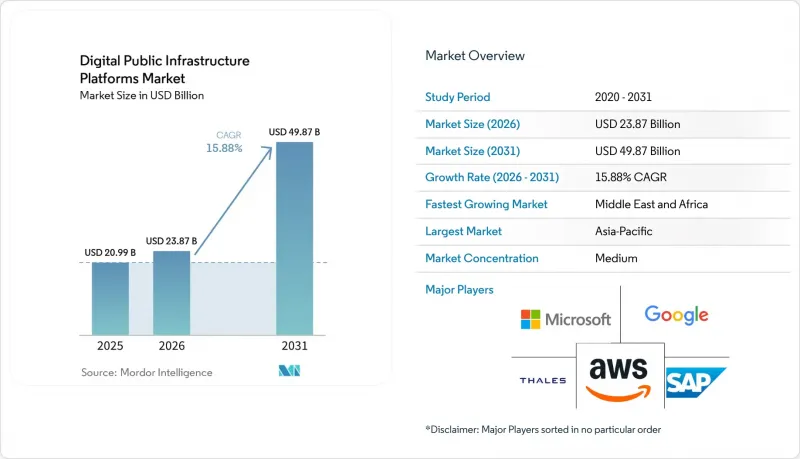
Mordor Intelligence에 의하면, 디지털 공공 인프라 플랫폼 시장 규모는 2025년 210억 달러로 평가되었고, 2026년 239억 달러에서 2031년까지 499억 달러로 확대될 전망이며, 2026-2031년 CAGR 15.88%를 나타낼 것으로 예측됩니다.
본 보고서는 플랫폼 유형별(디지털 ID, 디지털 결제, 데이터 교환·동의, 디지털 알림·메시징, 기타), 배포 방식별(클라우드 기반, 온프레미스, 하이브리드), 최종 사용자별(정부·공공 부문, 금융 기관, 의료 서비스 제공업체, 통신 사업자, 교통·모빌리티 기관, 기타), 지역별(북미, 남미, 유럽, 아시아태평양, 기타)로 분류되어 있습니다. 시장 예측은 금액(달러) 기준으로 제시되어 있습니다.
세계의 디지털 공공 인프라 플랫폼 시장 동향 및 인사이트
각국에서의 디지털 ID 확대
디지털 ID 프로그램은 더 광범위한 공공 서비스 분야에서 종이 기반의 신원 확인 방식을 대체하고 있습니다. 2025년에는 조사 대상인 OECD 회원국 33개국 중 88%가 상호운용성 프레임워크를 운영하고 있었으며, 18개국에서는 안전한 디지털 ID를 통해 시민들이 공공 서비스의 최소 75%를 이용할 수 있게 되었습니다. 북유럽 국가들과 네덜란드에서는 인구의 90% 이상의 디지털 ID 도입률이 보고되고 있습니다. 규정(EU) 2024/1183에 따르면, 유럽연합(EU) 회원국은 2026년 말까지 시민과 거주자에게 최소 1개의 EU 디지털 ID 지갑을 제공해야 합니다. 필리핀에서는 PhilSys에 8,000만 명이 등록되어 있으며, 이는 대상 인구의 87%에 해당합니다. 또한, 이 등록에 따라 800만 건의 신규 은행 계좌가 개설되었습니다. 이러한 성과로 인해 디지털 공공 인프라 플랫폼 시장은 복지 급여, 금융 접근성, 국가 서비스 제공을 담당하는 기관들에게 중요한 요소가 되었습니다.
정부의 실시간 결제 인프라 및 복지 급여 지급
정부에서 개인으로의 결제는 국가 디지털 인프라의 핵심 이용 사례가 되고 있습니다. 인도 정부가 인용한 데이터에 따르면, 인도의 UPI는 2024년에 전 세계 실시간 결제 거래량의 49%를 처리했으며, 하루 평균 7억 4,300만 건의 거래를 처리했습니다. 브라질의 ‘gov.br’은 2026년 3월 기준 등록 사용자 수 1억 7,500만 명에 달했으며, ‘Conecta gov.br’은 2025년에 11억 건 이상의 데이터 교환 거래를 완료했습니다. 미국에서는 FedNow가 2025년에 8,534억 달러의 결제 금액을 처리했으며, 2026년 1분기에는 2,713억 달러를 처리했습니다. 1,600개 이상의 금융 기관이 FedNow에 참여했으며, 재무부는 ‘디지털 지급 프로그램(Digital Payout Program)’을 통해 연방 정부 기관에 이 서비스를 제공했습니다. 이러한 진전으로 결제, 신원 확인, 데이터 기능이 연계됨에 따라 디지털 공공 인프라 플랫폼 시장은 재정 관리에 한 걸음 더 가까워지고 있습니다.
데이터 주권 및 개인정보 보호에 대한 책임
데이터 현지화 규제는 국경을 넘는 플랫폼 설계를 더욱 어렵게 만들 수 있습니다. 유럽과 인도의 개인정보 보호 프레임워크에서는 생체 인식 정보를 포함한 개인 데이터에 대한 엄격한 관리가 요구됩니다. 서비스 제공업체는 각 관할 구역마다 독립적인 주권형 클라우드 환경, 인증 절차, 운영 팀이 필요할 수 있습니다. 2025년에 실시된 디지털 주권에 관한 검토에서는 데이터 개인정보 보호, 보안상의 위험, 국제 기술에 대한 의존이 국가 디지털 인프라에 대한 신뢰를 저해하는 주요 장벽으로 지목되었습니다. 플랫폼이 복지 급여, 의료 기록, 금융 서비스의 인증을 수행하는 과정에서 보안상의 결함이 발생할 경우, 동일한 기반 시스템을 통해 여러 서비스에 영향이 미칠 가능성이 있습니다. 이로 인해 조달 기간이 장기화되고, 하이브리드형이나 멀티 벤더형 아키텍처가 채택되기 쉬워지며, 디지털 공공 인프라 플랫폼 시장에서의 수익 집중이 억제될 가능성이 있습니다.
부문 분석
디지털 ID 플랫폼은 2025년에 디지털 공공 인프라 플랫폼 시장의 36.78% 점유율을 차지한 것으로 평가되었습니다. 이러한 위상은 하류 공공 서비스의 인증 계층으로서 검증된 ID의 역할을 반영한 것입니다. 2025년에는 최소 64개국이 DPI(디지털 공공 인프라)와 유사한 디지털 ID 시스템을 운영할 것으로 예측됩니다. 또한, 유럽 디지털 ID 지갑 요건에 따라 유럽연합(EU) 전역에서 명확한 규정 준수 일정이 수립되고 있습니다. 도입이 지연되고 있는 국가들에서도 기본적인 등록 및 자격 인증 확대가 진행됨에 따라, 각국의 ID 프로그램은 계속해서 중요한 위치를 차지할 것으로 보입니다. 이러한 요인들로 인해 등록, 인증, 지갑, 자격 정보 관리 시스템에 대한 지속적인 조달이 촉진될 것으로 예측됩니다.
데이터 교환 및 동의 플랫폼은 2031년까지 연평균 성장률(CAGR) 16.43%를 나타낼 것으로 예측됩니다. 이러한 성장은 개인정보 보호 규정 및 상호 운용 가능한 공공 데이터 시스템의 필요성과 밀접한 관련이 있습니다. ISO/IEC TS 27560:2023은 기계 판독 가능한 동의 기록에 관한 중요한 표준으로 부상하고 있습니다. 급여 지급 및 실시간 결제 시스템은 신뢰할 수 있는 신원 확인과 데이터 연동에 의존하고 있으므로, 결제 플랫폼은 계속해서 중요한 역할을 수행할 것입니다. 또한, 알림 및 메시징 도구는 프로그램 현황이나 규제 업데이트에 대한 정보를 시민에게 제공함으로써 서비스의 지속성을 뒷받침할 수 있습니다. 그 밖의 플랫폼 유형으로는 주민등록의 디지털화, 전자 조달, 환경 데이터 시스템 등이 있으며, 이는 국가 공공 인프라에 대한 보다 광범위한 해석을 반영하고 있습니다.
지역별 분석
아시아태평양은 2025년에 매출의 31.21%를 차지한 것으로 평가되었으며, 지역별로는 가장 큰 디지털 공공 인프라 플랫폼 시장이 될 전망입니다. 인도의 경우, 2025년까지 Aadhaar 등록자 수가 14억 명, 전자 인증 건수가 1,250억 건에 달할 것으로 예측됩니다. 또한, 정부의 복지 프로그램을 통해 직접 지급 방식으로 4,500억 달러가 지급될 것으로 전망됩니다. 인도는 2026년 2월까지 24개국과 DPI 협력 양해각서를 체결할 전망입니다. 말레이시아의 ‘MyDigital ID’는 2026년 6월까지 사용자 수가 1,200만 명에 달하고, 114개의 온라인 행정 서비스와 연동될 전망입니다. 필리핀의 신분증 프로그램 또한 기초 등록과 금융 접근성 간의 연관성을 보여주고 있습니다.
북미와 유럽에서는 기존 대규모 공공 시스템의 현대화 수요가 성장을 뒷받침하고 있습니다. ‘FedNow’는 2026년 1분기에 1,600개 이상의 참여 금융기관을 통해 2,713억 달러 규모의 결제 처리를 수행할 것으로 예측됩니다. 또한, 미국 연방 정부는 2025년에 정보 기술(IT)에 연간 1,000억 달러 이상을 지출할 것으로 예측됩니다. GAO(미국 정부감사원)에 따르면, 해당 지출의 80%는 기존 시스템의 유지 관리에 사용되고 있다고 합니다. 유럽의 디지털 ID 지갑 요건은 계속해서 ID 제공업체에게 규정 준수를 중심으로 한 비즈니스 기회를 창출하고 있습니다. 브라질에서는 gov.br과 Conecta gov.br을 통해 남미 지역에서 큰 움직임이 나타나고 있습니다.
중동 및 아프리카는 2031년까지 연평균 성장률(CAGR) 17.32%로 확대될 것으로 예측됩니다. 아프리카 연합(AU)은 2025년 2월에 ‘아프리카 대륙 자유무역협정(AfCFTA) 디지털 무역 의정서’의 8개 부속서를 채택할 전망입니다. ‘코토누 선언’에서는 서아프리카와 중앙아프리카 각국 정부에 대해 15개국에 걸친 상호 운용 가능한 결제 시스템의 실현과 디지털 국경 간 송금 비용의 40% 감축을 약속했습니다. 유엔개발계획(UNDP) 보고서에 따르면, 2026년에는 아프리카연합(AU) 가입국 55개국 중 31개국에서 실시간 결제 시스템이 가동될 전망입니다. 또한, 36개국이 디지털 신분증을 도입한 반면, 5억 5,000만 명 이상의 아프리카인이 여전히 공식 신분증을 소지하지 못하고 있는 것으로 보고되었습니다. 이러한 보급률 격차는 해당 지역 전체에 대한 장기적인 투자의 필요성을 뒷받침하고 있습니다.
기타 혜택
- 엑셀 형식 시장 예측(ME) 시트
- 3개월간의 애널리스트 지원
자주 묻는 질문
목차
제1장 서론
제2장 조사 방법
제3장 주요 요약
제4장 시장 구도
제5장 시장 규모 및 성장 예측
제6장 경쟁 구도
제7장 시장 기회 및 향후 전망
AJY 26.09.03According to Mordor Intelligence, the digital public infrastructure platforms market size is projected to expand from USD 21.0 billion in 2025 and USD 23.9 billion in 2026 to USD 49.9 billion by 2031, registering a CAGR of 15.88% between 2026 to 2031.
This report is Segmented by Platform Type (Digital Identity, Payments, Data Exchange, Notifications, and More), Deployment Mode (Cloud-Based, On-Premises, and Hybrid), End User (Government, Financial Institutions, Healthcare, Telecom, Transport, and More), and Geography (North America, South America, Europe, Asia-Pacific, and More). The Market Forecasts are Provided in Terms of Value (USD).
Global Digital Public Infrastructure Platforms Market Trends and Insights
National Digital Identity Expansion
Digital identity programs are replacing paper-based verification across a broader range of public services. In 2025, 88% of the 33 surveyed OECD countries had active interoperability frameworks, while 18 countries gave citizens access to at least 75% of public services through secure digital identity. The Nordic countries and the Netherlands reported identity adoption rates above 90% of their populations. Regulation (EU) 2024/1183 requires European Union member states to provide citizens and residents with at least 1 EU Digital Identity Wallet by the end of 2026. In the Philippines, PhilSys enrolled 80 million people, equal to 87% of the eligible population, and enrollment was associated with 8 million new bank accounts. These outcomes make the digital public infrastructure platforms market relevant to agencies responsible for benefits, financial access, and national service delivery.
Real-Time Government Payment Rails and Benefit Delivery
Government-to-person payments are becoming a core use case for national digital infrastructure. India's UPI handled 49% of global real-time payment transaction volume in 2024 and processed 743 million transactions a day, according to data cited by the Government of India. Brazil's gov.br had reached 175 million registered users by March 2026, and Conecta gov.br completed more than 1.1 billion data-exchange transactions in 2025. In the United States, FedNow processed USD 853.4 billion in payment value during 2025 and USD 271.3 billion in the first quarter of 2026. More than 1,600 financial institutions participated in FedNow, and the Treasury made the service available to federal agencies through its Digital Payout Program. These developments bring the digital public infrastructure platforms market closer to fiscal administration, as payment, identity, and data functions become connected.
Data Sovereignty and Privacy Liability
Data localization rules can make cross-border platform design more difficult. Privacy frameworks in Europe and India require strong controls over personal data, including biometric information. Providers may need separate sovereign-cloud environments, certification processes, and operational teams for individual jurisdictions. A 2025 review of digital sovereignty identified data privacy, security exposure, and dependence on international technology as major barriers to trust in national digital infrastructure. As platforms authenticate welfare payments, health records, and financial services, a security failure can affect several services through the same foundational system. This can lengthen procurement, favor hybrid and multi-vendor architectures, and limit revenue concentration in the digital public infrastructure platforms market.
Other drivers and restraints analyzed in the detailed report include:
- Interoperable Data Exchange and Consent Frameworks
- Open Standards and Modular Open-Source Adoption
- Fragmented Governance and Institutional Ownership
For complete list of drivers and restraints, kindly check the Table Of Contents.
Segment Analysis
Digital identity platforms are expected to hold 36.78% of the digital public infrastructure platforms market share in 2025. This position reflects the role of verified identity as the authentication layer for downstream public services. At least 64 countries are expected to operate DPI-like digital identity systems in 2025. The European Digital Identity Wallet requirement is also establishing a defined compliance timeline across the European Union. National identity programs are likely to remain important as late-adopting countries expand basic registration and credentialing. These factors are expected to support continued procurement of enrollment, authentication, wallet, and credential-management systems.
Data exchange and consent platforms are projected to register a CAGR of 16.43% through 2031. Their growth is linked to privacy regulations and the need for interoperable public data systems. ISO/IEC TS 27560:2023 is emerging as a relevant reference for machine-readable consent records. Payment platforms remain important because benefit delivery and real-time payment systems depend on trusted identity and data links. Notification and messaging tools can also support service continuity by keeping citizens informed about program status and regulatory updates. Other platform types include civil registry digitization, e-procurement, and environmental data systems, reflecting a broader interpretation of national public infrastructure.
Complete Report Scope:
- By Platform Type
- Digital Identity Platforms
- Digital Payments Platforms
- Data Exchange and Consent Platforms
- Digital Notifications and Messaging Platforms
- Other Platform Type
- By Deployment Mode
- Cloud-Based
- On-Premise
- Hybrid
- By End User
- Government and Public Sector
- Financial Institutions
- Healthcare Providers
- Telecommunications Operators
- Transport and Mobility Agencies
- Utilities and Energy Operators
- Other End Users
- By Geography
- North America
- United States
- Canada
- Mexico
- South America
- Brazil
- Argentina
- Rest of South America
- Europe
- United Kingdom
- Germany
- France
- Italy
- Rest of Europe
- Asia-Pacific
- China
- Japan
- India
- South Korea
- Rest of Asia
- Middle East and Africa
- Middle East
- Saudi Arabia
- United Arab Emirates
- Rest of Middle East
- Africa
- South Africa
- Egypt
- Rest of Africa
- Middle East
- North America
Geography Analysis
Asia-Pacific is expected to account for 31.21% of revenue in 2025, making it the largest digital public infrastructure platforms market by geography. India is expected to record 1.4 billion Aadhaar enrollments and 125 billion e-authentications by 2025. Government welfare programs are also expected to disburse USD 450 billion through direct benefit transfers. India is expected to sign DPI cooperation memoranda with 24 countries by February 2026. Malaysia's MyDigital ID is expected to reach 12 million users and integrate with 114 online government services by June 2026. The Philippines' identity program also shows the link between foundational registration and financial access.
Modernization needs across large existing public systems support growth in North America and Europe. FedNow is expected to process USD 271.3 billion during the first quarter of 2026 across more than 1,600 participating institutions. The US federal government is expected to spend more than USD 100 billion annually on information technology in 2025. The GAO stated that 80% of that spending goes toward maintaining existing systems. European wallet requirements continue to create a compliance-led pipeline for identity providers. Brazil adds significant activity in South America through gov.br and Conecta gov.br.
The Middle East and Africa are projected to expand at a CAGR of 17.32% through 2031. The African Union is expected to adopt eight annexes to the AfCFTA Digital Trade Protocol in February 2025. The Cotonou Declaration committed West and Central African governments to interoperable payments across 15 countries and a 40% reduction in digital cross-border transfer costs. UNDP reported that instant payment systems are expected to operate in 31 of 55 African Union member states in 2026. It also reported that 36 countries had deployed digital identity, while more than 550 million Africans still lacked official identification. This coverage gap supports a long-term investment need across the region.
- Microsoft Corporation
- International Business Machines Corporation
- Thales Group
- NEC Corporation
- Oracle Corporation
- Entrust Corporation
- Ping Identity Corporation
- IDEMIA Group
- Signicat AS
- Mitek Systems, Inc.
- Jumio Corporation
- Okta, Inc.
- SAP SE
- Amazon Web Services, Inc.
- Google LLC
- Veridos GmbH
Additional Benefits:
- The market estimate (ME) sheet in Excel format
- 3 months of analyst support
TABLE OF CONTENTS
1 INTRODUCTION
- 1.1 Study Assumptions and Market Definition
- 1.2 Scope of the Study
2 RESEARCH METHODOLOGY
3 EXECUTIVE SUMMARY
4 MARKET LANDSCAPE
- 4.1 Market Overview
- 4.2 Market Drivers
- 4.2.1 National Digital Identity Expansion
- 4.2.2 Real-Time Government Payment Rails and Benefit Delivery
- 4.2.3 Interoperable Data Exchange and Consent Frameworks
- 4.2.4 Open Standards and Modular Open Source Adoption
- 4.2.5 AI-Ready Public Service Architecture
- 4.2.6 Cross-Border Digital Service Portability
- 4.3 Market Restraints
- 4.3.1 Data Sovereignty and Privacy Liability
- 4.3.2 Fragmented Governance and Institutional Ownership
- 4.3.3 Legacy System Integration and Talent Scarcity
- 4.3.4 Sustainable Funding and Lifecycle Operations Pressure
- 4.4 Value Chain Analysis
- 4.5 Regulatory Landscape
- 4.6 Technological Outlook
- 4.7 Porter's Five Forces Analysis
- 4.7.1 Threat of New Entrants
- 4.7.2 Bargaining Power of Buyers
- 4.7.3 Bargaining Power of Suppliers
- 4.7.4 Threat of Substitutes
- 4.7.5 Industry Rivalry
5 MARKET SIZE AND GROWTH FORECASTS (VALUE)
- 5.1 By Platform Type
- 5.1.1 Digital Identity Platforms
- 5.1.2 Digital Payments Platforms
- 5.1.3 Data Exchange and Consent Platforms
- 5.1.4 Digital Notifications and Messaging Platforms
- 5.1.5 Other Platform Type
- 5.2 By Deployment Mode
- 5.2.1 Cloud-Based
- 5.2.2 On-Premise
- 5.2.3 Hybrid
- 5.3 By End User
- 5.3.1 Government and Public Sector
- 5.3.2 Financial Institutions
- 5.3.3 Healthcare Providers
- 5.3.4 Telecommunications Operators
- 5.3.5 Transport and Mobility Agencies
- 5.3.6 Utilities and Energy Operators
- 5.3.7 Other End Users
- 5.4 By Geography
- 5.4.1 North America
- 5.4.1.1 United States
- 5.4.1.2 Canada
- 5.4.1.3 Mexico
- 5.4.2 South America
- 5.4.2.1 Brazil
- 5.4.2.2 Argentina
- 5.4.2.3 Rest of South America
- 5.4.3 Europe
- 5.4.3.1 United Kingdom
- 5.4.3.2 Germany
- 5.4.3.3 France
- 5.4.3.4 Italy
- 5.4.3.5 Rest of Europe
- 5.4.4 Asia-Pacific
- 5.4.4.1 China
- 5.4.4.2 Japan
- 5.4.4.3 India
- 5.4.4.4 South Korea
- 5.4.4.5 Rest of Asia
- 5.4.5 Middle East and Africa
- 5.4.5.1 Middle East
- 5.4.5.1.1 Saudi Arabia
- 5.4.5.1.2 United Arab Emirates
- 5.4.5.1.3 Rest of Middle East
- 5.4.5.2 Africa
- 5.4.5.2.1 South Africa
- 5.4.5.2.2 Egypt
- 5.4.5.2.3 Rest of Africa
- 5.4.5.1 Middle East
- 5.4.1 North America
6 COMPETITIVE LANDSCAPE
- 6.1 Market Concentration
- 6.2 Strategic Moves
- 6.3 Market Share Analysis
- 6.4 Company Profiles (includes Global Level Overview, Market Level Overview, Core Segments, Financials as available, Strategic Information, Market Rank/Share, Products and Services, Recent Developments)
- 6.4.1 Microsoft Corporation
- 6.4.2 International Business Machines Corporation
- 6.4.3 Thales Group
- 6.4.4 NEC Corporation
- 6.4.5 Oracle Corporation
- 6.4.6 Entrust Corporation
- 6.4.7 Ping Identity Corporation
- 6.4.8 IDEMIA Group
- 6.4.9 Signicat AS
- 6.4.10 Mitek Systems, Inc.
- 6.4.11 Jumio Corporation
- 6.4.12 Okta, Inc.
- 6.4.13 SAP SE
- 6.4.14 Amazon Web Services, Inc.
- 6.4.15 Google LLC
- 6.4.16 Veridos GmbH
7 MARKET OPPORTUNITIES AND FUTURE OUTLOOK
- 7.1 White Space and Unmet Need Assessment


