|
시장보고서
상품코드
2119249
배터리 전해액 첨가제 : 시장 점유율 분석, 업계 동향 및 통계, 성장 예측(2026-2031년)Battery Electrolyte Additives - Market Share Analysis, Industry Trends & Statistics, Growth Forecasts (2026 - 2031) |
||||||
 Mordor Intelligence
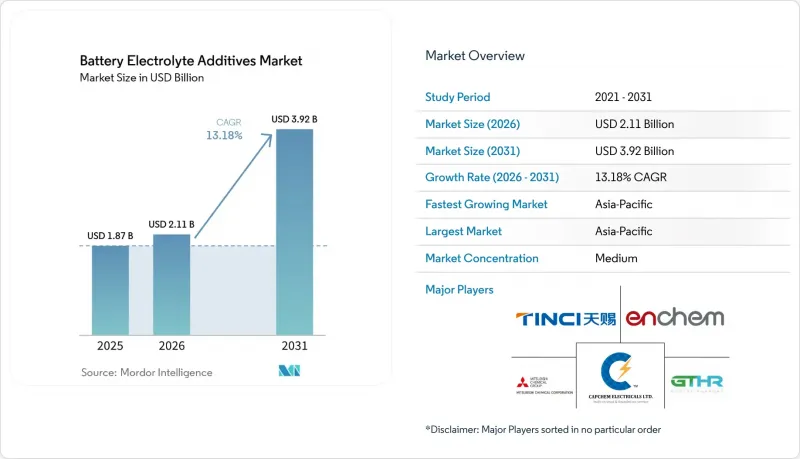
Mordor Intelligence에 의하면, 배터리 전해액 첨가제 시장 규모는 2025년에 18억 7,000만 달러로 평가되었습니다. 2026년 21억 1,000만 달러에서 2031년까지 39억 2,000만 달러로 확대되어 예측 기간(2026-2031년) CAGR은 13.18%가 된다고 전망되고 있습니다.
본 보고서는 화학 조성(비닐렌 카보네이트, 기타), 배터리 유형(리튬 이온 배터리, 기타), 용도(전기자동차, 기타), 최종 사용자 산업(배터리 셀 제조업체, 기타), 지역(아시아태평양, 북미, 유럽, 남미, 중동 및 아프리카)별로 분류되어 있습니다. 시장 전망은 금액(달러) 기준으로 제시되어 있습니다.
세계의 배터리 전해액 첨가제 시장 동향 및 인사이트
전기차용 배터리 생산 확대
전기차용 배터리 생산 확대에 따라 주요 배터리 화학 조성 전반에 걸쳐 전해액 첨가제에 대한 수요가 증가하고 있습니다. 국제에너지기구(IEA) 보고서에 따르면, 2025년에는 약 2,200만 대의 전기차가 생산되었으며, 이 중 중국의 생산 대수가 전 세계 생산량의 약 4분의 3을 차지했습니다. 동 기관은 2026년에는 전 세계적으로 2,300만 대의 전기차가 생산될 것으로 예측했습니다. 이러한 성장은 배터리 전해액 첨가제 시장에 호재가 되고 있습니다. 이는 각 지역에 신설되는 기가팩토리가 자사의 배터리 프로그램을 위해 소재 인증을 획득해야 하기 때문입니다. 따라서 공급업체는 재료 공급량뿐만 아니라 첨가제 검증에 필요한 지속적인 업무를 통해서도 이익을 얻을 수 있습니다. 또한, 북미의 적격성 평가는 ‘우려 대상 외국 기업(FEOC)’에 관한 요건에 의해 점점 더 좌우되고 있으며, 이는 연방 세액 공제 적용 대상이 되는 자재 조달 자격에 영향을 미치고 있습니다.
그리드 규모의 에너지 저장 시스템 확대
그리드 규모의 에너지 저장 시스템은 제한적인 수요 대응 도구의 범위를 넘어 전력망의 핵심 자산으로 자리 잡고 있습니다. 미국 에너지 정보국(EIA)은 2025년에 사상 최대인 15GW가 추가된 데 이어, 2026년에는 24GW 규모의 유틸리티급 배터리 저장 설비가 추가될 것으로 예측했습니다. 이러한 확대는 배터리 전해액 첨가제 시장을 견인하고 있습니다. 이는 고정형 배터리 저장 장치가 15-20년의 수명과 딥 사이클 성능을 중시하기 때문입니다. 이러한 용도에서는 주로 급속 충전을 위해 설계된 소재보다 LiBOB 및 LiDFOB를 포함한 설턴계 및 붕산염계 첨가제가 요구됩니다. 그 결과 발생하는 화학적 요구 사항은 많은 전기차(EV) 프로그램의 요구 사항과는 다릅니다. 또한 에너지 저장 시스템 통합 업체들도 전해액 성능 요구 사항을 설정하는 데 있어 더 직접적인 역할을 수행하고 있습니다.
높은 인증 비용과 긴 셀 검증 주기
새로운 전해액 첨가제는 자동차 용도로 승인받기 전에 셀 수준의 여러 인증 단계를 거쳐야 합니다. 이러한 단계에는 초기 전해액 스크리닝, 다양한 온도 조건 하에서의 장기 사이클 시험, 가스 발생 시험, 안전성 확인을 위한 가혹 조건 시험, OEM(Original Equipment Manufacturer)에 의한 통합 시험이 포함됩니다. 자동차 프로그램에서 이 과정을 완료하는 데는 2-4년이 소요될 수 있습니다. 단일 첨가제 후보에 대한 검증 서비스 비용은 프로그램당 20만-80만 달러 범위입니다. 따라서 경쟁 분자가 더 우수한 성능을 내세운다 하더라도, 기존 배합은 검증된 프로그램에서 2-4년 동안 우위를 유지할 수 있습니다. 첨가제가 변경될 경우, UN 38.3 운송 규정 준수 및 OEM의 설계 변경 절차로 인해 추가적인 시험 요건이 부과될 가능성이 있습니다.
부문 분석
2025년, 비닐렌 카보네이트(VC)는 배터리 전해액 첨가제 시장 점유율의 34.67%를 차지했습니다. 음극 표면에서의 환원 거동은 리튬 이온을 전도하고 용매의 공동 삽입을 억제하는 치밀한 계면층을 형성합니다. 이러한 기능 덕분에 흑연 음극을 사용하는 리튬 이온 배터리에서 초기 용량 손실이 감소합니다. 그 결과, 비닐렌 카보네이트는 시판되는 리튬 이온 배터리 배합에서 표준 피막 형성 소재로서의 입지를 유지하고 있습니다. 이 화학 조성의 배터리 전해액 첨가제 시장 규모는 흑연 음극 셀의 지속적인 보급에 힘입어 성장하고 있습니다. 또한, 확립된 인증 실적을 바탕으로 셀 제조업체는 첨가제 패키지 선정 시 익숙한 출발점을 확보할 수 있습니다.
플루오로에틸렌 카보네이트(FEC)는 가장 빠르게 성장하는 화학 조성으로, 2031년까지의 예측 연평균 성장률(CAGR)은 13.84%를 나타낼 전망입니다. FEC는 실리콘이 풍부한 음극에 적합합니다. 이는 실리콘의 반복적인 팽창과 수축을 통해 계면이 손상되지 않고 유지되어야 하기 때문입니다. 리튬 비스(옥살산) 붕산염(LiBOB) 및 리튬 디플루오로(옥살산) 붕산염(LiDFOB)을 포함한 붕산염계 첨가제는 고전압 시스템에서 양극 보호 기능을 제공하며, VC를 대체하기보다는 이를 보완할 수 있습니다. 1,3-프로판설톤 및 프로펜설톤을 포함한 설폰과 설톤은 양극 패시베이터 및 과충전 방지제 역할을 합니다. 트리스(트리메틸실릴)인산과 같은 인산계 물질은 난연성을 높이고, 고니켈 배터리 내 알루미늄 집전체를 보호합니다. 이러한 물질군의 사용은 단일 배합에서 계면 안정성, 양극 보호, 안전성, 사이클 수명의 균형을 맞추어야 할 필요성을 반영합니다.
2025년, 리튬 이온 배터리는 배터리 전해액 첨가제 시장 점유율의 70.35%를 차지했습니다. 그 대규모 제조거점 덕분에 VC는 기존 배터리 생산에서 사용량이 가장 많은 첨가제가 되었습니다. 리튬인산철(LFP) 및 리튬망간인산철(LMFP) 배터리에는 최대 에너지 밀도보다 긴 수명과 높은 사이클 수를 실현하도록 설계된 조성이 요구됩니다. 이러한 요구 사항으로 인해 그리드 규모의 에너지 저장 용도에서 특수 설폰 및 붕산염 패키지에 대한 수요가 뒷받침되고 있습니다. 리튬 이온 배터리는 예측 기간 동안 생산량의 주축으로 남아 있을 것이며, 그 규모가 유지됨에 따라 견고한 인증과 일관된 순도의 중요성이 지속될 것입니다.
차세대 플랫폼은 2031년까지 연평균 성장률(CAGR) 13.93%를 나타낼 것으로 예측됩니다. 이러한 플랫폼에는 실리콘이 풍부한 음극, 나트륨 이온 배터리, 리튬 금속 배터리가 포함됩니다. 일반적인 용매계에서 나트륨의 배위 구조는 리튬의 배위 구조와 다르며, 리튬 금속 배터리에는 덴드라이트 억제 요건이 있기 때문에 각 플랫폼마다 서로 다른 첨가제 접근 방식이 필요합니다. Group14 Technologies의 SCC55 상용화는 실리콘 음극재가 파일럿 단계에서 상용 공급 단계로 전환되고 있음을 보여줍니다. 국제에너지기구(IEA)에 따르면, 2030년까지 전고체 배터리의 용도는 하이엔드 제품 및 방위 분야로 제한될 전망입니다. 이데미츠 코산(出光興産)이 2026년에 내릴 전고체 전해질 파일럿 플랜트에 대한 최종 투자 결정(2027년 완공 예정)은 향후 수요 변화가 일어날 가능성을 시사하고 있습니다.
지역별 분석
아시아태평양은 2025년 배터리 전해액 첨가제 시장 점유율의 47.02%를 차지했으며, 2031년까지 연평균 성장률(CAGR) 14.05%를 나타낼 것으로 예측됩니다. 2025년, 중국은 전 세계 배터리 셀 생산 능력의 80% 이상을 차지했으며, 이 지역에는 조달 및 제조를 위한 대규모 기반이 갖춰져 있습니다. 중국 내에 제조 거점이나 기술 서비스 체계를 갖추지 않은 공급업체는 이러한 조달 환경에서 불리한 입장에 놓일 가능성이 있습니다. Enchem, Soulbrain, Chunbo, Dongwha Electrolyte 등의 한국 기업들은 한국의 주요 셀 제조업체에 공급하는 한편, 중국의 에너지 저장 시스템(ESS) 시장에서도 경쟁을 펼치고 있습니다. 일본의 미쓰비시 화학은 MU Ionic Solutions를 통해, UBE 주식회사는 독자적인 첨가제 특허를 보유한 지적 재산(IP)이 풍부한 기존 기업으로서의 지위를 유지하고 있습니다.
북미와 유럽에서는 국내 배터리 제조에 대한 투자가 증가함에 따라 낮은 수준에서 시장이 확대되고 있습니다. 미국에서는 미국 에너지정보청(EIA)이 2026년에 24GW 규모의 신규 유틸리티급 저장 용량을 전망하고 있으며, 이것이 해당 지역의 배터리 재료 수요를 뒷받침하고 있습니다. Ultium Cells, 삼성SDI의 시설, 혼다와 LG에너지솔루션의 합작 투자 등을 포함한 지역 내 배터리 생산으로 인해 현지에서 배합된 첨가제 및 수입 첨가제에 대한 수요가 증가하고 있습니다. 유럽의 경우, 재활용 가능성 요건 및 퍼플루오로알킬 물질과 폴리플루오로알킬 물질(PFAS) 관련 규제가 화학 조성 선정에 영향을 미칠 수 있으므로 수요 추세는 다를 수 있습니다. 그 결과, 유럽의 배터리 전해액 첨가제 시장에서는 세계 표준 제품과는 다른 배합이 요구될 가능성이 있습니다. 각 생산 거점이 독자적인 승인된 공급 기반을 구축함에 따라, 지역 기가팩토리 인증을 위한 현지화가 더욱 중요해질 것으로 보입니다.
남미, 중동 및 아프리카는 여전히 초기 단계에 있는 지역이지만, 배터리 전해액 첨가제 시장에서 그 중요성이 높아지고 있습니다. 브라질과 아르헨티나에서는 중국 OEM 업체들의 사업 확장에 따라 전기차 조립 활동이 활발해지고 있으며, 이로 인해 수입 첨가제에 대한 초기 수요가 발생하고, 셀 제조가 뒤따르면서 현지 공급 기반이 뒷받침될 가능성이 있습니다. 2026년 7월, 아프리카 개발 은행은 Gotion Power Morocco의 통합형 인산철 리튬(LFP) 기가팩토리에 대해 1억 유로(약 1억 1,370만 달러)의 대출을 승인했습니다. 이 프로젝트는 1단계에서 10GWh, 본격 가동 시에는 100GWh 생산을 목표로 하고 있습니다. 사우디아라비아의 석유화학 산업 기반 또한 탄산염계 용매 공급을 위한 잠재적 기반을 제공합니다. 이 지역들이 2028-2029년까지 세계 시장 점유율에 실질적인 변화를 가져올 가능성은 낮지만, 조기에 해당 지역에서 생산 체제를 구축하는 기업들에게는 공급망의 대안이 될 것으로 보입니다.
기타 혜택
- 엑셀 형식 시장 예측(ME) 시트
- 3개월간의 애널리스트 지원
자주 묻는 질문
목차
제1장 서론
제2장 조사 방법
제3장 주요 요약
제4장 시장 구도
제5장 시장 규모 및 성장 예측
제6장 경쟁 구도
제7장 시장 기회 및 향후 전망
KTH 26.09.10According to Mordor Intelligence, the battery electrolyte additives market size was estimated at USD 1.87 billion in 2025 and is estimated to grow from USD 2.11 billion in 2026 to USD 3.92 billion by 2031, at a CAGR of 13.18% during the forecast period (2026-2031).

This report is Segmented by Chemistry (Vinylene Carbonate and More), Battery Types (Lithium-Ion Batteries and More), Application (Electric Vehicles and More), End-User Industry (Battery Cell Manufacturers and More), and Geography (Asia-Pacific, North America, Europe, South America, and Middle-East and Africa). The Market Forecasts are Provided in Terms of Value (USD).
Global Battery Electrolyte Additives Market Trends and Insights
Electric Vehicle Battery Production Growth
Electric vehicle battery production is increasing the demand for electrolyte additives across major cell chemistries. The International Energy Agency reported nearly 22 million electric cars produced in 2025, with China accounting for around three-quarters of global output. The agency projects 23 million electric cars globally in 2026. The battery electrolyte additives market benefits from this growth because new regional gigafactories must qualify materials for their own cell programs. A supplier can therefore gain from material quantities and from recurring work needed to validate additives. North American qualification is also increasingly shaped by Foreign Entity of Concern requirements that affect material-sourcing eligibility for federal tax credits.
Expansion of Grid-Scale Energy Storage Systems
Grid-scale storage is becoming a core grid asset rather than a limited demand-response tool. The U.S. Energy Information Administration projected 24 GW of utility-scale battery storage additions in 2026, following a record 15 GW added in 2025. This expansion supports the battery electrolyte additives market because stationary batteries prioritize 15-20 years of calendar life and deep-cycle performance. These applications require sultone-based and borate-based additives, including LiBOB and LiDFOB, over materials designed mainly for fast charging. The resulting chemistry requirement is distinct from that of many electric vehicle programs. Energy storage integrators are also taking a more direct role in setting electrolyte performance requirements.
High Qualification Costs and Long Cell-Validation Cycles
A new electrolyte additive must pass several cell-level qualification steps before it is approved for automotive use. These steps include initial electrolyte screening, extended cycling at various temperatures, gas evolution tests, safety abuse tests, and Original Equipment Manufacturer (OEM) integration tests. Automotive programs can take 2-4 years to complete this process. Validation service fees for a single additive candidate range from USD 200,000 to USD 800,000 per program. Existing formulations can therefore retain a 2-4-year advantage in a validated program, even when competing molecules claim better performance. UN 38.3 transport compliance and OEM engineering-change procedures can add further testing requirements when an additive is changed.
Other drivers and restraints analyzed in the detailed report include:
- Demand for Higher Voltage and Longer-Life Cells
- Commercialization of Silicon-Rich Anodes and High-Nickel Cathodes
- Raw-Material Price Volatility and Limited High-Purity Supply
For complete list of drivers and restraints, kindly check the Table Of Contents.
Segment Analysis
Vinylene carbonate (VC) held 34.67% of the battery electrolyte additives market share in 2025. Its reduction behavior at the anode surface forms a dense interphase that conducts lithium ions and limits solvent co-intercalation. This function reduces initial capacity loss in graphite-anode lithium-ion cells. As a result, vinylene carbonate has remained a standard film-forming material in commercial lithium-ion formulations. The battery electrolyte additives market size for this chemistry is supported by the continued scale of graphite-anode cells. Its established qualification history also gives cell makers a familiar starting point for additive packages.
Fluoroethylene carbonate (FEC) is the fastest-growing chemistry, with a forecast CAGR of 13.84% through 2031. FEC is suited to silicon-rich anodes because the interphase must remain intact through repeated silicon expansion and contraction. Borate-based additives, including lithium bis(oxalato)borate (LiBOB) and lithium difluoro(oxalate)borate (LiDFOB), provide cathode protection in high-voltage systems and can complement VC rather than replace it. Sulfones and sultones, including 1,3-propane sultone and propene sultone, act as cathode passivators and overcharge protectors. Phosphate-based materials, such as tris(trimethylsilyl)phosphate, enhance flame retardancy and protect aluminum current collectors in high-nickel cells. The use of these material families reflects the need to balance interphase stability, cathode protection, safety, and cycle life in a single formulation.
Lithium-ion batteries accounted for 70.35% of the battery electrolyte additives market share in 2025. Their large installed manufacturing base keeps VC the highest-tonnage additive across conventional cell production. Lithium iron phosphate (LFP) and lithium manganese iron phosphate (LMFP) batteries require formulations designed for long calendar life and high cycle counts rather than maximum energy density. This requirement supports demand for specialized sultone and borate packages in grid storage applications. Lithium-ion batteries will remain the output foundation across the forecast period, and their continuing scale preserves the importance of robust qualification and consistent purity.
Next-generation platforms are forecast to grow at a 13.93% CAGR through 2031. These platforms include silicon-rich anode, sodium-ion, and lithium-metal batteries. Each platform requires a different additive approach because sodium coordination differs from lithium coordination in common solvent systems, and lithium-metal cells impose dendrite-suppression requirements. Group14 Technologies' commercial SCC55 production illustrates the movement of silicon anode materials from pilot activity toward commercial supply. Solid-state batteries remain limited to premium and defense applications through 2030, according to the International Energy Agency. Idemitsu Kosan's 2026 final investment decision for a solid-electrolyte pilot plant, targeted for completion in 2027, points to a possible later shift in demand.
Complete Report Scope:
- By Chemistry
- Vinylene Carbonate
- Fluoroethylene Carbonate
- Borate-Based Additives (LiBOB, LiDFOB)
- Sulfones and Sultones
- Phosphate-Based Additives
- Others
- By Battery Types
- Lithium-Ion Batteries
- LFP and LMFP Batteries
- Next-Generation Batteries (Silicon-Rich Anode, Sodium-Ion, Lithium-Metal)
- Solid-State Batteries
- Others
- By Application
- Electric Vehicles
- Energy Storage Systems
- Consumer Electronics
- Industrial Applications
- Others
- By End-User Industry
- Battery Cell Manufacturers
- Electrolyte Formulators
- Electric Vehicle OEMs
- Energy Storage Integrators
- Others
- By Geography
- Asia-Pacific
- China
- India
- Japan
- South Korea
- ASEAN Countries
- Rest of Asia-Pacific
- North America
- United States
- Canada
- Mexico
- Europe
- Germany
- United Kingdom
- France
- Italy
- Spain
- NORDIC Countries
- Russia
- Rest of Europe
- South America
- Brazil
- Argentina
- Rest of South America
- Middle-East and Africa
- Saudi Arabia
- South Africa
- Rest of Middle-East and Africa
- Asia-Pacific
Geography Analysis
Asia-Pacific held 47.02% of the battery electrolyte additives market share in 2025 and is forecast to grow at a 14.05% CAGR through 2031. China accounted for more than 80% of global battery cell production capacity in 2025, giving the region a large base for procurement and manufacturing. Suppliers without China-based manufacturing or technical service capabilities may be at a disadvantage in this procurement environment. South Korean companies such as Enchem, Soulbrain, Chunbo, and Dongwha Electrolyte supply major Korean cell makers and compete in China's energy storage system (ESS) market. Japan's Mitsubishi Chemical, through MU Ionic Solutions, and UBE Corporation retain positions as IP-rich incumbents with original additive patents.
North America and Europe are growing from lower bases as domestic cell manufacturing investment increases. In the United States, the U.S. Energy Information Administration (EIA) projects 24 GW of new utility-scale storage capacity in 2026, supporting regional demand for battery materials. Regional cell production, including Ultium Cells, Samsung SDI facilities, and Honda-LG Energy Solution joint ventures, is increasing the need for locally blended and imported additives. Europe presents a different demand profile, as recyclability requirements and per- and polyfluoroalkyl substances (PFAS)-related regulations can affect the selection of chemistry. As a result, the battery electrolyte additives market in Europe may require formulations that differ from globally standard products. Localization for regional gigafactory qualifications is likely to become more important as each manufacturing hub develops its own approved supply base.
South America, the Middle-East, and Africa remain early-stage regions but are becoming more relevant to the battery electrolyte additives market. Brazil and Argentina have seen growing electric vehicle assembly activity linked to Chinese OEM expansion, creating initial demand for imported additives and potentially supporting local supply as cell manufacturing follows. In July 2026, the African Development Bank approved a EUR 100 million loan (~USD 113.7 million) for Gotion Power Morocco's integrated lithium iron phosphate (LFP) gigafactory. The project targets 10 GWh in Phase 1 and 100 GWh at full build-out. Saudi Arabia's petrochemical base also provides a potential foundation for supplying carbonate solvents. These regions are unlikely to materially shift global market shares before 2028-2029, but they offer supply chain options for firms that establish regional capabilities early.
- 3M
- Asahi Kasei Corporation
- BASF
- Capchem Electricals Limited
- Central Glass Co., Ltd.
- Chunbo Co., Ltd.
- Dongwha Group
- ENCHEM Co., Ltd.
- Guangzhou Tinci Materials Technology Co., Ltd.
- Idemitsu Kosan Co.,Ltd.
- LG Chem
- Mitsubishi Chemical Corporation
- NEI Corporation
- Solvay
- Soulbrain Co., Ltd.
- UBE Corporation
- Zhangjiagang Guotai Huarong New Chemical Materials Co.,Ltd.
- Zhejiang Yongtai Technology Co., Ltd.
Additional Benefits:
- The market estimate (ME) sheet in Excel format
- 3 months of analyst support
TABLE OF CONTENTS
1 Introduction
- 1.1 Study Assumptions and Market Definition
- 1.2 Scope of the Study
2 Research Methodology
3 Executive Summary
4 Market Landscape
- 4.1 Market Overview
- 4.2 Market Drivers
- 4.2.1 Electric Vehicle Battery Production Growth
- 4.2.2 Expansion of Grid-Scale Energy Storage Systems
- 4.2.3 Demand for Higher-Voltage and Longer-Life Cells
- 4.2.4 Commercialization of Silicon-Rich Anodes and High-Nickel Cathodes
- 4.2.5 Formulation Localization for Regional Gigafactory Qualification
- 4.2.6 Additive Co-Optimization with Battery Manufacturing Data Systems
- 4.3 Market Restraints
- 4.3.1 High Qualification Costs and Long Cell-Validation Cycles
- 4.3.2 Raw-Material Price Volatility and Limited High-Purity Supply
- 4.3.3 Additive Loading Trade-Offs with Energy Density
- 4.3.4 PFAS Compliance Uncertainty and Fluorinated Chemistry Substitution Risk
- 4.4 Value Chain Analysis
- 4.5 Porter's Five Forces Analysis
- 4.5.1 Threat of New Entrants
- 4.5.2 Bargaining Power of Suppliers
- 4.5.3 Bargaining Power of Buyers
- 4.5.4 Threat of Substitutes
- 4.5.5 Competitive Rivalry
5 Market Size and Growth Forecasts (Value)
- 5.1 By Chemistry
- 5.1.1 Vinylene Carbonate
- 5.1.2 Fluoroethylene Carbonate
- 5.1.3 Borate-Based Additives (LiBOB, LiDFOB)
- 5.1.4 Sulfones and Sultones
- 5.1.5 Phosphate-Based Additives
- 5.1.6 Others
- 5.2 By Battery Types
- 5.2.1 Lithium-Ion Batteries
- 5.2.2 LFP and LMFP Batteries
- 5.2.3 Next-Generation Batteries (Silicon-Rich Anode, Sodium-Ion, Lithium-Metal)
- 5.2.4 Solid-State Batteries
- 5.2.5 Others
- 5.3 By Application
- 5.3.1 Electric Vehicles
- 5.3.2 Energy Storage Systems
- 5.3.3 Consumer Electronics
- 5.3.4 Industrial Applications
- 5.3.5 Others
- 5.4 By End-User Industry
- 5.4.1 Battery Cell Manufacturers
- 5.4.2 Electrolyte Formulators
- 5.4.3 Electric Vehicle OEMs
- 5.4.4 Energy Storage Integrators
- 5.4.5 Others
- 5.5 By Geography
- 5.5.1 Asia-Pacific
- 5.5.1.1 China
- 5.5.1.2 India
- 5.5.1.3 Japan
- 5.5.1.4 South Korea
- 5.5.1.5 ASEAN Countries
- 5.5.1.6 Rest of Asia-Pacific
- 5.5.2 North America
- 5.5.2.1 United States
- 5.5.2.2 Canada
- 5.5.2.3 Mexico
- 5.5.3 Europe
- 5.5.3.1 Germany
- 5.5.3.2 United Kingdom
- 5.5.3.3 France
- 5.5.3.4 Italy
- 5.5.3.5 Spain
- 5.5.3.6 NORDIC Countries
- 5.5.3.7 Russia
- 5.5.3.8 Rest of Europe
- 5.5.4 South America
- 5.5.4.1 Brazil
- 5.5.4.2 Argentina
- 5.5.4.3 Rest of South America
- 5.5.5 Middle-East and Africa
- 5.5.5.1 Saudi Arabia
- 5.5.5.2 South Africa
- 5.5.5.3 Rest of Middle-East and Africa
- 5.5.1 Asia-Pacific
6 Competitive Landscape
- 6.1 Market Concentration
- 6.2 Strategic Moves
- 6.3 Market Share (%)/Ranking Analysis
- 6.4 Company Profiles (includes Global Overview, Market Overview, Core Segments, Financials as available, Strategic Information, Products and Services, Recent Developments)
- 6.4.1 3M
- 6.4.2 Asahi Kasei Corporation
- 6.4.3 BASF
- 6.4.4 Capchem Electricals Limited
- 6.4.5 Central Glass Co., Ltd.
- 6.4.6 Chunbo Co., Ltd.
- 6.4.7 Dongwha Group
- 6.4.8 ENCHEM Co., Ltd.
- 6.4.9 Guangzhou Tinci Materials Technology Co., Ltd.
- 6.4.10 Idemitsu Kosan Co.,Ltd.
- 6.4.11 LG Chem
- 6.4.12 Mitsubishi Chemical Corporation
- 6.4.13 NEI Corporation
- 6.4.14 Solvay
- 6.4.15 Soulbrain Co., Ltd.
- 6.4.16 UBE Corporation
- 6.4.17 Zhangjiagang Guotai Huarong New Chemical Materials Co.,Ltd.
- 6.4.18 Zhejiang Yongtai Technology Co., Ltd.
7 Market Opportunities and Future Outlook
- 7.1 White-Space and Unmet-Need Assessment