|
시장보고서
상품코드
2119252
배터리 전극 바인더 재료 : 시장 점유율 분석, 업계 동향 및 통계, 성장 예측(2026-2031년)Battery Electrode Binder Materials - Market Share Analysis, Industry Trends & Statistics, Growth Forecasts (2026 - 2031) |
||||||
 Mordor Intelligence
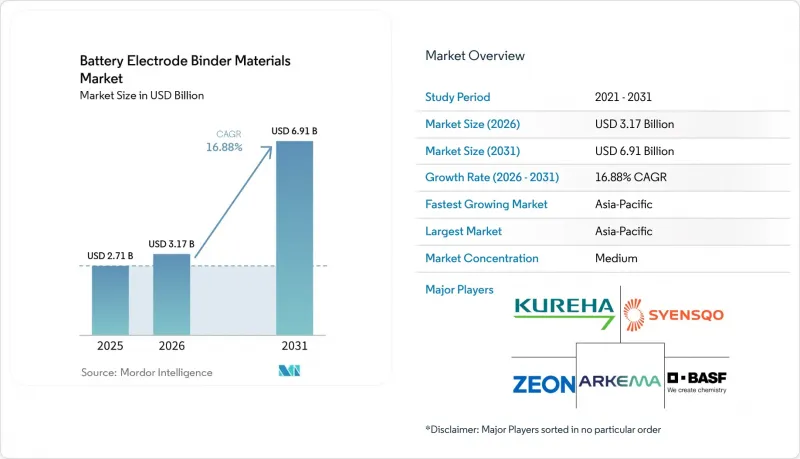
Mordor Intelligence에 의하면, 배터리 전극 바인더 재료 시장은 2025년에 27억 1,000만 달러 규모로 평가되었습니다. 2026년 31억 7,000만 달러에서 2031년까지 69억 1,000만 달러에 이를 것으로 예상되며, 예측 기간(2026-2031년) CAGR은 16.88%를 나타낼 전망입니다.
본 보고서는 화학 조성(폴리비닐리덴플루오라이드(PVDF), SBR/CMC, 기타), 전극 유형(양극 바인더, 음극 바인더), 배터리 화학 조성(NMC/NCA 배터리, 기타),용도(전기차, 기타), 지역(아시아태평양, 북미, 유럽, 남미, 중동 및 아프리카)별로 분류되어 있습니다. 시장 예측은 금액(달러) 기준으로 제시되어 있습니다.
세계의 배터리 전극 바인더 재료 시장 동향 및 인사이트
전기차 및 기가팩토리의 생산 능력 확대
확정된 셀 공장의 생산 능력 확대는 배터리 전극 바인더 재료 시장에 있어 지속적인 수요 기반이 되고 있습니다. 새로운 생산 라인이 추가될 때마다 상용 셀 생산을 시작하기 전에 인증된 바인더공급 체계를 구축해야 합니다. 미국의 개발업체들은 2025년에 15GW를 추가한 후, 2026년에는 24GW 규모의 유틸리티급 에너지 저장 시스템을 추가할 계획이며, 이는 전기차용 셀 제조에 더해 고정형 수요도 증가하게 될 것입니다. 아르케마(Arkema)는 북미의 배터리 생산 확대를 지원하기 위해 2026년 6월 켄튀르키예주 칼버트시티에서 PVDF 생산 능력을 15% 증설했습니다. 일부 지역에서는 인증된 공급량이 발표된 배터리 생산 능력을 여전히 하회하고 있습니다. 이러한 격차로 인해 현재 인증 주기에서 현지에서 생산되고 인증을 받은 바인더 등급에 대한 수요가 뒷받침되고 있습니다.
그리드 규모의 에너지 저장 시스템 도입
그리드 규모의 에너지 저장 시스템은 배터리 전극 바인더 재료 시장에서 독자적인 수요 기반을 형성하고 있습니다. 이러한 시스템에는 긴 수명과 비용 관리가 요구되며, 많은 인산철 리튬(LFP) 셀에서 수성 CMC/SBR 바인더 구성이 선호되고 있습니다. 축전지 시스템은 2031년까지 연평균 성장률(CAGR) 19.05%를 나타낼 것으로 예측됩니다. 사업자들은 일반적으로 에너지 밀도나 급속 충전 성능보다 사이클 수명, 처리 능력, 소재 비용을 우선시합니다. 『Nature Communications』지에 게재된 연구에 따르면, 코스모트로픽 수성 공정을 채택함으로써 NMP 기반 공정과 비교하여 양극재의 제조 운영 비용을 23%, 관련 자본 비용을 95% 절감할 수 있는 것으로 보고되었습니다. 이 제조 기법을 통해 에너지 저장 시스템의 도입이 확대됨에 따라 수성 공정의 역할이 더욱 확대될 가능성이 있습니다.
불소계 폴리머 원료 및 공급의 집중
배터리 등급 PVDF공급은 여전히 소수의 인증 제조업체에 집중되어 있습니다. 업스트림 공정에서의 R142b 의존도는 PVDF계 바인더 시스템에 주기적인 조달 압박을 초래할 가능성이 있습니다. 유럽화학물질청(ECHA)은 2026년에 유럽집행위원회에 제안된 퍼플루오로알킬 물질 및 폴리플루오로알킬 물질(PFAS) 규제에 대한 최종 위원회 의견을 제출할 예정입니다. 현재 제안에는 화학물질의 등록, 평가, 허가 및 제한(REACH)에 따라 에너지 분야의 배터리용 바인더 용도에 대한 13.5년간의 적용 예외가 포함되어 있습니다. 이 규정의 재검토로 인해 유럽의 셀 제조업체들은 불소를 포함하지 않는 양극 바인더 대안을 모색하도록 촉구하고 있습니다. 크레하는 이와키 공장의 생산 능력을 연간 8,000톤 확대하고 있으며, 2026년도에 상업 운전을 시작할 예정입니다.
부문별 분석
2025년 기준, 화학 조성별 배터리 전극 바인더 재료 시장에서 PVDF는 42.08%의 점유율을 차지했습니다. 이러한 위상은 리튬 이온 배터리 분야에서 오랫동안 입증된 적합성과 고니켈 양극재에 요구되는 안정성 요건을 반영한 것입니다. PVDF는 양극 조성에서 검증된 전기화학적 성능이 요구되는 상황에서 여전히 특히 중요한 역할을 하고 있습니다. Arkema의 ‘Kynar HSV 1200’ 및 ‘HSV 1400’ 제품은 접착성 향상과 바인더 함량 감소를 실현한 LFP 양극재를 대상으로 합니다. 이러한 접근 방식을 통해 공급업체는 새로운 양극 설계를 위해 확립된 화학 조성을 개선할 수 있게 됩니다. 배터리 전극 바인더 재료 산업에서는 많은 인증된 양극 플랫폼에서 PVDF가 계속해서 신뢰받고 있습니다.
SBR/CMC는 2031년까지 연평균 성장률(CAGR) 18.21%를 나타낼 것으로 예측됩니다. 이러한 성장은 수성 음극 처리에 대한 전환과 흑연 및 실리콘-흑연 음극과의 적합성을 반영한 것입니다. BASF의 생산 거점은 아시아와 유럽 및 미국의 셀 제조업체 모두에 대한 공급을 뒷받침하고 있습니다. PTFE는 기계적 전단 하에서 피브리릴화되기 때문에 건식 전극 파일럿 프로그램에서 주목받고 있습니다. PAA계 바인더 또한 고니켈 양극재의 수성 처리로 가는 길을 제시하고 있습니다. 『Nature Communications』지의 연구에 따르면, 코스모트로픽 수성 공정을 사용한 여러 NMC 양극재에 대해 NMP 계열 처리에 비해 재료 비용을 96% 절감하면서도 동등한 사이클 수명을 달성한 것으로 보고되었습니다.
2025년, 양극 바인더는 배터리 전극 바인더 재료 시장 매출 점유율의 59.67%를 차지했습니다. 재료 부하량 증가와 PVDF계 시스템이 가져다주는 경제적 우위가 이러한 주도적인 위치를 뒷받침했습니다. 또한, 양극 배합과 관련하여 셀 제조업체와 인증 공급업체 간에 내구성에 관한 인증 체계가 확립되어 있습니다. 양극 바인더 시장 규모는 가혹한 전압 조건에서도 안정적인 성능이 요구되는 고니켈 셀에 의해 뒷받침되고 있습니다. PVDF-그래프트-PAA 바인더 네트워크에 대한 연구에서는 NMC811 양극에서 인성, 탄성, 리튬 이온 전도성이 향상된 것으로 나타났습니다. 이러한 결과는 차세대 양극의 인증 기준에 영향을 미칠 가능성이 있습니다.
음극 바인더 시장은 2031년까지 연평균 성장률(CAGR) 18.33%를 나타낼 것으로 예측됩니다. 실리콘의 도입과 나트륨 이온 배터리 규모의 확대로 인해, 보다 전문성이 높은 음극 배합에 대한 수요가 증가하고 있습니다. 2024년 4월, Primearth EV Energy는 도요타의 하이브리드 차량용 배터리에 Resonac의 폴리아미드이미드 바인더 ‘POLYSOL LB’를 채택했습니다. 이 소재는 전극의 무결성을 유지하면서 최대 30%의 실리콘 활물질 함량을 지원할 수 있습니다. 또한 UBE도 실리콘계 음극용 수용성 폴리이미드 바인더를 발표했습니다. 이러한 제품들은 음극 바인더를 기존 흑연만을 표준 소재로 취급하던 관행에서 벗어나고 있음을 보여줍니다.
지역별 분석
아시아태평양은 2025년 배터리 전극 바인더 재료 시장 매출 점유율의 47.25%를 차지했으며, 2031년까지 연평균 성장률(CAGR) 18.17%로 성장할 것으로 전망됩니다. 양쯔강 삼각주와 주강 삼각주에 위치한 중국의 생산 클러스터는 PVDF와 SBR/CMC의 주요 소비 거점입니다. 쿠레하는 중국 내 개별 배터리 제조업체의 PVDF 연간 소비량을 1만 5,000-2만 톤으로 추정하고 있습니다. 한국과 일본은 NMC811 및 실리콘·흑연 바인더 시스템의 인증 요건을 수립하는 데 중요한 역할을 하고 있습니다.
아르케마(Arkema)는 2026년 3월, 중국 창수(常熟)의 PVDF 생산 능력을 20% 확대할 것이라고 발표했으며, 2028년 가동을 시작할 예정입니다. 인도는 생산 연계형 인센티브 프로그램을 통해 배터리 제조를 확대되고 있습니다. 아세안 시장도 전기차 정책에 연계된 초기 단계의 배터리 조립 활동을 유치하고 있습니다. 북미와 유럽에서는 현지화 및 규정 준수 요건에 대응하기 위해 현지 생산 능력을 강화하고 있습니다. Arkema는 2026년 6월, 2,000만 달러를 투자하여 칼버트 시티의 PVDF 생산 능력 확장을 완료했습니다. BASF는 2025년 3월, 펜실베이니아주 모나카와 테네시주 채터누가에 ‘Licity’ 음극 바인더 생산 거점을 설립했습니다.
EU 배터리 규정에 따르면, 2025년 2월부터 배터리 실사(due diligence) 정책이 의무화되며, 2026년부터는 배터리 여권 요건이 도입됩니다. 이러한 규정은 유럽 공급망 내 인증 및 추적성 실무에 영향을 미칠 것입니다. Syensqo는 Orbia와 공동으로 사우스캐롤라이나주 오거스타에 PVDF 생산 거점을 개발하여 서방 국가들 수요에 대응할 예정입니다. 남미, 중동 및 아프리카는 현재로서는 비교적 소규모 수요 거점입니다. 브라질, 아르헨티나, 남아프리카공화국, 사우디아라비아는 배터리 공급망 계획, 광물 자원, 에너지 저장 분야 투자를 통해 장기적으로 중요한 위치를 차지하게 될 것입니다. 이 지역들에서는 조기에 인증을 획득할 기회가 있지만, 2031년까지는 세계 판도를 바꿀 정도의 영향력은 미치지 못할 것으로 예측됩니다.
기타 혜택
- 엑셀 형식 시장 예측(ME) 시트
- 3개월간의 애널리스트 지원
목차
제1장 서론
제2장 조사 방법
제3장 주요 요약
제4장 시장 구도
제5장 시장 규모 및 성장 예측
제6장 경쟁 구도
제7장 시장 기회 및 향후 전망
KTHAccording to Mordor Intelligence, the battery electrode binder materials market was valued at USD 2.71 billion in 2025 and is estimated to grow from USD 3.17 billion in 2026 to reach USD 6.91 billion by 2031, at a CAGR of 16.88% during the forecast period (2026-2031).
This report is Segmented by Chemistry (Polyvinylidene Fluoride (PVDF), SBR/CMC, and More), Electrode Type (Cathode Binders and Anode Binders), Battery Chemistry (NMC/NCA Batteries, and More), Application (Electric Vehicles, and More), and Geography (Asia-Pacific, North America, Europe, South America, and Middle-East and Africa). The Market Forecasts are Provided in Terms of Value (USD).
Global Battery Electrode Binder Materials Market Trends and Insights
Electric Vehicle and Gigafactory Capacity Expansion
Committed cell-factory capacity additions continue to provide a clear demand base for the battery electrode binder materials market. Each new production line needs qualified binder supply arrangements before commercial cell output begins. U.S. developers plan to add 24 GW of utility-scale battery storage in 2026 after adding 15 GW in 2025, adding stationary demand alongside electric-vehicle cell manufacturing. Arkema completed a 15% PVDF capacity expansion at Calvert City, Kentucky, in June 2026 to support the North American battery ramp. Regional qualified supply still trails announced cell capacity in some locations. This gap supports demand for locally produced and approved binder grades during the current qualification cycle.
Grid-Scale Battery Energy Storage Deployment
Grid-scale storage is creating a separate demand base within the battery electrode binder materials market. These systems require long service life and cost discipline, which favors aqueous CMC/SBR binder configurations for many lithium iron phosphate (LFP) cells. Battery energy storage systems are projected to grow at a 19.05% CAGR through 2031. Operators commonly prioritize cycle life, throughput, and material cost rather than energy density or fast-charge performance. A study in Nature Communications reported that a kosmotropic aqueous process could reduce cathode manufacturing operating costs by 23% and related capital costs by 95% compared with NMP-based processing. This manufacturing path can widen the role of water-based processing as storage deployments expand.
Fluoropolymer Feedstock and Supply Concentration
Battery-grade PVDF supply remains concentrated among a limited group of qualified manufacturers. Upstream dependence on R142b can lead to periodic procurement pressure for PVDF-based binder systems. The European Chemicals Agency is due to provide final committee opinions on the proposed per- and polyfluoroalkyl substances (PFAS) restriction to the European Commission in 2026. The current proposal includes a 13.5-year derogation for energy-sector battery-binder uses under Registration, Evaluation, Authorization, and Restriction of Chemicals (REACH). This regulatory review is encouraging European cell producers to consider fluorine-free cathode-binder options. Kureha is expanding Iwaki Factory capacity by 8,000 metric tons per year, with commercial operation scheduled for fiscal 2026.
Other drivers and restraints analyzed in the detailed report include:
- Silicon-Rich Anode Qualification Requirements
- Dry-Electrode Process Commercialization
- High Binder Qualification and Switching Costs
For complete list of drivers and restraints, kindly check the Table Of Contents.
Segment Analysis
PVDF held 42.08% of the battery electrode binder materials market share by chemistry in 2025. Its position reflects a long qualification history in lithium-ion cells and the stability requirements of high-nickel cathodes. PVDF remains particularly relevant where cathode formulations require proven electrochemical performance. Arkema's Kynar HSV 1200 and HSV 1400 products target LFP cathodes with improved adhesion and lower binder loading. This approach allows suppliers to improve established chemistry for newer cathode designs. The battery electrode binder materials industry continues to rely on PVDF for many qualified cathode platforms.
SBR/CMC is forecast to grow at an 18.21% CAGR through 2031. Its growth reflects the transition toward water-based anode processing and compatibility with graphite and silicon-graphite anodes. BASF's production footprint supports supply to both Asian and Western cell producers. PTFE is gaining attention in dry-electrode pilot programs because it fibrillates under mechanical shear. PAA-based binders also offer a route to aqueous processing for high-nickel cathodes. The Nature Communications study reported comparable cycle life for several NMC cathodes using a kosmotropic aqueous process, with 96% lower material cost than NMP-based processing.
Cathode binders accounted for 59.67% of the battery electrode binder materials market revenue share in 2025. Higher material loading and the premium economics of PVDF-based systems supported this leading position. Cathode formulations also involve durable qualification relationships between cell producers and approved suppliers. The battery electrode binder materials market size for cathode binders is supported by high-nickel cells that require stable performance at demanding voltages. Research on PVDF-graft-PAA binder networks points to improvements in toughness, elasticity, and lithium-ion transport for NMC811 cathodes. These results can influence the criteria for next-generation cathode qualification.
Anode binders are projected to grow at an 18.33% CAGR through 2031. Silicon adoption and sodium-ion scale-up are increasing the demand for more specialized anode formulations. Primearth EV Energy adopted Resonac's POLYSOL LB polyamide-imide binder for Toyota hybrid-vehicle batteries in April 2024. The material can tolerate up to 30% silicon active-material content while maintaining electrode integrity. UBE has also presented a water-soluble polyimide binder for silicon-based anodes. These products show a shift away from treating anode binders as standard graphite-only materials.
Complete Report Scope:
- By Chemistry
- Polyvinylidene Fluoride (PVDF)
- SBR/CMC
- PTFE
- Polyacrylic Acid (PAA)
- Other Chemistries (Alginate, Bio-based, Other Fluorine-Free Binders)
- By Electrode Type
- Cathode Binders
- Anode Binders
- By Battery Chemistry
- NMC/NCA Batteries
- LFP/LMFP Batteries
- Sodium-Ion Batteries
- Solid-State Batteries
- Other Battery Chemistries (LCO, LMO, Lead-Acid and Emerging Chemistries)
- By Application
- Electric Vehicles
- Battery Energy Storage Systems
- Consumer Electronics
- Industrial Applications
- Other Applications
- By Geography
- Asia-Pacific
- China
- India
- Japan
- South Korea
- ASEAN Countries
- Rest of Asia-Pacific
- North America
- United States
- Canada
- Mexico
- Europe
- Germany
- United Kingdom
- France
- Italy
- NORDIC Countries
- Russia
- Rest of Europe
- South America
- Brazil
- Argentina
- Rest of South America
- Middle-East and Africa
- Saudi Arabia
- South Africa
- Rest of Middle-East and Africa
- Asia-Pacific
Geography Analysis
Asia-Pacific held 47.25% of the battery electrode binder materials market revenue share in 2025 and is forecast to grow at an 18.17% CAGR through 2031. Chinese production clusters in the Yangtze River Delta and Pearl River Delta are important consumption centers for PVDF and SBR/CMC. Kureha has cited annual PVDF consumption of 15,000 to 20,000 metric tons for individual Chinese battery manufacturers. South Korea and Japan play an important role in setting qualification requirements for NMC811 and silicon-graphite binder systems.
Arkema announced a 20% PVDF capacity expansion at Changshu, China, in March 2026, with startup planned for 2028. India is scaling battery manufacturing through production-linked incentive programs. ASEAN markets are also attracting early battery-assembly activity linked to electric-vehicle policies. North America and Europe are adding local production capacity to address localization and compliance requirements. Arkema completed its USD 20 million Calvert City PVDF expansion in June 2026. BASF established Licity anode-binder production capability in Monaca, Pennsylvania, and Chattanooga, Tennessee, in March 2025.
The EU Batteries Regulation requires battery due-diligence policies from February 2025 and introduces battery passport requirements from 2026. These rules affect qualification and traceability practices in European supply chains. Syensqo is developing an Augusta, South Carolina PVDF site with Orbia to supply Western demand. South America, and Middle-East and Africa currently represent smaller demand centers. Brazil, Argentina, South Africa, and Saudi Arabia have longer-term relevance through battery supply-chain plans, mineral resources, and energy-storage investment. These areas offer early qualification opportunities but are not expected to change the global balance through 2031.
- Arkema
- Ashland
- BASF
- DAIKIN INDUSTRIES, Ltd.
- ENEOS Materials Corporation
- KUREHA CORPORATION
- LG Chem
- Resonac Holdings Corporation
- SUMITOMO SEIKA CHEMICALS CO.,LTD.
- Syensqo
- Synthomer plc
- The Chemours Company
- UBE Corporation
- ZEON CORPORATION
Additional Benefits:
- The market estimate (ME) sheet in Excel format
- 3 months of analyst support
TABLE OF CONTENTS
1 Introduction
- 1.1 Study Assumptions and Market Definition
- 1.2 Scope of the Study
2 Research Methodology
3 Executive Summary
4 Market Landscape
- 4.1 Market Overview
- 4.2 Market Drivers
- 4.2.1 Electric Vehicle and Gigafactory Capacity Expansion
- 4.2.2 Grid-Scale Battery Energy Storage Deployment
- 4.2.3 Silicon-Rich Anode Qualification Requirements
- 4.2.4 Water-Based Electrode Manufacturing Adoption
- 4.2.5 Dry-Electrode Process Commercialization
- 4.2.6 Demand for High-Voltage and High-Nickel Cathode Stability
- 4.3 Market Restraints
- 4.3.1 High Binder Qualification and Switching Costs
- 4.3.2 Fluoropolymer Feedstock and Supply Concentration
- 4.3.3 Performance Trade-Offs in Emerging Binder Systems
- 4.3.4 Uncertain Scale-Up Timing for Dry-Electrode Lines
- 4.4 Value Chain Analysis
- 4.5 Porter's Five Forces Analysis
- 4.5.1 Threat of New Entrants
- 4.5.2 Bargaining Power of Suppliers
- 4.5.3 Bargaining Power of Buyers
- 4.5.4 Threat of Substitutes
- 4.5.5 Competitive Rivalry
5 Market Size and Growth Forecasts (Value)
- 5.1 By Chemistry
- 5.1.1 Polyvinylidene Fluoride (PVDF)
- 5.1.2 SBR/CMC
- 5.1.3 PTFE
- 5.1.4 Polyacrylic Acid (PAA)
- 5.1.5 Other Chemistries (Alginate, Bio-based, Other Fluorine-Free Binders)
- 5.2 By Electrode Type
- 5.2.1 Cathode Binders
- 5.2.2 Anode Binders
- 5.3 By Battery Chemistry
- 5.3.1 NMC/NCA Batteries
- 5.3.2 LFP/LMFP Batteries
- 5.3.3 Sodium-Ion Batteries
- 5.3.4 Solid-State Batteries
- 5.3.5 Other Battery Chemistries (LCO, LMO, Lead-Acid and Emerging Chemistries)
- 5.4 By Application
- 5.4.1 Electric Vehicles
- 5.4.2 Battery Energy Storage Systems
- 5.4.3 Consumer Electronics
- 5.4.4 Industrial Applications
- 5.4.5 Other Applications
- 5.5 By Geography
- 5.5.1 Asia-Pacific
- 5.5.1.1 China
- 5.5.1.2 India
- 5.5.1.3 Japan
- 5.5.1.4 South Korea
- 5.5.1.5 ASEAN Countries
- 5.5.1.6 Rest of Asia-Pacific
- 5.5.2 North America
- 5.5.2.1 United States
- 5.5.2.2 Canada
- 5.5.2.3 Mexico
- 5.5.3 Europe
- 5.5.3.1 Germany
- 5.5.3.2 United Kingdom
- 5.5.3.3 France
- 5.5.3.4 Italy
- 5.5.3.5 NORDIC Countries
- 5.5.3.6 Russia
- 5.5.3.7 Rest of Europe
- 5.5.4 South America
- 5.5.4.1 Brazil
- 5.5.4.2 Argentina
- 5.5.4.3 Rest of South America
- 5.5.5 Middle-East and Africa
- 5.5.5.1 Saudi Arabia
- 5.5.5.2 South Africa
- 5.5.5.3 Rest of Middle-East and Africa
- 5.5.1 Asia-Pacific
6 Competitive Landscape
- 6.1 Market Concentration
- 6.2 Strategic Moves
- 6.3 Market Share (%)/Ranking Analysis
- 6.4 Company Profiles (includes Global Overview, Market Overview, Core Segments, Financials as available, Strategic Information, Products and Services, and Recent Developments)
- 6.4.1 Arkema
- 6.4.2 Ashland
- 6.4.3 BASF
- 6.4.4 DAIKIN INDUSTRIES, Ltd.
- 6.4.5 ENEOS Materials Corporation
- 6.4.6 KUREHA CORPORATION
- 6.4.7 LG Chem
- 6.4.8 Resonac Holdings Corporation
- 6.4.9 SUMITOMO SEIKA CHEMICALS CO.,LTD.
- 6.4.10 Syensqo
- 6.4.11 Synthomer plc
- 6.4.12 The Chemours Company
- 6.4.13 UBE Corporation
- 6.4.14 ZEON CORPORATION
7 Market Opportunities and Future Outlook
- 7.1 White-Space and Unmet-Need Assessment