|
시장보고서
상품코드
2119254
물 전해 스택 소재 및 구성 요소 : 시장 점유율 분석, 업계 동향 및 통계, 성장 예측(2026-2031년)Water Electrolyzer Stack Materials and Components - Market Share Analysis, Industry Trends & Statistics, Growth Forecasts (2026 - 2031) |
||||||
 Mordor Intelligence
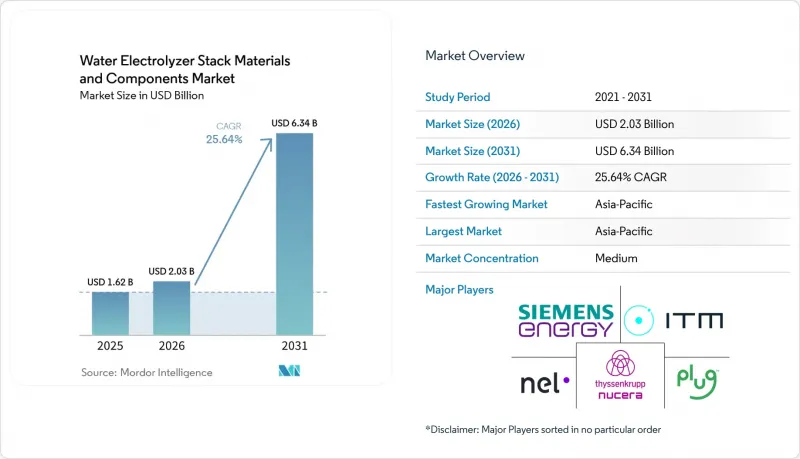
Mordor Intelligence에 의하면, 물 전해 스택 소재 및 구성 요소 시장 규모는 2025년에 16억 2,000만 달러로 평가되었습니다. 2026년 20억 3,000만 달러에서 2031년까지 63억 4,000만 달러로 확대되어 예측 기간(2026-2031년) CAGR은 25.64%가 된다고 전망되고 있습니다.
본 보고서는 기술별(알칼리형 전해조 등), 구성품 유형별(바이폴라 플레이트 등),소재 유형별(백금족 금속(PGMs) 등), 최종 사용자 산업별(에너지 저장 등), 지역별(아시아태평양, 북미, 유럽, 남미, 중동 및 아프리카)로 분류되어 있습니다. 시장 예측은 금액(미 달러) 기준으로 제시되어 있습니다.
세계의 물 전해 스택 소재 및 구성 요소 시장 동향 및 인사이트
암모니아, 석유 정제, 철강 산업의 산업 탈탄소화
암모니아, 정유, 철강 산업의 탈탄소화 압력으로 인해 대형 전해조용 재료에 대한 지속적인 수요가 발생하고 있습니다. 이러한 부문에서는 모빌리티 및 분산형 에너지 용도를 능가하는 양의 수소가 소비되고 있습니다. 2026년 1월, 렙솔(Repsol)은 스페인 페트로놀(Petronor) 정유시설에 두 번째 100MW 알칼리형 전해조를 설치할 것이라고 발표했습니다. 이 프로젝트에는 2억 9,200만 유로(약 3억 3,639만 달러)가 투자되며, 2029년 가동을 시작할 예정입니다. 이 프로젝트는 연간 최대 1만 5,000톤의 재생 가능 수소를 생산하는 것을 목표로 하고 있습니다. 이러한 정유시설 프로젝트에는 물 전해 스택 소재·부품 시장에서 막, 전극 및 기타 스택 소재의 안정적인 공급이 요구됩니다.
2026년 3월, 티센크루프 누셀라(Thyssenkrupp Nusser)는 스페인의 모베(Move)가 진행하는 300MW 규모의 오누바(Onuba) 프로젝트를 위해 표준화된 20MW 알칼리형 유닛 15기를 공급하는 계약을 수주했습니다. 이번 수주는 대규모 산업 플랜트가 물 전해 스택 소재 및 구성 요소 시장의 부품 공급업체에 대해 선제적인 조달 수요를 창출하고 있음을 보여줍니다. 직접 환원법에 의한 철강 생산에는 높은 가동률이 요구되며, 이로 인해 분리막과 전극의 내구성에 특히 높은 요구 사항이 부과됩니다. 장기간의 가동 수명을 입증할 수 있는 공급업체는 지속적인 운전 부하가 수반되는 프로젝트에서 더 유리한 입지를 확보할 수 있을 것입니다.
기가와트급 전해조 도입
서브 메가와트급 실증 실험에서 50MW 및 200MW급 플랜트로의 전환에 따라, 스택 구성 부품의 각 카테고리별 공급업체에 대한 요구 사항이 변화하고 있습니다. 2026년 5월, Nel ASA는 차세대 가압 알칼리형 플랫폼을 발표하며, 25MW 플랜트의 턴키 비용을 1,450달러/kW 미만으로 낮추는 것을 목표로 했습니다. 이 회사는 이 플랫폼에 대해 대상 산업화 비용의 60%를 충당하는 1억 3,500만 유로(약 1억 5,552만 달러)의 EU 혁신 기금 보조금을 확보했습니다. 또한 Nel사는 2025년 12월, Heroya 공장의 생산 능력을 연간 4기가와트로 확대하기 위한 최종 투자 결정을 내렸습니다. 이러한 투자는 물 전해 스택 소재 및 구성 요소 시장에서 표준화된 제조의 중요성이 높아지고 있음을 반영합니다.
중국의 OEM 제조업체들은 단위 규모와 공장 생산 능력을 모두 확대되고 있습니다. LONGi Hydrogen은 연간 5.0 GW의 제조 능력을 보유하고 있습니다. 2024년 말까지 Shuangliang사는 에너지 소비량이 4.532 kWh/Nm3 H2인 5,000 Nm3/h 용량의 알칼리형 전해조를 발표했습니다. 물 전해 스택 소재 및 구성 요소 시장의 대규모 플랜트에서는 막 및 양극판 소재를 연속적이고 대면적 형태로 공급할 수 있는 공급업체가 선호됩니다. 이러한 요건은 인증의 문턱을 높여, 기술적으로 승인된 생산자 사이에 장기 공급 계약이 집중되는 요인이 될 수 있습니다.
이리듐, 백금, 티타늄 및 퍼플루오로설폰산(PFSA)공급 제약
이리듐 공급량과 양성자 교환막(PEM)의 예상 수요 간의 격차는 여전히 PEM 구성 요소의 규모 확대에 있어 주요 제약 요인으로 남아 있습니다. 이리듐은 백금 채굴의 부산물로 생산되기 때문에 공급을 신속하게 확대하기 어렵습니다. 2026년 조사에 따르면, 전 세계 연간 이리듐 생산량은 7-10톤으로 추정되며, 넷 제로 시나리오 하에서는 PEM 물 전해가 전 세계 연간 이리듐 생산량의 최대 30%를 필요로 할 가능성이 있는 것으로 나타났습니다. 부하를 추가로 줄이지 않고 도입이 확대될 경우, 2028년까지 공급 부족이 발생할 우려가 있습니다.
티타늄 양극판과 백금 피복 다공성 수송층 역시 유사한 비용 압박에 직면해 있습니다. 대규모 생산에서 티타늄 부품의 기계 가공 비용은 흑연이나 스테인리스 스틸 대체재에 비해 여전히 4-5배 더 높습니다. 또한, PFSA 막 공급업체들은 유럽에서 진행 중인 퍼플루오로알킬 물질(PFAS) 규제 움직임으로 인해 불확실성에 직면해 있습니다. 물 전해 스택 소재 및 구성 요소 시장의 새로운 막, 코팅, 촉매의 화학적 조성은 산업용으로 사용되기 전에 긴 검증 기간이 필요합니다. 이러한 인증 위험으로 인해, 실험실 결과가 소재 사용량 감소나 성능 향상을 보여주고 있더라도 도입이 지연될 가능성이 있습니다.
부문 분석
2025년, 알칼리형 전해조는 물 전해 스택 소재 및 구성 요소 시장에서 54.40%의 점유율을 차지했습니다. 이러한 입지는 니켈, 스테인리스 스틸, 티타늄의 확립된 공급망은 물론, 중국과 유럽에서 100MW 규모의 도입을 통해 축적된 경험에 힘입은 것입니다. 낮은 재료 비용은 운전 조건이 허용하는 한 알칼리형 시스템을 뒷받침하고 있으며, 이 기술은 대규모 산업용 수소 프로젝트에서 계속해서 중심적인 위치를 차지하고 있습니다.
PEM 전해조는 2026년부터 2031년까지 연평균 성장률(CAGR) 28.52%로 성장하여 가장 빠르게 성장하는 기술 부문이 될 것으로 예측됩니다. 재생에너지와 연계된 용도이나 분산형 용도에서는 작동 압력, 가스 순도, 동적 응답성 측면에서 PEM 시스템이 선호됩니다. AEM 및 SOEC 기술에 대해서는 계속해서 연구 개발 투자가 이루어지고 있습니다. Enapter사는 2026년, 100MW를 초과하는 하이브리드 플랜트를 위한 ‘AEM Stack 250’을 발표했으며, Topsoe사는 2026년 3월 덴마크 헤르닝에 SOEC 제조 시설을 개설했습니다. 미국 에너지부가 제시한 이리듐 부하량 및 막 두께 감축 목표는 PEM 부품 공급업체에게 성능과 비용 면에서 중요한 기준이 되고 있습니다.
2025년, 막 및 분리막은 시장 점유율의 32.71%를 차지하며, PEM, 알칼리 및 AEM 각 아키텍처에 채택되었습니다. PEM 시스템에서는 PFSA 막이, 알칼리 시스템에서는 지르코니아 복합 다이어프램이, AEM 시스템에서는 음이온 교환 기능을 갖춘 고분자 막이 사용되고 있습니다.
촉매층과 전극은 AEM 스택용 이리듐 부하량 감소 및 비귀금속계 양기능성 촉매의 채택에 힘입어 2031년까지 연평균 성장률(CAGR)이 29.66%를 나타낼 것으로 예측되는 등,가장 빠르게 성장하는 부품 카테고리가 될 것으로 예측됩니다. 바이폴라 플레이트는 PEM 스택 비용의 53%를 차지하고 있습니다. 2026년 『Langmuir』 저널의 연구에 따르면, 크롬 중간층에 백금 코팅을 적용한 3D 프린팅 방식의 스테인리스 스틸 다공성 수송층에 대해 표면적이 50배 증가하고 부식 속도가 96% 감소했다고 보고되었습니다. 2025년 『Nano-Micro Letters』 저널의 연구에서는 산소 전달성을 향상시키기 위해 높은 다공성을 갖춘 3층 구조의 다공성 전달층에 대해 기술하고 있습니다. 고온 SOEC 시스템이나 PFAS가 없는 AEM 시스템에는 특수 소재가 필요하기 때문에 개스킷 및 씰에 관한 특허 출원은 계속해서 활발합니다.
지역별 분석
아시아태평양은 2025년에 물 전해 스택 소재 및 구성 요소 시장 점유율의 37.46%를 차지했으며, 2031년까지 연평균 성장률(CAGR) 29.05%로 이 지역에서 가장 높은 성장률을 나타낼 것으로 전망됩니다. 중국의 생산 규모, 인도의 현지화 계획, 그리고 한국의 수소 관련 노력이 이 지역 수요를 뒷받침하고 있습니다. 중국의 설비 용량과 생산 거점은 알칼리형 스택 생산에서 비용 면에서의 우위를 가져다주고 있습니다. LONGi Hydrogen은 연간 5.0 GW의 생산 능력을 보유하고 있습니다. 또한, 인도 역시 물 전해 스택 소재 및 구성 요소의 중요한 현지화 시장으로 부상하고 있습니다.
티센크루프 누셀라와 BHEL은 2026년 7월, 인도 내 알칼리성 물 전해 모듈 생산을 현지화하기 위해 전략적 제휴 협약을 체결했습니다. 일본과 한국은 막 화학 기술과 정밀 전극 코팅 기술을 제공합니다. 호주는 그린 철 및 암모니아 프로젝트 수요 거점으로 자리 잡고 있습니다. 2025년 8월, 프로그레시브 그린 솔루션스(Progressive Green Solutions)는 호주 내 1.4GW 규모의 전해조 프로젝트의 우선 공급업체로 티센크루프 누셀라를 선정했습니다. 이러한 움직임은 물 전해 스택 소재 및 구성 요소 시장에서 대형 알칼리 스택 부품에 대한 지역 수요를 뒷받침하는 것입니다.
유럽은 물 전해 스택 소재 및 구성 요소 시장에서 지역별 2위 규모를 차지하고 있습니다. 독일, 스페인, 네덜란드는 EU 수소 뱅크의 지원을 받는 주요 도입 거점입니다. 유럽연합 집행위원회의 수소 경매 절차는 혁신 기금을 통해 재생 가능 수소 프로젝트를 지원하고 있습니다. 존 코카레일(John Coccarile)사는 2026년 7월 프랑스에서 최초의 5MW 알칼리 스택을 조립했습니다. 선파이어(Sunfire)사의 가압 시스템은 2025년 유럽의 산업 시설에서 누적 가동 시간 8만 5,000시간을 돌파했습니다. 북미에서는 섹션 45V와 관련된 불확실성에 직면하고 있는 반면, 남미 및 중동에서는 풍부한 재생에너지 자원과 암모니아 생산과 연계된 기회가 있습니다. NEOM 프로젝트의 2.2 GW 전해조 용량과 4.0 GW의 병설 재생에너지는 걸프 지역 내 공급업체 인증 요건의 규모를 여실히 보여줍니다.
기타 혜택 :
- 엑셀 형식 시장 예측(ME) 시트
- 3개월간의 애널리스트 지원
자주 묻는 질문
목차
제1장 서론
제2장 조사 방법
제3장 주요 요약
제4장 시장 구도
제5장 시장 규모 및 성장 예측
제6장 경쟁 구도
제7장 시장 기회 및 향후 전망
KTH 26.09.10According to Mordor Intelligence, the water electrolyzer stack materials and components market size was estimated at USD 1.62 billion in 2025 and is estimated to grow from USD 2.03 billion in 2026 to USD 6.34 billion by 2031, at a CAGR of 25.64% during the forecast period (2026-2031).
This report is Segmented by Technology (Alkaline Electrolyzers and More), Component Type (Bipolar Plates and More), Material Type (Platinum Group Metals (PGMs) and More), End-User Industry (Energy Storage and More), and Geography (Asia-Pacific, North America, Europe, South America, and Middle-East and Africa). The Market Forecasts are Provided in Terms of Value (USD).
Global Water Electrolyzer Stack Materials and Components Market Trends and Insights
Industrial Decarbonization of Ammonia, Refining, and Steel
Decarbonization pressure in the ammonia, refining, and steel industries is creating sustained demand for large-format electrolyzer stack materials. These sectors consume hydrogen at volumes that exceed those of mobility and distributed energy applications. In January 2026, Repsol announced a second 100 MW alkaline electrolyzer at its Petronor refinery in Spain, supported by EUR 292 million (~USD 336.39 million) in investment and planned for commissioning in 2029. The project is intended to produce up to 15,000 tons of renewable hydrogen per year. Such refinery projects require a reliable supply of membranes, electrodes, and other stack materials in the water electrolyzer stack materials and components market.
In March 2026, thyssenkrupp nucera received a contract to supply 15 standardized 20 MW alkaline units for Moeve's 300 MW Onuba project in Spain. The order illustrates how larger industrial plants are creating forward procurement requirements for component suppliers in the water electrolyzer stack materials and components market. Direct-reduced steel production requires high capacity-factor operation, which places particular demands on the durability of separators and electrodes. Suppliers that can validate long operating lifetimes may be better positioned for projects with sustained operating loads.
Gigawatt-Scale Electrolyzer Deployment
The shift from sub-megawatt demonstrations to 50-MW and 200-MW plants is changing supplier requirements across stack-component categories. In May 2026, Nel ASA launched its next-generation pressurized alkaline platform, targeting a turnkey cost below USD 1,450/kW for a 25 MW plant. The company supported the platform with a EUR 135 million (~USD 155.52 million) EU Innovation Fund grant covering 60% of eligible industrialization costs. Nel also reached a final investment decision in December 2025 to scale Heroya production to 4 GW per year. These investments reflect the growing importance of standardized manufacturing in the water electrolyzer stack materials and components market.
Chinese original equipment manufacturers are increasing both unit size and factory capacity. LONGi Hydrogen has 5.0 GW of annual manufacturing capacity. By the end of 2024, Shuangliang presented a 5,000 Nm3/h alkaline electrolyzer with energy consumption of 4.532 kWh/Nm3 H2. Larger plants in the water electrolyzer stack materials and components market favor suppliers that can provide membrane and bipolar plate material in continuous, large-area formats. This requirement raises qualification barriers and can concentrate long-term supply agreements among technically approved producers.
Iridium, Platinum, Titanium, and Perfluorosulfonic Acid (PFSA) Supply Constraints
The gap between iridium supply and projected Proton Exchange Membrane (PEM) demand remains a major constraint on scaling PEM components. Iridium is produced as a by-product of platinum mining, which limits the ability to increase supply quickly. A 2026 study estimates annual global iridium production at 7-10 tons and indicates that PEM water electrolysis could require up to 30% of annual global iridium production under net-zero scenarios. Supply shortfalls could arise by 2028 if deployment expands without further reductions in loading.
Titanium bipolar plates and platinum-coated porous transport layers face related cost pressure. At scale, machining costs for titanium components remain four to five times higher than those for graphite or stainless steel alternatives. PFSA membrane suppliers also face uncertainty due to ongoing European Per- and Polyfluoroalkyl Substances (PFAS) restriction efforts. New membranes, coatings, and catalyst chemistries in the Water Electrolyzer Stack Materials and Components Market require long validation periods before industrial use. This qualification risk can delay adoption, even when laboratory results indicate lower material use or improved performance.
Other drivers and restraints analyzed in the detailed report include:
- Renewable Power Integration and Energy Storage
- Falling Catalyst Loadings and Component Cost Curves
- High Cost of Green Hydrogen Versus Fossil-Based Hydrogen
For complete list of drivers and restraints, kindly check the Table Of Contents.
Segment Analysis
Alkaline electrolyzers held 54.40% of the water electrolyzer stack materials and components market share in 2025. Their position rests on an established supply chain for nickel, stainless steel, and titanium, along with accumulated experience in 100 MW-scale deployments in China and Europe. Lower material costs support alkaline systems where operating conditions permit, keeping this technology central to large industrial hydrogen projects.
PEM electrolyzers are projected to be the fastest-growing technology segment at a 28.52% CAGR from 2026 to 2031. Renewable-coupled and distributed applications favor PEM systems for their operating pressure, gas purity, and dynamic response. AEM and SOEC technologies continue to receive research and development investment. Enapter introduced its AEM Stack 250 in 2026 for hybrid plants above 100 MW, and Topsoe opened an SOEC manufacturing facility in Herning, Denmark, in March 2026. U.S. Department of Energy targets for reduced iridium loading and membrane thickness define a key performance and cost boundary for PEM component suppliers.
Membranes and separators held 32.71% of the market share in 2025, serving PEM, alkaline, and AEM architectures. PEM systems use PFSA membranes, alkaline systems use zirconia-composite diaphragms, and AEM systems rely on polymer membranes with anion-exchange functionality.
Catalyst layers and electrodes are forecast to be the fastest-growing component category, with a 29.66% CAGR through 2031, supported by lower iridium loadings and non-precious bifunctional catalysts for AEM stacks. Bipolar plates account for 53% of the PEM stack cost. A 2026 Langmuir study reported 3D-printed stainless-steel porous transport layers with chromium-interlayer platinum coatings that achieved a 50-fold increase in surface area and a 96% reduction in corrosion rate. A 2025 Nano-Micro Letters study described triple-layer porous transport layers with high porosity for improved oxygen transport. Gaskets and seals continue to attract patent activity, as high-temperature SOEC systems and PFAS-free AEM systems require specialized materials
Complete Report Scope:
- By Technology
- Proton Exchange Membrane (PEM) Electrolyzers
- Alkaline Electrolyzers
- Others (AEM and SOEC)
- By Component Type
- Membranes and Separators
- Catalyst Layers and Electrodes
- Bipolar Plates
- Porous Transport Layers (PTL)/Gas Diffusion Layers (GDL)
- Others (Gaskets, Seals, End Plates, MEAs)
- By Material Type
- Platinum Group Metals (PGMs)
- Nickel, Stainless Steel and Titanium
- Polymer Materials (PFSA, Hydrocarbon, AEM)
- Graphite and Carbon Composites
- Others (Ceramics and Emerging Materials)
- By End-User Industry
- Green Hydrogen Production
- Power-to-X Applications
- Industrial Applications (Refining, Ammonia, Steel)
- Energy Storage
- Others (Mobility and Hydrogen Refueling)
- By Geography
- Asia-Pacific
- China
- India
- Japan
- South Korea
- Rest of Asia-Pacific
- North America
- United States
- Canada
- Mexico
- Europe
- Germany
- United Kingdom
- France
- Italy
- Rest of Europe
- South America
- Brazil
- Argentina
- Rest of South America
- Middle-East and Africa
- Saudi Arabia
- South Africa
- Rest of Middle-East and Africa
- Asia-Pacific
Geography Analysis
Asia-Pacific held 37.46% of the water electrolyzer stack materials and components market share in 2025 and is projected to record the fastest regional CAGR of 29.05% through 2031. China's manufacturing scale, India's localization plans, and South Korea's hydrogen commitments are supporting regional demand. China's installed capacity and manufacturing footprint provide a cost advantage in alkaline stack production. LONGi Hydrogen has 5.0 GW of annual manufacturing capacity. India is also becoming an important localization market for water electrolyzer stack materials and components.
Thyssenkrupp Nucera and BHEL signed a Strategic Collaboration Agreement in July 2026 to localize the fabrication of alkaline water electrolyzer modules in India. Japan and South Korea contribute membrane chemistry and precision electrode coating capabilities. Australia is a demand center for green iron and ammonia projects. Progressive Green Solutions selected Thyssenkrupp Nucera as a preferred supplier for a 1.4 GW electrolyzer project in Australia in August 2025. This activity supports regional demand for large alkaline stack components in the water electrolyzer stack materials and components market.
Europe held the second-largest regional position in the water electrolyzer stack materials and components market. Germany, Spain, and the Netherlands are key deployment centers supported by the EU Hydrogen Bank. The European Commission's hydrogen auction process supports renewable hydrogen projects through the Innovation Fund. John Cockerill assembled its first 5 MW alkaline stack in France in July 2026. Sunfire's pressurized systems exceeded 85,000 cumulative operating hours at European industrial sites in 2025. North America faces uncertainty around Section 45V, while South America and the Middle-East have opportunities tied to favorable renewable resources and ammonia production. The NEOM project's 2.2 GW electrolyzer capacity and 4.0 GW of co-located renewables illustrate the scale of Gulf supplier qualification requirements.
- Asahi Kasei Corporation
- Bloom Energy
- Cummins Inc.
- Enapter
- HydrogenPro
- ITM Power plc
- John Cockerill
- LONGi
- Nel ASA
- Plug Power Inc.
- Siemens Energy
- Sunfire SE
- SUNGROW
- thyssenkrupp nucera AG & Co. KGaA
- Topsoe A/S
Additional Benefits:
- The market estimate (ME) sheet in Excel format
- 3 months of analyst support
TABLE OF CONTENTS
1 Introduction
- 1.1 Study Assumptions and Market Definition
- 1.2 Scope of the Study
2 Research Methodology
3 Executive Summary
4 Market Landscape
- 4.1 Market Overview
- 4.2 Market Drivers
- 4.2.1 Industrial Decarbonization of Ammonia, Refining, and Steel
- 4.2.2 Gigawatt-Scale Electrolyzer Deployment
- 4.2.3 Renewable Power Integration and Energy Storage
- 4.2.4 Falling Catalyst Loadings and Component Cost Curves
- 4.2.5 Regional Manufacturing Localization Incentives
- 4.2.6 Stack Standardization and Modular Manufacturing
- 4.3 Market Restraints
- 4.3.1 Iridium, Platinum, Titanium, and PFSA Supply Constraints
- 4.3.2 High Cost of Green Hydrogen Versus Fossil-Based Hydrogen
- 4.3.3 Project Cancellations, Financing Gaps, and Slow Offtake Conversion
- 4.3.4 Qualification Risk for New Membranes, Coatings, and Catalyst Chemistries
- 4.4 Value Chain Analysis
- 4.5 Porter's Five Forces
- 4.5.1 Bargaining Power of Suppliers
- 4.5.2 Bargaining Power of Buyers
- 4.5.3 Threat of New Entrants
- 4.5.4 Threat of Substitutes
- 4.5.5 Competitive Rivalry
5 Market Size and Growth Forecasts (Value)
- 5.1 By Technology
- 5.1.1 Proton Exchange Membrane (PEM) Electrolyzers
- 5.1.2 Alkaline Electrolyzers
- 5.1.3 Others (AEM and SOEC)
- 5.2 By Component Type
- 5.2.1 Membranes and Separators
- 5.2.2 Catalyst Layers and Electrodes
- 5.2.3 Bipolar Plates
- 5.2.4 Porous Transport Layers (PTL)/Gas Diffusion Layers (GDL)
- 5.2.5 Others (Gaskets, Seals, End Plates, MEAs)
- 5.3 By Material Type
- 5.3.1 Platinum Group Metals (PGMs)
- 5.3.2 Nickel, Stainless Steel and Titanium
- 5.3.3 Polymer Materials (PFSA, Hydrocarbon, AEM)
- 5.3.4 Graphite and Carbon Composites
- 5.3.5 Others (Ceramics and Emerging Materials)
- 5.4 By End-User Industry
- 5.4.1 Green Hydrogen Production
- 5.4.2 Power-to-X Applications
- 5.4.3 Industrial Applications (Refining, Ammonia, Steel)
- 5.4.4 Energy Storage
- 5.4.5 Others (Mobility and Hydrogen Refueling)
- 5.5 By Geography
- 5.5.1 Asia-Pacific
- 5.5.1.1 China
- 5.5.1.2 India
- 5.5.1.3 Japan
- 5.5.1.4 South Korea
- 5.5.1.5 Rest of Asia-Pacific
- 5.5.2 North America
- 5.5.2.1 United States
- 5.5.2.2 Canada
- 5.5.2.3 Mexico
- 5.5.3 Europe
- 5.5.3.1 Germany
- 5.5.3.2 United Kingdom
- 5.5.3.3 France
- 5.5.3.4 Italy
- 5.5.3.5 Rest of Europe
- 5.5.4 South America
- 5.5.4.1 Brazil
- 5.5.4.2 Argentina
- 5.5.4.3 Rest of South America
- 5.5.5 Middle-East and Africa
- 5.5.5.1 Saudi Arabia
- 5.5.5.2 South Africa
- 5.5.5.3 Rest of Middle-East and Africa
- 5.5.1 Asia-Pacific
6 Competitive Landscape
- 6.1 Market Concentration
- 6.2 Strategic Moves
- 6.3 Market Share (%)/Ranking Analysis
- 6.4 Company Profiles (includes Global Overview, Market Overview, Core Segments, Financials as available, Strategic Information, Products and Services, and Recent Developments)
- 6.4.1 Asahi Kasei Corporation
- 6.4.2 Bloom Energy
- 6.4.3 Cummins Inc.
- 6.4.4 Enapter
- 6.4.5 HydrogenPro
- 6.4.6 ITM Power plc
- 6.4.7 John Cockerill
- 6.4.8 LONGi
- 6.4.9 Nel ASA
- 6.4.10 Plug Power Inc.
- 6.4.11 Siemens Energy
- 6.4.12 Sunfire SE
- 6.4.13 SUNGROW
- 6.4.14 thyssenkrupp nucera AG & Co. KGaA
- 6.4.15 Topsoe A/S
7 Market Opportunities and Future Outlook
- 7.1 White-Space and Unmet-Need Assessment