|
시장보고서
상품코드
2119276
산업용 로봇 지능형 소프트웨어 : 시장 점유율 분석, 업계 동향 및 통계, 성장 예측(2026-2031년)Industrial Robot Intelligence Software - Market Share Analysis, Industry Trends & Statistics, Growth Forecasts (2026 - 2031) |
||||||
 Mordor Intelligence
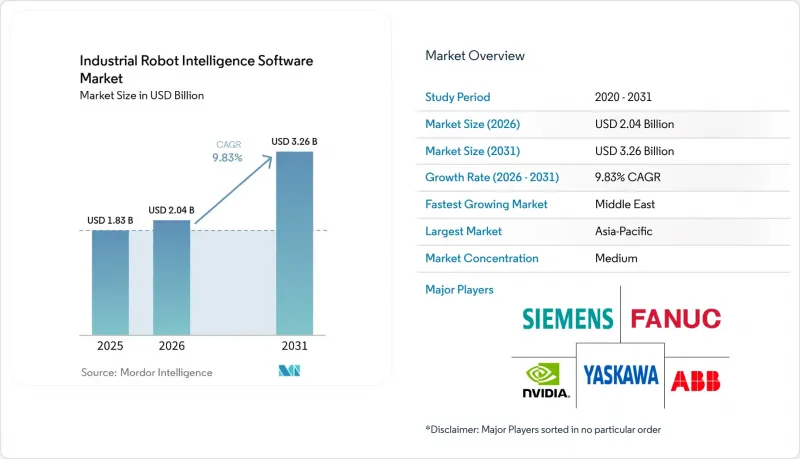
Mordor Intelligence에 의하면, 산업용 로봇 지능형 소프트웨어 시장 규모는 2025년 18억 3,000만 달러로 평가되었습니다. 2026년 20억 4,000만 달러에서 2031년까지 32억 6,000만 달러로 확대되어 2026년부터 2031년에 걸쳐 CAGR 9.83%를 나타낼 것으로 예측됩니다.
본 보고서는 소프트웨어 기능(로봇 프로그래밍, 오프라인 프로그래밍 등), 배포 모델(On-Premise 등), 용도(자재관리, 포장 등), 최종 사용자 산업(자동차 산업 등), 기업 규모(대기업, 중소기업) 및 지역별로 분류되어 있습니다. 시장 예측은 금액(달러) 기준으로 제시되어 있습니다.
세계의 산업용 로봇 지능형 소프트웨어 시장 동향 및 인사이트
AI를 활용한 적응형 로봇 실행
물리 AI를 위한 기반 모델은 산업용 로봇의 경제성을 혁신하고 있습니다. 제조업체는 모든 동작을 개별적으로 프로그래밍하는 대신, 광범위한 정책을 학습시켜 개별 셀에 적용할 수 있습니다. 이러한 접근 방식을 통해 기존에는 막대한 맞춤 설정이 필요했던 용도에서도 소프트웨어 개발 노력을 줄일 수 있습니다. 파낙(FANUC)은 2026년 5월, ROBOGUIDE와 NVIDIA Isaac Sim의 통합을 한층 더 심화시켜 시뮬레이션과 실제 로봇이 동일한 제어 알고리즘을 사용할 수 있도록 하고, 두 환경 간의 궤적 차이를 해결했습니다. ABB는 2026년 하반기에 ‘RobotStudio HyperReality’를 출시할 계획이며, NVIDIA Omniverse를 활용하여 가상 로봇과 실제 로봇의 동작 간 99%의 상관관계를 실현할 것이라고 주장하고 있습니다. 2026년 『Nature Communications』 저널에 실린 연구에 따르면, 고정밀 지각과 언어 모델을 활용한 추론을 결합함으로써 복잡하고 내결함성이 높은 제조 작업의 성과가 향상된다는 사실이 밝혀졌습니다. 이러한 진전으로 인해 하드웨어 비용의 감소와 소프트웨어 기능의 확대에 따라 산업용 로봇 지능 소프트웨어 시장에 대한 지속적인 투자가 촉진되고 있습니다.
공장의 인력 부족과 리쇼어링의 경제성
노동력 부족으로 인해 자동화 결정은 단기 자본 주기에 대한 의존도를 낮추고 있습니다. 제조업 고용주들은 부족한 전문 인력에 대한 의존도를 줄이면서도 작업을 수행할 수 있는 시스템을 필요로 하고 있습니다. 국제로봇연맹(IFR) 보고서에 따르면, 2025년 미국의 로봇 도입 대수는 11% 증가한 3만 8,000대로, 역대 세 번째로 높은 실적을 기록했습니다. 샌프란시스코 연방준비은행의 조사에 따르면, 무역 정책의 불확실성에 직면한 기업들은 산업용 로봇 활용을 확대하고 있으며, 정책 리스크와 자동화 활동 사이에 상관관계가 나타났습니다. 이로 인해 기존 로봇 군의 소프트웨어 업그레이드뿐만 아니라 신규 로봇 도입 프로젝트에 대한 수요도 발생하고 있습니다. 제조업체가 인건비 및 이전 비용을 억제하면서도 생산량을 유지해야 하는 상황에서 AI를 활용한 제어는 그 중요성이 점점 더 커지고 있습니다. 따라서 리쇼어링 계획에서 유연하고 재현성이 높은 생산 방식이 요구될 경우, 산업용 로봇 지능형 소프트웨어 시장은 그 혜택을 누리게 될 것입니다.
높은 통합 및 검증 비용
기존 공장에 지능형 소프트웨어를 도입하려면 프로그래머블 로직 컨트롤러(PLC), 안전 제어 장치, 비전 시스템, 제조 실행 시스템(MES)과의 연동이 필요합니다. 복잡하고 여러 공급업체가 관여하는 생산 셀에서는 이 작업에 드는 비용이 소프트웨어 라이선스 비용을 초과할 수도 있습니다. ABB가 ‘RobotStudio HyperReality’를 통해 시운전 시간을 최대 80% 단축할 수 있다고 추정하고 있는 점은 기존 시운전 작업의 규모를 보여주지만, 새로운 소프트웨어 스택 도입에는 여전히 초기 투자가 필요합니다. 남덴마크 대학교 연구진은 유럽의 소량 생산 환경에서 로봇 도입을 가로막는 가장 큰 장벽이 재구성 및 프로그래밍에 있음을 밝혔습니다. 여러 브랜드, 안전 인터록, 레거시 시스템이 관련된 프로젝트에서는 검증 작업으로 인해 프로젝트 기간이 장기화될 가능성이 있습니다. 사전 인증된 모듈이나 공통 통합 계층을 활용함으로써 부담을 줄일 수는 있지만, 현장 고유의 테스트가 필요 없어지는 것은 아닙니다. 이 때문에 예산이 제한된 조직이나 통합업체의 지원이 부족한 조직에서는 산업용 로봇 지능형 소프트웨어 시장의 보급이 더딘 실정입니다.
부문 분석
2025년 시점에서 산업용 로봇 지능형 소프트웨어 시장에서 ‘로봇 프로그래밍’ 및 ‘오프라인 프로그래밍’은 24.78%를 차지하며 가장 큰 소프트웨어 기능 카테고리가 되었습니다. 이러한 위상은 OEM 프로그래밍 환경에 대한 오랜 기간의 투자와 티치 펜던트를 통한 방대한 워크플로우 도입 실적을 반영한 것입니다. ABB RobotStudio, FANUC ROBOGUIDE, KUKA iiQWorks는 생산 셀에서 여전히 필수적인 계획, 프로그래밍, 검증 작업을 지원하고 있습니다. 지각 및 비전 가이던스는 2031년까지 연평균 성장률(CAGR) 12.16%로 확대될 것으로 예상되며, 이는 소프트웨어 기능 중 가장 높은 성장률입니다. AI 네이티브 비전 도구는 전용 지그 없이도 CAD 참조 프레임에서 부품의 위치를 파악할 수 있습니다. 이 기능을 통해 소량 생산 용도에서의 설정 작업이 줄어들고, 더 광범위한 생산 조건에 대응할 수 있게 됩니다. 2025년 연구에 따르면, 실제 산업용 검사 이미지의 합성 데이터를 사용하여 학습시킨 감지 모델의 평균 정확도는 98.40%였습니다. 이 결과는 CAD 모델 및 물리 기반 이미지 생성이 산업용 지각 분야에서 데이터 수집 부담을 어떻게 줄일 수 있는지를 보여줍니다.
시뮬레이션 및 디지털 트윈 소프트웨어는 프로그래밍과 인식을 결합하여 엔지니어가 가상 환경 내에서 비전 유도 작업의 검증을 수행할 수 있도록 합니다. 파낙(FANUC)과 NVIDIA는 시뮬레이션상의 로봇 동작과 물리적 로봇 동작 간의 차이를 해결하기 위해 2026년 5월 양사의 협력을 강화했습니다. 또한, 여러 로봇이 공유 작업 공간 내에서 동작을 조율하고 충돌을 회피해야 하는 용도에서 모션 플래닝과 제어의 가치도 높아지고 있습니다. Realtime Robotics사는 컨트롤러 펌웨어 상층에서 작동하는 모션 플래닝 소프트웨어를 통해 이러한 요구 사항을 충족시키고 있습니다. 예측 유지보수 및 진단, 그리고 데이터 관리와 분석은 제조업체들이 생산의 입력 요소로 로봇 텔레메트리 데이터를 활용함에 따라 확대되고 있습니다. KUKA의 ‘iiQWorks.Copilot’은 AI 지원과 시뮬레이션 워크플로를 결합하고 있습니다. 이를 통해 프로그래밍, 시뮬레이션, AI 지원이 단일 워크플로우 내에서 더욱 긴밀하게 연계됩니다. 그 결과, 산업용 로봇 지능형 소프트웨어 시장은 개별 기능 도구에서 보다 통합된 엔지니어링 플랫폼으로 전환되고 있습니다.
2025년에는 On-Premise 배포가 시장의 60.59%를 차지했습니다. 이러한 우위는 움직임에 민감한 생산 업무에서 로컬 제어가 필요하다는 점을 반영합니다. 폐쇄 루프 서보 제어는 4밀리초 미만의 사이클 타임으로 작동하기 때문에 클라우드의 왕복 지연에 의존할 수 없습니다. 자동차, 항공우주, 방위 분야공급망에서도 생산 소프트웨어에 대해 엄격한 데이터 관리 요건이 부과되고 있습니다. 이러한 요인들로 인해 실행 계층의 기능은 계속해서 로봇 컨트롤러 근처에 배치되고 있습니다. On-Premise 환경은 안전성이 극히 중요한 업무에 필요한 높은 신뢰성을 지속적으로 지원하고 있습니다. 또한 제조업체가 로컬에서 검증이나 공장별 설정을 관리할 수 있게 해줍니다. 이러한 구조적 역할로 인해 클라우드 서비스가 로컬에 배포된 제어 소프트웨어를 대체하는 속도는 제한되고 있습니다.
클라우드 기반 도입은 2031년까지 연평균 성장률(CAGR) 13.02%로 확대될 것으로 예측됩니다. 이 모델은 대규모 AI 훈련, 합성 데이터 생성 및 거점 간 협업을 지원합니다. NVIDIA OSMO는 분산 컴퓨팅 환경 전반에 걸쳐 Isaac Sim 워크플로우의 오케스트레이션을 지원합니다. ABB의 RobotStudio HyperReality는 매개변수화된 로봇 스테이션을 NVIDIA Omniverse로 내보내, 하드웨어 시운전 전에 클라우드 기반 모델 훈련을 수행할 수 있게 해줍니다. Robotics-as-a-Service(RaaS) 계약에서는 하드웨어, 소프트웨어, 연결성 및 유지보수가 통합되어 경상 비용으로 계상됩니다. Workr사는 ABB의 로봇과 클라우드에서 학습된 물리 AI를 결합하여 중소규모 제조업체에 서비스를 제공합니다. 하이브리드 아키텍처는 로컬 실행과 클라우드 기반 업데이트 및 플릿 분석을 결합합니다. 이러한 접근 방식을 통해 여러 거점을 보유한 제조업체는 셀 수준의 실시간 성능을 저하시키지 않으면서 지능형 관리를 중앙 집중화할 수 있습니다.
지역별 분석
2025년, 아시아태평양은 시장의 48.62%를 차지했습니다. 중국에서는 2024년에 29만 5,000대의 산업용 로봇이 도입되어 전 세계 연간 도입 대수의 54%를 차지했으며, 가동 중인 로봇 대수는 202만 7,200대에 달하여 프로그래밍, AI 업그레이드 및 커넥티드 운영에 대한 지속적인 수요를 창출하고 있습니다. 삼성은 2026년 7월, 구미에서 휴머노이드 로봇의 양산 및 AI 중심 제조를 위해 19조 원(137억 7,000만 달러)을 투자할 것이라고 발표했습니다. 한편, 현대위아는 AI 및 소프트웨어 스타트업에 대한 출자를 포함한 로봇 분야 투자로 4,000억 원(2억 8,990만 달러)을 투입할 것이라고 발표했습니다. Config사는 2026년 5월, 로봇용 기반 모델의 데이터 수집 및 클라우드 기반 ‘Robot-as-a-Service(RaaS)’ 플랫폼 구축을 위해 2,700만 달러 규모의 시드 라운드 자금 조달을 완료했습니다. 일본과 한국에는 정기적인 소프트웨어 업그레이드가 필요한 대규모 로봇 도입 기반이 존재하는 반면, 인도와 호주에서는 새로운 소프트웨어 스택에 대한 성장이 더욱 빠른 비즈니스 기회가 기대되고 있습니다.
북미와 유럽을 합치면 산업용 로봇 지능형 소프트웨어 시장에서 이에 버금가는 시장 규모를 차지하고 있습니다. 미국에서는 2025년에 3만 8,000대의 로봇이 도입되어 전년 대비 11% 증가했습니다. 식품 분야의 자동화, 리쇼어링(생산 거점의 국내 복귀) 프로그램, AI 인프라가 수요를 견인하고 있습니다. NVIDIA의 Isaac 생태계는 개발자와 제조업체를 대상으로 시뮬레이션, 합성 데이터 생성, 엣지 배포를 지원합니다. 서유럽에서는 2024년 제조업 종사자 1만 명당 267대의 로봇 밀도를 기록했으며, 독일, 스위스, 네덜란드, 이탈리아가 해당 지역 내 도입을 주도하고 있습니다. 유럽 고객들은 가상 시운전, 안전 기준, 사이버 보안 요건을 특히 중시하는 반면, 남미는 자동차 조립 및 프로그래밍 도구를 중심으로 한 신흥 시장으로 남아 있습니다.
중동은 2031년까지 연평균 성장률(CAGR) 13.06%로 확대될 것으로 예측되며, 산업용 로봇 지능형 소프트웨어 시장에서 가장 높은 지역별 성장률을 보이고 있습니다. ‘사우디 비전 2030’과 아랍에미리트(UAE)의 ‘오퍼레이션 300bn’은 로봇 도입을 보다 광범위한 다각화 계획과 연계하고 있습니다. ADNOC은 2026년에 타윌라에서 대형 자율형 운영 로봇을 도입하여 연말까지 본격적인 가동을 목표로 하고 있습니다. Lianhe Sowell International Group은 2025년 10월, 아랍에미리트(UAE) 내 AI 탑재 로봇 제조 및 연구 거점 건설을 위해 1억 3,250만 달러 규모의 자금 조달 기본 계약을 체결했습니다. 한편, Micropolis AI Robotics는 2026년 5월, EMSTEEL사와 자율형 물류 로봇 4대 도입에 관한 120만 달러 규모의 계약을 체결했습니다. 이러한 움직임은 정부 주도의 시범 사업과 병행하여 상용화가 진행되고 있음을 보여줍니다. 한편, 아프리카는 여전히 규모가 가장 작은 지역 부문이며, 남아프리카공화국과 나이지리아의 초기 수요는 광업, 물류, 식품 가공 분야에 집중되어 있습니다.
기타 혜택 :
- 엑셀 형식 시장 예측(ME) 시트
- 3개월간의 애널리스트 지원
자주 묻는 질문
목차
제1장 서론
제2장 조사 방법
제3장 주요 요약
제4장 시장 구도
제5장 시장 규모 및 성장 예측
제6장 경쟁 구도
제7장 시장 기회 및 향후 전망
KTH 26.09.10According to Mordor Intelligence, the industrial robot intelligence software market size is projected to expand from USD 1.83 billion in 2025 and USD 2.04 billion in 2026 to USD 3.26 billion by 2031, registering a CAGR of 9.83% between 2026 to 2031.
This report is Segmented by Software Function (Robot Programming and Offline Programming, and More), Deployment Model (On-Premise, and More), Application (Material Handling and Packaging, and More), End-User Industry (Automotive, and More), Enterprise Size (Large Enterprises, and Small and Medium-Sized Enterprises) and Geography. The Market Forecasts are Provided in Terms of Value (USD).
Global Industrial Robot Intelligence Software Market Trends and Insights
AI-Enabled Adaptive Robot Execution
Foundation models for physical AI are changing the economics of industrial robotics. Manufacturers can train broad policies and adapt them to individual cells, rather than programming every action separately. This approach can lower the software effort for applications that previously required extensive custom work. FANUC deepened its ROBOGUIDE integration with NVIDIA Isaac Sim in May 2026 so simulation and physical robots use the same control algorithms, addressing trajectory differences between the two settings. ABB planned RobotStudio HyperReality for release in the second half of 2026, using NVIDIA Omniverse to support a claimed 99% correlation between virtual and physical robot behavior. A 2026 Nature Communications study found that combining precision perception with language-model reasoning improved results on complex, fault-tolerant manufacturing tasks. These developments support continued spending on the industrial robot intelligence software market as hardware costs decline and software capabilities expand.
Factory Labor Scarcity and Reshoring Economics
Labor shortages are making automation decisions less dependent on short-term capital cycles. Manufacturing employers need systems that can perform tasks with less reliance on scarce specialist labor. The International Federation of Robotics reported that U.S. robot installations rose 11% to 38,000 units in 2025, the third strongest result on record. The Federal Reserve Bank of San Francisco found that firms facing trade-policy uncertainty increased their use of industrial robots, linking policy risk with automation activity. This creates demand for software upgrades in existing fleets as well as new robot projects. AI-guided execution becomes more relevant where manufacturers must sustain output while controlling labor and relocation costs. The industrial robot intelligence software market, therefore, benefits when reshoring programs require flexible, repeatable production methods.
High Integration and Validation Cost
Deploying intelligence software in established factories requires coordination with programmable logic controllers, safety controls, vision systems, and manufacturing execution systems. This work can cost more than the software license in complex, multi-supplier cells. ABB's estimate of up to 80% lower commissioning time for RobotStudio HyperReality indicates the scale of existing commissioning effort, though a new software stack still requires upfront investment. Researchers at the University of Southern Denmark found that reconfiguration and programming were the leading barriers to robot adoption in small-batch European manufacturing settings. Validation can lengthen projects where multiple brands, safety interlocks, and legacy systems are involved. Pre-certified modules and common integration layers can reduce the burden, but they do not eliminate the need for site-specific testing. This slows adoption in the industrial robot intelligence software market among organizations with smaller budgets or limited integrator support.
Other drivers and restraints analyzed in the detailed report include:
- Digital Twins and Virtual Commissioning Requirements
- Low-Code Programming for High-Mix Production
- Cybersecurity and Functional-Safety Exposure
For complete list of drivers and restraints, kindly check the Table Of Contents.
Segment Analysis
Robot Programming and Offline Programming accounted for 24.78% of the industrial robot intelligence software market in 2025, making it the largest software-function category. Its position reflects long-running investment in OEM programming environments and the large installed base of teach-pendant workflows. ABB RobotStudio, FANUC ROBOGUIDE, and KUKA iiQWorks support planning, programming, and validation tasks that remain essential in production cells. Perception and Vision Guidance is projected to expand at a 12.16% CAGR through 2031, the fastest rate among software functions. AI-native vision tools can locate parts from CAD reference frames without dedicated fixtures. That capability reduces setup work for lower-volume applications and supports a wider set of production conditions. A 2025 study reported a mean average precision of 98.40% for a detection model trained on synthetic data on real industrial inspection images. The result shows how CAD models and physics-based image generation can reduce the data-collection effort for industrial perception.
Simulation and Digital Twin software link programming and perception, allowing engineers to validate vision-guided tasks in a virtual environment. FANUC and NVIDIA strengthened their integration in May 2026 to address differences between simulated and physical robot behavior. Motion Planning and control are also gaining value in applications where multiple robots must coordinate their movements and avoid collisions in shared workspaces. Realtime Robotics addresses this requirement with motion-planning software that operates above controller firmware. Predictive Maintenance and Diagnostics, along with Data Management and Analytics, expand as manufacturers use robot telemetry as a production input. KUKA's iiQWorks.Copilot combines AI assistance with simulation workflows. This brings programming, simulation, and AI support closer together in a single workflow. The industrial robot intelligence software market is consequently shifting from separate functional tools toward more integrated engineering platforms.
On-Premises deployment accounted for 60.59% of the market in 2025. This lead reflects the need for local control in motion-sensitive production operations. Closed-loop servo control operates at cycle times below 4 milliseconds and cannot depend on cloud round-trip latency. Automotive, aerospace, and defense supply chains also apply strict data-control requirements to production software. These factors keep execution-layer functions close to the robot controller. On-premises environments continue to support the high reliability needed for safety-critical operations. They also allow manufacturers to manage local validation and plant-specific configurations. This structural role limits the speed at which cloud services can replace locally deployed control software.
Cloud-Based deployment is projected to expand at a 13.02% CAGR through 2031. The model supports large-scale AI training, synthetic-data generation, and collaboration across locations. NVIDIA OSMO supports orchestration of Isaac Sim workflows across distributed compute environments. ABB's RobotStudio HyperReality can export parameterized robot stations to NVIDIA Omniverse for cloud-based model training before hardware commissioning. Robotics-as-a-Service contracts combine hardware, software, connectivity, and maintenance into recurring operating expenses. Workr has used cloud-trained physical AI with ABB robots to serve smaller manufacturers. Hybrid architectures combine local execution with cloud-based updates and fleet analytics. This approach gives multi-site manufacturers centralized intelligence management without compromising real-time performance at the cell level.
Complete Report Scope:
- By Software Function
- Robot Programming and Offline Programming
- Perception and Vision Guidance
- Simulation and Digital Twin
- Motion Planning and Control
- Other Software Functions (Predictive Maintenance and Diagnostics, Data Management and Analytics)
- By Deployment Model
- On-Premises
- Cloud-Based
- Hybrid
- By Application
- Material Handling and Packaging
- Assembly and Joining
- Welding and Surface Treatment
- Quality Inspection and Metrology
- Machine Tending and Processing
- Other Applications (Picking, Kitting, and Order Fulfillment, Intralogistics and Mobile Manipulation, Hazardous-Environment Operations)
- By End-User Industry
- Automotive and Mobility
- Electronics and Semiconductors
- General Manufacturing
- Food and Beverage
- Pharmaceuticals and Medical Devices
- Other End-User Industries (Metals and Machinery, Logistics and Warehousing, Aerospace and Defense)
- By Enterprise Size
- Large Enterprises
- Small and Medium-Sized Enterprises
- By Geography
- North America
- United States
- Canada
- Mexico
- South America
- Brazil
- Argentina
- Rest of South America
- Europe
- Germany
- Italy
- France
- United Kingdom
- Russia
- Rest of Europe
- Asia-Pacific
- China
- Japan
- South Korea
- India
- Australia
- Rest of Asia-Pacific
- Middle East
- Saudi Arabia
- United Arab Emirates
- Turkey
- Rest of Middle East
- Africa
- South Africa
- Nigeria
- Rest of Africa
- North America
Geography Analysis
Asia-Pacific held 48.62% of the market in 2025. China installed 295,000 industrial robots in 2024, accounting for 54% of global annual installations, and had an operational stock of 2,027,200 units, creating ongoing demand for programming, AI upgrades, and connected operations. Samsung announced KRW 19 trillion (USD 13.77 billion) for humanoid robot mass production and AI-centered manufacturing in Gumi in July 2026, while Hyundai Wia announced KRW 400 billion (USD 289.9 million) for robotics investments, including stakes in AI and software startups. Config raised a USD 27 million seed round in May 2026 for robot-foundation-model data collection and a cloud-based robot-as-a-service platform. Japan and South Korea have large installed bases of robots that require periodic software upgrades, while India and Australia offer faster-growing opportunities for newer software stacks.
North America and Europe together provide the next largest combined contribution to the industrial robot intelligence software market. The United States installed 38,000 robots in 2025, an 11% increase from the prior year, with food-sector automation, reshoring programs, and AI infrastructure contributing to demand. NVIDIA's Isaac ecosystem supports simulation, synthetic-data generation, and edge deployment for developers and manufacturers. Western Europe recorded a robot density of 267 units per 10,000 manufacturing employees in 2024, with Germany, Switzerland, the Netherlands, and Italy leading regional adoption. European customers place particular weight on virtual commissioning, safety standards, and cybersecurity requirements, while South America remains an emerging area centered on automotive assembly and programming tools.
The Middle East is projected to expand at 13.06% CAGR through 2031, the fastest geographic rate in the industrial robot intelligence software market. Saudi Vision 2030 and the United Arab Emirates Operation 300bn connect robotics deployment with wider diversification plans. ADNOC deployed a heavy-duty autonomous operator robot at Taweelah in 2026, with full operation targeted by year-end. Lianhe Sowell International Group signed a USD 132.5 million financing framework in October 2025 for an AI-powered robot manufacturing and research base in the United Arab Emirates, while Micropolis AI Robotics signed a USD 1.2 million deployment agreement with EMSTEEL in May 2026 for 4 autonomous logistics robots. These activities show commercial deployments emerging alongside state-backed pilots, while Africa remains the smallest geographic segment, with early demand in South Africa and Nigeria focused on extractives, logistics, and food processing.
- ABB Ltd.
- FANUC Corporation
- Siemens AG
- NVIDIA Corporation
- Yaskawa Electric Corporation
- KUKA Aktiengesellschaft
- Rockwell Automation, Inc.
- Mitsubishi Electric Corporation
- Omron Corporation
- Universal Robots A/S
- Robert Bosch GmbH
- Dassault Systemes SE
- PTC Inc.
- Microsoft Corporation
- Amazon Web Services, Inc.
- Inbolt SAS
- Augmentus Pte. Ltd.
- Palladyne AI Corp.
- Fizyr B.V.
- Brain Corporation
- Realtime Robotics, Inc.
- Visual Components Oy
Additional Benefits:
- The market estimate (ME) sheet in Excel format
- 3 months of analyst support
TABLE OF CONTENTS
1 INTRODUCTION
- 1.1 Study Assumptions and Market Definition
- 1.2 Scope of the Study
2 RESEARCH METHODOLOGY
3 EXECUTIVE SUMMARY
4 MARKET LANDSCAPE
- 4.1 Market Overview
- 4.2 Market Drivers
- 4.2.1 AI-Enabled Adaptive Robot Execution
- 4.2.2 Factory Labor Scarcity and Reshoring Economics
- 4.2.3 Digital Twins and Virtual Commissioning Requirements
- 4.2.4 Low-Code Programming for High-Mix Production
- 4.2.5 CAD-Trained Perception for Fixture-Light Automation
- 4.2.6 Synthetic Data and Sim-to-Real Training Pipelines
- 4.3 Market Restraints
- 4.3.1 High Integration and Validation Cost
- 4.3.2 Cybersecurity and Functional-Safety Exposure
- 4.3.3 Sim-to-Real Transfer Risk in Variable Cells
- 4.3.4 Scarcity of Safety-Certified Robotics Software Talent
- 4.4 Industry Value-Chain Analysis
- 4.5 Regulatory Landscape
- 4.6 Technological Outlook
- 4.7 Porter's Five Forces Analysis
- 4.7.1 Threat of New Entrants
- 4.7.2 Bargaining Power of Suppliers
- 4.7.3 Bargaining Power of Buyers
- 4.7.4 Threat of Substitutes
- 4.7.5 Competitive Rivalry
5 MARKET SIZE AND GROWTH FORECASTS (VALUE)
- 5.1 By Software Function
- 5.1.1 Robot Programming and Offline Programming
- 5.1.2 Perception and Vision Guidance
- 5.1.3 Simulation and Digital Twin
- 5.1.4 Motion Planning and Control
- 5.1.5 Other Software Functions (Predictive Maintenance and Diagnostics, Data Management and Analytics)
- 5.2 By Deployment Model
- 5.2.1 On-Premises
- 5.2.2 Cloud-Based
- 5.2.3 Hybrid
- 5.3 By Application
- 5.3.1 Material Handling and Packaging
- 5.3.2 Assembly and Joining
- 5.3.3 Welding and Surface Treatment
- 5.3.4 Quality Inspection and Metrology
- 5.3.5 Machine Tending and Processing
- 5.3.6 Other Applications (Picking, Kitting, and Order Fulfillment, Intralogistics and Mobile Manipulation, Hazardous-Environment Operations)
- 5.4 By End-User Industry
- 5.4.1 Automotive and Mobility
- 5.4.2 Electronics and Semiconductors
- 5.4.3 General Manufacturing
- 5.4.4 Food and Beverage
- 5.4.5 Pharmaceuticals and Medical Devices
- 5.4.6 Other End-User Industries (Metals and Machinery, Logistics and Warehousing, Aerospace and Defense)
- 5.5 By Enterprise Size
- 5.5.1 Large Enterprises
- 5.5.2 Small and Medium-Sized Enterprises
- 5.6 By Geography
- 5.6.1 North America
- 5.6.1.1 United States
- 5.6.1.2 Canada
- 5.6.1.3 Mexico
- 5.6.2 South America
- 5.6.2.1 Brazil
- 5.6.2.2 Argentina
- 5.6.2.3 Rest of South America
- 5.6.3 Europe
- 5.6.3.1 Germany
- 5.6.3.2 Italy
- 5.6.3.3 France
- 5.6.3.4 United Kingdom
- 5.6.3.5 Russia
- 5.6.3.6 Rest of Europe
- 5.6.4 Asia-Pacific
- 5.6.4.1 China
- 5.6.4.2 Japan
- 5.6.4.3 South Korea
- 5.6.4.4 India
- 5.6.4.5 Australia
- 5.6.4.6 Rest of Asia-Pacific
- 5.6.5 Middle East
- 5.6.5.1 Saudi Arabia
- 5.6.5.2 United Arab Emirates
- 5.6.5.3 Turkey
- 5.6.5.4 Rest of Middle East
- 5.6.6 Africa
- 5.6.6.1 South Africa
- 5.6.6.2 Nigeria
- 5.6.6.3 Rest of Africa
- 5.6.1 North America
6 COMPETITIVE LANDSCAPE
- 6.1 Market Concentration
- 6.2 Strategic Moves
- 6.3 Market Share Analysis
- 6.4 Company Profiles (includes Global Level Overview, Market Level Overview, Core Segments, Financials as available, Strategic Information, Market Rank/Share, Products and Services, Recent Developments)
- 6.4.1 ABB Ltd.
- 6.4.2 FANUC Corporation
- 6.4.3 Siemens AG
- 6.4.4 NVIDIA Corporation
- 6.4.5 Yaskawa Electric Corporation
- 6.4.6 KUKA Aktiengesellschaft
- 6.4.7 Rockwell Automation, Inc.
- 6.4.8 Mitsubishi Electric Corporation
- 6.4.9 Omron Corporation
- 6.4.10 Universal Robots A/S
- 6.4.11 Robert Bosch GmbH
- 6.4.12 Dassault Systemes SE
- 6.4.13 PTC Inc.
- 6.4.14 Microsoft Corporation
- 6.4.15 Amazon Web Services, Inc.
- 6.4.16 Inbolt SAS
- 6.4.17 Augmentus Pte. Ltd.
- 6.4.18 Palladyne AI Corp.
- 6.4.19 Fizyr B.V.
- 6.4.20 Brain Corporation
- 6.4.21 Realtime Robotics, Inc.
- 6.4.22 Visual Components Oy
7 MARKET OPPORTUNITIES AND FUTURE OUTLOOK
- 7.1 White-Space and Unmet-Need Assessment