|
시장보고서
상품코드
2119279
급성 통증 : 시장 점유율 분석, 업계 동향 및 통계, 성장 예측(2026-2031년)Acute Pain - Market Share Analysis, Industry Trends & Statistics, Growth Forecasts (2026 - 2031) |
||||||
 Mordor Intelligence
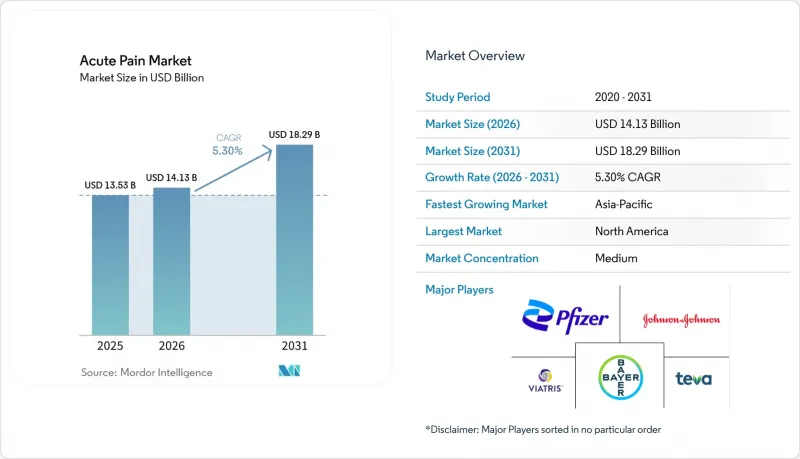
Mordor Intelligence에 의하면, 급성 통증 시장 규모는 2025년 135억 3,000만 달러로 평가되었습니다. 2026년 141억 3,000만 달러에서 2031년까지 182억 9,000만 달러로 확대되며 2026년부터 2031년에 걸쳐 CAGR 5.30%를 나타낼 전망입니다.
본 보고서는 약물 분류별(NSAIDs, 아세트아미노펜, 오피오이드, 국소 마취제, 보조 요법), 통증 유형별(수술 후, 외상, 치과, 근골격계·스포츠, 급성 질환),투여 경로(경구, 주사, 외용, 기타), 유통 채널(병원, 소매, 온라인 약국), 지역(북미, 유럽, 아시아태평양, 중동 및 아프리카, 남미)
세계의 급성 통증 시장 동향 및 인사이트
수술 및 의료 시술 건수 증가
선진국 및 신흥국의 의료 시스템에서 수술 및 시술 건수는 지속적으로 증가하고 있습니다. 2019년까지의 20년 동안, 미국 내 인공 고관절 전치환술 건수는 177% 증가했으며, 인공 무릎관절 전치환술 건수는 156% 증가했습니다. 또한, 팬데믹 기간이 지난 후에도 미실시된 수술 건수의 누적 효과가 수요를 지속적으로 뒷받침하고 있습니다. 중증도의 시술이 외래 진료로 전환되고 있어, 이에 따라 당일 퇴원 후 효과적인 통증 관리의 필요성이 높아지고 있습니다. 자택에서 회복 중인 환자는 장기간의 입원 중 모니터링에 의존할 수 없기 때문에 의료 제공업체에게는 작용 시간이 길고 실용적인 치료법이 요구되고 있습니다. 2026년 미국마취과학회(ASA) 지침에서는 다각적인 수술 전후 관리의 일환으로 국소 진통 및 수술 부위에 대한 침윤 마취가 권장되고 있습니다. 이 지침은 급성 통증 시장 전반 및 급성 통증 치료 과정 전반에 걸쳐 보다 광범위한 활용과 보다 일관된 프로토콜 수립을 뒷받침합니다.
오피오이드 사용을 억제하는 치료의 도입
오피오이드 중심 치료에서 벗어나는 것은 임상 실무 및 지급 요건과 밀접하게 연관되어 있습니다. CMS Measure 477은 임상의들에게 수술 전후 기간 동안 다모드 통증 관리 기록을 권장하고 있습니다. 2026년 체계적 문헌고찰에 따르면, 두 번째 다모드 요소를 추가함으로써 24시간 동안의 오피오이드 사용량이 경구 모르핀 환산 기준으로 5.2mg 감소했으며, 4시간 후 통증 점수도 낮아진 것으로 밝혀졌습니다. 이러한 근거는 확립된 진통제와 국소·구역 마취를 결합한 프로토콜의 유효성을 뒷받침합니다. 미국 질병통제예방센터(CDC)는 급성 통증에 대해 필요한 최소 기간 동안 유효한 오피오이드를 최저 용량으로 투여할 것을 권장하고 있습니다. 오피오이드 사용량이 감소하는 추세 속에서도 대체 요법은 제네릭 오피오이드보다 가격이 높은 경우가 많기 때문에 급성 통증 시장은 여전히 가치가 높아질 가능성이 있습니다. 따라서 급성 통증 시장 전체에서 보상 제도의 설계가 중요해집니다.
오피오이드 안전성에 대한 면밀한 검토와 처방 제한
오피오이드 규제의 강화는 급성 통증 시장에 복잡한 결과를 초래하고 있습니다. CDC의 지침은 투여 기간과 용량을 제한하고 있는 반면, 각 주의 정책에 따라 급성 통증에 대한 처방량에 상한선을 설정하는 경우도 있습니다. 이러한 조치로 인해 오피오이드의 역할은 축소되지만, 모든 환자가 자동으로 고가의 비오피오이드 제제로 전환되는 것은 아닙니다. 예산이 제한적인 경우, 많은 의료 제공업체와 보험사는 여전히 저비용의 NSAIDs나 아세트아미노펜에 의존하고 있습니다. 제공된 자료에 인용된 조사에 따르면, 3차 의료를 받는 환자의 50%가 불충분한 통증 완화만 받고 있으며, 80% 이상이 퇴원 후 2주 이내에 중등도에서 중증의 수술 후 통증을 경험한 것으로 나타났습니다. 그 결과, 치료가 파편화되어 환자는 충분한 치료를 받지 못한 채 방치되는 반면, 보험사는 고비용의 대체 요법에 거부감을 보이는 상황이 발생할 수 있습니다.
부문별 분석
2025년 시점에서 NSAIDs는 매출의 34.5%를 차지했으며, 급성 통증 시장에서 가장 큰 약제군으로 자리매김하고 있습니다. 이러한 위상은 수술 후, 근골격계, 치과 및 일반의약품 분야에서 폭넓게 사용되고 있음을 반영합니다. NSAIDs는 오랜 임상 실적에 더해, 병원, 소매점, 디지털 채널을 통해 구할 수 있다는 이점을 바탕으로 하고 있습니다. 2025년 연구에 따르면, 복합 치료법에서 NSAIDs와 덱사메타손은 아세트아미노펜보다 수술 후 통증 점수를 더 효과적으로 완화하고 오피오이드 소비량을 줄이는 것으로 나타났습니다. 이러한 증거는 여전히 아세트아미노펜을 비오피오이드 계열의 기본 선택지로 취급하고 있는 병원 위원회에 영향을 미칠 가능성이 있습니다.
국소 마취제는 2031년까지 연평균 성장률(CAGR) 6.2%로 가장 빠른 성장을 기록할 것으로 예측됩니다. 리포솜형 부피바카인은 정형외과, 재건외과, 척추 수술에서 더 빈번하게 사용되고 있습니다. 파실라(Pasira)사는 2026년 1분기 EXPAREL의 판매량이 전년 동기 대비 7% 증가했다고 보고했습니다. 아세트아미노펜은 모든 연령대에서 여전히 보조 약물로 널리 사용되고 있지만, 중증도의 수술 후 또는 급성기 암 치료 현장에서는 오피오이드가 여전히 필수적입니다. 가바펜티노이드, 케타민, 덱스메데토미딘 및 코르티코스테로이드는 단독 치료 옵션이라기보다는 병용 프로토콜의 구성 요소로 점점 더 많이 사용되고 있습니다.
2025년에는 수술 후 통증이 매출의 31.8%를 차지했으며, 이는 거의 모든 외과 전문 분야에서 중요한 역할을 하고 있음을 시사합니다. 환자가 퇴원한 후에도 통증이 지속될 가능성이 있기 때문에 수술 후 통증은 종종 치료에 가장 많은 노력이 필요한 적응증이 됩니다. 이로 인해 병원 및 소매 채널 전반에 걸쳐 수요가 발생하고 있습니다. 또한 시술마다 다른 프로토콜이 존재하기 때문에 수술 후 관리는 적응증 개발이나 병원의 약품 목록 결정에서도 중요한 위치를 차지하고 있습니다. 급성 통증 업계는 예측 가능한 수요와 치밀하게 관리되는 치료 경로가 결합되어 있어, 계속해서 외과 분야의 용도에 의존하고 있습니다. 이러한 용도들은 급성 통증 시장에서 여전히 중심적인 위치를 차지하고 있습니다.
근골격계 및 스포츠로 인한 통증 시장은 2031년까지 연평균 성장률(CAGR) 6.8%를 나타낼 것으로 예측됩니다. 스포츠 참여, 직장 내 부상 및 응급 외상 치료로 인해 그 사용 범위는 계획된 외과 수술의 범위를 넘어 확장되고 있습니다. 응급실에서의 치료가 불충분한 경우가 많기 때문에 외상이나 부상으로 인한 통증 시장 침투율은 여전히 낮은 수준을 유지하고 있습니다. 제시된 조사 결과에 따르면, 응급실 환자의 74%가 약물 투여를 받았음에도 불구하고 퇴원 시 여전히 중등도에서 중증의 통증을 호소하는 것으로 나타났습니다. 치과 통증은 여전히 일반의약품(OTC)에 대한 수요가 많은 적응증이지만, 신장 산통, 겸상적혈구증 발작, 편두통의 경우 각각 고유한 치료 요구 사항과 전문의에 의한 진료 경로가 존재합니다.
지역별 분석
2025년, 북미는 전 세계 매출의 42.1%를 차지하며, 이 지역은 급성 통증 시장에서 가장 큰 점유율을 기록했습니다. 이 지역은 높은 시술 건수, 확립된 병원 조달 시스템, 그리고 다중 모드 프로토콜의 조기 도입이라는 이점을 가지고 있습니다. 2025년 1월부터 적격 비오피오이드계 진통제에 대한 메디케어 파트 B의 별도 지급이 시작되어, 병원 외래 진료 부서 및 당일 수술센터에서의 경제적 장벽이 완화되었습니다. 2026년 7월, 파실라(Pasira)사는 유나이티드 헬스케어(United Healthcare)가 외래 진료 환경 전반에서 EXPAREL에 대해 별도 환급을 실시한다고 발표했습니다. 캐나다와 멕시코도 수요를 끌어올리고 있지만, 신규 비오피오이드 제제의 보급은 미국에 비해 여전히 제한적입니다.
유럽에서는 독일, 영국, 프랑스, 이탈리아, 스페인을 통해 의미 있는 수요가 발생하고 있습니다. 임상적 근거가 존재하는 경우에도 각국의 평가 및 급여 결정 절차로 인해 새로운 진통제의 도입이 지연될 가능성이 있습니다. 이러한 환경에서는 새로운 치료법이 현지 심사를 완료할 때까지 기존에 확립된 NSAIDs나 아세트아미노펜이 선호되는 경향이 있습니다. 국소 마취와 다각적인 치료는 유럽의 ‘강화된 회복(Enhanced Recovery)’ 실천과 점점 더 부합하고 있습니다. 중동 및 아프리카에서는 양극화된 경향이 나타나고 있으며, 걸프협력회의(GCC) 회원국에서는 고품질 치료법의 도입이 진행되고 있는 반면, 사하라 이남의 많은 시장에서는 제네릭 의약품에 의존하고 있습니다.
아시아태평양은 2031년까지 연평균 성장률(CAGR) 6.3%를 나타낼 것으로 예측되며, 이는 급성 통증 시장에서 지역별 가장 높은 성장률입니다. 중국과 인도는 의료 인프라 확충, 제조 능력 향상, 그리고 방대한 환자 수로 인해 주요 성장 동력이 되고 있습니다. 일본에서는 고령화가 진행됨에 따라 비오피오이드계 통증 치료제에 대한 수요가 증가하고 있으나, 규제 당국의 심사로 인해 신제품 시장 출시가 지연될 가능성이 있습니다. 파실라(Pasira)사는 2026년 1월, LG화학(LG Chem)과 제휴하여 한국 및 태국에서 EXPAREL의 상용화를 추진하게 되었습니다. 남미에서는 효과적인 일반의약품(OTC)에 대한 수요가 증가하고 있지만, 예산 제약과 환율 변동으로 인해 프리미엄 치료법의 도입은 제한적인 상황입니다.
기타 혜택 :
- 엑셀 형식 시장 예측(ME) 시트
- 3개월간의 애널리스트 지원
자주 묻는 질문
목차
제1장 서론
제2장 조사 방법
제3장 개요
제4장 시장 구도
제5장 시장 규모 및 성장 예측
제6장 경쟁 구도
제7장 시장 기회 및 향후 전망
KTH 26.09.02According to Mordor Intelligence, the acute pain market size is projected to expand from USD 13.53 billion in 2025 and USD 14.13 billion in 2026 to USD 18.29 billion by 2031, registering a CAGR of 5.30% between 2026 to 2031.
This report is Segmented by Drug Class (NSAIDs, Acetaminophen, Opioids, Local Anesthetics, Adjunctive Therapies), Pain Type (Postoperative, Trauma, Dental, Musculoskeletal & Sports, Acute Medical), Route of Administration (Oral, Injectable, Topical, Others), Distribution Channel (Hospital, Retail, Online Pharmacies), and Geography (North America, Europe, Asia-Pacific, MEA, South America)
Global Acute Pain Market Trends and Insights
Rising Surgical And Procedural Volumes
Surgical and procedural volumes continue to expand across developed and emerging healthcare systems. U.S. total hip arthroplasty volume rose 177%, while total knee arthroplasty volume rose 156% during the 2 decades to 2019, and procedure backlogs continued to support demand after the pandemic period. Higher-acuity procedures are moving into ambulatory settings, which increases the need for effective pain control after same-day discharge. Patients recovering at home cannot rely on extended inpatient monitoring, so providers need longer-acting and practical regimens. The 2026 American Society of Anesthesiologists guidelines recommend regional analgesia and surgical-site infiltration within multimodal perioperative care. This guidance supports broader use and more consistent protocol design across the acute pain market and across the acute pain treatment pathway.
Opioid-Sparing Treatment Adoption
The move away from opioid-centered treatment has become tied to clinical practice and payment requirements. CMS Measure 477 encourages clinicians to document multimodal pain management during the perioperative period. A 2026 systematic review found that adding a second multimodal component reduced 24-hour opioid use by 5.2 mg oral morphine equivalents and reduced pain scores at 4 hours. This evidence makes the case for protocols that combine established analgesics with regional or local options. The U.S. Centers for Disease Control and Preventionrecommends the lowest effective opioid dose for the shortest necessary duration for acute pain. As opioid use falls, the acute pain market can still gain value because replacement therapies often carry higher prices than generic opioids, making reimbursement design important across the acute pain market.
Opioid Safety Scrutiny And Prescribing Restrictions
Tighter opioid controls create a mixed outcome for the acute pain market. The CDC guidance limits duration and dose, while state policies can cap the supply prescribed for acute pain. These measures reduce the role of opioids but do not automatically move every patient to premium non-opioid products. Many providers and payers still rely on lower-cost NSAIDs and acetaminophen when budgets are limited. Research cited in the supplied material reported that 50% of tertiary-care patients had inadequate pain relief, while more than 80% experienced moderate-to-severe postoperative pain within 2 weeks of discharge. The result can be fragmented treatment, with patients remaining undertreated while payers resist higher-cost alternatives.
Other drivers and restraints analyzed in the detailed report include:
- Expansion Of Ambulatory And Same-Day Surgery
- Innovation For Underserved Care Settings
- High Cost Of Novel Non-Opioid Therapies
For complete list of drivers and restraints, kindly check the Table Of Contents.
Segment Analysis
NSAIDs held 34.5% of revenue in 2025, making them the largest drug class in the acute pain market. Their position reflects broad use in postoperative, musculoskeletal, dental, and over-the-counter care. They are supported by long clinical experience and availability across hospital, retail, and digital channels. A 2025 study found that NSAIDs and dexamethasone reduced postoperative pain scores and opioid consumption more effectively than acetaminophen within multimodal regimens. That evidence can influence hospital committees that still treat acetaminophen as the default non-opioid option.
Local anesthetics are forecast to record the fastest growth at a 6.2% CAGR through 2031. Liposomal bupivacaine is used more often in orthopedic, reconstructive, and spine procedures. Pacira reported 7% year-over-year EXPAREL volume growth in the first quarter of 2026. Acetaminophen remains a widely used adjunct across age groups, while opioids remain necessary in high-severity postoperative and acute oncology settings. Gabapentinoids, ketamine, dexmedetomidine, and corticosteroids are increasingly used as components of combination protocols rather than as stand-alone choices.
Postoperative pain accounted for 31.8% of revenue in 2025, reflecting its role in nearly every surgical specialty. It is often the most treatment-intensive application because pain may continue after a patient leaves the facility. This creates demand across hospital and retail channels. Procedure-specific protocols also make postoperative care important for label development and hospital formulary decisions. The acute pain industry continues to depend on surgical applications because they combine predictable demand with closely managed treatment pathways. These applications remain central to the acute pain market.
Musculoskeletal and sports pain is projected to grow at a 6.8% CAGR through 2031. Participation in sports, workplace injuries, and emergency trauma care are extending use beyond planned surgical settings. Trauma and injury pain remains underpenetrated because emergency department treatment is often insufficient. The supplied research cited findings that 74% of emergency department patients still reported moderate-to-severe pain at discharge despite receiving medication. Dental pain remains a high-volume indication for OTC products, while renal colic, sickle cell crises, and migraines have their own treatment needs and specialist pathways.
Complete Report Scope:
- By Drug Class
- Nonsteroidal Anti-Inflammatory Drugs
- Acetaminophen and Paracetamol
- Opioids
- Local Anesthetics
- Adjunctive Therapies
- By Pain Type and Clinical Application
- Postoperative Pain
- Trauma & Injury Pain
- Dental Pain
- Musculoskeletal & Sports Pain
- Acute Medical Condition Pain
- By Route of Administration
- Oral
- Injectable and Parenteral
- Topical and Transdermal
- Other Routes (Inhaled, rectal, etc)
- By Distribution Channel
- Hospital Pharmacies
- Retail Pharmacies and Drug Stores
- Online Pharmacies
- By Geography
- North America
- United States
- Canada
- Mexico
- Europe
- Germany
- United Kingdom
- France
- Italy
- Spain
- Rest of Europe
- Asia-Pacific
- China
- India
- Japan
- South Korea
- Australia
- Rest of Asia-Pacific
- Middle East & Africa
- GCC
- South Africa
- Rest of Middle East and Africa
- South America
- Brazil
- Argentina
- Rest of South America
- North America
Geography Analysis
North America held 42.1% of global revenue in 2025, giving the region the largest acute pain market share. The region benefits from high procedure volumes, established hospital purchasing systems, and early adoption of multimodal protocols. Separate Medicare Part B payment for qualifying non-opioid pain drugs began in January 2025 and reduced a financial barrier in hospital outpatient departments and ambulatory surgery centers. Pacira announced in July 2026 that UnitedHealthcare provides separate reimbursement for EXPAREL across outpatient settings. Canada and Mexico add volume, but uptake of novel branded non-opioids remains more limited than in the United States.
Europe contributes meaningful demand through Germany, the United Kingdom, France, Italy, and Spain. National assessment and reimbursement processes can delay uptake of new analgesics even when clinical evidence is available. This environment favors established NSAIDs and acetaminophen until new therapies complete local reviews. Regional analgesia and multimodal care are increasingly consistent with European enhanced recovery practice. The Middle East and Africa have a two-tier profile, with Gulf Cooperation Council countries more able to adopt premium therapies while many sub-Saharan markets rely on generic medicines.
Asia-Pacific is projected to grow at a 6.3% CAGR through 2031, the fastest regional rate in the acute pain market. China and India are the main growth engines because of expanding healthcare infrastructure, manufacturing capacity, and large patient populations. Japan's aging population supports demand for non-opioid pain treatment, although regulatory reviews can slow new product access. Pacira entered an agreement with LG Chem in January 2026 to pursue EXPAREL commercialization in South Korea and Thailand. South America has rising demand for effective OTC products, but budget pressure and currency volatility limit adoption of premium therapies.
- Vertex Pharmaceuticals
- Pfizer
- Johnson & Johnson
- Viatris
- Teva Pharmaceutical Industries
- Bayer
- Haleon plc
- Kenvue Inc.
- Reckitt Benckiser Group
- Heron Therapeutics
- Pacira BioSciences
- Ocular Therapeutix, Inc.
- Formosa Pharmaceuticals, Inc.
- Medical Developments International Limited
- Latigo Biotherapeutics
- Neumentum, Inc.
- Scilex Holding
- Tris Pharma, Inc.
- Sandoz Group AG
- Sun Pharmaceuticals Industries
Additional Benefits:
- The market estimate (ME) sheet in Excel format
- 3 months of analyst support
TABLE OF CONTENTS
1 INTRODUCTION
- 1.1 Study Assumptions and Market Definition
- 1.2 Scope of the Study
2 RESEARCH METHODOLOGY
3 EXECUTIVE SUMMARY
4 MARKET LANDSCAPE
- 4.1 Market Overview
- 4.2 Market Drivers
- 4.2.1 Rising Surgical and Procedural Volumes
- 4.2.2 Opioid-Sparing Treatment Adoption
- 4.2.3 Expansion of Ambulatory and Same-Day Surgery
- 4.2.4 Acute-Pain Formulation Innovation in Underserved Care Settings
- 4.2.5 Hospital Procurement Shift Toward Opioid-Free Recovery Pathways
- 4.2.6 Growing Incidence of Trauma, Sports Injuries, and Emergency Care Cases
- 4.3 Market Restraints
- 4.3.1 Opioid Safety Scrutiny and Prescribing Restrictions
- 4.3.2 High Cost of Novel Non-Opioid Therapies
- 4.3.3 Acute-Pain Trial Endpoint and Real-World Adoption Complexity
- 4.3.4 Limited Reimbursement and Hospital Cost-Containment Pressures
- 4.4 Value and Supply-Chain Analysis
- 4.5 Regulatory Landscape
- 4.6 Technological Outlook
- 4.7 Porters Five Forces
- 4.7.1 Supplier Power
- 4.7.2 Buyer Power
- 4.7.3 Threat of New Entrants
- 4.7.4 Threat of Substitutes
- 4.7.5 Competitive Rivalry
- 4.7.6 Porters Five Forces Analysis
5 MARKET SIZE AND GROWTH FORECASTS
- 5.1 By Drug Class
- 5.1.1 Nonsteroidal Anti-Inflammatory Drugs
- 5.1.2 Acetaminophen and Paracetamol
- 5.1.3 Opioids
- 5.1.4 Local Anesthetics
- 5.1.5 Adjunctive Therapies
- 5.2 By Pain Type and Clinical Application
- 5.2.1 Postoperative Pain
- 5.2.2 Trauma & Injury Pain
- 5.2.3 Dental Pain
- 5.2.4 Musculoskeletal & Sports Pain
- 5.2.5 Acute Medical Condition Pain
- 5.3 By Route of Administration
- 5.3.1 Oral
- 5.3.2 Injectable and Parenteral
- 5.3.3 Topical and Transdermal
- 5.3.4 Other Routes (Inhaled, rectal, etc)
- 5.4 By Distribution Channel
- 5.4.1 Hospital Pharmacies
- 5.4.2 Retail Pharmacies and Drug Stores
- 5.4.3 Online Pharmacies
- 5.5 By Geography
- 5.5.1 North America
- 5.5.1.1 United States
- 5.5.1.2 Canada
- 5.5.1.3 Mexico
- 5.5.2 Europe
- 5.5.2.1 Germany
- 5.5.2.2 United Kingdom
- 5.5.2.3 France
- 5.5.2.4 Italy
- 5.5.2.5 Spain
- 5.5.2.6 Rest of Europe
- 5.5.3 Asia-Pacific
- 5.5.3.1 China
- 5.5.3.2 India
- 5.5.3.3 Japan
- 5.5.3.4 South Korea
- 5.5.3.5 Australia
- 5.5.3.6 Rest of Asia-Pacific
- 5.5.4 Middle East & Africa
- 5.5.4.1 GCC
- 5.5.4.2 South Africa
- 5.5.4.3 Rest of Middle East and Africa
- 5.5.5 South America
- 5.5.5.1 Brazil
- 5.5.5.2 Argentina
- 5.5.5.3 Rest of South America
- 5.5.1 North America
6 COMPETITIVE LANDSCAPE
- 6.1 Market Concentration
- 6.2 Market Share Analysis
- 6.3 Company Profiles (includes Global Level Overview, Market Level Overview, Core Segments, Financials as available, Strategic Information, Market Rank/Share, Products and Services, Recent Developments)
- 6.3.1 Vertex Pharmaceuticals Incorporated
- 6.3.2 Pfizer Inc.
- 6.3.3 Johnson & Johnson
- 6.3.4 Viatris Inc.
- 6.3.5 Teva Pharmaceutical Industries Ltd.
- 6.3.6 Bayer AG
- 6.3.7 Haleon plc
- 6.3.8 Kenvue Inc.
- 6.3.9 Reckitt Benckiser Group plc
- 6.3.10 Heron Therapeutics, Inc.
- 6.3.11 Pacira BioSciences, Inc.
- 6.3.12 Ocular Therapeutix, Inc.
- 6.3.13 Formosa Pharmaceuticals, Inc.
- 6.3.14 Medical Developments International Limited
- 6.3.15 Latigo Biotherapeutics
- 6.3.16 Neumentum, Inc.
- 6.3.17 Scilex Holding Company
- 6.3.18 Tris Pharma, Inc.
- 6.3.19 Sandoz Group AG
- 6.3.20 Sun Pharmaceutical Industries Limited
7 MARKET OPPORTUNITIES AND FUTURE OUTLOOK
- 7.1 White-Space and Unmet-Need Assessment