
|
시장보고서
상품코드
2119281
배터리용 고순도 황산망간 일수화물(HPMSM) : 시장 점유율 분석, 업계 동향 및 통계, 성장 예측(2026-2031년)Battery-Grade High-Purity Manganese Sulfate Monohydrate (HPMSM) - Market Share Analysis, Industry Trends & Statistics, Growth Forecasts (2026 - 2031) |
||||||
 Mordor Intelligence
Mordor Intelligence에 의하면, 배터리용 고순도 황산망간 일수화물(HPMSM) 시장은 2025년에 4억 6,000만 달러로 평가되었습니다. 2026년 5억 4,000만 달러에서 2031년까지 11억 5,000만 달러에 이를 것으로 예상되며, 예측 기간(2026-2031년) CAGR은 16.45%를 나타낼 전망입니다.
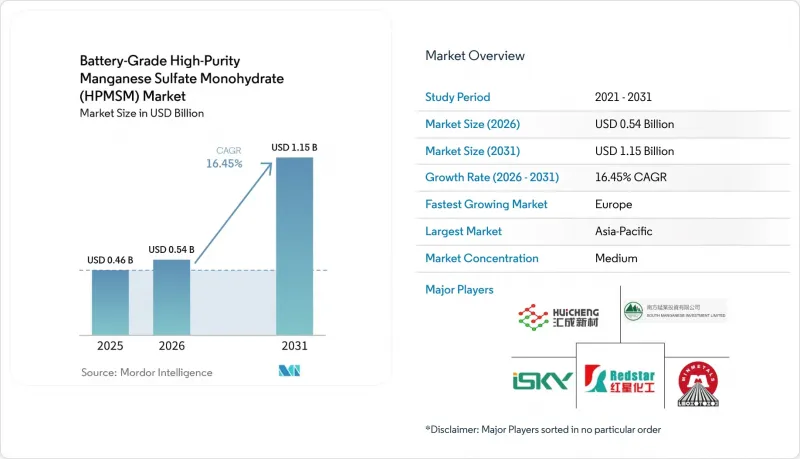
본 보고서는 원료 유형(전해 망간 금속, 망간 광석, 재활용 재료 및 산업 잔재물), 배터리용도(NMC, LMFP, 기타 배터리용도), 최종 이용 산업(전기자동차, 에너지 저장 시스템, 기타 최종 이용 산업), 지역(아시아태평양, 북미, 유럽 등)별로 분류되어 있습니다. 시장 전망은 금액(달러) 기준으로 제시되어 있습니다.
세계의 배터리용 고순도 황산망간 일수화물(HPMSM) 시장 동향 및 인사이트력
망간 함량이 높은 배터리 화학 조성의 채택
배터리용 고순도 황산망간 일수화물(HPMSM) 시장은 LMFP, 고망간 함유 NMC 및 LMR과 같은 화학 조성이 상업화 단계로 진입함에 따라 혜택을 받고 있습니다. LMFP 양극재는 질량 비율로 60%에서 80%의 망간을 함유하고 있어, 이로 인해 양극재 생산 단위당 망간 수요가 증가합니다. POSCO Future M은 LMR 양극재 개발을 완료하고 2025년에 시범 생산을 달성했습니다. 이 회사는 2025년 말까지 양산화했으며, 이는 고망간 배합이 LMFP에만 국한되지 않음을 시사합니다. 망간 함유 소재는 리튬이온 양극 기술의 70% 이상에 채택되고 있습니다. 이처럼 기술적으로 널리 보급되어 있기 때문에 화학 조성의 단계적 변경을 통해 배터리 제조업체가 기존의 셀 플랫폼을 모두 교체하지 않고도 HPMSM 사용량을 늘릴 수 있게 됩니다.
전기차 및 에너지 저장용 배터리 제조 확대
배터리 제조 계획에 따라, 많은 신규 셀 공장이 본격 가동에 들어가기 전에 HPMSM 조달 및 공급업체 인증 작업이 앞당겨져 진행되고 있습니다. 따라서 배터리용 고순도 황산망간 일수화물(HPMSM) 시장은 물리적 생산 능력 확충보다 몇년앞서 이루어지는 조달 결정에 좌우됩니다. 전기차 수요는 특히 NMC 소재를 사용하는 고에너지 용도에서 여전히 양극재 조달의 중요한 원천이 되고 있습니다. 에너지 저장 분야는 고정형 설비 운영 사업자가 비용, 내구성, 공급 안정성을 중시하기 때문에 또 다른 수요 경로를 제공합니다. 이러한 조합으로 인해 향후 HPMSM 생산업체의 경우 자동차 생산에 대한 의존도가 낮아지며, 이는 더 이상 계획의 유일한 변수가 되지 않을 것입니다. 모빌리티 및 그리드 저장 고객 모두를 충족시킬 수 있는 프로젝트는 단일 이용 사례에 초점을 맞춘 공급업체보다 더 다양한 판매처 관계를 구축할 가능성이 있습니다.
중국을 중심으로 한 가공 및 저비용 공급
2024년, 전 세계 HPMSM 생산량의 95%를 중국이 차지했으며, 나머지 생산량은 벨기에와 일본이 공급했습니다. 중국의 가공 클러스터는 구이저우성, 광시 좡족 자치구, 후난성에서 망간 원료, 황산 공급, 수력 발전을 결합하고 있습니다. 이러한 통합된 체계는 중국 외부의 많은 신규 프로젝트가 쉽게 따라잡을 수 없는 비용 벤치마크를 만들어내고 있습니다. 그 결과, 중국 이외 지역의 배터리용 고순도 황산망간 일수화물(HPMSM) 시장은 투자를 뒷받침하기 위해 정책 지원, 조달상의 우대 조치, 그리고 지속가능성 요건에 의존하고 있습니다. 또한 중국은 하류 수요 변동에 대응할 수 있는 확립된 생산 능력을 보유하고 있습니다. 이러한 생산 능력은 양극재 생산이 둔화되는 기간 동안 중국 외 지역의 신규 시설이 필요로 하는 가격 신호를 제한할 가능성이 있습니다.
부문 분석
2025년에는 전해 망간 금속이 원료 수요의 58.54%를 차지하며, 배터리용 고순도 황산망간 일수화물(HPMSM) 시장에서 가장 큰 점유율을 기록했습니다. 전해 망간 금속을 이용한 제조 공정은 배터리용도에서 결정화를 제어하고 일관된 순도를 확보할 수 있기 때문에 확립되어 있습니다. HPMSM 1메트릭톤을 생산하려면 황산과 에너지 외에도 약 1/3메트릭톤의 전해 망간 금속이 필요합니다. 따라서 이 제조 공정은 금속, 황산 및 전력 비용에 민감합니다. 망간 광석은 보다 복잡한 불순물 제거 과정을 관리할 수 있는 일관 생산 업체에서 주로 사용됩니다. 금속을 결정으로 전환하는 데 기존 설비를 활용하기 때문에 특정 브라운필드 프로젝트의 개발 부담을 줄일 수 있습니다. 배터리용 고순도 황산망간 일수화물(HPMSM) 시장에서 원료 선택은 공정 신뢰성, 비용 관리 및 승인 획득의 성패에 있어 여전히 매우 중요합니다.
재활용 재료 및 산업 잔여물은 2026년부터 2031년까지 연평균 성장률(CAGR) 18.85%를 나타낼 것으로 예측됩니다. EU 배터리 규정에서는 2031년까지 신규 배터리에 재활용 망간을 8% 사용하도록 의무화하고 있습니다. 이러한 요건으로 인해 추적 가능성이 확보된 2차 원료에 대한 독자적인 조달 기회가 생겨나고 있습니다. Tracegrow사는 2025년 11월, EU산 재활용 알칼리 전지 및 산업 부산물을 사용하여 ‘REDO-M’을 출시했습니다. 해당사의 발표에 따르면, 오울루 대학교가 이 제품의 순도를 확인했습니다. 또한, STREAMS 프로젝트에서는 Eti BakIr사의 MazIdagI 시설에서 광업 부산물을 활용한 황산망간 회수 실증도 진행되었습니다. 재활용 원료는 양극재 제조업체가 국내산 원료 비율 및 재활용 원료 함유율 요건을 충족하는 데 도움이 됩니다. 그 역할은 신뢰성 높은 회수 시스템, 불순물 관리, 그리고 적절한 상업적 규모의 생산에 달려 있습니다. 구매자가 원산지 증명서나 재활용 소재의 함유율을 중시하는 경우, 이러한 조달 경로가 우선적으로 채택될 가능성이 있습니다.
지역별 분석
2025년, 아시아태평양은 전 세계 HPMSM 시장의 52.28%를 차지했습니다. 구이저우성, 광시 좡족 자치구, 후난성에 위치한 중국의 가공 클러스터가 이 지역의 주도적 지위를 뒷받침하고 있습니다. 2024년, 중국은 전 세계 HPMSM 생산량의 95%를 공급했습니다. 2025년 첫 9개월 동안, 한국의 배터리용 황산망간 수입량은 50배 이상 증가했습니다. 2024년에는 그 수입량의 92%(중량 기준)를 중국이 공급했으며, 이는 2022년의 32%에서 크게 증가한 수치입니다. 한국은 이러한 의존도를 경제 안보상의 우려 사항으로 간주하고 있으며, 연간 10조 원 규모공급망 안정화 기금을 운용하고 있습니다. 일본은 중국 이외의 몇 안 되는 생산자 중 하나인 일본덴코를 통해 상업 생산을 유지하고 있습니다. 인도는 ‘생산 연계형 인센티브(PLI)’ 지원에 힘입어 국내 배터리 생산 능력이 확대되고 있어 향후 수요원이 될 전망입니다.
유럽은 2026년부터 2031년까지 연평균 성장률(CAGR) 19.31%를 나타낼 것으로 예측되며, 이는 배터리용 고순도 황산망간 일수화물(HPMSM) 시장에서 지역별 가장 높은 성장률입니다. 이 지역에서는 계획 중인 배터리 생산 능력을 뒷받침하고 단일 공급원에 대한 의존도를 낮추기 위해 새로운 공급원을 모색하고 있습니다. 유럽회계감사원은 2026년 2월, ‘중요 원자재법’이 목표로 하는 공급 안정성을 실현할 가능성은 낮다는 견해를 밝혔습니다. 이러한 격차로 인해 예측 기간 동안 기준을 충족하는 원자재에 대한 조달 수요가 지속될 가능성이 있습니다. 체코 공화국의 유로 망간(Euro Manganese)사의 흐발레티체(Chvaletice) 프로젝트는 연간 15만 톤의 HPMSM 생산 능력을 목표로 하고 있습니다. 이 프로젝트는 2026년 5월에 예비 경제성 평가를 발표했으며, 2027년 상반기에 타당성 조사를 실시하는 것을 목표로 하고 있습니다. 트레이스그로우(Tracegrow)의 재활용 제품 ‘REDO-M’은 해당 지역의 양극재 공급을 위한 또 다른 경로를 제공합니다. 유럽 내 비즈니스 기회는 프로젝트 실행, 책임 있는 조달, 그리고 배터리 제조업체의 확실한 인증에 달려 있습니다.
북미에서는 국내에 HPMSM 생산 기반이 없는 상황인 만큼, 초기 제조 거점 구축이 진행되고 있습니다. 엘리먼트 25(Element 25)사의 루이지애나주 프로젝트는 연간 6만 5,000톤 생산을 목표로 하고 있으며, 제너럴 모터스(GM), 스텔란티스(Stellantis), 그리고 미국 에너지부(DOE)의 지원을 받고 있습니다. 사우스 32(South 32)의 애리조나주 헤르모사 프로젝트는 광산에서 HPMSM에 이르는 통합형 구조를 통해 연간 6만 톤의 생산을 목표로 하고 있습니다. 아프리카에서는 Manganese Metal Company가 2026년 음봉벨라에서 연간 6,000톤 규모의 배터리 등급 결정화 공장을 가동했습니다. 보츠와나의 Giyani사의 K.Hill 프로젝트는 HPMSM 생산량의 70%를 북미에, 30%를 유럽에 공급할 계획입니다. 이 프로젝트는 2029년 첫 생산을 목표로 하고 있습니다. 이러한 프로젝트들을 통해, 자금 조달, 시운전 및 고객 인증이 조건이 되겠지만, 아프리카는 유럽과 미국의 배터리 밸류체인에서 잠재적인 공급원으로서의 입지를 확립하게 될 것입니다.
기타 혜택 :
- 엑셀 형식 시장 예측(ME) 시트
- 3개월간의 애널리스트 지원
자주 묻는 질문
목차
제1장 서론
제2장 조사 방법
제3장 주요 요약
제4장 시장 구도
제5장 시장 규모 및 성장 예측
제6장 경쟁 구도
제7장 시장 기회 및 향후 전망
KTH 26.09.10According to Mordor Intelligence, the battery-Grade high-Purity manganese sulfate monohydrate (HPMSM) market was valued at USD 0.46 billion in 2025 and is estimated to grow from USD 0.54 billion in 2026 to reach USD 1.15 billion by 2031, at a CAGR of 16.45% during the forecast period (2026-2031).
This report is Segmented by Feedstock Type (Electrolytic Manganese Metal, Manganese Ore, and Recycled Materials and Industrial Residues), Battery Application (NMC, LMFP, and Other Battery Applications), End-Use Industry (Electric Vehicles, Energy Storage Systems, and Other End-Use Industries), and Geography (Asia-Pacific, North America, Europe, and More). The Market Forecasts are Provided in Terms of Value (USD).
Global Battery-Grade High-Purity Manganese Sulfate Monohydrate (HPMSM) Market Trends and Insights
Manganese-Rich Battery Chemistry Adoption
The battery-grade high-purity manganese sulfate monohydrate (HPMSM) market benefits as LMFP, higher-manganese NMC, and LMR chemistries move through commercial development. LMFP cathodes contain 60% to 80% manganese by mass, which raises manganese demand per unit of cathode production. POSCO Future M completed LMR cathode development and achieved pilot production in 2025. The company targeted a mass-production decision by the end of 2025, indicating that higher manganese formulations extend beyond LMFP. Manganese-containing materials appear in more than 70% of lithium-ion cathode technology formats. This broad technical presence means incremental chemistry changes can increase HPMSM use without requiring battery manufacturers to replace every established cell platform.
EV and Energy Storage Battery Manufacturing Expansion
Battery manufacturing plans are bringing HPMSM sourcing and supplier qualification work forward before many new cell plants enter full operation. The battery-grade high-purity manganese sulfate monohydrate (HPMSM) market, therefore, depends on procurement decisions that can precede physical capacity additions by several years. Electric vehicle demand remains an important source of cathode procurement, especially for high-energy applications using NMC materials. Energy storage provides a separate demand path because stationary operators focus on cost, durability, and supply assurance. This combination reduces reliance on vehicle production as the only planning variable for prospective HPMSM producers. Projects that can serve mobility and grid storage customers may gain more diversified offtake relationships than suppliers focused on a single use case.
China-Centric Processing and Low-Cost Supply
China accounted for 95% of global HPMSM production in 2024, while Belgium and Japan supplied the remaining production. Its processing clusters combine manganese inputs, sulfuric acid availability, and hydropower in Guizhou, Guangxi, and Hunan. This integrated position creates a cost benchmark that many greenfield projects outside China cannot readily match. The battery-grade high-purity manganese sulfate monohydrate (HPMSM) market outside China consequently relies on policy support, procurement preferences, and sustainability requirements to support investment. China also has established capacity that can respond to changes in downstream demand. That capacity can limit the price signals needed for new non-Chinese facilities during periods of slower cathode production.
Other drivers and restraints analyzed in the detailed report include:
- Strategic Localization of Critical Mineral Refining
- Cost and Safety Advantages Versus Nickel and Cobalt Intensive Cathodes
- High Qualification and Impurity-Control Requirements
For complete list of drivers and restraints, kindly check the Table Of Contents.
Segment Analysis
Electrolytic manganese metal captured 58.54% of feedstock demand in 2025, giving it the largest position in the battery-grade high-purity manganese sulfate monohydrate (HPMSM) market share. The electrolytic manganese metal route is established because it supports controlled crystallization and consistent purity for battery applications. Producing 1 metric ton of HPMSM requires close to one-third of a metric ton of electrolytic manganese metal, together with sulfuric acid and energy. The route is therefore sensitive to metal, acid, and power costs. Manganese ore is used mainly by integrated producers that can manage more complex impurity removal. Metal-to-crystal conversions use existing facilities and can lower the development burden for selected brownfield projects. Feedstock choice remains central to process reliability, cost control, and approval performance in the battery-grade high-purity manganese sulfate monohydrate (HPMSM) market.
Recycled materials and industrial residues are forecast to grow at an 18.85% CAGR from 2026 to 2031. The EU Battery Regulation requires 8% recycled manganese in new batteries by 2031. That requirement creates a separate procurement opportunity for traceable secondary material. Tracegrow launched REDO-M in November 2025 using EU-sourced recycled alkaline batteries and industrial by-products. The University of Oulu confirmed the product's purity, according to the company announcement. The STREAMS project also demonstrated manganese sulfate recovery from mining by-products at Eti BakIr's MazIdagI facility. Secondary feedstocks can help cathode producers address domestic-content and recycled-content requirements. Their role depends on reliable collection systems, impurity control, and production at an adequate commercial scale. These routes may receive purchasing preference where buyers value documented origin and circular-material content.
Complete Report Scope:
- By Feedstock Type
- Electrolytic Manganese Metal
- Manganese Ore
- Recycled Materials and Industrial Residues
- By Battery Application
- NMC (Nickel Manganese Cobalt)
- LMFP (Lithium Manganese Iron Phosphate)
- Other Battery Applications (LMO, LMNO, Sodium-Ion)
- By End-Use Industry
- Electric Vehicles
- Energy Storage Systems
- Other End-Use Industries (Consumer Electronics, Specialty Cells)
- By Geography
- Asia-Pacific
- China
- India
- Japan
- South Korea
- Rest of Asia-Pacific
- North America
- United States
- Canada
- Mexico
- Europe
- Germany
- United Kingdom
- France
- Italy
- Rest of Europe
- South America
- Brazil
- Argentina
- Rest of South America
- Middle-East and Africa
- Saudi Arabia
- South Africa
- Rest of Middle-East and Africa
- Asia-Pacific
Geography Analysis
Asia-Pacific held 52.28% of the global HPMSM market in 2025. China's processing clusters in Guizhou, Guangxi, and Hunan underpin the region's leading position. China supplied 95% of global HPMSM output in 2024. South Korea's manganese sulfate imports for battery applications rose more than 50-fold in the first 9 months of 2025. China supplied 92% of those imports by weight in 2024, compared with 32% in 2022. Korea considers this dependence an economic security concern and operates a KRW 10 trillion annual supply-chain stabilization fund. Japan retains commercial production through Nippon Denko, one of the few non-Chinese producers. India represents a future demand source as domestic cell capacity develops under Production-Linked Incentive support.
Europe is forecast to grow at a 19.31% CAGR from 2026 to 2031, the highest regional rate in the battery-grade high-purity manganese sulfate monohydrate (HPMSM) market. The region is seeking new supply to support planned cell manufacturing capacity and reduce reliance on a single source. The European Court of Auditors stated in February 2026 that the Critical Raw Materials Act was unlikely to deliver the targeted supply security. That gap may sustain procurement demand for compliant material through the forecast period. Euro Manganese's Chvaletice project in the Czech Republic targets 150,000 tpa of HPMSM capacity. The project published a preliminary economic assessment in May 2026 and targets a feasibility study in H1 2027. Tracegrow's recycled REDO-M product provides another route for regional cathode supply. Europe's opportunity rests on project execution, responsible sourcing, and reliable qualification by cell producers.
North America is building an early manufacturing base from a position with no domestic HPMSM production. Element 25's Louisiana project targets 65,000 tpa and has support from General Motors, Stellantis, and the U.S. Department of Energy. South32's Hermosa project in Arizona targets 60,000 tpa in an integrated mine-to-HPMSM configuration. In Africa, Manganese Metal Company commissioned a 6,000 tpa year battery-grade crystallization plant in Mbombela in 2026. Giyani's K.Hill project in Botswana is designed to send 70% of HPMSM output to North America and 30% to Europe. The project targets first production in 2029. These projects position Africa as a potential supplier to Western battery value chains, subject to financing, commissioning, and customer qualification.
- Changsha Lantian Chemicals Co., Ltd.
- Changsha Rongqing Chemical Co., Ltd.
- China Minmetals Corporation
- Element 25
- Euro Manganese Inc.
- Giyani Metals Corp.
- Guangxi Detian Chemical Cycle Co., Ltd.
- Guizhou Dalong Huicheng New Material Co., Ltd.
- Guizhou Manganese Mineral Group Co., Ltd.
- Guizhou Redstar Co., Ltd
- Guizhou Union Manganese Corporation Co., Ltd.
- ISKY Chemicals Co., Ltd.
- Manganese X Energy Corp.
- South Manganese Investment Limited
- Vibrantz
- Xiangtan Electrochemical Scientific Co., Ltd.
Additional Benefits:
- The market estimate (ME) sheet in Excel format
- 3 months of analyst support
TABLE OF CONTENTS
1 Introduction
- 1.1 Study Assumptions and Market Definition
- 1.2 Scope of the Study
2 Research Methodology
3 Executive Summary
4 Market Landscape
- 4.1 Market Overview
- 4.2 Market Drivers
- 4.2.1 Manganese-Rich Battery Chemistry Adoption
- 4.2.2 EV and Energy-Storage Battery Manufacturing Expansion
- 4.2.3 Strategic Localization of Critical-Mineral Refining
- 4.2.4 Cost and Safety Advantages Versus Nickel- and Cobalt-Intensive Cathodes
- 4.2.5 Qualification Demand for Traceable, Low-Carbon HPMSM
- 4.2.6 Metal-to-Crystal Brownfield Conversion
- 4.3 Market Restraints
- 4.3.1 China-Centric Processing and Low-Cost Supply
- 4.3.2 High Qualification and Impurity-Control Requirements
- 4.3.3 Ex-China Project Financing and Scale-Up Risk
- 4.3.4 Chemistry Mix Volatility and Qualification Delays
- 4.4 Value Chain Analysis
- 4.5 Porter's Five Forces Analysis
- 4.5.1 Bargaining Power of Suppliers
- 4.5.2 Bargaining Power of Buyers
- 4.5.3 Threat of New Entrants
- 4.5.4 Threat of Substitutes
- 4.5.5 Competitive Rivalry
5 Market Size and Growth Forecasts (Value)
- 5.1 By Feedstock Type
- 5.1.1 Electrolytic Manganese Metal
- 5.1.2 Manganese Ore
- 5.1.3 Recycled Materials and Industrial Residues
- 5.2 By Battery Application
- 5.2.1 NMC (Nickel Manganese Cobalt)
- 5.2.2 LMFP (Lithium Manganese Iron Phosphate)
- 5.2.3 Other Battery Applications (LMO, LMNO, Sodium-Ion)
- 5.3 By End-Use Industry
- 5.3.1 Electric Vehicles
- 5.3.2 Energy Storage Systems
- 5.3.3 Other End-Use Industries (Consumer Electronics, Specialty Cells)
- 5.4 By Geography
- 5.4.1 Asia-Pacific
- 5.4.1.1 China
- 5.4.1.2 India
- 5.4.1.3 Japan
- 5.4.1.4 South Korea
- 5.4.1.5 Rest of Asia-Pacific
- 5.4.2 North America
- 5.4.2.1 United States
- 5.4.2.2 Canada
- 5.4.2.3 Mexico
- 5.4.3 Europe
- 5.4.3.1 Germany
- 5.4.3.2 United Kingdom
- 5.4.3.3 France
- 5.4.3.4 Italy
- 5.4.3.5 Rest of Europe
- 5.4.4 South America
- 5.4.4.1 Brazil
- 5.4.4.2 Argentina
- 5.4.4.3 Rest of South America
- 5.4.5 Middle-East and Africa
- 5.4.5.1 Saudi Arabia
- 5.4.5.2 South Africa
- 5.4.5.3 Rest of Middle-East and Africa
- 5.4.1 Asia-Pacific
6 Competitive Landscape
- 6.1 Market Concentration
- 6.2 Strategic Moves
- 6.3 Market Share (%)/Ranking Analysis
- 6.4 Company Profiles (includes Global Overview, Market Overview, Core Segments, Financials as available, Strategic Information, Products and Services, and Recent Developments)
- 6.4.1 Changsha Lantian Chemicals Co., Ltd.
- 6.4.2 Changsha Rongqing Chemical Co., Ltd.
- 6.4.3 China Minmetals Corporation
- 6.4.4 Element 25
- 6.4.5 Euro Manganese Inc.
- 6.4.6 Giyani Metals Corp.
- 6.4.7 Guangxi Detian Chemical Cycle Co., Ltd.
- 6.4.8 Guizhou Dalong Huicheng New Material Co., Ltd.
- 6.4.9 Guizhou Manganese Mineral Group Co., Ltd.
- 6.4.10 Guizhou Redstar Co., Ltd
- 6.4.11 Guizhou Union Manganese Corporation Co., Ltd.
- 6.4.12 ISKY Chemicals Co., Ltd.
- 6.4.13 Manganese X Energy Corp.
- 6.4.14 South Manganese Investment Limited
- 6.4.15 Vibrantz
- 6.4.16 Xiangtan Electrochemical Scientific Co., Ltd.
7 Market Opportunities and Future Outlook
- 7.1 White-Space and Unmet-Need Assessment


