|
시장보고서
상품코드
2119282
암모니아 분쇄 촉매 : 시장 점유율 분석, 업계 동향 및 통계, 성장 예측(2026-2031년)Ammonia Cracking Catalysts - Market Share Analysis, Industry Trends & Statistics, Growth Forecasts (2026 - 2031) |
||||||
 Mordor Intelligence
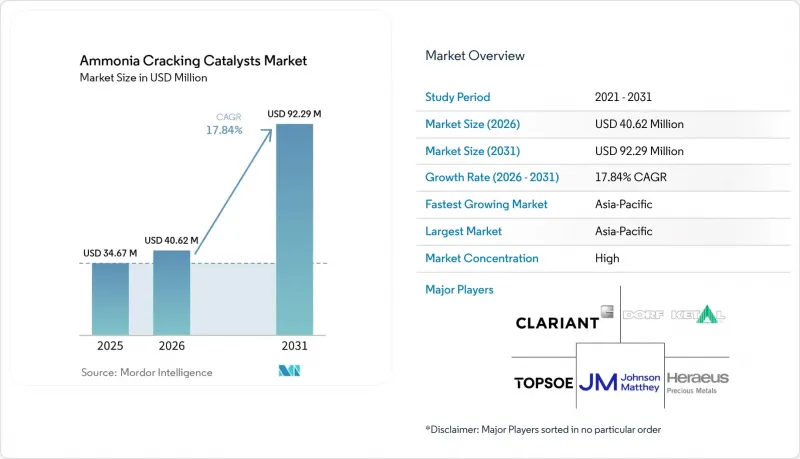
Mordor Intelligence에 의하면, 암모니아 분쇄 촉매 시장은 2025년에 3,467만 달러 규모로 평가되었습니다. 2026년 4,062만 달러에서 2031년까지 9,229만 달러에 이를 것으로 추정되고 예측 기간(2026-2031년) CAGR은 17.84%를 나타낼 전망입니다.
본 보고서는 촉매별(니켈계 촉매, 루테늄 및 기타 귀금속(PGM)계 촉매, 철계 촉매 등), 용도별(산업용 수소, 연료전지 및 모빌리티, 발전, 화학 원료, 기타 용도), 그리고 지역별(아시아태평양, 북미, 유럽,남미, 중동 및 아프리카)로 분류되어 있습니다. 시장 예측은 금액(달러) 기준으로 제시되어 있습니다.
세계의 암모니아 분쇄 촉매 시장 동향 및 인사이트
암모니아에서 수소로의 전환이 필요한 수소 수입 허브
유럽 및 동북아시아에서는 암모니아 크래킹을 특수 공정에서 더 대규모의 상업 운영으로 전환하기 위한 시설이 건설되고 있습니다. 각 터미널은 장기적인 촉매 공급 관계를 유지할 수 있습니다. 에어 리퀴드(Air Liquide)는 2025년 11월 앤트워프·브뤼헤에서 하루 30메트릭톤 규모의 암모니아 분해 파일럿 플랜트 가동을 시작했습니다. 이 프로젝트는 사업자가 향후 수입 시설을 계획할 때 플랜트 규모에 대한 참고 기준을 제공하는 것입니다. 일본 및 한국의 집중형 프로젝트는 여러 고객에게 공급하는 산업용 파이프라인으로 수소를 송출하도록 설계되었습니다. 암모니아 분쇄 촉매 시장은 촉매 충전재 교체가 3년에서 7년마다 필요하기 때문에 터미널이 가동을 시작한 후에도 지속적인 수요가 발생한다는 점에서 혜택을 보고 있습니다.
산업의 탈탄소화와 고순도 수소 수요
2024년 전 세계 수소 수요는 1억 톤에 육박했으나, 저배출 수소는 총 사용량의 1% 미만에 그쳤습니다. 철강, 유리, 화학, 정유 업계의 사용자들은 운영 호환성을 확보하기 위해 99.9%를 초과하는 순도의 수소를 점점 더 필요로 하고 있습니다. 촉매 분해와 압력 스윙 흡착을 결합함으로써 산업 시설에서 이러한 요구를 충족시킬 수 있습니다. 톱소(Topsoe)사에 따르면, 자사의 H2Retake 공정은 30바(게이지 압력)에서 최대 99.999%의 수소 순도를 실현할 수 있다고 합니다. 항만 지역의 사용자들은 탄소 비용 상승에 따라 핵심 공정 설비를 변경하지 않고도, 천연가스 개질을 통한 수소에서 수입된 암모니아 크래킹 유래 수소로 전환할 수 있습니다. 2026년 과학 연구에 따르면, 암모니아 크래킹, 자가열식 개질 및 고체 산화물 전해를 통합함으로써 석유화학 클러스터의 수소 비용을 절감할 수 있는 것으로 밝혀졌습니다.
루테늄 및 귀금속의 비용 위험
루테늄 비용은 기존의 금속 함량을 사용하는 촉매에 있어 중요한 제약 요인으로 작용하고 있습니다. 2025년 전 세계 1차 루테늄 생산량은 31메트릭톤이며, 그중 90% 이상이 남아프리카공화국의 부시벨드 화성암 복합체에서 생산됩니다. 이러한 공급 집중으로 인해 광산은 수요 증가에 신속하게 대응할 수 있는 능력이 제한적입니다. Amogy사의 저루테늄 촉매와 미쓰비시 중공업의 비귀금속계 HyMACS 촉매는 공급업체들이 이러한 위험을 어떻게 완화하고 있는지를 보여줍니다. 따라서 암모니아 분쇄 촉매 시장에서는 고품질의 저온용 배합 제품과 금속 함량이 낮은 대체 제품 모두 선호될 전망입니다.
부문 분석
2025년, 니켈계 촉매는 암모니아 분쇄 촉매 시장에서 42.67%의 점유율을 차지했습니다. 이러한 위상은 대규모 산업용 크래커에서의 오랜 운영 실적과 관형 연소 장치에서 사용되는 온도 환경 하에서의 내성을 반영합니다. 탑소(Topso)사의 ‘DNK-30 Retake’ 및 ‘DNK-40 Retake’ 촉매는 산업용 표준 플랜트에서 30만 시간 이상의 가동 실적을 쌓아왔습니다. 이 두 제품은 관형 연소 크래커의 서로 다른 구간에 맞추어 설계되었습니다. 철계 소재는 코발트와 철의 화학적 특성이 운전 조건에 적합한 중수 플랜트에서 틈새 시장을 유지하고 있습니다. 또한, 코발트 및 몰리브덴계 시스템도 저비용 바이메탈 대체재로 주목받고 있습니다.
루테늄 및 기타 PGM 촉매는 2026년부터 2031년까지 연평균 성장률(CAGR) 19.55%를 나타낼 것으로 예측됩니다. 이 촉매들은 저온에서 뛰어난 성능을 발휘하며, 고온 니켈 반응기의 실용성이 낮은 연료전지 및 모빌리티 용도를 위한 소형 크래커를 뒷받침하고 있습니다. 헤라에우스 프레셔스 메탈즈는 2025년 5월, 산업적으로 실용적인 조건 하에서 암모니아 분해에 견딜 수 있는 안정적인 루테늄 촉매를 개발하는 연구 개발 프로그램을 완료했습니다. 2025년 연구에 따르면, 알루미나 지지체에 부착된 CoNi 촉매는 분산형 시스템과 관련된 조건에서 500°C에서 95%의 암모니아 분해율을 달성한 것으로 밝혀졌습니다. 한국화학연구소는 2025년 2월, 코발트·철계 층상 이산화물 촉매에 대해 450°C에서 암모니아의 수소 전환율이 81.9%에 달했다고 보고했습니다. 또한, 한국에너지연구소도 2025년 7월, 루테늄 합성법을 통해 수소 수율이 1.7배 향상되고 활성화 에너지가 20% 감소했다고 보고했습니다.
지역별 분석
아시아태평양은 2025년 전 세계 매출의 36.34%를 차지했으며, 2031년까지 연평균 성장률(CAGR) 20.80%를 나타낼 것으로 예측됩니다. 이 지역은 수소 수입 계획과 촉매 개발을 병행하고 있어 2026년에는 핵심 수요 지역이 될 전망입니다. 한국은 2030년까지 연간 400만 메트릭톤의 암모니아 수입을 목표로 하고 있습니다. 한국의 암모니아 인프라는 수소 수입을 위한 실질적인 기반을 제공합니다. 일본은 신에너지·산업기술종합개발기구(NEDO)가 지원하는 프로그램을 통해 국내 기술 개발을 추진하고 있습니다. Amogy사와 JGC 홀딩스는 2025년 4월에 저루테늄 촉매 파일럿 플랜트를 가동했습니다. 미쓰비시 중공업과 일본촉매는 2025년 10월에 NEDO공급망 개발 프로젝트에 선정되었습니다.
유럽에서는 독일이 여러 수입 터미널 계획을 추진하는 한편, 벨기에와 네덜란드는 라인강·스헬데강 항만 클러스터의 혜택을 누리고 있습니다. 에어 리퀴드(Air Liquide)가 2025년 11월 앤트워프·브뤼헤에서 운영한 파일럿 플랜트에서는 하루 30메트릭톤의 암모니아가 처리되었습니다. 또한 독일에서는 반응기의 열 관리 및 귀금속을 포함하지 않는 촉매에 관한 조사 활동에 대해 공공 지원이 이루어지고 있습니다. 이러한 노력을 통해 촉매 기술 분야에서의 유럽의 역량이 강화되고 있습니다.
북미에서는 산업용 수소 및 초기 단계의 암모니아 혼소 사업을 중심으로 다소 완만한 수요 추이가 예상됩니다. 미국 멕시코만 연안 지역에서는 수입 지역에서 리턴 플로우형 크래킹 수요를 창출할 가능성이 있는 블루 암모니아 수출 공급망이 구축되고 있습니다. 남미, 특히 브라질과 아르헨티나는 여전히 유망한 암모니아 생산 지역입니다. 중동 및 아프리카도 주요 크래킹 시장이라기보다는 생산·공급 지역으로서 더 중요한 위치를 차지하고 있습니다. 사우디아라비아는 수출용 암모니아 생산 능력을 구축하고 있습니다. 남아프리카가 1차 루테늄 생산의 대부분을 차지하고 있기 때문에 이 지역은 촉매 공급 측면에서 업스트림 부문의 역할을 담당하고 있습니다.
기타 혜택 :
- 엑셀 형식 시장 예측(ME) 시트
- 3개월간의 애널리스트 지원
자주 묻는 질문
목차
제1장 서론
제2장 조사 방법
제3장 주요 요약
제4장 시장 구도
제5장 시장 규모 및 성장 예측
제6장 경쟁 구도
제7장 시장 기회 및 향후 전망
KTH 26.09.10According to Mordor Intelligence, the ammonia cracking catalysts market was valued at USD 34.67 million in 2025 and is estimated to grow from USD 40.62 million in 2026 to reach USD 92.29 million by 2031, at a CAGR of 17.84% during the forecast period (2026-2031).
This report is Segmented by Catalyst (Nickel-Based Catalysts, Ruthenium and Other PGM Catalysts, Iron-Based Catalysts, and More), End-Use (Industrial Hydrogen, Fuel Cell and Mobility, Power Generation, Chemical Feedstock, and Other End-Uses), and Geography (Asia-Pacific, North America, Europe, South America, and Middle-East and Africa). The Market Forecasts are Provided in Terms of Value (USD).
Global Ammonia Cracking Catalysts Market Trends and Insights
Hydrogen Import Hubs Requiring Ammonia-to-Hydrogen Conversion
Europe and Northeast Asia are building facilities that can move ammonia cracking from a specialized process to larger commercial operations. Each terminal can support a long-term catalyst supply relationship. Air Liquide commissioned its 30-metric ton-per-day cracking pilot at Antwerp-Bruges in November 2025. The project gives operators a plant-scale reference point while they plan future import facilities. Centralized projects in Japan and South Korea are designed to send hydrogen into industrial pipelines serving several customers. The ammonia cracking catalysts market benefits because catalyst fills need replacement every 3 to 7 years, creating recurring demand after a terminal enters service.
Industrial Decarbonization and High-Purity Hydrogen Demand
Global hydrogen demand reached nearly 100 million metric tons in 2024, while low-emissions hydrogen represented less than 1% of total use. Steel, glass, chemicals, and refining users increasingly require hydrogen purity above 99.9% for compatible operations. Catalytic cracking paired with pressure swing adsorption can meet this need at industrial facilities. Topsoe states that its H2Retake process can deliver hydrogen purity of up to 99.999% at 30 bar gauge. Port-based users can switch from natural-gas-reforming hydrogen to imported cracked-ammonia hydrogen without changing their core process equipment as carbon costs rise. A 2026 scientific study found that integrated ammonia cracking, autothermal reforming, and solid oxide electrolysis can reduce hydrogen costs in petrochemical clusters.
Ruthenium and Precious-Metal Cost Exposure
Ruthenium costs are a material constraint for catalysts using conventional metal loading levels. Global primary ruthenium production was 31 metric tons in 2025, with more than 90% of output coming from South Africa's Bushveld Igneous Complex. This supply concentration gives mines a limited ability to respond quickly to a demand increase. Amogy's low-ruthenium catalyst and Mitsubishi Heavy Industries' non-precious-metal HyMACS catalyst show how suppliers are reducing this exposure. The ammonia cracking catalysts market is therefore likely to support both premium low-temperature formulations and lower-metal alternatives.
Other drivers and restraints analyzed in the detailed report include:
- Existing Ammonia Storage, Shipping and Handling Infrastructure
- Growth of Distributed Power and Fuel-Cell Applications
- High Endothermic Heat Duty and Energy-Integration Complexity
For complete list of drivers and restraints, kindly check the Table Of Contents.
Segment Analysis
Nickel-based catalysts held 42.67% of the ammonia cracking catalysts market share in 2025. Their position reflects long operating experience in large industrial crackers and their resilience at the temperatures used in tubular-fired equipment. Topsoe's DNK-30 Retake and DNK-40 Retake catalysts have accumulated more than 300,000 operating hours in industrial reference plants. The two products are designed for different sections of a tubular-fired cracker. Iron-based materials retain a niche in heavy-water plants where cobalt-iron chemistry suits operating conditions. Cobalt- and molybdenum-based systems are also receiving attention as lower-cost bimetallic alternatives.
Ruthenium and other PGM catalysts are forecast to grow at a 19.55% CAGR from 2026 to 2031. Their lower-temperature performance supports compact crackers for fuel cell and mobility uses where high-temperature nickel reactors are less practical. Heraeus Precious Metals completed an R&D program in May 2025 that produced a stable ruthenium catalyst for ammonia cracking under industrially relevant conditions. A 2025 study found that CoNi catalysts on alumina achieved 95% ammonia decomposition at 500 °C in conditions relevant to decentralized systems. The Korea Chemical Research Institute reported 81.9% ammonia-to-hydrogen conversion at 450 °C for a cobalt-iron layered double oxide catalyst in February 2025. The Korea Institute of Energy Research also reported 1.7 times higher hydrogen yield and 20% lower activation energy from a ruthenium synthesis method in July 2025.
Complete Report Scope:
- By Catalyst
- Nickel-Based Catalysts
- Ruthenium and Other PGM Catalysts
- Iron-Based Catalysts
- Cobalt- and Molybdenum-Based Catalysts
- Other Catalysts
- By End-Use
- Industrial Hydrogen
- Fuel Cell and Mobility
- Power Generation
- Chemical Feedstock
- Other End-Uses
- By Geography
- Asia-Pacific
- China
- India
- Japan
- South Korea
- ASEAN Countries
- Rest of Asia-Pacific
- North America
- United States
- Canada
- Mexico
- Europe
- Germany
- United Kingdom
- France
- Italy
- NORDIC Countries
- Russia
- Rest of Europe
- South America
- Brazil
- Argentina
- Rest of South America
- Middle-East and Africa
- Saudi Arabia
- South Africa
- Rest of Middle-East and Africa
- Asia-Pacific
Geography Analysis
Asia-Pacific held 36.34% of global revenue in 2025 and is expected to grow at a 20.80% CAGR through 2031. The region is the central demand area in 2026 because it combines hydrogen-import planning with catalyst development. South Korea targets ammonia imports of 4 million metric tons per year by 2030. Its ammonia infrastructure offers a practical basis for hydrogen imports. Japan is supporting domestic technology development through New Energy and Industrial Technology Development Organization (NEDO)-backed programs. Amogy and JGC Holdings deployed a low-ruthenium catalyst pilot in April 2025. Mitsubishi Heavy Industries and Nippon Shokubai were selected for a NEDO supply-chain development project in October 2025.
In Europe, Germany is advancing multiple import-terminal plans, while Belgium and the Netherlands benefit from the Rhine-Scheldt port cluster. Air Liquide's November 2025 Antwerp-Bruges pilot processed 30 metric tons of ammonia per day. Germany also has publicly supported research activity in reactor heat management and precious-metal-free catalysts. These efforts strengthen Europe's capability in the catalyst technology tier.
North America has a more gradual demand profile centered on industrial hydrogen and early ammonia co-firing activity. The U.S. Gulf Coast is developing blue-ammonia export supply chains that can create return-flow cracking demand in importing regions. South America remains a prospective ammonia production area, particularly in Brazil and Argentina. The Middle-East and Africa are also more important as production and supply regions than as major cracking markets. Saudi Arabia is developing ammonia production capacity for export. South Africa's majority share of primary ruthenium output gives the region an upstream role in catalyst supply.
- AMOGY Inc.
- Casale SA
- Catator AB
- CLARIANT
- Dorf Ketal
- Evonik Industrues AG
- HEESUNG CATALYSTS CORP
- Heraeus Precious Metals
- Honeywell International Inc.
- Johnson Matthey
- Nikki-Universal Co., Ltd.
- TANAKA PRECIOUS METAL GROUP Co., Ltd.
- thyssenkrupp Uhde GmbH
- Topsoe
- UNICAT Catalyst Technologies, LLC
Additional Benefits:
- The market estimate (ME) sheet in Excel format
- 3 months of analyst support
TABLE OF CONTENTS
1 Introduction
- 1.1 Study Assumptions and Market Definition
- 1.2 Scope of the Study
2 Research Methodology
3 Executive Summary
4 Market Landscape
- 4.1 Market Overview
- 4.2 Market Drivers
- 4.2.1 Hydrogen Import Hubs Requiring Ammonia-to-Hydrogen Conversion
- 4.2.2 Industrial Decarbonization and High-Purity Hydrogen Demand
- 4.2.3 Existing Ammonia Storage, Shipping and Handling Infrastructure
- 4.2.4 Growth of Distributed Power and Fuel-Cell Applications
- 4.2.5 Low-Temperature Catalyst and Heat-Integration Innovation
- 4.2.6 Port-Based Hydrogen Demand Creating Cracker Anchor Loads
- 4.3 Market Restraints
- 4.3.1 Ruthenium and Precious-Metal Cost Exposure
- 4.3.2 High Endothermic Heat Duty and Energy-Integration Complexity
- 4.3.3 Ammonia Toxicity, Slip Control and Permitting Requirements
- 4.3.4 Catalyst Deactivation Under Water, Hydrogen and Impurity Exposure
- 4.4 Value Chain Analysis
- 4.5 Porter's Five Forces
- 4.5.1 Threat of New Entrants
- 4.5.2 Bargaining Power of Suppliers
- 4.5.3 Bargaining Power of Buyers
- 4.5.4 Threat of Substitutes
- 4.5.5 Competitive Rivalry
5 Market Size and Growth Forecasts (Value)
- 5.1 By Catalyst
- 5.1.1 Nickel-Based Catalysts
- 5.1.2 Ruthenium and Other PGM Catalysts
- 5.1.3 Iron-Based Catalysts
- 5.1.4 Cobalt- and Molybdenum-Based Catalysts
- 5.1.5 Other Catalysts
- 5.2 By End-Use
- 5.2.1 Industrial Hydrogen
- 5.2.2 Fuel Cell and Mobility
- 5.2.3 Power Generation
- 5.2.4 Chemical Feedstock
- 5.2.5 Other End-Uses
- 5.3 By Geography
- 5.3.1 Asia-Pacific
- 5.3.1.1 China
- 5.3.1.2 India
- 5.3.1.3 Japan
- 5.3.1.4 South Korea
- 5.3.1.5 ASEAN Countries
- 5.3.1.6 Rest of Asia-Pacific
- 5.3.2 North America
- 5.3.2.1 United States
- 5.3.2.2 Canada
- 5.3.2.3 Mexico
- 5.3.3 Europe
- 5.3.3.1 Germany
- 5.3.3.2 United Kingdom
- 5.3.3.3 France
- 5.3.3.4 Italy
- 5.3.3.5 NORDIC Countries
- 5.3.3.6 Russia
- 5.3.3.7 Rest of Europe
- 5.3.4 South America
- 5.3.4.1 Brazil
- 5.3.4.2 Argentina
- 5.3.4.3 Rest of South America
- 5.3.5 Middle-East and Africa
- 5.3.5.1 Saudi Arabia
- 5.3.5.2 South Africa
- 5.3.5.3 Rest of Middle-East and Africa
- 5.3.1 Asia-Pacific
6 Competitive Landscape
- 6.1 Market Concentration
- 6.2 Strategic Moves
- 6.3 Market Share (%)/Ranking Analysis
- 6.4 Company Profiles (includes Global Overview, Market Overview, Core Segments, Financials as available, Strategic Information, Products and Services, and Recent Developments)
- 6.4.1 AMOGY Inc.
- 6.4.2 Casale SA
- 6.4.3 Catator AB
- 6.4.4 CLARIANT
- 6.4.5 Dorf Ketal
- 6.4.6 Evonik Industrues AG
- 6.4.7 HEESUNG CATALYSTS CORP
- 6.4.8 Heraeus Precious Metals
- 6.4.9 Honeywell International Inc.
- 6.4.10 Johnson Matthey
- 6.4.11 Nikki-Universal Co., Ltd.
- 6.4.12 TANAKA PRECIOUS METAL GROUP Co., Ltd.
- 6.4.13 thyssenkrupp Uhde GmbH
- 6.4.14 Topsoe
- 6.4.15 UNICAT Catalyst Technologies, LLC
7 Market Opportunities and Future Outlook
- 7.1 White-Space and Unmet-Need Assessment