
|
시장보고서
상품코드
2119288
리튬 망간 철 인산염 배터리 소재 : 시장 점유율 분석, 업계 동향 및 통계, 성장 예측(2026-2031년)Lithium Manganese Iron Phosphate (LMFP) Battery Materials - Market Share Analysis, Industry Trends & Statistics, Growth Forecasts (2026 - 2031) |
||||||
 Mordor Intelligence
Mordor Intelligence에 의하면, 리튬 망간 철 인산염 배터리 소재 시장 규모는 2025년에 10억 2,000만 달러로 평가되었습니다. 2026년 12억 5,000만 달러에서 2031년까지 36억 2,000만 달러로 확대되어 2026년부터 2031년에 걸쳐 CAGR 23.78%를 나타낼 것으로 예측됩니다.
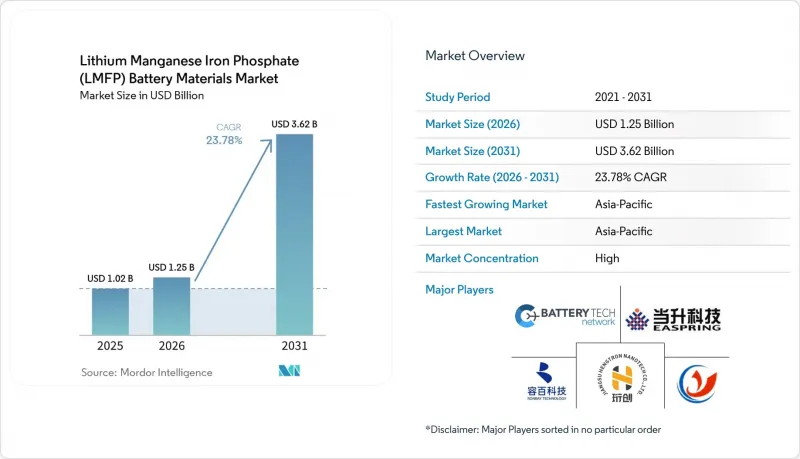
본 보고서는 소재 유형(LMFP 양극재, 음극재 등), 셀 형태(원통형 셀, 각형 셀 등), 용도(전기차 등), 지역(아시아태평양, 북미, 유럽, 남미, 중동 및 아프리카)별로 분류되어 있습니다. 시장 예측은 금액(달러) 기준으로 제시되어 있습니다.
세계의 리튬 망간 철 인산염 배터리 소재 시장 동향 및 인사이트
전기차(EV)의 보급과 LFP와 동등한 비용으로 실현되는 고에너지 밀도에 대한 수요
LMFP는 기존 LFP와 동등한 비용 구조를 유지하면서 15%에서 20% 더 높은 에너지 밀도를 실현할 수 있습니다. 이러한 특징 덕분에 주행 거리, 비용, 안전성이 차량 설계 결정에 영향을 미치는 중거리 전기차에서의 채택이 촉진되고 있습니다. LFP는 2025년에 전기차 배터리 도입에서 니켈계 화학 조성을 능가하며, 인산망간철리튬(LMFP) 배터리 소재 시장이 발전할 수 있는 더 대규모의 생산 및 공급 기반을 구축했습니다. Contemporary Amperex Technology Co. Limited(CATL)의 망간 고함유 M3P 플랫폼은 주행 거리 700km를 내세우는 ‘Zhijie S7’에 탑재되었으며, 한편 Ronbay사의 순수 LMFP 배합은 2026년에 소량으로 차량에 도입되기 시작했습니다. LMFP는 니켈 고함량 배터리 화학계에 영향을 미치는 니켈 및 코발트공급 제약 없이 시장을 확대할 수 있습니다. EU 배터리 규정 2023/1542에 따르면, 2025년 8월 이후 탄소 발자국 공개 및 공급망 실사가 의무화되어, 코발트 의존도가 낮은 양극재 선택은 규정 준수 측면에서 이점을 제공합니다.
그리드 규모의 배터리 에너지 저장 시스템 확대
그리드 규모의 배터리 에너지 저장 시스템은 인산망간철리튬(LMFP) 배터리 소재 시장에 승용차 이외 수요 채널을 제공합니다. 저장 시스템 구매자들은 4시간의 지속 시간을 가정하여 설계된 시스템을 점점 더 많이 채택하고 있으며, 랙 베이당 에너지 밀도가 높을수록 고정된 설치 장소 내에서 이용 가능한 용량을 향상시킬 수 있습니다. 또한 LMFP는 에너지 저장 시스템 개발자가 화재 안전 및 보험 요건을 검토할 때 중요하게 여기는 열적 안정성도 갖추고 있습니다. 따라서 사용 가능한 공간, 인허가, 운영상의 안전성이 조달 결정에 영향을 미치는 용도에 이 화학 성분이 적합합니다. 배터리 에너지 저장 시스템의 계약 기간은 15년에서 20년에 달할 수 있어, 자동차 모델 주기보다 더 장기적인 수요 전망을 제공합니다. 프로젝트 개발자가 계획 단계에서 건설 단계로 넘어감에 따라, 이러한 장기 계약이 양극재의 조달 물량을 뒷받침할 가능성이 있습니다.
망간의 용출, 얀-텔러 변형 및 용량 저하
충전 사이클 및 고온 조건 하에서 발생하는 망간의 용출은 여전히 LMFP의 상업적 규모 확장에 있어 주요 기술적 제약으로 남아 있습니다. 2024년 연구에 따르면, 용출된 Mn2+ 이온이 양극에서 이동하여 흑연으로 만들어진 음극에 침착함으로써 고체 전해질 계면의 열화 및 리튬 저장량 손실에 기여하는 것으로 밝혀졌습니다. 이러한 열화 과정은 사이클 횟수가 늘어남에 따라 더욱 두드러집니다. 2025년 연구에서는 Mn³+ 이온의 얀-텔러 왜곡이 격자 변형의 원인임이 밝혀졌습니다. 이로 인해 망간 함유량이 높을 경우 리튬 이온의 확산이 제한될 가능성이 있습니다. 총 몰 농도가 낮은 LiPF6 및 LiFSI를 사용한 혼합염 전해액은 망간 침전 억제 효과를 높여줍니다. 이러한 배합에서는 표준 LFP 전해액 제조보다 엄격한 합성 관리가 필요하기 때문에 산업적 활용이 더욱 확대되기 전까지는 높은 비용이 지속될 가능성이 있습니다.
부문 분석
LMFP 양극재는 2025년 리튬 망간 철 인산염 배터리 소재 시장 점유율의 69.45%를 차지했으며, 2031년까지 연평균 성장률(CAGR) 26.13%를 나타낼 것으로 예측됩니다. 양극은 셀의 전압, 에너지 밀도 및 사이클 특성의 대부분을 결정하기 때문에 LMFP 소재 체인에서 주요 가치 요소로 자리 잡고 있습니다. 생산 규모 확대는 관련 소재 전반에 걸친 비용 절감에도 기여합니다. 실리콘-탄소 복합 음극은 LMFP 양극과 결합함으로써 주어진 팩 크기에서 더 긴 주행 거리를 실현할 수 있으므로, 이 음극 소재가 해당 밸류체인을 뒷받침하고 있습니다. 이러한 조합으로 인해 수요는 대용량 실리콘-흑연 혼합물로 이동할 가능성이 있습니다. 또한, LMFP는 작동 전압 컷오프가 약 4.3V로 높고, 망간의 용해를 제어하기 위한 대책이 필요하기 때문에 전해액 및 분리막 소재의 중요성이 점점 더 커지고 있습니다.
리튬비스(플루오로설포닐)이미드(LiFSI)를 기반으로 한 염 혼합물이나 불소화 공용매는 요구되는 전해액의 성능을 뒷받침할 수 있어, 특수한 배합에 대한 수요를 창출하고 있습니다. 기타 범주에 속하는 전도성 첨가제, 바인더, 집전체도 LMFP의 활성 입자가 미세화됨에 따라 혜택을 보고 있습니다. 이로 인해 리튬의 확산 거리는 단축되지만, 표면적이 큰 카본블랙이나 더 엄격한 바인더 사양이 요구되게 됩니다. 분리막 소재의 경우, 더 미세한 입자에 대응하고 고전압 하에서 안정성을 유지하기 위해 기공 직경을 더욱 정밀하게 제어해야 합니다. 표준 LFP 양극재는 2019년부터 2025년에 걸쳐 한 자릿수 성장률을 보인 반면, LMFP의 상업적 생산은 훨씬 낮은 수준에서 시작되었습니다.
지역별 분석
아시아태평양은 2025년에 인산망간철리튬(LMFP) 배터리 소재 시장의 45.02%를 차지했으며, 2031년까지 연평균 성장률(CAGR) 25.83%를 나타낼 것으로 예측됩니다. 중국이 이러한 위치를 유지하고 있는 것은 양극재 생산 인프라, 확립된 셀 제조 거점, 그리고 2024년 중반까지 풀가동에 도달한 Dynanonic사의 구징(曲靖)에 위치한 연산량 11만 톤 규모의 LMFP 제조 시설 덕분입니다. 2026년 5월, 다이나노닉(Dynanonic)은 2개의 인산염계 소재 프로젝트에 87억 위안(12억 달러)을 투자한다고 발표했습니다. 인도는 아그라타스 에너지 스토리지 솔루션즈(Agratas Energy Storage Solutions)가 방갈로르에 건설 중인 4억 달러 규모의 연구개발 센터와, 알트민(Altmin) 및 히마도리 특수화학제품(Himadri Specialty Chemicals)이 계획 중인 LFP 및 LMFP 생산 능력 등 양극재 프로젝트를 통해 관련 생산 능력을 구축하고 있습니다.
한국에서는 미국의 조달 요건을 충족하기 위한 목적으로 론베이(Ronbay)의 충주 양극재 생산 라인을 통해 공급이 확대되고 있습니다. 일본에서는 파나소닉이 2027년에 시작될 예정인 프로그램을 위해 대형 원통형 LMFP 셀의 인증을 추진하고 있습니다. 이러한 활동을 통해 양극재, 셀 및 최종 용도에 걸쳐 리튬 망간 철 인산염 배터리 소재 시장의 지역별 생산 능력이 확대되고 있습니다. 아시아태평양 이외에서는 북미와 유럽이 여전히 정책 주도형 투자 지역으로서 가장 중요한 위치를 차지하고 있습니다. 유럽에서는 EU 배터리 규정에 따라 2027년 2월에 발효될 ‘디지털 배터리 패스포트’ 요건이 유럽연합(EU) 역내의 배터리 소재 공급을 뒷받침하고 있습니다. CATL과 스텔란티스는 스페인 사라고사에 41억 유로(47억 5,000만 달러)를 투자해 50GWh 규모의 LFP 기가팩토리를 건설 중이며, 2026년 하반기 생산 개시를 목표로 하고 있습니다.
다이나노닉과 ICL 그룹은 인산망간철리튬(LMFP) 배터리 소재 시장에 대응하기 위해 살렌토에 2억 8,500만 유로(3억 1,000만 달러)를 투자해 LFP 및 LMFP 공장을 건설 중입니다. 남미는 ‘리튬 트라이앵글’의 자원과 유망한 광산 파트너십을 통해 업스트림 부문에서 중요한 역할을 하고 있습니다. 중동 및 아프리카 수요는 청정 에너지 계획에 따른 계통 연계용 에너지 저장 수요와 관련이 있으나, 두 지역 모두 현재 수입 소재에 의존하고 있습니다. 이 지역들의 장기적인 수요는 에너지 저장 프로젝트가 개발 단계에서 조달 단계로 전환되느냐에 달려 있습니다.
기타 혜택 :
- 엑셀 형식 시장 예측(ME) 시트
- 3개월간의 애널리스트 지원
자주 묻는 질문
목차
제1장 서론
제2장 조사 방법
제3장 주요 요약
제4장 시장 구도
제5장 시장 규모 및 성장 예측
제6장 경쟁 구도
제7장 시장 기회 및 향후 전망
KTH 26.09.10According to Mordor Intelligence, the lithium manganese iron phosphate (LMFP) battery materials market size is estimated at USD 1.02 billion in 2025 and is estimated to grow from USD 1.25 billion in 2026 to USD 3.62 billion by 2031, at a CAGR of 23.78% during the forecast period (2026-2031).

This report is Segmented by Material Type (LMFP Cathode Materials, Anode Materials, and More), Cell Format (Cylindrical Cells, Prismatic Cells, and More), Application (Electric Vehicles and More), and Geography (Asia-Pacific, North America, Europe, South America, and Middle-East and Africa). The Market Forecasts are Provided in Terms of Value (USD).
Global Lithium Manganese Iron Phosphate (LMFP) Battery Materials Market Trends and Insights
EV Adoption and Demand for Higher Energy Density at LFP-Like Cost
LMFP can deliver 15% to 20% higher energy density than conventional LFP while maintaining a comparable cost structure. This combination supports its use in mid-range electric vehicles, where range, cost, and safety influence vehicle design decisions. LFP surpassed nickel-based chemistries in electric vehicle battery deployments in 2025, creating a larger production and supplier base from which the Lithium Manganese Iron Phosphate (LMFP) Battery Materials Market can develop. Contemporary Amperex Technology Co. Limited (CATL)'s manganese-rich M3P platform powered the Zhijie S7, which claims a 700 km range, while Ronbay's pure-use LMFP formulation entered small-batch vehicle deployment in 2026. LMFP can expand without the nickel and cobalt supply constraints that affect nickel-rich battery chemistries. The EU Battery Regulation 2023/1542 has required carbon footprint declarations and supply chain due diligence since August 2025, creating a compliance benefit for cathode choices with lower cobalt exposure.
Expansion of Grid-Scale Battery Energy Storage Systems
Grid-scale battery energy storage provides the Lithium Manganese Iron Phosphate (LMFP) Battery Materials Market with a demand channel beyond passenger vehicles. Storage buyers increasingly use systems designed for a 4-hour duration, where higher energy density per rack bay can improve usable capacity within a fixed site. LMFP also retains the thermal stability that storage developers consider when addressing fire safety and insurance requirements. This makes the chemistry relevant in applications where available space, permitting, and operating safety influence procurement decisions. Battery energy storage system agreements can extend for 15 to 20 years, providing longer demand visibility than vehicle model cycles. These longer contracts may support cathode procurement quantities as project developers move from pipeline planning to construction.
Manganese Dissolution, Jahn-Teller Distortion, and Capacity Fade
Manganese dissolution during cycling and at elevated temperatures remains a key technical constraint on LMFP commercial scale-up. A 2024 study found that dissolved Mn2+ ions migrate from the positive electrode and deposit on the graphite negative electrode, contributing to solid-electrolyte interface degradation and lithium inventory loss. The failure process becomes more pronounced as the cycle count increases. A 2025 study identified Jahn-Teller distortion of Mn3+ ions as a cause of lattice strain, which can limit lithium-ion diffusion at higher manganese loadings. Mixed-salt electrolytes using LiPF6 and LiFSI at lower total molarity have improved the suppression of manganese deposition. These formulations require tighter synthesis control than standard LFP electrolyte production, which may maintain a cost premium until industrial use becomes more widespread.
Other drivers and restraints analyzed in the detailed report include:
- Lower Exposure to Cobalt and Nickel Supply-Chain Risk
- Localization of Battery Material Manufacturing
- Dual-Voltage Behavior and Battery Management Complexity
For complete list of drivers and restraints, kindly check the Table Of Contents.
Segment Analysis
LMFP cathode materials accounted for 69.45% of the Lithium Manganese Iron Phosphate (LMFP) Battery Materials Market share in 2025 and are forecast to grow at a CAGR of 26.13% through 2031. The cathode determines much of the cell's voltage, energy density, and cycle behavior, making it the primary value component in the LMFP materials chain. Production scale also supports cost reduction across complementary materials. Anode materials support this value chain, as silicon-carbon composite anodes can pair with LMFP cathodes to deliver a greater range from a given pack size. This pairing can shift demand toward higher-capacity silicon-graphite blends. Electrolyte and separator materials are increasingly important because LMFP has a higher operating-voltage cutoff of nearly 4.3 V and requires measures to control manganese dissolution.
Lithium bis(fluorosulfonyl)imide (LiFSI)-based salt blends and fluorinated co-solvents can support the required electrolyte performance, creating demand for specialized formulations. Conductive additives, binders, and current collectors in the other category also gain from smaller LMFP active particles, which reduce lithium diffusion distances but require higher-surface-area carbon black and tighter binder specifications. Separator materials require tighter pore-size control to accommodate smaller particles and maintain stability at elevated voltages. Standard LFP cathodes grew at a measured single-digit pace from 2019 to 2025, while LMFP commercial production started from a much lower base.
Complete Report Scope:
- By Material Type
- LMFP Cathode Materials
- Anode Materials
- Electrolyte Materials
- Separator Materials
- Others (Conductive Additives, Binders, Current Collectors)
- By Cell Format
- Cylindrical Cells
- Prismatic Cells
- Others (Pouch Cells)
- By Application
- Electric Vehicles
- Battery Energy Storage Systems
- Consumer Electronics
- Others (Industrial Applications)
- By Geography
- Asia-Pacific
- China
- India
- Japan
- South Korea
- ASEAN Countries
- Rest of Asia-Pacific
- North America
- United States
- Canada
- Mexico
- Europe
- Germany
- United Kingdom
- France
- Italy
- NORDIC Countries
- Rest of Europe
- South America
- Brazil
- Argentina
- Rest of South America
- Middle-East and Africa
- Saudi Arabia
- South Africa
- Rest of Middle-East and Africa
- Asia-Pacific
Geography Analysis
Asia-Pacific held 45.02% of the Lithium Manganese Iron Phosphate (LMFP) Battery Materials Market share in 2025 and is forecast to grow at a CAGR of 25.83% through 2031. China holds this position through cathode production infrastructure, an established cell manufacturing base, and Dynanonic's 110,000-ton-per-year LMFP facility in Qujing, which reached full utilization by mid-2024. In May 2026, Dynanonic announced a CNY 8.7 billion (USD 1.2 billion) investment in two phosphate-based material projects. India is building related capacity through cathode projects, including Agratas Energy Storage Solutions' USD 400 million research and development center in Bengaluru and planned LFP and LMFP capacity from Altmin and Himadri Specialty Chemical.
South Korea adds supply through Ronbay's Chungju cathode line, which targets United States sourcing requirements. In Japan, Panasonic is qualifying large-format cylindrical LMFP cells for programs scheduled to begin in 2027. These activities add regional capacity in the Lithium Manganese Iron Phosphate (LMFP) Battery Materials Market across cathode materials, cells, and end-use applications. North America and Europe remain the most policy-driven investment areas outside Asia-Pacific. In Europe, digital battery passport requirements, which take effect in February 2027 under the EU Battery Regulation, support battery material supply within the European Union. CATL and Stellantis are developing a 50 GWh LFP gigafactory in Zaragoza, Spain, with an investment of EUR 4.1 billion (USD 4.75 billion), and target production in late 2026.
Dynanonic and ICL Group are developing a EUR 285 million (USD 310 million) LFP and LMFP plant in Sallent, to serve the Lithium Manganese Iron Phosphate (LMFP) Battery Materials Market. South America has an upstream role through lithium-triangle resources and prospective mine partnerships. Demand in the Middle-East and Africa is linked to grid-storage needs under clean-energy programs, although both regions currently rely on imported materials. Their longer-term demand depends on storage projects moving from development to procurement.
- Beijing Easpring Material Technology Co., LTD
- BYD Europe B.V.
- CALB Group Co., Ltd.
- Contemporary Amperex Technology Co., Limited.
- Gotion
- Guangzhou Tinci Materials Technology Co., Ltd.
- Hunan Reshine New Material Co. Ltd.
- Hunan Yuneng New Energy Battery Material Co., Ltd.
- Integrals Power
- Jiangsu Hengtron Nanotech Co., Ltd.
- Livium Ltd
- NANO
- REPT BATTERO Energy Co., Ltd.
- Ronbay New Energy Technology Co., Ltd.
- Shenzhen Dynanonic Co., Ltd.
- SVOLT Energy
- XTC New Energy Materials (Xiamen) Co., Ltd.
Additional Benefits:
- The market estimate (ME) sheet in Excel format
- 3 months of analyst support
TABLE OF CONTENTS
1 Introduction
- 1.1 Study Assumptions and Market Definition
- 1.2 Scope of the Study
2 Research Methodology
3 Executive Summary
4 Market Landscape
- 4.1 Market Overview
- 4.2 Market Drivers
- 4.2.1 EV Adoption and Demand for Higher Energy Density at LFP-Like Cost
- 4.2.2 Expansion of Grid-Scale Battery Energy Storage Systems
- 4.2.3 Lower Exposure to Cobalt and Nickel Supply-Chain Risk
- 4.2.4 Localization of Battery Material Manufacturing
- 4.2.5 Flexible LFP-LMFP Production Lines and Blending Strategies
- 4.2.6 Recycling-Derived Manganese and Closed-Loop Material Supply
- 4.3 Market Restraints
- 4.3.1 Mn-Dissolution, Jahn-Teller Distortion, and Capacity Fade
- 4.3.2 Dual-Voltage Behavior and Battery Management Complexity
- 4.3.3 Competition from LFP, NMC, and Emerging Solid-State Chemistries
- 4.3.4 Low Commercial Utilization of Announced LMFP Capacity
- 4.4 Value Chain Analysis
- 4.5 Porter's Five Forces Analysis
- 4.5.1 Threat of New Entrants
- 4.5.2 Bargaining Power of Suppliers
- 4.5.3 Bargaining Power of Buyers
- 4.5.4 Threat of Substitutes
- 4.5.5 Competitive Rivalry
5 Market Size and Growth Forecasts (Value)
- 5.1 By Material Type
- 5.1.1 LMFP Cathode Materials
- 5.1.2 Anode Materials
- 5.1.3 Electrolyte Materials
- 5.1.4 Separator Materials
- 5.1.5 Others (Conductive Additives, Binders, Current Collectors)
- 5.2 By Cell Format
- 5.2.1 Cylindrical Cells
- 5.2.2 Prismatic Cells
- 5.2.3 Others (Pouch Cells)
- 5.3 By Application
- 5.3.1 Electric Vehicles
- 5.3.2 Battery Energy Storage Systems
- 5.3.3 Consumer Electronics
- 5.3.4 Others (Industrial Applications)
- 5.4 By Geography
- 5.4.1 Asia-Pacific
- 5.4.1.1 China
- 5.4.1.2 India
- 5.4.1.3 Japan
- 5.4.1.4 South Korea
- 5.4.1.5 ASEAN Countries
- 5.4.1.6 Rest of Asia-Pacific
- 5.4.2 North America
- 5.4.2.1 United States
- 5.4.2.2 Canada
- 5.4.2.3 Mexico
- 5.4.3 Europe
- 5.4.3.1 Germany
- 5.4.3.2 United Kingdom
- 5.4.3.3 France
- 5.4.3.4 Italy
- 5.4.3.5 NORDIC Countries
- 5.4.3.6 Rest of Europe
- 5.4.4 South America
- 5.4.4.1 Brazil
- 5.4.4.2 Argentina
- 5.4.4.3 Rest of South America
- 5.4.5 Middle-East and Africa
- 5.4.5.1 Saudi Arabia
- 5.4.5.2 South Africa
- 5.4.5.3 Rest of Middle-East and Africa
- 5.4.1 Asia-Pacific
6 Competitive Landscape
- 6.1 Market Concentration
- 6.2 Strategic Moves
- 6.3 Market Share (%)/Ranking Analysis
- 6.4 Company Profiles (includes Global Overview, Market Overview, Core Segments, Financials as available, Strategic Information, Products and Services, and Recent Developments)
- 6.4.1 Beijing Easpring Material Technology Co., LTD
- 6.4.2 BYD Europe B.V.
- 6.4.3 CALB Group Co., Ltd.
- 6.4.4 Contemporary Amperex Technology Co., Limited.
- 6.4.5 Gotion
- 6.4.6 Guangzhou Tinci Materials Technology Co., Ltd.
- 6.4.7 Hunan Reshine New Material Co. Ltd.
- 6.4.8 Hunan Yuneng New Energy Battery Material Co., Ltd.
- 6.4.9 Integrals Power
- 6.4.10 Jiangsu Hengtron Nanotech Co., Ltd.
- 6.4.11 Livium Ltd
- 6.4.12 NANO
- 6.4.13 REPT BATTERO Energy Co., Ltd.
- 6.4.14 Ronbay New Energy Technology Co., Ltd.
- 6.4.15 Shenzhen Dynanonic Co., Ltd.
- 6.4.16 SVOLT Energy
- 6.4.17 XTC New Energy Materials (Xiamen) Co., Ltd.
7 Market Opportunities and Future Outlook
- 7.1 White-Space and Unmet-Need Assessment