

|
시장보고서
상품코드
2119308
기계식 주유기 : 시장 점유율 분석, 업계 동향 및 통계, 성장 예측(2026-2031년)Mechanical Fuel Dispensers - Market Share Analysis, Industry Trends & Statistics, Growth Forecasts (2026 - 2031) |
||||||
 Mordor Intelligence
에 의하면, 기계식 주유기 시장 규모는 2025년 11억 4,000만 달러로 평가되었습니다. 2026년에는 11억 6,000만 달러로 확대되어 2026년부터 2031년에 걸쳐 CAGR 3.98%로 성장을 지속하여, 2031년에는 14억 1,000만 달러에 이를 것으로 예측됩니다.

본 보고서는 연료 유형(가솔린, 디젤, 등유, 바이오연료, 기타 연료), 계량기 유형(용적식, 기계식 터빈), 설치 유형(독립형, 섬형),최종 사용자(소매 주유소, 상용 차량 등), 지역(북미, 유럽, 아시아태평양, 남미, 중동 및 아프리카)별로 분류되어 있습니다. 시장 전망은 금액(달러) 기준으로 제시되어 있습니다.
세계의 기계식 주유기 시장 동향 및 인사이트
신흥 경제국에서의 연료 소매 인프라 확대
아프리카 및 남아시아의 연료 소매에 대한 투자는 주유소 네트워크가 확대되고 있는 지역의 신규 설비 수요를 뒷받침하고 있으며, 기계식 주유기 시장에 실질적인 성장 기반이 되고 있습니다. 기계식 주유기 시장은 저비용이며 유지보수가 용이한 설비가 사업자가 간편한 유지보수가 필요한 소규모 및 외딴 지역의 거점에 대응할 수 있을 때 혜택을 받습니다. 인도에서는 2026년 5월, 정부 인증 시험 센터의 검증 범위를 확대하여 휘발유, 디젤, CNG, LPG, LNG 및 수소 디스펜서를 포함하도록 했습니다. 검증 요건의 확대에 따라 신규 설치 및 교체 프로그램에서 인증된 장비의 중요성이 높아지고 있습니다. 이는 주유소 운영자가 해당 장비가 상업적 이용에 적합함을 입증해야 하기 때문입니다. 또한, 규정 준수 증명 서류, 현지 서비스 지원, 예비 부품 및 운영자 교육을 제공할 수 있는 공급업체가 유리해집니다. 이러한 상황으로 인해 조달 결정은 초기 가격에만 의존하기 어려워지고 있습니다.
정밀도 및 디지털 결제를 위한 노후 주유소 개보수
구형 주유소에서는 제한된 자본 계획 기간 내에 계량 및 결제 구성 요소의 업그레이드가 진행되고 있습니다. 결제 환경에는 PCI DSS 4.0 보안 요건이 적용되므로, 실외 결제 단말기에서도 안전한 결제 아키텍처가 중요해지고 있습니다. 많은 운영자는 기계식 계량 장치를 유지한 채 인증된 결제 모듈을 추가할 수 있으며, 이를 통해 연료 공급 시스템에 미치는 영향을 최소화할 수 있습니다. Dover Fueling Solutions사는 2026년 6월 EMEA 지역을 대상으로 ‘DFS Crypto NOVA’를 출시했습니다. 이는 Tokheim OASE 시스템과 호환되며, 250종 이상의 카드를 지원하는 안드로이드 기반의 개방형 결제 플랫폼입니다. 이러한 접근 방식을 통해, 특히 공사 기간 중에도 고객 서비스 제공을 지속해야 하는 거점에서는 완전한 교체에 수반되는 비용, 가동 중단 위험 및 설치로 인한 업무 차질을 완화할 수 있습니다. 또한, 이는 기계식 주유기 시장에서 애프터마켓 수익 기회도 창출합니다.
전기차(EV)의 보급이 성숙 시장에서 기존 연료의 판매량을 감소시키고 있다.
전기차 보급으로 인해 성숙 시장의 각 거점에서 기존 연료 판매량이 감소할 가능성이 있습니다. 이러한 영향은 충전 인프라 접근성 및 전기차 보유율이 더 높은 서유럽 및 북미 연안 시장에서 특히 두드러집니다. 다만, 본 분석에서 대상으로 한 전 세계 기계식 주유기 설치 대수에서 차지하는 영향은 극히 일부에 그칩니다. 이는 화물 운송, 산업용 및 외딴 지역의 주유 용도에서는 여전히 기존 연료에 대한 의존도가 지속되고 있기 때문입니다. 이 지역 사업자들은 기존의 주유 능력을 확충하기보다는 시설의 일부를 충전 설비로 전환할 가능성이 있습니다. 장비 공급업체들은 주유소의 제품 라인업을 확충하는 동시에, 이미 설치된 기존 장비에 대한 지원을 유지함으로써 이러한 추세에 대응하고 있습니다. 기계식 주유기 시장은 화물 운송, 외딴 지역에서의 운영, 그리고 전기차 보급률이 낮은 지역에서 여전히 견조한 모습을 보이고 있습니다.
부문 분석
2025년에는 디젤이 수요의 46.8%를 차지했으나, 바이오연료는 2031년까지 연평균 성장률(CAGR) 4.2%로 확대될 것으로 예측됩니다. 디젤 수요는 상업용 운송, 발전 및 비도로용 분야에서 뒷받침되고 있습니다. 이러한 용도에서는 첨단 디지털 기능보다 신뢰할 수 있는 공급, 실용적인 유지보수, 예측 가능한 교정 및 교체 부품의 가용성이 우선시됩니다. 바이오연료에 대한 요구 사항은 설치된 장비가 사용 중인 혼합 연료와 호환되어야 하고, 특정 용도에 대한 제조업체의 문서로 뒷받침되어야 하기 때문에 수요를 창출하고 있습니다. 미국 환경보호청(EPA)은 바이오디젤용 장비 및 저장 시스템에 대한 호환성 요건을 규정하고 있습니다.
UL 87B 표준은 급유 설비의 대상이 되는 디젤 및 바이오디젤 혼합 연료의 용도를 정의하고 있습니다. 브라질의 B15 바이오디젤 요건, EU의 EN590 B7 표준, 그리고 인도의 E20 프로그램은 문서화된 호환성이 요구되는 요인으로 확인되었습니다. 디젤 이외의 분야에서는 가솔린과 등유가 계속해서 수요를 지탱하고 있습니다. 기타 액체 연료에는 대형 차량 차고에서 디젤 배기액(DEF)을 주유하는 것이 포함됩니다. 기계식 주유기 시장은 여러 연료 등급에 걸친 변화하는 재료 호환성 요건을 충족해야 합니다.
2025년, 기계식 주유기 시장 규모의 81.4%를 용적식 유량계가 차지했습니다. 이 점유율은 미세한 측정 오차만으로도 연료 계량에 영향을 미칠 수 있는 소매, 차량 함대 및 외딴 지역에서의 용도에서 신뢰할 수 있는 거래 계량이 필요함을 반영합니다. OIML R 117-1은 상업용 계량에 사용되는 동적 액체 계량 시스템의 요구 사항을 규정하고 있습니다. 용적식 기술은 외부 전원이 없이도 작동할 수 있으며, 업스트림 측에 직선 파이프를 설치할 필요도 없습니다. 이러한 특성은 전력망에서 멀리 떨어진 장소나 기술 지원이 제한적인 설치 환경에 적합하며, 가혹한 운영 환경에서도 기계식 주유기 시장의 유지에 기여하고 있습니다.
기계식 터빈 미터는 2031년까지 연평균 성장률(CAGR) 4.6%를 나타낼 것으로 예측됩니다. 이 미터의 사용은 연료가 깨끗하고 점도가 안정적이며, 운영자가 제어된 운전 조건을 유지할 수 있는 고유량 차량 기지에 집중되어 있습니다. 터빈 시스템은 적절한 용도에서 더 낮은 압력 손실과 노즐당 낮은 설비 투자 비용을 실현할 수 있습니다. 그 성능은 연료의 점도, 온도 및 혼합 조성의 변화에 더 민감할 수 있습니다. 공급업체는 각 현장의 연료, 유량 프로파일 및 측정 요구 사항에 맞추어 계량기를 선정해야 합니다.
지역별 분석
2025년 기준, 아시아태평양은 기계식 주유기 시장 규모의 38.6%를 차지했습니다. 중국, 인도, 인도네시아, 베트남, 태국은 밀집된 주유소 네트워크를 통해 이 지역을 뒷받침하고 있습니다. 중국은 이 지역에서 가장 큰 절대 판매량을 자랑하며, 국내 제조업체들은 섬형 설치형 장비, 지역 유통, 가격 중심의 조달 분야에서 치열한 경쟁을 펼치고 있습니다. 인도는 2026년 5월, 여러 유형의 연료 디스펜서에 대한 검증 대상 범위를 확대했습니다. 일본과 한국은 정확도 인증이 중요시되는 고사양 시장으로 남아 있습니다.
중동 및 아프리카는 2031년까지 연평균 성장률(CAGR) 5.1%를 나타낼 것으로 예측됩니다. 수요는 연료 소매의 확대, 주유소 네트워크의 현대화, 물류 활동, 그리고 견고한 장비와 간편한 유지보수가 필요한 외딴 지역에서의 운영과 관련이 있습니다. 본 분석에 따르면, 사우디아라비아의 주유소 현대화가 구형 하드웨어 교체 수요를 뒷받침하고 있습니다. 모로코, 이집트, 아랍에미리트(UAE)는 고속도로 및 도시 지역 소매망 구축을 통해 조달을 촉진하고 있습니다. 사하라 이남 아프리카의 일부 지역에서는 사업자가 장거리 이동, 불안정한 전력 공급, 전문적인 지원 부족과 같은 과제에 직면할 가능성이 있으므로, 현지 서비스 체계나 전원에 의존하지 않는 장비가 중요합니다.
북미와 유럽은 기계식 주유기 시장이 성숙한 지역으로, 규정 준수, 개조 및 기존 자산을 유지하려는 사업자들의 노력이 수요를 형성하고 있습니다. NIST(미국 국립표준기술연구소)의 법정 계량에 관한 지침 및 PCI 보안 프레임워크로 인해, 정확한 측정과 보호된 결제 시스템이 업그레이드의 핵심 요소가 되고 있습니다. 유럽의 바이오연료 혼합 요건은 주유 설비의 재질 및 인증 재검토를 촉진할 가능성이 있습니다. 남미에서는 브라질의 바이오디젤 프로그램, 아르헨티나의 물류 활동, 칠레와 콜롬비아의 광업 및 도시 지역 성장을 통해 안정적인 수요가 창출되고 있습니다.
기타 혜택 :
- 엑셀 형식 시장 예측(ME) 시트
- 3개월간의 애널리스트 지원
자주 묻는 질문
목차
제1장 서론
제2장 조사 방법
제3장 주요 요약
제4장 시장 구도
제5장 시장 규모 및 성장 예측
제6장 경쟁 구도
제7장 시장 기회 및 향후 전망
KTH 26.09.10According to Mordor Intelligence, the mechanical fuel dispensers market size is expected to grow from USD 1.14 billion in 2025 to USD 1.16 billion in 2026 and is forecast to reach USD 1.41 billion by 2031 at 3.98% CAGR over 2026-2031.
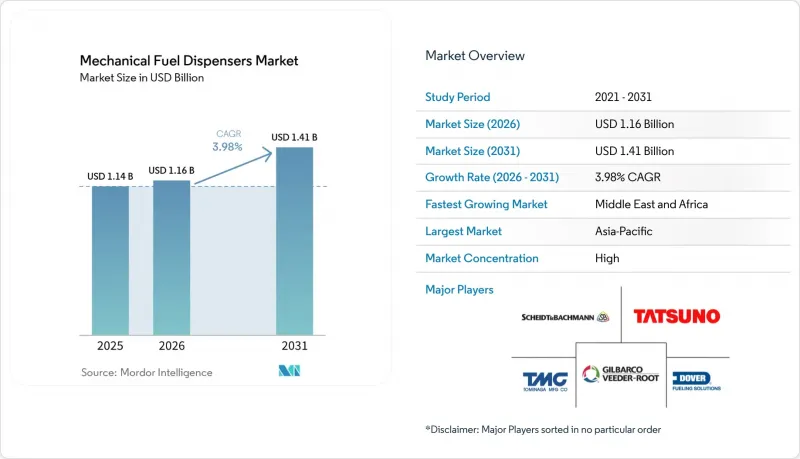
This report is Segmented by Fuel Type (Gasoline, Diesel, Kerosene, Biofuels, Other Fuels), Meter Type (Positive Displacement, Mechanical Turbine), Installation Type (Standalone, Island-Mounted), End User (Retail Fuel Stations, Commercial Fleet, and More), and Geography (North America, Europe, Asia-Pacific, South America, Middle East and Africa). The Market Forecasts are Provided in Terms of Value (USD).
Global Mechanical Fuel Dispensers Market Trends and Insights
Expansion of Fuel-Retail Infrastructure in Emerging Economies
Fuel retail investment in Africa and South Asia supports new equipment demand where station networks are expanding, providing a practical growth base for the mechanical fuel dispensers market. The mechanical fuel dispensers market benefits when lower-cost, serviceable equipment can support smaller and remote locations where operators need straightforward maintenance. India expanded the Government-Approved Test Centre verification scope in May 2026 to include petrol, diesel, CNG, LPG, LNG, and hydrogen dispensers. The broader verification requirement raises the importance of certified equipment in new installations and replacement programs because a station operator must demonstrate that the equipment is acceptable for commercial use. It also favors suppliers that can provide documented compliance, local service support, spare parts, and training for station operators. These conditions make procurement decisions less dependent on initial price alone.
Retrofitting of Aging Forecourts for Accuracy and Digital Payments
Older forecourts are upgrading measurement and payment components within a narrow capital-planning period. PCI DSS 4.0 security requirements apply to payment environments, making secure payment architecture relevant to outdoor payment terminals. Many operators can retain the mechanical metering unit while adding certified payment modules, limiting disruption to the fuel-delivery system. Dover Fueling Solutions launched DFS Crypto NOVA for EMEA in June 2026 as an open, Android-based payment platform compatible with Tokheim OASE systems and supporting more than 250 card types. This approach can lower the cost, outage risk, and installation disruption of a full replacement, especially at sites that must continue serving customers while work is completed. It also creates aftermarket revenue opportunities for the mechanical fuel dispensers market.
EV Adoption Reducing Conventional-Fuel Volumes in Mature Markets
Electric vehicle adoption can reduce conventional-fuel volumes at sites in mature markets. The impact is most relevant in Western Europe and coastal North American markets where charging access and electric vehicle ownership are more developed. This exposure affects a minority of global mechanical dispenser volumes in the supplied analysis because freight, industrial, and remote fueling applications continue to depend on conventional fuels. Operators in these regions may convert part of a site to charging rather than add conventional fueling capacity. Equipment suppliers are responding by broadening their forecourt portfolios and maintaining support for installed conventional equipment. The mechanical fuel dispensers market remains more resilient in freight, remote operations, and regions with lower electric vehicle penetration.
Other drivers and restraints analyzed in the detailed report include:
- Growth of Commercial Fleet and High-Flow Diesel Refueling
- Multi-Fuel Compatibility for Biofuels, CNG, LNG, Hydrogen, and DEF
- Cybersecurity Exposure of Connected Dispensers and Legacy Payment Hardware
For complete list of drivers and restraints, kindly check the Table Of Contents.
Segment Analysis
Diesel held 46.8% of demand in 2025, while biofuels are forecast to expand at a 4.2% CAGR through 2031. Diesel demand is sustained by commercial transport, power generation, and off-highway operations. These uses prioritize dependable delivery, practical maintenance, predictable calibration, and access to replacement parts over advanced digital features. Biofuel requirements create demand because installed equipment must be compatible with the blend in use and supported by manufacturer documentation for its intended application. The U.S. Environmental Protection Agency identifies compatibility requirements for biodiesel equipment and storage systems.
UL 87B defines covered diesel and biodiesel blend applications for dispensing equipment. Brazil's B15 biodiesel requirement, the EU EN590 B7 standard, and India's E20 program were identified as factors requiring documented compatibility. Gasoline and kerosene continue to support demand outside diesel. Other liquid fuels include diesel exhaust fluid dispensing at heavy-duty fleet sites. The mechanical fuel dispensers market must address changing material-compatibility requirements across several fuel grades.
Positive displacement meters accounted for 81.4% of the mechanical fuel dispensers market size in 2025. Their position reflects the need for reliable custody-transfer measurement in retail, fleet, and remote applications, where small measurement errors can affect fuel accounting. OIML R 117-1 sets requirements for dynamic liquid measuring systems used in commercial measurement. Positive displacement technology can operate without external power and does not require an upstream straight-pipe run. These attributes suit off-grid locations and installations with limited technical support, which helps sustain the mechanical fuel dispensers market in difficult operating environments.
Mechanical turbine meters are forecast to grow at a 4.6% CAGR through 2031. Their use is concentrated in high-flow fleet depots where fuel is clean, viscosity is stable, and operators can maintain controlled operating conditions. Turbine systems can offer lower pressure drop and a lower capital cost per nozzle in suitable applications. Their performance can be more sensitive to changes in fuel viscosity, temperature, and blend composition. Suppliers must match meter selection to the fuel, flow profile, and measurement requirements of each site.
Complete Report Scope:
- By Fuel Type
- Gasoline
- Diesel
- Kerosene
- Biofuels
- Other Liquid Fuels
- By Meter Type
- Positive Displacement (PD) Flow Meter
- Mechanical Turbine Flow Meter
- By Installation Type
- Standalone Fuel Dispensers
- Island-Mounted Fuel Dispensers
- By End User
- Retail Fuel Stations
- Commercial Fleet Fueling
- Mining
- Construction
- Industrial Facilities
- Others
- By Geography
- North America
- United States
- Canada
- Mexico
- Europe
- Germany
- France
- Italy
- Spain
- United Kingdom
- Poland
- Russia
- Rest of Europe
- Asia-Pacific
- China
- India
- Japan
- South Korea
- Australia
- Indonesia
- Vietnam
- Thailand
- Rest of Asia-Pacific
- South America
- Brazil
- Argentina
- Chile
- Rest of South America
- Middle East and Africa
- Saudi Arabia
- United Arab Emirates
- Egypt
- South Africa
- Morocco
- Rest of Middle East and Africa
- North America
Geography Analysis
Asia-Pacific held 38.6% of the mechanical fuel dispensers market size in 2025. China, India, Indonesia, Vietnam, and Thailand support the region through dense fuel station networks. China generates the largest absolute volume in the region, with domestic manufacturers competing strongly in island-mounted equipment, regional distribution, and price-sensitive procurement. India expanded verification coverage for several types of fuel dispensers in May 2026. Japan and South Korea remain higher-specification markets where accuracy certification is important.
Middle East & Africa is forecast to grow at a 5.1% CAGR through 2031. Demand is linked to fuel retail expansion, modernized station networks, logistics activity, and remote operations that require robust equipment and straightforward servicing. Saudi Arabia's station modernization supports replacement demand for legacy hardware in the supplied analysis. Morocco, Egypt, and the UAE support procurement through highway and urban retail coverage. Local service capacity and power-independent equipment are important in parts of sub-Saharan Africa, where operators may face long travel distances, intermittent grid supply, and limited specialized support.
North America and Europe are mature areas of the mechanical fuel dispensers market, where compliance, refurbishment, and operator efforts to retain existing assets shape demand. NIST's legal metrology guidance and the PCI security framework make accurate measurement and protected payment systems central to upgrades. Europe's biofuel blend requirements can prompt a review of dispensing materials and certification. South America contributes steady demand through Brazil's biodiesel program, logistics activity in Argentina, and mining and urban growth in Chile and Colombia.
- Beijing Sanki Petroleum Technology Co., Ltd.
- Bennett Pump Company
- Censtar Science & Technology Corp., Ltd.
- Dover Fueling Solutions (DFS)
- Gilbarco Veeder-Root
- Jiangsu Furen Group
- Jiangsu Henghe Petroleum Machinery Co., Ltd.
- Korea EnE Co., Ltd.
- Kraus Global Ltd.
- Neotec Corporation
- Scheidt & Bachmann GmbH
- Shenzhen Kaisai Electric Motor Co., Ltd.
- Tatsuno Corporation
- Tokheim Group S.A.S.
- Tominaga Mfg. Co., Ltd.
- Zhejiang Datian Machine Co., Ltd.
- Zhejiang Lanfeng Machine Co., Ltd.
Additional Benefits:
- The market estimate (ME) sheet in Excel format
- 3 months of analyst support
TABLE OF CONTENTS
1 INTRODUCTION
- 1.1 Study Assumptions and Market Definition
- 1.2 Scope of the Study
2 RESEARCH METHODOLOGY
3 EXECUTIVE SUMMARY
4 MARKET LANDSCAPE
- 4.1 Market Overview
- 4.2 Market Drivers
- 4.2.1 Expansion of Fuel-Retail Infrastructure in Emerging Economies
- 4.2.2 Retrofitting of Aging Forecourts for Accuracy and Digital Payments
- 4.2.3 Growth of Commercial Fleet and High-Flow Diesel Refueling
- 4.2.4 Multi-Fuel Compatibility for Biofuels, CNG, LNG, Hydrogen and DEF
- 4.2.5 Water-Ingress Detection and Fuel-Quality Assurance in Remote Stations
- 4.2.6 Automated Visual Safety Authorization for Low-Staffed Stations
- 4.3 Market Restraints
- 4.3.1 EV Adoption Reducing Conventional-Fuel Volumes in Mature Markets
- 4.3.2 High Compliance and Re-Certification Costs for Legal Metrology
- 4.3.3 Calibration Drift from Fuel Blends, Temperature and Water Contamination
- 4.3.4 Cybersecurity Exposure of Connected Dispensers and Legacy Payment Hardware
- 4.4 Supply-Chain Analysis
- 4.5 Porter's Five Forces Analysis
- 4.5.1 Bargaining Power of Suppliers
- 4.5.2 Bargaining Power of Buyers
- 4.5.3 Threat of New Entrants
- 4.5.4 Threat of Substitutes
- 4.5.5 Competitive Rivalry
- 4.6 Technology Outlook
- 4.7 Regulatory Landscape
- 4.8 Investment Analysis
5 MARKET SIZE AND GROWTH FORECASTS
- 5.1 By Fuel Type
- 5.1.1 Gasoline
- 5.1.2 Diesel
- 5.1.3 Kerosene
- 5.1.4 Biofuels
- 5.1.5 Other Liquid Fuels
- 5.2 By Meter Type
- 5.2.1 Positive Displacement (PD) Flow Meter
- 5.2.2 Mechanical Turbine Flow Meter
- 5.3 By Installation Type
- 5.3.1 Standalone Fuel Dispensers
- 5.3.2 Island-Mounted Fuel Dispensers
- 5.4 By End User
- 5.4.1 Retail Fuel Stations
- 5.4.2 Commercial Fleet Fueling
- 5.4.3 Mining
- 5.4.4 Construction
- 5.4.5 Industrial Facilities
- 5.4.6 Others
- 5.5 By Geography
- 5.5.1 North America
- 5.5.1.1 United States
- 5.5.1.2 Canada
- 5.5.1.3 Mexico
- 5.5.2 Europe
- 5.5.2.1 Germany
- 5.5.2.2 France
- 5.5.2.3 Italy
- 5.5.2.4 Spain
- 5.5.2.5 United Kingdom
- 5.5.2.6 Poland
- 5.5.2.7 Russia
- 5.5.2.8 Rest of Europe
- 5.5.3 Asia-Pacific
- 5.5.3.1 China
- 5.5.3.2 India
- 5.5.3.3 Japan
- 5.5.3.4 South Korea
- 5.5.3.5 Australia
- 5.5.3.6 Indonesia
- 5.5.3.7 Vietnam
- 5.5.3.8 Thailand
- 5.5.3.9 Rest of Asia-Pacific
- 5.5.4 South America
- 5.5.4.1 Brazil
- 5.5.4.2 Argentina
- 5.5.4.3 Chile
- 5.5.4.4 Rest of South America
- 5.5.5 Middle East and Africa
- 5.5.5.1 Saudi Arabia
- 5.5.5.2 United Arab Emirates
- 5.5.5.3 Egypt
- 5.5.5.4 South Africa
- 5.5.5.5 Morocco
- 5.5.5.6 Rest of Middle East and Africa
- 5.5.1 North America
6 COMPETITIVE LANDSCAPE
- 6.1 Market Concentration
- 6.2 Strategic Moves
- 6.3 Market Share Analysis
- 6.4 Company Profiles (includes Global Level Overview, Market Level Overview, Core Segments, Financials as available, Strategic Information, Market Rank/Share, Products and Services, Recent Developments)
- 6.4.1 Beijing Sanki Petroleum Technology Co., Ltd.
- 6.4.2 Bennett Pump Company
- 6.4.3 Censtar Science & Technology Corp., Ltd.
- 6.4.4 Dover Fueling Solutions (DFS)
- 6.4.5 Gilbarco Veeder-Root
- 6.4.6 Jiangsu Furen Group
- 6.4.7 Jiangsu Henghe Petroleum Machinery Co., Ltd.
- 6.4.8 Korea EnE Co., Ltd.
- 6.4.9 Kraus Global Ltd.
- 6.4.10 Neotec Corporation
- 6.4.11 Scheidt & Bachmann GmbH
- 6.4.12 Shenzhen Kaisai Electric Motor Co., Ltd.
- 6.4.13 Tatsuno Corporation
- 6.4.14 Tokheim Group S.A.S.
- 6.4.15 Tominaga Mfg. Co., Ltd.
- 6.4.16 Zhejiang Datian Machine Co., Ltd.
- 6.4.17 Zhejiang Lanfeng Machine Co., Ltd.
7 MARKET OPPORTUNITIES AND FUTURE OUTLOOK
- 7.1 White-Space and Unmet-Need Assessment


