|
시장보고서
상품코드
2119309
관절경 셰이버 : 시장 점유율 분석, 업계 동향 및 통계, 성장 예측(2026-2031년)Arthroscopic Shavers - Market Share Analysis, Industry Trends & Statistics, Growth Forecasts (2026 - 2031) |
||||||
 Mordor Intelligence
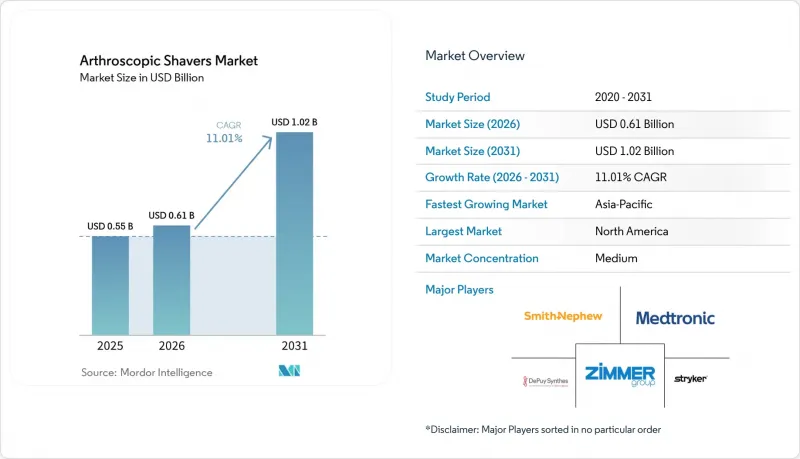
Mordor Intelligence에 의하면, 관절경 셰이버 시장 규모는 2025년에 5억 5,000만 달러로 평가되었습니다. 2026년 6억 1,000만 달러에서 2031년까지 10억 2,000만 달러에 이를 것으로 예상되며, 예측 기간(2026-2031년) CAGR은 11.01%를 나타낼 전망입니다.
본 보고서는 제품 유형별(셰이버 콘솔, 핸드피스, 블레이드 및 바, 액세서리 및 소모품), 동력원별(전기식, 배터리 구동식, 공압식),용도(무릎, 어깨·팔꿈치, 고관절, 기타 관절경 검사), 최종 사용자(병원, ASC, 정형외과 클리닉), 지역(북미, 유럽, 아시아태평양, 중동 및 아프리카, 남미)별로 분류되어 있습니다.
세계의 관절경 셰이버 시장 동향 및 인사이트
정형외과 및 스포츠 외상 수술 건수 증가
스포츠 의학 수술 건수는 관절경 셰이버 시장에 여전히 직접적인 수요 원천이 되고 있습니다. 2025년 전 세계 스포츠 의학 관련 매출액은 76억 달러에 달하여 2024년 대비 5.8% 증가했습니다. 이 중 미국은 2025년에 50억 달러를 차지하며 연평균 5.9%의 성장률을 기록했습니다. 수술 건수 증가는 일상적인 관절 수술에 사용되는 블레이드, 바, 핸드피스에 대한 수요를 뒷받침하고 있습니다. 또한, 복잡한 관절 보존 수술에서도 정밀한 절개와 조직 제거가 요구됩니다. 이러한 요건들이 관절경 셰이버 시장 전반에 걸쳐 특수한 형태의 블레이드와 보다 신속한 조직 제거에 대한 수요를 뒷받침하고 있습니다.
저침습 및 외래 관절경 수술로의 전환
외래수술센터(ASC)의 부상으로 인해 관절경 셰이버의 구매 및 사용 환경이 변화하고 있습니다. 이러한 시설에서는 컴팩트한 시스템, 간편한 설치, 그리고 효율적인 환자 입실 및 퇴실을 가능하게 하는 멸균된 소모품이 선호되고 있습니다. 이러한 변화로 인해 일부 수술에서는 설비 투자 비용이 큰 콘솔식 구성의 매력이 점차 줄어들고 있습니다. 또한, 다목적실에서 케이블 관리의 번거로움을 줄여주는 무선 핸드피스의 도입이 의료 제공업체들에게 권장되고 있습니다. 각 제조업체들은 경량 시스템 및 수술용 팩으로 제품 라인업을 전환하고 있습니다. 이러한 흐름은 관절경 셰이버 시장에서 소모품 사용 빈도를 높이는 계기가 되고 있습니다.
전동 시스템의 초기 투자 비용 및 시술당 비용
전동 셰이버 시스템의 도입 비용은 소규모 시설이나 가격에 민감한 의료 시스템에서의 도입을 제한하는 요인이 될 수 있습니다. 이 문제는 콘솔 교체나 서비스 계약에 할당할 예산이 제한적인 의료 기관에서 더욱 두드러집니다. 고급 시스템의 시술당 비용을 정당화하기 어려운 경우, 수동식이나 기본적인 재사용 가능한 구성이 여전히 매력적인 선택지가 될 수 있습니다. 서비스, 교육, 보증 프로그램이 세트로 구성된 플랜은 초기 조달 비용을 높일 가능성이 있습니다. 이러한 계약 형태는 예산이 제한된 시설에서는 도입이 어려울 수 있습니다. 따라서 관절경 셰이버 시장에서는 고급 무선 시스템이나 통합형 시스템의 도입 현황에 편차가 나타납니다.
부문 분석
2025년 기준, 관절경 셰이버 시장 규모의 52.4%를 ‘셰이버 블레이드 및 바’가 차지했습니다. 이러한 비중은 병원이나 외래 수술에서 블레이드의 빈번한 교체가 필요하다는 점을 반영합니다. 또한, 호환 가능한 시스템의 도입 대수도 기기 본체 판매 후에도 블레이드 구매가 지속되는 요인이 되고 있습니다. ‘액세서리 및 소모품’은 2031년까지 연평균 성장률(CAGR) 11.8%를 나타낼 것으로 예측됩니다. 멸균 팩, 체액 관리 세트 및 시술 전용 바 키트가 이러한 성장을 뒷받침하고 있습니다. 이러한 제품들은 각 시술에서 사용되는 주요 블레이드 이외의 추가 지출을 유발할 가능성이 있습니다.
면도기용 핸드피스와 콘솔은 이 카테고리에서 내구성이 높은 장비 계층을 형성하고 있습니다. 이러한 시스템의 교체 주기는 일반적으로 소모품 구매 주기보다 길습니다. 배터리 구동식 핸드피스는 의료진이 구형 유선 장비를 교체할 때 업데이트 결정을 앞당길 수 있습니다. 제품 공급업체는 소모품을 통한 지속적인 수익에 대한 수요와 호환 가능한 장비 플랫폼을 유지해야 할 필요성 사이에서 균형을 맞추어야 합니다. 2025년 라이프사이클 조사에 따르면, 재사용 가능한 기기를 재사용 가능한 대체품으로 교체함으로써 회전근개 복원술 1건당 이산화탄소 환산 배출량을 54% 줄일 수 있는 것으로 나타났습니다. 이 점은 지속가능성 요건이 조달 정책을 좌우하는 경우, 재사용 가능한 기기의 선택을 뒷받침하는 요인이 될 수 있습니다.
2025년 시점에서 전기식 시스템은 관절경 셰이버 시장 점유율의 71.6%를 차지했습니다. 이러한 선도적인 위상은 수십 년에 걸친 콘솔 도입 실적과 수술팀 사이에서 쌓아온 친숙도를 반영합니다. 기존의 전기식 플랫폼은 호환 가능한 블레이드와 핸드피스에 대한 지속적인 수요를 창출하고 있습니다. 배터리 구동 시스템은 2031년까지 연평균 성장률(CAGR) 11.9%로 확대될 것으로 예측됩니다. 무선 설계 덕분에 수술실에서 고정형 전원 인프라에 대한 의존도가 낮아집니다. 또한 의료진에게 있어 수술실 준비 및 케이블 관리가 간소화됩니다.
무선 방식은 외래수술센터(ASC)의 운영 모델과 부합합니다. 이러한 센터에서는 여러 유형의 수술을 수행할 수 있는 유연한 수술실을 중요시하는 경우가 많습니다. Arthrex사는 2025년, 여러 정형외과 전문 분야를 위해 설계된 배터리 구동 플랫폼을 탑재한 ‘Synergy Power’ 시스템을 출시했습니다. 이 제품은 완전히 유선에 의존하던 시스템 설계에서 벗어나려는 더 광범위한 추세를 여실히 보여줍니다. 공압식 시스템은 압축 가스 인프라에 의존하고 있어, 자립형 외래 진료 환경에는 여전히 적합하지 않습니다. 새로운 시설에서 무선 기기가 선호됨에 따라, 그 중요성은 앞으로 더욱 낮아질 가능성이 있습니다.
지역별 분석
2025년, 북미는 관절경 셰이버 시장 규모의 42.5%를 차지했습니다. 이 지역은 스포츠 의학 기반이 탄탄하고 소모품 교체가 정착되어 있다는 장점이 있습니다. 미국 스포츠 의학 분야의 매출액은 2025년에 50억 달러에 달하여 2024년 대비 5.9% 증가했습니다. 이 지역은 외래 수술 환경이 잘 갖춰져 있어 수술실 회전율 향상을 지원하는 제품에 대한 수요가 높아지고 있습니다. 복잡한 수술의 경우, 여전히 병원이 주요 수요처로 자리 잡고 있습니다. 외래수술센터(ASC)는 무선 핸드피스 및 멸균된 소모품에 대한 새로운 판매 채널이 되고 있습니다.
유럽은 확립된 정형외과 교육 체계, 보험 적용 범위 및 병원 인프라 덕분에 여전히 중요한 시장입니다. 또한 이 지역에서는 재사용 가능한 의료기기에 대해 엄격한 규제와 재처리 요건이 부과되고 있습니다. 이러한 요인으로 인해 명확한 세척 기록과 검증된 처리 절차를 제공하는 공급업체가 우위를 점할 가능성이 있습니다. 무선 기기는 유럽 의료 시스템 전반에 걸쳐 확대되고 있는 외래 수술 모델에 적합합니다. 또한, 지속가능성에 대한 고려도 재사용 가능한 제품과 일회용 제품의 선택에 영향을 미칠 수 있습니다. 따라서 공급업체는 감염 관리 요구 사항과 친환경 조달 간의 균형을 맞추어야 합니다.
아시아태평양은 2031년까지 연평균 성장률(CAGR) 12.3%를 나타낼 것으로 예측됩니다. 중국, 인도, 일본, 한국은 각각 서로 다른 구매 환경을 가지고 있습니다. 인도의 경우, 정형외과 의료 수요가 충분히 충족되지 않은 상황과 민간 병원 네트워크의 확장으로 인해 성장 여지가 있습니다. 한국에서는 병원 인프라가 잘 갖춰져 있고 스포츠 의학 분야가 활성화되면서 첨단 기기에 대한 수요가 뒷받침되고 있습니다. 일본은 성숙한 의료 제도를 갖추고 있어, 감염 예방 및 소모품 사용이 제품 도입을 촉진하는 요인이 됩니다. 중동 및 아프리카에서는 병원 현대화를 통해 스포츠 의학 체계가 정비되고 있는 반면, 남미에서는 브라질 내 선택적 수술에 대한 접근성 확대와 스포츠 외상 치료 수요가 성장의 견인차 역할을 하고 있습니다.
기타 혜택 :
- 엑셀 형식 시장 예측(ME) 시트
- 3개월간의 애널리스트 지원
자주 묻는 질문
목차
제1장 서론
제2장 조사 방법
제3장 주요 요약
제4장 시장 구도
제5장 시장 규모 및 성장 예측
제6장 경쟁 구도
제7장 시장 기회 및 향후 전망
KTH 26.09.10According to Mordor Intelligence, the arthroscopic shavers market size was valued at USD 0.55 billion in 2025 and is estimated to grow from USD 0.61 billion in 2026 to reach USD 1.02 billion by 2031, at a CAGR of 11.01% during the forecast period (2026-2031).
This report is Segmented by Product (Shaver Consoles, Handpieces, Blades and Burrs, Accessories and Consumables), Power Source (Electric, Battery-Powered, Pneumatic), Application (Knee, Shoulder and Elbow, Hip, Other Arthroscopy), End User (Hospitals, Ascs, Orthopedic Clinics), and Geography (North America, Europe, Asia-Pacific, MEA, South America).
Global Arthroscopic Shavers Market Trends and Insights
Rising Orthopedic And Sports-Injury Procedure Volumes
Sports medicine procedure volumes remain a direct source of demand for the arthroscopic shavers market. Global sports medicine sales reached USD 7.6 billion in 2025, rising 5.8% from 2024. The United States generated USD 5 billion of this total in 2025 and recorded 5.9% annual growth. Higher case volumes support demand for blades, burrs, and handpieces used in routine joint procedures. Complex joint-preservation procedures also require precise cutting and tissue removal. These requirements support demand for specialized blade geometries and faster tissue removal across the arthroscopic shavers market.
Shift Toward Minimally Invasive And Outpatient Arthroscopy
Ambulatory surgical centers are changing the settings in which arthroscopic shavers are purchased and used. These facilities favor compact systems, simple setup, and sterile consumables that support efficient patient turnover. The shift reduces the appeal of capital-intensive console arrangements for some procedures. It also encourages providers to select cordless handpieces that reduce cable management needs in multipurpose rooms. Manufacturers are adapting their product offerings toward lightweight systems and procedure packs. This channel gives the arthroscopic shavers market a route to higher-frequency consumable use.
Capital and Per-Procedure Cost Of Powered Systems
The capital cost of a powered shaver system can limit adoption in smaller facilities and price-sensitive health systems. This challenge is more pronounced where providers have limited budgets for console replacement and service contracts. Manual and basic reusable configurations can remain attractive when the per-procedure cost of advanced systems is difficult to justify. Bundled service, training, and warranty programs can add to the initial procurement cost. Such arrangements may be harder to place in lower-budget facilities. The arthroscopic shavers market, therefore, faces uneven adoption of premium cordless and integrated systems.
Other drivers and restraints analyzed in the detailed report include:
- Disposable Shaver Adoption For Infection-Control Workflows
- Precision Cutting And Visualization Integration
- Regulatory And Reprocessing Burden
For complete list of drivers and restraints, kindly check the Table Of Contents.
Segment Analysis
Shaver Blades & Burrs accounted for 52.4% of the arthroscopic shavers market size in 2025. Their position reflects the frequent replacement requirements of blades in hospital and outpatient procedures. The installed base of compatible systems also supports continuing blade purchases after the original equipment sale. Accessories & Consumables is forecast to grow at an 11.8% CAGR through 2031. Sterile packs, fluid-management sets, and procedure-specific burr kits support this growth. These products can add spending beyond the primary blade used in each procedure.
Shaver Handpieces and Consoles form the durable equipment layer of the category. Replacement cycles for these systems are commonly longer than consumable purchasing cycles. Battery-powered handpieces can shorten refresh decisions when providers replace older tethered equipment. Product suppliers must balance the demand for recurring consumable revenue with the need to maintain compatible equipment platforms. A 2025 life-cycle study found that replacing reusable equipment with reusable alternatives reduced carbon-dioxide-equivalent emissions by 54% per rotator cuff repair case. This consideration can support reusable equipment choices where sustainability requirements shape procurement.
Electric Systems held 71.6% of the arthroscopic shavers market share in 2025. Their leading position reflects decades of console installation and familiarity among surgical teams. Existing electric platforms create ongoing demand for compatible blades and handpieces. Battery-Powered Systems is forecast to expand at an 11.9% CAGR through 2031. Cordless designs reduce reliance on fixed power infrastructure in procedure rooms. They also simplify room setup and cable management for providers.
The cordless approach aligns with the operating model of ambulatory surgical centers. These centers often value flexible rooms that can accommodate more than one type of procedure. Arthrex launched its Synergy Power system in 2025 with a battery-powered platform designed for several orthopedic specialties. The product illustrates the wider move away from fully tethered system designs. Pneumatic systems depend on compressed-gas infrastructure and remain less suited to self-contained outpatient configurations. Their relevance may continue to decrease as new facilities favor cordless equipment.
Complete Report Scope:
- By Product Type
- Shaver Consoles
- Shaver Handpieces
- Shaver Blades and Burrs
- Accessories & Consumables
- By Power Source
- Electric Systems
- Battery-Powered Systems
- Pneumatic Systems
- By Application
- Knee Arthroscopy
- Shoulder & Elbow Arthroscopy
- Hip Arthroscopy
- Other Arthroscopy Procedures
- By End User
- Hospitals
- Ambulatory Surgical Centers
- Orthopedic Specialty Clinics
- By Geography
- North America
- United States
- Canada
- Mexico
- Europe
- Germany
- United Kingdom
- France
- Italy
- Spain
- Rest of Europe
- Asia-Pacific
- China
- India
- Japan
- South Korea
- Australia
- Rest of Asia-Pacific
- Middle East & Africa
- GCC
- South Africa
- Rest of Middle East and Africa
- South America
- Brazil
- Argentina
- Rest of South America
- North America
Geography Analysis
North America held 42.5% of the arthroscopic shavers market size in 2025. The region benefits from a large sports medicine base and established consumable replacement practices. United States sports medicine sales reached USD 5 billion in 2025, increasing 5.9% from 2024. The region has a developed outpatient procedure environment and strong demand for products that support fast room turnover. Hospitals still represent a major source of volume for complex procedures. Ambulatory surgical centers create an additional channel for cordless handpieces and sterile consumables.
Europe remains a significant market because of established orthopedic training, insurance coverage, and hospital infrastructure. The region is also exposed to strict regulatory and reprocessing expectations for reusable devices. These factors can favor suppliers that provide clear cleaning documentation and validated processing instructions. Cordless equipment can fit the expansion of outpatient surgical models across European health systems. Sustainability considerations may also influence choices between reusable and disposable products. Suppliers must therefore balance infection-control needs with environmental procurement considerations.
Asia Pacific is forecast to grow at a 12.3% CAGR through 2031. China, India, Japan, and South Korea each present distinct purchasing conditions. India offers expansion potential through underserved orthopedic care needs and growing private hospital networks. South Korea supports advanced equipment demand through developed hospitals and sports medicine activity. Japan has a mature healthcare system where infection prevention and consumable use can support adoption. The Middle East and Africa are developing sports medicine capacity through hospital modernization, while South America is led by Brazil's elective procedure access and sports injury care needs.
- Arthrex
- Stryker
- Smiths Group
- Medtronic
- Karl Storz
- Conmed
- Zimmer Biomet
- DePuy Synthes Companies
- Olympus
- Richard Wolf
- B. Braun
- De Soutter Medical Limited
- Integra LifeSciences
- DJO Global
- GPC Medical Ltd.
- Joimax
- Sklar Surgical Instruments
- Tulpar Medical Solutions
- Integrated Endoscopy, Inc.
- Auxein Medical Pvt. Ltd.
Additional Benefits:
- The market estimate (ME) sheet in Excel format
- 3 months of analyst support
TABLE OF CONTENTS
1 INTRODUCTION
- 1.1 Study Assumptions and Market Definition
- 1.2 Scope of the Study
2 RESEARCH METHODOLOGY
3 EXECUTIVE SUMMARY
4 MARKET LANDSCAPE
- 4.1 Market Overview
- 4.2 Market Drivers
- 4.2.1 Rising Orthopedic and Sports-Injury Procedure Volumes
- 4.2.2 Shift Toward Minimally Invasive and Outpatient Arthroscopy
- 4.2.3 Disposable Shaver Adoption for Infection-Control Workflows
- 4.2.4 Precision Cutting and Visualization Integration
- 4.2.5 Underdiagnosed Joint Disease and Expanding Orthopedic Access in Asia-Pacific
- 4.3 Market Restraints
- 4.3.1 Capital and Per-Procedure Cost of Powered Systems
- 4.3.2 Regulatory and Reprocessing Burden
- 4.3.3 Surgeon Training and Procedure-Standardization Gaps
- 4.3.4 Metal-Particulate and Sustainability Scrutiny for Shaver Consumables
- 4.4 Value / Supply-Chain Analysis
- 4.5 Regulatory Landscape
- 4.6 Technological Outlook
- 4.7 Porters Five Forces Analysis
- 4.7.1 Threat of New Entrants
- 4.7.2 Bargaining Power of Suppliers
- 4.7.3 Bargaining Power of Buyers
- 4.7.4 Threat of Substitutes
- 4.7.5 Competitive Rivalry
5 MARKET SIZE AND GROWTH FORECASTS
- 5.1 By Product Type
- 5.1.1 Shaver Consoles
- 5.1.2 Shaver Handpieces
- 5.1.3 Shaver Blades and Burrs
- 5.1.4 Accessories & Consumables
- 5.2 By Power Source
- 5.2.1 Electric Systems
- 5.2.2 Battery-Powered Systems
- 5.2.3 Pneumatic Systems
- 5.3 By Application
- 5.3.1 Knee Arthroscopy
- 5.3.2 Shoulder & Elbow Arthroscopy
- 5.3.3 Hip Arthroscopy
- 5.3.4 Other Arthroscopy Procedures
- 5.4 By End User
- 5.4.1 Hospitals
- 5.4.2 Ambulatory Surgical Centers
- 5.4.3 Orthopedic Specialty Clinics
- 5.5 By Geography
- 5.5.1 North America
- 5.5.1.1 United States
- 5.5.1.2 Canada
- 5.5.1.3 Mexico
- 5.5.2 Europe
- 5.5.2.1 Germany
- 5.5.2.2 United Kingdom
- 5.5.2.3 France
- 5.5.2.4 Italy
- 5.5.2.5 Spain
- 5.5.2.6 Rest of Europe
- 5.5.3 Asia-Pacific
- 5.5.3.1 China
- 5.5.3.2 India
- 5.5.3.3 Japan
- 5.5.3.4 South Korea
- 5.5.3.5 Australia
- 5.5.3.6 Rest of Asia-Pacific
- 5.5.4 Middle East & Africa
- 5.5.4.1 GCC
- 5.5.4.2 South Africa
- 5.5.4.3 Rest of Middle East and Africa
- 5.5.5 South America
- 5.5.5.1 Brazil
- 5.5.5.2 Argentina
- 5.5.5.3 Rest of South America
- 5.5.1 North America
6 COMPETITIVE LANDSCAPE
- 6.1 Market Concentration
- 6.2 Strategic Moves
- 6.3 Market Share Analysis
- 6.4 Company Profiles
- 6.4.1 Arthrex, Inc.
- 6.4.2 Stryker Corporation
- 6.4.3 Smith & Nephew plc
- 6.4.4 Medtronic plc
- 6.4.5 KARL STORZ SE & Co. KG
- 6.4.6 CONMED Corporation
- 6.4.7 Zimmer Biomet Holdings, Inc.
- 6.4.8 DePuy Synthes Companies
- 6.4.9 Olympus Corporation
- 6.4.10 Richard Wolf GmbH
- 6.4.11 B. Braun Melsungen AG
- 6.4.12 De Soutter Medical Limited
- 6.4.13 Integra LifeSciences Corporation
- 6.4.14 DJO Global, Inc.
- 6.4.15 GPC Medical Ltd.
- 6.4.16 Joimax GmbH
- 6.4.17 Sklar Surgical Instruments
- 6.4.18 Tulpar Medical Solutions
- 6.4.19 Integrated Endoscopy, Inc.
- 6.4.20 Auxein Medical Pvt. Ltd.
7 MARKET OPPORTUNITIES AND FUTURE OUTLOOK
- 7.1 White-Space and Unmet-Need Assessment