

|
시장보고서
상품코드
2119317
통신 사기 인텔리전스 플랫폼 : 시장 점유율 분석, 업계 동향 및 통계, 성장 예측(2026-2031년)Telecom Fraud Intelligence Platforms - Market Share Analysis, Industry Trends & Statistics, Growth Forecasts (2026 - 2031) |
||||||
 Mordor Intelligence
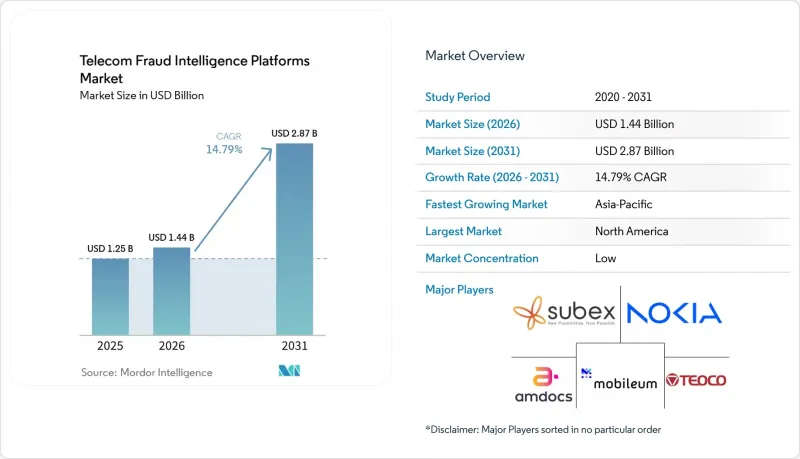
Mordor Intelligence에 의하면, 통신 사기 인텔리전스 플랫폼 시장 규모는 2025년 12억 5,000만 달러로 평가되었습니다. 2026년에는 14억 4,000만 달러로 확대되어 2031년까지 28억 7,000만 달러에 이를 것으로 예측되며, 2026년부터 2031년까지 연평균 성장률(CAGR)은 14.79%를 나타낼 전망입니다.
본 보고서는 구성 요소(소프트웨어, 서비스), 도입 형태(클라우드, 기타), 용도(수익 보호, 신원 확인, 기타), 최종 사용자(모바일 네트워크 사업자, 기타), 조직 규모(대기업, 기타), 기술(자연어 처리, 기타) 및 지역별로 분류되어 있습니다. 시장 예측은 금액(달러) 기준으로 제시되어 있습니다.
세계의 통신 사기 인텔리전스 플랫폼 시장 동향 및 인사이트
5G, IoT 및 클라우드 네이티브 시그널링 영역의 확대
모놀리식 코어에서 5G 독립형 서비스 기반 아키텍처로의 전환으로 인해 통신 사업자가 부정 위험을 평가하는 방식이 변화했습니다. HTTP/2 및 REST API는 코어 기능을 연결하여 기존의 SS7 공격이나 레거시 시그내링 방화벽 제어와는 다른 부정 사용 패턴을 만들어내고 있습니다. 이러한 인터페이스를 처리하기 위해서는 REST 시맨틱, JSON 페이로드, OAuth 흐름, 통화 상세 기록(CDR), 시그널링 이벤트 및 코어 네트워크 기능 간의 변화하는 관계를 평가할 수 있는 플랫폼이 필요합니다. 통신 사업자들은 5G 네트워크를 위한 부정 행위 감지 기준을 수립하고, 정상적인 활동과 새로운 부정 행위 형태를 비교하는 과정에서 패킷 코어, 서비스 기반 아키텍처 및 RAN 텔레메트리를 도입하고 있습니다. 통신 사업자가 트래픽 발생 후에만 문제를 파악할 수 있는 과금 기록에만 의존하지 않고, 네트워크 기능에 더 가까운 위치에서 부정 행위 감지를 수행함에 따라 통신 부정 행위 감지 플랫폼 시장은 혜택을 보고 있습니다. 이로 인해 다양한 텔레메트리 데이터를 정규화하고, 관련 이벤트를 상호 연관시키며, 배치 처리 도구로 인한 며칠간의 지연 없이 이상 현상을 식별할 수 있는 시스템에 대한 수요가 뒷받침되고 있습니다.
증가하는 계약, 신원 확인 및 계정 탈취 사기
CFCA의 기록에 따르면, 2025년에는 계약 관련 사기로 인한 손실이 53억 1,000만 달러, 계정 탈취로 인한 손실이 47억 3,000만 달러에 달했습니다. Cifas의 기록에 따르면, 2024년에 약 3,000건의 부정 SIM 스왑이 발생했으며, 이는 1,055% 증가한 수치입니다. 계정 탈취 사례 중 48%를 모바일 계정이 차지하고 있습니다. 모바일 ID가 침해되면 은행 계좌, 2단계 인증 시스템, 의료 포털 및 계정 복구에 전화번호를 사용하는 기타 서비스에도 영향을 미칠 수 있습니다. 이로 인해 SIM 스왑과 관련된 책임 범위는 통신 사업자의 직접적인 서비스 수익을 넘어 확장되며, 하류 조직의 신속한 검증의 중요성이 더욱 커집니다. GSMA는 ‘Open Gateway’ 및 ‘CAMARA’ 프레임워크를 통해 SIM 스왑 감지, 착신 전환 모니터링, 사기 인텔리전스를 위한 표준화된 사기 방지 API를 추진하고 있습니다. 통신 사업자의 사기 감지 플랫폼 시장은 통신 사업자가 데이터에 대한 접근 및 이용을 명확하게 관리할 수 있는 기업용 API 제품으로서, 가입자 ID 인텔리전스를 제공함으로써 혜택을 얻을 수 있습니다.
레거시 데이터의 사일로화와 CDR 및 시그널링 데이터의 품질 불균일성
많은 통신 사업자에게 있어 주요 장애물은 부정 감지 알고리즘의 부재가 아니라 데이터의 파편화에 있습니다. 통화 상세 기록(CDR), 시그널링 이벤트, 프로비저닝 데이터, 과금 거래 및 고객 계정 업데이트 정보는 서로 다른 운영 목적을 위해 구축된 개별 OSS 및 BSS 환경에 분산되어 있는 경우가 많습니다. 이러한 구조에서는 머신러닝 모델에 필요한 도메인 간 행동 프로파일을 구축하기 어려워지며, 부정 의심 사건의 확인이 지연될 가능성이 있습니다. 2025년 GLF 보고서에서는 국제적인 수익 분배 사기의 위험이 광범위하게 퍼져 있으며, 준실시간 데이터를 활용한 경로 차단 자동화 능력이 제한적이라는 점이 지적되었습니다. 별도의 중재 시스템에서 나오는 기록을 스트리밍 계층에서 통합함으로써, 운영 팀 간에 의심스러운 활동을 식별, 평가, 에스컬레이션하는 데 필요한 시간을 단축할 수 있습니다. 통신 사기 인텔리전스 플랫폼 시장에서는 특히 멀티 벤더에 의한 현대화 프로그램이 아직 시작되지 않았거나 데이터 소유권이 부서 간에 분산된 상태로 남아 있는 경우, 도입 주기가 장기화되는 경향이 있습니다.
부문별 분석
2025년, 소프트웨어는 통신 사기 인텔리전스 플랫폼 시장의 68.38% 점유율을 차지했습니다. 이러한 상황은 감지 로직, 행동 스코어링, 케이스 워크플로우 및 보고서 관리 기능을 단일 운영 플랫폼에 통합하는 조달 모델을 반영합니다. 각 벤더는 자율적인 조사 도구, 실시간 스코어링, 설명 가능한 AI 기능 및 규칙 거버넌스 기능을 자사 소프트웨어에 추가하고 있습니다. 이러한 기능을 통해 모델 튜닝, 임계값 설정, 사례 관리 및 일상적인 분석가 검토 과정에서 외부 서비스에 대한 의존도를 줄일 수 있습니다. 또한 통신 사업자는 다양한 부정 이용 사례에 걸쳐 새로운 감지 로직을 손쉽게 적용할 수 있게 됩니다. 따라서 통신 부정 인텔리전스 플랫폼 시장은 일회성 프로젝트가 아닌 지속적인 운영 활용을 지원하는 제품으로 전환되고 있습니다. 이는 통신 사업자가 부정 사용 패턴, 네트워크 서비스, 규제 당국의 기대, 그리고 내부 조사 실무의 진화에 맞추어 업데이트 가능한 시스템을 필요로 하기 때문입니다.
서비스 시장은 2031년까지 연평균 성장률(CAGR) 15.68%로 확대될 것으로 예측됩니다. AI 및 보안 전문 지식이 제한적인 통신 사업자에게는 부정 방지 관리형 서비스, 위협 인텔리전스 피드, 모델 적응 서비스, 도입 지원 및 전문 분석가의 지원이 여전히 중요합니다. CFCA의 조사에 따르면, 2025년 시점에서 응답자의 84%가 자사의 AI 관련 지식과 경험을 ‘초급’ 또는 ‘중급’ 수준으로 평가했습니다. 이러한 기술 격차로 인해, 도입 후 통신 사업자가 경보를 해석하고 통제 조치를 정교화할 수 있도록 지원할 수 있는 제공업체의 역할이 대두되고 있습니다. 단말기 사기, 구독 서비스 부정 이용 및 국제 수익 분배 사기에 대응하는 모듈형 플랫폼은 디지털 네이티브 모바일 가상 네트워크 사업자(MVNO)들 사이에서 주목받고 있습니다. Subex는 2025년에 ‘FraudZap’을 도입하여 단말기 사기 대책의 도입을 몇 달이 아닌 며칠 만에 실현 가능하게 만들었습니다. 이는 대규모 플랫폼 설정을 기다릴 여유가 없는 통신 사업자의 도입 부담을 경감시켜 주는 서비스에 대한 관심을 보여줍니다.
2025년에는 클라우드 도입이 시장 점유율의 58.14%를 차지했습니다. 탄력적인 처리, 모델의 지속적인 업데이트, 인프라 투자 감소, 그리고 사업자 간의 인텔리전스 집약이 클라우드 채택을 뒷받침하고 있습니다. 또한 클라우드 플랫폼을 통해 통신량, 이벤트 유형, 네트워크 기능 증가에 따라 통신 사업자는 분석 규모를 확대할 수 있게 되었습니다. 이 모델을 통해 부정 행위 방지 팀은 동등한 수준의 로컬 컴퓨팅 능력을 유지할 필요 없이 최신 감지 기능을 활용할 수 있게 됩니다. 5G 및 IoT 서비스로 인해 생성되는 네트워크 데이터가 증가하는 가운데, 통신 사기 감지 인텔리전스 플랫폼 시장은 이러한 유연성의 혜택을 누리고 있습니다. 그러나 지역별 개인정보 보호 규제로 인해 해당 지역 내 클라우드 환경에서의 가입자 데이터 마이그레이션이 제한될 가능성이 있으므로, 클라우드 도입을 결정할 때는 데이터 흐름이 확립되기 전에 네트워크, 보안, 개인정보 보호, 법무 각 팀의 상세한 검토가 필요한 경우가 많습니다.
하이브리드 배포는 2031년까지 연평균 성장률(CAGR) 16.32%로 확대될 것으로 예측됩니다. 이 모델은 유럽, 인도, 중국 및 걸프협력회의(GCC) 시장에서 클라우드 규모의 분석과 데이터 주권 요구 사항 사이에서 발생하는 갈등을 해결하기 위한 것입니다. 통신 사업자는 통신 AI 워크로드의 배치 위치를 결정할 때 데이터 주권, 지연, 데이터 중력, 그리고 운영 준비 상태를 평가합니다. On-Premise 도입은 규제 대상인 Tier 1 통신 사업자나 광역 네트워크의 지연을 허용할 수 없는 시그널링 기능에서 여전히 중요한 역할을 하고 있습니다. 하이브리드 시스템에서는 엣지 측에서 이벤트에 점수를 매기면서, 익명화된 정보를 클라우드로 전송하여 보다 광범위한 위협 인텔리전스의 상관 분석을 수행할 수 있습니다. 이 접근 방식을 통해 통신 사업자는 기밀성이 높은 가입자 기록을 보다 엄격하게 관리하면서도 확장 가능한 처리 리소스에 대한 접근을 유지할 수 있습니다. 또한, 즉각적인 로컬 대응이 필요한 기능과 클라우드 환경에서 실행 가능한 분석 워크로드를 분리할 수 있게 됩니다.
지역별 분석
2025년, 북미는 통신 사기 인텔리전스 플랫폼 시장의 34.12% 점유율을 차지했습니다. 이 지역에는 클라우드 네이티브 사기 인텔리전스 벤더가 집중되어 있으며, 통신 분야에 대한 지출도 크고 규제 집행도 엄격합니다. FCC는 2026년 5월, ‘Know Your Upstream Provider(업스트림 제공업체 파악)’에 관한 강화된 규정 및 STIR/SHAKEN 인증 기준을 채택했습니다. 또한, 로보콜 대책 데이터베이스의 연례 재인증 기한인 2026년 3월 1일에 따라, 규정 준수 요건이 소규모 음성 서비스 제공업체로도 확대되었습니다. 캐나다와 멕시코에서는 상호 연결 보안 및 소비자 보호 체계를 통해 지역적 수요가 발생하고 있습니다.
유럽은 독일, 영국, 프랑스, 이탈리아, 스페인이 주도하는 형태로 지역별 두 번째로 큰 점유율을 차지했습니다. Cifas의 보고에 따르면, 2025년에 회원사로부터 보고된 사건의 72%를 신원 도용 및 장비 탈취가 차지했으며, 통신 사업자가 모바일 제품과 관련된 계정 탈취의 주요 표적으로 지목되었습니다. 스칸디나비아 시장에서는 5G 독립형 네트워크에 따른 SEPP 및 API 공개 도입에 따라, AI를 활용한 시그널링 방화벽 업그레이드에 대한 투자가 진행되고 있습니다. NIS2는 통신 사업자를 비롯한 중요 서비스 제공업체에 대한 네트워크 보안 의무를 강화하는 한편, GDPR(EU 개인정보보호규정)은 유럽의 데이터 거주 요건을 충족하는 도입 모델을 지원하고 있습니다.
아시아태평양은 2026년부터 2031년까지 연평균 성장률(CAGR) 16.92%로 확대될 것으로 예측되며, 가장 빠르게 성장하는 지역이 될 전망입니다. 이 지역의 모바일 가입자 수는 37억 명을 넘어섰으며, 중국, 인도, 한국, 일본의 대규모 5G 프로그램으로 인해 사기 피해의 위험 규모가 확대되고 있습니다. 중국의 ‘사이버 보안법’에서는 가입자의 신원 확인과 데이터 보호가 의무화되어 있는 반면, 인도에서는 SMS 스팸에 대한 무관용 정책이 적용되고 있습니다. 남미, 중동 및 아프리카는 여전히 높은 잠재력을 지닌 지역이며, 플랫폼 보급률을 웃도는 속도로 부정 행위로 인한 손실이 증가하고 있습니다. 남아프리카공화국에서는 2025년에 사이버 범죄로 인한 피해액이 53억 랜드(2억 9,000만 달러) 이상에 달했으며, 걸프 지역 통신 사업자들은 5G 혁신 프로그램의 일환으로 투자를 추진했습니다.
기타 혜택 :
- 엑셀 형식 시장 예측(ME) 시트
- 3개월간의 애널리스트 지원
자주 묻는 질문
목차
제1장 서론
제2장 조사 방법
제3장 개요
제4장 시장 구도
제5장 시장 규모 및 성장 예측
제6장 경쟁 구도
제7장 시장 기회 및 향후 전망
KTH 26.09.02According to Mordor Intelligence, the telecom fraud intelligence platforms market size is projected to expand from USD 1.25 billion in 2025 to USD 1.44 billion in 2026, and to USD 2.87 billion by 2031, registering a CAGR of 14.79% between 2026 and 2031.
This report is Segmented by Component (Software, and Services), Deployment Mode (Cloud, and More), Application (Revenue Protection, Identity Verification, and More), End User (Mobile Network Operators, and More), Organization Size (Large Enterprises, and More), Technology (Natural Language Processing, and More), and Geography. The Market Forecasts are Provided in Terms of Value (USD).
Global Telecom Fraud Intelligence Platforms Market Trends and Insights
Expansion of 5G, IoT, and Cloud-Native Signaling Surfaces
The move from monolithic cores to a 5G standalone, service-based architecture has changed how operators assess fraud exposure. HTTP/2 and REST APIs connect core functions and create abuse patterns that differ from traditional SS7 attacks and legacy signaling firewall controls. These interfaces require platforms that can assess REST semantics, JSON payloads, OAuth flows, call detail records, signaling events, and changing relationships between core network functions. Operators are incorporating packet-core, service-based architecture, and RAN telemetry as they build fraud-detection baselines for 5G networks and compare normal activity with new forms of abuse. The Telecom Fraud Intelligence Platforms Market benefits as operators place detection closer to network functions, rather than relying solely on billing records that may identify issues only after traffic has occurred. This supports demand for systems that normalize diverse telemetry, correlate related events, and identify anomalies without the multi-day delays associated with batch-processing tools.
Rising Subscription, Identity, and Account Takeover Fraud
The CFCA recorded USD 5.31 billion in subscription fraud losses and USD 4.73 billion in account takeover losses in 2025. Cifas recorded nearly 3,000 unauthorized SIM swaps in 2024, an increase of 1,055%, with mobile accounts accounting for 48% of account takeover cases. A compromised mobile identity can also affect bank accounts, two-factor authentication systems, healthcare portals, and other services that rely on a phone number for account recovery. This broadens the liability associated with a SIM swap beyond an operator's direct service revenue, making prompt verification more important for downstream organizations. The GSMA is promoting standardized fraud-prevention APIs for SIM swap detection, call-forwarding monitoring, and scam intelligence through the Open Gateway and CAMARA frameworks. The Telecom Fraud Intelligence Platforms Market can benefit when operators offer subscriber identity intelligence as an enterprise API product with clear controls over data access and use.
Legacy Data Silos and Inconsistent CDR and Signaling Data Quality
The main obstacle for many operators is fragmented data, rather than a lack of fraud algorithms. Call detail records, signaling events, provisioning data, billing transactions, and customer account updates often remain in separate OSS and BSS environments, each built for different operational purposes. That structure makes it harder to build the cross-domain behavioral profiles that machine learning models require, and it can delay the confirmation of a suspected fraud event. The 2025 GLF report described widespread international revenue-share fraud exposure and a limited ability to automate route blocks using near-real-time data. Unifying records from separate mediation systems in a streaming layer can reduce the time needed to identify, assess, and escalate suspicious activity across operational teams. The Telecom Fraud Intelligence Platforms Market faces longer adoption cycles, particularly when multi-vendor modernization programs have not yet started or when data ownership remains divided across departments.
Other drivers and restraints analyzed in the detailed report include:
- Increasing Real-Time Revenue Protection Requirements
- Interconnect Bypass and Messaging Fraud Intelligence Gaps
- Privacy, Data Residency, and Cross-Border Intelligence Constraints
For complete list of drivers and restraints, kindly check the Table Of Contents.
Segment Analysis
Software held 68.38% of the Telecom Fraud Intelligence Platforms Market share in 2025. This position reflects procurement models that integrate detection logic, behavioral scoring, case workflows, and reporting controls into a single operating platform. Vendors are adding autonomous investigation tools, real-time scoring, explainable AI functions, and rule governance features to their software. These features can reduce dependence on external services for model tuning, threshold setting, case management, and routine analyst review. They also make it easier for operators to apply new detection logic across multiple fraud use cases. The Telecom Fraud Intelligence Platforms Market is therefore moving toward products that support continuous operational use rather than isolated projects, because operators need systems that can be updated as fraud patterns, network services, regulatory expectations, and internal investigation practices evolve.
Services are projected to expand at a 15.68% CAGR through 2031. Managed fraud operations, threat intelligence feeds, model adaptation services, implementation support, and specialist analyst support remain important for operators with limited AI and security expertise. The CFCA found that 84% of respondents described their AI knowledge and experience as beginner or intermediate in 2025. This skills gap creates a role for providers that can help operators interpret alerts and refine controls after deployment. Modular platforms for handset fraud, subscription abuse, and international revenue-share fraud are gaining traction among digital-native mobile virtual network operators. Subex introduced FraudZap in 2025 to enable handset fraud deployment in days rather than months, illustrating interest in offerings that reduce the delivery burden for operators who cannot wait for extensive platform configuration.
Cloud deployment held 58.14% of the market share in 2025. Elastic processing, continuous model updates, lower infrastructure investment, and cross-operator intelligence aggregation support cloud adoption. Cloud platforms also allow operators to scale analysis as traffic volumes, event types, and network functions increase. This model can give fraud teams access to current detection capabilities without requiring them to maintain the same level of local computing capacity. The Telecom Fraud Intelligence Platforms Market benefits from this flexibility as 5G and IoT services generate more network data. However, local privacy rules can limit the movement of subscriber data within regional cloud environments, so cloud implementation decisions often require detailed review by network, security, privacy, and legal teams before data flows are established.
Hybrid deployment is projected to expand at a 16.32% CAGR through 2031. The model addresses the tension between cloud-scale analytics and data sovereignty requirements in Europe, India, China, and Gulf Cooperation Council markets. Operators assess data sovereignty, latency, data gravity, and operational readiness when deciding where to place telecom AI workloads. On-premises installations remain relevant for regulated tier-1 operators and signaling functions that cannot tolerate wide-area network latency. Hybrid systems can score events at the edge while sending anonymized intelligence to the cloud for broader threat correlation. This approach gives operators greater control over sensitive subscriber records while retaining access to scalable processing resources, and it lets them separate functions that require immediate local action from analytical workloads that can run in a cloud environment.
Complete Report Scope:
- By Component
- Software
- Services
- By Deployment Mode
- Cloud
- On-Premises
- Hybrid
- By Application
- Revenue Protection
- Identity Verification
- Payment Security
- Network and Signaling Monitoring
- Regulatory Compliance
- Other Applications
- By End User
- Mobile Network Operators
- Fixed-Line and Broadband Providers
- Internet Service Providers
- Mobile Virtual Network Operators
- Wholesale Carriers and Interconnect Hubs
- Other End Users
- By Organization Size
- Large Enterprises
- Small and Medium Enterprises
- By Technology
- Machine Learning and Deep Learning
- Natural Language Processing
- Big Data Analytics
- Other Technologies
- By Geography
- North America
- United States
- Canada
- Mexico
- South America
- Brazil
- Argentina
- Chile
- Rest of South America
- Europe
- Germany
- United Kingdom
- France
- Italy
- Spain
- Rest of Europe
- Asia-Pacific
- China
- Japan
- India
- South Korea
- Australia
- Rest of Asia-Pacific
- Middle East
- United Arab Emirates
- Saudi Arabia
- Qatar
- Rest of Middle East
- Africa
- South Africa
- Egypt
- Nigeria
- Rest of Africa
- North America
Geography Analysis
North America held 34.12% of the Telecom Fraud Intelligence Platforms Market share in 2025. The region has a high concentration of cloud-native fraud intelligence vendors, substantial telecom spending, and strong regulatory enforcement. The FCC adopted enhanced Know Your Upstream Provider rules and STIR/SHAKEN attestation standards in May 2026. The Robocall Mitigation Database annual recertification deadline of March 1, 2026, also extended compliance requirements to smaller voice service providers. Canada and Mexico add regional demand through interconnect security and consumer-protection frameworks.
Europe was the second-largest regional position, led by Germany, the United Kingdom, France, Italy, and Spain. Cifas reported that identity fraud and facility takeover accounted for 72% of cases filed by members in 2025, and identified telecoms as the main target for account takeover involving mobile products. Scandinavian markets are investing in AI-driven signaling firewall upgrades as 5G standalone networks introduce SEPP and API exposure. NIS2 raises network-security obligations for essential service providers, including telecom operators, while GDPR supports deployment models that meet European data residency needs.
Asia-Pacific is projected to expand at a 16.92% CAGR from 2026 to 2031, making it the fastest-growing region. Its mobile subscriber base exceeded 3.7 billion, and large 5G programs in China, India, South Korea, and Japan increase the scale of fraud exposure. China's Cybersecurity Law requires subscriber identity verification and data protection, while India has applied zero-tolerance SMS spam policies. South America, the Middle East, and Africa remain high-potential regions where fraud losses are rising faster than platform adoption. South Africa lost more than ZAR 5.3 billion, USD 290 million, to cybercrime in 2025, and Gulf operators are investing as part of 5G transformation programs.
- Subex Limited
- Mobileum, Inc.
- Araxxe SAS
- TEOCO Corporation
- Telarix, Inc.
- Heksagon Technologies Ltd.
- Cellusys Limited
- upCOM Labs LLC
- Amdocs Limited.
- TransNexus, Inc.
- Tollring Limited
- Nokia Corporation
- Calltic NV
- Mobik d.o.o.
- SecurityGen Cyber Security Solutions PTE. LTD.
- Enea AB
- Belgacom International Carrier Services SA
- Zumigo, Inc.
- Syntelligence AI Inc.
- Tango Telecom Limited
- Latro Services, Inc.
- Comviva Technologies Limited
- Vonage Holdings Corp.
- Socure Inc.
Additional Benefits:
- The market estimate (ME) sheet in Excel format
- 3 months of analyst support
TABLE OF CONTENTS
1 INTRODUCTION
- 1.1 Study Assumptions and Market Definition
- 1.2 Scope of the Study
2 RESEARCH METHODOLOGY
3 EXECUTIVE SUMMARY
4 MARKET LANDSCAPE
- 4.1 Market Overview
- 4.2 Market Drivers
- 4.2.1 Expansion of 5G, IoT, and Cloud-Native Signaling Surfaces
- 4.2.2 Rising Subscription, Identity, and Account-Takeover Fraud
- 4.2.3 Increasing Real-Time Revenue Protection Requirements
- 4.2.4 Interconnect Bypass and Messaging Fraud Intelligence Gaps
- 4.2.5 Fraud Intelligence for Programmable Networks and API Exposure
- 4.2.6 Operator Demand for Autonomous, Explainable Fraud Investigation
- 4.3 Market Restraints
- 4.3.1 Legacy Data Silos and Inconsistent CDR and Signaling Data Quality
- 4.3.2 Long Telco Procurement and Integration Cycles
- 4.3.3 Privacy, Data-Residency, and Cross-Border Intelligence Constraints
- 4.3.4 Adversarial Adaptation and False-Positive Fatigue
- 4.4 Impact of Macroeconomic Factors on the Market
- 4.5 Industry Value-Chain Analysis
- 4.6 Technology Outlook
- 4.7 Regulatory Landscape
- 4.8 Porter's Five Forces Analysis
- 4.8.1 Threat of New Entrants
- 4.8.2 Bargaining Power of Suppliers
- 4.8.3 Bargaining Power of Buyers
- 4.8.4 Threat of Substitutes
- 4.8.5 Intensity of Competitive Rivalry
5 MARKET SIZE AND GROWTH FORECASTS (VALUE)
- 5.1 By Component
- 5.1.1 Software
- 5.1.2 Services
- 5.2 By Deployment Mode
- 5.2.1 Cloud
- 5.2.2 On-Premises
- 5.2.3 Hybrid
- 5.3 By Application
- 5.3.1 Revenue Protection
- 5.3.2 Identity Verification
- 5.3.3 Payment Security
- 5.3.4 Network and Signaling Monitoring
- 5.3.5 Regulatory Compliance
- 5.3.6 Other Applications
- 5.4 By End User
- 5.4.1 Mobile Network Operators
- 5.4.2 Fixed-Line and Broadband Providers
- 5.4.3 Internet Service Providers
- 5.4.4 Mobile Virtual Network Operators
- 5.4.5 Wholesale Carriers and Interconnect Hubs
- 5.4.6 Other End Users
- 5.5 By Organization Size
- 5.5.1 Large Enterprises
- 5.5.2 Small and Medium Enterprises
- 5.6 By Technology
- 5.6.1 Machine Learning and Deep Learning
- 5.6.2 Natural Language Processing
- 5.6.3 Big Data Analytics
- 5.6.4 Other Technologies
- 5.7 By Geography
- 5.7.1 North America
- 5.7.1.1 United States
- 5.7.1.2 Canada
- 5.7.1.3 Mexico
- 5.7.2 South America
- 5.7.2.1 Brazil
- 5.7.2.2 Argentina
- 5.7.2.3 Chile
- 5.7.2.4 Rest of South America
- 5.7.3 Europe
- 5.7.3.1 Germany
- 5.7.3.2 United Kingdom
- 5.7.3.3 France
- 5.7.3.4 Italy
- 5.7.3.5 Spain
- 5.7.3.6 Rest of Europe
- 5.7.4 Asia-Pacific
- 5.7.4.1 China
- 5.7.4.2 Japan
- 5.7.4.3 India
- 5.7.4.4 South Korea
- 5.7.4.5 Australia
- 5.7.4.6 Rest of Asia-Pacific
- 5.7.5 Middle East
- 5.7.5.1 United Arab Emirates
- 5.7.5.2 Saudi Arabia
- 5.7.5.3 Qatar
- 5.7.5.4 Rest of Middle East
- 5.7.6 Africa
- 5.7.6.1 South Africa
- 5.7.6.2 Egypt
- 5.7.6.3 Nigeria
- 5.7.6.4 Rest of Africa
- 5.7.1 North America
6 COMPETITIVE LANDSCAPE
- 6.1 Market Concentration
- 6.2 Strategic Moves
- 6.3 Market Share Analysis
- 6.4 Company Profiles (includes Global Level Overview, Market Level Overview, Core Segments, Financials as available, Strategic Information, Market Rank/Share, Products and Services, Recent Developments)
- 6.4.1 Subex Limited
- 6.4.2 Mobileum, Inc.
- 6.4.3 Araxxe SAS
- 6.4.4 TEOCO Corporation
- 6.4.5 Telarix, Inc.
- 6.4.6 Heksagon Technologies Ltd.
- 6.4.7 Cellusys Limited
- 6.4.8 upCOM Labs LLC
- 6.4.9 Amdocs Limited.
- 6.4.10 TransNexus, Inc.
- 6.4.11 Tollring Limited
- 6.4.12 Nokia Corporation
- 6.4.13 Calltic NV
- 6.4.14 Mobik d.o.o.
- 6.4.15 SecurityGen Cyber Security Solutions PTE. LTD.
- 6.4.16 Enea AB
- 6.4.17 Belgacom International Carrier Services SA
- 6.4.18 Zumigo, Inc.
- 6.4.19 Syntelligence AI Inc.
- 6.4.20 Tango Telecom Limited
- 6.4.21 Latro Services, Inc.
- 6.4.22 Comviva Technologies Limited
- 6.4.23 Vonage Holdings Corp.
- 6.4.24 Socure Inc.
7 MARKET OPPORTUNITIES AND FUTURE OUTLOOK
- 7.1 White-Space and Unmet-Need Assessment


