|
시장보고서
상품코드
2119319
리튬 이온 블랙 매스 부유 시약 : 시장 점유율 분석, 업계 동향 및 통계, 성장 예측(2026-2031년)Lithium-Ion Black-Mass Flotation Reagents - Market Share Analysis, Industry Trends & Statistics, Growth Forecasts (2026 - 2031) |
||||||
 Mordor Intelligence
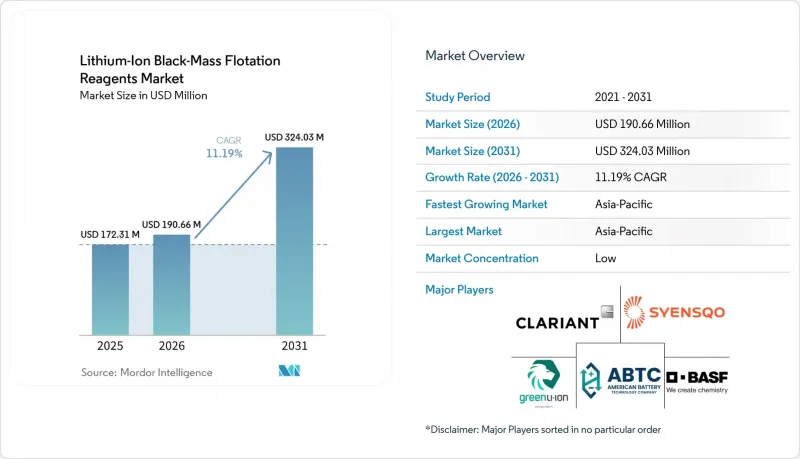
Mordor Intelligence에 의하면, 리튬 이온 블랙 매스 부유 시약 시장은 2025년에 1억 7,231만 달러 규모로 평가되었습니다. 2026년 1억 9,066만 달러에서 성장하여 2031년까지 3억 2,403만 달러에 이를 것으로 예측됩니다.
예측 기간(2026-2031년) 동안 연평균 성장률(CAGR)은 11.19%가 될 것으로 전망됩니다.
본 보고서는 시약 유형(수집제, 발포제 등), 블랙매스 공급원(전기차용 배터리 등), 대상 물질 회수(니켈 및 코발트 회수, 리튬 회수 등), 배터리의 화학 조성(NMC 배터리 등),및 지역(아시아태평양, 북미, 유럽 등)별로 분류되어 있습니다. 시장 예측은 금액(달러) 기준으로 제시되어 있습니다.
세계의 리튬 이온 블랙 매스 부유 시약 시장 동향 및 인사이트
전기차용 배터리에서 발생하는 블랙매스 공급량 증가
2026년에는 전 세계 전기차용 배터리의 폐기가 본격화되면서, 리튬 이온 블랙 매스 부양 시약 시장에서 블랙매스공급량이 증가할 전망입니다. 2024년 전 세계 전기차 판매 대수는 1,700만 대를 넘어섰으나, 2017년부터 2019년에 제조된 배터리는 현재 회수 및 해체 단계에 접어들었습니다. 자동차 제조업체의 회수 의무와 유럽연합(EU)의 ‘배터리 여권’ 요건이 본격화됨에 따라, 2026년 이후 재활용 능력 확대가 요구될 것입니다. 중국은 노후 전기차 보유 대수와 확립된 처리 능력을 모두 갖추고 있어, 가장 빠르게 처리량 증가가 예상됩니다. 이러한 시점에 따라 유럽이나 북미에서 동등한 처리량이 발생하기 전에, 중국에서 검증된 시약 패키지에 대한 조기 수요가 촉진될 것입니다.
배터리 재활용 의무화 및 중요 물질 회수 목표
규제 준수는 현재 유럽의 리튬 이온 블랙 매스 부유 시약 시장에서 주요 수요 요인으로 작용하고 있습니다. 유럽위원회 위임규정(EU) 2025/606은 2025년 7월 24일에 발효되었으며, 재활용 효율 및 재료 회수율의 측정 방법을 규정하고 있습니다. 이 규정에 따르면 2027년 말까지 코발트, 구리, 납, 니켈에 대해서는 90%, 리튬에 대해서는 50%의 회수율이 요구됩니다. 이러한 요건은 2031년 말까지 각각 95% 및 80%로 상향될 전망입니다. 이러한 기준에 따라 사업자는 침출 처리 전에 업스트림 공정에서의 농축 처리나 선택적 억제제 및 pH 조절제 시스템의 도입을 촉진하게 될 것입니다. 또한, 중국은 GB/T 45203-2024에 따른 분류를 변경한 후, 2025년 8월 1일부터 규정을 준수하는 재활용 흑연의 수입을 허용했습니다. 규정(EU) 2026/1738에 따라, 순환 경제에 관한 요건이 폐자동차 공급망 전체로 확대되었습니다.
블랙매스의 조성 편차 및 원료 품질의 불균일성
블랙매스의 조성 편차와 원료 품질의 불균일성은 리튬 이온 블랙 매스 부유 시약 시장에서 안정적인 시약 선정을 방해하는 요인이 되고 있습니다. 전기자동차 차량에서 회수된 재료에는 여러 가지 양극 화학 조성, 셀 형태 및 열화 상태가 혼재되어 있을 수 있습니다. 그 결과, 입자 크기 분포, 표면 화학적 특성 및 바인더 함량은 크게 다를 수 있습니다. 그 결과, 특정 화학 조성에 맞추어 조정된 공정이라 하더라도 블랙매스의 회수율, 양극재 선택성 및 발포제 소비량에 변화가 발생할 수 있습니다. 중국에서는 2025년 7월 1일 시행된 GB/T 45203-2024를 통해 재활용 흑광석의 성분 분류 및 유해 물질 함유량 기준이 도입되었습니다. 사업자가 공정 매개변수를 일관되게 설정하고 지속적인 시약 수요를 확보하기 위해서는 선별, 특성 평가 및 품질 인증의 향상이 필수적입니다.
부문 분석
2025년, 집전제는 리튬 이온 블랙 매스 부양 시약 시장에서 34.83%의 점유율을 차지했습니다. 등유, 디젤유 및 독자적인 배합을 포함한 비극성 탄화수소 오일은 양극과 음극의 분리 과정에서 흑연의 소수성을 높였습니다. 이러한 첨가량은 발포제나 pH 조절제보다 많습니다. 동료 검토를 거친 시험에 따르면, 콜렉터의 첨가량은 블랙매스 1메트릭톤당 350g인 반면, 발포제는 1메트릭톤당 100-150g이었습니다. 이러한 소비 패턴으로 인해 시약 총 지출에서 콜렉터가 차지하는 비중이 증가했습니다. 발포제의 경우, 메틸이소부틸카비놀 및 소나무유 유도체가 기포 안정화 및 기포 크기 조절에 사용되고 있습니다.
리튬 이온 블랙 매스 부양 시약 업계에서 감압제 시장은 2031년까지 연평균 성장률(CAGR) 12.14%로 확대될 것으로 예측됩니다. 리튬 이온 블랙 매스 부유 시약 시장에서 리튬 회수가 코발트나 니켈 회수와 마찬가지로 필수적인 처리 성과로 자리 잡음에 따라, 감압제의 역할은 확대되고 있습니다. 나트륨 규산염,덱스트린 및 신흥 폴리머 제제는 흑연의 부유를 저해하지 않으면서 음극의 부유를 억제할 수 있습니다. 2025년 친환경 전처리에 관한 연구에 따르면, 대기압 열분해를 거친 감마-발레롤락톤이 양극의 친수성을 향상시켜,외부 집금제를 사용하지 않고도 흑연의 회수율을 100%(플로트 내)로 달성하며, 양극의 캐리오버를 15.63%로 저감시킨 사실이 밝혀졌습니다. 이 기법의 보급으로 인해 집금제 수요가 감소하는 동시에, 전처리 및 억제제 화학 기술에 대한 투자가 확대될 가능성이 있습니다. 또한, 사업자가 개별 첨가제를 미리 배합된 패키지로 대체함에 따라 특수 블렌드 및 응집제의 중요성도 높아지고 있습니다.
2025년, 전기차용 배터리는 리튬 이온 블랙마스용 부양 시약 시장 규모의 54.16%를 차지했습니다. 이러한 선도적인 위상은 전 세계 흑광 공급에서 전기차 차량군이 수행하는 중심적인 역할을 반영한 것입니다. 북미에서는 전기차 배터리 원료를 처리하기 위한 전용 처리 인프라가 구축되고 있습니다. 소비자용 전자기기용 배터리도 여전히 중요한 공급원이지만, 스몰셀 형태에서는 미세한 입자가 생성되어 부양의 유체역학을 복잡하게 만들 가능성이 있습니다. 산업용 배터리는 관리된 가동 환경에서 공급되므로, 성분을 예측하기가 더 쉽다는 특징이 있습니다.
리튬 이온 블랙 매스 부양 시약 시장에서 에너지 저장 시스템용 배터리는 2031년까지 연평균 성장률(CAGR) 13.02%로 확대될 것으로 예측됩니다. 2017년부터 2020년에 걸쳐 도입된 초기 상용 그리드 저장 시스템의 폐기로 인해 이 원료의 흐름이 증가하고 있습니다. 이러한 배터리 팩은 주로 대형 각형 셀에 리튬인산철을 채택하고 있습니다. 리튬인산철의 높은 함유량으로 인해 자동차용 니켈·망간·코발트계 블랙매스와는 다른 광물학적 특성을 보입니다. 전기차에서 유래한 니켈·망간·코발트계 소재에 대해 검증된 배합은 리튬인산철 원료에 맞추어 재조정이 필요하며, 특히 억제제의 선택, 메틸이소부틸카르비놀의 투여량 및 pH 설정값에 대한 조정이 필요합니다.
지역별 분석
아시아태평양은 2025년에 리튬 이온 블랙마스용 부양 시약 시장의 37.29% 점유율을 차지했으며, 2031년까지 연평균 성장률(CAGR) 12.98%를 나타낼 것으로 예측됩니다. 중국은 성숙한 전기차 보유 대수, 블랙매스 처리 인프라, 그리고 진화하는 규제를 모두 갖추고 있습니다. 중국의 수입 정책에 따라 기준을 충족한 재활용 블랙매스는 2025년 8월 1일부터 자유롭게 거래될 수 있게 되었습니다. 이에 따라 중국의 부양 및 습식 제련 처리업체가 처리할 수 있는 물량이 확대되었습니다.
북미에서는 전기차 배터리, 제조 스크랩 및 가전제품을 처리하기 위한 처리 능력이 확충되고 있습니다. 주 차원의 확대 생산자 책임(EPR) 규제로 인해 미국 내 회수되는 배터리공급량은 확대될 가능성이 있습니다. 그러나 운영의 경제성 및 정책 지원에 대한 의존도는 여전히 재활용 업체들에게 위험 요인으로 남아 있습니다. 이 지역의 리튬 이온 블랙 매스 부양 시약 시장 수요는 안정적인 원료 공급 상황과 처리 업체의 재무 건전성에 좌우될 것입니다.
유럽 수요는 규정(EU) 2023/1542에 기반한 재료 회수 요건에 의해 뒷받침되고 있습니다. 2027년까지 리튬 회수율 50%라는 목표와 향후 코발트, 구리, 니켈에 대해 설정될 회수율 95%라는 기준은 전처리 공정에 대한 투자를 촉진하고 있습니다. BASF는 2025년 6월, 연간 생산 능력 1만 5,000메트릭톤 규모의 슈바르츠하이드-블랙마스 공장의 상업 가동을 시작했습니다. 브라질에서는 미래를 내다보는 관심이 쏠리고 있지만, 남미, 중동 및 아프리카는 여전히 초기 단계 시장에 머물러 있습니다.
기타 혜택 :
- 엑셀 형식 시장 예측(ME) 시트
- 3개월간의 애널리스트 지원
자주 묻는 질문
목차
제1장 서론
제2장 조사 방법
제3장 주요 요약
제4장 시장 구도
제5장 시장 규모 및 성장 예측
제6장 경쟁 구도
제7장 시장 기회 및 향후 전망
KTH 26.09.10According to Mordor Intelligence, the lithium-Ion black-Mass flotation reagents market was valued at USD 172.31 million in 2025 and is estimated to grow from USD 190.66 million in 2026 to reach USD 324.03 million by 2031, at a CAGR of 11.19% during the forecast period (2026-2031).

This report is Segmented by Reagent Type (Collectors, Frothers, and More), Black-Mass Source (Electric Vehicle Batteries, and More), Target Material Recovery (Nickel and Cobalt Recovery, Lithium Recovery, and More), Battery Chemistry (NMC Batteries, and More), and Geography (Asia-Pacific, North America, Europe, and More). The Market Forecasts are Provided in Terms of Value (USD).
Global Lithium-Ion Black-Mass Flotation Reagents Market Trends and Insights
Rising Black-Mass Volumes from Electric Vehicle Batteries
Global electric vehicle battery retirements are becoming an operating reality in 2026, increasing the supply of black mass for the lithium-ion black-mass flotation reagents market. The global electric vehicle sales exceeded 17 million units in 2024, while battery cohorts produced during 2017-2019 are now entering collection and disassembly. Recycling capacity must rise from 2026 as automaker take-back obligations, and European Union battery passport requirements mature. China is likely to receive the earliest volume increase because it has both an older electric vehicle fleet and established processing capacity. This timing supports early demand for validated reagent packages in China before comparable volumes develop in Europe and North America.
Mandatory Battery Recycling and Critical-Material Recovery Targets
Regulatory compliance is now a primary demand factor for the lithium-ion black-mass flotation reagents market in Europe. Commission Delegated Regulation (EU) 2025/606 entered into force on July 24, 2025, and set methods for measuring recycling efficiency and material recovery. The regulation requires 90% recovery for cobalt, copper, lead, and nickel, and 50% recovery for lithium by the end of 2027. These requirements are expected to rise to 95% and 80%, respectively, by the end of 2031. Such thresholds encourage operators to use upstream pre-concentration and selective depressant and pH-modifier systems before leaching. China also allowed compliant recycled black mass to be imported from August 1, 2025, after changing its classification under GB/T 45203-2024. Regulation (EU) 2026/1738 now extends circularity requirements through the end-of-life vehicle supply chain.
Variable Black-Mass Composition and Inconsistent Feed Quality
Variable black-mass composition and inconsistent feed quality limit stable reagent selection in the lithium-ion black-mass flotation reagents market. Material from electric vehicle fleets can combine several cathode chemistries, cell formats, and degradation states. The resulting particle-size distribution, surface chemistry, and binder content can vary widely. A circuit calibrated for 1 chemistry can then show changes in graphite recovery, cathode selectivity, and frother consumption. China introduced compositional classifications and hazardous-substance limits for recycled black mass through GB/T 45203-2024, which took effect on July 1, 2025. Sorting, characterization, and quality certification must improve before operators can consistently set circuit parameters and commit to recurring reagent demand.
Other drivers and restraints analyzed in the detailed report include:
- Growing Need to Recover Graphite Alongside Cathode Metals
- Chemistry-Specific Flotation Optimization for LFP and NMC Feedstocks
- Binder, Electrolyte, and Fine-Particle Entrainment Interference
For complete list of drivers and restraints, kindly check the Table Of Contents.
Segment Analysis
Collectors held 34.83% of the lithium-ion black-mass flotation reagents market share in 2025. Non-polar hydrocarbon oils, including kerosene, diesel, and proprietary formulations, promoted graphite hydrophobicity during anode-cathode separation. Their dosage rates are higher than those for frothers or pH modifiers. Peer-reviewed trials documented collector application rates of 350 g per metric ton of black mass, compared with 100-150 g per metric ton for frothers. This consumption pattern increased collectors' contribution to total reagent spending. In frothers, methyl isobutyl carbinol and pine-oil derivatives are used for froth stability and bubble-size control.
Depressants are forecast to advance at a 12.14% CAGR through 2031 within the lithium-ion black-mass flotation reagents industry. Their role grows as lithium recovery joins cobalt and nickel recovery as a required processing outcome in the lithium-ion black-mass flotation reagents market. Sodium silicate, dextrin, and emerging polymer formulations can suppress cathode flotation without suppressing graphite. A 2025 green pretreatment study found that gamma-valerolactone with atmospheric pyrolysis improved cathode hydrophilicity, achieved 100% graphite recovery to froth, and reduced cathode carry-over to 15.63% without an external collector. Wider use of this approach could reduce collector demand and move spending toward pretreatment and depressant chemistry. Specialty blends and flocculants also gain relevance as operators replace individual additions with formulated packages.
Electric vehicle batteries accounted for 54.16% of the lithium-ion black-mass flotation reagents market size in 2025. Their leading position reflected the central role of electric vehicle fleets in global black-mass supply. Purpose-built processing infrastructure is being developed to absorb electric vehicle battery feedstock in North America. Consumer electronics batteries also remain an important source, although small cell formats produce fine particles that can complicate flotation hydrodynamics. Industrial batteries provide a more predictable composition because they come from controlled operating environments.
Energy storage system batteries are forecast to advance at a 13.02% CAGR through 2031 in the lithium-ion black-mass flotation reagents market. Retirements of early commercial grid-storage systems installed from 2017 to 2020 are increasing this feedstock stream. These packs mainly use lithium iron phosphate in large prismatic cells. Their high iron phosphate content creates a mineralogy that behaves differently from nickel manganese cobalt automotive black mass. Formulations validated for electric vehicle-derived nickel manganese cobalt material require recalibration for lithium iron phosphate feedstock, particularly in depressant choice, methyl isobutyl carbinol dosage, and pH setpoint.
Complete Report Scope:
- By Reagent Type
- Collectors
- Frothers
- Depressants
- pH Modifiers
- Other Reagent Types (Dispersants, Flocculants and Coagulants, Specialty/Proprietary Blends)
- By Black-Mass Source
- Electric Vehicle Batteries
- Consumer Electronics Batteries
- Energy Storage System Batteries
- Industrial Batteries
- Other Black-Mass Sources (Mixed Battery Waste Streams)
- By Target Material Recovery
- Nickel and Cobalt Recovery
- Lithium Recovery
- Graphite Recovery
- Multi-Metal Recovery
- Other Target Material Recoveries (Manganese and Minor Metals)
- By Battery Chemistry
- NMC Batteries
- LFP Batteries
- NCA Batteries
- LCO Batteries
- Other Battery Chemistries (LMFP, Mixed Lithium-Ion Feedstocks)
- By Geography
- Asia-Pacific
- China
- India
- Japan
- South Korea
- Rest of Asia-Pacific
- North America
- United States
- Canada
- Mexico
- Europe
- Germany
- United Kingdom
- France
- Italy
- Rest of Europe
- South America
- Brazil
- Argentina
- Rest of South America
- Middle-East and Africa
- Saudi Arabia
- South Africa
- Rest of Middle-East and Africa
- Asia-Pacific
Geography Analysis
Asia-Pacific held 37.29% of the lithium-ion black-mass flotation reagents market share in 2025 and is projected to grow at a 12.98% CAGR through 2031. China combines a mature electric vehicle fleet, black-mass processing infrastructure, and evolving regulation. Its import policy allowed compliant recycled black mass to be traded freely from August 1, 2025. This raised the throughput available to Chinese flotation and hydrometallurgical processors.
In North America, processing capacity is being added to handle electric vehicle batteries, manufacturing scrap, and consumer electronics. State-level extended producer responsibility rules can expand the collected supply of batteries in the United States. However, operating economics and reliance on policy support still create risk for recyclers. The region's demand in the lithium-ion black-mass flotation reagents market will depend on the availability of consistent feedstock as well as the financial strength of processors.
Europe's demand is supported by material-recovery requirements under Regulation (EU) 2023/1542. The 50% lithium recovery target for 2027 and the future 95% recovery threshold for cobalt, copper, and nickel encourage investment in pre-separation circuits. BASF began commercial operation of its Schwarzheide black-mass plant in June 2025, with an annual capacity of 15,000 metric tons. South America, and Middle-East and Africa remain early-stage markets, despite forward-looking interest in Brazil.
- ACCUREC-Recycling GmbH
- American Battery Technology Company
- Ascend Elements Inc.
- BASF
- Cirba Solutions
- CLARIANT
- Duesenfeld GmbH
- ECOBAT
- Elemental Holding S.A.
- Green Li-ion Pte Ltd.
- Lithion Technologies
- RecycLiCo Battery Materials Inc.
- Redwood Materials Inc.
- Syensqo
- Umicore
Additional Benefits:
- The market estimate (ME) sheet in Excel format
- 3 months of analyst support
TABLE OF CONTENTS
1 Introduction
- 1.1 Study Assumptions and Market Definition
- 1.2 Scope of the Study
2 Research Methodology
3 Executive Summary
4 Market Landscape
- 4.1 Market Overview
- 4.2 Market Drivers
- 4.2.1 Rising Black-Mass Volumes From Electric Vehicle Batteries
- 4.2.2 Mandatory Battery Recycling and Critical-Material Recovery Targets
- 4.2.3 Growing Need to Recover Graphite Alongside Cathode Metals
- 4.2.4 Shift Toward Integrated Physical and Hydrometallurgical Recycling
- 4.2.5 Chemistry-Specific Flotation Optimization for LFP and NMC Feedstocks
- 4.2.6 Low-Temperature, Low-Reagent Separation Innovation
- 4.3 Market Restraints
- 4.3.1 Variable Black-Mass Composition and Inconsistent Feed Quality
- 4.3.2 Binder, Electrolyte, and Fine-Particle Entrainment Interference
- 4.3.3 Environmental Pressure on Hydrocarbon Collectors and Volatile Frothers
- 4.3.4 Limited Commercial-Scale Validation of Reagent-Based Flotation
- 4.4 Value and Supply-Chain Analysis
- 4.5 Porter's Five Forces Analysis
- 4.5.1 Bargaining Power of Suppliers
- 4.5.2 Bargaining Power of Buyers
- 4.5.3 Threat of New Entrants
- 4.5.4 Threat of Substitutes
- 4.5.5 Competitive Rivalry
5 Market Size and Growth Forecasts (Value)
- 5.1 By Reagent Type
- 5.1.1 Collectors
- 5.1.2 Frothers
- 5.1.3 Depressants
- 5.1.4 pH Modifiers
- 5.1.5 Other Reagent Types (Dispersants, Flocculants and Coagulants, Specialty/Proprietary Blends)
- 5.2 By Black-Mass Source
- 5.2.1 Electric Vehicle Batteries
- 5.2.2 Consumer Electronics Batteries
- 5.2.3 Energy Storage System Batteries
- 5.2.4 Industrial Batteries
- 5.2.5 Other Black-Mass Sources (Mixed Battery Waste Streams)
- 5.3 By Target Material Recovery
- 5.3.1 Nickel and Cobalt Recovery
- 5.3.2 Lithium Recovery
- 5.3.3 Graphite Recovery
- 5.3.4 Multi-Metal Recovery
- 5.3.5 Other Target Material Recoveries (Manganese and Minor Metals)
- 5.4 By Battery Chemistry
- 5.4.1 NMC Batteries
- 5.4.2 LFP Batteries
- 5.4.3 NCA Batteries
- 5.4.4 LCO Batteries
- 5.4.5 Other Battery Chemistries (LMFP, Mixed Lithium-Ion Feedstocks)
- 5.5 By Geography
- 5.5.1 Asia-Pacific
- 5.5.1.1 China
- 5.5.1.2 India
- 5.5.1.3 Japan
- 5.5.1.4 South Korea
- 5.5.1.5 Rest of Asia-Pacific
- 5.5.2 North America
- 5.5.2.1 United States
- 5.5.2.2 Canada
- 5.5.2.3 Mexico
- 5.5.3 Europe
- 5.5.3.1 Germany
- 5.5.3.2 United Kingdom
- 5.5.3.3 France
- 5.5.3.4 Italy
- 5.5.3.5 Rest of Europe
- 5.5.4 South America
- 5.5.4.1 Brazil
- 5.5.4.2 Argentina
- 5.5.4.3 Rest of South America
- 5.5.5 Middle-East and Africa
- 5.5.5.1 Saudi Arabia
- 5.5.5.2 South Africa
- 5.5.5.3 Rest of Middle-East and Africa
- 5.5.1 Asia-Pacific
6 Competitive Landscape
- 6.1 Market Concentration
- 6.2 Strategic Moves
- 6.3 Market Share (%)/Ranking Analysis
- 6.4 Company Profiles (includes Global Overview, Market Overview, Core Segments, Financials as available, Strategic Information, Products and Services, and Recent Developments)
- 6.4.1 ACCUREC-Recycling GmbH
- 6.4.2 American Battery Technology Company
- 6.4.3 Ascend Elements Inc.
- 6.4.4 BASF
- 6.4.5 Cirba Solutions
- 6.4.6 CLARIANT
- 6.4.7 Duesenfeld GmbH
- 6.4.8 ECOBAT
- 6.4.9 Elemental Holding S.A.
- 6.4.10 Green Li-ion Pte Ltd.
- 6.4.11 Lithion Technologies
- 6.4.12 RecycLiCo Battery Materials Inc.
- 6.4.13 Redwood Materials Inc.
- 6.4.14 Syensqo
- 6.4.15 Umicore
7 Market Opportunities and Future Outlook
- 7.1 White-Space and Unmet-Need Assessment