

|
시장보고서
상품코드
2119343
통신 네트워크 현대화 관련 의사결정권자 설문조사 : 시장 점유율 분석, 업계 동향 및 통계, 성장 예측(2026-2031년)Telecom Network Modernization Decision-Maker Survey - Market Share Analysis, Industry Trends & Statistics, Growth Forecasts (2026 - 2031) |
||||||
 Mordor Intelligence
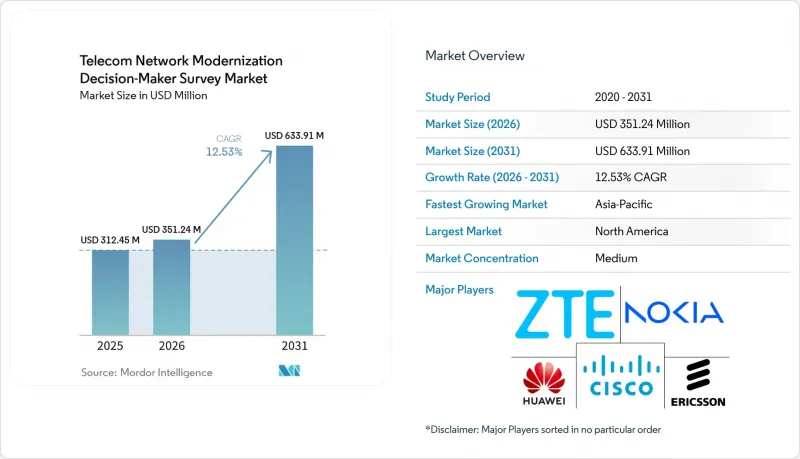
Mordor Intelligence에 의하면, 통신 네트워크 현대화 관련 의사결정권자 설문조사 시장 규모는 2025년에 3억 1,245만 달러로 평가되었습니다. 2026년 3억 5,124만 달러에서 성장하여 2031년까지 6억 3,391만 달러에 이를 것으로 예측되며, 2026년부터 2031년까지 CAGR은 12.53%를 나타낼 전망입니다.

본 보고서는 구성 요소(조사 설계 및 설문지 프로그래밍 등), 네트워크 도메인(무선 액세스 네트워크, 코어 네트워크 등), 배포 모드(On-Premise, 클라우드, 하이브리드), 조직 유형(Tier 1 모바일 네트워크 사업자 등) 및 지역별로 분류되어 있습니다. 시장 예측은 금액(달러)으로 제시되어 있습니다.
세계의 통신 네트워크 현대화 관련 의사결정권자 설문조사 시장 동향 및 인사이트
5G 독립형(SA) 및 5G-Advanced에 대한 투자 결정
상용 5G 독립형(SA)의 배포는 각 프로그램이 새로운 기술 및 공급업체와 관련된 과제를 야기하기 때문에 통신 네트워크 현대화 관련 의사결정권자 설문조사 시장을 뒷받침하고 있습니다. GSA의 기록에 따르면, 2026년 3월까지 전 세계적으로 392건의 상용 5G 서비스가 시작되었으며, 그중 95건이 5G 독립형(SA) 서비스 개시이고, 35개 통신 사업자가 5G-Advanced에 투자했습니다. 구매 담당자는 동종 업계 경쟁사들이 코어 네트워크 업그레이드,자동화, 주파수 대역 활용, 그리고 벤더 평가를 어떤 순서로 진행하고 있는지 파악해야 합니다. AT&T는 2026년 3월, 광섬유, 5G 및 AI를 활용한 운영을 포괄하는 총액 2,500억 달러 규모의 5개년 미국 인프라 투자 계획을 발표했습니다. 이러한 지출로 인해 조사 제공 기업이 추적 가능한 조달 결정이 지속적으로 생성됩니다. 현재의 조사 패널에서는 공식 서비스 개시와 그 이후의 코어 네트워크 전환, 운영 활용, 그리고 계약 벤더에 의한 작업을 구분해야 합니다.
다중 벤더 네트워크의 복잡성과 운영 비용 절감
다중 벤더 네트워크는 조달, 인터페이스, 운영 비용, 그리고 네트워크 도메인 간의 책임 분담에 관한 조사 수요를 창출합니다. 통신 사업자는 벤더의 다양성과 장비, 소프트웨어, 관리 시스템을 통합하는 데 필요한 노력을 저울질해야 합니다. AT&T는 AI 도입을 통해 연간 10억 달러 이상의 운영 비용 절감을 달성했다고 보고하며, 자동화 옵션에 대한 증거의 필요성을 뒷받침하고 있습니다. 조사에서는 각 결정 사항을 개별적으로 검토하기보다는 RAN, 코어, OSS/BSS 및 운영상의 우선순위를 통합적으로 파악해야 합니다. 고위 경영진을 대상으로 반복적인 인터뷰를 실시함으로써, 도입 과정에서 문제가 발생한 후에도 전략이 안정적으로 유지되고 있는지 파악할 수 있습니다. 통신 네트워크 현대화 관련 의사결정권자 설문조사는 표명된 계획과 실적 데이터로 뒷받침되는 운영 모델을 명확히 구분할 때 가장 유용합니다.
레거시 OSS/BSS의 기술적 부채와 마이그레이션 리스크
레거시 OSS/BSS 환경은 통신 사업자의 팀이 파편화된 시스템과 비용이 많이 드는 마이그레이션을 관리해야 하기 때문에 현대화 의사결정을 지연시킵니다. 이러한 제약으로 인해 응답자가 여러 기술 프로그램에 걸쳐 있는 기업의 우선순위를 파악하기 어려워질 수 있습니다. 에릭슨과 IDC의 보고서에 따르면, OSS/BSS 관련 자본 지출은 2025년부터 2028년 사이에 2,110억 달러에 달할 가능성이 있으며, 응답자의 66%가 데이터 시스템에 대한 추가 투자의 필요성을 언급했습니다. 이러한 압박으로 인해 확고한 기술 선택이라기보다는 미해결된 예산 상의 갈등을 반영한 응답이 나올 수 있습니다. 또한 특정 기능에 대한 관심이 지연되고 있는 데이터 또는 통합 프로젝트에 의존하고 있는 경우, 조사 결과의 해석도 복잡해집니다. 조사에서는 계획된 아키텍처 변경과 마이그레이션 위험으로 인해 미뤄진 결정을 구분해야 합니다.
부문 분석
2025년 통신 네트워크 현대화 관련 의사결정권자 설문조사 시장에서 데이터 수집 및 패널 관리는 31.12%의 점유율을 차지했으며, 이는 관련 고위 의사결정자로부터 응답을 얻는 데 있어 그 역할을 반영하고 있습니다. 신뢰할 수 있는 패널을 위해서는 적절한 응답자의 직급 수준, 조직 전체를 아우르는 광범위한 커버리지, 그리고 개별 응답에 대한 신중한 검증이 필요합니다. Tier 1 통신 사업자의 기술 책임자가 제공하는 정보는 익명의 온라인 참가자와 본질적으로 다를 수 있으므로, 이러한 요소들은 여전히 중요합니다. 조사 설계와 설문지 작성은 패널 관리와 밀접하게 관련되어 있습니다. 이는 질문 내용이 공급업체 및 네트워크 도메인 전반에 걸친 선택 사항의 변화를 반영해야 하기 때문입니다. 통신 네트워크 현대화 관련 의사결정권자 설문조사 시장은 조사 결과가 광범위한 기술적 관심사가 아닌 실제 의사결정 과정을 정확하게 묘사하도록 보장하기 위해 이러한 작업에 의존하고 있습니다.
대시보드, 벤치마킹 및 자문 결과물은 2031년까지 연평균 성장률(CAGR) 12.61%를 나타낼 것으로 예측되며, 이는 각 구성 요소 중 가장 높은 성장률입니다. 고객은 조달, 투자 계획 및 공급업체와의 협의에 활용하기 위해 동종 업계 기업과의 비교를 점점 더 요구하고 있습니다. 현재의 대시보드는 정기 보고서의 단편적인 결과가 아닌, 정의된 통신 사업자 그룹에 대한 지속적인 관점을 제공할 수 있습니다. 또한 조사 대상에 규모, 지역, 성숙도가 서로 다른 사업자가 포함될 경우, 데이터 처리, 가중치 부여 및 집계 작업의 중요성도 높아집니다. 통신 네트워크 현대화 관련 의사결정권자 설문조사 시장은 투명성이 높은 기법을 적용하고, 응답자로부터 얻은 제한된 증거를 과대평가하지 않으면서 비교 가능한 결과를 제시함으로써 이러한 요구를 충족시킬 수 있습니다.
2025년, 통신 네트워크 현대화 관련 의사결정권자 설문조사 시장에서 무선 액세스 네트워크(RAN)는 38.14%의 점유율을 차지했습니다. RAN 프로그램은 안테나 구성, 오픈 프론트홀 준수, 무선 플랫폼, AI-RAN 로드맵 등 광범위한 의사 결정을 수반합니다. 이러한 선택은 커버리지, 용량, 공급업체와의 관계에 영향을 미치기 때문에 많은 5G 투자 계획에서 여전히 중심적인 위치를 차지하고 있습니다. 에릭슨은 2026년 말까지 160종의 Open-RAN 지원 검증 완료 무선 모델을 목표로 한다고 발표했으며, 이는 호환 가능한 RAN 옵션의 중요성이 계속해서 높아지고 있음을 반영합니다. 통신 네트워크 현대화 관련 의사결정권자 설문조사 시장은 어떤 RAN 요구 사항이 공식 조달 기준에 포함되고, 어떤 요구 사항이 여전히 검토 단계에 있는지 고객이 비교하는 데 도움을 줍니다.
OSS/BSS 및 서비스 오케스트레이션은 2031년까지 연평균 성장률(CAGR) 12.73%를 나타낼 것으로 예측되며, 네트워크 분야 중 가장 빠르게 성장하는 분야가 될 전망입니다. 5G 독립형(SA) 및 AI 관련 이용 사례로 인해 운영상의 의사결정 속도가 가속화되는 가운데, 통신 사업자들은 서비스 관리 및 오케스트레이션 기능을 필요로 하고 있습니다. 5G 독립형(SA)으로의 전환은 코어 네트워크 계획에도 영향을 미치는 한편, 전송 관련 결정은 증가하는 데이터센터 연결 수요에 대응하기 위한 것입니다. KDDI는 ‘Power-to-Connect 2028’ 계획에 대해 3개 회계연도에 걸쳐 1조 2,000억 엔(74억 4,000만 달러)을 투자하기로 결정했습니다. 이 계획은 저지연 전송, AI 데이터센터 인프라 및 위성 지상국을 포괄합니다. 엣지, 프라이빗 무선 및 비지상파 네트워크와 관련된 활동을 통해, 연구 프로그램이 대응해야 할 현대화 관련 의사결정권자층에 기업 사용자도 포함되고 있습니다.
지역별 분석
2025년, 북미는 통신 네트워크 현대화 관련 의사결정권자 설문조사 시장 점유율의 34.12%를 차지했습니다. 이 지역에는 충분한 자금력을 보유하고 적극적인 현대화 계획을 추진하는 Tier 1 통신 사업자들이 집중되어 있습니다. AT&T는 2026년 3월, 광섬유, 5G 및 AI를 활용한 운영을 위한 총 2,500억 달러 규모의 5개년 투자 계획을 발표했습니다. 이러한 프로그램은 아키텍처, 공급업체, 소프트웨어 및 운영 모델에 걸친 의사결정을 이끌어내고 있습니다. 따라서 북미의 조사 수요는 통신 사업자들의 막대한 지출과 동종 업계 경쟁사들과의 진행 상황 비교 필요성에 의해 뒷받침되고 있습니다.
아시아태평양은 2031년까지 연평균 성장률(CAGR) 13.14%를 나타낼 것으로 예측되며, 이는 지역별로는 가장 높은 성장률입니다. 일본, 한국, 인도, 중국은 각각 서로 다른 투자 패턴과 의사 결정 배경을 가지고 있습니다. NTT 도코모는 2026 회계연도 설비 투자액으로 8,570억 엔(53억 7,000만 달러)을 목표로 설정하고, 2026년 7월 에릭슨의 차세대 RAN 컴퓨트 플랫폼 상용화를 시작했습니다. KDDI는 저지연 전송, AI 데이터센터, 위성 지상국을 위해 3개 회계연도에 걸쳐 1조 2,000억 엔(74억 4,000만 달러)을 투자하기로 결정했습니다. 통신 네트워크 현대화 관련 의사결정권자 설문조사 시장에서는 이 지역의 기술 도입 현황, 언어, 벤더 상황이 크게 다르기 때문에 국가별 패널 조사가 필요합니다.
2025년, 유럽은 큰 점유율을 차지했으며, 조사 수요는 공급업체의 다양화, 업계 재편 및 데이터 주권에 의해 형성되었습니다. MasOrange는 2026년 2월, 4개의 IMS 플랫폼과 2개의 레거시 5G 코어를 통합된 5G 독립형 아키텍처로 통합하기 위해 에릭슨과 6년간의 계약을 체결했습니다. 영국은 2030년까지 35%의 Open RAN 트래픽 목표를 유지하며, 2026년에 통신 보안 규정을 개정했습니다. 남미, 중동 및 아프리카는 규모는 작지만 조달 활동이 확대되고 있는 지역입니다. 에릭슨과 e&UAE는 2025년, 클라우드 네이티브 기술을 활용해 해당 통신 사업자의 5G 코어를 현대화하기로 합의했습니다.
기타 혜택 :
- 엑셀 형식 시장 전망(ME) 시트
- 3개월간의 애널리스트 지원
자주 묻는 질문
목차
제1장 서론
제2장 조사 방법
제3장 주요 요약
제4장 시장 구도
제5장 시장 규모 및 성장 예측
제6장 경쟁 구도
제7장 시장 기회 및 향후 전망
KTH 26.09.10According to Mordor Intelligence, the telecom network modernization decision-Maker survey market size was valued at USD 312.45 million in 2025 and is estimated to grow from USD 351.24 million in 2026 to reach USD 633.91 million by 2031, at a CAGR of 12.53% during the forecast period (2026-2031).
This report is Segmented by Component (Survey Design and Questionnaire Programming, and More), Network Domain (Radio Access Network, Core Network, and More), Deployment Model (On-Premises, Cloud, and Hybrid), Organization Type (Tier-1 Mobile Network Operators, and More), and Geography. The Market Forecasts are Provided in Terms of Value (USD).
Global Telecom Network Modernization Decision-Maker Survey Market Trends and Insights
5G Standalone and 5G-Advanced Investment Decisions
Commercial 5G Standalone activity supports the Telecom Network Modernization Decision-Maker Survey Market, as each program introduces new technology and supplier questions. GSA recorded 392 commercial 5G launches worldwide by March 2026, including 95 5G Standalone launches and 35 operators investing in 5G-Advanced. Buyers need to understand how peers sequence core upgrades, automation, spectrum use, and vendor evaluations. AT&T announced a USD 250 billion, 5-year U.S. infrastructure investment plan in March 2026 covering fiber, 5G, and AI-enabled operations. This spending creates a continuing flow of procurement decisions that survey providers can track. Current panels must distinguish a formal launch from subsequent core migration, operational use, and contracted supplier work.
Multi-Vendor Network Complexity and Operating Cost Reduction
Multi-vendor networks create research demand around sourcing, interfaces, operating costs, and accountability across network domains. Operators must weigh supplier diversity against the effort required to integrate equipment, software, and management systems. AT&T reported more than USD 1 billion in annualized operating cost savings from AI deployment, reinforcing the need for evidence on automation choices. Research must connect RAN, core, OSS/BSS, and operational priorities rather than consider each decision separately. Repeated interviews with senior respondents can show whether a strategy remains stable after implementation issues emerge. The Telecom Network Modernization Decision-Maker Survey Market is most useful when it distinguishes stated plans from operating models supported by performance evidence.
Legacy OSS/BSS Technical Debt and Migration Risk
Legacy OSS/BSS environments slow modernization decisions because operator teams must manage fragmented systems and costly migrations. The constraint can make it harder for respondents to identify a firm's priorities across multiple technology programs. Ericsson and IDC reported that OSS/BSS-related capital expenditure could reach USD 211 billion between 2025 and 2028, and 66% of respondents cited a need for additional data-system investment. This pressure can produce responses that reflect unresolved budget conflicts rather than committed technology choices. It also complicates survey interpretation when interest in a capability depends on a delayed data or integration project. Research must separate planned architectural changes from decisions deferred due to migration risk.
Other drivers and restraints analyzed in the detailed report include:
- Cloud-Native Core and Edge Modernization
- AI-Enabled Closed-Loop Network Operations
- Interoperability and Integration Complexity
For complete list of drivers and restraints, kindly check the Table Of Contents.
Segment Analysis
Data Collection and Panel Management held 31.12% of the Telecom Network Modernization Decision-Maker Survey Market share in 2025, reflecting its role in obtaining responses from relevant senior decision-makers. A reliable panel requires suitable respondent seniority, broad organization coverage, and careful validation of individual responses. These factors remain important because a Tier-1 operator technology leader can provide materially different evidence from that of an anonymous online participant. Survey Design and questionnaire programming remain closely connected to panel management because questions must reflect evolving choices across suppliers and network domains. The Telecom Network Modernization Decision-Maker Survey Market depends on this work to ensure that findings describe actual decision processes rather than broad technology interest.
Dashboard, Benchmarking, and Advisory Outputs are forecast to grow at a 12.61% CAGR through 2031, the fastest rate among components. Clients increasingly require peer comparisons for use in procurement, investment planning, and supplier discussions. Current dashboards can provide repeated views of a defined group of operators, rather than isolated results from periodic reports. Data Processing, Weighting, and Tabulation also become more important when research includes differing operator sizes, geographies, and maturity levels. The Telecom Network Modernization Decision-Maker Survey Market can serve this need by applying transparent methods and presenting comparable outputs without overstating the limited evidence from respondents.
Radio Access Network held 38.14% of the Telecom Network Modernization Decision-Maker Survey Market share in 2025. RAN programs generate a wide range of decisions involving antenna configurations, Open Fronthaul compliance, radio platforms, and AI-RAN roadmaps. These choices remain central to many 5G investment plans because they affect coverage, capacity, and supplier relationships. Ericsson stated that it targeted 160 Open-RAN-proven radio models by the end of 2026, reflecting the continuing importance of compatible RAN options. The Telecom Network Modernization Decision-Maker Survey Market can help clients compare which RAN requirements have entered formal procurement criteria and which remain exploratory.
OSS/BSS and Service Orchestration are forecast to grow at a 12.73% CAGR through 2031, making it the fastest-growing network domain. Operators need service management and orchestration capabilities as 5G Standalone and AI-related use cases increase the pace of operational decisions. The move to 5G Standalone also shapes Core Network programs, while transport decisions respond to growing data-center connectivity needs. KDDI committed JPY 1.2 trillion (USD 7.44 billion) over 3 fiscal years to its Power-to-Connect 2028 plan, covering low-latency transport, AI data center infrastructure, and satellite ground stations. Edge, private wireless, and non-terrestrial network activity adds enterprise users to the set of modernization decision-makers that research programs must address.
Complete Report Scope:
- By Component
- Survey Design and Questionnaire Programming
- Data Collection and Panel Management
- Data Processing, Weighting, and Tabulation
- Dashboard, Benchmarking, and Advisory Outputs
- By Network Domain
- Radio Access Network
- Core Network
- Transport and Optical Network
- OSS/BSS and Service Orchestration
- Edge, Private Wireless, and Non-Terrestrial Networks
- By Deployment Model
- On-Premises
- Cloud
- Hybrid
- By Organization Type
- Tier-1 Mobile Network Operators
- Tier-2 and Tier-3 Mobile Network Operators
- Fixed and Converged Operators
- Neutral Host Providers
- Private Network Owners
- By Geography
- North America
- United States
- Canada
- Mexico
- South America
- Brazil
- Argentina
- Chile
- Rest of South America
- Europe
- Germany
- United Kingdom
- France
- Italy
- Spain
- Rest of Europe
- Asia-Pacific
- China
- Japan
- India
- South Korea
- Australia
- Rest of Asia-Pacific
- Middle East
- United Arab Emirates
- Saudi Arabia
- Qatar
- Rest of Middle East
- Africa
- South Africa
- Egypt
- Nigeria
- Rest of Africa
- North America
Geography Analysis
North America held 34.12% of the Telecom Network Modernization Decision-Maker Survey Market share in 2025. The region has a high concentration of well-funded Tier-1 operators with active modernization plans. AT&T announced a USD 250 billion, 5-year investment plan in March 2026 for fiber, 5G, and AI-enabled operations. These programs create decisions across architecture, suppliers, software, and operating models. North American survey demand is therefore supported by the depth of operator spending and the need to compare progress against peers.
Asia-Pacific is forecast to grow at a 13.14% CAGR through 2031, the fastest regional rate. Japan, South Korea, India, and China each contribute different investment patterns and decision contexts. NTT DOCOMO targeted JPY 857 billion (USD 5.37 billion) in capital expenditure for FY2026 and began commercial deployment of Ericsson's next-generation RAN Compute platform in July 2026. KDDI committed JPY 1.2 trillion (USD 7.44 billion) across 3 fiscal years for low-latency transport, AI data centers, and satellite ground stations. The Telecom Network Modernization Decision-Maker Survey Market needs country-specific panels in this region because technology deployment, language, and vendor conditions vary substantially.
Europe held a significant share in 2025, with research demand shaped by supplier diversification, consolidation, and data sovereignty. MasOrange signed a 6-year agreement with Ericsson in February 2026 to consolidate 4 IMS platforms and 2 legacy 5G cores into a unified 5G Standalone architecture. The United Kingdom retained a 35% Open RAN traffic target for 2030 and updated its telecommunications security code in 2026. South America, the Middle East, and Africa are smaller but expanding areas for procurement activity. Ericsson and e& UAE agreed in 2025 to modernize the operator's 5G Core with cloud-native technologies.
- Huawei Technologies Co., Ltd.
- Telefonaktiebolaget LM Ericsson
- Nokia Corporation
- ZTE Corporation
- Samsung Electronics Co., Ltd.
- Cisco Systems, Inc.
- Ciena Corporation
- NEC Corporation
- Fujitsu Limited
- Juniper Networks, Inc.
- ADTRAN Holdings, Inc.
- Ribbon Communications Inc.
- Aviat Networks, Inc.
- Airspan Networks Inc.
- Mavenir Systems, Inc.
- Parallel Wireless, Inc.
- Baicells Technologies Co., Ltd.
- Sercomm Corporation
- Cambium Networks Corporation
- DZS Inc.
- HFCL Limited
- Radisys Corporation
- Ekinops S.A.
- Ribbon Communications Inc.
- Sterlite Technologies Limited
Additional Benefits:
- The market estimate (ME) sheet in Excel format
- 3 months of analyst support
TABLE OF CONTENTS
1 INTRODUCTION
- 1.1 Study Assumptions and Market Definition
- 1.2 Scope of the Study
2 RESEARCH METHODOLOGY
3 EXECUTIVE SUMMARY
4 MARKET LANDSCAPE
- 4.1 Market Overview
- 4.2 Market Drivers
- 4.2.1 5G Standalone and 5G-Advanced Investment Decisions
- 4.2.2 Multi-Vendor Network Complexity and Opex Reduction
- 4.2.3 Cloud-Native Core and Edge Modernization
- 4.2.4 AI-Enabled Closed-Loop Network Operations
- 4.2.5 Open RAN and Supplier Diversification Mandates
- 4.2.6 AI RAN and Real-Time Network Data Requirements
- 4.3 Market Restraints
- 4.3.1 Legacy OSS/BSS Technical Debt and Migration Risk
- 4.3.2 Interoperability and Integration Complexity
- 4.3.3 Cybersecurity, Data Sovereignty, and AI Governance Exposure
- 4.3.4 Shortage of Cloud-Native Telecom Skills
- 4.4 Impact of Macroeconomic Factors on the Market
- 4.5 Industry Value-Chain Analysis
- 4.6 Technology Outlook
- 4.7 Regulatory Landscape
- 4.8 Porter's Five Forces Analysis
- 4.8.1 Threat of New Entrants
- 4.8.2 Bargaining Power of Suppliers
- 4.8.3 Bargaining Power of Buyers
- 4.8.4 Threat of Substitutes
- 4.8.5 Intensity of Competitive Rivalry
5 MARKET SIZE AND GROWTH FORECASTS (VALUE)
- 5.1 By Component
- 5.1.1 Survey Design and Questionnaire Programming
- 5.1.2 Data Collection and Panel Management
- 5.1.3 Data Processing, Weighting, and Tabulation
- 5.1.4 Dashboard, Benchmarking, and Advisory Outputs
- 5.2 By Network Domain
- 5.2.1 Radio Access Network
- 5.2.2 Core Network
- 5.2.3 Transport and Optical Network
- 5.2.4 OSS/BSS and Service Orchestration
- 5.2.5 Edge, Private Wireless, and Non-Terrestrial Networks
- 5.3 By Deployment Model
- 5.3.1 On-Premises
- 5.3.2 Cloud
- 5.3.3 Hybrid
- 5.4 By Organization Type
- 5.4.1 Tier-1 Mobile Network Operators
- 5.4.2 Tier-2 and Tier-3 Mobile Network Operators
- 5.4.3 Fixed and Converged Operators
- 5.4.4 Neutral Host Providers
- 5.4.5 Private Network Owners
- 5.5 By Geography
- 5.5.1 North America
- 5.5.1.1 United States
- 5.5.1.2 Canada
- 5.5.1.3 Mexico
- 5.5.2 South America
- 5.5.2.1 Brazil
- 5.5.2.2 Argentina
- 5.5.2.3 Chile
- 5.5.2.4 Rest of South America
- 5.5.3 Europe
- 5.5.3.1 Germany
- 5.5.3.2 United Kingdom
- 5.5.3.3 France
- 5.5.3.4 Italy
- 5.5.3.5 Spain
- 5.5.3.6 Rest of Europe
- 5.5.4 Asia-Pacific
- 5.5.4.1 China
- 5.5.4.2 Japan
- 5.5.4.3 India
- 5.5.4.4 South Korea
- 5.5.4.5 Australia
- 5.5.4.6 Rest of Asia-Pacific
- 5.5.5 Middle East
- 5.5.5.1 United Arab Emirates
- 5.5.5.2 Saudi Arabia
- 5.5.5.3 Qatar
- 5.5.5.4 Rest of Middle East
- 5.5.6 Africa
- 5.5.6.1 South Africa
- 5.5.6.2 Egypt
- 5.5.6.3 Nigeria
- 5.5.6.4 Rest of Africa
- 5.5.1 North America
6 COMPETITIVE LANDSCAPE
- 6.1 Market Concentration
- 6.2 Strategic Moves
- 6.3 Market Share Analysis
- 6.4 Company Profiles (includes Global Level Overview, Market Level Overview, Core Segments, Financials as available, Strategic Information, Market Rank/Share, Products and Services, Recent Developments)
- 6.4.1 Huawei Technologies Co., Ltd.
- 6.4.2 Telefonaktiebolaget LM Ericsson
- 6.4.3 Nokia Corporation
- 6.4.4 ZTE Corporation
- 6.4.5 Samsung Electronics Co., Ltd.
- 6.4.6 Cisco Systems, Inc.
- 6.4.7 Ciena Corporation
- 6.4.8 NEC Corporation
- 6.4.9 Fujitsu Limited
- 6.4.10 Juniper Networks, Inc.
- 6.4.11 ADTRAN Holdings, Inc.
- 6.4.12 Ribbon Communications Inc.
- 6.4.13 Aviat Networks, Inc.
- 6.4.14 Airspan Networks Inc.
- 6.4.15 Mavenir Systems, Inc.
- 6.4.16 Parallel Wireless, Inc.
- 6.4.17 Baicells Technologies Co., Ltd.
- 6.4.18 Sercomm Corporation
- 6.4.19 Cambium Networks Corporation
- 6.4.20 DZS Inc.
- 6.4.21 HFCL Limited
- 6.4.22 Radisys Corporation
- 6.4.23 Ekinops S.A.
- 6.4.24 Ribbon Communications Inc.
- 6.4.25 Sterlite Technologies Limited
7 MARKET OPPORTUNITIES AND FUTURE OUTLOOK
- 7.1 White-Space and Unmet-Need Assessment


