
|
시장보고서
상품코드
2119356
치즈 왁스 : 시장 점유율 분석, 업계 동향 및 통계, 성장 예측(2026-2031년)Cheese Wax - Market Share Analysis, Industry Trends & Statistics, Growth Forecasts (2026 - 2031) |
||||||
 Mordor Intelligence
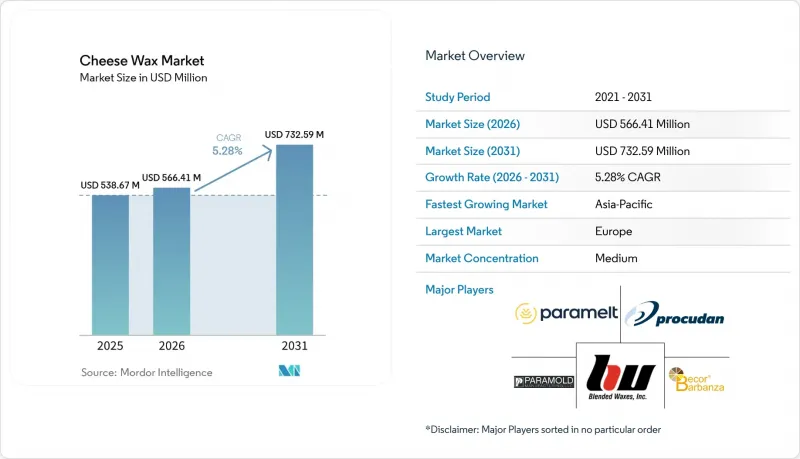
Mordor Intelligence에 의하면, 치즈 왁스 시장 규모는 2025년에 5억 3,867만 달러로 평가되었습니다. 예측 기간(2026-2031년) CAGR 5.28%로 확대되어 2026년 5억 6,641만 달러에서 2031년에는 7억 3,259만 달러에 이를 전망입니다.
본 보고서는 제품 유형(파라핀계 치즈 왁스, 미세결정성 치즈 왁스 등), 용도(수분·유통기한 보호, 곰팡이 방지·표면 보호 등), 지역(아시아태평양, 북미, 유럽, 남미, 중동 및 아프리카)별로 분류되어 있습니다. 시장 전망은 금액(달러) 기준으로 제시되어 있습니다.
세계의 치즈 왁스 시장 동향 및 인사이트
숙성 치즈, 특산 치즈 및 수제 치즈 생산 확대
특산 치즈의 생산은 숙성 기간이 길고 제품 형태도 다양하기 때문에 보호 코팅에 대한 수요를 뒷받침하고 있습니다. 미국 농무부(USDA) 국립농업통계국(NASS)의 데이터에 따르면, 위스콘신주에서는 2025년에 특산 치즈 생산량이 사상 최고치인 10억 3,000만 파운드에 달하여 전년 대비 1.1% 증가했으며, 이는 주 전체 치즈 총생산량의 28.2%를 차지했습니다. 이러한 생산 기반은 표면 보호가 필요한 휠형 및 기타 형태의 치즈 생산자들에게 치즈 왁스 시장에 대한 안정적인 판로를 제공합니다. 또한, 유럽의 보호 지정 치즈 품종의 경우, 생산자는 제품 및 외관에 관한 규격을 충족해야 하며, 이는 외부 표면의 일관된 처리를 뒷받침합니다. 이러한 수요는 일반적으로 필름이나 진공포장이 사용되는 대량 생산형 가공 치즈에 대한 의존도가 상대적으로 낮습니다.
숙성 중 수분 유지 및 곰팡이 방지에 대한 수요
왁스 코팅은 숙성 중 표면의 수분 손실을 억제하고 외부로부터의 오염을 방지하는 장벽 역할을 합니다. 이러한 역할은 장기간 숙성되며 일관된 중량과 표면 상태를 유지해야 하는 경질 치즈나 반경질 치즈에서 특히 중요합니다. 수분 손실의 미세한 변화조차도 판매 가능한 수율에 영향을 미칠 수 있으므로, 코팅의 일관성은 유제품 가공업체에게 중요한 요소가 됩니다. 식품 접촉 관련 규정에서도 승인된 코팅 재료에 대한 확립된 준수 경로가 제시되어 있어, 치즈 제조업체가 이미 사용하고 있는 제품에 대한 장벽이 완화되었습니다. 따라서 다른 형태의 제품에 포장 필름을 사용할 수 있는 경우에도 치즈 왁스 시장은 기능적인 역할을 유지하고 있습니다.
폴리머 필름, 진공포장, 천연 껍질 처리로부터의 경쟁
고차단 필름과 진공 시스템은 슬라이스 치즈, 소분 치즈, 가공 치즈 형태에서 왁스와 경쟁하고 있습니다. 진공 스킨 포장은 특히 포장 치즈에 대한 수요가 높은 시장에서 유통 기한을 연장하고 소매점에서의 외관을 개선할 수 있습니다. 또한, 표면 처리를 최소화하는 것이 제품 정체성의 일부가 된 특정 수제 치즈의 경우, 천연 껍질 처리도 여전히 중요한 역할을 하고 있습니다. 이러한 대안들로 인해 특정 치즈 카테고리에서 기존 코팅이 목표로 하는 시장은 축소되고 있습니다. 왁스는 표면 보호나 전통적인 외관이 제품에 중요한 숙성된 경질 치즈 및 반경질 치즈의 원형 치즈에는 여전히 적합합니다. 그 결과, 치즈 왁스 시장은 통째로 판매되는 특산 치즈보다 산업용 포맷에서 경쟁에 더 쉽게 노출되는 상황에 놓여 있습니다.
부문별 분석
2025년, 파라핀계 치즈 왁스는 제품 부문의 44.14%를 차지하며 치즈 왁스 시장에서 가장 큰 카테고리가 되었습니다. 이러한 위상은 비용 경쟁력 있는 공급, 안정적인 용융 특성, 그리고 수작업 침지 및 확립된 자동화 설비 모두와의 호환성을 반영한 것입니다. 생산자들은 오랫동안 다양한 유형의 치즈와 생산 규모에 걸쳐 파라핀 계열 등급을 사용해 왔습니다. 미세결정성 치즈 왁스는 유연성과 내파손성을 갖추고 있어 보다 전문적인 역할을 수행합니다. 이러한 특성은 숙성 과정에서 껍질의 변화에 대응할 수 있는 코팅이 요구되는 가스 발생형 치즈와 관련이 있습니다. 파라멜트(Paramelt)사는 자사의 식물 유래 제품군인 ‘파라딥 노왁스(Paradip Nowax)’가 통기성 제어 특성 덕분에 가스 발생형 치즈의 코팅에 특히 적합하다고 밝혔습니다.
블렌드 치즈 왁스는 가장 빠르게 성장하는 제품 유형으로, 2026년부터 2031년까지 연평균 성장률(CAGR) 6.85%가 예상됩니다. 이러한 제품은 파라핀의 비용 측면과 기계적 특성 및 규제상 특성의 향상을 균형 있게 추구하는 유제품 가공업체의 요구를 충족시킵니다. 일부 블렌드에는 식품 등급의 식물성 왁스 성분이 포함되어 있어, 특정 수분 프로파일에 맞추어 투과성을 조절하는 데 도움이 됩니다. 코덱스 위원회는 2025년 식품 내 광물유계 탄화수소에 관한 행사를 개최하며, 이러한 오염 물질에 대해 통일된 논의를 진행할 필요성을 언급했습니다. 이러한 추세에 따라, 완전히 새로운 코팅 시스템으로 즉시 전환할 필요 없이 변화하는 고객 요구 사항을 충족할 수 있는 제품에 대한 관심이 높아지고 있습니다. 또한 공급업체들이 석유 유래 왁스를 대체할 수 있는 대안을 제공함에 따라, 천연 및 바이오 배합도 아직은 소규모 기반이긴 하지만 계속해서 확대되고 있습니다.
지역별 분석
2025년, 치즈 왁스 시장에서 유럽은 38.62%라는 가장 규모가 큰 지역 점유율을 차지했습니다. 이 지역에는 숙성 치즈 및 특산 치즈 생산자가 밀집해 있으며, 원산지 명칭 보호 제도(PDO)와 같은 대규모 생태계가 형성되어 있습니다. 이러한 생산 구조는 치즈 전체를 보호하고 의도된 외관을 유지하는 데 도움이 되는 코팅제에 대한 수요를 뒷받침하고 있습니다. 또한, 유럽은 광물유계 식품 접촉 재료와 관련하여 단기적으로 가장 활발한 규제 환경에 놓여 있습니다. 2026년 5월 13일에 승인된 EU 조치에 따라, 지역 왁스 제조업체와 유제품 업계 고객들의 배합 변경 결정이 가속화되고 있습니다.
북미는 미국의 특수 치즈 및 수제 치즈 생산에 힘입어 치즈 왁스 시장에서 지역별 점유율 2위를 차지하고 있습니다. 미국 농무부(USDA) 국립농업통계국(NASS)의 데이터에 따르면, 2025년 위스콘신주의 특수 치즈 생산량은 10억 3,000만 파운드였으며, 가동 중인 공장은 53곳이었습니다. 캐나다와 멕시코의 생산자들도 규모는 작지만 지역 수요에 기여하고 있습니다. 남미는 국내 하드 치즈 생산 및 지역 무역과 연계되어 있으며, 규모는 작지만 안정적인 역할을 수행하고 있습니다. 중동 및 아프리카는 현지 치즈 소비의 대부분을 수입품이나 가공품이 차지하고 있기 때문에 여전히 소규모 시장에 머물러 있습니다.
아시아태평양은 2026년부터 2031년까지 연평균 성장률(CAGR) 6.26%를 기록하며, 지역별로는 가장 높은 성장률을 보일 것으로 예측됩니다. 중국에서는 외식 산업, 베이커리, 즉석식품 등의 형태를 통해 치즈 소비가 확대됨에 따라, 더 대규모의 유제품 가공 기반이 구축되고 있습니다. 미국 농무부 해외농업국(FAS)은 중국의 치즈 소비량이 2025년 21만 9,000메트르톤에서 2026년에는 22만 3,000메트르톤으로 증가할 것으로 전망하고 있습니다. OECD-FAO는 피자, 햄버거, 즉석식품 등의 유통 경로를 통해 신흥 시장이 세계 치즈 소비의 급속한 성장을 이끄는 주요 원동력이라고 지적하고 있습니다. 인도에서는 도시 지역의 외식 산업과 전문 식품 소매업이 확대됨에 따라 장기적인 기회가 예상됩니다. 한편, 일본과 한국에서는 확립된 콜드체인을 통해 고급 수입품에 대한 수요가 뒷받침되고 있습니다.
기타 혜택 :
- 엑셀 형식 시장 예측(ME) 시트
- 3개월간의 애널리스트 지원
자주 묻는 질문
목차
제1장 서론
제2장 조사 방법
제3장 개요
제4장 시장 구도
제5장 시장 규모 및 성장 예측
제6장 경쟁 구도
제7장 시장 기회 및 향후 전망
KTH 26.09.02According to Mordor Intelligence, the cheese wax market size is estimated at USD 538.67 million in 2025 and is estimated to grow from USD 566.41 million in 2026 to USD 732.59 million by 2031, at a CAGR of 5.28% during the forecast period (2026-2031).
This report is Segmented by Product Type (Paraffin-Based Cheese Wax, Microcrystalline Cheese Wax, and More), Application (Moisture and Shelf-Life Protection, Mold Prevention and Surface Protection, and More), and Geography (Asia-Pacific, North America, Europe, South America, and Middle-East and Africa). The Market Forecasts are Provided in Terms of Value (USD).
Global Cheese Wax Market Trends and Insights
Expansion of Aged, Specialty, and Artisan Cheese Production
Specialty cheese production supports demand for protective coatings because it involves longer aging cycles and differentiated product formats. Wisconsin produced a record 1.03 billion pounds of specialty cheese in 2025, up 1.1% from the prior year and accounting for 28.2% of the state's total cheese production, according to USDA National Agricultural Statistics Service (NASS) data. This production base provides the cheese wax market with a stable outlet among producers of wheels and other formats that require surface protection. Protected designation cheese varieties in Europe also require producers to meet product and presentation specifications, which supports consistent treatment of outer surfaces. This demand is less dependent on high-output processed cheese formats that typically use films or vacuum packaging.
Demand for Moisture Retention and Mold Protection During Aging
Wax coatings help limit surface dehydration during maturation and provide a barrier against external contamination. This role is most relevant for hard and semi-hard cheeses that mature over extended periods and must retain consistent weight and surface condition. Small changes in moisture loss can affect salable yield, making coating consistency important for dairy processors. Food-contact regulations also provide established compliance pathways for approved coating materials, reducing barriers for products already in use by cheese makers. The cheese wax market therefore retains a functional role even where packaging films are available for other formats.
Competition From Polymer Films, Vacuum Packaging, and Natural Rind Treatments
High-barrier films and vacuum systems compete with wax in pre-sliced, portioned, and processed cheese formats. Vacuum skin packaging can extend shelf life and provide a clean retail appearance, particularly in markets with strong demand for packaged cheese. Natural rind treatments also remain relevant for certain artisan cheeses, where minimal surface intervention is part of the product identity. These alternatives reduce the addressable market for conventional coatings in specific cheese categories. Wax remains suitable for aged hard and semi-hard wheels, where a protective surface and traditional appearance are important to the product. The cheese wax market is consequently more exposed to competition in industrial formats than in whole-wheel specialty cheese.
Other drivers and restraints analyzed in the detailed report include:
- Premiumization Through Color, Gloss, and Brand Differentiation
- Adoption of Bio-Based and Fossil-Free Cheese Coatings
- Regulatory Scrutiny of Mineral Oil Hydrocarbons and Food-Contact Materials
For complete list of drivers and restraints, kindly check the Table Of Contents.
Segment Analysis
Paraffin-based cheese wax accounted for 44.14% of the product segment in 2025, making it the largest category in the cheese wax market. Its position reflects cost-competitive supply, consistent melting behavior, and compatibility with both manual dipping and established automated equipment. Producers have used paraffin-based grades for many years across cheese types and production scales. Microcrystalline cheese wax serves a more specialized role, offering flexibility and fracture resistance. This characteristic is relevant to gas-forming cheeses, where the coating must accommodate rind changes during aging. Paramelt states that its Paradip Nowax vegetable-based range is especially suitable for coating gas-forming cheeses due to its permeability-control properties.
Blended cheese wax is the fastest-growing product type, with a forecast CAGR of 6.85% from 2026 to 2031. These products address dairy processors seeking a balance between paraffin's cost profile and improved mechanical or regulatory properties. Some blends include food-grade vegetable wax fractions, which can help control permeability for specific moisture profiles. The Codex Alimentarius Commission hosted a 2025 event on mineral oil hydrocarbons in food, addressing the need for harmonized discussion of these contaminants. This development raises interest in products that can meet changing customer requirements without requiring immediate conversion to an entirely new coating system. Natural and bio-based formulations also continue to expand from a smaller base as suppliers provide alternatives to petroleum-derived waxes.
Complete Report Scope:
- By Product Type
- Paraffin-Based Cheese Wax
- Microcrystalline Cheese Wax
- Blended Cheese Wax
- Others (Natural and Bio-Based, Synthetic and Polymer-Modified Cheese Wax)
- By Application
- Moisture and Shelf-Life Protection
- Mold Prevention and Surface Protection
- Branding and Product Identification
- Others (Label Sealing, Transport Protection, Surface Finish)
- By Geography
- Asia-Pacific
- China
- India
- Japan
- South Korea
- ASEAN Countries
- Rest of Asia-Pacific
- North America
- United States
- Canada
- Mexico
- Europe
- Germany
- United Kingdom
- France
- Italy
- NORDIC Countries
- Russia
- Rest of Europe
- South America
- Brazil
- Argentina
- Rest of South America
- Middle-East and Africa
- Saudi Arabia
- South Africa
- Rest of Middle-East and Africa
- Asia-Pacific
Geography Analysis
Europe held the largest regional share of the cheese wax market at 38.62% in 2025. The region has a dense base of aged and specialty cheese producers and a large ecosystem of protected designations. This production structure supports demand for coatings that protect whole cheeses and help maintain their intended appearance. Europe also has the most active near-term regulatory environment for mineral-oil-based food-contact materials. The EU action endorsed on May 13, 2026, has accelerated reformulation decisions by regional wax producers and their dairy customers.
North America holds the second-largest regional share of the cheese wax market, supported by specialty and artisan cheese production in the United States. USDA National Agricultural Statistics Service (NASS) data recorded Wisconsin specialty cheese production at 1.03 billion pounds in 2025, with 53 active plants. Canadian and Mexican producers also contribute to regional demand, although at lower levels. South America plays a smaller but stable role linked to domestic hard cheese production and regional trade. The Middle-East and Africa remain smaller markets, as imported and processed formats account for much of local cheese consumption.
Asia-Pacific is forecast to grow at the highest regional rate, at a CAGR of 6.26% from 2026 to 2031. China is building a larger dairy processing base as cheese consumption expands through foodservice, bakery, and ready-meal formats. USDA Foreign Agricultural Service (FAS) forecasts Chinese cheese consumption at 223 thousand metric tons in 2026, compared with 219 thousand metric tons in 2025. OECD-FAO identifies emerging markets as the primary source of faster global cheese consumption growth, including through pizza, burger, and ready-meal channels. India offers a longer-term opportunity as urban foodservice and specialty food retail expand, while Japan and South Korea support demand for premium imported varieties through established cold chains.
- BECOR BARBANZA SL
- Blended Waxes Inc.
- Ivarson Inc.
- Kahl GmbH & Co. KG
- Koster Keunen
- Paramelt
- Paramold Manufacturing LLC
- Procudan
- Roger A Reed Inc
- Safic-Alcan
- Serowar
- Siwax Group
- Sonneborn LLC
- SouthWest Wax
- The International Group, Inc.
Additional Benefits:
- The market estimate (ME) sheet in Excel format
- 3 months of analyst support
TABLE OF CONTENTS
1 Introduction
- 1.1 Study Assumptions and Market Definition
- 1.2 Scope of the Study
2 Research Methodology
3 Executive Summary
4 Market Landscape
- 4.1 Market Overview
- 4.2 Market Drivers
- 4.2.1 Expansion of Aged, Specialty and Artisan Cheese Production
- 4.2.2 Demand for Moisture Retention and Mold Protection During Aging
- 4.2.3 Premiumization Through Color, Gloss and Brand Differentiation
- 4.2.4 Adoption of Bio-Based and Fossil-Free Cheese Coatings
- 4.2.5 Compatibility of Advanced Wax Grades With Automated Coating Lines
- 4.3 Market Restraints
- 4.3.1 Competition From Polymer Films, Vacuum Packaging and Natural Rind Treatments
- 4.3.2 Regulatory Scrutiny of Mineral Oil Hydrocarbons and Food-Contact Materials
- 4.3.3 Inconsistent Coating Performance Across Cheese Moisture, Gas Formation and Aging Profiles
- 4.4 Value Chain Analysis
- 4.5 Porter's Five Forces Analysis
- 4.5.1 Threat of New Entrants
- 4.5.2 Bargaining Power of Suppliers
- 4.5.3 Bargaining Power of Buyers
- 4.5.4 Threat of Substitutes
- 4.5.5 Competitive Rivalry
5 Market Size and Growth Forecasts (Value)
- 5.1 By Product Type
- 5.1.1 Paraffin-Based Cheese Wax
- 5.1.2 Microcrystalline Cheese Wax
- 5.1.3 Blended Cheese Wax
- 5.1.4 Others (Natural and Bio-Based, Synthetic and Polymer-Modified Cheese Wax)
- 5.2 By Application
- 5.2.1 Moisture and Shelf-Life Protection
- 5.2.2 Mold Prevention and Surface Protection
- 5.2.3 Branding and Product Identification
- 5.2.4 Others (Label Sealing, Transport Protection, Surface Finish)
- 5.3 By Geography
- 5.3.1 Asia-Pacific
- 5.3.1.1 China
- 5.3.1.2 India
- 5.3.1.3 Japan
- 5.3.1.4 South Korea
- 5.3.1.5 ASEAN Countries
- 5.3.1.6 Rest of Asia-Pacific
- 5.3.2 North America
- 5.3.2.1 United States
- 5.3.2.2 Canada
- 5.3.2.3 Mexico
- 5.3.3 Europe
- 5.3.3.1 Germany
- 5.3.3.2 United Kingdom
- 5.3.3.3 France
- 5.3.3.4 Italy
- 5.3.3.5 NORDIC Countries
- 5.3.3.6 Russia
- 5.3.3.7 Rest of Europe
- 5.3.4 South America
- 5.3.4.1 Brazil
- 5.3.4.2 Argentina
- 5.3.4.3 Rest of South America
- 5.3.5 Middle-East and Africa
- 5.3.5.1 Saudi Arabia
- 5.3.5.2 South Africa
- 5.3.5.3 Rest of Middle-East and Africa
- 5.3.1 Asia-Pacific
6 Competitive Landscape
- 6.1 Market Concentration
- 6.2 Strategic Moves
- 6.3 Market Share (%)/Ranking Analysis
- 6.4 Company Profiles (includes Global Overview, Market Overview, Core Segments, Financials as available, Strategic Information, Products and Services, and Recent Developments)
- 6.4.1 BECOR BARBANZA SL
- 6.4.2 Blended Waxes Inc.
- 6.4.3 Ivarson Inc.
- 6.4.4 Kahl GmbH & Co. KG
- 6.4.5 Koster Keunen
- 6.4.6 Paramelt
- 6.4.7 Paramold Manufacturing LLC
- 6.4.8 Procudan
- 6.4.9 Roger A Reed Inc
- 6.4.10 Safic-Alcan
- 6.4.11 Serowar
- 6.4.12 Siwax Group
- 6.4.13 Sonneborn LLC
- 6.4.14 SouthWest Wax
- 6.4.15 The International Group, Inc.
7 Market Opportunities and Future Outlook
- 7.1 White-Space and Unmet-Need Assessment

(주말 및 공휴일 제외)


